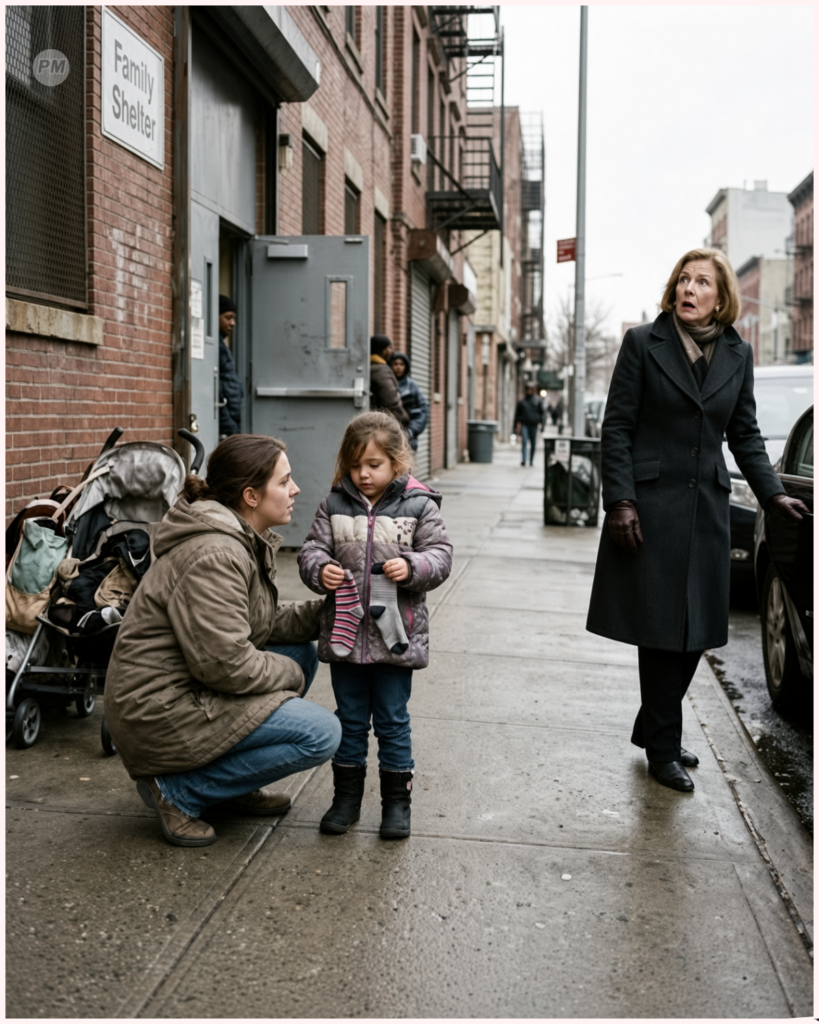
My 6-year-old daughter and I were at a family shel…
My 6-year-old daughter and I were at a family shelter when a black sedan pulled up…
My grandmother—the richest person in our family—spotted the two of us and asked, “Why aren’t you back at the house on Hawthorne Street?”
I froze. “What house?” Three days later, I walked into a family gathering—and my parents stopped cold, the wineglass in my father’s hand slipping down…
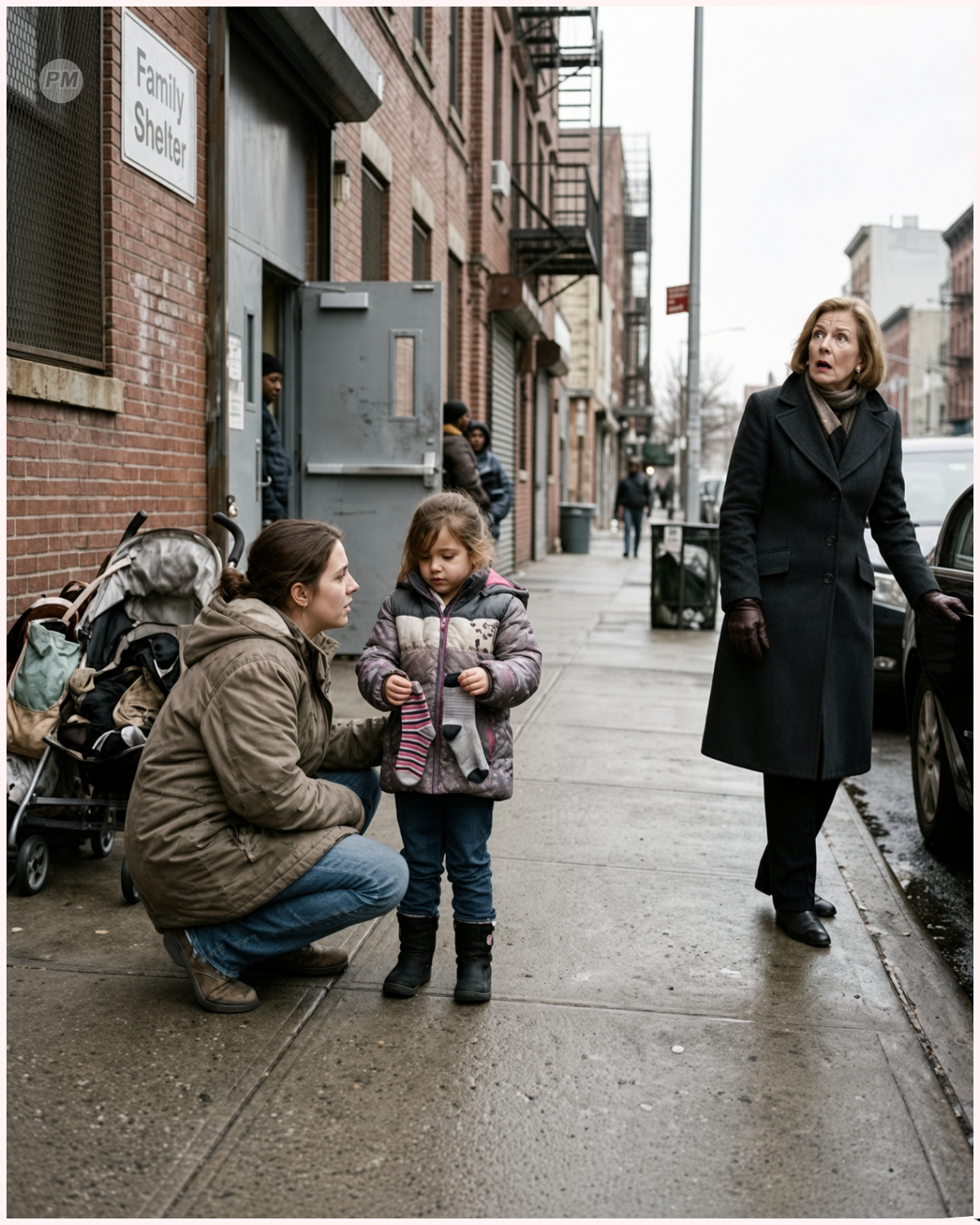
It was still early enough that the streetlights felt awake. Outside St. Bridget Family Shelter, Laya stood beside me in her puffy coat, holding two mismatched socks like they were a peace treaty—one pink unicorn, one that had lost its fight with laundry a long time ago.
“It’s okay, Mom,” she whispered. “I can wear different ones.” Then she asked, careful and quiet, “Do I still have to say my address when Mrs.
Cole asks?” My stomach tightened. “Probably not today,” I said, like that was a normal sentence to say on a normal morning.
The shelter door sighed open behind us, cold air spilling out. I adjusted Laya’s backpack strap, the way I always did when I couldn’t fix anything bigger.
That’s when the black sedan rolled up to the curb. It didn’t hesitate. It didn’t circle.
It stopped like it belonged there, and that alone made my skin prickle—because nothing expensive ever stops on this block unless it’s lost or looking for something.
The rear door opened, and my grandmother stepped out. Evelyn Hart looked exactly like herself—tailored coat, calm posture, the kind of composure that makes people straighten their shoulders without knowing why.
Her eyes moved from my face to Laya’s socks, then lifted to the sign above the entrance.
Family shelter. Confusion flickered across her expression, then hardened into something sharp and controlled. “Maya,” she said.
“What are you doing here?” “I’m fine,” I lied on autopilot. “We’re okay. Temporary.” Evelyn lowered her voice, as if we were standing in a quiet hotel lobby instead of a sidewalk that smelled like snow and damp concrete.
“Why aren’t you back at the house on Hawthorne Street?” The world tilted. “What house?”
I managed. “Grandma… I don’t have a house.” Laya tugged my sleeve. “Mom… do we have a house?”
I swallowed. “No, honey.” My grandmother went very still, and I’d seen that stillness before—right before decisions got made.
“Get in the car,” she said. Inside the sedan, the seats were warm in a way that made me feel embarrassed for needing it.
Evelyn made one call, then another, her tone calm and surgical. “I want three answers today,” she said.
“Who has the keys, who is living there, and who’s been benefiting from it.” Then she looked at me and asked one question that hit harder than the cold outside the shelter.
“Has your mother ever mentioned a lockbox code?” She asked. I stared at her. “No.”
Evelyn didn’t react like someone guessing. She reacted like someone confirming. The next two days blurred into hotel keycards, the smell of coffee in a breakfast room, and me forcing my voice steady while my grandmother’s phone kept lighting up with updates she didn’t explain yet.
Laya laughed when the waffle maker beeped, like life was simple again, and I let her—because she deserved that.
Late on the second night, Evelyn set her phone on the table between us. A message thread.
My mother’s name at the top. Bright, cheerful words that made my stomach turn. She didn’t hand me the phone.
She didn’t need to. I saw enough to understand one thing: someone had been telling her a story where I was safe and settled.
On the third day, Evelyn said, “Your parents are hosting a family dinner.” The venue was one of those chain-hotel ballrooms near the highway—patterned carpet, round tables with tight white linens, a folding sign by the entrance with our family name printed neatly beneath the date.
People wore sticky name tags like they were at a fundraiser, and the small talk had that polished suburban rhythm—whose cul-de-sac got repaved, which HOA mailbox got knocked over, who was “so busy lately.”
Evelyn arranged a side room for Laya with snacks and an assistant. “She doesn’t belong in the center of this,” she said.
Then she looked at me. “You go in first.” When I walked into the ballroom alone, my mother’s smile snapped on automatically—then froze.
My father’s hand loosened. The wineglass slipped down his fingers just enough to tell me the truth.
They hadn’t expected me to show up clean. Upright. Witnessed. A minute later, the air changed.
Evelyn Hart entered, unhurried and composed. Beside her was a man with a slim laptop bag and a polite face that didn’t match the sudden tightness in my mother’s eyes.
Evelyn nodded at my parents and said, almost pleasantly, “Before we eat, I’d like to clear up something you told me.”
The man reached for the projector cable. The machine gave a soft whir as it woke up, the screen turning that blank, waiting blue.
My mother’s breathing turned shallow. My father’s knuckles went white around what was left of his glass.
And in that suspended moment—ice clinking, chairs shifting, the whole room pretending not to watch—I realized the next thing that appeared on that screen was going to answer my daughter’s question.
→ The blue rectangle flickered, then resolved into a crisp, high-resolution scan of a property deed.
At the top, in bold legal serif, were the words: Irrevocable Trust Transfer — 412 Hawthorne Street.
Below it, listed as the sole beneficiary, was my name. A low murmur rippled across the white-linened tables.
My aunt leaned forward, squinting through her reading glasses. ”Three years ago,” Evelyn said, her voice carrying effortlessly to the back corners of the ballroom without ever rising above a conversational volume, “when Maya’s husband passed and she was left alone with a toddler, I purchased that home outright.
I placed it in a trust for her and Laya, and I appointed my son and daughter-in-law as temporary trustees until the paperwork cleared.”
The man with the laptop tapped a key. The deed vanished, replaced by a spreadsheet of bank transfers and a short-term rental listing.
Photos of a sunlit living room, freshly painted craftsman trim, and a tidy fenced backyard filled the screen—alongside a five-star Superhost badge under my mother’s maiden name.
”According to your texts to me,” Evelyn continued, turning slowly to face my parents, “Maya loved the neighborhood.
You told me she was busy settling in, that she preferred her privacy, and that the monthly stipend I sent for property taxes and maintenance was going straight toward Laya’s preschool.”
My mother opened her mouth, a practiced, trembling excuse already forming on her lips. “Evelyn, you don’t understand—Maya wasn’t ready for the responsibility of a house, we were just holding onto the rental income to build a—”
”To build a vacation fund in Scottsdale?” The man beside Evelyn interrupted politely, clicking to a third slide.
Statement after statement appeared: luxury resort deposits, country club dues, and a lease agreement for my father’s new sedan, all paid directly from the trust’s escrow account.
My father set his wineglass down on the table with a sharp click. He couldn’t look at me.
Neither could my mother, whose face had drained of all color beneath her carefully applied makeup.
Around the room, cousins stared down at their water glasses, and my uncle quietly slid his chair back an inch as if distancing himself from the blast radius.
”I didn’t come here for an explanation,” Evelyn said, signaling the man to shut down the projector.
The room plunged back into the warm, awkward glow of the chandeliers. “The locks at 412 Hawthorne Street were changed at noon today.
The current short-term guests have been relocated to a hotel at your expense, and my attorneys have already filed to remove you both as trustees and recover every dollar diverted from that account.”
She stepped back, leaving the floor to me. My mother finally looked up, her eyes glistening with sudden, desperate tears.
“Maya, please. We’re family. Let’s talk about this privately.” I looked at the woman who had watched me struggle for three years, who had listened to me worry about rent over the phone while pocketing the money meant to keep my child off the street.
There was no anger left in me—only a profound, quiet clarity. ”You told me last month that you couldn’t help with Laya’s winter coat because things were tight,” I said evenly.
“I believed you. I won’t make that mistake again.” I turned and walked out of the ballroom without waiting for an answer.
Down the hall, in the quiet side room, Laya was sitting at a small table with a coloring book and a half-eaten plate of apple slices.
When she saw me, she hopped down and ran over, grabbing my hand. ”Are we going back to the shelter now?”
She asked softly. I knelt down, smoothed her hair back, and smiled for the first time in months.
“No, sweetheart. Tomorrow morning, when Mrs. Cole asks for your address, I’m going to write it down for you.”
The following morning, my grandmother handed me a small brass key attached to a blue plastic keychain.
There was nothing particularly remarkable about it.
No decorative ribbon.
No expensive presentation box.
Just a key.
But when she placed it in my palm, my fingers closed around it so tightly that its edges pressed into my skin.
“Are you ready?” Evelyn asked.
I looked at Laya, who was sitting beside me in the back seat of the sedan, wearing a new purple winter coat.
“Yes.”
Twenty minutes later, we turned onto Hawthorne Street.
It was a quiet neighborhood lined with mature maple trees, modest houses, and sidewalks dusted with snow.
A man was clearing his driveway.
Someone had left a child’s bicycle beside a garage.
Christmas wreaths still hung on several front doors.
Then the car stopped.
412 Hawthorne Street.
A cream-colored Craftsman house with dark green shutters, a covered porch, and a little wooden fence surrounding the backyard.
Laya pressed her face against the window.
“Mommy, is that it?”
I nodded, unable to speak.
“That’s our house?”
Evelyn turned toward her.
“Yes, darling.”
Laya’s eyes widened.
“Can we go inside?”
My grandmother smiled.
“Your mother has the key.”
I stood on the porch for nearly a minute before unlocking the door.
Three years.
For three years, this house had existed.
While I worked double shifts.
While I counted quarters at the laundromat.
While I watered down soup to make it last another evening.
While I apologized to my daughter for things no six-year-old should ever have to understand.
This house had been here.
Waiting.
Except it hadn’t been waiting for us.
It had been making money for my parents.
I turned the key.
The door opened.
Laya ran inside.
“Mommy! There’s stairs!”
She raced through the living room, stopping at every doorway.
“There’s a fireplace!”
Then the kitchen.
“There’s a big refrigerator!”
Then the back window.
“Mommy! We have a backyard!”
I stood in the entrance, holding my handbag against my chest.
The house smelled faintly of lemon cleaner and fresh paint.
Everything was furnished.
There were comfortable couches, a dining table, clean curtains, and framed prints on the walls.
My grandmother had originally arranged for the house to be furnished before I moved in.
My parents had simply turned that generosity into a business.
Evelyn stood beside me.