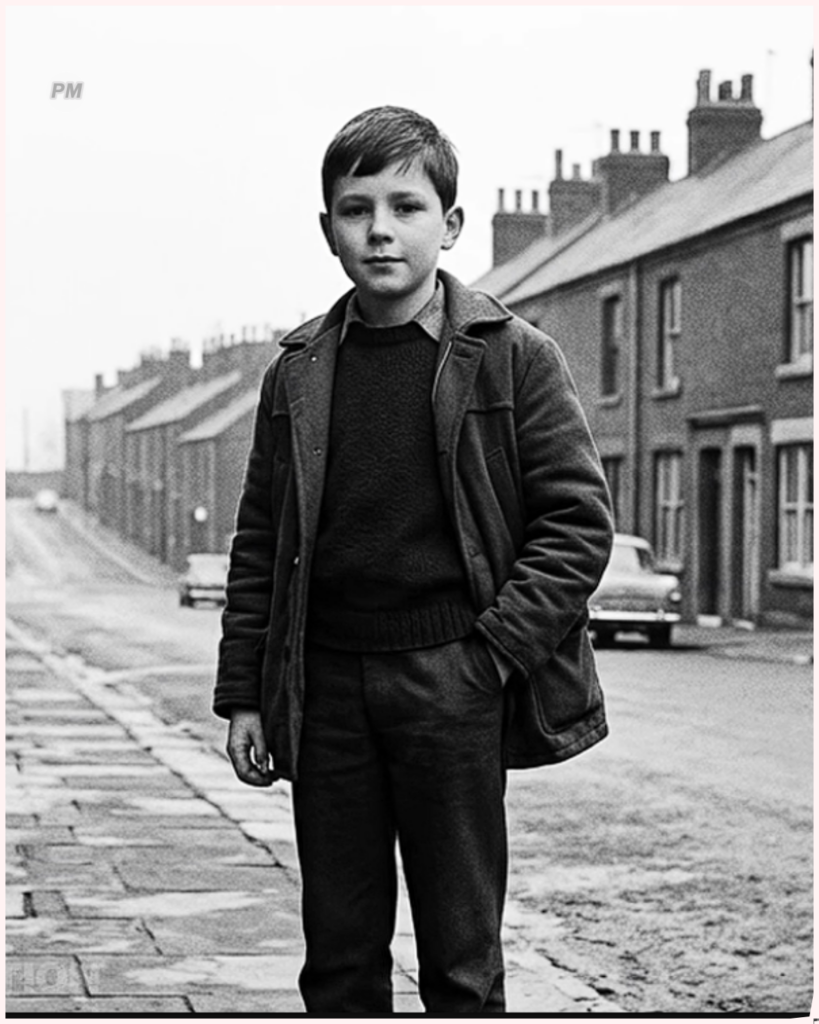
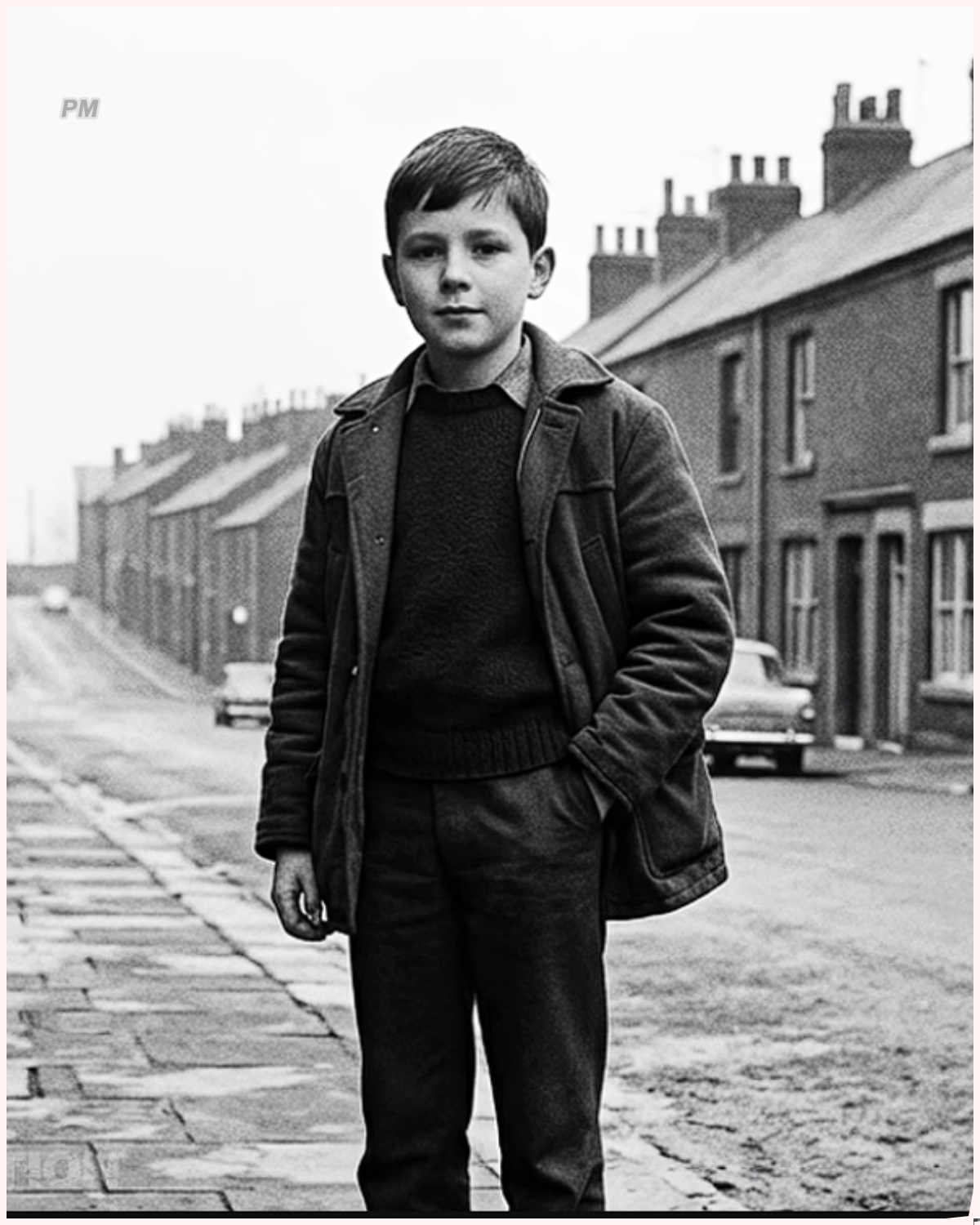
Saturday, the 24th of January, 1970. Gerald Street, Benwell, Newcastle upon Tyne. Alan Graham is 11 years old.
He is visiting family, and a trip to a nearby shop should be the least remarkable part of his weekend.
By the next morning, his body will be found in a water-filled ditch in the Northumberland countryside.
He has been strangled. The police will know where he disappeared and where he was discovered, but they will struggle to account for the hours between.
And many years later, an old friend will describe an encounter involving a dark blue van.
The question is, how so much happened between those places without leaving a clear trail.
Alan’s home was not in Benwell. He lived across the River Tyne in Gateshead with his mother, Mary Wells.
Newspaper accounts gave the family’s address as Buick Road. That weekend, he was staying with his older brother, Dennis Barron, and Dennis’s wife, Moira, on Gerald Street in Newcastle’s West End.
His sister, Pauline, was 17 at the time, and other family members, including his brother, Fred, would later be drawn into the long effort to understand his death.
For them, that final afternoon was the beginning of a lifetime without answers. Benwell in 1970 was an established residential part of Newcastle with local shops and streets where a short errand could be woven into an ordinary day.
Gateshead, where Alan lived, lay on the other side of the Tyne. Ponteland and the countryside around Callerton Grange Farm felt very different again.
That contrast explains the central problem. Alan did not vanish on an isolated country lane.
He disappeared from a neighborhood where people lived close to one another and was discovered somewhere that seemed disconnected from his immediate plans.
The surviving public accounts don’t give us a reliable portrait of everything Alan loved, feared, or wanted to become.
It would be easy to fill those gaps with invented habits or conversations, but that would make him less real, not more.
His sister later remembered him as a cheeky, ordinary boy. Detective Chief Inspector Andy Fairlamb, speaking during a later review, described him as a youngster who smoked and spent time wandering the streets.
That was the detective’s description, not a reason to blame a child for his death.
On the Saturday in question, Alan went towards a nearby sweet shop and tobacconist to buy cigarettes.
Family recollections placed it only about 50 yards from the house. That estimate came from later family accounts.
Police would later put his last known movements at around 1:00 in the afternoon. The most reliable starting point is simple.
Alan left the family home, and the record never established a complete, certain sequence of what happened next.
For anyone looking back now, the temptation is to draw a straight line from the house to the shop and assume every step is known.
It isn’t. No recording establishes whom he met or which way he went afterwards. Even the question of whether he reached the shop has to be considered alongside a witness account recorded much later.
At the time, the family knew only that an ordinary errand had gone wrong. The longer Alan remained away, the harder it became to explain his absence as a small delay.
The missing person response also tells us something about how different an investigation could be in 1970.
According to Fairlamb’s later account, police were contacted after Alan had been missing for roughly 7 hours.
The officer who first attended the house remembered using a public telephone box outside to report what had happened.
That meant the first hours depended heavily on what people remembered. There was no phone belonging to Allan that officers could locate and no digital trail waiting to be checked.
We don’t know exactly what was said in the house that evening, but the family’s reason for alarm was clear enough.
An 11-year-old boy had set off for somewhere close by and hours later they couldn’t account for him.
Search efforts and police inquiries began with one urgent aim, finding Allan. By morning those efforts would be overtaken by a discovery far outside the streets of Benwell.
On Sunday, the 25th of January, a farm worker discovered a child’s body in a water-filled ditch near Callerton Grange Farm in the area associated with Ponteland and Throckley.
The boy was identified as Allan Graham. His death was treated as murder and strangulation was reported as the cause.
For his relatives, any hope that he had simply gone somewhere without telling them was gone.
For detectives, a missing child case now presented a different task, establishing the circumstances of a killing without knowing where the killing itself had taken place.
The distance between Benwell and the recovery site was commonly described as around 7 miles.
That suggests a journey of some kind, but not who made it, when it happened, or whether Allan was alive during it.
A vehicle is a possibility, not a proven fact. Investigators could not say for certain how his body reached the ditch and the recovery location did not establish the murder scene.
It was entirely possible that the most revealing evidence had been left somewhere else, at a place nobody yet knew to search.
That uncertainty makes the geography more than a detail for a map. If Allan had gone willingly with someone, police needed to understand how that person gained his trust.
If force was involved, they needed witnesses who might have noticed a struggle or something out of place.
If the body had been moved after his death, the physical evidence might point away from Gerald Street altogether.
None of those possibilities has been established or linked to a named person. The first investigation generated statements, reports, and appeals for help.
Officers face the task of finding someone who could place Allan at a specific point after he left the house or connect a person or vehicle to the rural site.
Newspapers followed the murder inquiry, but publicity does not automatically create a useful lead. Witnesses might remember a face but not a name.
The difficulty was converting fragments of memory into something that could survive scrutiny rather than merely sound persuasive.
Exactly 1 week after Allan disappeared on Saturday, the 31st of January, police carried out a public reconstruction on Gerald Street.
A boy of a similar age and build retraced Allan’s reported movements while people gathered to watch.
Surviving photographs record the scene. To a passerby, it might have looked like a brief unusual gathering on an ordinary street.
For the investigators, it was a way of asking residents to look again. Could they recall seeing Allan?
Had they noticed anybody nearby who now seemed relevant? A reconstruction can prompt a memory.
It cannot recreate an afternoon. People know afterwards that a murder has occurred. That knowledge changes the way ordinary details appear.
A parked vehicle can start to look suspicious. A conversation that drew no attention at the time can acquire a darker meaning.
This is one reason historical witness accounts need care. A striking recollection may be valuable enough to investigate without becoming proof on its own.
The distinction would matter enormously when a childhood friend spoke publicly about Allan years later.
The murder remained unsolved and the trail grew harder to follow. Surviving records preserved details of the original inquiry, but the passage of time changed the investigation around them.
People moved, witnesses aged, and information that might once have been checked immediately became difficult to test.
That did not mean police abandoned the case. Later detectives revisited old material searching for discrepancies and leads their predecessors could not resolve.
What made this review unusual was that it eventually brought a very specific memory into public view.
In 2014, Ken Brown, who had known Allan as a child, gave an account of the afternoon he disappeared.
Brown said he and another boy, Dave Bryson, had been playing with Allan. He remembered Allan going into the shop and coming out again.
Then, according to Brown, a man in a dark blue van called out to Allan by name and tried to get him to come inside.
This is one of the most arresting accounts connected with the case. It is also a later recollection, not a verified recording of the encounter.
Brown described the man as slim with dark hair combed back, appearing to be in his late 20s and speaking with a Geordie accent.
He also recalled details of the vehicle, including its rear doors and rounded headlights. In his version of event, Allan did not get in.
He ran away. Every one of those details carries a possible line of inquiry, but also a warning.
They were being recalled more than 40 years after the incident. No publicly established identification connects that driver or van to Allan’s murder, and there is no confirmed evidence that Allan was transported in it.
Brown’s recollection of the man using Allan’s name was particularly striking. That could suggest familiarity, but it doesn’t establish a relationship.
A stranger might have heard the name spoken nearby. Brown could have remembered the words differently, or the incident could have happened just as he described and still have no connection to the killing.
We cannot honestly select the most sinister reading because it makes better television. What mattered to investigators was whether any part of the account could be checked against surviving statements, locations, or other witnesses.
Brown’s recollection also raised a procedural question. He and people connected with Dave Bryson later said the boys had spoken briefly to police after Allan vanished, and that further interviews they had expected never followed.
That was their retrospective account, not proof of exactly what officers did or failed to do at the time.
Detectives took a formal statement from Brown during the renewed attention to the case, but by then the opportunity to inspect a van on the day, interview its driver immediately, or compare fresh memories had long since gone.
Even a sincere witness may be left with a clue that is almost impossible to test.
In 2015, renewed hopes for forensic progress met a setback. Reporting on the case said attempts to recover a usable DNA profile of the killer had failed.
DNA can sound like a modern answer to every historical crime, but forensic work depends on what material survives, how it was collected, and whether any biological trace can be connected to an offender.
A failed attempt does not identify a suspect, and neither does it mean every possible test has been exhausted.
For Allan’s family, the result offered no resolution. For investigators, it meant that the older evidence still demanded careful handling.
When the case reached its 50th anniversary in January 2020, Detective Chief Inspector Andy Fairlamb spoke about that challenge.
Police had examined historical statements and tried to follow up inconsistencies. Fairlamb also described an item of evidence retained from the area where Allan’s body had been discovered.
He did not publicly identify what it was. Specialists, including forensic experts in Canada, had been consulted about whether more could be learned from it.
That detail was intriguing precisely because it came with a limit. The public had not been told that the item carried the killer’s DNA or even that testing would produce a usable result.
There was a difficult balance to strike. Some forensic methods can consume the very material they examine.
If an experiment produced nothing, the chance of using a future technique might be reduced.
So, the issue was not simply why police hadn’t run one more test. It was whether the prospect of learning something now justified risking evidence that could become more informative later.
Fairlamb’s comments showed that the cold case still involved active judgment calls rather than just boxes of papers waiting to be opened.
And one question remained unanswered. What exactly might the preserved material eventually be able to tell them?
If you were weighing Brown’s account against the surviving physical evidence, which would you want investigators to examine first and why?
Let me know in the comments. I’m interested in how you judge a lead when the memory is detailed but the independent proof is missing.
Neither the van recollection nor the unidentified item should be treated as a solution. They illustrate two very different ways a cold case might move forward through someone speaking or through something material revealing a fact that nobody noticed before.
Fairlamb also made clear what the public record could not settle. Investigators had not established the place where Alan was killed.
They did not know the means by which he reached the ditch or whether more than one person was involved.
That left room for possibilities without giving investigators a sound basis to announce a theory as fact.
The idea of an offender already known to Alan and the idea of an approach by a stranger both remained unproven.
So did any account placing the fatal attack in Benwell on the road towards Ponteland or near the recovery site itself.
Another strand of the renewed appeal was human rather than scientific. Fairlamb believed someone could still be withholding information about the killer.
That was a reason for asking people to speak, not proof that a particular family member, neighbor, or witness had lied.
It can be tempting in unsolved cases to turn that sort of appeal into a There is no justification for doing so here.
A person might possess one small detail without recognizing its value. Equally, police might be mistaken about whether anyone alive still knows the truth.
If you value crime documentaries that separate what witnesses remember from what evidence actually proves, consider subscribing.
It helps us keep telling cases like Alan’s without inventing a suspect or dressing uncertainty up as a revelation.
The police appeals were addressed to people who may have been in Newcastle’s West End at the time or who had heard something about the circumstances afterwards.
Even a seemingly modest piece of information could matter if it could be compared with the records already held.
But no public appeal can guarantee that the missing piece is still available. While investigators worked through the evidence, Allen’s relatives lived with a loss that no renewed inquiry could undo.
His sister Pauline later spoke about the grief carried through her life and about their mother, Mary Wells, who she said never recovered from the murder.
These are among the few publicly reported details that bring us close to the family rather than the investigation.
They tell us what the unsolved status meant beyond police files, birthdays, family gatherings, and the growing distance between the child they knew and the adults who continued to remember him.
In February 2023, surviving relatives returned to the area associated with Allen’s last known movements.
For them, Gerald Street was not an abstract pin on an old map. It marked the point after which they could no longer account for the life of someone they loved.
Pauline described Allen as a cheeky ordinary boy, a far more useful way to remember him than any dramatic label.
Members of the family born after his death had grown up knowing his name. He remained part of their lives despite never having the chance to grow older alongside them.
A later report published on the 31st of March 2026 stated that Allen’s brother, Dennis Barron, had died.
That publication date should not be mistaken for the date of his death. Dennis had spent much of his life hoping to learn who murdered his younger brother.
The report adds a painful reality to the passage of time. People who knew Allen personally may die before an answer arrives.
It also shows why an appeal matters even when no arrest follows. The material available for this documentary does not establish a conviction for Allen’s murder.
It also does not allow anyone outside the investigation to claim they know the identity of the person responsible.
The dark blue van remains a witness’s later recollection. The surviving evidence remains publicly unidentified, and the original inquiry, despite the reconstruction, did not establish a chain of events strong enough to resolve the case.
Those limits may feel frustrating, but respecting them is the only way to tell Allan’s story without turning uncertainty into fiction.
There is one thought worth leaving with. Police once put another boy on Gerald Street, hoping someone looking on would suddenly remember the detail that mattered.
Later, detectives turned to old statements, a childhood friend’s account, and material kept in storage.
Each effort asked a version of the same question in a different way. Is there still a fact about Allan’s final hours that can be verified?
Until that happens, the strongest ending is not an invented twist. It is Allan Graham’s name, the people who have kept it alive, and the possibility that someone, somewhere, still has information they have never shared.