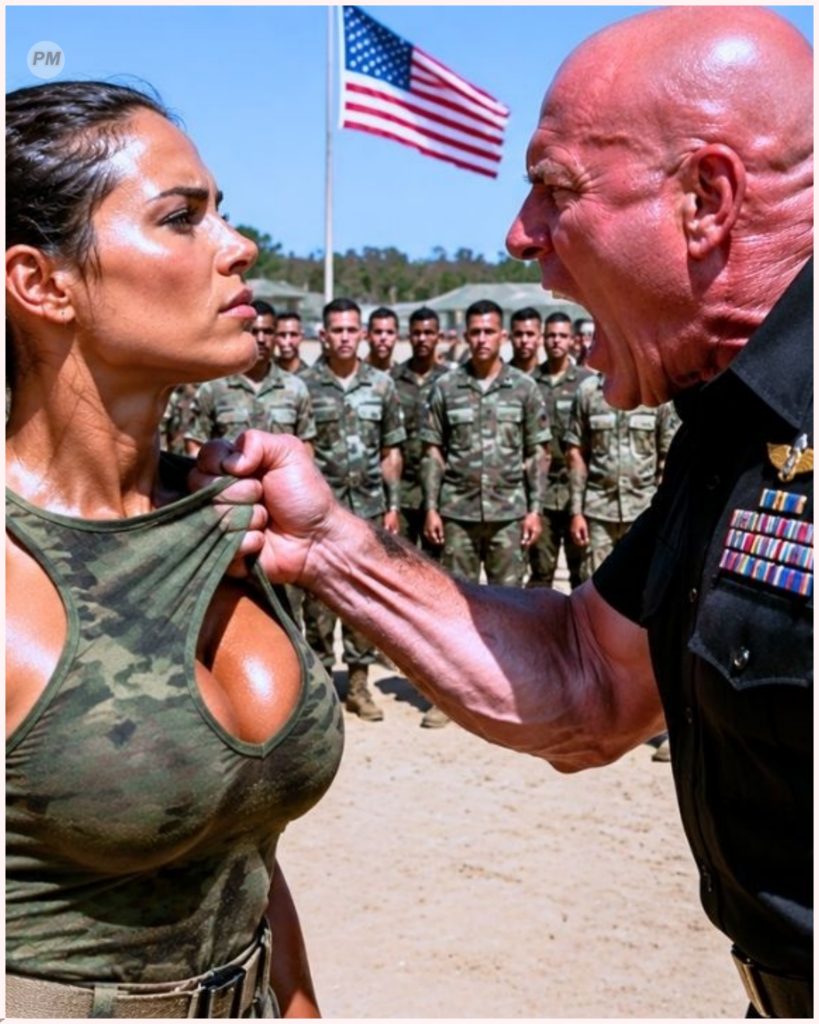
His fist slammed her rifle to the ground. Then drill sergeant Marcus Whitaker grabbed Sophia Bennett’s collar, yanked her forward until his face was inches from hers, and snarled in front of 390 watching recruits.
You do not belong in my army. You never will. She was 23 years old.
She weighed 130 lb. She had buried her brother in a flag-draped casket and walked into this place anyway.
And she did not move, did not flinch, did not break.
Follow every second of this story and drop your city in the comments. I want to see exactly how far this reaches.
The morning Sophia Bennett arrived at Fort Liberty, North Carolina. The air tasted like red clay and diesel fuel and something she could not name but would later recognize as consequence.
She had taken a bus from Raleigh, carried one militaryissued duffel bag onto the processing floor, and stood in a line of people who all looked like they were trying to convince themselves they had made the right decision.
Most of them were staring straight ahead with their jaws locked and their shoulders squared because they had already been told by someone that this was what strength looked like.
Sophia stood straight, too, but she was not performing anything. She was simply waiting. She learned a long time before this morning that waiting was one of the most powerful things a person could do.
She was 23 years old and she had been planning this for nearly 4 years.
The photograph she kept folded inside the breast pocket of her civilian jacket was of her brother Daniel.
He was 26 in the picture. He was wearing his dress uniform and smiling in the way that soldiers smiled when someone was taking their photograph and they knew their family was going to keep it forever.
He had shipped out 8 months after that picture was taken. He came home in a flag draped casket 2 years after that.
And at the funeral, there had been a general who told the family that Daniel Bennett had died doing something that mattered.
Sophia had stood at that graveside and made a promise that she was not going to simply mourn what her brother had done with his life.
She was going to continue it. The army recruiter who had processed her enlistment had looked at her paperwork with the particular expression of someone who was trying very hard to maintain professionalism while communicating skepticism.
She was small. She was a woman. She had no prior military training. She had grown up in a midsized city with no connection to military culture except a brother who had believed in it completely.
“Your brother served,” the recruiter had said. And the way he said it made it sound like a question, even though grammatically it was not.
He did, Sophia said. Infantry. Yes, that’s a different path than what your I’m not trying to walk his path, Sophia said.
I’m trying to make my own. The recruiter had stamped her paperwork. Now she was standing in a line at Fort Liberty and the man at the front of the processing room was reading names off a clipboard with the enthusiasm of someone who had given up on enthusiasm approximately one decade ago.
390 recruits had arrived that day. Sophia had counted. She did things like that without deciding to just noticed and cataloged and filed away information the way some people filed away.
Worry automatically, constantly almost without thinking. Daniel used to say she was the most observant person he had ever known and he meant it as the highest compliment he could give.
She used to say she learned it from watching people underestimate her. He used to laugh at that.
She never laughed because she was not really joking. The barracks they assigned her to had 17 women in it.
Three of them had prior military family experience. Two had played team sports at the collegiate level.
One had been working in a warehouse for 6 years and had the kind of quiet physical confidence that did not require commentary.
Sophia introduced herself to each of them on the first night, asked where they were from.
Listened carefully when they answered and remembered everything. She always remembered everything. “You seem calm,” said the woman in the bunk above hers, whose name was Pria Navaro.
She was 25 from Fresno, California, and she had the kind of dark, direct eyes that suggested she was evaluating everything around her at all times.
Sophia respected that immediately. “I’m not calm,” Sophia said. “I’m just not panicking out loud.”
Priya looked at her for a moment. “Okay,” she said. “Fair.” They shook hands in the dark, and that was the beginning of the most important friendship Sophia would make in her military career.
The first week was what everyone expected it to be, which was brutal. In the uncomplicated physical way of any institution designed to test the human body’s relationship with discomfort.
Sophia ran when she was told to run. She dropped and performed push-ups when she was told to do push-ups.
She cleaned her weapon until her hands were raw and then cleaned it again. She ate fast, slept less than she needed, and woke up before the lights came on because she had trained herself to do that at home in her apartment for 3 months before she arrived because she had understood that the psychological shock of early deprivation was one of the main tools basic training used to sort people out.
She did not want to be sorted out. She wanted to be sorted in. Drill Sergeant Marcus Whitaker appeared on the fourth day.
Sophia would remember that moment for the rest of her life, not because of what he did, but because of how he moved.
He walked into the formation like a man who had never in his life felt the ground pushed back against him.
He was 6’2 in of decorated service with a combat infantry man badge on his chest, an air assault tab on his shoulder, and the particular way of holding his body that came from two decades of telling other people how to hold theirs.
His uniform was perfect. His voice carried without effort. He had the kind of presence that made people want to perform for him immediately.
And the first thing he said to the assembled company was that he did not care what they wanted from this experience.
He only cared what the army needed. I don’t make friends, Whitaker said. I make soldiers.
And if any of you have come here looking for validation or encouragement or a participation trophy, let me tell you right now, you are in the wrong building.
A few people laughed nervously. Whitaker did not laugh. Sophia did not laugh either, but for a different reason.
She was too busy watching him scan the formation, watching the way his eyes moved, watching the pattern of where they paused and where they moved on quickly and what that pattern revealed about what he was actually looking at.
He was categorizing people. She could see it happening in real time. He’s already deciding, Priya said under her breath, barely moving her lips.
He decided before he walked in, Sophia said equally quiet. You don’t know that yet.
Give it a week, Sophia said. It took less than that. By the sixth day, Sophia had begun to see the architecture of it.
Not a conscious conspiracy, not a premeditated plan, but something that functioned like one because it had been built by habit and repetition and the kind of unchallenged authority that eventually stopped questioning itself.
Whitaker pushed everyone because pushing everyone was his job and he was good at his job.
But he did not push everyone in the same direction. Some recruits, the ones who arrived with a certain physicality or a certain swagger or a certain background were pushed toward their best performance.
They were corrected and then given the room to correct themselves. They were criticized and then watched to see how they responded.
Others were pushed toward a wall. The criticism came faster for them. The second chances came slower.
The margin for error, the invisible gap between an acceptable mistake and an unacceptable one, was measurably smaller for certain people.
Sophia spent her evenings after lights out lying in her bunk and reconstructing the day in her mind, like footage she could rewind and study.
She was not imagining patterns. The patterns were there. She just needed to understand them well enough to document them without leaving room for interpretation.
She started writing things down on day seven, not in any way that would attract attention.
A small spiral notebook that looked, if anyone happened to see it, like the kind of notes a diligent recruit might take on training procedures.
She wrote times, she wrote names, she wrote exact words when she could remember them and approximate words when she could not.
And she noted the difference between the two. She wrote what infraction had been cited, what punishment had been issued, and what the comparable response had been for a different recruit in a comparable situation.
She was not building a case in the legal sense. She was building a record in the evidentiary sense, which is different because a record does not need a conclusion yet.
A record just needs to be accurate. You’re writing in that notebook again, Priya said one night, leaning down from her bunk.
I’m taking notes, Sophia said. About training. Sophia looked up at her about what’s happening in training.
Priya was quiet for a moment. You’re not wrong, she said finally. About what you’re seeing.
I know I’m not, but knowing isn’t enough. I know that too, Sophia said. That’s why I’m writing.
The second week was when things escalated. Whitaker’s attention had settled on Sophia in a way that was different from his attention on other recruits, and the difference was not one of greater rigor or higher standards.
It was one of creative justification. When Sophia performed well, the performance was either not acknowledged or retroactively complicated.
[snorts] During the second week’s weapons inspection, she presented her M4 in a condition that met every standard the army had established.
Whitaker looked at it for 11 seconds, handed it back to her, and told her that her cleaning technique was improper.
“My technique meets regulations,” Sophia said. “I didn’t ask what it meets,” Whitaker said. “I told you what it is.
Do it again.” She did it again. He handed it back the second time without comment, which meant she had done it correctly both times and he knew it, which meant the correction the first time had not been about technique.
She wrote that down that evening. During the physical fitness test on day 11, Sophia completed her runtime 3 seconds under the female standard for her age group, which placed her in the upper quartortile of female recruits in the company.
Whitaker did not know. What he noted afterward was that her formation position during the cool down walk was 2 in out of alignment.
2 in. He made her redo the cool down lap alone in front of the company while explaining step by step what proper formation position looked like.
No one else was corrected for formation position that day. She wrote that down too.
What she was not prepared for and what she would later identify as her most important misreading of the situation was that Whitaker was not simply trying to make her quit.
Plenty of drill sergeants used pressure to thin the herd to find the people who would break under stress and identify them early.
So the investment of training resources could be redirected towards those who would not. Sophia had understood that mechanism coming in and had accepted it as a feature of the system she was trying to enter.
She had told herself she would not break and had believed it. But Whitaker was not just testing whether she would break.
He was building a story about her. She understood this fully on the 14th day when Sergeant Firstclass Deborah Haynes, the senior female non-commissioned officer attached to the training company, pulled Sophia aside after morning formation and told her with the flat expression of someone delivering news, “They do not enjoy delivering.”
That Whitaker had filed a preliminary performance concern notation in Sophia’s training record. Sophia’s stomach went cold.
“What grounds?” She said. “Attitude,” Hayne said. “Failure to respond appropriately to correction.” “That’s not accurate.”
“I know,” Hayne said and then after a pause that felt very long. “But I can’t say that officially.”
“Why not?” Hannes looked at her. She was a 20-year army career non-commissioned officer, and she had the eyes of someone who had made a great many calculations about what battles were worth fighting and had occasionally miscounted.
“Because I don’t have documentation,” she said. “Because it’s his word against yours right now.
Because the system doesn’t run on what people know, it runs on what people can prove.”
Sophia looked back at her. “Okay,” she said. “Then I’ll prove it.” Hayne said nothing for a moment.
Then she said, “You need to be very careful. I know he has a lot of history here.
He has relationships and credibility and a record that goes back 22 years. I know.
And you have been here 14 days.” “I know that, too,” Sophia said. “But I’ve been keeping records since day seven, and I have 17 more days in this training cycle.
That’s 17 more days of documentation before I have to decide anything.” Haynes was quiet again.
Then she said something that Sophia would carry with her for years afterward. Your brother’s service record is in your file.
Haynes said, “I read it when the training company got your assignment. He was a good soldier.
He was the best person I knew.” Sophia said. “Don’t become him,” Hayne said. “Don’t become a story someone else tells at a funeral.
Become someone who is here doing this work in 20 years.” That’s what survival looks like, not heroics.
Persistence. Sophia thanked her. She walked back to her barracks. She opened her notebook and she wrote down everything Haynes had said.
And underneath it, she wrote a single sentence in capital letters that she would look at every morning when she woke up for the rest of the training cycle.
The system does not run on what people know. It runs on what people can prove.
It was on the 15th day that Dion Washington knocked on the frame of the barracks door and asked if he could talk to her.
Dion was 21 from Baltimore, 6 feet tall, broad-shouldered, and had the particular social confidence of someone who had grown up in an environment where reading people quickly was not a hobby, but a survival skill.
He had been in Whitaker’s crosshairs from the first week for reasons that were different from Sophia’s reasons, but came from the same source.
He had watched what Whitaker was doing to her. He had been watching it more carefully than she knew.
I want to show you something, he said. And he sat down across from her and pulled out his own notebook.
Sophia stared at it. You’ve been doing the same thing, she said. Day nine, he said.
She looked at his records. They were detailed, consistent, and cross-referenced in a way that showed someone who had been taking this seriously.
He had documentation she did not have. She had documentation he did not have. Together, their records covered 22 of the first 15 days of training in a way that was both comprehensive and mutually corroborating.
We’re going to need more. She said, “I talked to Tommy Chen.” Dion said, “He’s in the third platoon.
He’s been watching, too. Does he want to be involved? His dad was army. His grandfather was army.
He has feelings about how this institution is supposed to work.” Dion paused. He’s angry.
“Angry doesn’t document things,” Sophia said. Careful documents things. He’s also careful. Dion said he’s angry and careful, which honestly might be the most useful combination.
Sophia thought about that. She thought about the fact that she was sitting in a barracks on day 15 of basic training at Fort Liberty, North Carolina, and she had just discovered that at least three of the 390 people around her had independently arrived at the same conclusion she had arrived at and had independently decided to do something about it.
She had not organized this. She had not recruited anyone. The patent had been visible enough, consistent enough, undeniable enough that multiple people had seen it on their own and had [clears throat] started keeping records on their own.
That told her something important. It told her the pattern was not subtle. We keep doing what we’re doing.
She said, “We don’t discuss this outside of the three of us. We don’t make accusations.
We don’t confront anyone. We just keep building the record.” And then what? Dion asked.
Then we decide what to do with it when Barney when we have enough that the decision makes itself.
Sophia said on the 17th day Whitaker pulled Sophia out of a leadership exercise in front of the entire platoon and told her with 47 people watching that her judgment was inadequate for the responsibilities of a team leader role and that she was being removed from the rotation.
She had been in the team leader rotation for exactly one day. The trainee who replaced her had made a tactical error 2 hours earlier that Whitaker had corrected with three sentences in a demonstration.
Sophia had made no tactical errors. She had led her team through a route navigation exercise and arrived at the objective 4 minutes ahead of schedule.
She stood at parid rest and received the correction. [clears throat] She said understood drill sergeant.
She walked back to her position in the formation and that evening she wrote down every detail of what had happened including the exact time the location, the names of every witness she could identify and the precise nature of the correction she had received versus the correction the other trainee had received 47 minutes earlier.
47 witnesses had watched what happened to her. She had 47 potential corroborating sources for that single event.
She was beginning to understand that the most important resource she had was not her own meticulous recordkeeping.
It was the 389 people standing in formation around her. Every time Whitaker chose to make her an example in front of the entire company, he was adding to the number of people who had seen what he was doing.
He believed he was using the public nature of the corrections to isolate and humiliate her.
He did not understand that he was actually building her case for her. On the 20th day, Sophia filed a preliminary concern report with the Equal Opportunity Office.
She did not tell anyone she was going to do it. She did not discuss it with Dion or Tommy or Priya beforehand.
[snorts] She simply walked to the EO office during a scheduled administrative period, sat down across from the equal opportunity adviser, and placed her notebook on the desk between them.
I’ve been documenting a pattern of differential treatment in my training company. She said, “I’d like to file a preliminary concern report and establish a formal record.”
The EO adviser, a staff sergeant named Rivera, who had the expression of someone who had heard both too many complaints and too few, looked at the notebook.
He opened it. He read for a long time without speaking. “How long have you been keeping this?”
He asked. “Since day seven,” Sophia said. He looked up. “Day seven of a 32-day cycle.”
“Yes, you came in planning to do this?” No, she said, “I came in planning to complete basic training and earn my place in the United States Army.
I started doing this because I observed something that needed to be documented.” Rivera looked back at the notebook.
He turned several more pages. His expression was carefully neutral, which Sophia had learned to read as the expression of someone who recognized something significant and was deciding how to respond to it.
“I need to ask you something,” he said. “Okay. Do you understand what happens if you file this officially to you, to your training record, to your standing in this company?
I understand there are risks, Sophia said. I also understand that I came here to do the right thing and to be part of an institution that does the right thing.
If this institution is what it says it is, then the right thing is to report this.
And if it’s not, Rivera said, “If the system doesn’t respond the way it should,” Sophia looked at him evenly.
Then I’ll find out what’s really possible, she said, and I’ll decide what to do from there.
Rivera closed the notebook and slid it back across the desk to her. He reached into his desk and pulled out a form.
I’m going to need you to fill this out, he said. And I’m going to need you to leave me a copy of the relevant sections of your documentation.
Not the original. A copy. You keep the original. Sophia felt something loosen slightly in her chest.
Some tightly wound spring of tension she had not fully admitted was there. Not relief, not victory, just the very specific sensation of a process beginning.
Thank you, she said. Don’t thank me yet, Rivera said. This is step one. You have no idea how many steps there are.
She did not, but she was beginning to understand that she had already done something that could not be undone, that a clock had started somewhere in the formal machinery of the institution she was trying to enter, and that whatever happened next was going to happen in a different kind of arena than a training field.
That evening, she went back to her barracks and she lay in her bunk and she looked at the photograph of Daniel.
I don’t know if I’m doing this right, she said quietly to the photograph, which was not something she usually did, and which she was slightly embarrassed about.
I don’t know if I’m being brave or being reckless. I don’t know if there’s a difference.
Priya’s voice came down from the top bunk, quiet and steady. You documented the truth and you reported it through the proper channel, Priya said.
Whatever anyone tells you later about whether that was the right thing to do, remember that you did it the right way.
You heard all of that, Sophia said. I hear everything, Priya said. I just don’t always say anything about it until it matters.
Sophia put the photograph back in her breast pocket. What do you think he’s going to do?
She said Whitaker. Priya was quiet for a moment. I think he’s going to get worse, she said.
I think people like that always get worse when they start to feel like the ground is shifting.
I think he’s going to feel it start to shift and he’s going to press down harder because that’s the only thing he knows how to do.
And what do I do when that happens? You keep doing exactly what you’ve been doing.
Priya said, “You stay perfect. You stay documented. You stay visible. You give him nothing except witnesses.”
Sophia stared at the ceiling. 389 people were sleeping or not sleeping in buildings around her.
389 people who had watched the same things she had watched, who had heard the same words she had heard, who had their own notebooks or their own memories or their own private tallies of the moments when the rules seemed to apply differently depending on who was standing in front of them.
She had filed a report. Rivera had taken it seriously. The machinery had begun. 12 days remained in the training cycle.
She did not know yet what those 12 days were going to contain. She did not know what Whitaker was going to do when he found out or if he had already found out or what form the retaliation would take.
She did not know if the EO process would work the way it was supposed to work or if it would work the way it had worked for the people before her, the ones who had filed and been absorbed back into silence.
What she knew was this. She had come to Fort Liberty to prove that courage was not about physical size or gender or reputation.
She had come to prove that it was about character under pressure. She had not expected the pressure to come from inside the institution she was trying to defend.
But she was beginning to understand that maybe that was the most important place for it to come from because an institution that could not withstand honest scrutiny from within was not an institution that could be trusted to withstand anything at all.
And she had made a promise at a graveside to be part of something that was worth trusting.
She was going to keep that promise, whatever it cost, whatever it took. She closed her eyes.
She opened them again almost immediately because she had just remembered something important and needed to write it down before she forgot it.
The notebook was already in her hand. The notebook was still in her hand when the lights came on the next morning.
Sophia had not slept more than 2 hours. Not because she was afraid, though fear had been present.
A cold and specific kind of fear that lived not in the chest but somewhere lower, somewhere more practical.
She had not slept because her mind had been running calculations all night. The kind of calculations that could not be paused or postponed because the variables kept shifting.
She had filed the report. Rivera had taken her documentation. The clock had started and now there were 12 days left in the training cycle and she had no way of knowing which of those 12 days was going to be the day Whitaker found out.
She got up before the lights came on. She made her bunk. She laced her boots.
She put the photograph of Daniel in her breast pocket and pressed her hand flat against it for 3 seconds, which was something she had done every morning since she arrived and which she did not analyze and did not discuss with anyone.
You didn’t sleep, Pria said from the top bunk. I slept a little. You were lying there doing math for 6 hours.
Operational math, Sophia said. Is that what we’re calling it? That’s what it is. Sophia stood up and reached for her jacket.
Today is going to be normal. I’m going to perform normally, react normally, give him absolutely nothing to work with.
Whatever happens, whatever he does, my response is the same, which is perfect execution. Sophia said every single time.
Priya dropped down from the top bunk and stood next to her. They were nearly the same height and for a moment they just looked at each other in the gray pre-dawn light of the barracks with the specific kind of understanding that forms between people who have been watching the same thing happen and have both decided independently not to look away from it.
He’s going to find out about the report. Priya said probably. And when he does, when he does, Sophia said, I want to already have 10 more days of documentation in that notebook.
I want the record to be so complete that there is no version of this story where the truth is ambiguous.
Priya was quiet for a moment. Then she said, “You know what your brother would say right now?”
“Don’t, Sophia said, but without sharpness, just a boundary stated clearly.” “Okay,” Pria said. Then I’ll say it.
He’d say, “You’re already a soldier. You became one the second you decided to document instead of retaliate.”
Sophia picked up the notebook. She tucked it into the inside pocket of her jacket.
She walked out into the morning. Day 21 started like every other day had started with a formation in the pre-dawn darkness in a series of physical tasks designed to stress the body before the mind had fully engaged with the day.
Sophia ran her miles at her pace, which was a pace that consistently met standards and occasionally exceeded them.
She completed her push-ups. She completed her sit-ups. She ate breakfast in 11 minutes, which was the exact amount of time the schedule allowed, no more and no less, because eating too slowly suggested inattention to time management, and eating too quickly suggested anxiety, and she was giving Whitaker neither.
He came into the morning training block at 07:30 and he looked to someone who had not been watching him carefully for 20 days exactly the same as he always looked.
Precise, certain, authoritative, the kind of man who had never in his life had caused to question whether the room he walked into would take him seriously.
But Sophia had been watching him carefully for 20 days. And something was different. It was in the half-second pause before he spoke.
It was in the way his eyes moved across the formation and then stopped on her and then moved on just slightly faster than they usually did.
It was the quality of the pause, not the casual dismissive pass of a man who had already categorized someone and filed them away.
Something more alert, more calculating. He knew she could not prove it yet. She did not write it down as a fact.
She wrote it down as an observation, noted it with the time and the date and the precise description of what she had seen, and she filed it away behind everything else and kept her face exactly as it always was, which was calm and attentive and ready.
Bennett Whitaker said, “Drill sergeant,” she said, “you’re on equipment maintenance this afternoon alone. Everyone else is on the range.”
She felt the room shift, not literally, but she felt it. That thing that happens when a public statement lands wrong and everyone in the proximity registers it even if no one says anything.
Being pulled from range time was not a common disciplinary tool. Range qualification was one of the primary benchmarks of the training cycle.
Removing a recruit from the range day had implications for their training record implications that were not always fully reversible.
Understood drill sergeant. She said. He moved on down the formation behind her so quietly that only she could have heard it.
Dion Washington exhaled through his nose in the way people exhale when they are trying not to say something they very much want to say.
She found Dion during the 10-minute administrative break at Duro 900. And she told him what she needed him to do.
She told him to go to the range, to perform at his absolute best, to do nothing that could be characterized as anything other than full compliance with every instruction he received.
She told him not to look for her, not to ask about her, not to create any appearance of connection between the two of them for the rest of the training day.
In the notebook, he said, “You have your copy. Keep adding to it. Everything you see today gets documented, timestamped, and compared against what I document from my end.
What are you going to document from equipment maintenance? Everything, she said. Because he’s going to send someone to check on me, and that someone is going to report back on whether I’m angry, whether I’m on my phone, whether I’m doing anything that can be added to the story he’s building.
So, I’m going to be the most thorough, most focused equipment maintenance person this training company has ever seen.
Dion looked at her for a long moment. You know what the crazy thing is?
He said, “What?” He thinks he’s isolating you, Dion said. But every time he does something like this in front of 40 people, he’s just giving 40 more people a reason to pay attention.
She had known that, but hearing it said out loud by someone else confirmed something she needed confirmed, which was that she was not manufacturing significance where there was none.
The significance was real. Other people were seeing it. She went to equipment maintenance. Corporal Enuian, who had been assigned to oversee her, was 26 years old, two years out of his own basic training cycle, and had the specific discomfort of someone who had been given an assignment they did not fully understand and were not sure they agreed with.
He checked in on her three times in the first hour. Each time she was doing exactly what she had been assigned to do.
The fourth time he came in, he did not leave immediately. “You know you’re missing range calls today,” he said.
I’m aware, she said without looking up from what she was doing. That’s going to affect your record.
I know. He was quiet for a moment. Then he said in a voice that was careful and a little lower than his normal register.
I’ve seen your scores. You don’t need the range practice. She looked up at him.
Then that’s not the point of this, she said. He met her eyes. He held them for a moment.
No, he said it’s not. And then he walked out and she wrote down the time in the exact words.
And the fact that his tone had shifted in a way that suggested he was aware of the subtext of what was happening and she went back to work.
At 1400, Tommy Chen found her during the meal break. Tommy was 24 from Seattle with a quiet intensity that came from being the grandson of a Korean War veteran and the son of a Vietnam veteran and having grown up in a household where military service was not a career choice, but a family inheritance that carried weight and obligation and specific grief.
He sat down across from her and put his tray down and did not say anything for almost 30 seconds, which Sophia had learned was his way of organizing his thoughts before committing them to words.
“He pulled your range calls,” Tommy said finally. “I know I was there.” “My grandfather lost his hearing in one ear because of range training.
He used to say that the only people who got to miss range days were the ones who didn’t need them or the ones being punished.”
He looked at her. Which one does everyone think you are? Which one do you think I am?
She said, I think you’re neither. Tommy said, I think you’re being made into an example, and I think the example is supposed to say something that he doesn’t have the nerve to say out loud.
She did not respond to that directly. She said, “How many people were on the range today?
Full company minus you. And how many of them noticed that you were there and I wasn’t?”
Tommy was quiet for a moment. “All of them,” he said. Then the example isn’t working the way he intended.
She said, “Because examples are supposed to discourage. And when people see something that doesn’t make sense, they don’t get discouraged.
They get curious.” Tommy picked up his fork. “I’ve been talking to some people,” he said carefully.
“Not about your report. I don’t know the details of your report and I haven’t asked, but about what they’ve been seeing.
And there are people in this company who have their own stories, not just observations, their own experiences.”
Sophia set down her fork. How many people? At least six that I’ve spoken to directly.
Probably more who haven’t said anything to me yet. Do they want to come forward?
Some of them. Some of them are scared. Some of them don’t think it’ll matter.
It’ll matter. Sophia said. You don’t know that yet. No, she said, “But I know that six people with documented experiences is a pattern.
And a pattern is harder to explain away than an individual. If I’m one person making a complaint, that’s a personnel issue.
If we’re seven people with corroborating accounts and documentation, that’s a systemic problem. And the army has very specific protocols for systemic problems.
Tommy looked at her for a long time. You know a lot about this for someone who’s been here 21 days.
I’ve been preparing for a lot longer than 21 days, she said. The afternoon passed without incident which was itself a kind of incident because nothing about the afternoon felt neutral.
It felt like the hell breath before something the specific quality of silence that is not peaceful but anticipatory.
She finished her equipment maintenance. She was thorough and meticulous and left everything in better condition than she had found it because she understood that every task she completed in this period was a data point evidence that she was not a problem recruit but a competent one who was being treated as something else.
At 1620 Sergeant First Class Haynes found her walking back to the barracks. Walk with me, Hayne said.
They walked. Rivera called me. Hayne said Sophia said nothing. I wanted me to know that your preliminary concern report has been logged formally in the EO office and assigned a case number.
He also wanted me to know that under army regulations, once a concern report is formally logged, any adverse action taken against the reporting individual within the training cycle must be reviewed for potential retaliatory characteristics.
Sophia felt something shift in her chest, not relief, something more structural than relief, like a beam settling into a loadbearing position.
Does Whitaker know about the case number? She said he will by tomorrow morning. Haynes said the notification protocol requires disclosure to the training coder supervisor within 24 hours of formal logging.
And what happens when he finds out? Hayne stopped walking. She turned and looked at Sophia with the full attention of someone who had been in the army for 20 years and had learned exactly which moments required that kind of attention.
One of two things, she said. Either he becomes more careful, which would suggest he understands the exposure he’s created, or he [snorts] escalates, which would suggest something else entirely.
Which do you think he’ll do? I think Hayne said carefully that men who have operated without accountability for a long time do not tend to respond to the threat of accountability by becoming more careful.
They tend to respond by doubling down because the alternative requires them to admit that what they’ve been doing required accountability.
And most men in that position are not capable of making that admission quickly. Sophia absorbed that.
She filed it next to everything else she had filed. What do you need from me?
She said, “I need you to stay clean, Hayne said. I need your record to be perfect.
I need your performance to be beyond question. I need there to be absolutely nothing that anyone can point to and say she was a problem recruit.”
Because the moment your record becomes debatable, this becomes a he said, she said situation.
And you know how those end. I know how those end, Sophia said. Good. Haynes began walking again.
And Bennett. Yes, Sergeant. You’re not alone in this anymore. I want you to know that you were alone when you walked into Rivera’s office.
You are not alone now. Sophia did not respond immediately. She walked alongside Haynes for a few steps and let the weight of those words settle somewhere real instead of just noted and filed.
Not alone. She turned it over. She had been alone with this for 21 days, alone with the notebook and the calculations and the coal specific fear.
And now something in the architecture of the situation had shifted. And she was not certain yet what to do with that, how to hold it without becoming dependent on it because she had learned early that the most dangerous thing you could do was structure your courage around the assumption that someone else would hold you up.
Thank you, she said. But I need to keep performing as if I am alone because I need whatever happens next to be mine.
My record, my documentation, my decision-making. If this works, I need it to work because the evidence was undeniable, not because someone else carried it for me.
Haynes looked at her sideways. Your brother was stubborn, too. She said he was principled, Sophia said.
There’s a difference. For the first time in their interactions, Hayne smiled. It was brief and controlled and gone almost before it registered, but it was there.
Day 22 arrived like a verdict. Whitaker came into the 0630 formation with a quality of attention that Sophia recognized immediately and that she saw several other recruits register to a sharpening of focusing the way a lens changes when someone adjusts it from a wide field to a narrow one.
He ran formation efficiently and without incident. He corrected two recruits for minor infractions, and the corrections were proportionate and procedurally clean.
He gave Sophia no special attention, no correction, no public notation. He looked at her exactly as long as he looked at everyone else, which is to say briefly as part of a scan with no evident particular interest.
It should have been reassuring. It was not. He knows, Dion said during the morning break, falling into step beside her.
He knew yesterday, Sophia said. Today he’s adjusting to what? To the fact that there’s a case number to the fact that whatever he does now is being evaluated differently than what he did 3 weeks ago.
She kept walking. This is the most dangerous period right now. When someone smart realizes they’ve been operating in one context and suddenly they’re in a different context.
Why is that the most dangerous? Because smart people who feel cornered don’t stop. They redirect.
They don’t make the same moves they’ve been making. They find new moves. She paused.
We need to be as thorough in the next 10 days as we were in the first 20.
Maybe more thorough because what he does now under this new pressure is going to be different from what he did before.
And different is what the investigators are going to be looking for. You’ve thought about this a lot.
Dion said, I’ve thought about almost nothing else for 3 weeks. She said at 1100 during a tactics classroom session, a name came up that Sophia had not heard before.
One of the other Kajger members, a staff sergeant named Briggs who was filling in for a scheduled absence was going over historical case studies in training methodology when he made a reference offhand almost incidental to a case from four years earlier in which a training company at a different installation had undergone an EO investigation.
The details were vague and Briggs moved past them quickly, but Sophia caught two words before he moved on.
Martinez complaint. She wrote them down. She added a question mark. After the session, she went to Tommy and she said two words to him and watched his face.
Carmen Martinez, she said. Tommy’s expression changed. Not dramatically, but it changed in the specific way that a face changes when it recognizes something it has been trying not to think about.
Where did you hear that name? He said Briggs. He mentioned a case. He didn’t give details.
Tommy looked around. He lowered his voice. My cousin went through basic training at Benning 4 years ago.
He mentioned a name once. A woman who filed a complaint and then disappeared from the training roster.
He didn’t know detail. He just remembered the name because of what happened afterward. What happened afterward?
Nothing. Tommy said that was the point. Nothing happened. She filed and then she was gone and the complaint went nowhere.
And Whitaker transferred here 18 months later. Sophia stood very still. She filed against Whitaker.
My cousin thinks so. He wasn’t certain. Can you reach your cousin? I can try.
I need to know what he knows. Sophia said everything. Because if there is a prior complaint, a documented one, even a failed one, that changes the entire context of what’s in my notebook.
That turns a pattern of individual behavior into a history. And a history is a different kind of evidence.
Tommy nodded. His jaw was tight. I’ll reach out tonight. Be careful how you frame it, she said.
Don’t tell him anything about what’s happening here. Just ask what he remembers. She walked back to the barracks with Carmen Martinez’s name sitting at the front of her mind like an alarm that had started quietly and was getting louder.
If the complaint existed, if it was documented somewhere in the system, then Sophia’s case was not a single soldier’s grievance.
It was the second verse of a song that someone had already tried to sing and been silenced.
And if that was true, then everything Sergeant Haynes had said about the system was right.
Not because the system was broken, because the system had been given the chance to work and had chosen not to.
That evening, she wrote for 2 hours. She reconstructed every observation from the past 22 days with new context, re-examining each incident through the lens of a pattern that was now potentially four years older than she had understood it to be.
She was not revising what had happened. She was deepening her understanding of what it meant.
At Twint 200, Priya came and sat at the end of her bunk. “Tommy told me, Priya said he shouldn’t have.
He was worried about you. He thought you needed someone to talk to who wasn’t also carrying documentation.
Sophia looked at her. Are you going to tell me to be careful? No. Pria said, “I’m going to tell you that what you’re doing is going to matter, not just for you.
I know you know that already. But sometimes it helps to hear it from outside your own head.”
She paused. My mother served. She left after 4 years. She never talked about why not really, not fully.
But there were things she said over the years, small things. And when I was old enough to understand what they meant, I understood why she left.
Another pause. I came here partly because of her to see if it was different now.
Sophia was quiet for a moment. Is it? She said. I think it can be, Priya said.
I think that’s what you’re doing. Not making it different. Making it possible for it to be.
They sat in silence for a while. Outside, the installation moved with its nighttime rhythms the sounds of an institution that never fully stopped.
Sophia thought about Carmen Martinez filing a complaint four years ago and watching it disappear.
She thought about the recruits who had come before her and the ones who would come after.
She thought about Hayne saying, “You are not alone anymore.” And she thought about how long it might have taken for that sentence to become true.
“10 days,” Sophia said. “10 days,” Priya agreed. On day 23, Whitaker was different in a way that confirmed her worse calculation.
He was better, not kinder, not more equitable. Better in the tactical sense, which meant he had rec-alibrated his approach with enough precision that the differential treatment was now harder to see from outside.
The corrections he issued were more balanced on the surface. He distributed attention across the company in a pattern that to a casual observer looked like thoroughess.
He was performing fairness in a way that was almost convincing. Almost. Because Sophia was not a casual observer, and what she was watching was not Whitaker becoming fair.
She was watching Whitaker become careful. She was watching the gap between what he was actually doing and what it now looked like he was doing.
And that gap, while smaller than it had been, was still there. And she was documenting every inch of it.
At 1400, during a physical readiness assessment, something happened that she had not anticipated. A recruit named Aaron Foster, who had been consistently strong in physical performance assessments, stumbled on a course obstacle and fell.
It was a clean fall, no injury, the kind of thing that happened in training without consequence.
Every drill sergeant on the field saw it. Most of them said nothing. Whitaker walked over, stood above Foster, and said with perfect procedural correctness, “Get up, soldier.
Try again.” Foster got up. He tried again. He completed the obstacle. Whitaker said nothing further.
And then he walked directly to Sophia’s station and found her completing the same obstacle and said also with perfect procedural correctness.
Technique is sloppy. Repeat. Her technique was not sloppy. She repeated the obstacle anyway. She completed it with the same technique which was correct which met every standard.
And when she finished, Whitaker said nothing further and walked away. She wrote it down.
Time, location, names, the exact words. The difference in response between Fosters’s fall, which was an actual error, and her performance, which was not.
She wrote it down with the precision of someone who understood that this was not just a record of unfairness.
It was evidence of a man trying to continue doing what he had always done while believing that if he chose his moments carefully enough, no one would be able to see the pattern anymore.
He was wrong. She could see it. Dion could see it. And at the end of that day when she spoke to Tommy and he told her quietly that he had reached his cousin and his cousin had confirmed the name and confirmed that a complaint had been filed and that the complaint had been assigned a case number and then had stalled and disappeared from the official record approximately 2 months after Carmen Martinez left the training program.
Sophia sat with that information for a long time before she spoke. She left voluntarily.
She said he doesn’t know. Tommy said he just knows she was there and then she wasn’t and he never heard what happened to the complaint.
Sophia thought about the word stalled. She thought about what it meant for a formal complaint to receive a case number and then stall.
She thought about all the things that could make a documented complaint disappear, a transfer, an administrative closure, a decision somewhere up the chain of authority that the evidence was insufficient or the situation had resolved.
>> [snorts] >> She thought about the fact that Whitaker had transferred to Fort Liberty 18 months after that complaint stalled.
“I need you to write down everything your cousin told you.” She said, “Exactly what he said, how he heard it, what details he has, and what he doesn’t.
I need it clean and dated. It’s hearsay,” Tommy said. “It won’t be admissible. It’s a lead,” she said.
“And leads get followed. That’s what investigators do with them.” She looked at him. “This is bigger than one training cycle, Tommy.
This has been going on for years. And the reason it’s been going on is because every time someone tried to stop it, the attempt was isolated.
It was one person’s word, one person’s documentation, one complaint that could be managed and absorbed and made to disappear.
She stopped. She let the next sentence arrive with the full weight it deserved. We are not going to be one complaint, she said.
We are going to be the complaint that the system cannot absorb because we are going to make sure the documentation is so thorough, so corroborated, so impossible to dismiss that there is no administrative mechanism on this installation capable of making it disappear.
Tommy looked at her. His expression was the expression of someone who had come into a situation with their own anger and their own purpose and had just encountered someone else’s clarity and had felt [clears throat] their own thinking reorganize around it.
Okay, he said. Okay. He took a breath. What do you need from me? Keep talking to people, she said.
Keep listening. If anyone wants to come forward, I need to know. I’m not going to pressure anyone.
But anyone who chooses to be part of this needs to understand what they’re choosing and they need to be ready.
Ready for what? She thought about the 10 days remaining. She thought about Whitaker recalibrating.
She thought about the case number in Hannes’s voice and Carmen Martinez disappearing from a training roster.
She thought about her brother’s photograph in her breast pocket and the promise she had made at a graveside.
Ready for it to get harder before it gets better, she said. Because that’s what [clears throat] happens when the truth starts to move.
It doesn’t arrive quietly. It arrives the way everything real arrives. She looked at him steadily like pressure.
The pressure Tommy had described arrived on day 24, and it did not arrive quietly.
Sophia was in the middle of a land navigation exercise when Corporal Nuian appeared at the edge of the course and told her with the clipped apologetic efficiency of someone delivering a message.
They had not chosen to deliver that she was to report to the training company’s administrative office immediately.
Not after the exercise, not at the next scheduled break. Immediately, she handed her compass to the recruit standing next to her, a quiet kid from Ohio named Marcus Webb, who had been struggling with the exercise and who looked at her with a specific expression of someone watching a person walk towards something they themselves would not have the nerve to walk toward.
She said nothing to him. She just walked. The administrative office of the training company was a room she had been in exactly once before on processing day when everything was forms and photographs in administrative efficiency.
It looked different now or rather it felt different with the quality of a space that had been arranged for a specific purpose rather than a general one.
Whitaker was there. The company commander, Captain Gerald Stokes, was there. A woman Sophia did not recognize was seated to one side with a notepad in the neutral expression of someone whose job was to record without interpreting.
Stokes was 51 years old, 28 years of service, and had the air of a man who had navigated enough institutional complexity to be deeply uncomfortable with situations that could not be resolved by procedure.
He just for Sophia to sit, she sat. She kept her hands flat on her knees and her back straight and her face exactly as it always was.
Recruit Bennett, Stoke said. I want to be direct with you. I’d appreciate that, sir, she said.
You filed a preliminary concern report with the equal opportunity office 8 days ago. I did, sir.
Stokes glanced at Whitaker, then back at her. Whitaker was standing with her arms at his sides and his jaw set in a way that suggested he was containing something that did not want to be contained.
That report has generated some procedural requirements that I want to make sure you understand.
Stoke said, “The Equal Opportunity Office has a formal process and that process has timelines and protocols.
I want to make sure you have access to those protocols.” She looked at him carefully.
This was not what she had expected. [snorts] She had expected confrontation. What she was receiving was something that looked on its surface like procedure.
But procedure could be weaponized as easily as anything else. And she had learned enough in the past 24 days to understand that the shape of something was not always the same as its intention.
“I understand the EO process, sir,” she said. “I’ve been working with Staff Sergeant Rivera.”
Good. Stokes said, “Good,” he paused. “I also want to address the training record notation that drill sergeant Whitaker filed on day 14.
Given the active EO concern report, that notation is under review.” She felt it again that structural settling the beam finding its loadbearing position.
I appreciate that, sir, she said. Is there anything you want to add to your report at this time?
Stokes asked. Anything that should be documented as part of this meeting? She understood the question from two directions simultaneously.
From one direction, it was a genuine procedural offer. From the other direction, it was a test of whether she would escalate in a room where escalation could be characterized as aggression.
She chose the direction that served her best. I’m satisfied with my documentation as it stands, she said.
I’m continuing to observe and note anything relevant to my original concern report. Something moved across Whitaker’s face.
It was there and gone in less than a second, but she caught it and she cataloged it precisely.
It was not anger. It was recognition. He had just understood something about her that he had not fully understood before, which was that she had anticipated this meeting and she was not going to do anything in this room that gave him material.
Stokes dismissed her 14 minutes after she arrived. She walked back to the navigation course and rejoined the exercise without comment.
Marcus Webb handed her compass back without a word. She picked up where she had left off and completed the exercise at standard.
She wrote down the time and the details of the meeting that evening, including the exact words, she remembered the names of everyone present.
The quality of Whitaker’s expression in the moment she had seen it, in her interpretation of what the meeting had been intended to accomplish.
At the bottom of the entry, she wrote, “They are not trying to stop the investigation.
They are trying to contain it.” Day 25 was when Dion came to her with something she had not seen coming.
He found her after evening cow and the look on his face was the look of someone carrying information they were not sure how to put down.
He sat across from her, looked at his hands for a moment and then looked up.
Aaron Foster talked to me today, he said. She waited. I wants to file his own report, Dion said.
She was quiet for a moment. Aaron Foster was not someone she had identified as a witness to differential treatment directed at her specifically.
He was a strong performer, physically dominant, the kind of recruit who fit the image Whitaker favored.
She had noted him in her documentation as someone who received proportionate treatment, which meant his experiences were part of the baseline she used to measure the disproportion of her own.
Why? She said, because of what happened on the physical readiness assessment two days ago when he fell and got the standard correction and then watched Whitaker walk straight to you and manufacture a deficiency in your technique.
Dion paused. He said it was the moment he stopped being able to tell himself it was just hard training.
He said he’s been in this company for 25 days and he’s been watching the same things we’ve been watching.
And the difference between him and us is that nobody was doing it to him.
So he told himself it wasn’t as bad as it looked. She thought about that.
She thought about Aaron Foster standing on a physical readiness assessment course watching Whitaker correct a fall with three words and then walk immediately to a recruit who had done nothing wrong and manufacture a reason to correct her.
She thought about the particular moral discomfort of witnessing something clearly unjust that is not directed at you and having to decide whether that observation required anything of you.
He understands what filing means. She said to his own record to his standing. I told him, Dion said.
He said he understood and he still wants to. He said he can’t unknow what he knows.
Dion said. He said if he does nothing with it, he’s going to have to carry it and he doesn’t want to carry it.
She felt something that she did not immediately identify and then recognized as it settled.
It was not gratitude, though it included gratitude. It was the specific sensation of a structure becoming loadbearing that you had not been certain would hold.
She had built her documentation on the assumption that the truth was visible. Aaron Foster was the confirmation that the truth had been visible to people who had no personal stake in seeing it.
Tell him to talk to Rivera, she said independently. His own report, his own words, no coordination with mine.
The value of his account comes from the fact that he arrived at it separately.
He already knows that. Dion said he said to tell you something. What? He said she was right.
It’s not just hard training. I should have said something sooner. She nodded once. She wrote it down.
She wrote down the time and the context and Aaron Foster’s exact words as Dion reported them because she understood that in any subsequent investigation, the moment when a previously unaffected witness chose to come forward would be one of the most significant data points in the entire record.
Day 26 arrived with a change in weather and a change in the quality of attention in the training company that Sophia felt before she could articulate it.
Something had shifted in the social ecology of the formation. People were standing differently, not in any way that would register as significant to someone who had not been watching them for 26 days, but perceptibly differently to someone who had.
There was more eye contact across the group, more small conversations in the transitional moments between training blocks, a quality of collective attention that had not been present before.
She did not know yet whether that was good or dangerous or both. It became clearer at 0940 during a break in classroom instruction when a woman named Kesha Roland stepped up beside Sophia at the water station and said without preamble and in a voice designed to carry no farther than the space between them.
I need you to know that I’ve been keeping my own records since day four.
Sophia turned to look at her. Kesha Roland was 22 from Atlanta and had been in Sophia’s assessment of the company.
One of the quietest and most self-contained people in the formation. She performed consistently and drew no attention to herself, which Sophia now understood had been an intentional strategy since day four.
Sophia said, “I had experience with this kind of thing before I got here.” Kesha said, “Not military, other institutions.
I came in knowing what to look for.” A pause. I’ve been watching to see if someone else was going to do something about it.
Then I heard about your report through she stopped. I heard about it and I figured it was time to stop watching.
How thorough are your records? Sophia said. Very, Kesha said simply. Sophia thought about day four.
She had started on day seven. Kesha had started three days before her, which meant Kesha’s documentation covered incidents.
Sophia had not recorded incidents from the earliest days of the training cycle when the pattern was just beginning to establish itself.
The significance of that was immediate and clear. You need to talk to Rivera, Sophia said.
Today, this afternoon, if possible. I’m going after the next block, Kesha said. Good, Sophia paused.
File independently, your records, your words. No coordination with anything else that’s been filed. I know, Kesha said, and then before she walked away.
There are two others who want to come forward. They’re deciding. Sophia kept her face still.
Tell them I understand either way, she said. No pressure. This only works if people do it because they choose to.
Kesha nodded and walked back to the classroom. Sophia stood at the water station for exactly four more seconds, which was the amount of time it took her to contain what she was feeling, and convert it into information she could use.
Then she walked back inside. At Wonhung, during a weapons maintenance block, Whitaker came into the room and conducted an inspection.
He moved down the line with his usual precision, examining each weapon, issuing corrections where he found them.
He came to Sophia’s station and looked at her M4 for 17 seconds. She had counted.
He handed it back without comment and moved to the next station. She wrote down the time and the duration in the absence of comment.
Because in the context of 26 days of documentation, the absence of a manufactured deficiency was itself significant.
It meant he was aware of something. It meant his behavior was being modulated by knowledge of something external.
And modulated behavior in an investigation context was often more revealing than consistent behavior because it showed the line between what someone did when they believed they were unobserved and what they did when they knew they were being watched.
Day 27 was when the first leak happened. Sophia did not know about it until Tommy pulled her aside at 16:30 in controlled voice that suggested he was managing his own reaction carefully that someone had told a group of recruits in the third platoon about the EO reports.
Not the details, not the names, just the fact that multiple concern reports had been filed and that there was a formal investigation beginning.
Who? She said, I don’t know, Tommy said could be anyone who picked up something from the administrative side.
Could be someone in Rivera’s office. Could be someone who overheard something they shouldn’t have.
How widespread. Third platoon. Definitely. Probably bleeding into second by tonight. She thought about that for a moment.
The spread of information through a formation of 390 people was not something she could control.
She had known that from the beginning. What she could control was what happened in response to it.
Is there panic? And she said, “Some,” Tommy said. Some people are worried about retaliation.
Some are worried about being associated with it, even if they haven’t done anything. A few are angry.
Angry at what? At the situation, he said, “At the fact that this has been happening at themselves, maybe for not doing something sooner,” he paused.
And at Whitaker, she heard the weight in that last sentence. 390 people had been in this company for 27 days.
390 people had watched the same things happen that she had been documenting. Most of them had filed it away as the acceptable hardship of training the price of admission, the thing you endured because everyone endured it.
But there was a point at which the accumulation of observation tipped from passive understanding into active recognition.
And that point was different for every person and something was pushing people toward it.
Now tell anyone who asks that the process is happening through the proper channels. She said tell them that the most important thing they can do is exactly what they’ve been doing.
Perform observed and if they have their own experiences to report, report them to Rivera directly.
And if they ask about you specifically, tell them I’m fine. She said, tell them I’m exactly where I need to be.
Day 28 was 32 hours before the weapons inspection. That would change everything. Sophia spent the evening doing what she had done every evening for the past 3 weeks, reconstructing the day with precision adding to the record, cross-referencing new observations against existing ones.
Her notebook was nearly full. She had begun transferring key entries to a second notebook, writing in the compressed, precise style of someone who had learned to say everything necessary in the minimum number of words because she had understood early that volume was not the same as evidence.
Clarity was evidence. Specificity was evidence. The thing that made documentation useful was not how much of it there was, but how completely it could be understood by someone reading it with no prior context.
At 2:1 Hender, Priya came and sat with her. Kesha filed today. Priya said, “I know.”
And two others from what I heard. I know. Priya was quiet for a moment.
Then how are you actually doing? Not operationally. Actually, Sophia set down her pen. [snorts] She thought about the question with the same attention she gave every other question because Priya deserved that and because she had made a practice through this entire process of being honest with herself about her own state.
Because someone who was not honest with themselves about their own state made errors in judgment that they did not see coming.
I’m tired, she said. I’m more tired than I’ve been at any point in this cycle.
Not physically, the physical part I can manage. It’s the sustained attention. 28 days of watching everything, documenting everything, calculating every response before I make it.
That level of vigilance is exhausting in a way that sleep doesn’t fix. But Priya said, “But I’m also clearer than I’ve ever been about why I’m here.”
Sophia said about what this is actually about. When I arrived, I thought this was about proving I belonged.
And I still think that’s true. But it’s bigger than me belonging. It’s about whether the institution itself is what it says it is.
She paused. My brother believed it was. He gave his life in service to something he believed was worth that.
And I think the most important thing I can do for his memory is not to accept that the institution he died for is one that treats people the way I’ve been treated.
I think the most important thing I can do is hold it to the standard he believed it had.
Priya did not say anything for a moment. Then she said, “You know what? I keep thinking about what all the people before you who saw the same things and didn’t say anything, not because they were cowards, but because they made the rational calculation that saying something would cost them more than staying silent.
She paused. And I keep thinking about the fact that rational calculations in unjust systems produce unjust outcomes.
And the only thing that changes that to someone who decides to make an irrational calculation.
Is that what this is? Sophia said. No. Priya said, “That’s what it looks like from the outside.
From the inside, what you’re doing is completely rational. You came here with a purpose and you’re pursuing it with everything you have.
And the fact that it requires courage doesn’t make it irrational.” She looked at Sophia steadily.
It makes it necessary. Sophia picked up her pen. She went back to writing. Day 29, the morning of the weapons inspection.
She woke at her four threesy and she cleaned her rifle with the same attention she had given it every other morning except that this morning she gave it more.
Not because her technique was lacking, because she understood that today was going to be the day.
She did not know how she knew it. She had no specific intelligence about what Whitaker had planned or whether he had planned anything.
She knew it the way soldiers described knowing certain things in the field, not from data, but from the accumulated weight of observation, the pressure of 29 days of watching a situation build toward a point.
Her rifle was perfect. Her uniform was perfect. Her record for the past 29 days was perfect in every dimension that could be measured because she had made it that way deliberately and with complete attention.
Because she had understood from the beginning that the moment her performance could be questioned, the documentation could be questioned and the documentation could not be questioned.
She stood in formation at 0600 with the photograph of Daniel in her breast pocket, in her notebook, in her jacket, in her rifle at perfect order, arms and she waited.
Whitaker arrived at 0615 and he moved through the inspection with the methodical thoroughess of a man who knew exactly what he was looking for and had already decided where he would find it.
He moved down the line. He inspected weapons. He issued two corrections to other recruits, proportionate corrections for actual deficiencies, and he moved on.
He came to Dion Washington and examined his weapon and found nothing and moved on.
He came to Aaron Foster who had filed his own Eio concern report the previous afternoon and examined his weapon and found nothing and moved on.
He came to Sophia. He took her rifle. He looked at it for 22 seconds.
She counted. He handed it back. He said nothing. He stepped back. And then something shifted in him.
Something that she felt before she saw it. A decision being made in real time.
A calculation completing itself. And he said in a voice that was loud enough to carry across the entire company, “Bennett, you have been a problem in this training company since day one.
390 people went still.” She kept her face exactly as it was. “Drill sergeant,” she said.
“Your attitude is a problem. Your performance documentation is a problem. Your presence in this formation is a problem.”
He [clears throat] stepped forward. His voice was not shouting. It was worse than shouting.
It was controlled, deliberate, shaped for maximum public damage. You do not belong in my army.
You have never belonged in my army. And I am going to make sure that your record reflects exactly what you are.
She felt every pair of eyes in the formation like a physical weight. 389 people were watching.
Many of them had been watching for 29 days and had been [clears throat] waiting without knowing they were waiting for this moment.
And she stood in the middle of it with her rifle at her side and her back straight and her breathing [clears throat] even.
And she said clearly and without raising her voice, “Drill sergeant, I have documented every incident in this training cycle.
My documentation has been filed with the equal opportunity office and assigned a formal case number.
Multiple recruits have filed independent corroborating reports. Anything you say in front of these witnesses is part of the record.”
The silence that followed was the loudest thing she had ever heard. Whitaker looked at her and then he did the thing that she had told Priya was the most dangerous possibility.
The thing that people did when they felt cornered and were not capable of stopping themselves.
He grabbed her collar, both hands, a yank forward that brought her face within inches of his.
His knuckles were white against the fabric of her uniform, and his face was the face of a man who had operated without consequence for so long that he had forgotten in this moment that consequence existed.
“You think your little notebook is going to save you,” he said. 390 witnesses. Not one of them moved.
Sophia felt the fear. She felt it fully and clearly. And she did not pretend it was not there because it was real and it was physical.
And it was the body’s honest response to a man twice her size putting his hands on her in front of an entire company.
She felt it. And then she felt something move through her that was older and deeper and had been building for 29 days and for 4 years of grief and preparation.
And for a lifetime of being told in a 100 different ways that people who look like her and were built like her and carried the histories they carried did not belong in the rooms they were trying to enter.
She looked directly at him. She said three words in a voice that was perfectly level and perfectly clear and perfectly audible to every person standing in that formation.
Witnesses are watching. His hands released her collar. She did not step back. She did not look away.
She stood exactly where she was and watched the realization move across his face in stages.
The recognition of what he had just done in front of how many people on a day when a formal case number existed and multiple independent reports had been filed.
And every person in this formation was now a potential witness to a physical act that no documentation strategy and no administrative containment procedure was going to be able to explain away.
And 390 soldiers watched the balance of power shift in a formation at Fort Liberty, North Carolina on the 29th day of a training cycle at 0634 in the morning when a 23-year-old woman said three words and meant every single one of them.
Nobody moved. Nobody breathed. And then from somewhere in the middle of the formation, from a place that could not be identified because it came from too many directions at once, there was a sound.
It was not loud. It was the sound of 389 people exhaling at the same moment.
And in the seconds that followed, as Whitaker took a step back, and the field reformed itself around the enormous thing that had just happened in the middle of it, Sophia Bennett stood at attention with her rifle at her side and her brother’s photograph in her breast pocket and 29 days of documentation in her jacket.
And she did not move and did not speak and did not allow herself to feel anything yet that she could not afford to feel because it was not over.
It was only the moment when everything that had been building for 29 days became visible to everyone.
The moment when the truth stopped being something that lived in a notebook. The moment when it stood in front of 390 witnesses and refused to be invisible anymore.
The field did not return to normal after Whitaker walked away. That was the first thing Sophia noticed.
In every previous incident, every public correction, every manufactured deficiency, the formation had absorbed what happened and reconstituted itself around the event the way water closes over a stone.
People had learned to do that. 29 days of training had built in them the reflex of moving on, of processing, and continuing because that was what the institution demanded and what survival required.
This time the formation did not close over what had happened. It held it. She could feel it in the way people were standing in the quality of the silence that followed Whitaker’s retreat.
In the fact that 389 people were looking at something that was not the drill sergeant who had just walked away but was not quite looking at her either.
They were looking at the space where the thing had happened. The way people look at the aftermath of something they did not expect to see and are still processing what it means that they saw it.
Corporal Enu called the formation back to order at 0641. 7 minutes had passed since Whitaker grabbed her collar.
7 minutes that felt to Sophia like a different kind of time, the kind that does not move at the same rate as ordinary time, but compresses and expands according to the weight of what it contains.
She went through the rest of the morning block with her face exactly as it always was.
But her mind was running in two directions simultaneously. The direction that was managing the immediate present and the direction that was calculating what came next because she understood that the moment on the field was not a conclusion.
It was an ignition point and what burned from here would depend entirely on what happened in the next 12 to 24 hours.
8800 Staff Sergeant Rivera appeared at the edge of the training area. He did not approach her directly.
He caught her eye across the group during a transition between activities and gave her a single small nod that communicated with the economy of someone who had learned to say important things without saying them that he had already heard.
She nodded back at 09 Henderan during the morning break. Dion Washington came and stood next to her at the water station and did not say anything for almost 30 seconds.
“You okay?” He said finally. “I’m fine,” she said. “You don’t have to do that with me?”
He said the I’m fine thing. She looked at him. I know. She said, “I’m actually fine.
I’m not performing fine. I just want to be very precise about what I’m feeling so that I’m working from accurate information.”
And what are you actually feeling? She thought about it honestly. Clarity, she said. I’m feeling clarity.
Everything that happened in the past 29 days just became very simple. There are 390 witnesses to a physical contact incident that occurred against a recruit who had an active EO case number.
That’s not a complicated situation. That’s a documented fact with human verification. Dion was quiet for a moment.
He put his hands on you, he said. That’s not just a documented fact. That’s something that shouldn’t have happened.
I know, she said. Both things are true. Are you going to be all right?
He said. And the way he said it meant something different from the first question meant the underneath of things, the part that documentation did not capture.
She thought about the feel of his hands on her collar, the forward yank, the closeness, the white knuckles.
She thought about the 3 seconds of fear she had felt before before the other thing had moved through her.
She thought about 29 days of preparation that had made those 3 seconds manageable instead of catastrophic.
Yes, she said. I’m going to be all right. At 10:15, Captain Stokes called her into his office.
Rivera was already there. A man she had not met before was also there in civilian clothes with the bearing of someone who had worn a uniform for long enough that it still showed in how he held his body even without one.
He introduced himself as Major Allen from the Inspector General’s office at the installation level.
She noted the rank. She noted the office. She noted that the IG’s office had sent a representative within approximately 3 and a half hours of the incident on the field, which meant someone had made a call very quickly after D634 this morning, and that someone was almost certainly Rivera, which meant Rivera had been prepared for exactly this kind of escalation.
She sat down. She kept her hands flat on her knees. She answered every question that was asked of her with precision and without elaboration because she had learned that elaboration in formal interview context was where people introduced inconsistencies and she did not want to introduce inconsistencies.
She had documentation. She had the documentation of corroborating parties. She had 390 witnesses. She did not need to elaborate.
She needed to be accurate. Major Allen asked her to describe exactly what had occurred at 0634.
She described it. He asked her to describe the sequence of events that had preceded the physical contact.
She described that too. He asked if she had been injured. No sir, she said.
Do you want a medical evaluation? I think a medical evaluation is part of the proper protocol for a physical contact incident, she said.
So yes, sir. Allan made a note. The physical contact you described is a serious matter.
He said regardless of the outcome of the broader EO inquiry, the physical contact incident will be investigated separately under a different regulatory framework.
She understood what that meant. It meant the investigation was no longer a single thread.
It had bifurcated. There was the EO investigation which addressed the pattern of differential treatment across the training cycle.
And now there was a separate investigation into the physical contact which was governed by a completely different set of army regulations and which carried its own set of potential consequences entirely distinct from the EO findings.
She had not planned for them to bifurcate, but she recognized immediately that the bifurcation made the overall situation stronger, not more complicated, because two separate investigative tracks drawing on the same underlying pattern were harder to dismiss than one.
I understand, sir, she said. Stoke said nothing during the entire meeting. He sat at the edge of the room with the expression of a man who was watching the full weight of a situation.
He had been managing quietly for 10 days land on his desk with a force he had not anticipated.
She was dismissed at 11:03. At 130, she found Priya in the corridor outside the barracks and told her in brief and precise terms what had happened in Stokes’s office.
Pria listened without interrupting. When Sophia finished, Priya said, “The IG is involved as of this morning.
That’s above the installation EO office.” “I know. That means this is no longer something that can be resolved at the training company level.”
“I know,” Sophia said. “That’s the point.” Priya looked at her for a moment with the full weight of everything they had been through together for 29 days.
“You knew this was where it was going,” she said. Not necessarily today, not necessarily this incident, but you knew it was going to get here.
I hoped it would get here, Sophia said. Hoping and knowing aren’t the same thing.
But you built the documentation for this level, Priya said. You built it for the IG level, not just the EO level.
Sophia was quiet for a moment. I built it for the level at which it would be impossible to make it disappear.
She said, I didn’t know what level that was. I just kept going until I thought we were there.
And are we there? I think we’re getting there, she said. But the next few days are going to determine whether the structure holds.
At 1400, something happened that Sophia would later identify as the first moment she understood how thoroughly the morning had changed the company’s internal landscape.
She was returning from a medical evaluation, which had documented no injury, but had generated a formal medical record of the examination when Marcus Webb fell in to step beside her.
Marcus was the quiet kid from Ohio who had handed back her compass on the morning she was called to Stokes’s office.
He had said almost nothing directly to her in 29 days of training. He was not someone she had identified as a witness or a potential corroborating voice.
He had been in her mental model of the company, one of the large quiet middle, the people who observed without acting.
I need to tell you something, he said. She kept walking. Okay, she said. I’ve been watching what’s been happening since week one, he said.
I didn’t say anything because I didn’t think it was my place and I didn’t think it would matter.
A pause. But I was there this morning. I was six people to your left and I saw everything.
I know. She said, “He grabbed you?” Web said, “He physically grabbed you in front of all of us and I was standing there thinking, what does it mean that I’m standing here watching this and not doing anything?”
Another pause. It means I’m part of the problem. That’s what it means. She stopped walking.
She turned and looked at him. He was 20 years old and had the specific expression of someone who had just made a decision they could not unmake and were not entirely sure they were ready for the consequences of but had made it anyway because not making it had become more costly than making it.
You want to file a witness statement, she said. I want to do whatever the right thing is.
He said, I don’t exactly know what that is, but I know doing nothing is wrong.
Talk to Rivera, she said. Tell him you were present at the 0634 incident this morning and you want to provide a witness statement.
He’ll walk you through the process. Will it matter? Webb said. One more person. It’s not one more person, she said.
You’re the eighth person, and the eighth person is different from the first person. The eighth person is a pattern becoming undeniable.
He nodded. He looked like he was going to say something else. Then he just nodded again and walked toward Ria’s office.
She watched him go. Day 29 continued and the afternoon brought the first fracture in Whitaker’s public composure.
She did not witness it directly. She heard about it from Kesha Roland who had been in the second platoon’s afternoon training block when Whitaker appeared.
He had conducted the training session with the surface efficiency he had been performing since day 22.
But something was different about the surface now. It was thinner. It did not sit as convincingly over whatever was underneath it.
He had corrected two recruits and the corrections had been proportionate. But there had been a quality to them, a tightness, a compression that was perceptible to people who had been watching him for 29 days.
He knows the IG is involved, Kesha said. I could see it. He was managing himself consciously managing every word and every movement.
How did the recruits respond to him? Sophia asked. Differently, Kesha said, “That’s the thing.
Before this morning, people responded to him the way you respond to authority. You don’t question.
After this morning, people were responding to him the way you respond to authority, you’ve started to evaluate.
She paused. That’s a very different thing. I know, Sophia said. Once people start evaluating instead of just obeying, Kesha said, you can’t make them stop.
At 1700, Rivera called Sophia back to the EO office and told her something that changed the shape of everything she thought she understood about the situation.
He sat across from her with a folder on his desk and his hands flat on top of it in the expression of a man who had just received information he had been hoping to receive for a long time and was still processing the fact that it had arrived.
“I made some calls this morning,” he said after the incident to the IG office at Benning.
She felt something still inside her. Carmen Martinez, she said. He looked at her. How do you know that name?
I found it 4 days ago, she said. Through a secondary source. My documentation notes it as unverified, but credible.
Rivera opened the folder. Carmen Martinez filed a formal EO complaint against drill sergeant Marcus Whitaker at Fort Benning 4 years and 3 months ago.
He said the complaint was assigned a case number. The investigation was initiated and then approximately 6 weeks after filing the complaint was administratively closed on the grounds of insufficient corroborating evidence.
Sophia kept her face still. Martinez left the training program 2 weeks after the complaint was closed.
Rivera continued. Her departure was classified as voluntary withdrawal. No other notation in her record.
Was it voluntary? Sophia said. I don’t know. Rivera said, “But I know this. The investigator assigned to her case at Benning was a staff sergeant who retired 18 months ago.”
The training company commander who signed off on the administrative closure was a major who was promoted to lieutenant colonel 14 months after that closure and transferred to an installation in Europe.
He paused and Whitaker was transferred to Fort Liberty 8 months after the complaint was closed.
The room was very quiet. I was moved. Sophia said he was transferred. Rivera said there is a difference officially and unofficially.
Rivera was quiet for a moment. Unofficially, he said carefully, someone made a decision that it was easier to move the problem than to address it.
And that decision meant that everyone in this training company for the past 3 years has been dealing with the consequences of a choice made by people who are no longer here.
Sophia thought about Carmen Martinez filing a complaint and watching it absorb into the administrative machinery and disappear and then leaving a program she had chosen to enter classified as a voluntary withdrawal, which was the institutional language for something that everyone involved knew was not entirely voluntary.
She thought about four years of recruits at Fort Liberty, who had come after Martinez and had dealt with Whitaker because the system had decided it was more convenient to move him than to stop him.
She thought about all the notebooks that might have existed, all the silent documentation that might have been compiled and then never submitted because the people who compiled it had watched what happened to Carmen Martinez and had decided the calculation did not add up.
What happens now? She said the IG office is pulling Martinez’s original case file. Rivera said they’re going to look at whether the administrative closure was procedurally sound.
They’re going to look at the circumstances of Whitaker’s transfer. They’re going to look at who signed what and when and whether the decisions made at Benning four years ago reflected the evidence or reflected something else.
And the investigation here continues independently. He said, “Your documentation, the corroborating reports, the witness statements from this morning.
All of that is still the primary evidence in this investigation. What happened at Benning is context, important context.
But the case here has to stand on its own.” She nodded. She stood up.
She was almost at the door when Rivera said her name. She turned. You should know something, he said, about why the Martinez complaint closed the way it did.
He paused. At the time, there was one complaintant and no corroborating witnesses. The investigator noted that the lack of corroboration made it impossible to establish a pattern.
The official finding was that the evidence was insufficient. Another pause. You have eight corroborating parties.
You have documentation that goes back to day seven. You have a physical contact incident with 390 witnesses.
The circumstances are not the same. I know, she said. I’m telling you because I want you to understand that what you built here made the difference.
Rivera said, not just for you. It made it possible to go back and look at what happened to her.
Without your case, the Martinez file stays closed forever. She thought about that for a long time after she left his office.
She thought about it walking back to the barracks. She thought about the fact that everything she had done in the past 29 days, every careful notation, every precisely worded observation, every decision to stay and document instead of leave and escape had not only been building a case for herself.
It had been building the leverage needed to go back and retrieve something that had been buried four years ago.
It had been building the mechanism by which a wrong that had been made to disappear might actually be made right.
At 1900, she called a meeting. She used the word meeting carefully and quietly communicating it to Dion and Tommy and Priya and Kesha through the informal channels of the training company.
The small accumulated proximities of a 32-day cycle spent in close quarters with the same people.
Eight people came. They sat in a corner of the barracks that offered the most privacy available in an institution that did not prioritize privacy.
She looked at them. Dion Washington, 21 years old, from Baltimore, who had knocked on her barracks door on day 15 with his own notebook.
Tommy Chen, 24 years old from Seattle, who had been angry and careful in exactly the right proportions.
Pria Navaro, 25 years old, from Fresno, who had said from the top bunk on the first night that she wasn’t panicking out loud.
Kesha Roland, 22 years old from Atlanta, who had been documenting since day four in silence.
Aaron Foster, who had filed because he could not unknow what he knew. Marcus Webb, who had spent 29 days in the quiet middle and had finally decided that the middle was not a neutral position, and two others, a woman named Jade Porter from Houston and a man named Elijah Cross from Memphis, who had filed reports in the past 48 hours.
Eight people. I need to tell you where things stand, she said. And then I need to ask you something.
She told them about Rivera’s call to Benning. She told them about Carmen Martinez. She told them what Rivera had said about why the previous complaint had failed and why the circumstances this time were different.
She watched their faces as she spoke and she saw in them the specific reaction that people have when they understand that something they thought was isolated and personal is in fact part of a larger history.
The way a map expands when you see a feature you thought was unique to your location and realize it appears on a much larger scale.
She was alone, Dion said when Sophia finished. It was not a question. She was alone.
Sophia confirmed. The silence that followed was different from previous silences. It was the silence of eight people absorbing a responsibility that had just expanded.
So everything we do here matters for her, too. Tommy said, “Everything we do here is the reason anyone will ever know what happened to her.”
Sophia said, “If our case holds the Martinez file gets reopened, if our documentation is solid enough that the IG finds the pattern undeniable here, they have grounds to go back and look at whether the closure at Benning was legitimate, whether she deserved a different outcome.”
She paused. She deserved a different outcome. We are right now in the position to give that to her.
Aaron Foster had been quiet throughout. He was a big man with a physical presence that filled space and his quietness had a weight to it that drew attention.
“I went to Rivera because I couldn’t unknow what I knew,” he said slowly. “But this is different.
This isn’t just about what I saw. This is about whether people who tried to do the right thing before us got treated right.”
He looked around at the group. I was one of the people he favored. He never came for me the way he came for some of you.
And the whole time I was telling myself it was just training. It was just hard.
His jaw tightened. That was a lie I told myself because it was more comfortable than the truth.
And I’m not going to tell myself comfortable lies anymore. Nobody said at anything for a moment.
Then Jade Porter, who had spoken very little in the entire meeting, said, “What do we need to do?”
Stay the course. Sophia said. 3 days left in this cycle. 3 days. Your performance stays exactly what it has been.
Your documentation, if you’ve been keeping it, stays exact and current. If anyone contacts you from the IG office or the EO office for additional statements, you respond accurately, specifically without elaboration.
You tell the truth exactly as you observed it, nothing more and nothing less. And Whitaker, Elijah Cross said, what happens to him during the next three days, I don’t control that.
Sophia said, “The investigation controls that. What I control is whether we give them everything they need to make the right decision.”
At 2100, Sergeant Firstclass Haynes appeared in the doorway. She looked at the group assembled in the barracks corner.
She looked at Sophia. Her expression was the controlled expression she always wore, but there was something behind it that Sophia had not seen in their previous interactions.
Not surprise, something more like resolve. I need to speak to Bennett, Hayne said. The others left.
Hayne sat down. The IG called the company commander this afternoon, Hayne said. Whitaker has been placed on administrative reassignment pending the investigation.
He will not be running the final 3 days of the training cycle. Sophia absorbed that.
She had not expected it to happen this quickly. Who takes the cycle? She said.
I do, Hayne said. Effective tomorrow morning. They looked at each other. You should also know, Hayne said, that three senior NCOs in this training battalion have been asked to provide statements about their observations of Whitaker’s training conduct over the past 3 years.
The IG is building a timeline. Your documentation is the anchor for that timeline, but they need institutional context.
People who worked alongside him. Will they provide it? Sophia said. Haynes was quiet for a moment.
Some of them will say they never observed anything concerning, she said. That’s possible. Some people genuinely don’t see what they don’t want to see.
A pause. But some of them saw and some of the ones who saw are ready to say so.
She looked at Sophia evenly because someone finally built a record solid enough that saying so doesn’t feel like throwing yourself off a cliff with no ground underneath.
Sophia thought about what it meant for people who had been watching for three years to have spent that time making quiet calculations about cost and benefit and arriving again and again at the conclusion that the cost of speaking was higher than the cost of silence.
She thought about what it meant that her 29 days of documentation had changed that calculation for people who had been holding their observations for 3 years.
I owe you an apology, Hayne said. Sophia looked at her. I told you when I first spoke to you that I couldn’t say officially that what was happening to you was wrong.
Hayne said, I told you I didn’t have documentation. That was true, but it was also a choice.
I could have started documenting. I chose not to because I made the calculation that one more voice in an already failing system was not worth the cost.
She paused. I was wrong and I want you to know that I know I was wrong.
Sophia thought about the right response to that. She thought about Carmen Martinez and the four years that had passed and all the recruits who had come through this training company in those four years and all the choices that had been made by people who had seen and said nothing, including this woman sitting across from her who had the courage to admit it now.
You’re here now, Sophia said. I am, Hayne said. That’s not nothing, Sophia said. They sat in silence for a moment.
Then Hayne stood up. She straightened her uniform. She looked at Sophia with the full attention that Sophia had now earned from every person in this building.
Finish this cycle clean, she said. All the way to the end. Give them nothing to question about your performance.
Let the record speak. I will, Sophia said. I know you will, Hayne said. I knew it on day one.
She paused at the door. I just wasn’t ready to say so yet. She left.
Sophia sat alone in the barracks corner for a long time. She thought about her brother.
She thought about the promise she had made at a graveside. She thought about 29 days of documentation 8 corroborating voices, 390 witnesses, a man in civilian clothes from the inspector general’s office, a case file from Benning being pulled from wherever buried things were kept in a sergeant first class with 20 years of service sitting down across from her and saying I was wrong.
She thought about Carmen Martinez, who had done this alone four years ago and had watched it disappear.
She reached into her jacket and took out her notebook. She wrote down everything that had happened that day.
Every word, every name, every moment and its time and its significance. She wrote for an hour.
When she finished, she pressed her hand flat against the photograph in her breast pocket.
Three more days, she said. And then she put the notebook away and closed her eyes.
And for the first time in 29 days, she slept through the night. She slept through the night for the first time in 29 days.
And when she woke at 4:30 on day 30, the first thing she felt was not relief and not victory.
And not the particular lightness that people describe when a long pressure lifts. What she felt was weight.
A different kind of weight than the one she had been carrying. Not the weight of something she was trying to hold up.
The weight of something that had landed fully and finely and was now exactly where it was supposed to be.
She made her bunk. She laced her boots. She pressed her hand against the photograph in her breast pocket for 3 seconds.
Then she walked out to meet the last three days of the training cycle. Sergeant First Class Haynes ran the 0600 formation with the economy of movement and language that characterized everything she did.
There was no announcement about Whitaker’s administrative reassignment. No explanation offered to the formation. The army did not explain personnel changes to recruit companies and Haynes was not about to begin a precedent.
She simply stood at the front of the formation and ran it in the 390 recruits who had been in that company for 30 days understood without being told that something fundamental had shifted.
Sophia stood in her position in the formation and she watched the company absorb the change.
She watched people’s faces in the peripheral vision that 29 days of vigilance had sharpened to a fine edge.
She saw the moment when each person in her line of sight registered that Haynes was running formation and drew their own conclusions.
Some faces showed relief. Some showed confusion. Some showed a carefully maintained blankness that was itself a kind of response.
Nobody asked any questions. That was the thing about 390 people who had spent 30 days being trained in discipline.
They had learned to wait for information through channels instead of reaching for it. Hannes conducted the first training block with precision and proportion.
Her corrections were surgical and she applied them evenly and without theater. She saw exactly what needed correcting and she corrected it and moved on.
Sophia watched her work and understood something about leadership that she had been circling for 29 days without finding the right language for it.
Leadership was not the performance of authority. It was the exercise of it in service of the people under your command.
Hannes was doing that. Every movement and every word was in service of the training objective which was to produce soldiers, not to produce an image of what a soldier was supposed to look like.
At her 9h10 during the morning break. Dion came and stood beside her. It feels different, he said.
I know the company feels different. The whole thing. I know, she said again. He was quiet for a moment.
Is this what it’s supposed to feel like? He said, when things are working the way they’re supposed to, she thought about that.
I think this is what it feels like when things start to correct, she said.
Working the way they’re supposed to would mean this never needed to happen. He nodded.
He looked out across the training area where the company was moving through its morning activities with the particular efficiency of people who had been at this long enough to do it without thinking.
390 people, he said. And the only reason any of this is happening is because eight of us decided to write things down.
Nine, she said. He looked at her. Carmen Martinez wrote things down 4 years ago.
She said she just didn’t have anyone to write things down with her. He was quiet for a long moment.
Then he said, “Do you think she knows about what’s happening here?” “I don’t know,” Sophia said, “but I think she will.”
At 10:30, Major Allen from the Inspector General’s office appeared in the training area and pulled Sophia aside for what he described as a preliminary interview update.
He was direct and organized in the way of someone who had been in institutional investigations long enough to know that the most valuable thing he could give a witness was clarity.
The investigation has expanded, he said. As of this morning, we have nine formal witness statements from members of this training company.
We have your documentation and the corroborating documentation from two other recruits. We have the physical contact incident from day 29, which has its own investigative track.
And we have initiated a review of the administrative closure of the Martinez complaint at Benning.
She absorbed each piece of information as he delivered it. The review of the Martinez case, she said, “What does that involve?”
We’re pulling the original case file. We’re looking at the investigator’s notes, the evidence recorded, the decision chain that led to the administrative closure.
We’re looking at the circumstances of Whitaker’s transfer from Benning to here. He paused. We’re also attempting to locate Martinez herself to determine whether she wants to participate in the expanded investigation.
Sophia felt something in her chest that was not quite pain and not quite release.
Something that lived in the space between the two. She left the program. She said after the complaint closed.
Yes. Does that disqualify her from participating? No. Allan said the investigation can include statements from former recruits whose experiences are relevant to establishing a pattern.
If Martinez chooses to participate, her account would be incorporated into the evidentiary record. She thought about Carmen Martinez four years of distance between her and a complaint that had gone nowhere receiving a call from the inspector general’s office telling her that the case was being reopened.
She thought about what that call would feel like, whether it would feel like justice arriving or whether it would feel like being asked to relive something she had spent four years trying to leave behind.
I hope she participates, Sophia said, but I understand if she can’t. Allan looked at her with the direct attention of someone reassessing what they were looking at.
You filed a concern report on day 20, he said. You had been in this army for 20 days, and you built a case that has now reached the IG level and reopened a 4-year-old investigation.
He paused. That is not a common outcome. I had help, she said. You had help that organized itself around your leadership.
He said, “That’s different from having help.” She did not respond to that. There was nothing to say to it that would not sound like either false modesty or confirmation of something she was not ready to claim yet.
What happens now? She said to the training cycle to the recruits. The cycle completes as scheduled.
Allan said Haynes will run it to graduation. The investigation continues in parallel. The recruits who have filed statements may be asked for follow-up information, but the training continues.
Good, she said. She meant it completely. The training needed to continue. The point was not to disrupt the institution.
The point was to hold it to its own standard. Allan left. She went back to the training area and completed the rest of the morning block exactly as she had completed every other morning block for the past 30 days.
Perfect execution every single time. Ate 4han on day 30. Tommy Chen pulled her aside with the specific urgency of someone who had just learned something that could not wait for a scheduled conversation.
They found her, he said. Sophia went still. Martinez, an IG investigator made contact this morning.
She’s in Phoenix. She’s been out of the army for 3 and 1/2 years. He paused.
She agreed to participate. The thing in Sophia’s chest that had been living in the space between pain and release chose in that moment a direction.
It did not feel like triumph. It felt like a door opening in a room that had been sealed for 4 years.
And the air that came through was not clean and easy, but it was real and real air, however complicated, was better than the sealed version.
Does she know the details of our case? Sophia said. Allan told her there was a new investigation with corroborating documentation.
He didn’t give her specifics. When did she make her statement? This week, Tommy said, remotely video interview with the IG team.
Sophia thought about Carmen Martinez sitting down in front of a camera in Phoenix to tell a story she had already told once and watched disappear.
She thought about what it took to do that, to open something you had put away and let it be examined again by different people in a different context with the knowledge that this time it might actually matter.
But also the knowledge that the last time you believed it might matter, it hadn’t.
She’s braver than I am, Sophia said quietly. Tommy looked at her. You built the case that made it possible for her to be brave again, he said.
That’s not nothing. She nodded. She walked back to the training area and she did not say anything else for the rest of the afternoon because there was nothing else that needed to be said.
Day 31 arrived with a quality of atmosphere that Sophia had not felt before in the training cycle.
It was a focused, forward-ing energy. The energy of a group of people who could see the finish line of something that had cost them something real and who were going to cross it on their feet.
390 people who had come to Fort Liberty as strangers and had become through the specific intimacy of shared difficulty something more complicated and more permanent than that.
The morning physical training was the hardest block of the cycle. It was designed to be the final stress test before graduation.
The last measurement of what 31 days of training had built in each recruit. Sophia ran it.
She lifted it. She pushed through it with the particular grim efficiency of someone who had been operating at exactly this level for long enough that the effort was no longer about determination.
It was just what her body did now. Haynes ran the block with them. All of it.
She did not observe from the outside. She ran with the company which was not required of her and which was a choice that communicated something important about the kind of authority she exercised.
Authority that did not ask of others what it was unwilling to do itself. At the end of the block, Hayne stood in front of the assembled company and said without preamble, “You have 32 hours left in this training cycle.
I want you to think about what you came here to do and whether you have done it.”
Not whether you have met every standard, though I expect you to meet every standard.
I mean whether you have been in this place, the person you came here to be.
Nobody spoke. 390 people stood in the morning air and absorbed those words at whatever depth each of them was capable of absorbing them.
Sophia absorbed them at the depth of 29 days of documentation in eight corroborating voices and 390 witnesses in a name from Phoenix who had agreed to tell her story again.
At 1100, the twist that Sophia had not seen coming arrived in the form of a Lieutenant Colonel she had never met.
Lieutenant Colonel Patricia Owens introduced herself to Sophia in the corridor outside Hannes’s office and did it with the direct unhurried manner of someone who had not come to manage the situation but to understand it.
She was 53 years old with the specific composure of a person who had spent a long time in rooms where things were decided and had learned to say what mattered without wasting time on anything that wasn’t.
I’m from the deputy commanding general’s office. Owen said, I’ve been asked to review the broader implications of this investigation for training command policy.
Sophia looked at her carefully. The deputy commanding general’s office was above the IG level.
The involvement of that office meant the investigation had traveled further up the chain of command than she had anticipated and it had traveled there not because of the physical contact incident alone but because of something larger that the physical contact incident had made visible.
What broader implications, Sophia said. Whether the failure here is individual or systemic, Owen said, whether what happened in your training cycle represents one person’s misconduct or a gap in how we identify, monitor, and respond to patterns of misconduct in training environments.
She paused. The difference matters because the remedy is different. An individual misconduct finding addresses one person.
A systemic finding requires policy change. Sophia felt the weight of the conversation shift into territory she had not fully mapped.
She had built her case around documenting what had happened to her and the people around her.
She had built it to be thorough enough that it could not be dismissed. She had not consciously been thinking about policy.
She had been thinking about truth. But truth in an institution did not stop being useful when it resolved one situation.
Truth in an institution, if it was documented well enough and corroborated thoroughly enough and presented in a context where the people receiving it were capable of using it, became a lever for change that extended far beyond the specific people who had generated it.
I can tell you what I observed and documented. Sophia said, “I can tell you what the eight people who filed corroborating reports observed.
I can tell you about the pattern, its consistency, its duration, and the mechanisms that allowed it to continue.”
She paused. What you do with that at the policy level is your work, not mine.
But I’ll give you everything I have. Owens looked at her for a moment with the expression of someone who had expected to find something and had found more of it than they expected.
How old are you? She said, “23, ma’am. And you’ve been in the army for 31 days?”
“Yes, ma’am.” Owens was quiet. Then she said, “Soldier, in 31 days, you have done something that 20-year veterans in this building have not done.
You have created a documented corroborated multi-source evidentiary record of a systemic problem in this training environment.
You have done it while simultaneously performing its standard in every measured category of basic training and you have done it in a way that is held up to scrutiny at the IG level and is now being reviewed at the DCG level.
She paused. I need you to understand what that means. I think I’m beginning to Sophia said it means you have changed something.
Owen said, “Not just for yourself, not just for the eight people who filed reports with you, not just for Carmen Martinez, whose case is being reopened because of the pattern your documentation established.
You have changed something structural. The way this installation reviews training cadre conduct is going to be different because of what you built in 31 days.”
She looked at her directly. I want you to know that Sophia held that. She held it carefully.
The way you hold something that is both heavier and more valuable than what you expected to be carrying.
I want you to know something too, ma’am. She said, “Go ahead. I didn’t do this to change policy.
I did this because my brother believed this institution was worth dying for, and I was not going to let what was happening in this training company be the definition of what he died for.
I did it because Carmen Martinez tried to do it alone and couldn’t. And I was not going to let it be possible for someone to say that the truth failed because no one built a record solid enough to hold it.
She paused. If it changes policy, I’m glad. But that was never why. Owens looked at her for a long moment.
No, she said quietly. I can tell that it wasn’t. Day 32, graduation day. The final training day of the cycle began at 0500 and moved with a particular forward momentum of something ending that had also unmistakably begun something.
390 people completed their final assessments. They were evaluated on weapons qualification, physical fitness, land navigation, and the accumulated demonstrated competencies of 32 days of training.
Sophia completed each element at the highest category available to her. She did not do it to prove anything to anyone who might be watching.
She did it because she had come here to become a soldier and becoming a soldier required meeting the standard and she met it.
At 10:30 during the lunch period before the graduation ceremony, Haynes pulled her aside for what Sophia had come to recognize as the specific quality of conversation that Hannes conducted only when she had something important to say and had [clears throat] decided it needed to be said before the moment passed.
I’ve been informed of the preliminary findings, Hayne said. Not the final report, that takes weeks, but the preliminary findings from the IG investigation.
Sophia waited. Which taker is being recommended for separation proceedings? Hayne said the physical contact incident alone would be sufficient grounds.
Combined with the pattern documentation, the findings from the EO investigation, and the preliminary review of the Martinez case, the recommendation is for full administrative separation rather than reassignment.
Sophia took that in separation proceedings, not a transfer, not a reassignment to another installation where the pattern could continue and collect new names, [clears throat] an ending.
In the Martinez case, she said the administrative closure four years ago is being reclassified as improper.
Hayne said the investigators found that the evidence at the time was sufficient to sustain the complaint and that the closure was not supported by the record.
That finding means the closure is void. Martinez’s complaint is being considered as having been improperly dismissed, which has implications for her record and her options going forward.
Sophia felt the space between pain and release resolve itself finally and completely into something she could name.
It was not exactly happiness. It was closer to the feeling of a correction applied correctly, a wrong measurement being replaced by an accurate one, the specific satisfaction of a truth that had been documented and challenged and held and had finally [clears throat] after everything proven that it could hold.
She’s going to get her record corrected. Sophia said that’s the direction this is going.
Hayne said it will take time but yes four years. Carmen Martinez had carried an improperly closed complaint for 4 years.
She had left a program she chose to enter and rebuilt her life in Phoenix and had received a call from an IG investigator who told her that someone in a training company at Fort Liberty had spent 32 days documenting a pattern that proved what Martinez had said 4 years ago was true.
Sophia thought about that call. She thought about what it would mean to receive it.
She thought about what it would mean to know that the record had been corrected, that the truth had been restored to the place where it belonged.
She pressed her hand against her breast pocket. “Thank you,” she said to Hannes. “Don’t thank me,” Hayne said.
“I stood on the wrong side of this for 3 years.” “Everything I’m doing now is catch up.”
“Then catch up.” “Well,” Sophia said. “That’s all any of us can do.” The graduation ceremony took place at 1400 on the Fort Liberty parade field with the installation commanding general present with families who had traveled from across the country to see people they loved complete something difficult with the specific somnity of an institution marking a transition from one state to another.
390 recruits became 390 soldiers in the time it took to read their names and present their unit assignments.
When they read Sophia Bennett’s name, something happened in the formation that she had not expected and would not have been able to predict.
Even with 29 days of careful observation of 389 people, they responded not loudly, not in any way that violated the decorum of the ceremony, but there was a quality to the collective response when her name was called, a collective in a breath, a collective moment of attention that was different from the response to any other name.
She walked forward to receive her unit assignment and the 389 people who had stood in that formation with her for 32 days were watching in a way that meant something specific and communicated it without words.
She had not asked them to do that. She had not wanted to be seen as something apart from them.
But she understood, accepting her orders and returning to her place, that the distinction had been made, not by her, but by what had happened by the 32 days of truthtelling that had made visible something that had been invisible for years, and that the 389 people who had witnessed it were carrying that visibility forward with them into their own service.
After the ceremony and the organized chaos of the reception period where 390 new soldiers were finding their families and their friends and their phones, she found a quiet moment alone and took out her notebook for the last time.
She opened it to the first entry. Day seven, the first time she had written down a time and a name and an observation and understood that the act of writing it was an act of refusal.
A refusal to let what was happening become invisible. A refusal to let institutional silence convert into individual shame.
She turned the pages slowly, not reading every entry, just feeling the weight of it.
32 days of evidence, the names of people who had chosen to speak, the times and the words and the specific moments when the truth had been clearest and the moments when it had required the most effort to hold.
The entry about Carmen Martinez noted as unverified but credible which was now the entry about a woman whose record was being corrected after 4 years.
She came to the last entry, the one she had written on the night Hannes told her she was not alone anymore.
She had written, “You are not alone anymore.” She had been writing about herself, but she understood now holding the full notebook in her hands that the sentence had always been larger than herself.
It had been about Carmen Martinez, who had been alone and was no longer. It had been about the eight people who had each made their own independent decision to speak and had found [clears throat] when they did that they were part of something.
It had been about the recruits who would come after her, who would train under different conditions because a pattern had been documented and a system had been held to its own standard.
She was not alone. None of them were. Dion found her first. He walked up and stood next to her without any of the performance that the occasion might have warranted.
No celebration, no particular expression of relief, just the straightforward presence of someone who had been through something real with another person and understood that real things did not require ornamentation.
Orders, he said, for Campbell, she said, “You same.” He said, she looked at him.
He looked at her. Something passed between them that was the specific wordless communication of people who have been forged into something together and know it will outlast the occasion.
Priya appeared next and then Tommy and then Kesha and Aaron and Marcus and Jade and Elijah.
They gathered not in any planned way but in the way of people whose orbits had aligned through 32 days of shared truthtelling and who found themselves naturally and without coordination in the same place at the same moment.
So what now? Aaron Foster said, “We serve,” Sophia said, “simply and completely. We do the job we came here to do.
We hold the standard. We watch for what needs to be watched for, and when we see it, we document it, and we don’t let the record stay buried.
And if we see the same thing again,” Tommy said. Then we do the same thing again, she said.
Except it won’t be just us. There are nine people leaving this installation today who know how to build a record.
There are 390 people who watched what a record could do. She looked around at them, each of them in turn.
Every unit we go to, every training environment we enter, every institution we serve in, we carry that knowledge with us.
And that knowledge has a half-life of never. Hannes appeared at the edge of the group.
She did not join it. She stood slightly apart as a sergeant first class appropriately maintained separation from the recruits in her charge.
But she was present and her presence communicated what she could not have said aloud in this context.
Sophia caught her eye. Hanes gave her the same small nod she had given across the training area on the morning of day 29.
The morning after the field incident. The nod that said without words that she had heard and understood and was doing something about it.
Sophia nodded back. The afternoon moved forward. Families regrouped with their soldiers. The installation continued its institutional rhythms.
390 new soldiers began making their way toward whatever came next. Sophia was one of the last to leave the parade field.
She stood in the emptying space and looked at the ground where 32 days had happened, where a weapons inspection had taken place at their 634 on day 29, where 390 people had exhaled.
The same moment when a 23-year-old woman said three words and meant them completely. She reached into her breast pocket and took out the photograph of Daniel.
She looked at it for a long time. His face in the dress uniform. The smile that was partly genuine and partly performance for whoever was taking the photograph.
The particular quality of someone who believed in something and had organized his life around that belief and had paid the ultimate price for it.
I didn’t just prove I belonged,” she said to the photograph. “I hope you can see that.”
She put it back in her pocket. She picked up her bag. She walked off the field toward whatever the army was going to ask of her next, carrying a notebook full of truth in a brother’s memory and 32 days of proof that the most powerful weapon in any institution was not rank, not medals, not two decades of unchallenged authority.
It was a person who refused to let the truth stay invisible. It was a record that could not be buried.
It was the willingness to stand still in front of everyone and say, “Witnesses are watching.”
And on that day at at Fort Liberty, 390 soldiers graduated and walked out into a United States Army that was by three pages of preliminary IG findings and one reopened case file from Phoenix, very slightly more honest than it had been 32 days before.
That was not nothing. That was in fact everything.