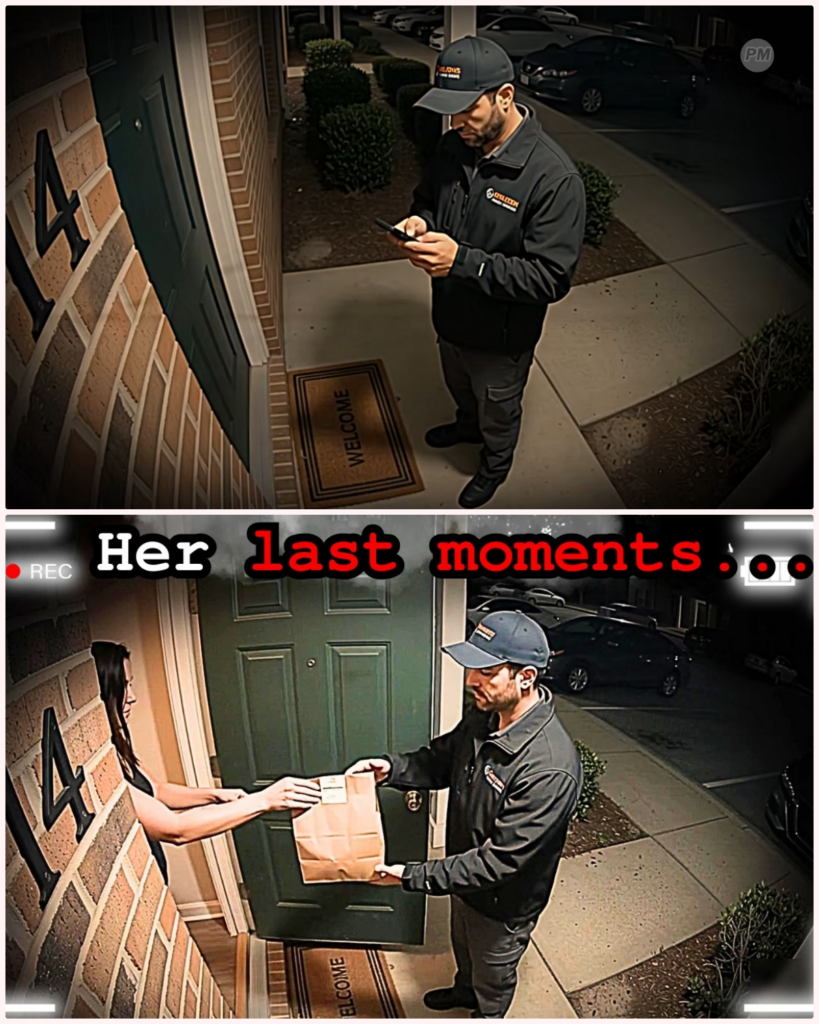
>> A doorbell camera shows a delivery driver standing on a porch 2 seconds longer than any delivery requires, staring down at his phone instead of walking back to his car.
He is looking at a number that just appeared on his screen. 11 days later, the woman who lived behind that door was reported missing, and investigators would eventually trace everything that happened to her back to that number and the 461 other numbers like it stored on his phone.
The footage itself shows nothing a homeowner would ever flag for review. No raised voice, no forced entry, no visible aggression of any kind.
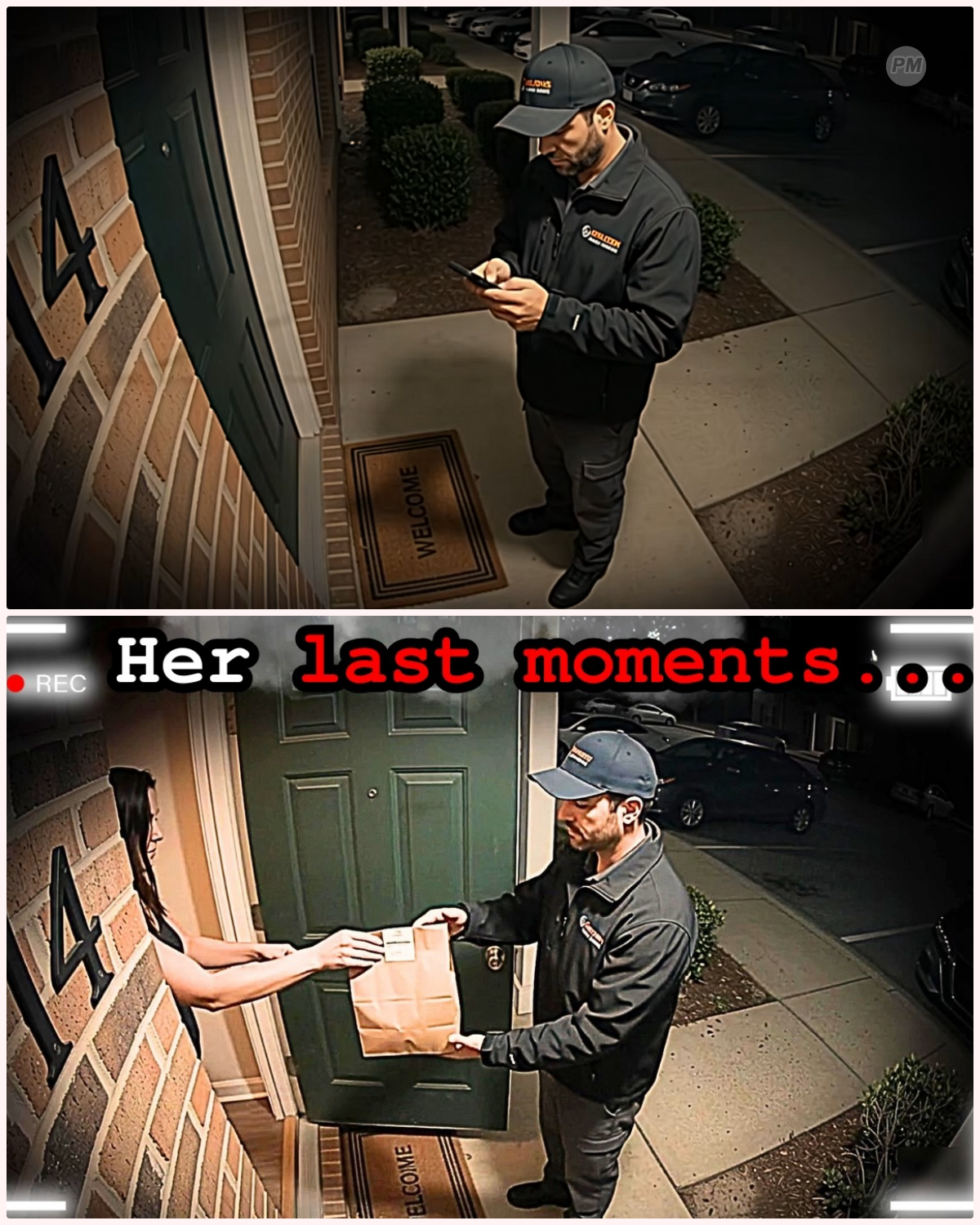
Just a man in a company branded jacket pausing on a welcome mat a beat longer than the job required, his face lit faintly by his own phone screen, before he turns and walks back to his car like any other driver finishing any other stop on an unremarkable Tuesday night.
Megan Stallworth moved to Tulsa, Oklahoma 2 years earlier for a quality assurance position at a software company headquartered downtown.
She was 28, originally from Springfield, Missouri, and had built a quiet, organized life in a one-bedroom unit in a converted warehouse building near the Arts District.
She shared the building with a close friend from college, Tasha Lindgren, who lived two floors below and worked as a hospital pharmacy technician on rotating shifts.
Co-workers described Megan as meticulous. The kind of tester who filed detailed bug reports other engineers joked were more thorough than the original product specifications.
She kept the same routine most weeks. Gym before work twice a week, a phone call with her mother in Springfield every Sunday afternoon, and dinner with Tasha on Friday nights.
Alternating between cooking and ordering in depending on whose week had been worse. Friends described her as careful in small specific ways.
The kind of person who double-checked that her car doors were locked even in her own building’s garage.
A habit her mother had instilled in her years earlier after a string of car break-ins in their old neighborhood.
Megan worked long hours testing software releases before launch. Often ordering dinner delivery three or four nights a week rather than cooking for herself after a 12-hour day.
She used a delivery app called Quick Eats almost exclusively. The same app most of her co-workers used rating her drivers honestly and without much thought.
The way most people rate strangers they will likely never interact with twice. Curtis Vandermeer was 37 years old and had driven for Quick Eats and a separate ride-share platform called Ride Now for just under 4 years working both apps simultaneously from the same car.
A routine he had settled into after losing a warehouse logistics job during a round of layoffs.
He had no criminal record. He had no documented history of violence. Co-workers at his previous job described him as quiet, precise, and unusually attentive to performance metrics.
A trait his former supervisor once mentioned approvingly in a performance review. Three years before that same trait would be be very differently in a criminal trial.
Curtis had lived alone since a divorce six years earlier that left him, according to his ex-wife’s later statement to investigators, increasingly fixated on measurable proof that he was doing things correctly.
A habit she traced back to a childhood she described only briefly as one where approval had never come easily or consistently.
After the warehouse layoffs, which he experienced as the second major rejection of his adult life following the divorce, gig driving offered him something he later described to the prison intake psychologist as the only job he had ever had where the rules were supposedly transparent.
A five-star rating meant he had done the job correctly. Anything less meant a stranger, for reasons he was never given, had decided he had failed.
Quick Eats, like most gig delivery platforms, ran on a five-star rating system that determined which drivers received priority access to higher-paying delivery requests during peak hours.
Drivers whose average rating fell below a certain threshold were quietly deprioritized by the app’s algorithm, receiving fewer assignments and lower weekly income with no human explanation offered and no appeal process beyond an automated support form.
Curtis had researched the algorithm extensively in online driver forums during his second year on the platform after a series of average ratings cost him what he calculated in a spreadsheet investigators would later recover to be just under $3,000 in lost income over four months.
From that point forward, Curtis began tracking every rating he received below five stars in a private spreadsheet on his personal laptop.
A habit he started, by his own later account to a prison intake psychologist, simply to identify patterns in his own service that he could improve.
The spreadsheet began as 11 entries in its first month, noting only the date, the star rating, and the general delivery area.
Megan ordered from Quick Eats on a Tuesday evening in early autumn of that year, a dinner delivery during a software deployment that ran late at her office.
The delivery arrived 19 minutes past its estimated window, and the food, by the time it reached her, was no longer hot.
She rated the delivery four stars and left a brief, unremarkable note in the optional comment field, observing only that the order had taken longer than expected and arrived lukewarm.
She did not remember the driver’s face. She had no reason to. Curtis remembered the address.
He added the entry to his spreadsheet that night, the way he had added hundreds of entries before it, except this one included something the earlier entries had not.
A notation in a column he had added only 6 weeks earlier, recording not just the rating and the date, but the building’s exterior features, its visible camera placements, and the approximate time the resident had returned home on three prior deliveries he cross-referenced from his own delivery history.
Detectives would later determine that Curtis’s spreadsheet, by the time of his arrest, contained 461 entries spanning just over 3 years, the overwhelming majority of which were nothing more than a frustrated man’s private record of a job he felt had been unfairly stacked against him by an algorithm he could not see or appeal to.
Of those 461 entries, investigators eventually identified 11 that escalated beyond data collection into documented surveillance, including repeat drive-bys of a residence outside any delivery context, photographs of a customer’s vehicle taken from Curtis’s own car, and, in three cases, direct unsolicited contact with the customer weeks or months after the original delivery, framed each time as a coincidental encounter.
Megan’s entry became the 12th. Three weeks after the lukewarm delivery, Megan received an unsolicited delivery to her building’s lobby, a coffee order she had not placed, marked in the app as a gift from a sender listed only as a Quick Eats promotional account.
She mentioned it to Tasha as a strange but harmless marketing gimmick. Tasha, who had worked retail jobs with similar loyalty promotions in the past, did not think much of it either.
Records later subpoenaed from Quick Eats showed no such promotional program had ever existed on the platform.
The order had been placed and paid for from Curtis’s own account, routed through a feature intended for customers to send gifts to other verified app users, a workaround he had used four times previously with four different women whose ratings appeared in his spreadsheet.
Over the following 6 weeks, Curtis appeared near Megan’s building on 11 separate occasions that investigators were later able to confirm through Quick Eats and Ride Now location data.
Only four of which corresponded to an actual assigned delivery or ride in that area.
On one occasion, a building neighbor, unconnected to Megan, mentioned to the building’s property manager that a sedan had been parked outside for over 2 hours one evening with someone seated inside doing nothing, an observation the property manager logged in a maintenance notebook but never followed up on.
Curtis’s method, as reconstructed later from his spreadsheet’s metadata and his own delivery app activity logs, relied on a feature most customers never thought twice about.
The platform’s option to accept lower-paying delivery requests outside a driver’s assigned zone, which Curtis used repeatedly to manufacture legitimate-looking reasons to be near addresses already logged in his spreadsheet, accepting orders at a financial loss specifically to maintain a documented presence in those neighborhoods without raising suspicion from the algorithm that tracked his efficiency.
Investigators calculated that Curtis lost an estimated $400 in net income over the 6 weeks he focused on Megan’s address, a loss he absorbed without apparent hesitation.
The early theory inside the Tulsa Police Department, once Megan was reported missing by Tasha after two missed shifts and an unanswered weekend of texts, centered initially on Megan’s on-and-off boyfriend, Derek Quillan, a 29-year-old contractor she had broken up with 4 months earlier following what Tasha described to detectives as a pattern of controlling, jealous behavior during the relationship.
Derek had a documented history of sending Megan repeated late-night messages after the breakup, several of which Tasha had personally seen and found alarming enough to mention to Megan directly.
Tasha told detectives that during one argument before the breakup, she had overheard Derek through the apartment wall accusing Megan of spending too much time responding to messages on her phone that had nothing to do with him, a complaint Tasha had assumed at the time referred to friends or co-workers.
Detectives noted the statement as corroborating evidence of a controlling dynamic, and for the first several days of the investigation, it shaped nearly every line of inquiry they pursued.
Detectives spent the first 4 days of the investigation building a case around Derek, pulling his phone records, interviewing his current co-workers, and confirming his whereabouts on the night Megan was last seen leaving her office building’s parking garage at 7:52 p.m., the final confirmed sighting of her on any camera in the city.
Derek’s alibi, a documented work shift at a construction site 40 minutes outside Tulsa with a foreman and two co-workers who confirmed his presence until nearly 11:00 p.m.
Held under scrutiny. The theory collapsed by the end of the first week leaving detectives with no suspect and a missing woman whose phone had gone dark less than a mile from her own apartment building.
Detective Talia Reyes, who took over the case in its second week after the initial leads stalled, began a wider review of Megan’s digital footprint that the first investigators had not prioritized, including her delivery and ride-share app history going back 18 months.
Reyes noticed the unsolicited coffee delivery flagged in Megan’s Quick Eats order history, an anomaly Tasha had mentioned in passing during an early interview, but that had not been pursued at the time.
Reyes subpoenaed Quick Eats for records connected to the gift order. The platform’s internal compliance team initially resisted the request citing standard data privacy policy before a court order compelled full cooperation.
The records identified Curtis Vandermeer as the account holder behind the gift transaction and cross-referenced his driver profile against Megan’s delivery history confirming he had completed the original four-star delivery 3 weeks before the gift order was placed.
Reyes obtained a warrant for Curtis’s apartment and vehicle 6 days after identifying him as a person of interest.
Investigators recovered his laptop containing the rating spreadsheet along with a separate folder of photographs taken from inside his car showing exterior shots of at least nine different residential buildings across Tulsa, Megan’s building included, timestamped across the prior 14 months.
A search of his apartment also turned up a printed street map of the metro area with 11 addresses circled in red pen.
Cross-referenced later against the 11 flagged entries in his digital spreadsheet, the apartment search took investigators nearly 11 hours.
Conducted under the supervision of a digital forensics team brought in specifically to image Curtis’s devices without altering any timestamp data that might later be challenged in court.
Among the recovered items was a secondary disconnected hard drive found inside a shoe box in his closet containing an earlier, cruder version of the same tracking system dating back to his first year on the platform before he had refined the spreadsheet into its later, more methodical form.
The progression between the two versions, prosecutors would later argue, demonstrated not a sudden break but a slow, deliberate escalation over years.
The spreadsheet’s structure, once forensic analysts mapped it in full, revealed a method far more deliberate than simple frustration.
Each entry below five stars included a secondary tracking column Curtis had labeled in his own handwriting on a printed backup copy found in a desk drawer as a column for what he called resolution status.
Most entries were marked closed with no further notes, representing customers Curtis had simply logged and never revisited.
11 entries, including Megan’s, were marked instead with a single letter Curtis never explained to investigators during questioning, a notation his attorney would later argue in court meant nothing more than an organizational habit.
Cross-referencing those 11 flagged entries against missing persons and unsolved assault records across the broader Tulsa metro area, Reyes’s team identified two additional cases that had never been connected to each other or to any common suspect.
One involved a delivery customer named Devin Castro, 24, who had left a three-star rating for a delayed order eight months before Megan’s disappearance and was found severely injured in a parking lot behind his own apartment complex 11 days after that rating was logged.
An assault he had been unable to describe to police beyond stating that he never saw his attacker’s face.
Devon had not connected the assault to a delivery rating at the time and no one investigating his case had ever asked him about one.
The second case involved a woman who had relocated out of state before any connection could be established whose four-star rating 18 months earlier coincided with a stalking complaint she had filed with a different police department.
A complaint that named no suspect and was eventually closed for lack of evidence. She was located and interviewed by Reyes’s team after Curtis’s arrest and she confirmed for the first time to any investigator a pattern of unexplained encounters in the months following that single delivery rating that she had eventually resolved on her own only by moving away entirely.
Curtis Vandermeer was arrested on a Thursday morning 19 days after Megan’s disappearance at the start of what would have been his delivery shift.
He did not resist and made no statement beyond requesting an attorney. Cell tower data placed his phone within a half mile of Megan’s apartment building during a four-hour window on the night she disappeared.
A window that did not correspond to any delivery or ride assignment logged on either platform that evening.
Reconstructing Megan’s final confirmed hours, investigators established that she had left her office at 7:52 p.m.
Stopped briefly at a grocery store four blocks from her building and used her phone to place a separate small order through a different delivery app entirely.
One Curtis did not drive for at 8:41 p.m. That order was completed without incident by an unrelated driver who later confirmed to police that Megan had answered the door normally and showed no signs of distress.
Her phone’s location data went dark at 9:14 p.m. Roughly 30 minutes after the second driver’s confirmed delivery, placing the most likely window of her abduction inside her own building or its immediate surrounding block.
Megan’s body was recovered 23 days after her disappearance, found by a utility crew in a drainage culvert on the outskirts of the city in an area investigators connected to Curtis’s vehicle through tire tread evidence and a single strand of fiber recovered from the scene matching the carpet lining of his car’s trunk.
The medical examiner’s findings, combined with the cell tower data and the surveillance photographs recovered from his apartment, led to a murder charge being filed against Curtis the same week alongside charges of stalking and unlawful surveillance connected to the broader pattern uncovered in his spreadsheet.
The trial began 11 months later in Tulsa County District Court. Prosecutors built their case methodically around the spreadsheet, walking the jury through its evolution from a frustrated worker’s informal log into a structured surveillance record.
Each entry cross-referenced against location data, photographs, and in Megan’s case, the unsolicited gift order that had first drawn investigative attention to him.
The defense argued that the spreadsheet reflected obsessive but ultimately harmless behavior and that no direct evidence placed Curtis at the scene where Megan’s body was found beyond circumstantial forensic overlap.
A digital forensics analyst testified across two days, walking the jury through the metadata embedded in the spreadsheet’s file history, showing edit timestamps that placed Curtis actively updating Megan’s entry as recently as the night cell tower data placed his phone within a half mile of her building.
The analyst explained that the file had been edited 18 times in the 6 weeks between the original delivery and Megan’s disappearance, far more frequently than any other single entry in the document’s 3-year history.
A detail the prosecution returned to repeatedly in closing arguments as evidence that something about this particular case had escalated beyond Curtis’s usual pattern.
Devon Castro testified, describing the assault he had survived 8 months before Megan’s disappearance and the three-star rating he had left a delivery driver he had never been able to identify until investigators showed him a photograph during their follow-up interview.
He told the jury he had spent 8 months believing his attack was random, a detail he said had made it impossible to feel safe anywhere because a random act of violence could happen again to anyone, anywhere, for no reason at all.
Learning there had been a reason, he said, did not make him feel safer. It made the world feel smaller and more deliberate than he had ever wanted to understand it to be.
The relocated stalking victim testified by video deposition rather than appearing in person, telling the jury she had moved across state lines specifically to escape a presence she could never prove existed.
And that hearing, for the first time, a name and a face attached to 18 months of unexplained fear had been both a relief and, in her words, the worst kind of confirmation a person could receive.
Detective Reyes testified to the methodology of the digital investigation, walking the jury through how an anomaly as small as one unexplained coffee delivery had ultimately unravelled 3 years of undetected surveillance across multiple victims, none of whom had ever reported behavior they recognized at the time, as connected to anything beyond an unusually persistent stranger.
The jury convicted Curtis Vandermeer on all counts after eight hours of deliberation, including first-degree murder, aggravated stalking, and unlawful surveillance tied to the broader pattern established through his spreadsheet, and the corroborating testimony of Devon Castro and the relocated stalking victim.
He was sentenced to life in prison without the possibility of parole. Quick Eats and Ride Now both updated their internal policies within a year of the trial’s conclusion, restricting drivers’ ability to view a customer’s full delivery history or send unsolicited gift transactions to any address outside an active assignment.
Neither company commented publicly on whether the policy changes were connected to the case, though both updates were implemented within four months of Curtis’s conviction becoming public record.
Tasha Lindgren still lives in the same building, two floors below the apartment that used to be Megan’s, now occupied by a different tenant who has no idea what happened there.
She has said, in the only interview she has given since the trial, that the detail she cannot stop thinking about is how ordinary the four-star rating was, how little thought Megan put into a few words about cold food on a Tuesday night, never imagining that somewhere on the other end of that rating, a man was already writing her address into a column on a spreadsheet, sorting her into a category meant only for people he had decided, for reasons that made sense to no one but him, were not yet finished business.
Devon Castro has said publicly that he now reads every delivery and ride-share review he leaves twice before submitting it.
Not because he believes most drivers are dangerous, but because he has learned there is no way, from inside an app built to feel anonymous and disposable to know which four-star rating someone on the other side is quietly unwilling to let go of.
Detective Reyes has since spoken at two regional law enforcement training sessions on the case, using it as an example of what she calls invisible platform crime.
Cases where the connecting thread between victims exists entirely inside a private company’s servers rather than in any public record a traditional investigation would normally think to request.
She has said the case took as long as it did not because the evidence was hard to find, but because no one initially thought to ask a delivery app the kind of questions usually reserved for phone carriers or banks.
Megan’s mother in Springfield has kept her daughter’s old Quick Eats account active for over a year after the trial, not to use it, but because closing it, she has said, felt like one more thing being taken from a life that had already lost everything else it was supposed to have.
She has said the only thing she wants other parents to understand is that the danger her daughter faced never once looked like a stranger.
It looked like a number on a screen and a few seconds of cold food on an ordinary Tuesday, the kind of small inconvenience no one is ever taught to be afraid of.