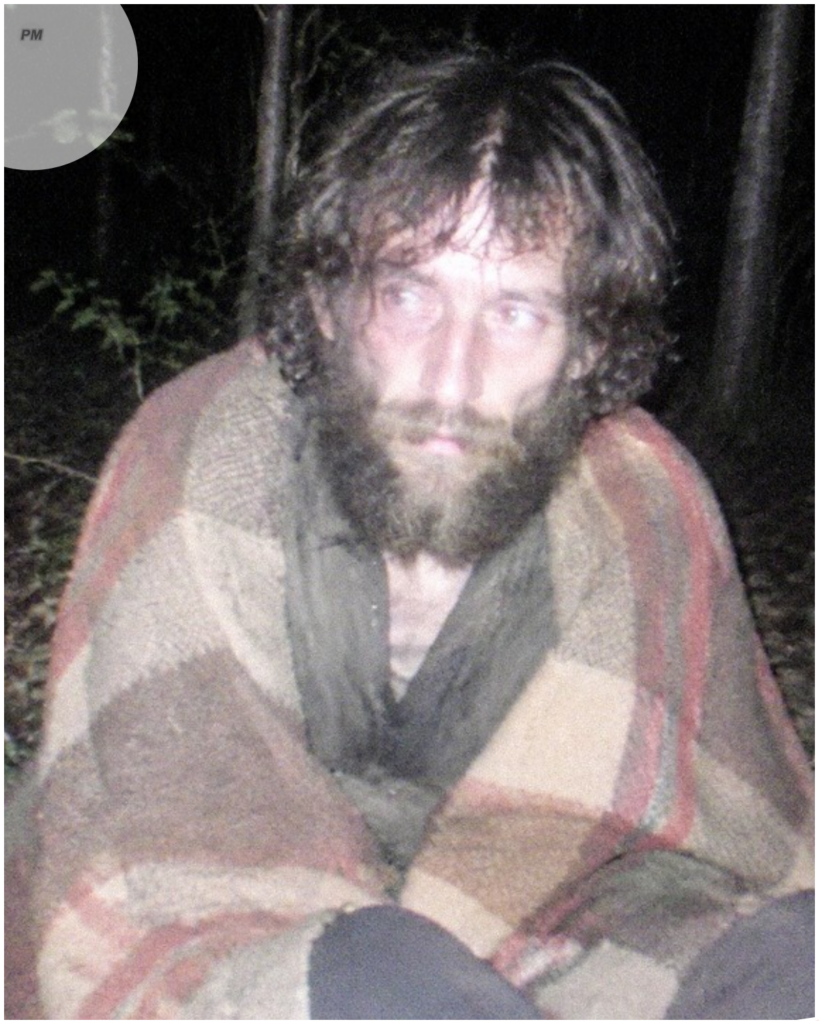
They found ordinary wildlife sign in the broader a…
They found ordinary wildlife sign in the broader area, but no clear trail identifying a large animal repeatedly circling the tent.
Nothing proved that another person had occupied the site with him. The visible damage came mainly from Michael’s cutting, fires, and gunfire.
That supported his description of preparing to remain under threat, but it could not establish whether the threat behaved as he remembered or whether all the sounds came from the same source.
With the site documented, investigators returned to the final part of his account. By the 17th day, Michael had little food left and only a few cartridges he could find.
He was sleeping in brief periods during daylight and struggling to gather enough wood. He remembered dropping a pot because his hand would not grip it properly.
The thought of another night maintaining the fires became more frightening than leaving. He decided to abandon anything that slowed him down including the rifle whose weight he could no longer justify with so little ammunition.
He put a water bottle and a small amount of food into his jacket and waited for morning.
Michael left on the 18th day by a route he had not previously attempted. He descended [music] to the creek and followed the water downstream sometimes moving within the channel where the banks became difficult.
He believed he heard movement above him during the first part of the journey, but this time he continued.
He did not try to identify it or stop to search with his flashlight when darkness came.
His memory of the night consisted [music] of short sections of ground cold water inside one boot and repeated efforts to stand after sitting down.
By the time he reached the logging road the next morning he had been moving for almost 23 hours with only brief rests.
[music] The searchers who examined his camp believed he had been frightened enough to alter almost every part of his normal behavior.
The defensive work and the ammunition supported that conclusion. They disagreed about what had started it and why it continued.
An animal could have approached the first nights and left him listening for its return.
Severe sleep loss and inadequate food could then have affected how he judged later sounds.
It was also possible that an animal remained nearby without leaving evidence the team could identify afterward.
The examination did not establish a species or verify that something deliberately blocked his attempts to escape.
Michael was told those possibilities and accepted that he could not prove what he heard.
He objected when people described him as simply waiting in camp to be rescued. He had expected to leave each morning and had repeatedly begun doing so.
His account explained why those attempts ended at the tent. Even though nobody could confirm what was ahead of him in the trees, when officers returned [music] his equipment, he asked Karen to store it.
He kept the notebook but did not take another overnight hunting trip that year or the next.
The written record ended with the recovery of a missing hunter [music] and the examination of the place where he spent most of 19 days.
The team found the tent, [music] the cut timber, and nearly all his ammunition fired around the clearing.
They did not find evidence that he had hidden another victim or an illegal kill.
Michael continued [music] to refuse requests to revisit the site, including an offer to return with several armed officers.
He had already described the way in and he believed that was all he could contribute.
If you were reviewing this case, how much weight would you give the condition of the camp when deciding whether Michael faced a continuing threat?
Share your thoughts in the comments and subscribe to UNK files to learn about more wilderness disappearances [music] and the people who made it back.
