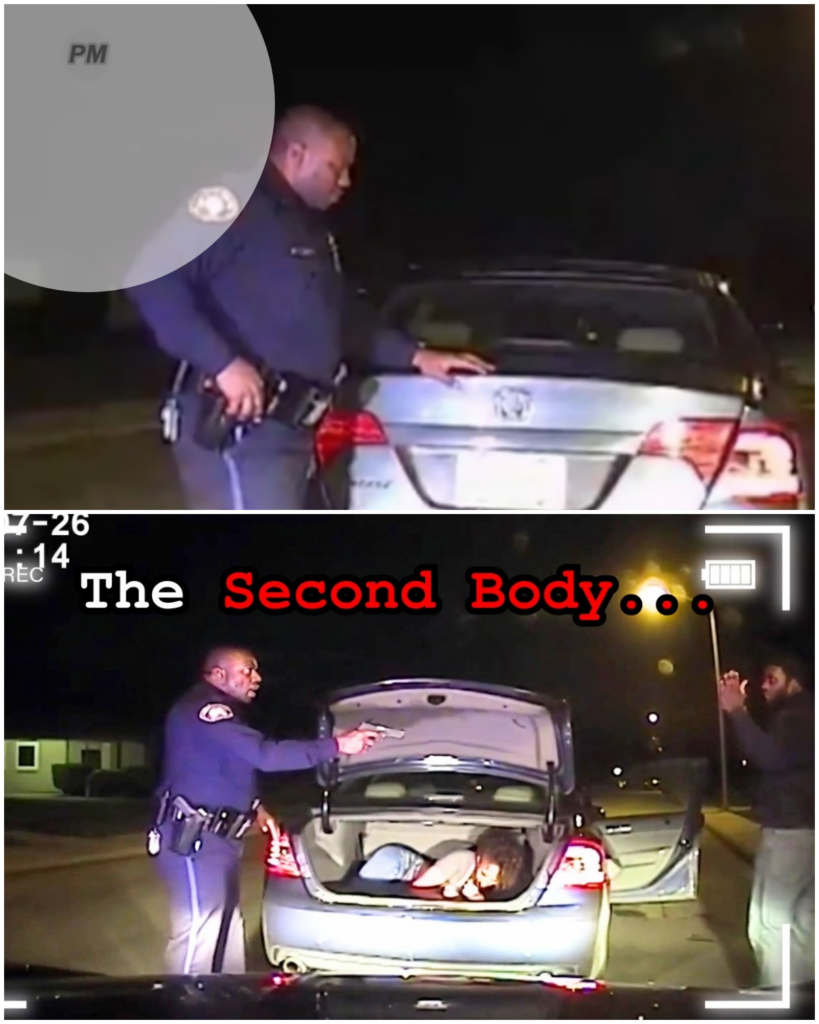
A reflexive movement
A reflexive movement. His department’s use of force review would later describe as instinctive and consistent with officer training, but one that meant the body camera lens mounted on his chest was angled away from Kesler at the precise fraction of a second the round was fired.
The dash camera, positioned to capture the front of the stopped vehicles, caught only the muzzle flash reflected faintly in the sedan’s rear window.
The farmhouse doorbell camera, the widest angle of the three, was too far away and too dark to resolve anything beyond a single flash of light.
And the sound a half second later, arriving across the distance between the properties. Roland Kesler was struck once and fell beside the open driver’s door.
Reyes radioed for backup and emergency medical services within seconds, then moved immediately to the trunk to free the woman inside, later identified as Diane Castellaniano, 31, who had at that point been missing for 6 days.
Now, we need to go back those 6 days because the story of what happened to Diane Castellano and to the person under that tarp beside her did not begin on that highway.
It began at a gas station two counties away, and it involves a decision Diane made that for years afterward, she would describe as the only thing that kept her alive long enough to be found.
Diane had stopped for gas on her way home from a night shift. A routine stop at a station she used regularly.
Surveillance footage from the station recovered days into the investigation shows her at the pump for just under 4 minutes before a gray sedan pulls in at the adjacent pump.
What the footage shows next, a brief conversation, Diane appearing to check her phone, then walking toward the passenger side of the sedan rather than back to her own car, would become one of the most analyzed sequences of the entire investigation because it appeared on first viewing to show a woman voluntarily getting into a stranger’s vehicle.
It did not. What the footage could not show, and what only came out in Diane’s own account afterward, was that Kesler had approached her claiming car trouble of his own, asking if she had jumper cables, and that when she walked toward his car to check, he had already positioned himself between her and her own vehicle, a positioning investigators would later recognize as a deliberate pattern, one Kesler had very likely used before.
Diane’s family reported her missing that same night when she failed to arrive home from her shift within the window she always texted to confirm.
The investigation that followed in its first 72 hours focused heavily on her personal life.
An aranged relationship, a workplace disagreement two weeks earlier. The kinds of leads that consume the early days of almost every missing person’s case involving an adult woman, often at the expense of examining stranger danger scenarios that statistically account for a smaller share of cases, but carry dramatically higher immediate risk.
It was only on day three, when a detective reviewing the gas station footage a second time noticed the positioning Diane had described that the case began to shift toward the theory investigators would eventually confirm.
By day five, the department had identified the gray sedan’s partial plate from a second camera angle recovered from a business across the street.
But the search radius for a car matching that partial description covered an area spanning three counties, and without a full plate or a name, there was little more investigators could do beyond circulating the description to patrol units and waiting.
It was, in the words of the detective who eventually closed the case, the kind of gap where you’re genuinely relying on luck and you hate that you’re relying on luck, but there’s nothing else left to rely on.
That gap closed the following night on a stretch of rural highway because of a broken tail light and a rookie officer who chose not to explain away a sound he couldn’t account for.
Diane told investigators months later that the six days that followed are in places difficult for her to reconstruct an order and that she has chosen not to share every detail publicly.
What she has said is that she made a decision sometime in the second or third day to stop resisting in any way Kesler could see and to begin looking instead for any moment he was not paying attention.
A decision that meant enduring conditions the medical examiners later report and her own hospital intake documented only in clinical terms and that we are not going to describe beyond that here.
