We need to stop here because everything about what…
We need to stop here because everything about what Reyes did in the next 90 seconds would later be studied, reviewed, and picked apart by his own department, by outside investigators, and eventually by a grand jury.
And understanding why requires understanding what Reyes did not yet know standing at that window.
He did not know that Kesler’s car had been reported 6 days earlier in connection with a missing person’s case two counties over.
He did not know that the woman two counties over had vanished from a gas station security camera getting into a gray sedan with a driver whose face the footage never clearly captured.
He knew only that he had heard something no routine traffic stop should ever produce and that his training told him exactly one thing.
The sound came first and the explanation would have to come after. Sir, I need you to step out of the vehicle.
Reyes said his body camera running the entire time captured Kesler’s hands go still on the wheel for exactly 2 seconds before he complied.
Reyes ordered him to open the trunk. What happened over the following 4 seconds is the reason this case would eventually be examined by a grand jury reconstructed frame by frame from three separate camera angles.
Reyes’s body camera, his cruiser’s dash camera, and a doorbell camera from a farmhouse set back from the road that happened to have a partial view of the shoulder.
Investigators would later say that the existence of even a partial third angle was a stroke of unusual luck for a rural stretch of highway with almost no other surveillance coverage for miles in either direction, and that without it, key portions of the timeline would have rested entirely on Reyes’s own account, with no independent corroboration at all.
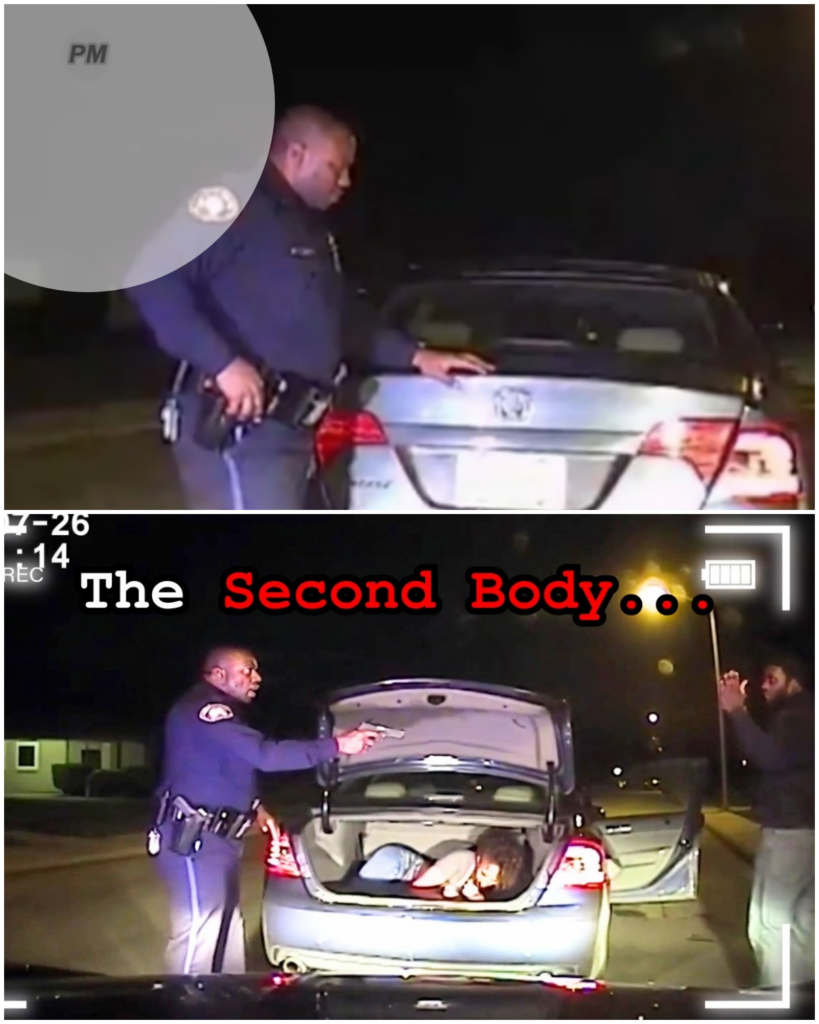
Kesler walked to the rear of the car slowly and popped the trunk release. Inside, illuminated only by Reyes’s flashlight and the weak glow of the trunk’s interior bulb, was a woman, wrists and ankles bound with what would later be identified as electrical cord, a strip of fabric tied across her mouth.
She was alive. Her eyes, according to Reyes’s own statement afterward, found his instantly, and what he saw in them, he said, was not fear exactly.
It was something closer to disbelief. The look of someone who had stopped expecting anyone to open that trunk at all.
Beside her, covered by a section of tarp identical in material to the one restraining her, was a second shape.
Still, the wrong shape and the wrong stillness for a person who was only sleeping.
Reyes has said that in the two or three seconds it took his mind to fully process what his flashlight was showing him, Kesler was already moving.
Here is where we need to slow the story all the way down because what happened next took less time to occur than it will take you to read this sentence and it is the single most disputed sequence in the entire case.
Kesler did not run in the conventional sense. No sudden sprint, no dramatic break for the tree line.
According to the frame by frame reconstruction later presented to the grand jury, he took one step backward from the open trunk, then a second, angling his body toward the driver’s side door, moving with the specific controlled urgency of a man calculating whether he could reach his own vehicle and put it in gear before the officer standing 8 ft away could stop him.
Reyes drew his weapon. His body camera audio captures him giving a single verbal command.
Don’t move. Followed less than two seconds later by Kesler reaching the driver’s door handle.
What the footage does not capture is the shot itself. At the exact moment Reyes discharged his weapon, his own body shifted, pivoting toward the trunk to keep the bound woman in his peripheral vision.