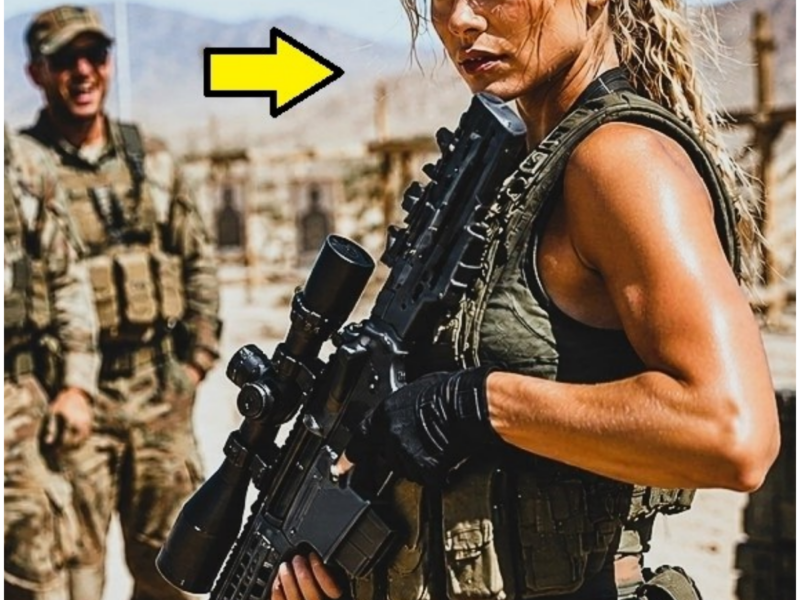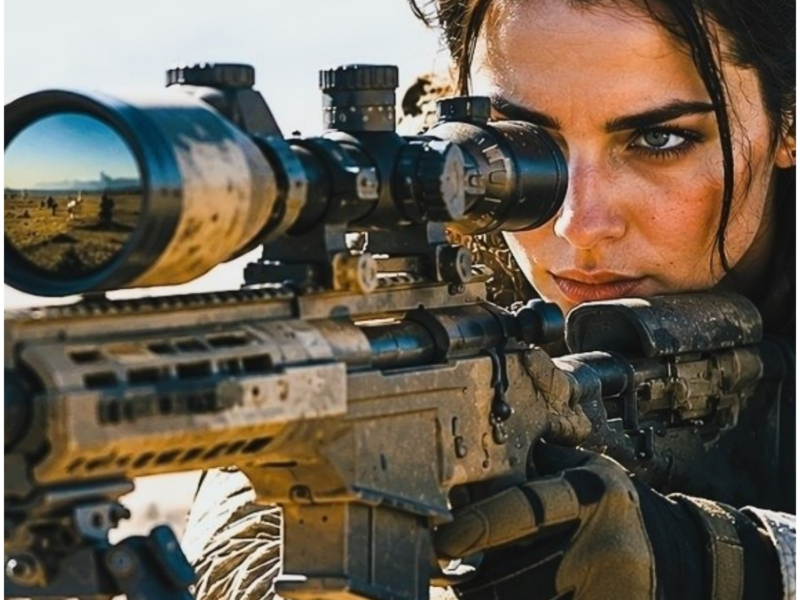
Sarah Martinez had always been the type of person who never backed down from a challenge.
Growing up in a small town in Texas, she was the girl who climbed the tallest trees, raised boys on bicycles, and never cried when she scraped her knees.
Her father, a Vietnam veteran, had taught her that strength wasn’t just about muscles. It was about heart, determination, and never giving up when things got tough.
When Sarah turned 18, she knew exactly what she wanted to do with her life.

While her classmates were planning college parties and worrying about which major to choose, Sarah was at the Army recruitment office, signing papers that would change her life forever.
Her parents weren’t surprised. They had watched their daughter’s fascination with military history, her respect for service members, and her burning desire to serve her country.
Basic training was everything Sarah had expected and more. The early morning runs, the obstacle courses, the shouting drill sergeants.
She loved every minute of it. While other recruits complained about the physical demands, Sarah thrived.
She was one of the fastest runners in her unit, could do more push-ups than most of the men, and never failed to complete any physical challenge thrown her way.
After basic training, Sarah specialized in logistics and supply chain management. It wasn’t the most glamorous job in the military, but it was crucial.
She understood that soldiers on the front lines depended on people like her to make sure they had food, ammunition, medical supplies, and equipment when they needed it most.
Sarah took this responsibility seriously, working long hours and always going the extra mile to ensure everything ran smoothly.
Her first deployment came sooner than expected. The situation in Afghanistan was escalating, and experienced logistics personnel were desperately needed.
Sarah found herself boarding a military transport plane, her heart pounding with a mixture of excitement and nervousness.
She was finally going to serve her country in a real combat zone, doing the work she had trained so hard for.
The forward operating base where Sarah was stationed was a bustling hub of activity. Helicopters landed and took off at all hours, bringing supplies in and taking wounded soldiers out.
Armored vehicles rolled through the gates, covered in dust and sometimes bearing the scars of improvised explosive devices.
The air was thick with tension, but also with purpose. Everyone knew their job was important, and everyone worked together to keep the mission going.
Sarah quickly established herself as someone who could be counted on. When supply convoys were delayed, she found creative solutions to stretch existing resources.
When equipment broke down, she worked with mechanics and engineers to get things running again.
Her commanding officers noticed her dedication and reliability, and she began taking on more responsibilities.
The base where Sarah worked was considered relatively safe compared to some forward positions, but safety was always relative in a war zone.
Mortar attacks happened regularly, sending everyone scrambling for bunkers. Sniper fire occasionally rang out, keeping everyone on edge.
Sarah learned to sleep through the sound of distant explosions and to keep working even when warning sirens wailed.
Despite the dangers, Sarah loved her work and felt proud of her service. She wrote letters home to her parents telling them about the Afghan people she met, the beautiful mountains she could see in the distance and the sense of purpose she felt every day.
She made friends with other soldiers, sharing stories and jokes during brief moments of downtime.
The camaraderie was unlike anything she had experienced in civilian life. Months passed and Sarah’s deployment was going well.
She had been promoted once and was being considered for another promotion. Her fitness reports were excellent and her commanding officers frequently praised her work ethic and leadership potential.
Sarah began thinking about making the military a career, perhaps eventually becoming a senior non-commissioned officer or even pursuing a commission as an officer.
Then came the day that would change everything. It started like any other morning at the base.
Sarah woke up before dawn, as was her routine, and headed to the messaul for a quick breakfast before beginning her duties.
The supply manifest for that day showed several important deliveries needed to reach outposts in the surrounding area.
Medical supplies were running low at one location, and another desperately needed ammunition resupply. As Sarah reviewed the paperwork and coordinated with the transportation unit, she felt the familiar satisfaction of a job well done.
Everything was organized perfectly. The schedules were tight but achievable, and the drivers knew their roots.
She had no way of knowing that this day would test her in ways she never could have imagined, or that the next few hours would demonstrate just how dangerous her supposedly safe job really was.
The morning briefing revealed increased enemy activity in the area, but that was nothing unusual.
Intelligence reports always mentioned potential threats, and convoys always went out with appropriate security measures.
Sarah had complete confidence in the soldiers who would be escorting the supply trucks, and she knew the drivers were experienced and capable.
As the convoy prepared to depart, Sarah did her final checks. She walked around each truck ensuring the cargo was properly secured and that all necessary paperwork was in order.
The drivers joked with her as they always did, calling her the most thorough supply sergeant in the entire army.
Sarah smiled and reminded them to stay safe out there, as she always did. What none of them knew was that enemy forces had spent weeks planning an attack on supply convoys.
They had studied the routes, identified the most vulnerable points, and prepared an ambush that would target not just the trucks, but anyone involved in the logistics operation.
Sarah’s attention to detail and dedication to her job had made her a target, though she wouldn’t discover this until it was almost too late.
The convoy rolled out of the base gates just as the sun was beginning to rise over the Afghan mountains.
Sarah watched them go, then returned to her office to continue working on the next day’s supply requirements.
She had no idea that in a few short hours her life would be forever changed, and that her journey from that moment forward would test every ounce of the strength and determination her father had taught her to cultivate.
The emergency call came through Sarah’s radio at exactly 11:47 a.m. The convoy she had organized that morning had been hit by an improvised explosive device, followed immediately by small arms fire from multiple positions.
Two trucks were damaged. Several soldiers were wounded and they needed immediate assistance. Without hesitation, Sarah grabbed her gear and joined the quick reaction force that was mobilizing to provide support.
The ride to the ambush site was tense and silent. Sarah sat in the back of an armored vehicle, checking her equipment and trying to prepare mentally for what she might find.
She had trained for situations like this, but training could never fully prepare someone for the reality of combat.
Her heart was pounding, but her mind was focused. Soldiers were in trouble, and they needed help.
When they arrived at the scene, the situation was chaotic, but under control. The ambush had been repelled, but the damage was significant.
One supply truck was completely destroyed, its contents scattered across the road. Another truck had substantial damage, but was still functional.
Most importantly, the security team had managed to prevent any casualties, though several soldiers had minor injuries from the explosion and flying debris.
Sarah immediately went to work assessing the situation. The destroyed truck had been carrying medical supplies desperately needed at a forward outpost.
The damaged truck contained ammunition and food rations. Her job was to figure out how to salvage what could be saved and arrange for replacement of what was lost.
It was exactly the kind of problem solving she excelled at. Working quickly but carefully, Sarah organized the recovery operation.
Salvageable supplies were loaded onto undamaged vehicles. She coordinated with base to arrange for replacement items to be prepared for immediate transport.
Her calm efficiency in the midst of chaos impressed everyone present, including the senior officers who had responded to the emergency.
But as Sarah was supervising the loading of recovered supplies, the enemy struck again. Intelligence later revealed that the insurgents had planned a complex multi-stage attack.
The first ambush was intended to damage the convoy and draw a response force to the area.
The second attack was designed to target the recovery operation, hoping to inflict maximum casualties on personnel who were focused on cleanup rather than security.
The second attack came without warning. Sarah was standing near the damaged truck, clipboard in hand when she heard the distinctive whistle of incoming mortar rounds.
She had seconds to react. Her training kicked in immediately and she dove toward the nearest cover, shouting warnings to the other soldiers in the area.
The first mortar round hit about 50 m away. Close enough to shower everyone with dirt and debris, but not close enough to cause serious harm.
Sarah pressed herself against the ground behind a concrete barrier, her heart racing as she waited for the next impact.
She could hear soldiers shouting orders and taking defensive positions. The second mortar round was much closer.
Sarah felt the ground shake beneath her, and her ears rang from the concussion. Dust and smoke filled the air, making it difficult to see or breathe.
She could hear the crack of rifle fire as the security team engaged enemy positions, but the sound seemed distant and muffled through her damaged hearing.
When the third mortar round hit, Sarah’s world changed forever. The explosion occurred less than 20 m from her position.
The blast wave picked her up and threw her against a concrete wall with tremendous force.
She felt a burning sensation across her back and shoulder, followed immediately by numbness and a strange floating feeling.
Sarah tried to get up but found that her body wasn’t responding the way it should.
She could see other soldiers moving around her, their mouths opening and closing, but she couldn’t hear what they were saying.
Everything seemed to be happening in slow motion. She noticed that her uniform was torn and that there was blood on her hands, though she couldn’t immediately tell where it was coming from.
The medic reached Sarah within minutes of the explosion. She was conscious but clearly in shock.
Her eyes wide and unfocused. As the medic began his initial assessment, he immediately saw the problem.
Sarah’s back and left shoulder were peppered with shrapnel from the mortar round. Some pieces were small, barely breaking the skin, but others were larger and had penetrated deeper into muscle tissue.
“Stay with me, Sergeant,” the medic said. Though Sarah couldn’t hear him clearly through the ringing in her ears, she tried to speak, but found that her voice sounded strange and distant.
The medic worked quickly, applying field dressings to the worst wounds and preparing Sarah for immediate medical evacuation.
The helicopter ride back to the base medical facility was a blur for Sarah. She drifted in and out of consciousness, occasionally aware of the medics working on her, sometimes hearing bits of radio conversation about her condition.
She remembered thinking that this wasn’t how her deployment was supposed to go and wondering if her parents would be notified that she had been wounded.
At the base hospital, doctors worked for several hours to remove the shrapnel from Sarah’s back and shoulder.
Some pieces came out easily, but others had traveled deeper and required more extensive surgery.
The largest piece had missed her spine by less than an inch. The doctors told her later that she had been incredibly lucky.
A few centimeters in any direction and she might have been paralyzed or killed. The recovery process was long and painful.
Sarah spent 2 weeks in the hospital at the base followed by medical evacuation to a larger facility in Germany and eventually to a military hospital in the United States.
The physical therapy was grueling and the psychological impact of the attack was something she hadn’t expected to deal with.
Some of the shrapnel couldn’t be removed safely and would remain in her body permanently.
Doctors explained that these metal fragments would likely cause ongoing pain and mobility issues. They would show up on X-rays and metal detectors for the rest of her life, permanent reminders of that terrible day when enemy mortars had found their target.
But Sarah was determined to recover fully and return to active duty. She had joined the military to serve her country, and one attack wasn’t going to change that.
She threw herself into physical therapy with the same dedication she had always shown. When doctors said certain exercises might be too difficult, she proved them wrong.
When therapists suggested she might want to consider a medical discharge, she refused to even discuss it.
The road ahead would be longer and more difficult than Sarah realized, but her determination remained unshaken.
18 months after the attack, Sarah was back on active duty, but her life had changed in ways she was still discovering.
The physical therapy had been successful in restoring most of her mobility, though she still experienced pain and stiffness, especially in cold weather or when storms were approaching.
The shrapnel that remained in her body created a constant awareness of that day in Afghanistan, a reminder that lived beneath her skin.
What bothered Sarah more than the physical limitations was how differently people treated her now.
Fellow soldiers who had known her before the attack sometimes looked at her with a mixture of respect and pity that made her uncomfortable.
New personnel she met often assumed she was fragile or needed special consideration. Sarah hated this perception more than anything else about her situation.
The army had assigned Sarah to a training facility in Georgia where she worked with new recruits learning logistics and supply chain management.
It was important work and she was good at it. But part of her missed the intensity and purpose she had felt during her deployment.
Teaching classroom lessons about convoy procedures felt less meaningful than actually organizing convoys that kept soldiers supplied and safe.
Sarah’s new assignment came with regular fitness requirements. Just like every other position in the army, physical training tests were administered twice a year, measuring soldiers ability to perform push-ups, sit-ups, and complete a timed run.
These tests were important for promotion eligibility and overall fitness ratings that affected every aspect of a soldier’s career.
For Sarah, the physical training test had become a source of anxiety she had never experienced before her injury.
The push-ups were particularly challenging because of the shrapnel in her shoulder and back. The metal fragments created pressure points that became painful during certain movements, and the scar tissue affected her range of motion.
What had once been easy for her now required significant effort and often resulted in pain that lasted for hours afterward.
Despite these challenges, Sarah was determined to meet the same standards as everyone else. She spent extra time in the gym working with physical therapists to develop modified techniques that would allow her to perform the required exercises.
She practiced push-ups daily, gradually building strength and endurance while managing the pain that accompanied each session.
The day of her first fitness test since returning to active duty, Sarah arrived early at the testing site.
She had prepared as thoroughly as possible, but she was nervous in a way she had never been before about a physical fitness evaluation.
The test administrator was a young lieutenant who didn’t know Sarah’s history, and she preferred it that way.
She didn’t want any special treatment or modified expectations. The push-up portion of the test came first.
Sarah got into position and waited for the command to begin. As she started the exercise, she felt the familiar pain in her shoulder, where the largest piece of shrapnel remained.
By the 10th repetition, the pain was significant. By the 20th, it was almost unbearable.
But Sarah kept going, determined to meet the minimum requirement regardless of how much it hurt.
She managed to complete the required number of push-ups. Though her form wasn’t as perfect as it had been before her injury, the pain in her shoulder was severe, and she could feel the scar tissue pulling with each movement.
When the time was up, Sarah was breathing heavily and trying not to show how much pain she was experiencing.
The sit-ups went better, though Sarah could feel the irregular contours where shrapnel remained in her back pressing against the ground.
The running portion was the easiest for her as her leg injuries had healed completely.
She finished the test having met all the minimum requirements, but she knew her performance wasn’t what it had been before Afghanistan.
Over the following months, Sarah’s relationship with physical fitness became increasingly complicated. She continued to pass the required tests, but each one was a struggle that left her in pain for days afterward.
She began to dread the testing periods, something that was completely foreign to someone who had once looked forward to physical challenges.
Sarah’s commanding officer, Lieutenant Colonel James Harrison, was a career military man with over 20 years of service.
He was known for his high standards and non-nonsense approach to military readiness. Harrison had served multiple deployments himself and had little patience for what he perceived as excuses or attempts to avoid difficult requirements.
When Sarah’s fitness scores began to show a declining trend, Harrison took notice. Her push-up numbers were consistently at or near the minimum requirement, and her overall fitness rating had dropped from excellent to satisfactory.
From Harrison’s perspective, this suggested a soldier who was becoming complacent or losing the discipline necessary for military service.
Harrison called Sarah into his office for a counseling session about her fitness performance. The meeting was formal and direct, as was Harrison’s style with all personnel under his command.
He expressed concern about her declining scores and asked if there were any issues affecting her ability to maintain proper fitness standards.
Sarah’s response was measured and professional. She explained that she was meeting all required standards and that her scores, while not as high as they had been previously, were still within acceptable ranges.
She didn’t mention the pain she experienced or the ongoing effects of her injuries. In her mind, those were not excuses, but simply challenges she needed to overcome.
Harrison wasn’t satisfied with this response. He had seen too many soldiers over the years who started making excuses for declining performance, and he believed that maintaining high standards was crucial for unit readiness and morale.
He told Sarah that he expected to see improvement in her next fitness test and that consistently minimum performance was not acceptable for a non-commissioned officer.
The conversation left Sarah frustrated and angry. She felt that her service record and dedication were being questioned unfairly.
She had continued serving despite significant injuries, had never complained about her assignments, and was performing well in all aspects of her job, except for the physical fitness tests that had become so difficult for her.
Sarah left Harrison’s office with a new determination to prove herself, but also with a growing resentment about the situation.
She began spending even more time in the gym, pushing herself through painful workouts in an attempt to improve her scores.
The physical therapy exercises that had helped her recover were supplemented with additional training that often left her in significant discomfort.
As her next fitness test approached, Sarah knew she needed to perform better to satisfy Harrison’s expectations.
She had been working with a trainer who specialized in helping injured soldiers, and together they had developed techniques that might help her achieve higher scores despite her limitations.
But Sarah also knew that the pain would be intense and she worried about causing further damage to her already compromised shoulder and back.
The stage was being set for a confrontation that would force both Sarah and Colonel Harrison to confront their assumptions about duty, sacrifice, and what it truly means to serve.
The morning of Sarah’s next fitness test arrived with typical Georgia humidity and heat. She had been preparing for weeks, pushing her body through painful training sessions and working with specialists to maximize her performance despite her injuries.
The test was scheduled for early morning to avoid the worst of the heat. But Sarah was already sweating from anxiety before she even began warming up.
Colonel Harrison had decided to personally observe this fitness test, something he didn’t typically do for individual soldiers.
His presence added extra pressure to an already stressful situation. Sarah could see him standing with the other test administrators clipboard in hand, clearly intending to closely monitor her performance.
The push-up portion began as it always did with Sarah getting into position and waiting for the command to start from the moment she lowered herself for the first repetition.
She could feel the sharp pain where the shrapnel pressed against muscle and nerve. But she had trained for this, developing techniques to distribute the weight differently and minimize the stress on her injured areas.
Sarah managed 15 push-ups before the pain became almost unbearable. She could see Colonel Harrison watching intently, his expression unreadable but focused.
She forced herself to continue gritting her teeth and using every technique she had learned to push through the discomfort.
At 20 repetitions, she was struggling visibly, her form becoming less perfect as she compensated for the pain.
By the time she reached 25 push-ups, Sarah was in agony. The shrapnel in her shoulder felt like it was tearing through muscle tissue with each movement.
Her breathing was labored and sweat was pouring down her face despite the early morning coolness.
But she kept going, driven by determination and the knowledge that Colonel Harrison was evaluating not just her fitness, but her commitment to military standards.
Sarah managed to complete 30 push-ups before her strength gave out completely. It was an improvement over her previous scores, but still well below what Harrison expected from a non-commissioned officer.
As she collapsed to the ground, breathing heavily and trying to hide the extent of her pain, she could see the disappointment on her commanding officer’s face.
The sit-ups and running portions of the test went better, but Sarah’s overall score was still only satisfactory rather than excellent.
When the test was over, Harrison approached her with a stern expression. He told her that while she had shown some improvement, her performance was still not at the level he expected from someone in her position.
“Sergeant Martinez,” Harrison said, his voice carrying the authority of his rank and years of service.
“I need to understand what’s going on here. You were once one of our top performers, and now you’re consistently scoring at minimum levels.
Are you not taking your fitness seriously? Are you not putting in the effort required?”
Sarah felt her temper rising. She had been putting in more effort than Harrison could possibly understand, pushing through pain that would have stopped most people from even attempting the exercises.
She had been working with trainers and physical therapists, spending extra hours in the gym, and following specialized workout routines designed to work around her injuries.
“Sir, I am meeting all required standards,” Sarah replied, trying to keep her voice professional despite her frustration.
“I train regularly and take my fitness responsibilities seriously.” Harrison’s expression grew more stern. Meeting minimum standards is not the same as maintaining the level of readiness we need from our non-commissioned officers.
I’ve seen too many soldiers start making excuses for declining performance. If there’s something preventing you from performing at your best, we need to address it directly.
The word excuses hit Sarah like a physical blow. She had never made excuses for anything in her military career.
She had volunteered for difficult assignments, had served in combat zones, had been wounded in service to her country, and had worked tirelessly to recover and return to active duty.
The suggestion that she was making excuses for poor performance was deeply insulting. “With respect, sir,” Sarah said, her voice tighter than she intended.
“I am not making excuses. I am performing to the best of my ability while meeting all required standards.”
Harrison wasn’t satisfied with this response. His experience had taught him that soldiers who couldn’t maintain proper fitness standards were often dealing with discipline issues, motivation problems, or personal difficulties that needed to be addressed.
He had seen the gradual decline in performance that often preceded more serious problems, and he believed early intervention was important.
Sergeant, if you’re having personal issues that are affecting your performance, we have resources available to help.
But I can’t help you if you’re not honest about what’s going on. Your fitness scores have been declining for months, and today’s performance, while slightly improved, is still not where it needs to be.
Sarah felt something snap inside her. She had been patient and professional throughout months of painful training, difficult recovery, and what she perceived as unfair scrutiny of her performance.
She had never asked for special treatment or accommodations. She had simply tried to do her job to the best of her ability despite circumstances that most people would never have to face.
“Sir,” Sarah said, her voice now carrying an edge of anger. “I have been honest about my performance.
I meet all standards. I complete all requirements, and I do my job well. If that’s not sufficient, then perhaps we need to discuss what exactly you expect from soldiers who have served in combat zones.”
The mention of combat service seemed to irritate Harrison rather than soften his position. He had served in combat himself and knew that many soldiers returned from deployments with various challenges.
But in his experience, the best soldiers found ways to overcome those challenges rather than allowing them to affect their performance.
Your combat service is noted and appreciated, Harrison replied. But it doesn’t exempt you from maintaining the same standards as every other soldier.
If you have medical issues that are affecting your fitness, then you need to work with medical personnel to address them.
If you have other issues, we have programs for that, too. But what I can’t accept is consistently mediocre performance without any explanation or effort to improve.
Sarah realized that Harrison had no idea about her injuries or the ongoing effects of the shrapnel in her body.
Her medical records would show the basic facts, but the day-to-day reality of living with embedded metal fragments, scar tissue, and chronic pain wasn’t something that appeared in fitness reports or personnel files.
Harrison was evaluating her performance based on numbers and standards without understanding the context that made those numbers meaningful.
For a moment, Sarah considered explaining her situation. She could tell Harrison about the attack in Afghanistan, about the months of recovery, about the ongoing pain she experienced during physical training.
She could describe the extra hours she spent in the gym working around her limitations or the specialized training techniques she had developed to compensate for her injuries, but something held her back.
Sarah had never wanted to be seen as damaged or limited by her injuries. She had worked hard to be treated the same as any other soldier, and she feared that explaining her situation would result in special treatment, or worse, questions about her fitness for duty.
She had seen other wounded soldiers transferred to desk jobs or medical units, and she didn’t want that for herself.
Instead, Sarah made a decision that would lead to one of the most dramatic moments of her military career.
Sarah looked directly at Colonel Harrison, her decision made. She was tired of being questioned, tired of having her dedication doubted, and tired of the assumption that she wasn’t giving her best effort.
If Harrison wanted to understand why her fitness scores had declined, she would show him exactly why.
Colonel,” Sarah said, her voice steady but determined. “You want to know why my performance isn’t what it used to be?
You think I’m making excuses or not putting in enough effort?” Harrison’s expression remained stern, but there was something in Sarah’s tone that made him pay closer attention.
The other soldiers who had been taking the fitness test had moved away, but a few were still within hearing distance, along with the test administrators and some training personnel.
I’ve been trying to explain that meeting minimum standards isn’t enough. Harrison replied, “As a non-commissioned officer, you need to set an example for junior soldiers.
If you’re having difficulties, we need to address them properly rather than accepting mediocre performance.”
Sarah felt a surge of anger mixed with determination. She had spent months trying to prove herself through actions, pushing through pain, and working harder than anyone realized.
Since her words weren’t convincing Harrison of her commitment, she decided it was time for a more direct demonstration.
Without saying anything further, Sarah began unbuttoning her army combat uniform top. Harrison looked confused and slightly alarmed by this unexpected action.
The other personnel nearby stopped what they were doing and began paying attention to the unusual scene developing.
“Sergeant, what are you doing?” Harrison asked, his voice carrying both authority and confusion. Sarah didn’t answer immediately.
She continued removing her uniform top, revealing the brown army t-shirt she wore underneath. Harrison was about to order her to stop this inappropriate behavior when Sarah turned around and began lifting the back of her t-shirt.
What Harrison saw made him stop speaking entirely. Sarah’s back was criss-crossed with surgical scars, some thin and precise from the operations to remove shrapnel.
Others more irregular from the original wounds, but most striking were the small dark marks scattered across her shoulder blade and lower back.
The permanent locations where pieces of shrapnel remained embedded in her body. “This is why my push-up performance isn’t what it used to be,” Sarah said, her voice carrying both pain and defiance.
She pointed to a particularly prominent scar near her left shoulder blade. “This is where a piece of mortar shell the size of a quarter is still lodged next to my shoulder joint.
Every time I do a push-up, it presses against nerves and muscle tissue. The fitness testing area had become completely quiet.
Other soldiers, trainers, and administrators had all stopped what they were doing to witness this unprecedented display.
Harrison stared at Sarah’s scarred back, his mind trying to process what he was seeing and understand how he had so completely misunderstood the situation.
Sarah pointed to other marks on her back, each one telling a story of the attack that had changed her life.
This one affects my range of motion. This one causes nerve pain that shoots down my arm when I put weight on it.
And this one, she indicated a scar low on her back makes it difficult to maintain proper form during extended physical activity.
Harrison had served in combat zones himself, but he had been fortunate enough to return without significant injuries.
He had seen wounded soldiers before, but usually in medical facilities or during visits to warrior transition units.
He had never had to confront the ongoing day-to-day reality of how combat injuries affected a soldier’s ability to perform routine duties.
“Sergeant,” Harrison began, his voice much softer than it had been moments before. “I had no idea.
Why didn’t you tell me about your injuries?” Sarah turned back around to face him, her expression a mixture of anger and exhaustion.
“Because I didn’t want to be treated differently. I didn’t want people looking at me like I’m broken or limited.
I wanted to do my job and be evaluated on my performance, not on sympathy for my injuries.
She began putting her uniform top back on, her movements deliberate and controlled. Every fitness test I take requires me to work around metal fragments that will be in my body for the rest of my life.
Every push-up causes pain that most people can’t imagine, but I still meet the minimum standards because I refuse to quit or give up.
Harrison felt a profound sense of shame about his assumptions and his handling of the situation.
He had been so focused on numbers and standards that he had failed to see the full picture of Sarah’s service and sacrifice.
The soldier standing before him wasn’t someone making excuses or lacking motivation. She was someone who had been pushing through significant physical challenges to continue serving.
The doctors wanted to give me a medical discharge. Sarah continued, her voice gaining strength.
They said I would never be able to perform at full capacity again, that I should consider transitioning to civilian life or taking a desk job.
But I chose to fight through the recovery, to work with physical therapists to develop new techniques that would let me continue serving.
By now, word of what was happening had spread, and more personnel had gathered in the area.
Other soldiers who had served in combat zones recognized something of their own experiences in Sarah’s story.
Some had their own hidden injuries or ongoing struggles that affected their performance in ways that weren’t always visible to their superiors.
Harrison looked around at the assembled group, realizing that this moment had implications far beyond just Sarah’s fitness scores.
How many other soldiers were dealing with similar challenges? How many times had he and other commanders made assumptions about performance without understanding the full context of a soldier’s situation?
Sergeant Martinez, Harrison said formally, I owe you an apology. I made assumptions about your performance and your dedication that were completely wrong.
Your service record speaks for itself, and I should have looked at the complete picture rather than focusing solely on fitness test scores.
Sarah finished buttoning her uniform and stood at attention, though she could see in Harrison’s eyes that the formal military bearing was no longer necessary.
The dynamic between them had fundamentally changed in the space of a few minutes. Sir, Sarah replied, “I don’t need an apology, but I do need you to understand that I’m giving everything I have to this job.
My scores may never be what they were before Afghanistan, but that doesn’t mean I’m not committed to serving or that I’m not doing everything possible to maintain readiness.
Harrison nodded, his mind already working through the implications of what he had learned. He realized that the military systems for evaluating performance might need to account for situations like Sarah’s more effectively.
There might be other soldiers in similar circumstances who are being unfairly judged based on standards that didn’t account for the realities of combat injuries.
I understand that now, Harrison said. And I think this conversation has taught me something important about leadership and about making assumptions.
Would you be willing to work with me to develop better ways to evaluate and support soldiers who are dealing with service connected injuries while remaining on active duty?
Sarah looked at her commanding officer with new respect. It took courage for someone in Harrison’s position to admit he had been wrong and to commit to making changes based on what he had learned.
This was the kind of leadership she had hoped to see throughout her recovery and returned to active duty.
The moment would become a turning point, not just for Sarah and Harrison, but for many other soldiers who faced similar challenges in balancing the ongoing effects of combat injuries with the demands of continued military service.
In the weeks following that dramatic morning on the fitness testing field, significant changes began to take place at the training facility and beyond.
Colonel Harrison, true to his word, initiated a comprehensive review of how the military evaluated and supported soldiers who had sustained combat injuries but remained on active duty.
Sarah found herself at the center of these changes, working closely with Harrison, medical personnel, and other wounded soldiers to develop new protocols and assessment methods.
Her expertise in logistics and her firsthand experience with combat injuries made her uniquely qualified to help design systems that would be both fair and effective.
The first major change was the implementation of individualized fitness assessments for soldiers with documented combat injuries.
Rather than requiring everyone to meet identical standards regardless of their physical limitations, the new system allowed for alternative exercises and modified requirements that still maintained overall readiness while acknowledging the realities of service connected disabilities.
For Sarah, this meant working with physical therapists and fitness specialists to develop a personalized training program that emphasized her strengths while accommodating her physical limitations.
Instead of struggling through traditional push-ups that caused severe pain, she was able to demonstrate upper body strength through modified exercises that didn’t aggravate her shrapnel injuries.
The changes went far beyond just fitness testing. Harrison established a new mentorship program that paired recently wounded soldiers with veterans like Sarah, who had successfully navigated the challenges of returning to active duty with combat injuries.
Sarah discovered that she had a talent for helping other soldiers work through both the physical and emotional aspects of their recovery.
One of the soldiers Sarah mentored was Private Firstclass Miguel Rodriguez, who had lost two fingers on his right hand to an improvised explosive device in Syria.
Miguel was struggling with depression and anger. Convinced that his military career was over and that he would never be able to perform his duties effectively again, Sarah worked with Miguel for months, sharing her own experiences and helping him develop techniques for overcoming his limitations.
She taught him that adaptation wasn’t the same as giving up and that finding new ways to accomplish tasks was a sign of strength rather than weakness.
Under Sarah’s guidance, Miguel not only returned to full duty, but eventually became one of the top performers in his unit.
The success of the mentorship program led to Sarah being offered a promotion and a transfer to a position at the Pentagon, where she would help develop military-wide policies for supporting wounded warriors who remained on active duty.
It was an incredible opportunity that would allow her to impact thousands of soldiers across all branches of the military.
But Sarah surprised everyone by declining the promotion. She had found her true calling in working directly with wounded soldiers, helping them navigate the challenges she had faced herself.
The bureaucratic environment of Washington held little appeal compared to the hands-on work she was doing with individual soldiers who needed guidance and support.
Instead, Sarah requested assignment to the warrior transition unit at a major medical center where she could work full-time with soldiers recovering from combat injuries.
Her request was approved and she found herself in a position where her own experiences with injury, recovery, and the challenges of returning to duty made her uniquely effective.
Colonel Harrison, meanwhile, had become a strong advocate for policy changes throughout the military. He spoke at conferences and training sessions about the importance of understanding the full context of a soldier’s situation before making judgments about their performance or dedication.
His own transformation from someone who focused solely on standards to a leader who understood the complexity of human performance became a model for other commanders.
The relationship between Sarah and Harrison evolved into one of mutual respect and collaboration. He often sought her input on policy decisions and she appreciated his willingness to admit his mistakes and work toward better solutions.
Their initial confrontation had led to a partnership that benefited countless soldiers. Sarah’s work with wounded warriors expanded beyond just those with physical injuries.
She began working with soldiers dealing with traumatic brain injuries, post-traumatic stress disorder, and other invisible wounds of war.
Her approach emphasized that every soldier’s situation was unique and that success should be measured by individual progress rather than universal standards.
Years later, Sarah was recognized with the Army Commenation Medal for her work in developing and implementing programs to support wounded soldiers.
During the award ceremony, Colonel Harrison, now promoted to full colonel, spoke about how Sarah’s courage in revealing her scars had changed not just his perspective, but the perspective of the entire military organization.
Sergeant Firstclass Martinez, Harrison said during his speech, showed us that true strength isn’t about hiding our wounds or pretending they don’t affect us.
True strength is about adapting, persevering, and finding ways to continue serving despite the challenges we face.
Her willingness to show her scars, both literally and figuratively, has made our entire organization stronger and more compassionate.
Sarah’s story became part of the training curriculum for new officers and non-commissioned officers, teaching them about the importance of understanding the full context of a soldier situation before making judgments about performance.
The lesson was simple but powerful. What appears to be a lack of effort or dedication might actually be evidence of extraordinary determination and sacrifice.
The metal fragments remained in Sarah’s body, and she continued to experience pain and limitations throughout her career, but she had learned to see these not as disabilities that defined her, but as reminders of her service and symbols of her resilience.
Every morning when she put on her uniform, she carried with her the knowledge that she had overcome challenges that would have stopped many people, and that her experiences had been transformed into tools for helping others.
Sarah eventually retired from the military after 20 years of service, but her impact continued through the soldiers she had mentored and the policies she had helped develop.
The programs she had worked to create became permanent parts of military culture, ensuring that future generations of wounded warriors would have better support and understanding as they worked to continue their service.
In her retirement speech, Sarah reflected on the moment when she had removed her jacket to show Colonel Harrison her scars.
That day, she said, “I learned that sometimes the most powerful thing you can do is show people your wounds.
Not to seek sympathy, but to help them understand that strength comes in many forms, and that the most important battles are often the ones no one else can see.”
The young woman who had once climbed the tallest trees in her Texas hometown had grown into a leader who helped others climb their own mountains.
Proving that the greatest victories are often won not by hiding our scars, but by transforming them into sources of strength and wisdom for those who follow in our footsteps.