She had written that Gerald's condition had deteri…
She had written that Gerald’s condition had deteriorated faster than expected and that the neurologist had recommended a short residential care placement, 2 to 3 weeks, just to stabilize his medication.
She had written that the house would need to be partially closed during that period, and that she had prepared a room upstairs where Cara could stay temporarily while she sorted out the arrangements.
She had written that it would be brief. She had written that she would explain more when things were clearer.
Cara had no reason to distrust this. Gerald’s decline had been visible to her for months.
The idea of a temporary placement was not implausible. She had followed Deborah upstairs. The room had the lamp on.
The mattress was made up. There was water in the basin. There were storage containers with food, enough to read as prepared care rather than imprisonment.
Deborah had closed the door behind Cara when she left. The lock, a commercial-grade slide bolt, was on the exterior.
Cara had understood the situation within the first hour. What Cara described next occupied the investigation for weeks.
She described the sounds of the house above and below her, muffled, distorted by the acoustic dampening, but present enough to provide a partial calendar of events.
She had heard Gerald’s movements on the floor below, slow and irregular, through 2019 and into 2020.
She had heard them stop. She had understood from the change in the house’s acoustics when Gerald was gone.
She had heard Deborah’s visits the particular rhythm of her arrivals, the time it took her to move through the house, the sounds of the chemical toilet being removed and replaced.
She had on multiple occasions struck the false wall with the flat of her hand during Deborah’s visits.
Deborah had not responded. The acoustic dampening had not been perfect. Carara could sometimes detect the sound of movement on the other side, but Deborah had chosen not to hear it.
She had also described with precision and without evident emotion the methods she had used to maintain her own cognitive function over nearly 5 years in a room with no external stimulation.
She had memorized ASL hand shapes and practiced them against the wall. She had maintained a count of days using marks on the baseboard.
Account that when investigators cross-referenced it against her January 2019 confinement date was accurate to within 11 days across 4 years and 9 months.
She had slept on a consistent schedule. She had exercised within the space available to her every day for as long as she was physically capable of it.
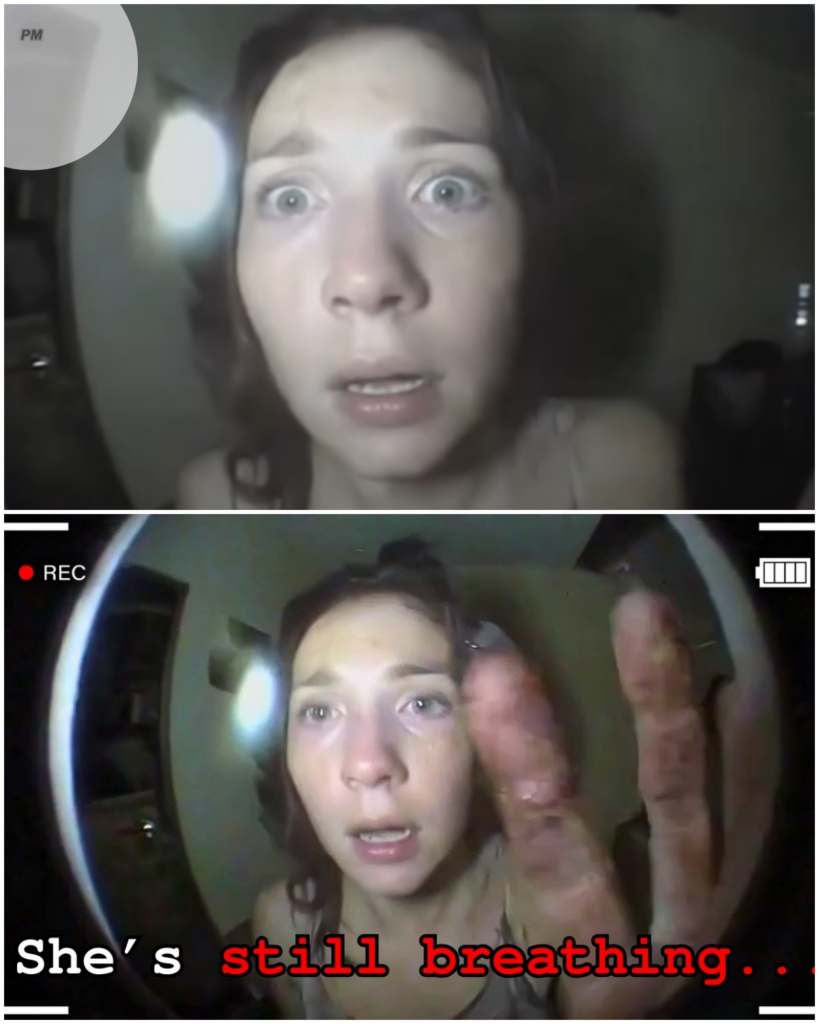
By the time Boyd Caulfield’s camera found her, she could no longer walk without support, but she had not lost her ability to think.
Investigators executed a search warrant on the Ellison Holt residence on the evening of October 14th, 2023.
In a locked metal box in the master bedroom closet, they recovered Deborah’s personal journals, 11 volumes, handwritten, dating from early 2017 to September 2023, 1 month before the house was listed.
The journals were read in full over 2 days. They documented in Deborah’s own syntax and vocabulary a progression that began with resentment and ended with calculation.
Early entries described Carara in terms of financial burden, the cost of her accommodation, the constraint her presence placed on Gerald’s estate, the injustice, as Deborah framed it, of a situation in which an adult with a disability occupied a position of permanent dependency within an inheritance she had not contributed to building.
The language escalated over the course of 2017 and into 2018. The entries became more specific.
Financial projections, asset valuations, timelines cross-referenced against Gerald’s projected cognitive decline. An entry from November 2018, described in practical terms the construction plan and its rationale.
Entry from February 2019, written 2 weeks after Cara was placed in the room, contained a sentence that the prosecution would later read aloud in court.
She will not be found because no one is looking. Scott Holt was taken into custody the night of the 14th.
He denied active participation in Carara’s ongoing confinement after the initial construction. He stated that he had believed the room was a short-term arrangement.
Investigators found no evidence that he had taken any action at any point in 4 years and 9 months to verify that claim or to contact authorities.
Deborah Ellison Hol was arrested on the morning of October 16th, 2023 at the Ellison Hol residence.
Officers arrived at 7:14 a.m. She was in the kitchen. She did not resist. A neighbor who observed the arrest from across the street later described her expression as flat, not frightened, not distressed, flat.
The charges filed by the VO County Prosecutor’s Office reflected the full scope of the investigation.
Unlawful confinement, a level three felony under Indiana Code. Criminal confinement resulting in serious bodily injury elevated to a level two felony given the documented medical consequences of CARA’s imprisonment.
Exploitation of a vulnerable adult filed under Indiana’s adult protective services statute. Financial exploitation in connection with the power of attorney and the estate of Gerald Ellison.
Conspiracy, naming Scott Holt as codefendant on the confinement and construction counts. The prosecution’s evidentiary case was built on four independent pillars.
The physical space itself documented by forensic analysts over 3 days of structured examination. The construction materials, the acoustic dampening membrane, the chemical toilet disposal records traced back to the RV facility 12 miles away, the water line, the bolt on the outside of the door, the financial records reconstructed by a forensic accountant through a six-week review of every account Deborah had controlled or co-controlled since 2018.
The draw down pattern, the cash expenditures, the insurance payout routing, the journals, all 11 volumes entered into evidence in their entirety, and Carara’s testimony delivered through an ASL interpreter across five recorded sessions, which provided the internal narrative that the physical evidence could not supply.
Phyllis Cormarmac testified for the prosecution. She was 73 years old by the time the trial began.
She brought her notebook, the one she had kept in the kitchen drawer since 2019.