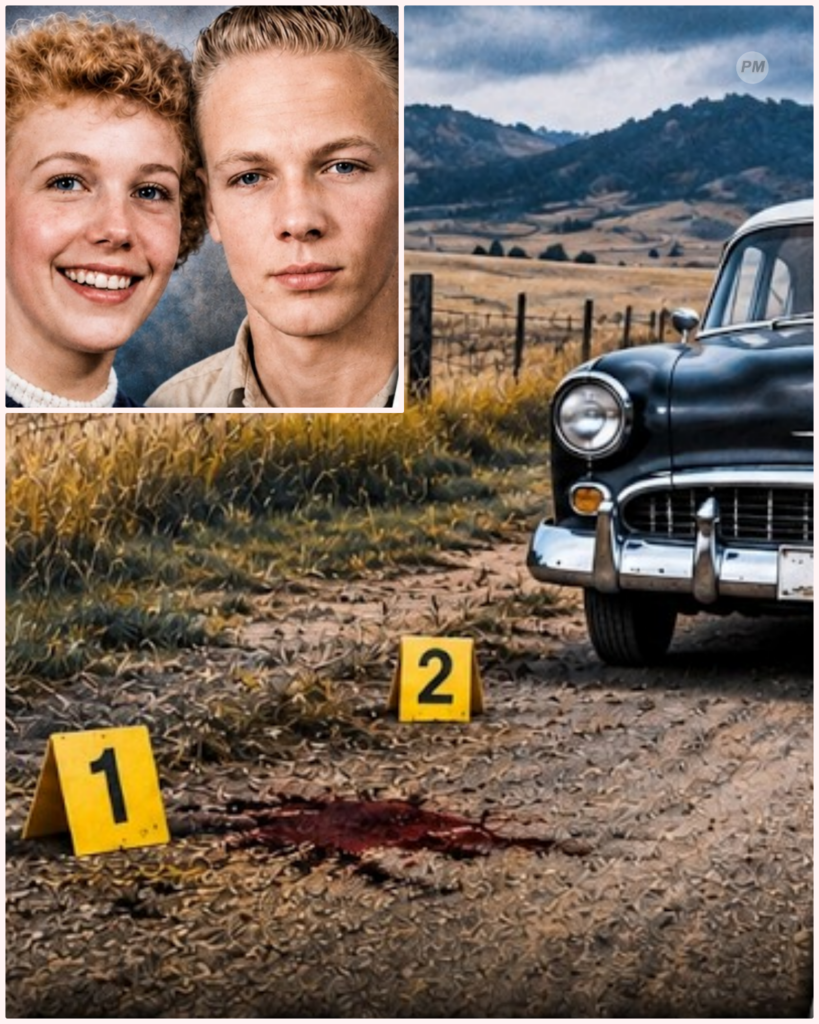
The vehicle was in gear, and the emergency brake w…
The vehicle was in gear, and the emergency brake was set. Whoever had done this had not been after his wallet, and there was no sign of Patricia.
A search began immediately. The scale of the search grew as word spread through town.
A teenage girl was missing, and her boyfriend had been murdered. The community was gripped.
The next day, January 4th, a county road worker found her. Patricia’s body was on Vineyard Road, north of Great Falls, roughly 7 miles from where Dwayne had been discovered.
She, too, had been shot in the head. Now, I want to pause here and tell you what investigators confirmed and what they only theorized.
What was confirmed was that both teenagers died from gunshot wounds to the head. That Dwayne’s body was found by the river near his car and that Patricia’s body was found miles away.
What investigators later theorized, and this is a theory, is the sequence of events. Detective John Cadner, who later led the case, believed the killer shot Dwayne first, then abducted Patricia and took her to another place where she was sexually assaulted and then killed.
That is the most plausible reconstruction of what happened, but no one can say for certain because the only other person who knows is dead.
Great Falls in 1956 was not the kind of place where this happened. Parents tightened their rules.
Teenagers stopped parking in quiet spots. Investigators went to work and they had a lot of ground to cover.
But in 1956, detectives had limited tools. There was no DNA testing. There were no surveillance cameras.
There was no national database of suspects. They had a crime scene, two victims, a car, and whatever people were willing to tell them.
The investigation moved fast and the leads came in. Detectives followed tip after tip and many of them sounded promising at first.
And then, one by one, they dried up. Over the years, as the case stayed open, investigators identified about 35 suspects.
Some were local men. Others were people from outside the area. At least one name that came up has since become infamous.
According to reports on the case, one of the men considered was a man named James “Whitey” Bulger, who would later become one of the most notorious gangsters in American history.
Like every other suspect in this case, he was eventually ruled out. His name appears in the file as a footnote, not as an answer.
That matters because cold cases often attract famous names, and it’s easy to let a famous name distract from the truth.
In this case, as with so many others, the answer turned out to be someone ordinary.
If you’re the kind of person who stays for stories like this, the ones that take decades to find their answer, subscribe to get new crime and cold case stories every week.
Now, back to Montana. By the end of the 1950s, the case had gone cold.
The investigators who first worked it moved on, retired, or passed away. The families of Patricia and Dwayne were left with unanswered questions.
Dwayne’s family was far away in Texas. Patricia’s family, in Great Falls, had to live every day in the town where she was taken.
But in the evidence room of the Cascade County Sheriff’s Office, the case file stayed.
