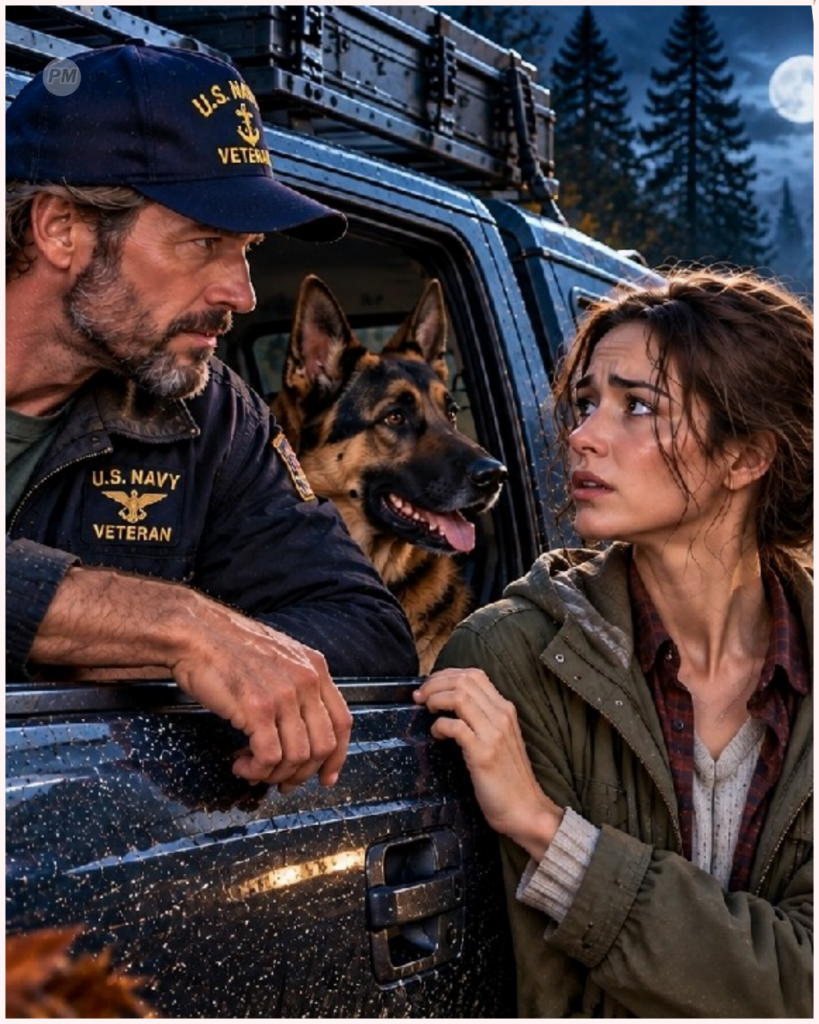
The first warning came from a dog that had not barked at thunder in 9 years.
At 11:47 on a Monday night, the black and tan German Shepherd lifted his head from the passenger seat of an old blue pickup and stared into the trees along County Road 9.
His name was Ranger. He had spent 6 years detecting explosives alongside Chief Petty Officer Daniel Mercer before an injury retired them both from active duty.
Daniel knew every ordinary sound. Ranger made the impatient whine at a red light, the small sneeze when snow landed on his nose, the deep breath that meant he was ready to sleep.
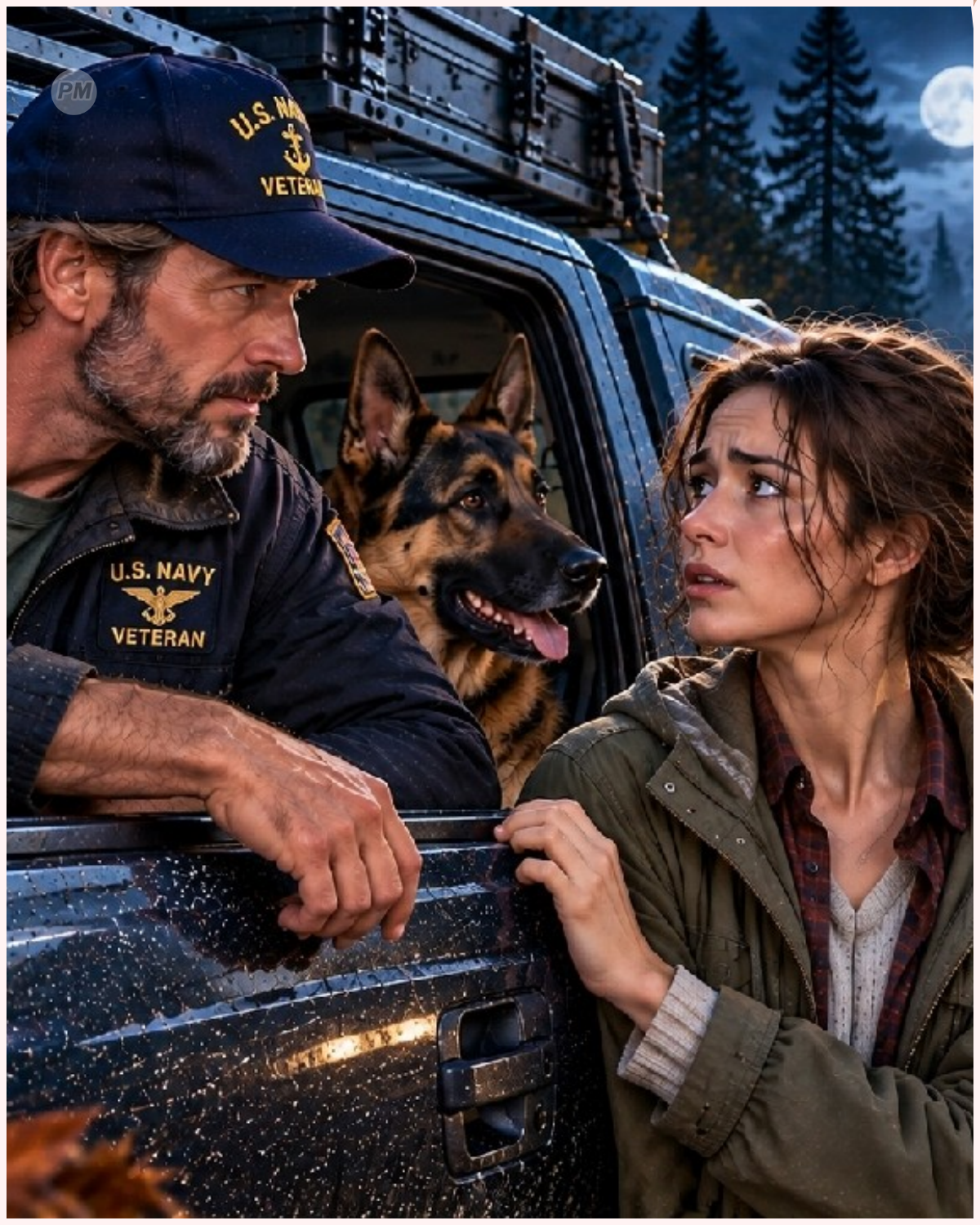
This was different. Ranger did not growl. He stopped breathing for one measured second, then touched Daniel’s forearm with his muzzle.
Daniel slowed the truck. Wind pushed dead maple leaves across the pavement. A storm was arriving early from the north carrying rain that would turn to sleet before dawn.
Beyond a bend between towering pines, a yellow lantern glowed in the upper window of a cabin everyone in Black Pine Hollow believed had been empty for 12 years.
Daniel had heard about the place that afternoon. The local diner called it the Bellwether House, though the name on the rusted mailbox was Veale.
Children dared one another to approach it every Halloween. Some claimed they saw moving lights.
Others said a woman cried inside when the wind blew east. Daniel did not believe in ghosts.
He believed in people who needed help and in people who wanted witnesses to believe the wrong thing.
Ranger leaned hard against the door. “I see it.” Daniel whispered. He turned onto the narrow access lane.
Halfway up, he noticed tire grooves in the wet gravel, fresh ones. A vehicle had visited recently.
He stopped short of the house, switched off his headlights, and waited. The lantern went dark.
Across the clearing, a figure moved between two trees too quickly to make out a face.
Ranger made a low sound deep in his chest. The same warning he used to give before a patrol crossed a blind corner.
Daniel’s old training asked him to investigate. His experience asked a better question. If someone wanted him in the woods, who was left unprotected behind him?
He backed down without stepping out, memorizing the tracks and the exact position of the open upstairs shutter.
A mile farther along the road, a second light appeared. This one came from the porch of a lived-in log house with a sagging red roof.
A woman in a green coat struggled to drag a sheet of plywood across the steps while the wind threatened to rip it from her hands.
A little girl, perhaps eight, held a flashlight behind her. One strong gust knocked the plywood against the porch railing.
The woman staggered. Daniel pulled over. Need another pair of hands? The woman straightened, not welcoming.
We can manage. The board tore free again. Ranger watched quietly through the open window.
The wind disagrees, Daniel said. I’m Daniel. That’s Ranger. We were headed into town. The girl squinted at the dog.
Is he a police dog? Retired military working dog. He mostly supervises now. He looks like he takes the job seriously.
The woman almost smiled. I’m Mara Vale. This is my niece, Sophie. If you can hold the left side for 30 seconds, I won’t argue.
Together, they braced the window and drove the screws home. Daniel noticed a broken porch light, a stack of unpaid-looking envelopes beneath the kitchen window, and a coil of wire running toward a weathered barn.
He noticed something else, too. A Halloween pumpkin lantern on the step had been deliberately turned, so its carved face looked away from the road.
“You live here alone?” He asked, then regretted it when Mara’s expression closed. “We live here,” she corrected, putting one hand on Sophie’s shoulder.
Ranger rose suddenly, ears forward. The trees across the road rustled. No animal emerged. Sophie moved behind Mara.
A voice came through the dark, faint, but perfectly human. “Give it back.” The words seemed to come from the old radio speaker attached to the barn wall.
Then, static swallowed them. Mara went white. Daniel looked at the speaker, then the cable leading to it, then the distant hill where he had seen that impossible lantern.
“Has that happened before?” He asked. Mara did not answer right away. She stared at the road as if she could see someone standing there.
“Every night since Friday,” she said at last. “And tomorrow the bank decides whether we lose this place.”
The first thing Mara made clear over coffee was that she was not looking for a hero.
The second was that she had not slept more than three consecutive hours in a week.
Her father had died in spring, leaving her a mountain property, a small repair business, and a debt complicated enough that the bank’s notices might as well have been written in another language.
Sophie had come to live with Mara after her mother, Mara’s younger sister Hannah, died in a highway collision the previous winter.
Mara was fighting to keep the only stable home the child still knew. Daniel sat at the kitchen table while Ranger lay with his chin across his paws, close enough for Sophie to touch him if she chose.
The child had set out two mismatched mugs, then quietly put a third on the floor for the dog.
Ranger drank from it as ceremoniously as if it were military issue. “The bank isn’t taking the house tomorrow,” Mara clarified.
“I have a hearing with their loan officer. They’re threatening to call the whole note because the property insurance lapsed while Dad was ill.
I can restore the coverage if I finish the barn’s electrical repairs and pass inspection, but the contractor who promised to do the work disappeared with my deposit.”
“How much time?” “Until Friday at 5:00 to submit the repair plan if the loan officer gives me the extension today.
The bank would still have to approve more time for the insurance binder and financing.
Halloween is Saturday. The town festival was supposed to help us raise what we’re short.”
She handed Daniel a handwritten flyer, Black Pine Harvest Walk, Light the Way Home. Her father had started the tradition for local families after a devastating storm 20 years earlier.
People walked a lantern trail across their land, donated to a winter relief fund, and shared soup at the barn.
Mara had hoped ticket donations this year would both support the fund and cover the final safety repairs.
Now a notice stapled to the flyer said the event might be canceled. “Why not call the sheriff about the voices?”
Daniel asked. “I did. Deputy Cole came Saturday. The speaker made no sound while he was here.
He said teenagers might be playing tricks. When I reported missing tools on Sunday, he filed a report, nothing more.”
Sophie stared at her cereal. “It’s not teenagers.” “Soph,” Mara said gently, “I saw the lantern at Grandpa’s old house, and I heard someone say my mom’s name.”
Mara set down her cup too fast. Daniel did not press. He had learned that frightened children often told the truth in fragments.
Forcing the whole story out at once only taught them to stop talking. When Sophie left for school with a neighbor, Mara took Daniel to the barn.
The building had been beautifully maintained once. At one end stood neatly labeled containers of lantern glass rope and folded tables.
At the other, an electrical panel hung open its cover, placed safely on a workbench.
The copper feeding a row of outdoor lights had been cut cleanly. There was no rodent damage.
Someone with tools had made the break. “This wasn’t a storm,” Daniel said. “I know.”
But everyone hears old house and Halloween and thinks I imagined it. He studied the cut, then glanced at Ranger sniffing the threshold.
Daniel had served as Ranger’s handler in the Navy. Years of work had taught them to recognize unusual patterns, not grant them magical powers.
Ranger could alert to a scent he knew or a person he detected. He could not tell Daniel a suspect’s name, motive, or intentions.
At the back door, the dog paused beside a smear of pale blue chalk. The same chalk marked the lower step of the old bellwether cabin.
Daniel had seen it from his truck lights as he backed away. He took photographs, careful not to disturb it.
Mara saw his face. “What is it?” “Something I passed last night. Could be nothing.
I don’t want you building a story around it yet. I already have enough stories.”
Daniel told her about the lantern in the abandoned cabin and the fresh tracks. Mara swallowed.
“That was my grandfather’s place,” she said. “My dad inherited both properties. We never use the old one.
The bridge on its service road washed out years ago. Someone uses it.” At noon, Mara drove to town for her meeting.
While Daniel stayed with her permission to repair the porch light and check the barn’s exposed circuits.
He had spent years maintaining shipboard electrical and communication systems before qualifying as Ranger’s handler.
He could identify a damaged circuit. He was not a licensed inspector. Mara would still need one to sign off.
As he replaced the porch fixture, a dark SUV rolled slowly past. Its driver wore a brown cap and did not look toward the house.
Ranger rose at the sound but did not alert. Daniel noted the because it passed twice in 10 minutes.
When Mara returned at 2:00, she carried good and bad news. The loan officer, Rebecca Shaw, had granted until Friday at 5:00 to submit a documented repair plan with a separate insurance binder deadline still subject to written approval.
The bank required proof that a licensed inspection was scheduled and that Mara was pursuing reinstated coverage.
The insurer required additional money up front. Mara’s savings were almost gone. Rebecca sounded sympathetic, Mara said, “but she warned me the Friday paperwork was only step one.
Without a written follow-up extension, the insurance delay could still force a sale. Maybe this is exactly what someone wants,” Daniel said.
“Who?” He looked through the window at the steep wooded ridge dividing her home from her grandfather’s cabin.
“Someone who benefits if you walk away before Halloween.” That evening, the old speaker crackled again.
This time the voice said, “The bridge remembers.” Ranger was already standing before the first word.
Daniel followed the wire with his flashlight to an unfamiliar black box tucked behind a barn beam.
The box was battery-powered. A cheap wireless receiver blinked under a strip of black tape.
The ghost had electronics. And whoever installed them expected Mara to be frightened enough not to look.
Daniel did not tell Mara he could solve everything. He told her what he could actually do.
Photograph the receiver, preserve it without altering its settings, help secure the vulnerable doors, and contact someone qualified to examine the electrical work.
A retired Navy colleague in Burlington knew a licensed contractor willing to drive to Black Pine after the storm front passed.
Mara had called three local electricians. None could arrive before Friday. This was the first real opening she’d had.
The sheriff’s office sent Deputy Elena Cole at 7:00. She was younger than Daniel expected alert.
And plainly irritated that the initial report had been dismissed as Halloween nonsense. She photographed the receiver, bagged it, and took a statement.
The device used an ordinary frequency that could be triggered from nearby. There was nothing supernatural about the voice, only something calculated about its timing.
“My brother’s kids have been telling ghost stories about that ridge.” Elena said. “Somebody may be counting on the whole town repeating them.”
Daniel showed her the photographs of the blue chalk. She frowned. “Survey marking, maybe? Or a trail marker?”
“I don’t know who put it there.” Mara explained that her father’s old maintenance maps were in the office.
They searched a filing cabinet together. Among invoices for lumber and faded permit drawings lay a bundle of letters tied with green ribbon.
One had been written by Mara’s father, Peter Vail, to a local land developer named Victor Harlan eight months before he died.
Peter refused an offer to purchase the ridge and access road. Beneath the refusal he had added a sentence that changed the room’s temperature.
“You know what was buried after the bridge failure. Do not ask me again.” Mara read it twice.
Dad never told me this. “What bridge failure?” Daniel asked. “The storm in 2006. A construction truck went through the temporary crossing at night.
No one died, but the county shut the road. Dad said the contractor cut corners.”
Elena checked the letter then called in Harlan’s name. Victor owned a development company that wanted the ridge for a luxury cabin resort.
He had repeatedly approached Peter and after Peter’s death, Mara. His latest offer had been less than half what she believed the combined property was worth, but enough to wipe out the debt.
She had declined. Now that offer looked less generous than urgent. When Elena left to request county records, Mara pulled a tin box from the top shelf.
Inside were a silver compass, a faded family photograph, and a cassette recorder with a cracked leather strap.
In the photograph, Peter stood with another man beside the old bridge, both young and muddy.
Peter had written two words on the back for Owen. “Owen Bell,” Mara said remembering.
“He worked with Dad at the bridge. Everyone said he moved away after the accident.”
Daniel noticed that the compass was engraved with a tiny star on one side and the initials OB on the other.
He had seen its twin in an old picture frame on the kitchen mantel. A second compass held in Peter’s hand when he returned from volunteer rescue duty.
He wondered why Mara’s father would keep another man’s belongings hidden with correspondence about land.
Late that morning as Daniel repaired a warped barn door, Sophie came home early. School had closed for weather preparation.
She drew three pumpkins on a piece of scrap wood while Ranger watched patient as a guard at a museum.
Then she said something Daniel could not ignore. “The voice didn’t say Mom’s name from the wall.
It came from outside my window. Daniel sat down the drill. Can you tell me exactly what you remember?
I woke up Friday. The porch was dark. A person stood near the tree with the bent branch.
They held up a little speaker and it said Hannah. Then they pointed at the old cabin.
Did you see their face? No. They had a yellow raincoat, but they limped like they had a rock in one shoe.
The detail mattered because Sophie offered it without being led. Daniel thanked her and asked if she could draw what she saw.
She drew a hood, a handheld box and a boot with a wide white stripe.
Mara, listening from the doorway, gripped the door frame. They used my sister’s name to frighten a child.
Daniel felt anger rise, but he kept his voice level. Then we make sure the child doesn’t have to face them again.
A hard knock interrupted them. Victor Harland stood on the porch beneath a spotless umbrella.
Though muddy tires splashed his SUV, he had the careful smile of someone who liked to sound reasonable while offering no choice.
Mara, he said, with the storm coming I’ve reconsidered my offer. Cash, fast closing, all your debt cleared.
Why risk your niece’s safety on a property you can’t maintain? Ranger remained beside Daniel watching.
The man’s boots were brown, not white striped. Daniel had learned not to accuse people because their presence was convenient.
Mara answered before he could. My niece’s safety is not for sale. Victor’s smile thinned.
Storms don’t care what we love. He left an envelope on the railing. It contained a higher offer and a deadline Thursday evening.
Mara had been given less than 36 hours to surrender land someone was increasingly desperate to own.
By late afternoon snow mixed with rain. Daniel rigged temporary lanterns along the porch, checked the emergency generator, and reviewed a simple safety plan with Mara.
If someone came onto the property again, they would stay inside, call Elena, and document what they could.
They would not chase shadows into the woods. Sophie learned the code phrase they would use if an unfamiliar voice called through a door, “The porch is warm.”
Only the three of them knew the answer, “Then come home.” Mara watched him teach it.
“You’re very calm about all this.” “I’m good at making plans,” Daniel said. “Staying calm is sometimes harder.”
She asked why he had come to Black Pine. He took a long time to answer.
After retirement, Ranger had struggled with crowds, and Daniel with the silence after them. His wife, Claire, had died of cancer 3 years before.
He was not fleeing the Navy. He was fleeing the version of himself who thought keeping everyone safe was always possible.
A winter rental outside town had seemed like a place where he and Ranger could start again without promising anybody too much.
“And then we showed up in your driveway,” Mara said. “You needed a second pair of hands.
That’s all I knew.” “You could have kept driving.” “I almost did.” She studied him with something gentler than gratitude.
They were both adults who had lost people and learned to hide inside practical work.
The admission did not make them suddenly close. It simply made the silence between them less guarded.
At 7:00, Elena returned with old county files. The 2006 bridge project had been supervised by Owen Bell, a former surveyor, who reported irregularities in the concrete footings.
His complaint disappeared after an internal review, and he left town several months later. Victor Harlan’s father had owned a subcontracting firm on the project.
Victor himself, then in his 20s, had overseen supply logistics. The original contractor folded. Records became sparse.
“No proof of crimes in any of this,” Elena cautioned, “but it’s enough for me to dig.”
Peter Vail’s letter made more sense now. He might have known where physical evidence from the botched bridge had been stored.
Maura remembered something her father used to say. “Whenever a storm rose over the ridge, the hill keeps what men try to wash away.”
She had assumed it was an old farmer’s proverb. Now she wondered whether it had been a warning.
Just after 8:00, a motion light flashed behind the barn. Ranger lifted his head, then walked toward the rear door.
He gave a short, sharp alert. Daniel kept the door closed and called to Elena, who stepped to a side window rather than charging outside.
In the wash of the light, a man stumbled from behind stacked firewood, hands raised.
“Don’t shoot,” he shouted. “I’m not here to hurt anyone.” Elena drew her flashlight across his face.
His beard was white, his yellow raincoat torn, and he leaned heavily on his left leg.
Sophie, looking from the kitchen, gasped at the white stripe on his boot. “That’s him,” she whispered.
Elena directed the stranger into the mudroom with his hands visible. He identified himself as Owen Bell.
He had not moved far away. He lived quietly in a neighboring county under the weight of a reputation he thought he deserved.
His left ankle had never healed properly after the bridge accident. The old yellow coat had been Peter’s, given to him in 2006.
Maura stared at the man whose compass lay on her table. “Why are you frightening my niece?”
Owen looked stricken. “I never went near her window. I’ve been coming to the old cabin trying to find what Peter hid.
I saw the lights from here and thought somebody was staying awake for me. I didn’t speak through any speaker.
You were at the cabin Monday, Daniel asked. I was there. I left when a vehicle came up the old lane.
I don’t know who was driving. Why not knock on the front door like a normal person?
Owen’s shoulders sagged. Because when I tried to tell the truth 20 years ago, the whole town called me a liar.
Peter believed me, but we were scared. I thought Mara would send me away, too.
From inside his raincoat, he took a folded map dotted with pale blue marks. He claimed the marks traced a dry drainage tunnel beneath the ridge, built before the bridge and later sealed on paper but never fully closed.
Peter had hidden duplicate material in a metal case somewhere near the tunnel’s upper end.
Owen had spent three nights searching hoping to retrieve it before Harland’s men did. Why now?
Elena demanded. Owen pointed at the survey map. Because Victor doesn’t just want to build vacation cabins.
He wants to blast the ridge. Whatever is under that slope will be gone. The old man looked at Mara.
Your father wanted you to have the proof when you were ready. I promised I wouldn’t let anyone take it from you.
Then outside in the dark, a car engine started. They had all been inside. The vehicle belonged to none of them.
A beam of headlights swung across the barn doors, paused on the kitchen window, and vanished down the access lane.
Someone had watched them take Owen in. The storm became a presence rather than a forecast.
Gusts shook the roof boats and made the pines bow over the road. School closed for 2 days.
The county announced that a section of road near the bridge would be blocked if the creek rose.
Black Pine Hollow’s residents hauled in firewood, charged batteries, and moved porch pumpkins out of the wind.
Inside Mara’s kitchen, a quieter storm began. Owen admitted that he had found an old cassette on the upper floor of the abandoned cabin several nights earlier.
He had brought it to Mara’s home and left it on the porch hoping she would recognize her father’s voice, but the cassette had disappeared by morning.
Mara realized she had mistaken his anxious visits for the stranger’s cruel threats. Owen had gone about everything badly.
That did not mean he was the saboteur. Elena asked him to give a formal statement at the sheriff’s office.
She also warned everyone that the evidence might be 20 years old and unreliable. A damaged bridge, a disputed report, and a developer’s aggressive offer did not yet add up to a charge.
They needed documentation and they needed to keep the family safe while finding it. Daniel suggested a legal safer path.
Request the public maintenance plans. Let Elena investigate the radio equipment and trespass and search Peter’s papers before risking the unstable tunnel.
Mara agreed. Owen wanted to go immediately. Their disagreement grew sharp. “Every hour we wait, Victor wins.”
Owen said. “Every hour we rush blindly, someone gets hurt.” Daniel answered. “You think you know these woods because you’ve walked one road.
No, I think I know what fear does to a decision.” Owen left with Elena promising to stay accessible.
Mara was furious at both men in different ways. At Owen for hiding the truth and at Daniel for sounding as if the tunnel was simply a logistical problem.
She knew this land was the life her father had built. She knew time was almost out.
Their fragile cooperation suffered its first real break when Mara discovered Daniel had called Rebecca Shaw directly asking what documents would satisfy the insurance extension.
He had not discussed it with her first. She felt as if another man had taken charge of a problem she had been handling alone for months.
You don’t get to manage my life because you know how to hold a drill, she told him.
Daniel did not defend the call. You’re right. I crossed a line. I was trying to see whether the inspection could be scheduled around the weather.
I should have asked. People keep deciding what’s best for us without asking. Then tell me what help you want.
I’ll respect the answer. It was the opposite of the argument Mara had prepared for.
She stood at the sink listening to the wind until the anger drained enough for her to speak honestly.
I need the lights safe. I need Sophie to sleep. And I need someone to believe we can save the place without deciding I should sell it.
I believe that. Daniel said. And I’ll follow your lead. They worked side by side through the afternoon.
Mara found Peter’s maintenance calendar. Daniel replaced ruined fixtures and isolated the damaged line. Leaving final connection and approval to the licensed electrician.
Sophie labeled battery lanterns for emergency use, a task she could control. For the first time in days, the house felt occupied by a team rather than surrounded by a threat.
At 4:00, Rebecca called. The insurer would accept a temporary binder if the electrical inspector passed the repaired system.
And Mara paid a reduced initial premium. A local credit union had a small emergency property loan program.
But Mara needed proof that the Harvest Walk could still operate as a safe community event.
If the weather canceled it, she would have to find another source of funds. Mara looked toward the lantern boxes.
So we’re relying on a festival nobody believes will happen. Not necessarily, Daniel said. The community can bring the festival somewhere safer.”
She thought of the elementary school gym currently being offered as a warming center if power failed.
She called the principal who agreed to ask the town council about moving the indoor portion to the school after the storm once the building was cleared for use.
The lantern trail would remain closed if conditions were unsafe. The fundraiser no longer depended on families hiking a steep ridge in bad weather.
That evening Victor’s deadline expired without a response. A message came to Mara’s phone from an unknown number.
“You have until the wind stops.” A photograph followed. It showed Ranger beside Sophie’s bedroom window taken that afternoon while Daniel had been in the barn.
Mara’s hands trembled. Daniel recognized the purpose immediately. Someone had turned an ordinary moment into proof that they could come close to a child.
He called Elena. For the first time he asked Mara whether she wanted him to stay in the guest room rather than drive to his rental.
She nodded, angry at needing to ask anyone to stand guard but more frightened of the alternative.
Daniel placed his duffel in the hall and laid Ranger’s blanket near Sophie’s door. At bedtime Sophie bent to scratch the dog’s ear.
“Are you scared?” She whispered to him. “Sometimes,” Daniel said from the hall. “The trick is not letting scared make every decision.”
Sophie considered this. “Then Ranger can be scared with us.” Ranger rested his head against her hand.
Outside the first tree fell across the access road. In the quiet after Sophie went to bed, Mara set an extra mug beside Daniel without asking whether he wanted tea.
He had repaired the latch but left the decision about the house entirely hers. She told him how Peter used to keep one lantern burning for late travelers.
Daniel told her why Ranger still checked every doorway before settling down. For a moment they talked without the debt, the threats, or the old bridge between them.
The warmth was tentative, but neither hurried to end it. The crash sounded like a door slammed by a giant.
Every window shivered. Mara reached the hallway as Daniel emerged with a flashlight. Ranger was already awake, ears pricked toward the rear of the house.
There was no need to speculate about a prowler yet. An enormous spruce had snapped above the driveway.
Its trunk blocked vehicle access and dragged the overhead power line down with it. The lights went out.
Daniel stopped Mara before she approached the driveway. Downed electrical lines could remain live. They called the utilities emergency number, then Elena, who reported that several roads had been damaged overnight.
The utility crew would come when conditions allowed. Until then, they were to stay well away from the fallen tree and line.
They had a generator wall a wood stove, and enough canned food for 2 days.
Daniel inspected the generator placement and kept it outside away from windows, avoiding the carbon monoxide danger that had killed people during previous storms.
Mara lit a battery lantern and checked Sophie’s blankets. No one argued over who was in charge.
Each knew what needed doing. By sunrise, the storm had turned the forest silver. A freezing rain crusted the branches.
Their phone signal came and went. Owen called once before losing service. He had found a note in his old survey bag suggesting Peter had split the bridge evidence into two places.
One piece at the abandoned cabin, another in a place identified only as where the children followed the stars.
Owen believed that meant the tunnel near a star-shaped survey mark. Mara thought of the silver compass on the kitchen shelf.
She remembered an old family game. Her father used to place reflective star stickers on trees along a short, safe trail behind the house for children’s lantern walks.
When Sophie was little, he showed her a saying, “The stars don’t lead to the bridge.
They lead you home.” The homeward path ended not at the road, but at the barn.
They searched the barn from inside without stepping near the power line. Sophie remembered a star burned into the workbench leg.
Beneath a false bottom in a drawer, Daniel found a small ledger wrapped in oilcloth.
Mara opened it and saw names, dates, shipment numbers, and handwritten notes about substituted materials on the 2006 project.
Several pages bore Peter’s initials. One column listed payments from a firm connected to the Harland family.
“It’s a record,” Daniel said, “not a verdict, but Elena needs to see it.” At the back was a note in Peter’s handwriting addressed to Mara.
“If you ever find this, don’t be ashamed that I was afraid. I waited too long because I thought silence kept us safe.
It doesn’t. Tell the truth even if your voice shakes.” Mara sat down hard on a crate.
Her father had seemed indestructible to her until his final illness. Here was evidence that he had carried a different kind of fear for 20 years.
“He was trying to protect us,” she whispered. “I think so,” Daniel said. “He also wanted you to make your own choice.”
She photographed the pages and sent them to Elena in small batches as the signal flickered.
The deputy acknowledged the first few images before the connection died. At 11:00 they heard three taps against a side window.
Ranger moved fast, standing between Sophie and the sound. Daniel approached from an angle that kept him out of direct view.
No one was at the glass. On the sill lay a carved wooden star wet with sleet.
A thin wire attached it to the eve where the wind could make it strike the frame like a deliberate knock.
Beneath the sill, fresh boot prints led toward the creek. “Someone wants us looking outside,” Daniel said.
Then, a second noise came from inside the house, the quiet click of a latch at the rear utility door.
Mara had locked it that morning. They checked from the inner hallway. The door remained closed, but a screwdriver had been wedged into the frame, bending the hardware.
Whoever had approached the house had tested more than one entrance. Ranger smelled along the seam, then returned to Sophie’s side.
Daniel would not open a compromised door to chase an intruder through freezing rain. He called Elena using the emergency satellite messenger he carried from hiking, sending their location and a concise report.
The device could not resolve the whole crisis, but the acknowledgement that the message had gone through eased Mara’s breathing.
An hour later, a different message arrived by ordinary text, delayed and broken. Found the second part.
Old cabin. Call me alone. Owen. Daniel looked at Mara. “Don’t answer yet. He may not have written it, but if he did, he could be in danger.
Then we tell Elena.” “We don’t give whoever sent it an isolated target.” Mara set her jaw.
“I won’t leave Owen out there. I also won’t leave Sophie.” They sent the message onward as soon as the signal returned.
After several tries, Elena responded, “Stay put. Deputies approaching from north. Road blocked. Owen was not answering calls.
At 3:00 that afternoon, the creek roared louder. The ridge above the old cabin vanished behind curtains of sleet.
Somewhere in the storm, a person needed help, and someone else wanted Mara to believe the only way to offer it was to walk into the dark alone.
The hardest thing Daniel did that day was stay inside. The instinct to move toward danger had been useful in the Navy, but the mission now was not a patrol.
It was protecting a child and a woman who had asked him to respect her decisions.
He could not call self-control cowardice simply because it felt uncomfortable. Mara made tea neither of them drank.
She kept checking Sophie’s face. Finally the girl asked why adults always whispered whenever they were worried.
Because we think quiet makes a hard thing smaller Mara admitted. It usually doesn’t. She told Sophie the simple truth someone was trying to scare the family into selling the property.
The police knew and the adults were making a plan. Sophie was not responsible for solving it.
She could help by staying in the safest part of the house and saying right away if she noticed something unusual.
Sophie nodded solemnly. Then I have to tell you about the orange ribbon. She led them to her grandfather’s old photo album.
During the harvest walk Peter had hung orange ribbons along the safe trail and blue ones where people should not go.
In an old picture a blue mark on a pine matched the chalk Daniel had seen near the empty cabin.
Peter was not drawing a route to treasure. He was marking a hazardous area above the blocked drainage tunnel.
Owen thought the stars pointed to the tunnel Mara said, but dad meant them to point away.
Daniel traced the creek on the map. And the messages have been pushing us toward exactly the wrong ground.
At 4:15 while the signal briefly held Mara emailed Rebecca the photographs of the repair work.
Luis Ortega’s signed appointment confirmation, the insurer’s conditional binder terms, and the school’s written approval for an indoor fundraiser.
Rebecca replied before 5:00 with a time-stamped receipt. The Friday submission requirement was met. Because the storm had made the licensed inspection impossible that day, the bank formally extended the coverage document deadline until Monday, November 2 at 5:00 in the afternoon, without waving the debt or promising final approval.
Mara printed the message on the battery-powered office printer and tucked it in the folder beside her father’s ledger.
The reprieve bought time, not a solution. At 4:30, Elena reached them on radio through a volunteer fire crew.
Two deputies had found Owen’s pickup on the north service road, empty but locked. Fresh footprints disappeared toward the old cabin.
The ground was unstable and responders were assembling a careful search, not rushing across the washout.
The office had also identified the wireless transmitter model, but not its purchaser. “A landslide warning just came in,” Elena said.
“If the slope moves, the cabin may be cut off. Keep out of there.” The line dropped.
Daniel had just started to fold the map when Ranger alerted at the front door.
Someone stumbled onto the porch, then fell against the railing. Through the glass, they saw a young man in a soaked roadworker jacket, blood on his forehead.
He called out that a tree had crushed his truck and he needed a phone.
Mara moved toward the lock. Daniel raised a hand not to stop her helping, but to slow a dangerous sequence.
He asked the man his name through the closed door. “Evan Briggs,” the stranger said.
He claimed to be a temporary worker for Harlan’s Surveying Company. Daniel asked him to step back where they could see his hands.
The young man did, shivering visibly. They called emergency services and had him enter the mudroom while Ranger stayed under control beside Daniel.
The wound was a shallow cut, but Evan was hypothermic and terrified. Mara gave him a dry blanket.
Daniel asked no threatening questions, only whether anyone else was hurt. Evan began to cry.
“I didn’t know there was a kid here. Victor said the place would be empty most of the week.”
The room went still. He confessed he had been hired to put up remote speakers, leave odd marks near the cabin, and take photographs that made Mara think strangers were watching.
Victor described it as a pressure campaign to make an impossible sale look attractive. Evan had never entered the house.
When the storm worsened, Victor ordered him to drive up to the old cabin and retrieve a metal case before the slope collapsed.
Evan refused after seeing the washed-out crossing. Victor went himself with another employee. “I tried to turn back,” Evan said.
“My truck slid into a ditch. I walked here because I didn’t know where else to go.”
“Who was with Victor?” Mara asked. “His site manager, Garrett Pike. He carries the recorder that plays those voices.”
Sophie stared at him. “Did he say my mom’s name?” Evan could barely meet her eyes.
“I heard him test it once. I’m sorry.” Mara’s anger was sharp enough to make her shake, but she did not take it out on the freezing young man.
She told him he would need to repeat everything to Elena. He agreed. Daniel recorded a brief account with Evan’s clear permission and saved the file for police, then gave him warm water and a seat away from the door.
A low boom rolled through the valley. Not thunder. The creek rose muddy against the retaining wall.
From the attic window, Mara could see a new scar of raw earth across the opposite hillside.
The slope above the old cabin had begun to move. A radio call came through from the search team.
Rescuers had heard someone shouting across the creek, but couldn’t establish a safe crossing in the fading light.
They were coordinating equipment from the county. The person could be Owen Victor or Garrett.
No one knew. Daniel looked at the map, then at Mara. His old instincts urged him toward the hazard.
Instead, he pointed to the marked maintenance route behind the barn, the one that stayed on high ground and met the county’s north access road before the damaged bridge.
That route might let rescuers reach the upper ridge without crossing the creek, he said.
But we give them the map. They decide whether it’s usable. Mara took Peter’s album and scanned the marked trail.
It was the first time her father’s Halloween tradition offered more than comfort. The safe route he had taught children might help trained adults reach someone stranded in a storm.
Elena arrived with the volunteer fire chief, Thomas Reed, at 6:20, coming on foot from a service lane that escaped the downed line.
Behind them were two firefighters carrying a medical pack ropes and portable radios. The utility had isolated the affected line, but the driveway was still blocked.
Reed took one look at the map and asked Mara to identify every change since her father’s last survey.
She pointed out a fallen retaining wall, a washed out culvert, and the route that remained above flood level.
That’s useful, Reed said. We still have to assess it in daylight or under controlled conditions.
A sharp crack cut him off. Across the valley, an old pine toppled onto the cabin’s rear porch.
The building was now visible between gusts. It’s attic window lit by the same yellow lantern Daniel had seen Monday night.
This time the light flickered in three short flashes, paused, and repeated. Is that a signal?
Mara asked. Daniel watched another cycle. Could be. We shouldn’t assume the person means anything specific, but someone’s in there.
Reed coordinated with the sheriff by radio. A rescue team would take the high route if a spotter confirmed it was stable.
Daniel offered his knowledge of the map and local obstacles, not his military past as a substitute for rescue qualifications.
Mara insisted on helping with landmarks because she knew where the old trails truly led.
Reed accepted her as a guide only for the safe initial approach with strict instructions to stop at the designated line and return if conditions changed.
Ranger remained leashed with Daniel and would not be sent into unstable structures. Sophie stayed at the house with Elena and Evan who was waiting to give his statement after receiving medical care.
Mara crouched before her niece. “The porch is warm,” she said. “Then come home,” Sophie answered clinging to her coat.
The rescue party moved through freezing rain and low pine branches. Mara carried a weatherproof lamp.
Daniel took the map and radio while Reed led with his trained crew. Half a mile uphill they reached a fallen oak that marked the split between the old bridge road and Peter’s marked homeward trail.
There, just as Sophie had said, a weathered reflective star shone on a cedar trunk.
It pointed toward an old maintenance gate, not the water. Mara felt her father’s hand in that tiny act of foresight.
They followed the safer ridge until the ground became too steep. Reed ordered Mara and Daniel to remain at the staging point with another firefighter while his qualified rope team continued.
Daniel hated the waiting. Ranger stood beside him listening to the dark. Every gust made the radio hiss.
At 7:40 the team reported reaching the cabin’s upper clearing. They found Owen Bell with a fractured wrist and a badly twisted ankle sheltering under the cellar steps.
He had come to recover a tin case. When the slope shifted, he fell and could not get out.
Victor and Garrett had reached the cabin separately arguing over the case. Then another slide trapped Garrett inside the ground floor while Victor fled uphill.
A shiver passed through Mara. One victim was the man who had helped terrify her niece.
She was horrified by what he had done. She still wanted him alive. Reed sent a message that rescue operations were underway and called for additional personnel.
For a moment it looked like the crisis might be resolved by patience and trained hands.
Then the radio failed. An electrical flash lit the ridge beyond the cabin followed by the smell of smoke drifting down through the rain.
The old generator shed had caught fire. Whether from damaged wiring or a fuel spill was not yet known.
Flames curled up one wall despite the sleet. Rescuers had to retreat from the building and reposition.
The hillside could collapse again. Ranger suddenly stiffened and faced uphill toward a narrow deer path behind the staging area.
A figure crashed through the brush sliding on wet leaves. Mara recognized Victor Harlan by his long gray coat before he saw the lamp.
He held a metal case tight against his chest. “Move.” He said wild-eyed. “That hillside’s coming down.”
Daniel didn’t approach him. The path was slick and Victor stood dangerously close to the drop.
“Come this way.” “Stay on the firm ground.” “You don’t understand.” “That box is mine.”
“What matters right now is getting down alive.” Victor looked past Daniel at Mara. “Your father could have taken the money.”
“He could have kept quiet.” “He did keep quiet.” Mara said. “For too long.” Victor shifted his weight.
Mud slipped under his heel. The case fell from his grasp and skidded toward the edge.
He lunged after it. Ranger barked once, loud and urgent. Daniel grabbed the back of Victor’s coat from firm ground, not reaching for the case.
Together with the firefighter, he pulled the man away just as loose soil peeled into the darkness.
The metal case vanished over the ridge. Victor stared after it. Something in his face collapsed.
The thing he valued most had gone, and a man he had threatened had just helped keep him alive.
Reed’s team called again. Garrett had been extracted from the structure and was conscious but had inhaled smoke.
Owen was being carried to the safer ridge route. Everyone needed to withdraw before the slope moved again.
Victor sat in the mud, breath ragged. Mara regarded him without triumph. “The proof may be gone,” she said, “but people heard what you said, and people know what you did.”
“You don’t have proof of anything,” Victor muttered. Then Daniel spoke quietly. “Maybe not of everything, but we have the ledger and Evan, and now we have your words.”
Victor looked up. The fear in his eyes was no longer of a ghost or the storm.
It was of a truth he’d spent 20 years outrunning. Everyone returned from the ridge alive.
It took hours to carry Owen down the wet trail and transfer him to an ambulance on the cleared North Road.
Garrett was hospitalized for smoke inhalation. Victor was taken to the sheriff’s office for questioning in connection with the intimidation campaign and suspected trespassing.
Investigators would make their own decisions about charges once the evidence had been examined. Daniel made no promises about convictions because he knew rescue was an action while justice was a process.
At 3:00 in the morning, Mara finally sat beside the wood stove with both hands around a mug.
Sophie had fallen asleep against Ranger on the couch, one small hand buried in the dog’s fur.
Ranger looked deeply pleased to have been assigned the least glamorous and most important watch of the night.
“You pulled Victor back.” Mara said, “He was falling after what he did to Sophie, to us.”
Daniel was quiet a moment, “Stopping him from hurting us doesn’t require wishing him dead.”
Mara took that in. “You made a choice I don’t know if I could have made.
You wanted Garrett brought out. You made the same choice.” She looked at him and the room changed in a modest, unmistakable way.
Neither spoke of love. The trust between them no longer depended on promises of what might happen later.
It rested on what each had done when the other could see. By morning, the wind had softened, though the sky remained low and gray.
Utility crews cleared the downed line and restored power to parts of the valley. The volunteer electrician Daniel had contacted Luis Ortega arrived with an apprentice as the roads reopened.
Mara had already arranged his licensed inspection visit. He assessed the barn, corrected the remaining faults, and confirmed what was safe for use.
He refused to sign off on the outdoor ridge lights until the route was repaired after the storm.
Mara agreed without hesitation. Keeping the tradition alive did not require pretending the woods were safe.
Rebecca Shaw called to confirm that the Friday submission had arrived on time and the bank’s written deadline extension was valid through Monday.
She had seen the updated repair estimate proof of the scheduled inspection and confirmation that the town had approved a relocated indoor fundraiser at the school gym.
The credit union would consider the bridge loan if the insurance binder could be issued that day.
The whole plan was not solved by a miraculous gift. It was a series of careful steps, a safety repair, proof of coverage, a documented fundraising alternative, and the work Mara had already done.
There was one problem. The insurer wanted the binder payment by noon Saturday to put coverage in force immediately.
Otherwise, Mara could still use the bank’s Monday extension, but she would be left exposed through the weekend.
The family was several hundred dollars short. Mara looked as though she might finally accept Victor’s offer in absentia just to stop the endless calculations.
Then she saw Sophie at the table painting tiny stars onto battery lanterns rescued from the barn.
“We’ll open the school gym tonight,” Mara said. “Even if we can’t save the place, the relief fund can still help somebody else.”
Daniel did not offer to buy her property or solve her finances with money he had never mentioned possessing.
He said, “Then I’ll help carry the lanterns.” At 10:00, Elena arrived with a county investigator and a small plastic evidence envelope.
It contained the silver compass from the tin case Victor had dropped. A rescue worker had found it in a shallow debris pocket below the ridge while checking the cleared route without entering the unstable slide area.
The metal case itself had not yet been recovered. The compass had snapped open on impact, exposing a folded strip of waterproof film tucked behind the face.
Elena told Mara she could view a photograph of the film once it was documented.
Under magnification, it showed copies of dated batch records and signatures related to the bridge supplies.
Investigators were checking authenticity and chain of custody. The film was not a magical solution.
It was another piece of evidence one Peter and Owen had protected when records went missing.
Your father prepared for someone finding the ledger and trying to deny it, Elena said.
Mara swallowed. He always said to keep a spare key. I never knew he meant this.
A second envelope came from Owen through the hospital. Inside was a handwritten apology for the way his frightened secrecy had put her family at risk.
He also explained that Peter had once paid the cost of Owen’s first months away from Blackwood Pine when public accusations ruined his work.
Owen had come back not to settle a score, but to honor the one man who believed him.
Mara held the note with the same care she had given her father’s last words.
At 11:15 the doorbell rang. Outside stood Rebecca Shaw, still wearing her bank coat, alongside the principal and two neighbors carrying a battered metal cash box.
Over the past week they had heard the festival might collapse. Several families had paid their harvest walk pledges anyway, and the principal had collected more donations after the rescue news spread.
They were not buying the estate for Mara. They were choosing to pay forward the generosity Peter had shown for two decades.
The total was enough to cover the short insurance payment with a little left for the relief fund.
Mara protested the donors had intended the money for struggling families, not her barn. Rebecca explained that the donors had separately designated the insurance portion as emergency help for preserving the community venue.
The original relief pledges were held apart. Mara insisted on receipts and records. It mattered to her that goodness not depend on confusion.
By noon after Louis submitted the safety documentation, the insurer issued the temporary binder. The credit union reviewed the updated paperwork and conditionally approved short-term financing subject to its normal documents.
The loan wasn’t forgiven. The repairs weren’t finished. And the future remained work. Because Mara had met Friday’s submission requirement and obtained the Monday extension in writing, there was no forced sale that weekend.
The conditional financing still required signed documents and ordinary underwriting. No one treated it as money already in her account.
For the first time all week, Mara cried from relief rather than fear. The town did not get the Halloween it had advertised.
No one walked the mountain trail. No children approached the haunted-looking cabin. And no volunteer pretended a dangerous hillside was suddenly harmless because the wind had stopped.
Instead, at 6:00 in the evening, Black Pine Elementary opened its gym under strings of paper stars.
Battery lanterns glowed along the walls. Someone brought apple cider. Someone else brought a speaker playing old folk music.
Costumes appeared slowly. A pirate with a missing hook, a mother dressed as a scarecrow, and a tiny firefighter who wanted to hear every rescue story, but only if no one was hurt in the end.
Mara set a wooden sign by the entrance, The Lanterns of Black Pine Hollow, We Find Our Way Home Together.
Beneath it sat a donation box for families facing winter heating and repair costs. The turnout was smaller than the old outdoor event had been, but the feeling inside the gym was larger.
Neighbors who had spoken only in passing stood at folding tables and discussed whose roof needed patching next.
The story people told was no longer about ghosts in an abandoned cabin. It was about a family threatened by fear and a town deciding fear would not have the final word.
Sophie wore a homemade costume of dark blue felt decorated with silver stars. She called herself the keeper of the lights.
Ranger wore a simple orange bandana and seemed content to receive compliments from a respectful distance.
Daniel had left his old navy jacket in the truck. Tonight he wanted the child to be the one people noticed.
Owen called from the hospital by video. He had an injured wrist, a damaged ankle, and several uncomfortable conversations ahead about the decisions he’d made.
Sophie forgave him for the strange cabin visits only after he apologized directly for scaring her.
He did not ask her to trust him instantly. He promised to earn it by being clear from now on.
She considered this and declared that next year he could help paint the safe route signs, but only if he listened to the adults first.
Helena stopped by in civilian clothes, exhausted but smiling. She told Mara the investigation would take time.
Evan was cooperating. Garrett had given an initial account. The recovered records were being examined by specialists and the county planned an independent review of the Old Bridge project before any Ridge permit would advance.
No outcome was guaranteed, but a process had begun publicly and on paper beyond the reach of whispered threats.
Daniel found Mara beside the side table after the children had finished their first round of games.
She watched Sophie teach two other children how to make paper lanterns and said, “I thought if I lost the house I’d lose the last part of my father.”
“You didn’t need the house to keep him,” Daniel said. “I know that now, but I still want to keep it.
Then we’ll find out what winter asks of us, one honest job at a time.”
Mara smiled. “You keep saying we.” Daniel looked startled then smiled, too. “I “I probably ask whether I’m invited.”
“You are,” she said. “Not to rescue me, to stay long enough to find out who we might be when we’re not afraid.”
He reached for her hand. It was a small, unhurried gesture with all the room in the world for her to step back.
She didn’t. Across the gym, Ranger lifted his head, observed the development, and went back to accepting gentle pats from Sophie.
A little before 8:00, the power flickered once as the last weather front moved through.
The children went silent. Then the battery lanterns kept shining. Sophie laughed first. Others joined.
For years, Peter Vale had taught the town that a light carried in your own hands mattered most when the main power failed.
This year, the lesson seemed almost too exact to be called coincidence. Mara took the microphone.
She was not used to making speeches. Her fingers trembled around the paper she had written, and she looked at Daniel before she began.
“My father used to tell me bravery didn’t mean you had never been frightened,” she said.
“It meant you knew someone else might be frightened, too, and you chose not to leave them alone.”
“This week, a lot of people chose that for us. Tonight, we’re going to choose it for somebody else.”
She announced that the winter relief fund would open emergency applications the following Monday through the town office, with a small committee keeping the finances transparent.
Peter’s tradition would survive, though the route might change, and safety would always come first.
The room applauded, but Mara’s eyes went to Sophie, who was holding a lantern high above her head.
Later, after the cider was gone and the last paper star had been put in a box, Daniel drove Mara and Sophie home along the now cleared road.
Snow began to fall, the first real snow of the season, quiet and delicate over the black branches.
The old cabin remained dark across the creek. It was only a building now, damaged, dangerous, and waiting for the proper authorities to decide what came next.
The terror had never lived in its walls. It had lived in what people did when they thought no one would challenge them.
At Mara’s house, the porch lamp glowed steadily above the repaired steps. Sophie hurried inside to put her costume away.
Ranger followed, inspected his blanket beside the stove, and settled with the deep sigh of a creature who had worked exactly as hard as his people needed him to.
Daniel remained on the porch with Mara. Cold air lifted the edge of her scarf.
Somewhere far off, a branch cracked under snow. Neither mistook it for a voice. “Will you be here at Thanksgiving?”
She asked. He thought of the quiet rental house he had planned to occupy alone, the ordinary future he had been too afraid to want, and the dog sleeping safely inside a home that had made space for them.
He also thought of Claire, whose memory would always belong to him without forbidding him to live again.
“If you’d like me here,” he said, “yes.” Mara stepped closer. “Then that’s settled.” A small yellow lantern burned on the sill beside the door.
It was one of Peter’s, its glass polished, its flame replaced with a safe battery candle.
Sophie had painted a silver star on the base. The light did not keep every storm away.
It did not promise nobody would ever be hurt or afraid. It offered something more human, and therefore more durable.
Someone was home, and the door would open for those who came in peace. When Daniel finally reached for the handle, he heard Sophie’s voice from inside.
“The porch is warm.” Mara looked at him, smiling through sudden tears. Together they answered, “Then come home.”
And on that Halloween night, with winter gathering beyond the trees, and Ranger sleeping beside the stove, they did.
The end.


