It wasn't a formal plea
It wasn’t a formal plea. It was, in the prosecution’s reading, a confession with a frame built around it.
The frame being that he was the real victim. He admitted being at the dock on the morning of October 23rd.
He admitted Desmond had not fallen accidentally. He denied administering the sedative, saying Nora had handled that.
He said he had believed the child was his, that Nora had told him the marriage was a financial arrangement she was planning to leave, that he had thought he was protecting his own family.
The prosecution didn’t deal. They took the statement, added it to the evidence package, and kept going.
The trial opened on a Monday in late April, 7 months after Desmond’s body had been pulled from the lake.
The gallery was full from the first session. Gerald Ray was in the front row every day.
Desmond’s sister beside him. Neither of them looked at Nora. Nora didn’t look at them.
The prosecution took 4 hours across two sessions for their opening. Insurance timeline, affair metadata, toxicology, the restaurant footage, and the dock camera from the private marina.
A fixed exterior camera that had recorded a vehicle matching the rental Reid had picked up 3 days before October 23rd, parked at the access road at 5:51 a.m.
11 minutes after Desmond’s truck had left the driveway. 11 minutes was enough time to get there first.
The defense split in directions that couldn’t both be true. Reed’s attorney argued he’d been manipulated by a calculating woman who’d used a pregnancy to weaponize his emotions.
Nora’s attorney argued Reed had acted alone, driven by jealousy, and was now rewriting history to distribute blame.
The prosecution’s closing made the logic plain. Both defendants were claiming to be the victim of the other.
The jury couldn’t acquit both. The evidence didn’t acquit either. The sedative lot number matched pharmaceutical samples from Reed’s own sales territory.
His signature was on the chain of custody log for a September client visit. His access wasn’t theoretical.
It was documented. On the third day of testimony, the prosecution played the restaurant footage for the jury.
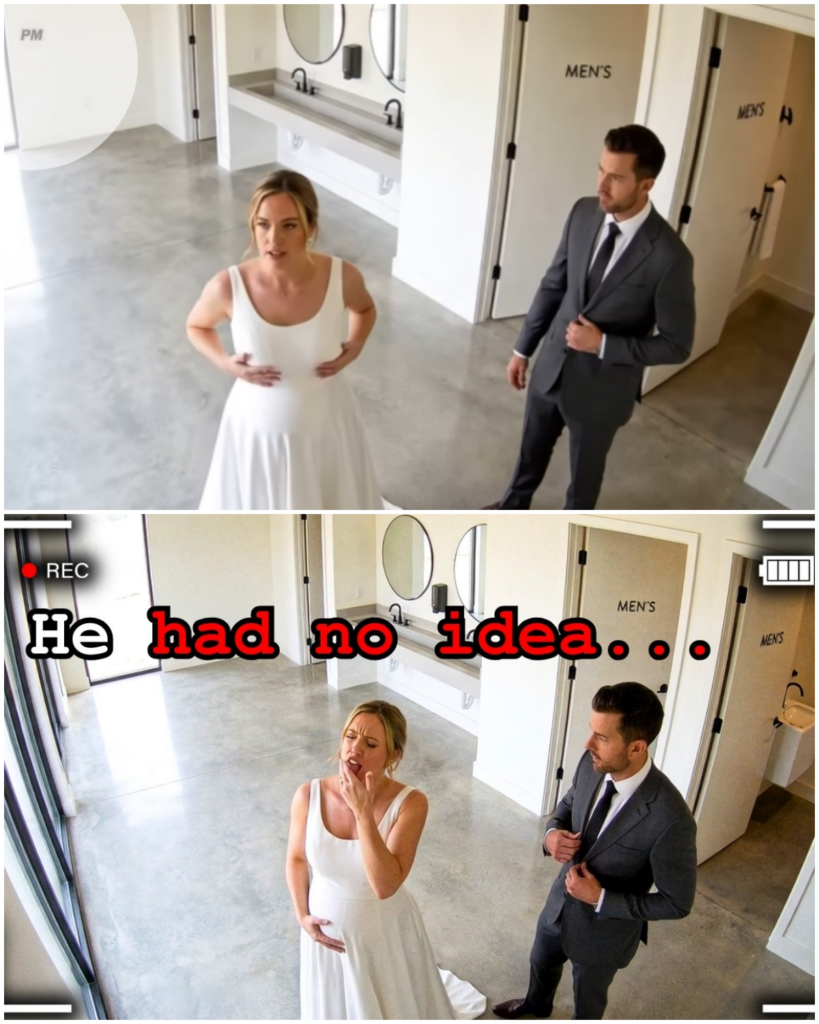
11 seconds. The white dress, the charcoal suit, the corridor, the walk back to the bar, the champagne flute going up, the room responding.
Desmond laughing at the head table. The jury watched it once, and the prosecutor asked the clerk to play it again.
Both times, the courtroom was completely quiet. Gerald Ray’s attorneys had filed a civil motion requesting DNA testing of the child, who’d been born during the pre-trial period and placed temporarily with Nora’s sister.
The criminal court hadn’t compelled the test during the main trial proceedings. The prosecution renewed the request in the final days of testimony, specifically to address whether Nora’s claim to Reed about the child’s paternity had been a deliberate lie used to secure his participation in the murder.
The judge allowed it. The results came in as a sealed exhibit and were read into the record on the second-to-last day of testimony.
The child was Desmond Ray’s. Reed’s attorney asked for a recess. 15 minutes. When proceedings resumed, something had gone out of Reed Callaway in a way that the reporters in the gallery all described with the same word afterward.
Gone. He sat there and looked like a man who had finally, completely understood the full shape of what had been done to him.
He had killed his best friend. For a child that wasn’t his. Because a woman had looked him in the eye and told him a lie precise enough to turn him into a weapon.
He’d lost Desmond. He’d lost any claim to the child. He’d lost the one story that had let him believe his own actions were something other than murder.
Nora Devlin didn’t move when the result was read. Whatever she thought, she kept it.
The jury came back Thursday afternoon after two days of deliberation. Reed Callaway. First-degree murder.
Life without parole. Nora Devlin. First-degree murder and conspiracy to commit murder. The same sentence.
The $1,340,000 policy was never paid. The insurer had voided the claim when the case was reclassified.
Gerald Ray’s attorneys filed a civil wrongful death action against Nora’s estate separately. There was nothing to go after.
She’d never owned anything in her own name. I want to pause here for a moment because this case does something that most true crime stories don’t.
It forces a question that goes beyond the crime itself. Reed Callaway was not a man with a violent history.