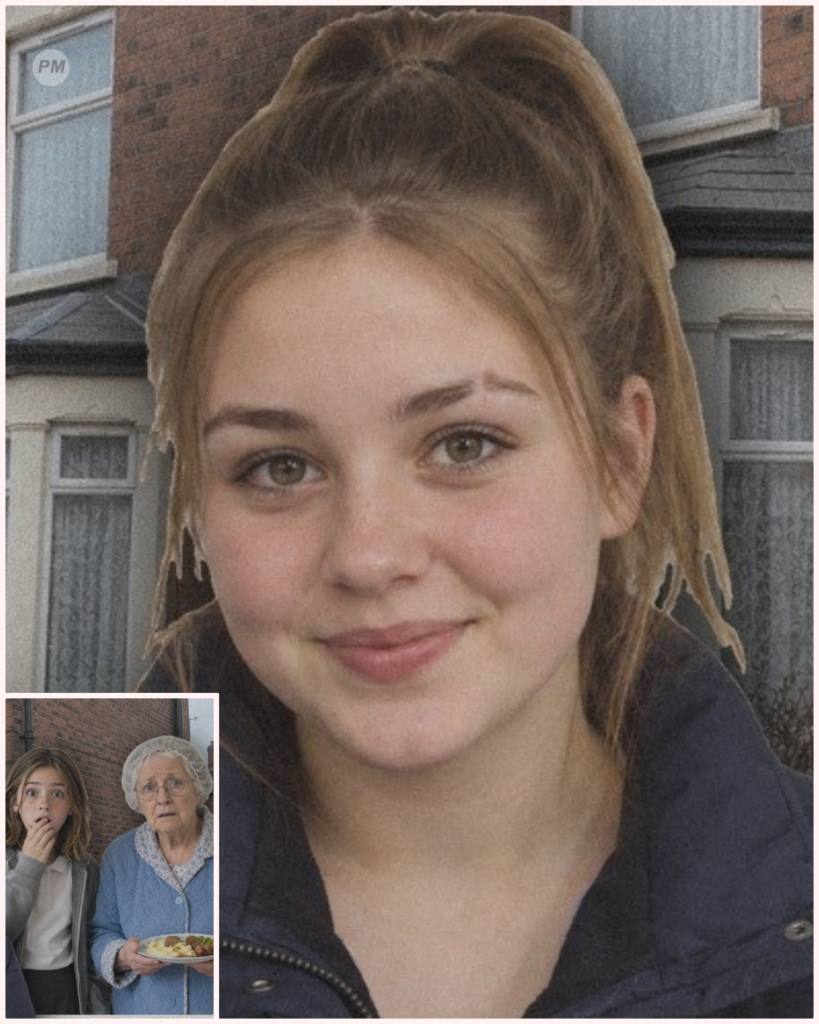
Neil said, "No." Poppy, who was 13 by then, said n…
Neil said, “No.” Poppy, who was 13 by then, said nothing because she knew her Nan.
Nan took the bus to the prison on her own in her good coat and was shown into the healthcare unit where a man weighing seven stone sat in a high-backed chair with a blanket over his knees.
He tried to get up. She told him to sit down. For a long time, neither of them said anything.
Then Ray said, “I don’t know why you’ve come.” “Neither do I,” said Nan. She put her handbag on the floor.
“I want to ask you one thing and I’d like a straight answer. You had that watch for 26 years.
Did you wind it every day?” His mouth moved. “Every day, Maureen. Every day. I never missed once.
Even in the hospital in Doncaster. I used to hide it under the sheet.” “Then it’s kept good time,” said Nan.
“That’s something.” She looked at his hands. “I’m not going to forgive you, Raymond. You’ll understand that.
I’ve no right to do it on her behalf, and I don’t think I could do it on mine.
But, I washed your shirts for 4 weeks, and I’ll not unwash them.” She stood up and picked up her bag.
“I fed a man who was hungry. I’d do it again. I want that said.
I’d do it again, and I’d not do it again with a bolt on the door.”
“No,” said Ray. “No, you wouldn’t.” Raymond Thackray died on Thursday, the 5th of June, 2025, in the health care unit, in his sleep.
The prison chaplain rang Nan to tell her. She thanked him for his trouble and put the phone down and went and sat in the front room by the mantelpiece because the mantelpiece still had its school photograph, its candle, and its blue inhaler.
And she had decided, at last, that she would move none of them. The Timex came back to her on Thursday, the 17th of July.
DC Hurst brought it in a small plastic bag, and Nan carried it into the kitchen and set it on the table and opened the bag with a pair of scissors, carefully, the way she opened everything.
The silver was dull. The glass still bore its Y. And under the strap, faded almost to gray, was the blue hair bobble that a 16-year-old girl had once tucked there so the metal wouldn’t pinch.
“Poppy,” she said, “come here.” Poppy was 13 and a head taller than in October.
She came and stood by the table, and Nan took the key from her housecoat pocket, the old cellar key, the one Keith had tied up with a spare blue bobble in the week that his daughter went.
She untied the knot. It took a minute. The elastic had stiffened. Then, she put it in Poppy’s hand and and her fingers around it.
“That’s yours. Your granddad tied that on the day he stopped being able to say her name.
Now you keep it. I’ve kept that door shut for 5 years. I’m not having a key hang on it again.”
Poppy nodded. She couldn’t speak. She picked up the Timex in both hands and found the little crown with her thumb and finger.
Click, click, click, click. The watch began to tick. They took it to the cemetery that evening, the two of them, on the bus.
The grass was dry for once and the sky over Pylon the color of a peach.
Nan stood in front of the stone and read it as she’d read it a hundred times.
Gemma Jane Holroyd, 1982 to 1998, beloved daughter. And she took the watch from her pocket and held it up so it caught the last of the sun.
“Ta-ra, Mum.” “Back by 10.” She said softly. “That’s what you said, duck, and I said, ‘Ta-ra.’ And I never turned round.”
She breathed. “Your dad said, ‘You’ll be late.’ And he blamed himself every day until he died.
You weren’t late, love. You were never late. Somebody made you late. It’s not the same thing, and I wish he’d known.”
She laid the Timex on the grass at the foot of the headstone, ticking, where it would stay until the next time she came.
Beside her, Poppy was crying without any sound. On Sunday, the 11th of October this year, they held the harvest festival at Providence Methodist.
And the front of the chapel was heaped with tins and marrows and loaves. Nan brought pickled onions in a jar as she had every year.
Poppy, who was 14 now, sat in the second pew in a school blazer, and in the pocket of the blazer was a blue hair bobble she had never once put down.
When the congregation stood to sing, a woman of 76 with the last of her sorrow in her chest, a contralto, opened her mouth and sang.
Back at number 14, the door at the end of the kitchen has no bolt on it now.
And on the wall of the front room, the cuckoo clock still runs, thanks to a man who wound things.
Every day at noon, it comes out of its little door and tells the house what time it is.
If this story stayed with you, please like this video, subscribe, and leave a comment.
Tell me where you’re watching from. And if a family you know is still waiting, share this.
Because somebody somewhere is still holding on to a name. Thank you for staying with me until the end.
See you in the next case.