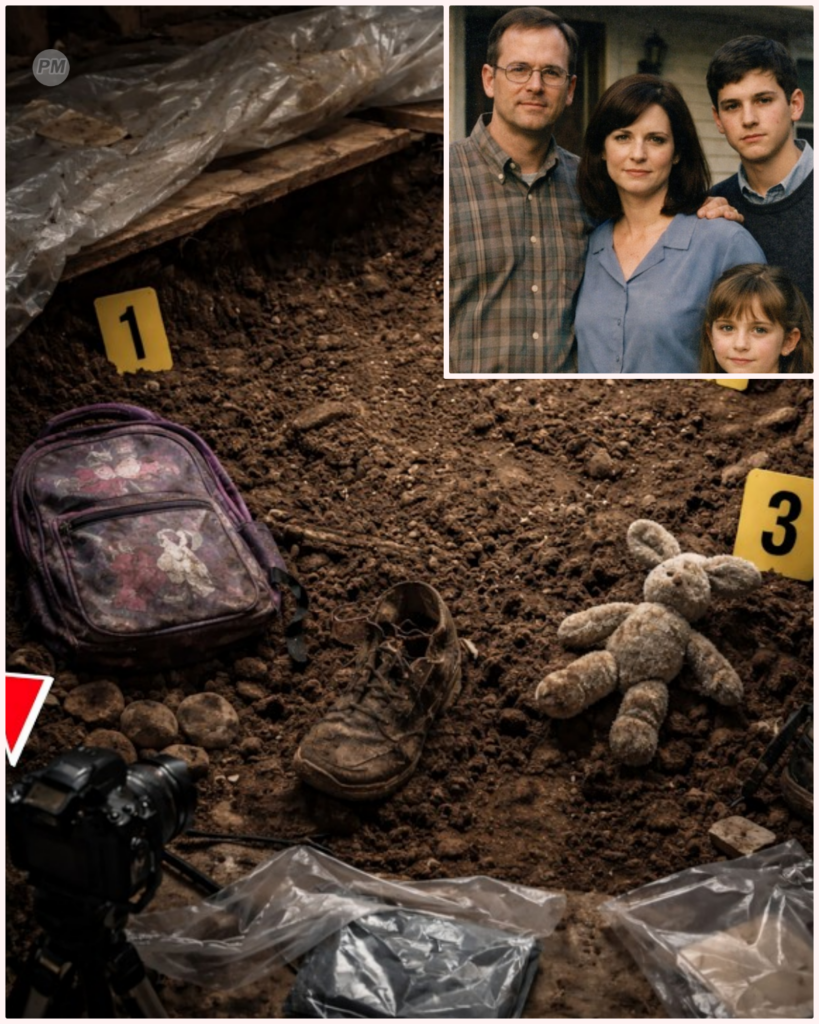
On the evening of the 14th of November, 1998, a family of four sat down to dinner in their home on Creswell Lane in Sable Creek, Louisiana, and by the following morning, not one of them remained.
The neighbor who noticed the front door ajar at 7:30 on a Sunday morning was a retired school teacher named Abigail Morse, who walked the same route every day, and who knew the Ashton family well enough to know that Gerald Ashton was not a man who left his front door open in November.
She pushed it gently and called inside and received no answer. She stepped into the entrance hall and called again.
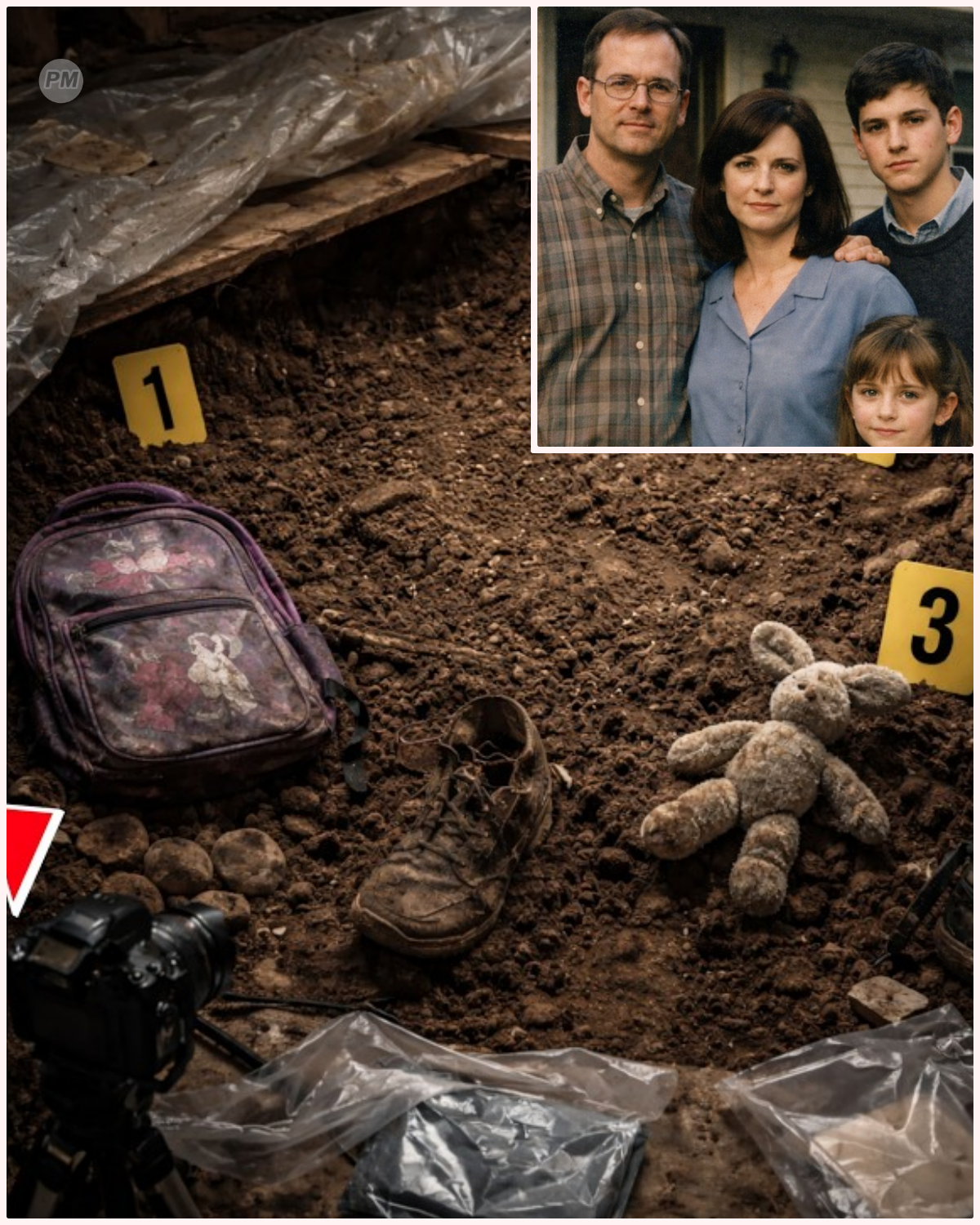
The television in the living room was on, the volume low, a Saturday night program still running on a channel nobody had switched off.
In the kitchen, four plates of partially eaten food sat on the table, the meal gone cold in the particular way of food that has been left for many hours rather than minutes.
Gerald Ashton’s reading glasses were folded on the table beside his plate. Ruth Ashton’s car keys were on the hook by the door where she always kept them.
The family dog, a large retriever named Copper, was in the kitchen. He was not loose.
He was tied to the handle of the radiator cabinet with a length of nylon rope that none of the family’s acquaintances would later recognize as belonging to the household.
He was unharmed. He was trembling. No vehicle had been taken from the drive. No luggage had been removed from the upstairs rooms.
The children’s school bags were on the landing where they left them every Friday. Gerald Ashton’s wallet was in his jacket pocket, the jacket folded over the back of his chair at the kitchen table, as if he had set it aside for a moment and would return for it.
He did not return. None of them did. Gerald and Ruth Ashton and their two children, Marcus aged 15 and Blythe aged eight, were never found.
Not that year, not in the years that followed, not across the 25 years of an investigation that had accumulated paperwork and theories and several promising leads that had dissolved into nothing and had eventually been reduced to a cold case file in the Sable Creek Parish Sheriff’s Department that nobody opened anymore unless a journalist called.
Until the spring of 2024, when a contractor hired to renovate the Cresswell Lane property before its sale accessed the crawl space beneath the kitchen floor and found something that stopped the renovation and brought the Sheriff’s Department back to the house for the first time in a decade.
What the contractor found was not structural damage. This is the story of Gerald Ashton, Ruth Ashton, Marcus Ashton, and Blythe Ashton.
A family who sat down to dinner on a November evening in their home and left behind a meal, a dog, a pair of reading glasses, and [music] 25 years of silence.
And what the ground beneath their kitchen had been holding all that time. Subscribe before we go further.
Because what was found beneath that house changes everything the investigation thought it understood. Sable Creek, Louisiana, population 12,400.
Situated in the northwestern region of the state where the land flattened toward the Red River Basin and the pine forests of the uplands gave way to the wider, more deliberate geography of alluvial plain.
The town had a particular quality of self-sufficiency that communities in that part of Louisiana often had.
The quality of places that had been built on the assumption that what you needed was either here or could be made here.
And that had organized themselves around that assumption across enough generations that it had become structural rather than philosophical.
Cresswell Lane was a residential street of modest but well-maintained houses set back from the road behind shallow front lawns.
The kind of street where people knew each other’s vehicles by sight and where an unfamiliar car parked for more than 2 hours generated the quiet ambient awareness that constituted a community monitoring itself.
It was not, by any assessment that the original investigators made or that subsequent reviewers of the case would make, the kind of street where a family of four could simply cease to exist without anyone seeing or hearing anything.
And yet, the Ashton family had lived at number 44 Creswell Lane for 9 years when they disappeared.
Gerald Ashton was 42, the manager of a regional insurance office whose moderate prosperity and complete absence of drama had defined his professional life.
Ruth Ashton was 38, a part-time librarian at the Sable Creek Parish Library who was remembered by her colleagues with a specificity that spoke to the depth of impression she had left.
The kind of person who was spoken about in the present tense for years after an absence began because the presence had been sufficiently vivid that the past tense felt presumptuous.
Marcus was 15, quiet and academic, in his third year of high school with particular aptitude in mathematics.
Blythe was eight, in the third grade, known to her teacher as a child who asked more questions than any answer could fully satisfy.
They were, by every available account, an ordinary family living an ordinary life on an ordinary street in a town that had no particular history of the extraordinary.
What happened to them had never been adequately explained. The crawl space beneath the kitchen floor of 44 Creswell Lane measured approximately 18 ft by 12.
It had been accessed twice during the original investigation, both times [music] briefly and without the benefit of systematic forensic examination.
It had been accessed once more in 2011 when a previous owner had reported a moisture problem.
It had not been accessed again until the spring of 2024 when the renovation contractor’s assistant, a young man named Curtis Deal, dropped a measuring tape through the access hatch and went down to retrieve it and came back up without the tape and with an expression on his face that caused the lead contractor to stop what he was doing [music] and look at him carefully before asking what was wrong.
Curtis Deal said he was not going back down there. He said there was something in the crawl space that he could not explain and that he did not want to explain and that somebody else was going to have to deal with because he was not the somebody for it.
The lead contractor went down himself. He was back up in 45 seconds. He called the Sable Creek Parish Sheriff’s Department from the front drive of 44 Creswell Lane [music] and he said, in the careful voice of a man keeping himself very controlled, that he needed someone to come to the house because he had found something beneath the kitchen floor that was not a moisture problem.
Nadia Correll had been writing about missing persons cases for 12 years, initially as a staff correspondent for a New Orleans-based investigative outlet and then, after the outlet’s restructuring had made staff positions a memory, as an independent journalist whose work appeared in long-form publications and whose two books had established her reputation as someone who brought to cold cases the particular combination of methodological rigor and narrative patience [music] that the subject required and rarely received.
She was 39 years old and she had developed, across 12 years of this specific work a finely calibrated sense of when a case warranted the sustained investment of her attention and when it was the kind of story that appeared significant at the surface and revealed itself on examination to be a case whose unresolved status reflected genuine investigative intractability rather than buried material waiting to be found.
The distinction mattered. Not every cold case had an answer dormant in it. Some were cold because they were genuinely cold.
The trail not merely obscured but absent and pursuing them with the full weight of a long investigation produced nothing except the exhaustion of the people doing the pursuing.
The Ashton family case had always sat in her awareness as belonging to the other category.
The category of cases whose unresolved status felt wrong in a specific and persistent way.
Whose surface details generated in her the particular alertness that she had learned to trust across 12 years because it had proven more often than not to be directing her attention towards something real.
She had first encountered the case in 2016 while researching a different disappearance in Northwestern Louisiana and had come across a reference to the Ashton family in a database of unsolved cases that she maintained and regularly updated.
She had pulled the public record at the time, read the available documentation, and had noted three things that she flagged in her case index with the notation that she used for cases she intended to return to.
The first was the dog tied to the radiator. Not by a member of the family.
The neighbors and family friends who were interviewed unanimously confirmed that the Ashtons had never restrained Copper indoors and that the length of nylon rope used to tie him was not something any of them recognized as belonging to the household.
Someone other than the family had tied the dog to the radiator. This meant someone other than the family had been inside the house before Abigail Morse pushed the front door open at 7:30 on Sunday morning.
The original investigation had noted this and had not resolved it. The second was the partially eaten dinner.
Four plates, four chairs occupied. The food had been served and partially consumed, which meant the family had been at the table and had been interrupted mid-meal.
No signs of struggle anywhere in the kitchen or in any other room of the house.
Whatever had interrupted the meal had produced no visible physical disruption. Four people had stopped eating dinner and had left the house and had not returned without breaking anything, without overturning anything, without leaving any physical evidence of the mechanism by which they had departed.
The third was a detail buried in the supplementary interview records that Nadia suspected had not received the attention it deserved because it appeared in the statement of a witness whose reliability had been questioned on other grounds and whose contribution to the investigation had therefore been partially discounted.
A man named Terrence Gill, who lived three houses down from the Ashtons on Cresswell Lane, had stated in his initial interview that on the Saturday evening at a time he estimated as between 9:00 and 10:00 in the evening, he had seen a vehicle he did not recognize parked at the far end of the lane on the unpaved section where the road terminated at the tree line of a small wood lot.
>> [music] >> He had described it as a dark van, possibly dark blue or dark green, parked with its engine off and its lights off.
He had thought nothing of it at the time. He had looked once and gone inside and had not seen it again when he looked out an hour later.
The investigation had noted Terrence Gill’s statement and had noted the question over his reliability and had filed the van detail without following it to any conclusion that the case record documented.
Nadia had flagged all three details in 2016 and had returned to them periodically across the years since, each time finding that they had not grown less interesting with the passing of time.
When the news item about the crawl space discovery appeared on a Tuesday in April of 2024 on the Sable Creek Parish Sheriff’s Department’s public information page, she was in Baton Rouge finishing a piece on an unrelated case.
She read the item, which was two paragraphs and contained no specific description of what had been found, and she drove to Sable Creek the following morning.
The town received her with the reserve that small Louisiana towns offered to people who arrived asking about things that the town had collectively tried to move past.
She checked into a motel on the main road, noted that the motel’s vacancy sign was entirely lit, which spoke to the season and the town’s modest traffic, and drove to Cresswell Lane before she did anything else.
The house at number 44 was a one-story ranch-style structure of the type built across the suburban south in the 1980s, brick-fronted with aluminum-framed windows and a shallow-pitched roof and a covered carport to the right side.
It looked like every fourth house on every comparable street in every comparable town in the region, ordinary to the point of invisibility, which was, Nadia had long since learned, not a disqualifying characteristic when it came to the things that happened inside houses.
The renovation company’s vehicles were parked in the drive, though no workers were visible. Sheriff’s Department tape crossed the front door.
She sat in her car and looked at the house and thought about a family sitting down to dinner on a November evening 25 years ago and a dog tied to a radiator with rope that did not belong to the household and four plates of food gone cold across a long night and a retired school teacher pushing open a front door at half past seven on a Sunday morning and calling into the silence.
She took out her notebook and wrote the date and the address at the top of the page.
Then she wrote the three flagged details from 2016 updated now with the addition of a fourth.
Something beneath the kitchen floor of 44 Creswell Lane that had caused a contractor to come back up through the access hatch in 45 seconds and call the sheriff’s department from the front drive.
She looked at the four details and then she looked at the house. She had the feeling she always had at the start of something that was going to take a long time.
The particular cold alertness that was not excitement but was adjacent to it. The feeling of standing at the edge of something whose full dimensions were not yet visible but whose depth she could already estimate.
She started the car and drove to the sheriff’s department. The Sable Creek Parish Library occupied a building on the town’s main street that had been a dry goods store in a previous life and that retained from that life a high pressed tin ceiling and wide planked pine floors that creaked in predictable places which the library’s long time staff had each mapped internally and navigated by habit in the way of people who have worked in a building long enough to know it as a physical personality rather than a structure.
It had been Ruth Ashton’s professional home for six years before she disappeared and it was of all the places in Sable Creek that were connected to the Ashton family, the one that had maintained the most sustained and conscious relationship with her memory across the 25 years since.
The library’s current director was a woman named Cora Bellfield, who was 58 and who had been a junior staff member in ’98 and who had known Ruth Ashton well enough to speak about her not with the reconstructed formality of someone describing a historical figure, but with the specific and unguarded directness of someone describing a person they had genuinely known and had never stopped missing.
She agreed to speak with Nadia on the Thursday of her first week in Sable Creek.
After Nadia had introduced herself and explained her work and her interest in the Ashton case with the careful transparency she always brought to first conversations, wanting the people she interviewed to understand precisely what they were contributing to and to make their decision about participation with full information, Cora Bellfield made that decision without apparent hesitation.
She led Nadia to a small office behind the reference section and poured coffee from a carafe that had been sitting long enough to have developed the particular intensity of coffee that has been kept warm past the point of optimal drinking.
And she settled into her chair with the ease of a woman who spent a great deal of time in it and began to speak about Ruth Ashton with the fluency of someone who had kept the subject alive in her mind for 25 years and needed no warm-up.
Ruth had been, Cora said, the kind of librarian who understood the work as being fundamentally about people rather than books, the books being the medium through which the relationship with people was maintained rather than the point of the relationship itself.
She had a particular gift for matching patrons with material they did not know they were looking for, the intuitive capacity to listen to what someone said they wanted and to hear in it what they actually needed and to find both simultaneously if the collection allowed.
She was known among the library’s regular patrons, several of whom Cora had stayed in contact with across the years, as someone who remembered not only what you had borrowed, but why you had borrowed it, and whether it had served the purpose you had brought to it.
She was also, Cora said with a quality of emphasis that suggested the detail was important, the kind of person who noticed things and who kept what she noticed to herself until she understood it well enough to share it, which was a quality of restraint that was admirable in general and that had, in the weeks before she disappeared, appeared to Cora to be under some particular strain.
Nadia asked her to explain what she meant. Cora set her coffee down and looked at the window of the small office, which gave onto the reference section, and the afternoon light falling through the library’s tall front windows across the pine floor in long rectangles that moved slowly as the sun moved.
She said that in the month before the disappearance, in October of ’98, Ruth had been different in a way that Cora had observed and had mentioned to her husband at the time, and had mentioned to the original investigators afterward, and that she had not been certain in any of those conversations that she had communicated the difference precisely enough to be fully understood.
She said Ruth had been watchful, not anxious in the surface performative way that anxiety sometimes displayed itself.
Watchful in the directed, deliberate way of someone who has identified something specific to watch for and is watching for it.
She came to work and did the work with the same professionalism she always brought to it, and she was warm with patrons and present in conversations, but there was running beneath all of it, Cora [music] said, a quality of sustained attention directed at something that was not in the room, something she was tracking internally while her external functioning continued in its normal pattern.
Cora had asked her once, directly, in the break room, whether everything was all right.
Ruth had said yes, fine, a little tired. The children had been keeping her up.
She had said it with the smooth delivery of someone who had prepared the answer before the question arrived, which was itself the answer to a different question, the one Cora had actually been asking.
Nadia asked whether Ruth had mentioned anything specific in those weeks, any concern about the neighborhood or a person.
Cora said not directly. She said Ruth had said one thing that [music] Cora had returned to many times across the years since.
She had said it in passing, casually, in the way that significant things sometimes arrived in conversation when the speaker was not yet ready to make them formally significant, as an aside rather than a statement.
She had said, in reference to nothing that the conversation had appeared to be about, that she had started noticing that things in the house were occasionally not where she had left them.
Small things. A book moved from one surface to another. A drawer not entirely closed in the way she always closed it.
A window latch in a position she was certain she had not left it in.
She had said, Cora recalled with the precision of someone who had replayed a memory so many times that its details had become fixed, that she supposed she was just becoming forgetful.
That she supposed it was tiredness. She had said this with the flat delivery of a person who did not believe what they were saying and knew the person they were saying it to did not believe it either and who was saying it anyway because the alternative was saying the thing she was not yet ready to say.
Nadia wrote this carefully. She wrote things moved in the house and window latch and she wrote the phrase not where she had left them and underlined it twice because it was the kind of detail that connected to other details in the way that the first thread connects to the rest of the fabric.
The detail whose significance grew in direct proportion to what surrounded it. She asked Cora if she had a sense of how long Ruth had been noticing these things before the disappearance.
Cora thought carefully. Then she said at least 6 weeks. She said the first time she had observed the watchfulness in Ruth was in the first week of October.
The family disappeared on the 14th of November. 6 weeks of a woman noticing that her home was being accessed by someone she could not identify, and making the calculation, the same calculation that women in other stories in other towns had made about whether what she had was sufficient to report, or whether it would simply sound like tiredness and forgetfulness, and be received as such.
Nadia sat with that for a moment. Then she asked whether Ruth had ever mentioned the crawl space.
Cora looked at her with an expression that shifted from the retrospective focus of memory to something more immediate.
She said Ruth had mentioned it once. In October, approximately 2 weeks into the period of watchfulness.
She had said, with the casual framing she brought to the things that were not casual, that Gerald had been meaning to get someone to look at the crawl space, because she had been hearing something from beneath the kitchen floor occasionally in the evenings.
A sound she could not identify. Intermittent. Like something settling or shifting in the enclosed space below.
Gerald had looked himself, she said. He had lifted the access hatch and put his head in with a flashlight, and had seen nothing, and had concluded it was the pipes or the foundation timbers adjusting to the autumn temperature change.
He had lowered the hatch and had not mentioned it again. The access hatch was in the kitchen floor, Nadia noted, beside the radiator cabinet, to which, 6 weeks later, someone had tied the family’s dog with a length of nylon rope that did not belong to the household.
She closed her notebook and looked at the pine floor of the library office and thought about a woman who had noticed that things in her home were not where she had left them, and who had made the calculation about whether to report it, and who had made the wrong calculation.
Not because she was wrong to doubt herself, but because the system that should have received her report would have required more than a book moved from one surface to another and a drawer not entirely closed.
And she had known this and had held the knowledge of it alongside the watchfulness and the not sleeping and the casual framing of things that were not casual across 6 weeks until the November evening when the dinner went cold on the table and the dog trembled on its rope.
And Abigail Morse pushed open a front door past 7:00 on a Sunday morning and called into the silence.
Nadia thanked Cora and drove back to the motel in the late afternoon. The main street of Sable Creek quiet around her in the way of small southern towns on weekday afternoons when the heat had driven the activity indoors.
She sat in her room with her notebook open and thought about a sound beneath the kitchen floor in the evenings, intermittent, like something settling or shifting.
She thought about a man putting his head through an access hatch with a flashlight and seeing nothing.
She thought about what a flashlight could and could not find in a crawl space of 18 ft by 12, depending on what was in it and how it was arranged and whether whoever had arranged it had done so with the specific intention of not being found by a flashlight held by a homeowner who was looking because his wife had asked him to and who would be satisfied by a reasonable alternative explanation.
She thought about what the contractor had found in that same space 25 years later.
>> [music] >> She reached for the phone and called the Sable Creek Parish Sheriff’s Department for the second time that day.
The Sable Creek Parish Sheriff’s Department assigned the reopened Ashton case to Detective Sergeant Phyllis Okafor in the second week of April 2024.
Okafor was 49 years old and had spent 21 years in Louisiana law enforcement across three parishes.
The last eight in Sable Creek, where she had arrived as a senior detective and had built, through the particular combination of methodological rigor and community knowledge that the work required, a reputation as someone who did not close cases until they were actually closed, rather than until they had become inconvenient to keep open.
She was a compact woman with a precise economy of movement and a quality of listening that people who had been interviewed by her described afterward as total.
The sense that she was receiving not just what you said, but the full architecture of how you said it and what the saying cost you and what you had decided not to say alongside what you had decided to say.
She had not worked the original Ashton investigation. She had been in a different parish in ’98, 3 years into her career, and the case existed for her as a case file, rather than a lived investigation, which she considered, on reflection, an advantage rather than a deficit.
She came to it without the accumulated assumptions that prolonged familiarity with an unresolved case could generate.
The subtle distortions that crept into thinking when you had spent years looking at the same evidence from the same angle and had unconsciously organized your understanding around the fact of of having produced nothing.
She read the full case file across two evenings before approaching the crawl space discovery.
All 412 pages of it. The original investigation reports, the interview records, the forensic documentation, the follow-up inquiries that had been conducted across the subsequent years, and the periodic review notes that various detectives had added when the case had been briefly revisited and then set aside again.
She made 31 notes on a legal pad in her precise small hand. Several of the notes were questions.
Several were observations about gaps between what had been investigated and what the available evidence suggested should have been investigated.
One note, written at the end of the second evening with a brevity that reflected the weight of the observation, said simply, “Crawl space.
Two brief accesses. No forensic examination. Never explained.” The renovation contractor’s name was Boyd Stin, a methodical man in his mid-50s who had been operating his company in Claiborne Parish and the surrounding area for 22 years, and who met Okafor at the house on a Wednesday morning with the careful professionalism of someone who had given his initial account to the first responding officers and had organized his thoughts in the days since into a version he could deliver with precision.
He had accessed the crawl space after his assistant Curtis Deal had declined to return to it.
He had gone down the six steps of the timber-framed access with a flashlight and had spent approximately 45 seconds in the space before ascending and making the call from the drive.
Okafor asked him to describe what he had seen with as much detail as he could provide.
Boyd Stin was quiet for a moment, collecting. Then he said the space was approximately the dimensions that the building plan indicated, roughly 18 by 12 with a concrete block foundation perimeter and a compacted earth floor and the standard network of pipe conduit and electrical routing running along the joists above.
He said the space was dry, which he noted as a departure from the moisture problem that a previous owner had reported in 2011, suggesting the drainage issue had been addressed at some point or had resolved itself.
He said the space was not empty. Along the northern wall, set against the foundation blocks with a deliberateness that was immediately apparent as intentional arrangement rather than storage accumulation, were three wooden crates of the type used in agricultural transport, low-sided and flat-bottomed, constructed from a pale timber that he did not immediately recognize.
They were set side by side with uniform spacing between them. Each crate contained objects that he had not examined closely because he had understood within the first few seconds of seeing them that examining them was not his role and that his role was to ascend the steps and make the call.
He said the objects in the crates were personal in character. The word he used was personal and then he looked for a better word and settled on intimate, which was the right word and which he said with the slight discomfort of a man using a word that felt too large for a practical conversation and who knew it was nonetheless accurate.
He said there was one other thing. Against the eastern wall of the crawl space at the far end from the access hatch, set directly below the point in the kitchen floor above where the radiator cabinet stood, there was a section of the compacted earth floor that was different from the rest of the floor in texture and color.
A rectangular area approximately 6 ft by 3 that was darker and more recently disturbed than in surrounding soil.
He had not touched it. He had looked at it from a distance of perhaps 8 ft in the flashlight beam, and he had understood, without being able to articulate the precise mechanism of the understanding, that it was the most important thing in the space, and that it was the thing that most required the people he was about to call.
Okafor thanked him and went into the house. The state forensic team had been on site since Monday.
They had processed the crawl space over 3 days with the systematic thoroughness that a space sealed for 25 years required.
Okafor had reviewed their preliminary documentation before meeting with Stin, and was now crossing the kitchen floor to the access hatch, which had been propped open and fitted with a portable lighting rig that eliminated the darkness that a flashlight only partially addressed.
She descended the six steps and stood in the crawl space with the forensic lead, a careful and experienced woman named Dr.
Simone Faye, who had been working Louisiana crime scenes for 16 years, and who briefed Okafor on the preliminary findings with the flat precision of someone who had long since learned to deliver findings of significant weight in the same register as findings of minimal weight, because the register itself was a form of professional respect for the material.
The three crates were as Stin had described. The forensic team had documented and cataloged their contents without removing anything from the space pending Okafor’s walk-through.
She looked at each crate in turn. The first held what appeared to be personal items belonging to a woman, a hairbrush with dark hair still threaded through its bristles, a library staff identification card in a plastic sleeve, two paperback novels with their spines cracked in the way of books that had been read more than once, and a folded piece of paper that Okafor could see from the edge was covered in handwriting.
The identification card bore a photograph that she recognized immediately from the missing person’s materials she had spent two evenings with.
Ruth Ashton photographed in the flat fluorescent light of an institutional ID looking directly at the camera with the expression of someone who has been asked to hold still and is complying with professional efficiency.
The second crate held items consistent with a male adult, a wallet empty of cash but containing a driver’s license whose photograph matched Gerald Ashton in the 1998 missing person’s record.
A folded pocket square in blue cotton, a keychain with two keys and a small metal tag engraved with the initials GA, a mechanical pencil of the type used in technical drawing, its barrel worn at the grip point in the way of something used daily for years.
The third crate was the one that required Okafor to exercise with conscious and deliberate effort the professional composure that 21 years of this work had built in her and that she had never needed more fully than she needed it at this moment.
It held smaller items, a mathematics textbook with a name written on the inside cover in a teenager’s careful block lettering.
Marcus Ashton. A child’s drawing on folded paper, the kind of drawing that 8-year-olds produced with the full investment of their technical capacity and their imaginative intention simultaneously.
A house with four figures in front of it and a large orange dog, the sun in the upper right corner with radiating lines.
In the lower left corner of the drawing, in the large round letters of a child who was still learning to make letters do what she wanted them to do, the name Blythe.
Okafor stood before the third crate for longer than she stood before the others. Then she moved to the eastern wall and stood at the edge of the rectangular area of disturbed earth, 6 ft by 3, darker and more recently worked than the surrounding floor, positioned directly beneath the radiator cabinet above.
Dr. Faye stood beside her. Faye said the ground-penetrating radar analysis conducted on Monday had produced results that she had submitted to the state pathologist’s office for formal assessment.
She said the preliminary indication from the radar was consistent with the presence of subsurface material at a depth of between 2 and 4 ft below the current floor level.
She said the formal excavation was scheduled to begin on Friday pending the pathologist’s authorization.
She said this in the same flat, precise register she brought to everything, but she looked at Okafor when she said it with an expression that communicated, beneath the professional register, the full weight of what Friday was going to require.
Okafor looked at the rectangular area of earth and thought about a family of four at a dinner table and a dog tied to a radiator above the point where she was standing and four plates of food going cold across a long night while something below the kitchen floor held what it had been given and waited with the patience of enclosed dark spaces that had no choice but to wait.
She thought about Ruth Ashton noticing that things in her home were not where she had left them.
Noticing the sound from beneath the kitchen floor in the evenings. Intermittent. Like something settling or shifting.
She thought about what had been settling in this space across 25 years and what it was going to mean for three families when Friday arrived.
She ascended the six steps into the kitchen light and stood for a moment with her hand on the edge of the access hatch before she closed it.
Then she called the state pathologist’s office and asked them to move the authorization to Thursday.
Nadia Corrales second week in Sable Creek was spent in the methodical construction of the peripheral record that she always built before approaching the central one, the layer of community context and background detail that gave a case its texture and that the official documentation rarely contained because official documentation was organized around what could be proven rather than what could be understood.
She spoke to neighbors, to former colleagues of Gerald’s at the insurance office, to the parents of Marcus’s school friends, to the teacher who had been in charge of Blythe’s third grade class in ’98 and who was now retired and living in Shreveport and who spoke about Blythe Ashton across a phone call with the sustained and undiminished clarity of someone for whom a particular child had never left the part of the memory reserved for the ones who mattered most.
She built across these conversations a picture of the Ashton family that was consistent in its outlines and specific in its details.
Gerald was organized and reliable and possessed of the mild unhurried competence of someone who had found the right level for his abilities and was comfortable there.
Ruth was the more vivid presence in the community, the one who left the more distinct impression, remembered with more immediacy and more personal specificity by the people who had known her.
Marcus was quiet and self-contained in the way of academically oriented teenagers who had found their footing in their intellectual life before they had fully found it socially.
Blythe was the question asker, the one whose teacher described as being in a permanent state of wanting to know more than the available information could satisfy, a quality that her teacher said, with the small tender smile of someone who had loved the characteristic even when it was inconvenient.
Nothing in these conversations suggested a family with enemies or debts or the kind of complicated private history that generated the explanations investigators reached for first.
Everything suggested a family of four living the ordinary life of a family of four on a residential street in a mid-sized Louisiana town in the late 1990s.
Which returned Nadia, as it had returned her several times daily since arriving in Sable Creek, to Terrence Gill and the dark van at the end of the lane.
She had located Terrence Gill through the parish voter registration records, which showed him at a current address in a neighborhood on the south side of town.
She had called ahead. He had answered without enthusiasm and had agreed to see her with the resigned acceptance of a man who had concluded, apparently some years ago, that the Ashton case was going to follow him at irregular intervals for the rest of his life.
And that accommodation was more practical than resistance. He was 68 now, a lean man with the weathered hands of someone who had spent decades in outdoor work, and who received Nadia in a small, clean living room with the economy of a person who did not waste space or words.
He poured no coffee. He sat across from her and looked at her with the direct assessment of someone who had decided to be cooperative and wanted to establish the terms of the cooperation clearly before proceeding.
He said he knew why she was there. He said the crawl space discovery had been the talk of Sable Creek for 2 weeks and that he had been expecting a call since the day the news broke.
He said he had given his account to the original investigators in ’98 and had given it to two journalists and one documentary producer in the years since, and that his account had not changed because his account was what he had seen and what he had seen was what it was.
[music] Nadia asked him to give her the account again. He said on the Saturday evening of the 14th of November ’98 at a time he estimated as 9:00 or 9:30, he had been in his living room at his then address on Creswell Lane, three houses down from the Ashtons at number 44.
He had looked out his front window for a reason he could not now recall, possibly to check the weather, possibly simply because he happened to look up from what he was doing.
He had seen a vehicle parked at the far end of the lane at the point where the paved road ended and a short unpaved section ran to the edge of the wood lot that backed the lane’s terminal properties.
The vehicle was a van, dark-colored, though in the limited light available at that end of the lane, he could not determine the exact color with certainty.
He said it could have been dark blue, dark green, or black. He said it was parked with its engine off and its lights off, which was what had made him look twice because a vehicle parked at that end of the lane with no lights on at 9:00 in the evening had no obvious innocent explanation.
He had looked at it for perhaps 30 seconds. He had not been able to see whether anyone was in it because of the distance and the light.
He had gone back to what he was doing. When he looked out again, approximately an hour later, the van was gone.
He had told the investigators this in ’98. He said the detective who had taken his statement had written it down and had asked him two follow-up questions, whether he had seen the van before and whether he recognized it as belonging to any resident of the lane.
He had answered no to both. The detective had thanked him and moved on. He had heard nothing further from the investigation about the van.
Nadia asked him whether in the 25 years since he had thought of anything additional about the van or its position that he had not included in his original statement.
Gill was quiet for a moment. He looked at his hands, the weathered capable hands of a man who had worked with them all his life.
Then he said yes. He said there was one thing he had not included in his original statement, not because he had been withholding it, but because in ’98 he had not understood its potential relevance.
And by the time he had understood it, the investigation had moved into the dormant phase that it had never emerged from, and there had seemed to be no point.
He had seen the van before. Not on Creswell Lane. At the insurance office on the main road where Gerald Ashton worked.
He had business occasionally at a neighboring office in the same building and had parked in the shared lot on three or four occasions in the months before the disappearance and had seen the same van, or a van he was confident was the same van, parked in the lot on two of those occasions.
He had not connected the lot sightings to the lane sighting until several months after ’98 when he happened to drive past the insurance building and see the lot empty and had experienced the sudden lateral connection of two memories that had been stored separately and had not previously been placed adjacent to each other.
By then, the investigation [clears throat] was dormant. He had not known who to call.
He had told his wife at the time. His wife had said he should call the sheriff’s department.
He had called and had been told someone would follow up. No one had followed up.
The detail had continued to exist in his memory without finding a home in the official record.
Nadia wrote it carefully. Van, insurance building lot, two sightings in months preceding disappearance. She wrote connected to Gerald Ashton’s workplace and she underlined it.
She asked whether Gil could provide any additional detail about the van that he had not provided in ’98, whether the intervening years of carrying the memory had produced any additional resolution in the detail.
He thought again. Then he said there was one thing he had never mentioned to anyone because it was so small he had consistently doubted whether he had actually seen it or whether his memory had constructed it in the years since.
He said he was mentioning it now because the crawl space had changed his threshold for what was too small to say.
He said on one of the occasions he had seen the van in the insurance building lot, he had parked adjacent to it, and he walked past its passenger side on the way to the building entrance.
He said the van had a small sticker in the lower corner of the passenger window.
A trade sticker, the kind that contractors and service companies used. A small oval with a business name or logo.
He had not read it deliberately. It was the kind of thing the eye registered peripherally without the mind fully processing, but he believed, with the uncertain confidence of a peripheral memory, that the sticker had contained a word related to property or building or maintenance.
Something in that semantic field. He could not be more specific than that. Nadia thanked him and drove back toward the center of town through the late afternoon.
She thought about a dark van in a residential lane at 9:00 in the evening with its engine off and its lights off, parked at the edge of a wood lot behind the house of a family who would be gone by morning.
She thought about the same van or its close equivalent in the parking lot of Gerald Ashton’s workplace on two occasions in the preceding months.
Patient and dark. Engine off, accumulating an understanding of a family schedule from the particular vantage point of a space that working people used without examining what else was using it alongside them.
She thought about a word in the semantic field of property or building or maintenance on a small oval sticker in the corner of a passenger window.
She thought about the contractor who had gone down into the crawl space of 44 Creswell Lane and had come back up in 45 seconds and had called the sheriff’s department from the drive.
She pulled over on the main road and sat for a moment with her notebook open across the steering wheel and wrote a single question at the bottom of the page.
She wrote it because it was the question that the morning’s two conversations had assembled and that now required an answer before anything else could proceed.
The question was, who maintained the property at 44 Creswell Lane in the years before the Ashton family moved in and in the years since?
She drove to the parish records office before it closed for the day. The Sable Creek parish records office closed at 4:30 on weekday afternoons, which gave Nadia 40 minutes when she arrived at 10:04, a margin she had navigated in enough records offices across enough Louisiana parishes to understand was sufficient if she was precise about what she needed and efficient about requesting it.
The clerk on duty was a young man named Ferris who had the particular quality of competence in his specific domain that people sometimes developed when they had worked a narrow and detailed field long enough to know it entirely and who produced the property history for 44 Creswell Lane within 8 minutes of her request.
The ownership history was uncomplicated. The house had been built in 1981 by a developer whose company had constructed 12 similar properties on Creswell Lane as part of a residential subdivision that had been absorbed into the general fabric of Sable Creek without particular distinction.
The first owners had been a couple named Whitford who had sold in 1989 to a man named Dale Prewitt who had sold in ’92 to Gerald and Ruth Ashton.
After the disappearance, the property had remained in legal limbo for several years while the estate was managed by a court-appointed administrator, had been sold in 2004 to a couple named Brent and Carla Sauvion who had lived there until 2012, had been sold again to a single owner named Hugh Macy who had held it until 2022, and had been acquired by the current estate in preparation for the renovation and sale that had produced the crawl space discovery.
Nadia photographed the ownership history and asked Ferris for the maintenance and contractor records associated with the property, specifically any permitted work that would have required a contractor to be documented in the parish records.
Ferris explained that permitted work generated a record, but that routine maintenance and minor repairs, the category of work that a property maintenance contractor would typically perform, did not require permits below a certain value threshold and therefore generated no parish record unless the homeowner had chosen to document it for their own purposes.
She thanked him and left with what she had, which was the ownership chain and the permitted work records, the latter comprising a roof replacement in 2007 and an HVAC upgrade in 2015, both conducted during the Sauvion period by contractors whose names she noted but whose connection to the case she considered, at first assessment, unlikely.
What she had not been able to get from Ferris, because it did not exist in the parish record, was the maintenance contractor history.
The informal, cash transaction world of property maintenance in a small Louisiana town was not a world that generated documentation unless one of its participants chose to create it.
She drove to the Ashton family’s former neighbor, Abigail Morse, whose name she had carried in her notes since her first reading of the case file, [music] and who she had been intending to visit since arriving in Sable Creek.
Abigail Morse was now 81 years old and had moved from Creswell Lane in 2008 into a smaller property on the eastern side of town, a tidy single-story house whose front garden was maintained with the careful attention of someone who found in its tending both pleasure and the particular satisfaction of a task whose results were visible and immediate.
She answered the door before Nadia had finished raising her hand to knock, which suggested she had been watching the approach, and she assessed Nadia with the sharp, undeceive eyes of a woman who had been reading people across 81 years, and who had developed a swift and reliable categorization system.
She said, “Come in.” Before Nadia had introduced herself, which was either an unusual trust or an indication that she had been expecting someone and had decided on the evidence of the approach and the car and the notebook visible under Nadia’s arm that this was the person she had been expecting.
She led Nadia to a sitting room that was ordered and personal in equal measure.
Photographs on the walls in the dense arrangement of a life that had contained many people and had documented them.
A bookshelf that appeared to have been organized by some system that was not alphabetical or categorical, but was clearly a system.
She sat in a high-backed chair and folded her hands in her lap and said she had been waiting for someone to come and ask about the Ashton house since April when the news broke about the crawl space, and she was glad Nadia had come before she lost any more patience.
Nadia sat across from her and opened her notebook and asked her to begin wherever she wanted to begin.
Abigail said she wanted to begin with the man she had seen at the Ashton house on three separate occasions in the 6 months before the family disappeared.
She said she had told the original investigators about him in ’98 and had been dissatisfied with the degree to which her account had been pursued.
A dissatisfaction she had carried productively across 25 years in the sense that it had kept her ready for a conversation in which it could be properly addressed.
She said she had first seen him in late May of ’98, approximately 6 months before the disappearance.
She had been in her front garden in the early morning when she had observed a man at the side of the Ashton house at the point where the property side gate gave access to the rear garden.
He was doing something at the gate with a tool she could not identify at the distance, working at the latch mechanism with a focused economy of movement that suggested he knew what he was doing and had done it before.
She had assumed initially that he was a tradesman or maintenance contractor and had returned to her gardening without extended scrutiny.
The second occasion was in August of the same year, a Saturday morning when the Ashtons were visibly out, their car absent from the drive.
She had seen the same man, recognized by his build and his particular way of moving, which she described as contained and without wasted motion, in the Ashton driveway.
He had been examining the foundation line of the house at the front left corner, crouching with his hand on the brickwork in the specific posture of someone assessing a structural element rather than merely looking at it.
She had watched him for perhaps 2 minutes from her front window. He had completed his assessment, stood, and walked to the street without looking at her house or at any other property on the lane.
He had walked east away from the center of town and had not been observed getting into a vehicle.
The third occasion was October, approximately 6 weeks before the disappearance. He had been in the rear of the Ashton property, visible over the low fence that separated the gardens, moving along the back of the house in the slow methodical progression of someone conducting a systematic inspection of the rear elevation.
She had been at her kitchen window. He had been close enough to her garden boundary that she had been able to observe him with more detail than the previous occasions had allowed.
She said he was approximately 50 to 55 in appearance at that time, which would make him 75 to 80 now if he were still living.
He was of average height, compact in his build, with dark hair that was graying at the temples.
He wore, on the October occasion, a canvas work jacket of the type that property maintenance and building trade workers commonly wore in that period.
She had not seen a logo or name on the jacket. She had seen, on the jacket’s breast pocket, a small oval patch that she had not been able to read from her kitchen window.
Nadia looked up from her notebook. She asked Abigail to describe the patch more specifically.
Abigail said it was small and oval, the standard shape of a trade patch or contractor identification, and that it appeared to contain text that she had not been able to read at the distance, but that its background color was pale, possibly white or cream, against the darker canvas of the jacket.
Nadia thought about Terrence Gill and a small oval sticker in the corner of a passenger window containing a word in the semantic field of property or building or maintenance.
She thought about the oval patch on the canvas jacket and the oval sticker on the van window and the fact that oval was a specific shape, and that two independent witnesses describing oval identifiers on a person and a vehicle associated with the same case across a span of months was not a coincidence in the category of coincidences that could be set aside.
She asked Abigail whether she had reported the sightings to the original investigators. Abigail said she had reported all three occasions.
She said the detective who had taken her statement had asked her whether she could confirm the man was not a licensed contractor hired by the Ashtons, and she had said she could not confirm that because she had not asked the Ashtons about it.
The detective had suggested that the most likely explanation was routine maintenance work and had noted her account in the file.
She had not been contacted again about the sightings. She had subsequently asked Ruth Ashton in late October whether they had hired a contractor for any work on the house.
Ruth had said they had not. She had said it with a brief stillness that preceded the answer, a pause of perhaps 2 seconds that Abigail had registered at the time and had registered many times since.
The pause of a woman for whom the question had arrived in a context she already had, and that the question had just made more specific.
Ruth had asked Abigail what had prompted the question. Abigail had described the three sightings.
Ruth had listened without expression. Then she had said that she appreciated Abigail telling her and that she would mention it to Gerald.
She had said it with the careful neutrality of a woman who was filing the information alongside other information she was already carrying, adding it to an existing account rather than opening a new one.
She had not, as far as Abigail knew, gone to the police. She had been dead or disappeared within 3 weeks of their conversation.
Nadia drove back to the motel in the evening dark, the streets of Sable Creek quiet around her, the warm Louisiana night pressing gently against the car windows.
She sat in the parking lot for a few minutes before going inside, thinking about an oval patch and an oval sticker and a man who moved without wasted motion and who knew the structure of a house from the outside in a way that suggested he had studied it with care and intention and had been studying it for months before the November evening when a family of four sat down to dinner and did not get up again.
She thought about Ruth Ashton listening to Abigail Morse describe three sightings of a man at the house and filing the information alongside other information she was already carrying.
Alongside the things moved in the house, alongside alongside the window latch, alongside the sound from beneath the kitchen floor in the evenings, intermittent, like something settling or shifting.
She thought about a woman who had been building a picture for six weeks and who had not gone to the police because what she had was peripheral and circumstantial and she had understood with the specific understanding that women in her position frequently developed that peripheral and circumstantial would not be received with the weight it deserved by an institution organized around the requirement of specificity.
She thought about how close Ruth had been to having enough, how close and how far.
Phyllis Okafor received the state pathologist’s formal authorization on the Thursday morning, one day earlier than originally scheduled, and the excavation of the rectangular area of disturbed earth beneath the kitchen floor of 44 Creswell Lane began at 8:00 in the morning with a forensic team of five specialists and Okafor present throughout.
She had requested that the excavation be conducted in complete privacy, no media access, no departmental observers beyond the immediate investigative team, and the request had been honored without debate because the people who needed to honor it understood what Thursday morning was likely to produce, and understood equally that what it produced deserved the privacy of a context that was not performing itself for any audience.
The excavation took 4 hours. The team worked at the measured pace of people who understood that what they were uncovering had been in the ground for 25 years, and that the additional hours required to do it correctly were not a cost, but an obligation.
Okafor watched from the periphery of the space, moving when the team needed room, remaining when they did not, present throughout with the focused composure that the situation demanded and that she had consciously constructed before descending the access hatch that morning, and had maintained with the deliberate effort of a person who understood that composure in this context was not a performance of professional detachment, but an act of respect for what she was witnessing.
The formal identifications would take weeks and would require the full apparatus of forensic pathology and DNA analysis.
But by midday on Thursday, the state pathologist who had traveled from Baton Rouge to conduct the excavation personally had communicated to Okafor in the quiet and carefully qualified language of a scientist who did not reach beyond what the evidence supported that what the ground beneath the kitchen floor of 44 Creswell Lane had contained for 25 years was consistent with the presence of four individuals, and that the material evidence was sufficiently intact for formal identification to proceed with reasonable confidence.
Okafor stood at the eastern wall of the crawl space for a moment after the pathologist had finished speaking and looked at the rectangular area that had been and was no longer undisturbed.
Then she ascended the six steps into the kitchen of the house and stood with her hand again on the hatch as she had stood the previous week, and she did not close it this time.
She stood in the kitchen of a house where a family had sat down to dinner 25 years earlier, and she stood there long enough to feel the full weight of what Thursday had confirmed, and then she went outside and called the state bureau and requested additional investigative resource, and called the district attorney’s office, and called the parish communications director to discuss what could be released and when in the ordered sequence of calls that an investigation’s critical development required.
She called Nadia Correll last from the parking lot of a diner three blocks from Creswell Lane where she had gone for coffee she needed more than she wanted.
She told Nadia what she could tell her and held the rest in the professional confidentiality that the formal process required, and that Nadia accepted without pressure because she understood the boundary and because she had what she needed from the call, which was the confirmation that the investigation had reached its critical threshold and that what came next would determine everything.
What came next was the name. Nadia had been working the property maintenance angle since her conversation with Abigail Morse and her subsequent return to the conversation with Terrence Gill to add the oval patch detail to the oval sticker detail and to ask him whether he had any recollection of the van’s condition that might indicate a trade or contractor vehicle rather than a personal one.
Gill had said the van had been clean and unmodified on the exterior as far as he could recall, but that it had the interior configuration visible through the driver’s window when he had walked past it in the insurance building lot of a vehicle that carried equipment and materials rather than passengers.
Shelving along one interior wall, tie-down points on the floor, the organized interior of a working vehicle rather than a personal one.
She had pulled the business registry for Sable Creek Parish and the surrounding area for the period from 1990 to 2000, searching for property maintenance, building services, and related business registrations whose name or description might contain an identifier consistent with an oval format logo.
The registry was partially digitized and partially preserved in bound ledger volumes at the parish clerk’s office, and the search had taken her two full days and the cooperation of the clerk, a patient woman named Denise Arsenault, who had worked the registry for 15 years and who approached Nadia’s research question with the focused interest of someone who took the proper use of her records seriously.
The result was a business registration from 1993 for a sole proprietorship operating under the name Calvard Property Services, registered to an individual whose listed address was a rural route number in the unincorporated area east of Sable Creek.
The business description covered routine property maintenance, structural assessment, and seasonal care for residential and commercial properties, which was the standard language of a maintenance contractor operating in the informal cash economy of small-town Louisiana.
The registration had been renewed annually through 2001 and had then lapsed without renewal. The registered owner’s name was Eustace Calvard.
Nadia ran the name through the public databases she had access to and found the following: >> [music] >> a Louisiana driver’s license issued in 1988 and renewed through 2003, a voter registration at the rural route address through 2002, a property tax record for a parcel on the rural route, a two-acre residential lot with a single structure.
Tax payments current through 2001 and lapsed from 2002 onward. The parcel eventually acquired by the parish for non-payment in 2007 and subsequently sold at a tax auction.
She found no death certificate in Louisiana or in any of the adjacent states when she ran the search.
She found no criminal record. She found after 2003 no record of any kind. She called Okafor and gave her the name.
Okafor was quiet for a long moment on the line, the quality of silence that Nadia had come to recognize as active rather than passive, the silence of a mind at full processing capacity.
Then she said she would run it immediately. She said Nadia had done good work.
She said it simply and directly without elaboration because she was not a person who elaborated on things that were clear on their own.
Nadia drove out to the rural route east of Sable Creek in the late afternoon of the same day.
>> [music] >> The address the business registration had listed was a section of road that had been unpaved in ’93 and remained unpaved now, running between Pinewood lots and occasional cleared parcels whose residential structures ranged from well maintained to long abandoned.
The two-acre parcel that had belonged to Eustace Calvert was identifiable by the concrete block foundation of a structure that had been demolished or collapsed at some point after the parcel changed hands, the foundation remaining as a low rectangular outline in ground that had been overtaken by the patient encroachment of the surrounding vegetation, grass and scrub, and the lower branches of adjacent pines extending across the cleared area like a slow reclamation.
She stood at the road’s edge and looked at the foundation outline in the late afternoon light and thought about a man who had maintained properties and had done it without generating documentation beyond the minimum required for a business registration, who had operated in the informal economy of routine maintenance that moved through small communities without record because record was not its habit.
Who had driven a dark van with an oval sticker in the corner of the passenger window and had worn a canvas jacket with an oval patch on the breast pocket and who had appeared at 44 Creswell Lane on three separate occasions across six months studying the structure of the house from the outside in a way that was not maintenance but was something else entirely.
She thought about the crawl space beneath the kitchen floor and the three crates against the northern wall and the rectangular area of disturbed earth against the eastern wall below the radiator cabinet.
She thought about what it meant to maintain a property in the expanded and private meaning of the word that Eustace Calvert appeared to have developed for himself.
What it meant to consider a house and everything in it and beneath it within the scope of your ongoing professional attention regardless of whose name was on the deed.
She thought about the oval patch and the oval sticker and a dark van at the end of a residential lane at 9:00 in the evening with its engine off and its lights off and she thought about a family sitting down to dinner 30 ft from an unlocked front door and she thought about a dog tied to a radiator with rope that did not belong to the household and she stood at the edge of the unpaved road while the late Louisiana light went gold and horizontal through the pine trees and the foundation outline held its rectangular shape in the encroaching grass patient and permanent.
The last visible evidence of a life that had dissolved its documentation and left only the concrete to prove it had existed at all.
She drove back towards Sable Creek as the dark came down and she drove with the specific quality of attention that she brought to the drives that followed the days when an investigation reached the point where the shape of it was finally irrevocably clear.
Not resolved, not finished, but clear. The shape visible at last in its full dimensions, so that what remained was not discovery, but the long and necessary work of proof.
He was sentenced to four consecutive life terms on a morning in March. The judge delivered the sentence in the tone of someone marking something that needed marking, permanent [music] and without equivocation.
Calvard was led from the courtroom in the quiet efficiency of the system that had finally reached him and that would now contain him for the remainder of the life he had.
Okafor stood in the courtroom after it had emptied and looked at the space where he had sat and then at the space where the four families had sat in the gallery and then at the windows and the winter light coming through them.
She had been doing this work for 21 years and she had developed across those years the understanding that the conclusion of a case was not the end of what the case had cost and that the verdicts were the thing that made the cost fully payable, but not the thing that paid it.
The paying took longer. The paying was the work of the families and the community and the investigators themselves, the long quiet work of living with what had happened and moving one careful day at a time in the direction of something that was not resolution exactly, but was the best available approximation of it.
She picked up her coat from the gallery bench and walked out of the courthouse into the March morning, the air still cold in the main street of Sable Creek quiet around her.
And she drove to Creswell Lane for the last time and parked across from the house at number 44 and sat for a few minutes looking at it.
The renovation had been completed during the trial period. The house looked as it had always looked, ordinary and unremarkable in the fabric of the residential street, the brick front and the aluminum windows and the covered carport and the shallow pitched roof, indistinguishable from every fourth house on every comparable street in every comparable town.
She looked at it until she had looked her fill, then she drove away and did not look back.
The house at 44 Creswell Lane sold in the summer of 2025 to a couple who had relocated from Shreveport for work and who had found the price and the location and the renovated condition of the property sufficiently compelling to proceed despite knowing the history, which their realtor had disclosed with the legal and moral obligation the disclosure required and which the couple had received and had considered and had decided after several conversations with each other and one conversation with a neighbor who had lived on the lane for 30 years was not a disqualifying fact.
They said they believed that a house was what you made it and that they intended to make something good of it, which was a thing that people said and that was sometimes true and sometimes aspirational and that in this case Abigail Morse, reached by the new owners for the neighbor conversation, judged to be true based on the quality of attention she observed in the two people sitting across from her in her front room asking what the lane was like and listening carefully to the answer.
Abigail told them the lane was quiet and the neighbors were good and that the house had a solid foundation, the last of which she meant in the literal and the extended sense simultaneously and which the new owners accepted in both senses with the nod of people who understood they were being told something beyond the technical.
A memorial was placed in the Sable Creek Parish Cemetery in September of 2025. Four stones in a row in the section that received the best morning light.
The section that the cemetery’s groundskeeper, a methodical man who had been tending the grounds for 20 years, kept with particular care because he understood that certain sections required it.
Each stone bore a name and a date and a line of text chosen by the family members who remained.
Gerald Ashton’s stone, chosen by his sister Constance, read, “He was steady and he was reliable and that was everything it sounds like.”
Ruth Ashton’s stone, chosen by her brother Philip after a conversation with Cora Belfield that lasted two hours and covered everything Cora remembered and some things Philip had not known and needed to know, read, “She knew and she watched and she was not wrong.
She was never wrong.” Marcus Ashton’s stone, chosen by Clifton Rourke in the absence of other surviving family of the appropriate generation and with the full consent of the Cosay family, read, “He was going to be extraordinary at something important.
He already was.” Blythe Ashton’s stone was the last and it was chosen by her third grade teacher who had driven from Shreveport for the dedication and who had stood before the stone after its unveiling with her hands at her sides for a long time and it read, “She asked more questions than any answer could satisfy.
The questions deserved better answers than she got.” Nadia Coral’s book was published in the winter of 2025.
It was longer than anything she had previously written and more densely documented in its examination of the specific institutional failures that had allowed Eustace Calvert to operate across six years of the Ashton family’s occupancy without detection.
The gap between the experience of women who noticed that their domestic environment had been intruded upon and the institutional capacity for receiving and acting on that experience with the seriousness it deserved.
The book generated the kind of response that long-form investigative work generated when it was doing what the form at its best could do, not merely telling a story, but making the story’s structure visible so that the structure could be examined and questioned and where necessary changed.
Whether it would be changed was the question she could not answer and had stopped trying to answer in the specific terms of any individual case, having learned across 13 years that the answer was longer than any case and wider than any book and that the work was to ask the question with sufficient precision and force that the question could not be easily set aside.
She asked it again here. She had not stopped asking it. Cora Belfield retired from the Sable Creek Parish Library in June of 2025 after 31 years of service, the last 27 of which she had spent as its director.
At her retirement gathering, held in the library’s main room in the amber late afternoon light that came through the tall front windows and fell across the wide planked pine floor, she spoke briefly about the library and the work of it and the particular satisfaction of work that was fundamentally about people rather than about the objects through which the relationship with people was maintained.
She did not mention Ruth Ashton by name in her remarks. She had said what she needed to say about Ruth in every conversation she had been asked to have and she had said it carefully and fully each time and the public remarks were for the library and the people in the room and were not the place for what Ruth deserved, which was the precision of a private and specific attention rather than a public reference.
After the gathering, she stayed behind to help with the tidying in the way that people who have been in a place for 31 years stayed behind naturally, the habit of the space asserting itself in the body without requiring a decision.
She straightened the chairs and collected the cups and stood for a moment in the empty room in the last of the amber light, the pine floor warm and golden beneath it, the pressed tin ceiling above casting its particular late day shadow.
And she thought about Ruth Ashton moving through this space for six years with the attentiveness that was her characteristic quality, finding for the people who came here what they needed alongside what they asked for, paying the full attention that the work deserved and that the people in it deserved and that the world, in the specific and terrible way the world sometimes operated, had not paid to her.
She thought about this for as long as she needed to. Then she turned off the lights and locked the door and walked home through the Sable Creek evening, the town quiet around her in the way of towns at the end of a day that had been as ordinary and as weighted as all the days that preceded it, ordinary on the surface and underneath it, as always, >> [music] >> everything that the ordinary contained.
Okafor transferred to the State Bureau of Investigation in the autumn of 2025, a move she had been considering for several years and had delayed for reasons she had not fully examined until the Ashton case had concluded and she had found, in the space the conclusion created, the clarity to examine them.
She took with her the 21 years of parish work and the specific and practiced patience that the work had built in her and the understanding, refined across those years and sharpened to precision by the Ashton case, that the most important quality an investigator could bring to a cold case was not intelligence or methodology or the capacity for sustained effort, though all of these were necessary.
The most important quality was the refusal to accept that an unresolved case was a resolved one.
The refusal to let the dormancy of a file become the conclusion of the thing the file contained.
She brought that refusal with her. She intended to use it. Eustace Calvard remained in custody at the Louisiana State Penitentiary.
He made no appeals and received no visitors. He was described in the facility’s periodic reviews as a quiet inmate who kept to himself and caused no difficulty.
The same language that had been applied to similar men in similar facilities in other states.
The language of institutions that had not read the trial transcripts and for whom quiet and self-contained were still descriptors of compliance rather than of something that required a more careful and more specific vocabulary.
He did not write letters. He did not make statements. He occupied whatever interior space he had always occupied, the space that had allowed him to sit beneath a family’s kitchen floor for six years and listen through the boards to the sound of four lives being lived directly above him and he was in that space still and the space was sufficient for him and the space was at last and permanently contained within walls that did not belong to him and would not open at his choosing.
The ornamental shrubbery behind the house at 44 Creswell Lane had been removed during the renovation.
The modified foundation vent had been sealed with new concrete block that matched the surrounding foundation and was indistinguishable from it.
The crawl space had been cleaned and treated and fitted with a proper vapor barrier and a secured interior hatch that operated with a mechanism requiring a key and that could not be modified from inside the space because there was nothing inside the space to modify it with.
The new owners planted a small garden in the rear in the section where the shrubbery had been because the ground there was well turned and the light was good in the afternoons and a garden seemed like the right thing to put in a place that needed something living and tended and present and entirely above ground.
They planted it in the spring and it came in well. He was sentenced to four consecutive life terms on a morning in March.
The judge delivered the sentence in the tone of someone marking something that needed marking, permanent and without equivocation.
Calvard was led from the courtroom in the quiet efficiency of the system that had finally reached him and that would now contain him for the remainder of the life he had.
Okafor stood in the courtroom after it had emptied and looked at the space where he had sat and then at the space where the four families had sat in the gallery and then at the windows and the winter light coming through them.
She had been doing this work for 21 years and she had developed across those years the understanding that the conclusion of a case was not the end of what the case had cost and that the verdicts were the thing that made the cost fully payable but not the thing that paid it.
The paying took longer. The paying was the work of the families and the community and the investigators themselves.
The long quiet work of living with what had happened and moving one careful day at a time in the direction of something that was not resolution exactly but was the best available approximation of it.
She picked up her coat from the gallery bench and walked out of the courthouse into the March morning.
The air still cold in the main street of Sable Creek quiet around her. And she drove to Creswell Lane for the last time and parked across from the house at number 44 and sat for a few minutes looking at it.
The renovation had been completed during the trial period. The house looked as it had always looked, ordinary and unremarkable in the fabric of the residential street, the brick front and the aluminum windows and the covered carport and the shallow pitched roof, indistinguishable from every fourth house on every comparable street in every comparable town.
She looked at it until she had looked her fill. Then she drove away and did not look back.
The house at 44 Cresswell Lane sold in the summer of 2025 to a couple who had relocated from Shreveport for work and who had found the price and the location and the renovated condition of the property sufficiently compelling to proceed despite knowing the history, which their realtor had disclosed with the legal and moral obligation the disclosure required and which the couple had received and had considered and had decided after several conversations with each other and one conversation with a neighbor who had lived on the lane for 30 years was not a disqualifying fact.
They said they believed that a house was what you made it and that they intended to make something good of it, which was a thing that people said and that was sometimes true and sometimes aspirational and that in this case Abigail Morse, reached by the new owners for the neighbor conversation, judged to be true based on the quality of attention she observed in the two people sitting across from her in her front room asking what the lane was like and listening carefully to the answer.
Abigail told them the lane was quiet and the neighbors were good and that the house had a solid foundation, the last of which she meant in the literal and the extended sense simultaneously and which the new owners accepted in both senses with the nod of people who understood they were being told something beyond the technical.
A memorial was placed in the Sable Creek Parish Cemetery in September of 2025. Four stones in a row in the section that received the best morning light.
The section that the cemetery’s groundskeeper, a methodical man who had been tending the grounds for 20 years, kept with particular care because he understood that certain sections required it.
Each stone bore a name and a date and a line of text chosen by the family members who remained.
Gerald Ashton’s stone, chosen by his sister Constance, read, “He was steady and he was reliable and that was everything it sounds like.”
Ruth Ashton’s stone, chosen by her brother Philip after a conversation with Cora Bellfield that lasted two hours and covered everything Cora remembered and some things Philip had not known and needed to know, read, “She knew and she watched and she was not wrong.
She was never wrong.” Marcus Ashton’s stone, chosen by Clifton Roark in the absence of other surviving family of the appropriate generation and with the full consent of the Cosay family, read, “He was going to be extraordinary at something important.
He already was.” Blythe Ashton’s stone was the last and it was chosen by her third grade teacher who had driven from Shreveport for the dedication and who had stood before the stone after its unveiling with her hands at her sides for a long time and it read, “She asked more questions than any answer could satisfy.
The questions deserved better answers than she got.” Nadia Coral’s book was published in the winter of 2025.
It was longer than anything she had previously written and more densely documented in its examination of the specific institutional failures that had allowed Eustace Calvard to operate across six years of the Ashton family’s occupancy without detection.
The gap between the experience of women who noticed that their domestic environment had been intruded upon and the institutional capacity for receiving and acting on that experience with the seriousness it deserved.
The book generated the kind of response that long-form investigative work generated when it was doing what the form at its best could do.
Not merely telling a story, but making the story structure visible so that the structure could be examined and questioned and where necessary changed.
Whether it would be changed was the question she could not answer and had stopped trying to answer in the specific terms of any individual case, having learned across 13 years that the answer was longer than any case and wider than any book and that the work was to ask the question with sufficient precision and force that the question could not be easily set aside.
She asked it again here. She had not stopped asking it. Cora Bellfield retired from the Sable Creek Parish Library in June of 2025 after 31 years of service, the last 27 of which she had spent as its director.
At her retirement gathering held in the library’s main room in the amber late afternoon light that came through the tall front windows and fell across the wide planked pine floor, she spoke briefly about the library and the work of it and the particular satisfaction of work that was fundamentally about people rather than about the objects through which the relationship with people was maintained.
She did not mention Ruth Ashton by name in her remarks. She had said what she needed to say about Ruth in every conversation she had been asked to have and she had said it carefully and fully each time and the public remarks were for the library and the people in the room and were not the place for what Ruth deserved, which was the precision of a private and specific attention, rather than a public reference.
After the gathering, she stayed behind to help with the tidying, in the way that people who have been in a place for 31 years stayed behind naturally, the habit of the space asserting itself in the body without requiring a decision.
She straightened the chairs and collected the cups and stood for a moment in the empty room in the last of the amber light, the pine floor warm and golden beneath it, the pressed tin ceiling above casting its particular late day shadow.
And she thought about Ruth Ashton moving through this space for six years with the attentiveness that was her characteristic quality, finding for the people who came here what they needed alongside what they asked for, paying the full attention that the work deserved and that the people in it deserved and that the world, in the specific and terrible way the world sometimes operated, had not paid to her.
She thought about this for as long as she needed to. Then she turned off the lights and locked the door and walked home through the Sable Creek evening, the town quiet around her in the way of towns at the end of a day that had been as ordinary and as weighted as all the days that preceded it, ordinary on the surface and underneath it, as always, everything that the ordinary contained.
Okafor transferred to the State Bureau of Investigation in the autumn of 2025, a move she had been considering for several years and had delayed for reasons she had not fully examined until the Ashton case had concluded and she had found, in the space the conclusion created, the clarity to examine them.
She took with her the 21 years of parish work and the specific and practiced patience that the work had built in her and the understanding, refined across those years and sharpened to precision by the Ashton case, that the most important quality an investigator could bring to a cold case was not intelligence or methodology or the capacity for sustained effort, though all of these were necessary.
The most important quality was the refusal to accept that an unresolved case was a resolved one.
The refusal to let the dormancy of a file become the conclusion of the thing the file contained.
She brought that refusal with her. She intended to use it. Eustace Calvard remained in custody at the Louisiana State Penitentiary.
He made no appeals and received no visitors. He was described in the facility’s periodic reviews as a quiet inmate who kept to himself and caused no difficulty.
The same language that had been applied to similar men in similar facilities in other states.
The language of institutions that had not read the trial transcripts and for whom quiet and self-contained were still still descriptors of compliance rather than of something that required a more careful and more specific vocabulary.
He did not write letters. He did not make statements. He occupied whatever interior space he had always occupied, the space that had allowed him to sit beneath a family’s kitchen floor for six years and listen through the boards to the sound of four lives being lived directly above him, and he was in that space still, and the space was sufficient for him, and the space was at last and permanently contained within walls that did not belong to him and would not open at his choosing.
The ornamental shrubbery behind the house at 44 Creswell Lane had been removed during the renovation.
The modified foundation vent had been sealed with new concrete block that matched the surrounding foundation and was indistinguishable from it.
The crawl space had been cleaned and treated and fitted with a proper vapor barrier and a secured interior hatch that operated with a mechanism requiring a key and that could not be modified from inside the space because there was nothing inside the space to modify it with.
The new owners planted a small garden in the rear in the section where the shrubbery had been because the ground there was well turned and the light was good in the afternoons and a garden seemed like the right thing to put in a place that needed something living and tended and present and entirely above ground.
They planted it in the spring and it came in well.