PART 1: SEVEN WORDS
The morning sun rose over the frontier settlement of Silver Fork and spilled gold across the timber buildings and dusty streets. Wagons rolled into the square from every direction. Ranchers, merchants, craftsmen, and weary families gathered for the annual Settlement Day, when those displaced by drought, debt, and hard years could find work, a home, and, for some, a marriage that might give them a fresh start.
Voices filled the air. Neighbors greeted one another. Children laughed as horses stamped patiently at the hitching rails. A fiddler played near the water trough, and the smell of fresh bread drifted from a baker’s cart. The atmosphere was thick with hope.
But one corner of the square remained strangely quiet.
Beneath the shade of an old cottonwood stood a young Apache woman, alone. She carried a small cloth bag that held everything she owned in the world. Her plain dress was clean but worn thin by years of travel. Long black hair fell over her shoulders, and her calm brown eyes stayed fixed on the ground.
Few people looked at her kindly. Most simply whispered as they passed.
“She keeps to herself.”
“Nobody knows where she’s been these last years.”
“Choose her and you’ll only bring trouble home.”
She heard every word. Her expression never changed. She had grown used to being judged long before anyone bothered to learn her name.
Nearby, an elderly woman struggled with a basket that had tumbled from her wagon. Apples rolled across the dirt in every direction. Without a word, the young Apache woman hurried forward, gathered each apple, brushed off the dust, and placed them carefully back in the basket.
The old woman smiled with surprise. “Thank you, child.”
The young woman answered with a gentle nod and returned quietly to her place beneath the tree, as though she had done nothing at all.
Only one person had noticed.
Daniel Carter stood near the horse pens with his hat tipped back and his arms resting on the rail. He owned a modest ranch twenty miles up the valley, and he was known from one end of the territory to the other for a single quality: he was fair. He paid honest wages. He kept his word. And he believed, with a conviction that had cost him more than one friendship, that a person’s character revealed itself in small, unnoticed acts rather than grand promises.
All morning, other men had moved through the crowd sizing up candidates the way they’d size up livestock. Strong arms. Good teeth. Respectable families. Daniel paid little attention to any of it.
He kept watching the woman beneath the cottonwood.
Then a wagon rattled past too fast, and a young horse tied near the pens shied violently, rearing against its rope, eyes rolling white. People scattered. A man cursed and reached for a whip.
The Apache woman stepped forward instead.
She approached the terrified animal slowly, speaking in a low, steady murmur. She did not reach for the rope. She simply stood close, breathing slow, letting the horse feel her calm. Within moments, the young horse lowered its head, blew out a long shuddering breath, and stood quietly at her side as if it had known her all its life.
Daniel smiled to himself.
“Kindness,” he murmured. “You can’t fake it.”
At the center of the square, a broad wooden platform had been raised before the courthouse steps. On it stood the man who organized Settlement Day every year, the man who had built half of Silver Fork with his own money and owned most of what he hadn’t built.
Colonel Rutherford Ashby.
He was tall and silver-haired, dressed in a black frock coat with a gold watch chain glinting across his vest. He had served in the territorial militia twenty years ago, and he never let anyone forget it. He sat on the town council, held the mortgage on half the ranches in the valley, and was spoken of in Silver Fork with the kind of reverence usually reserved for preachers and dead presidents.
“Daniel Carter!” Ashby called, reading from his ledger. “Have you made your choice?”
Daniel walked toward the platform. “I have.”
The crowd watched as he passed one eager candidate after another, women who smiled, women whose families had come with them to plead their case, women whom everyone agreed were sensible choices.
He passed them all.
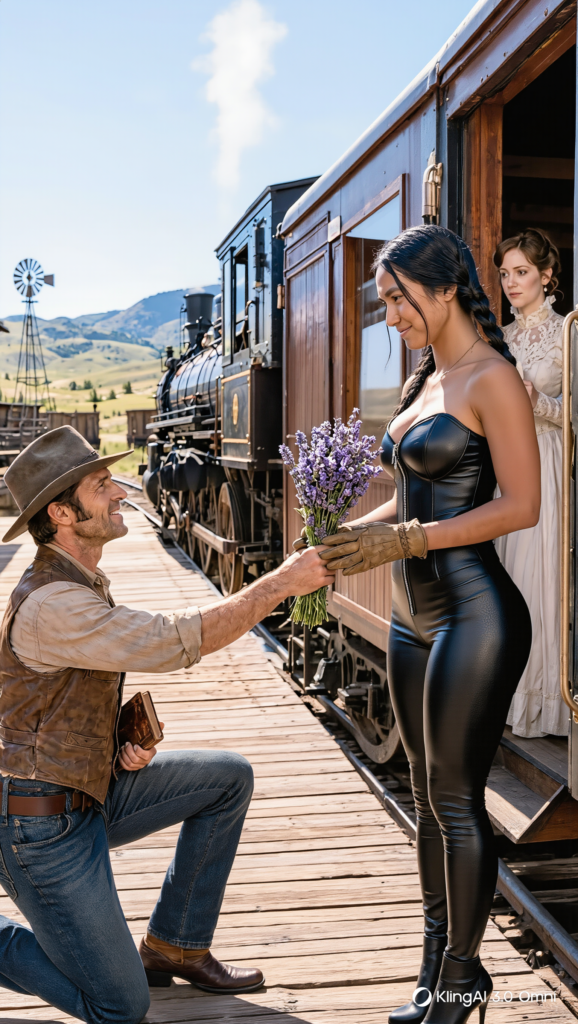
He stopped directly in front of the young woman beneath the cottonwood.
She looked up, startled. “Me?” she asked softly.
“If you’re willing,” Daniel said, with a warm smile. “I’d like to offer you a place on my ranch. Honest work. Honest pay. A roof that doesn’t leak and a door that locks from the inside. And if, someday, you’d want more than that, it would be your choice to make. Not mine. Not anyone’s.”
The square fell silent.
Then the whispers returned, louder than before.
An old rancher named Josiah Brandt shook his head. “Daniel, think hard about this.”
A heavyset farmer folded his arms and said what half the square was thinking. “You chose the wrong Apache bride, Carter. Mark my words. You’ll regret it before the first frost.”
Several people nodded their agreement.
Daniel looked over the crowd without a trace of anger. Then he turned back to the woman. He smiled, held out his hand, and waited.
“You don’t owe these people anything. Choose.”
Seven words.
They landed in the square like a stone dropped into still water. The woman stared at his outstretched hand. In all her years of travel, of being bartered over, turned away, and spoken about as though she weren’t there, no one had ever offered her a choice. Not like this. Not as though her answer were the only one that mattered.
After a long moment, she slowly lifted her hand.
Their palms met.
The whispers stopped. For reasons no one could explain, the entire square seemed to hold its breath.
Daniel didn’t notice what happened on the platform behind him. But an old traveler leaning against the courthouse wall did.
The moment the young woman lifted her face toward the light, Colonel Ashby’s ledger slipped from his fingers and struck the boards. He did not bend to retrieve it. He simply stood there, staring at her, and every drop of color drained from his face. His hand went to his collar as though it had suddenly grown too tight.
For one long second, his eyes met hers.
She did not look away. Something passed across her face then, something cold and steady and very old, and it was the Colonel who broke the gaze first.
The old traveler smiled faintly to himself. In a voice barely louder than the wind, he murmured, “They think he made a mistake.”
He glanced toward the distant hills.
“They have no idea who she really is.”
The ride to Daniel’s ranch was peaceful. The wagon rolled slowly along a winding trail through open prairie, past gentle creeks and stands of cottonwood. For miles, neither of them spoke. The only sounds were the steady clop of the horses and the breeze moving through tall grass. Daniel believed that silence didn’t always need to be filled.
When the sun climbed high, he reached into a basket and handed her fresh bread and a canteen of cool water. “You must be hungry.”
She accepted them with both hands. “Thank you.” Her voice was quiet but sure.
“I realize I never introduced myself. Daniel Carter.”
She looked toward the hills before answering. “My name is Ayanna. My mother said it means one who brings light.”
“It’s a beautiful name,” Daniel said. “I think names often become true, if we’re given the chance to live them.”
For the first time that day, a faint smile touched her face.
By sunset, the ranch came into view: a weathered timber house beside a big red barn, horses grazing in wide green pastures, chickens wandering the yard, and smoke curling gently from the chimney.
An older hand named Samuel Price walked out to meet the wagon. He was gray-bearded and bowlegged from thirty years in the saddle. His eyes moved to Ayanna. “So this is the one the whole territory’s talking about.”
“This is Ayanna,” Daniel said. “She’ll be staying with us.”
Samuel studied her for a moment, then touched the brim of his hat. “If she’s welcome to you, she’s welcome to me.”
Not everyone shared Samuel’s view. Later that evening, a young hand named Billy Royce muttered to another, “I still say the town was right.”
Ayanna heard. She kept carrying her buckets of water without a word.
Daniel noticed everything. But rather than scold anyone in front of the others, he simply went on treating Ayanna with the same respect he showed every soul on the ranch. He had learned long ago that respect, shown steadily, was a louder argument than any speech.
Over the following days, everyone began to notice something unexpected.
Before dawn each morning, Ayanna was already awake. She swept the porch, hauled fresh water, organized the storeroom, and prepared feed for the horses before anyone asked. If a fence had a loose board, she found it. If tools were misplaced, they quietly returned to their hooks.
When a young colt refused to eat after being spooked by a thunderstorm, Ayanna sat beside it for nearly an hour, brushing its mane and speaking softly until the animal relaxed and began to graze.
Samuel watched from the barn door. “Thirty years I’ve worked horses,” he told Daniel. “That colt trusts her more than anybody on this ranch.”
“Animals often see the truth before people do,” Daniel said.
One evening, Ayanna stood on the porch studying the western sky. “We should move the cattle closer tonight,” she said quietly. “Heavy rain before morning. The creek will rise.”
The sky was perfectly clear. Several hands exchanged doubtful looks. Billy Royce snorted.
Daniel simply said, “Then we’ll move them.”
The herd was driven to higher pasture before dark. Just before dawn, black clouds swallowed the valley. Rain fell in sheets for hours, and the creek swelled and overflowed its banks, flooding the low pasture where the cattle had been. Had they stayed, dozens would have drowned.
That morning, Billy Royce walked up to Ayanna with his hat in his hands and his face red to the ears. “Ma’am,” he mumbled, “I owe you an apology.”
Nobody on the ranch laughed at her again.
But something was wrong, and Daniel felt it.
Twice that week, riders appeared on the far ridge at dusk and sat watching the ranch before vanishing. Once, Samuel found fresh boot prints circling the barn, prints from expensive, city-made boots. And Ayanna, who had begun to smile more easily with each passing day, grew quiet again. She started sleeping with a lamp lit. She watched the road.
On the eighth night, Daniel woke to the sound of horses screaming.
He was out the door in his shirtsleeves, rifle in hand, before he was fully awake. An orange glow pulsed against the night sky. The hay shed beside the barn was on fire, flames climbing high into the dark, sparks spiraling toward the barn roof.
“Water!” he roared. “Get the horses out!”
The hands poured from the bunkhouse. For an hour they fought the blaze, hauling buckets from the trough and beating at embers with wet blankets. By the time the fire was out, the hay shed was a smoking ruin. But the barn stood. The horses were safe.
Daniel found Ayanna standing apart from the others, staring at something in the mud near the fence line. He walked over and looked down.
A coal-oil can, lying where someone had dropped it. And beside it, pressed deep into the wet earth, the print of an expensive, city-made boot.
This was no accident.
Ayanna’s face was pale in the firelight. Her hands were shaking. For the first time since he had known her, Daniel saw fear in her eyes.
“I’m sorry,” she whispered. “I should have told you the first day. I thought if I stayed quiet, he would let me be.”
“Who?” Daniel asked.
She turned and looked toward the east, toward Silver Fork, toward the distant glow of lamplight in the windows of the finest house in town.
“The man who stood on that platform,” she said, her voice barely steady. “The man everyone calls Colonel.”
She drew a long, ragged breath.
“Eleven years ago, Daniel, I watched him murder my father.”
PART 2: WHAT THE DEAD MAN WROTE
They sat at the kitchen table while the first gray light crept through the windows. Samuel sat with them, a cup of coffee going cold in his weathered hands. The smell of smoke still hung in the air.
Ayanna spoke for a long time.
“My father was named Nahkeh,” she said. “When I was a little girl, my family kept a camp by the springs in Cedar Valley, east of here. The best water for fifty miles. My father believed that kindness should never depend on where a person came from. Travelers of every kind came to our springs. Settlers with broken wagons. Soldiers who’d lost their way. Families with sick children. My father gave them water and shelter. My mother taught them which plants would heal and which would kill.”
Her voice softened. “She always said every season has something to teach us, if we are patient enough to learn it.”
Daniel listened without interrupting.
“When the government made the treaty for the valley,” Ayanna went on, “my father was one of the men who signed it. The springs were to remain ours. Forever. It was written plainly. The territorial governor signed it himself. My father was given a copy, and he kept it wrapped in oilskin in a cedar box, like something sacred.”
She paused.
“The man sent to carry the treaty to the land office was a militia captain. Rutherford Ashby.”
Samuel set his cup down very slowly.
“He never filed it,” Ayanna said. “He filed a different paper. One he wrote himself, with forged marks. It said my people had sold the springs for a few barrels of flour. And it gave the land to a company owned by Ashby and two partners.”
“Cedar Valley,” Samuel said quietly. “That’s where the Colonel built his fortune. Cattle, water rights, the stage station, all of it.”
Ayanna nodded. “My father rode to the fort to show them the true treaty. Ashby found him first, on the trail. I was eleven. I was hiding in the rocks above the road, because my father told me to stay there and not come out no matter what happened.” Her hands tightened around each other. “I didn’t come out.”
The kitchen was silent.
“They searched him. They searched his horse. They didn’t find the treaty, because he had given the cedar box to me that morning and told me to run if anything happened.” She lifted her eyes to Daniel’s. “I ran. I’ve been running for eleven years. Every territory, every town. Afraid to trust anyone with it. Afraid of who might sell me to him.” A bitter little laugh escaped her. “And then my wagon train came to Silver Fork, and there he stood on that platform, reading names from a ledger like a deacon in church.”
“He recognized you,” Daniel said.
“I have my mother’s face. He looked straight at me.” She reached into the worn cloth bag that never left her side and drew out a small cedar box, its corners rounded smooth by years of handling. She set it on the table between them.
“Everything I own is in that bag,” she said. “But this is the only thing in it worth dying for.”
Daniel opened it carefully. Inside, wrapped in oilskin, lay a folded document, yellowed but intact. The ink had browned with age, but every line was still legible: the terms of the treaty, the boundaries of Cedar Valley, the springs reserved to the Apache families in perpetuity. At the bottom were the marks of the signers, and above them all, in a strong and elegant hand, the signature and seal of the territorial governor.
Beneath it lay a second paper, smaller, in a different hand. A letter written by her father, describing the forged deed, naming Ashby and his partners, and listing the soldiers at the fort who had witnessed the true signing.
Daniel read both twice. Then he looked up.
“This doesn’t just prove he stole a valley,” he said. “It proves every title Ashby’s held for eleven years is built on a forgery. Every mortgage. Every water right. Half the ranches in this county owe money to a man whose fortune rests on a crime.”
“Now you understand,” Ayanna said quietly, “why he set fire to your barn.”
Daniel was quiet for a long time. Then he stood.
“We take it to the federal marshal at Fort Leland.”
“Ashby owns the sheriff,” Samuel warned.
“He doesn’t own the marshal,” Daniel said. “Marshal Eli Harmon answers to Washington, and he’s the stubbornest honest man I’ve ever met. Three days’ ride.”
Ayanna shook her head. “Ashby will be watching every road.”
“Then we don’t take the roads,” Daniel said, and he looked at her. “I’ve seen you read land that the rest of us can’t. Can you find us a way?”
For a long moment she studied him, searching his face for doubt. She found none. Slowly, she nodded.
They left before dawn the next morning, Daniel, Ayanna, and Samuel, riding light. Billy Royce stayed to guard the ranch with the other hands.
Ayanna led them where no trail existed. Up dry washes where their tracks vanished on stone. Across a high plateau by a route only the antelope seemed to know. She read the land the way Daniel read a ledger: a bent branch here meant riders had passed that morning; birds rising suddenly from a distant thicket meant men were waiting there. Twice she turned them aside from routes that looked perfectly safe, and twice, from high ground, they watched Ashby’s hired riders sweep through the very places they would have been.
On the second evening, Ayanna stopped on a ridge and stared at a dark line of clouds massing in the north.
“The river,” she said. “The rain in the mountains will reach the Hollow Creek crossing tomorrow afternoon. If we are not across by noon, we will not cross for a week.”
They rode through the night.
They reached the crossing at dawn on the third day, with the river already rising, brown and fast and muttering against the rocks. Daniel was halfway across, water churning around his horse’s chest, when he heard the shots.
Five riders burst from the trees on the near bank. At their head, on a tall gray horse, rode Colonel Rutherford Ashby himself.
“Carter!” Ashby bellowed over the roar of the water. “That woman is a thief! She stole private property from me eleven years ago, and I have the sheriff’s warrant to prove it. Hand her over and nobody gets hurt!”
Samuel’s horse stumbled in the current. Daniel grabbed its bridle and hauled it forward. Behind them, Ayanna’s mare lost its footing and went down to its shoulders. For one terrible instant, Daniel saw the river close over her head.
Then she surfaced, still clinging to the saddle with one arm. The other was wrapped tight around the oilskin bundle against her chest.
They staggered onto the far bank, soaked and gasping, as bullets kicked up mud around them. Daniel turned his horse and leveled his rifle across the water.
“Come across and get her, Colonel,” he called.
Ashby spurred his gray into the river. His men followed.
And then the water came.
It arrived exactly as Ayanna had said it would, a churning wall of brown floodwater rolling down from the mountains, carrying whole trees before it. Ashby’s horse screamed and spun. Two of his riders were swept from their saddles and dragged downstream, clawing for the bank. The Colonel barely fought his way back to the near shore, soaked and choking, his fine hat gone, his face twisted with rage.
On the far side of the swollen river, out of his reach for a week or more, Daniel Carter tipped his hat.
Marshal Eli Harmon was a lean, gray man with a face like a hatchet and eyes that missed nothing. He read the treaty three times at his desk in Fort Leland. Then he read Nahkeh’s letter. Then he sent a rider to the fort’s records office.
The rider returned at sundown with a dusty ledger. In it, in a clerk’s careful hand from eleven years before, was an entry recording the treaty signing at Cedar Valley, and the names of the officers who witnessed it. Two of those officers were still serving at Fort Leland.
Both remembered the day. Both remembered an Apache leader named Nahkeh. And both remembered that the treaty they had witnessed reserved the springs to his people.
“Never did sit right with me,” one grizzled sergeant muttered, “hearing those folks sold that water for flour. Nobody sells water in this country. Nobody.”
Marshal Harmon closed the ledger and looked at Ayanna for a long moment.
“Miss,” he said quietly, “you’ve been carrying this alone since you were eleven years old?”
“Yes.”
He stood and reached for his hat and gun belt.
“Then you’ve carried it long enough.”
PART 3: THE RIGHT CHOICE
Nine days later, Marshal Harmon rode into Silver Fork with six deputies, two army officers, Daniel Carter, and the young Apache woman the whole town had once whispered about.
They found Colonel Ashby on the courthouse steps, addressing a meeting of the town council. He stopped mid-sentence when he saw them. For a moment, the old confidence flickered across his face, the certainty of a man who had bought his way out of every trouble for eleven years.
Then he saw the cedar box in Ayanna’s hands, and the confidence died.
Marshal Harmon read the charges aloud in the middle of the square: forgery of a federal treaty, fraud against the United States government, theft of reserved lands, arson, and the murder of Nahkeh of Cedar Valley.
The square was utterly silent.
“This is absurd,” Ashby said, but his voice cracked. “The word of a savage girl against an officer of the territorial militia?”
“Not her word,” Harmon said. “The governor’s signature. Your own forged deed in the land office. Two officers of the United States Army who witnessed the true signing. And,” he added, nodding toward the back of the crowd, “one of your own partners, who decided last week that he’d rather testify than hang.”
A thin, sweating man in a banker’s suit stepped forward and would not meet Ashby’s eyes.
The Colonel’s knees gave out. He sat down hard on the courthouse steps, the same steps where he had stood reading names from his ledger like a deacon in church. When the deputies put the irons on his wrists, he did not resist.
As they led him past Ayanna, he stopped. For a long moment he stared at her, an old man now, gray and shrunken.
“You were a child,” he said hoarsely. “I never thought you’d survive.”
Ayanna looked at him with eyes that held no hatred. Only a weariness older than her years.
“My father told me to choose kindness, even when others forget how,” she said quietly. “So I will not wish you suffering. I will only wish that you remember his name for the rest of your life.” She paused. “His name was Nahkeh.”
The trial at Fort Leland lasted four days. The verdict took less than one hour.
In the months that followed, the federal court voided every title Ashby had held in Cedar Valley. The springs were restored to the Apache families, as the treaty had always promised. And the ranchers who had owed Ashby money found their mortgages transferred to an honest bank at fair terms, a mercy many of them had not expected and few of them deserved.
That autumn, eight riders appeared on the ridge above the Carter ranch. An elder with silver braids led them down into the yard. He dismounted slowly and studied Ayanna for a long time without speaking.
Then he smiled.
“Your father was my brother,” he said. “We searched for you for many seasons. When we heard a cowboy had taken in a lonely Apache woman with kindness instead of suspicion, we knew it must be you.” He turned to Daniel. “You honored her family more than you know.”
“I only gave her the respect every person deserves,” Daniel said.
“That,” the elder replied, “is rarer than gold in this country.”
The seasons turned. The ranch grew strong. Ayanna taught the neighbors’ children to read the clouds, to respect every living creature, and to notice the small signs most people walked right past. Ranchers came to ask her advice before planting and before driving cattle. Even those who had once doubted her now greeted her with warm smiles.
On a bright autumn afternoon, Silver Fork gathered for its harvest festival. Long tables groaned with bread, pies, and fruit. Fiddles played. Children raced across the field.
As the celebration reached its height, the new mayor called for quiet.
“A year ago,” she said, “this town believed it could judge a person’s worth before taking the time to know them. We were wrong. And it nearly cost us everything.”
Then an old farmer rose slowly from his bench. It was the heavyset man who had shouted across the square on Settlement Day. He removed his hat and turned toward Daniel, his face flushed.
“I remember what I said that day,” he began. “In front of all of you. I told this man he’d chosen the wrong Apache bride.”
The crowd fell absolutely silent.
The old farmer shook his head slowly. “I was wrong.” He turned to Ayanna, and his voice cracked. “My ranch was mortgaged to Ashby. If not for you, my family would have lost everything this winter. You were exactly the person this valley needed. I’m sorry it took me so long to see it.”
Warm applause rolled across the field like summer thunder.
Ayanna’s eyes filled with tears as she looked at Daniel. She remembered the dusty square, the frightened uncertainty she had carried, and the hand he had held out to her without asking anything in return.
That evening, beneath the old oak on the hill above the ranch, she found him watching the sunset.
“A year ago,” she said, “you told me I didn’t owe anyone anything. That I should choose.”
“I remember.”
“You also said that if someday I wanted more than a place on your ranch, it would be my choice to make.”
Daniel turned to look at her.
Ayanna smiled, the same faint, luminous smile he had first seen on the wagon road, the smile of a woman whose name meant one who brings light. Slowly, deliberately, she held out her hand.
“I choose.”
And this time, it was Daniel who took it.
Long afterward, the people of Silver Fork still told the story of that day. They told it to their children and their grandchildren, and they always ended it the same way:
The whole valley changed in the moment a cowboy smiled, held out his hand, and gave someone the chance to choose.
Sometimes the greatest courage isn’t found in conflict.
It’s found in choosing compassion when everyone else chooses doubt.