PART 1: The Wrong Bride
Beau Tremaine stood on the platform at Sweetgrass Junction, Nebraska, on a bright April morning in 1879, holding a fistful of wild prairie phlox that was already beginning to wilt, about to meet a woman who wasn’t the one he was waiting for.
He’d picked the flowers himself at first light. He wore his only good coat, the dark wool one he’d last worn to his father’s funeral. And the whole ride into town, he’d said her name over and over under his breath, until it stopped sounding like a stranger’s and started to sound like something that belonged to him.
Lavinia. Lavinia Ashford.
The eastbound train rolled in slow, hissing steam across the boards, and Beau searched every window the way a man searches the sky for weather.
A woman stepped down from the second car.
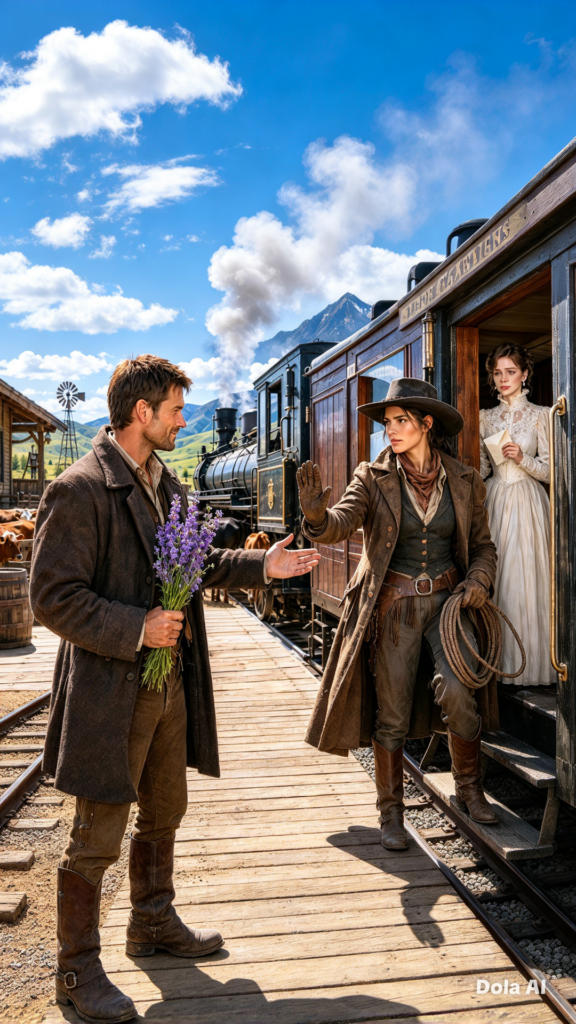
She wasn’t dressed for a wedding. She wore a split riding skirt of faded canvas, worn pale at the knees, a man’s wool coat two sizes too big for her, and leather gloves worn through at the first knuckle. A coiled lariat hung from the strap of her carpetbag, the way another woman might carry a parasol. Her face was sun-browned, her dark braid thick as a rope, her eyes the steady gray of a creek in winter. She looked like a person who’d covered more miles on horseback in her life than on foot.
Beau stepped forward anyway, flowers first, hope doing the thinking for him.
“Miss Ashford?”
The woman raised a gloved hand before he could come any closer. The exact gesture you’d use to stop a runaway calf.
“You bought the wrong bride,” she said.
Four words. Strong enough to bend flowers.
Beau Tremaine stood there on the platform of his own town, in front of half the people he’d grown up with, holding a bouquet for a woman who apparently no longer existed. Somebody snickered over by the freight office. Old Mrs. Pruitt put her hand to her mouth.
And here is the thing nobody in Sweetgrass Junction expected. Least of all the woman in front of him.
He smiled.
He smiled, lowered the flowers, and held out his hand.
“Then I’m glad to meet whoever you are,” he said. “Because you’ve come a long way to deliver bad news in person. And that’s no small thing.”
The woman looked at his outstretched hand as though it were a horse she hadn’t decided to trust. Then, slowly, she pulled off her glove and shook it. Her grip was hard and dry and calloused.
“Henrietta Dalton,” she said. “Folks call me Hank.”
Three days earlier, Hank Dalton had been minding her own business, which was cattle, not other people’s courtships.
She was twenty-six, from the Brazos country of Texas, and she’d spent the last six years driving her father’s cattle north along the rail lines, a job that suited her far better than any parlor ever could. That week she was escorting forty head to a buyer near Sweetgrass, riding the same eastbound train from the Omaha connection, two cars back, busy with her animals and her ledger and certainly not with anyone’s romance.
Lavinia Ashford was very busy with romance. And it was all going wrong.
Lavinia had answered Beau Tremaine’s matrimonial notice from a parlor in Philadelphia six months before, charmed by his letters about wide skies and good grass, which she’d pictured, wrongly, as something like a very large city park. She had written him sweetly all winter. She had packed a trunk full of dresses unsuited to every single task a ranch might ask of her.
And somewhere west of Omaha, watching the trees thin out and the land go flat and enormous and empty of anything she recognized, Lavinia Ashford understood, all at once and completely, that she had made a catastrophic mistake.
She would not get off the train.
She sat frozen in her seat as it slowed for Sweetgrass, staring straight ahead while the conductor pleaded with her and her trunk sat uselessly on the platform. She wasn’t brave enough, she admitted later through tears, to look the man she’d written a hundred letters to in the eye and tell him no.
What she was brave enough to do was grab the sleeve of the most capable-looking woman in the car, who happened to be Hank Dalton, coming back from checking on her cattle in the stock car, and beg her, in genuine desperation, to carry a folded letter to the man waiting outside and explain. Because Lavinia couldn’t bear to see his face when he heard it.
Hank had absolutely no reason to agree. She had cattle to sell, a schedule to keep, and no acquaintance at all with any disappointed rancher in Nebraska.
She agreed anyway. Later, she could never quite explain why, except that somebody had to, and the somebody standing at the door happened to be her.
She meant to hand him the letter and be gone in two minutes.
That isn’t quite what happened.
“There’s a letter,” Hank said, holding it out. “She asked me to give you this instead of telling you herself. I read enough over her shoulder to spare you some of the reading, if you’d rather hear it plain than dressed up.”
“Plain, then,” said Beau.
“She’s not coming. She looked out the train window at Nebraska and decided Nebraska was a lot more Nebraska than she’d pictured. She’s sorry. She means it. I don’t think she’s a bad woman. Just the wrong one for this kind of country. And she figured that out about six hundred miles too late to write it gently. So she sent me to say it gently instead.”
Beau looked down at the sealed letter in his hand for a long moment. Something passed over his face. Not quite grief. Not quite relief. Something honest that lived between the two.
“I’m obliged to you,” he said finally. “Minding your own cattle and somebody else’s heartbreak in the same week. That’s a poor bargain for you.”
“Wasn’t a gift,” Hank admitted. “But I couldn’t let a man stand on a platform with flowers and find out the hard way. Some things deserve to be said to your face. Even if it’s the wrong face saying them.”
She turned to go. She had a buyer waiting and forty head costing her money every hour they stood idle in the pens.
Beau’s next words stopped her cold.
“Miss Dalton. Before you go. You wouldn’t happen to know a hand around here who could use thirty days’ work? Because I’m in a fix a lot worse than a bride who didn’t show. And it turns out it’s the kind of fix where somebody who rides better than she talks might come in useful.”
Hank looked at him properly for the first time. Past the flowers, past the good coat, past the plain disappointment sitting on his shoulders. Something in the request snagged her attention, the way a strange brand catches a stockman’s eye.
“Thirty days for what?”
“To keep a ranch that won’t be mine,” said Beau, “unless I’m married by my thirtieth birthday. That’s the twenty-third of May. Which gives me twenty-nine days, counting from this morning.”
He laid it out for her over coffee at the Sweetgrass Hotel, and it wasn’t romantic at all. It was paperwork. And paper can be the cruelest enemy there is.
His father, Josiah Tremaine, had built the Lone Pine Ranch out of eleven thousand acres of grass and twenty years of sheer stubbornness. He’d died the autumn before, leaving a will that every lawyer in the county described as the work of a proud man determined to run his son’s life from the grave.
The ranch would go to Beau entirely, the will said, provided he be married and settled with a household of his own before his thirtieth birthday. If not, the ranch would be split down the middle, half of it going to Beau’s cousin, Mortimer Tremaine. A man who had never pulled a calf or mended a fence in his life, but who had been corresponding quietly and often, for six months now, with an agent of the Union Pacific Railroad.
“My father thought a wife would settle me down,” Beau said. “Mostly I think he was afraid of exactly what’s happening now. Mortimer means to sell his half the minute the deadline passes. To the railroad, or a cattle syndicate, or whoever pays most. And once outside money owns half the Lone Pine, the rest of it, my half included, will be swallowed in two years. I’ve watched it happen to three ranches in this county. I don’t mean to watch it happen to a fourth.”
“So you put a notice in the papers for a wife,” said Hank. “Like ordering seed from a catalog.”
“I’m not proud of how I went about it,” Beau admitted. “But I’ve got twenty-nine days before I lose the only thing my father ever built. And pride is a luxury I can’t afford this spring.”
Hank sat over her cooling coffee and studied him the way she’d study a horse before buying: legs, teeth, and temperament all at once.
“You’re asking a stranger you met forty minutes ago to marry you,” she said. “That’s a good deal more than asking for thirty days’ help.”
“I’m asking a stranger I met forty minutes ago to help me save a ranch,” Beau said. “How that help gets written down, on paper or otherwise, is a conversation for later. And only if you’re willing to have it.” He turned his cup slowly in his hands. “I was engaged six months to a woman I never laid eyes on, and it came to exactly nothing. I’m not fool enough anymore to think a wedding fixes anything that isn’t already true underneath. But I’ve got twenty-nine days. And I’d rather spend them working beside somebody honest than waiting on somebody who already sent a stranger and a folded letter to tell me she didn’t want this life.”
It was, Hank thought, very likely the strangest proposal ever made over a cup of lukewarm hotel coffee.
It was also, strangely, one of the most honest conversations she’d ever had with a man.
“I’ve got a buyer waiting on forty head,” she said. “I can give you two days while I settle that. After that, I answer to my father’s outfit. And they aren’t expecting me to marry a Nebraska rancher on my way home from selling steers.”
“Two days is a start,” said Beau. “I’ve learned to work fast this spring.”
Whatever Hank Dalton had expected of the Lone Pine Ranch (and she’d pictured something sagging and desperate, to match a man reduced to ordering a wife by mail), the truth surprised her.
The house was solid. The fences were tight. The herd was fat on spring grass. And the four hands, grizzled men who’d ridden for Josiah Tremaine ten years or more, watched her ride in with the guarded courtesy of men who meant to see whether a newcomer could actually work before deciding whether to like her.
She settled that question by sundown. She roped a lame heifer out of a bog on her second throw, and bound up its leg herself, better than the foreman could have done it. By supper, the four men had stopped calling her ma’am in that cool, polite way, and had started calling her ma’am the way you address someone who has earned the word.
Beau watched all of it with an expression Hank caught twice and couldn’t quite name. Not surprise exactly. Something closer to recognition. The way you listen to a tune you can’t name, but know you’ve heard before.
Two days stretched, honestly and without any fuss on either side, into four. Then a week. There was real work to be done, and Hank found herself in the thick of it: sorting, branding, riding fence with a skill that made the thirty-day arrangement feel less like charity and more like a partnership neither of them had quite named aloud.
In the evenings, they sat on the porch with the lawyer’s letters and the will spread out between them, plotting like two people solving a puzzle rather than two people falling in love.
Which, Hank noted privately, was probably the safest way to go about it. If it was going to happen at all.
Mortimer Tremaine rode out on the ninth day.
He was a soft, pale man in a fine city suit, sitting a rented horse as though it might bite him. He didn’t bother to hide his displeasure at finding a capable stranger working cattle, instead of a heartbroken bachelor waiting out the clock.
“Word in town is your bride never showed, cousin,” Mortimer said, without dismounting. His eyes slid over Hank the way a man studies a horse he means to have disqualified on a technicality. “And that whoever this is, she’s some drover’s daughter you scraped off a cattle car for the occasion. A judge will want to know whether any wedding is genuine, Beau. Or just a piece of paper to beat a deadline. I’ll make sure he asks.”
“Let him ask,” said Hank, before Beau could open his mouth. Her voice was the one that had loaded forty nervous steers onto a stock car without ever once being raised. “I’ve branded more calves on this place in nine days than you’ve branded in your whole life, Mr. Tremaine. You go on and tell your judge that a woman who can rope, doctor, and keep the books isn’t a real wife because she came in on a cattle car instead of a parlor car. I expect he’ll have his own opinion about which one of you understands what a marriage on a ranch actually means.”
Mortimer had no ready answer. He rode off a good deal less certain of his railroad money than when he’d arrived.
Beau looked at her a long time after the dust settled.
“You didn’t have to fight that fight,” he said. “It’s mine.”
“It’s ours,” said Hank. Then she heard what she’d said, and didn’t take it back. “If I stay past thirty days. Which I’m starting to think about.”
It was the first time either of them had said the word stay out loud. Neither of them made anything of it.
But they both noticed.
Mortimer didn’t go back to town that night.
Just past midnight, Hank woke to a sound she’d heard only twice in her life, and both times it had meant somebody would die.
A low, rolling thunder. Not from the sky. From the ground.
She was out of bed and into her boots before she was fully awake. Through the window, under a thin slice of moon, she saw the herd. All eight hundred head, pouring down off the north pasture in a single black, roaring river, straight toward the creek bottom and the hay barns and the bunkhouse where four men were sleeping.
And on the ridge above the pasture, she saw two riders, black against the stars, firing pistols into the air.
Stampede. And somebody had started it on purpose.
She was in the saddle before Beau even reached the porch. She didn’t wait for him. A stampede doesn’t wait for anyone.
She drove her horse hard along the edge of the herd, shouting, waving her hat, trying to bend the lead steers away from the bunkhouse. The ground shook. Dust rose so thick she could barely see her own hands. Somewhere behind her, she heard Beau’s voice yelling her name.
The lead steers began to turn. She’d done it. They were bending, curving away from the bunkhouse toward the open flats.
Then her horse stepped in a prairie-dog hole.
She felt the sickening lurch. She felt the horse go down beneath her, and the ground rush up, and the breath leave her body as she hit the earth hard.
She rolled onto her back, gasping, and lifted her head.
Eight hundred head of cattle were thundering straight toward her through the dark, horns lowered, so close she could feel the ground buck beneath her shoulders. And she couldn’t make her legs work.
PART 2: The Stitch
She would never remember exactly how he reached her.
She only remembered a shape coming out of the dust and the darkness, a horse driven so hard it was screaming, and an arm sweeping down to grab her by the back of her coat. Then she was off the ground, slammed across the front of a saddle, and the horse was turning, turning, as the first steers thundered past so close she felt the wind of their horns.
Beau held her there against the saddle with one arm, steering with the other, riding flat out across the face of the stampede until they broke free onto the open flats.
When the herd had finally run itself out against the creek bank, and the dust had settled, and the stars came back, he slid down from the saddle and lifted her to the ground. His hands were shaking.
“Are you hurt?” His voice was rough. “Hank. Are you hurt?”
“I don’t think so.” She tried to stand and her knees gave out. He caught her. “My horse—”
“Your horse is up and limping. He’ll mend.” He was holding her by both shoulders now, staring at her face in the moonlight as though memorizing it. “I saw you go down,” he said. “I saw you go down right in front of them, and I thought—”
He didn’t finish. He didn’t have to. He pulled her against his chest and held her there, and she could feel his heart hammering, and her own hammering back.
They stood like that for a long time, out on the empty flats, while the four hands rode up and quietly turned their horses away to give them their privacy.
The foreman found the spent cartridges on the ridge the next morning. And a fine leather glove, the kind no cowhand would ever wear. It had been dropped in the grass beside the hoofprints of two rented horses from the livery in town.
Nobody could prove whose glove it was.
Nobody needed to.
A letter reached Hank on the twelfth day, forwarded from the buyer’s office in Sweetgrass. It wasn’t the kind of letter that made staying any easier.
It was from her father. He was glad the cattle had sold well. And he mentioned, in the same steady voice he used for everything from branding schedules to bad news, that Garrett Hale had come by the house twice that month asking after her. That Garrett ran a solid outfit two counties over. And that a man who asked after a woman twice in one month while she was eight hundred miles from home deserved a serious answer, one way or the other.
Her father had never told her what to do. Not once. He simply laid the facts out on the table the way he laid out tack before a long ride, and let her choose what she was riding toward.
Hank read the letter on the porch steps twice, then a third time. Beau came out to check the evening stock, saw her face, and had the wisdom not to ask.
She wrote back that night by lamplight and tore up two drafts before she let the third one stand.
She told her father the truth, because lying to him hadn’t worked once in twenty-six years and she saw no reason to start now. She told him about the wrong bride, and the thirty days, and a rancher who’d offered her honest work instead of sweet promises, and a ranch that seemed, God help her, more worth fighting for every single day. She told him Garrett Hale was a good man, and that she couldn’t promise him anything, because she didn’t yet know what she was promising herself.
Near the bottom of the page, she wrote this:
You always said a person should choose the hard truth over the easy comfort. I don’t know yet if this is the truth. I only know it isn’t the easy road. And for once in my life, that doesn’t scare me.
Mortimer didn’t come back to the ranch.
He went to the county seat. Which was worse.
He filed a petition with Judge Ezra Quill, a circuit judge sent out specially from Kearney, asking that any marriage made just before the deadline be examined for what he called, in carefully chosen legal language, a lack of genuine intent. And he had his witnesses lined up: the station agent, who would swear the bride everyone expected had never gotten off the train; the hotel clerk, who would swear a different woman entirely had taken a room that same afternoon.
It was an unreasonable petition dressed in reasonable words. Which was exactly what made it dangerous.
“He isn’t wrong about the facts,” Beau said, reading the papers at the kitchen table with a grimness Hank hadn’t seen in him before. “He’s only wrong about what they mean. A judge who doesn’t know either of us will read this and see exactly what Mortimer wants him to see. A rancher panicking over a deadline. A woman paid to step off a train.”
“Nobody’s paying me anything,” said Hank.
“I know that. You know that. A stranger reading a file at a desk in Kearney doesn’t.” Beau rubbed his eyes. “The hearing’s set for the twenty-first. Two days before the deadline. If Quill decides the marriage was made in bad faith, the whole condition fails. Whether we’re married by the twenty-third or not. And Mortimer gets his half, clean.”
Hank was quiet a long while.
“Then we’d better give the judge something truer to look at than a file full of facts laid out crooked,” she said finally. “Facts told honest generally beat facts told clever. I’ve seen it happen at cattle auctions more times than I can count.”
She didn’t say what she hadn’t yet admitted even to herself: that the facts had stopped feeling arranged somewhere around the ninth day.
Somewhere around a stampede in the dark, and a man who rode straight into it to reach her.
They had started to feel simply true.
Nine days before the hearing, Hank sat on the porch by lamplight, mending a saddle blanket the stampede had torn. Her needle flashed through the canvas in a quick, familiar pattern she’d sewn a thousand times without ever thinking about it.
A line of tiny stitches in blue thread. Which, if you looked closely, made a row of little five-pointed stars.
Across the porch, Beau looked up from the lawyer’s papers in his lap.
And went completely still.
“Where did you learn that stitch?” he said. His voice had changed entirely.
“My mother,” Hank said, not looking up. “She sewed it on everything. Saddle blankets, coats, my brothers’ shirts when they tore. She used to say a plain patch was an insult to good canvas.” She glanced up, saw his face, and stopped. “Beau? What’s wrong?”
The papers slid off his lap onto the porch boards. He didn’t notice.
“Nothing’s wrong,” he said slowly. “I think something might finally be right. And I can’t quite believe it yet.”
He stood up. He was looking at her the way a man looks at a ghost.
“Winter of ‘76,” he said. “The Western Trail, north of the Platte. The worst blizzard anybody on that drive had ever seen. Does any of that mean something to you?”
Hank’s needle stopped moving.
PART 3: The Coat in the Trunk
To understand what happened next, you have to go back three winters, to a blizzard that neither of them knew, until that moment, they had shared.
In the winter of 1876, Beau Tremaine had been riding with his father’s outfit on a late drive up the Western Trail, pushing eight hundred head north against everyone’s advice and against weather that had no business turning so fast.
The storm came down off the plains with almost no warning. A wall of white that swallowed the sun in twenty minutes. Beau, chasing a break in the herd, was separated from the outfit and thrown when his horse plunged into a drift he never saw.
He lay in the snow long enough to stop feeling his hands. Every man on that trail knew what came after that.
What saved him was a stranger. A young cowgirl riding drag for another outfit a mile to the east, who saw a riderless horse circling in the storm and went looking, guided by nothing but instinct and pure stubbornness.
She found him half-buried. She built a fire out of buffalo chips and sagebrush with hands as frozen as his. She wrapped him in her own coat and blanket, and she stayed awake through the worst of the night, making him talk, so he wouldn’t drift off into the sleep that men don’t wake from.
In the gray hour before dawn, when the wind finally dropped, she heaved him up onto her horse, led him three miles to a line shack, built a second fire, and was gone before sunrise. Without ever giving her name. Because she had eight hundred head of somebody else’s cattle scattered across the blizzard, and a job to finish.
Beau Tremaine had spent three years trying to describe that night to people who hadn’t lived it, and never once managed to.
He remembered the coat most of all. An old canvas thing, too big for her, mended at one shoulder with a line of unmistakable blue stitches, sewn in the shape of tiny stars.
He remembered a voice that never once let fear into it, even after his own had started to give out.
He couldn’t clearly remember her face. Cold takes faces first and gives them back last.
He had searched for her for a year, at every ranch within three hundred miles. Nobody claimed her. Finally, he stopped asking, and put the memory away the way you put away a coat too painful to wear and too precious to throw out.
Until a woman stepped off a train in Sweetgrass Junction, telling him she was the wrong bride.
“There was a rider,” Hank said quietly. Her whole manner had changed. “Thrown and half frozen. Alone. I never knew his name. Didn’t have time to ask. Didn’t figure I’d ever see him again to need it.” She was searching his face now, adding years back onto it, the way you age a photograph in your mind. “I gave him my coat. The old canvas one. I got him to a line shack and left before dawn, because I had cattle scattered halfway to Kansas.” Her voice dropped to a whisper. “That coat had my mother’s stitching on the shoulder.”
“I still have it,” Beau said.
He went inside. She heard the lid of a trunk open in the back room.
When he came back out onto the porch, he was carrying a folded bundle of old canvas, faded and worn. He shook it out in the lamplight.
A big, ugly, too-large drover’s coat. And on the left shoulder, a mended tear, stitched over with a line of tiny blue stars.
Hank stood up slowly. She reached out and touched the stitches with her fingertips, the way you’d touch something you’d lost and never expected to see again.
“I couldn’t ever part with it,” Beau said. “I’ve carried it in that trunk three years.”
She looked up at him. Her eyes were wet. Hank Dalton, who hadn’t cried in front of anyone since she was nine years old.
“You saved my life without ever telling me your name,” Beau said, his voice unsteady. “And three years later, I found you on a train platform, and the very first thing you ever said to me was that I’d bought the wrong bride.”
He almost laughed. The sound that came out was something else entirely.
“Henrietta Dalton,” he said, “I don’t think you were ever anything but exactly the right one.”
The hearing on the twenty-first lasted eleven minutes. Eleven minutes too long, as it turned out, because Judge Ezra Quill, a plain, unsentimental man by every account, was moved in spite of himself.
Mortimer’s lawyer laid out the timeline just as it had been filed: a missing bride, a stranger off a cattle train, a marriage of convenience arranged against a deadline. It was a tidy story.
It fell apart the moment Beau Tremaine stood up, without being asked, and laid an old canvas coat on the judge’s bench.
He told the court about a blizzard in 1876. About a young woman who’d found a stranger dying in the snow, and kept him alive all night with her own coat and her own voice, and vanished at dawn without asking for anything in return. About the coat with her mother’s stitching on the shoulder, folded in a trunk for three long years. And about how he’d found her again on a train platform, by the purest chance, three weeks ago.
Then he asked the judge whether a marriage built on a debt three winters old, and a rescue that never expected repayment, looked to him like a fraud. Or like the truest thing that had ever happened to either of them.
Judge Quill examined the stitching on the coat’s shoulder for a long time. Then he asked Hank Dalton exactly one question.
“Do you love this man, Miss Dalton? Apart from any ranch, any deadline, or any cousin’s ambitions?”
Hank stood. She looked at Beau. Then she looked back at the judge.
“I loved the shape of him before I ever knew his name, Your Honor,” she said. “The ranch is just where I finally caught up with him.”
The petition was dismissed.
Mortimer Tremaine left the courthouse a good deal poorer in prospects than he’d come in. Two years later, he sold off his own failing business interests to a cattle syndicate for far less than the railroad would ever have paid him. Which, everyone who knew him agreed, was a kind of arithmetic justice that suited him exactly.
They were married on the morning of the twenty-third, Beau’s thirtieth birthday, in the yard of the Lone Pine Ranch, with the four hands as witnesses and a circuit preacher who asked no questions he didn’t already know the answers to.
Hank’s father arrived on the morning train, just in time, gruff and silent and wiping his eyes with the back of his hand when he thought nobody was looking. He shook Beau’s hand for a long time. Then he said only one thing.
“Her mother would have liked you, son. She always said the stars on that stitch were for luck.”
Hank wore her canvas riding skirt to her own wedding, patched at the knee with a fresh line of tiny blue stars. Because a woman doesn’t stop being the one who saved her husband in a blizzard just because the wedding finally caught up with the rescue.
The old canvas coat still hangs in the front hall of the Lone Pine Ranch, its mended shoulder stitched with little blue stars.
Neither of them has ever seen a reason to put it away.
And every winter, when the first storm comes howling down off the plains, Beau Tremaine takes it down from its peg, wraps it around his wife’s shoulders, and holds her by the fire until the wind dies down.
Just the way she once held him.