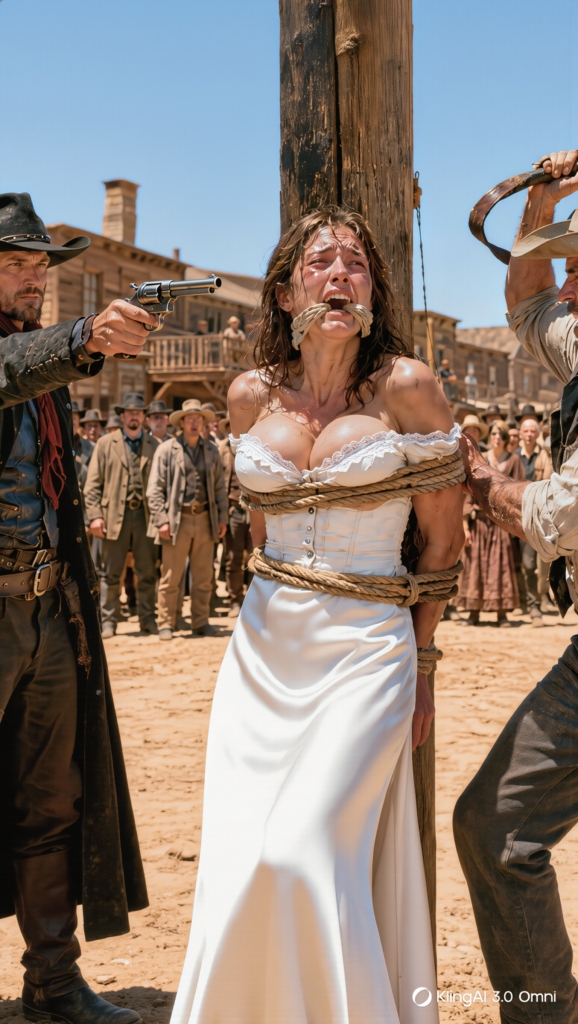
PART 1: Forty Pounds
The cold came down on Bitter Ridge like a judgment.
It had rolled in overnight from the north. It was the kind of cold that settled into the bones and stayed. The mud of Main Street was frozen hard at the edges and black and treacherous in the middle, and the sky above the rooftops was the dull gray of old pewter. Outside Calhoun’s saloon the horses stood with their heads low and their tails tucked against the wind.
Thomasina Ward came down the steps of Hattie McCord’s boarding house carrying everything she owned. That was how it always ended in these towns.
She owned very little. She had a cracked brown carpet bag with a broken brass latch, which she had tied shut with rawhide. Inside were a spare calico dress, a tin coin box with a dented lid, and her father’s ledger, worn thin at the spine. For eight years she had moved from boomtown to boomtown, and every season the bag got lighter.
She was thirty years old. She was broad-shouldered and stout and stood two inches taller than most women. Her plain face reddened in the cold, and she had learned to keep it turned toward the ground. People called her Sini, the ones who bothered to call her anything.
Hattie McCord was waiting on the boardwalk with her arms crossed. She was a narrow-faced woman with small bright eyes that missed nothing and forgave less, and she had already drawn a crowd before she opened her mouth.
“Thief.”
Sini stopped at the bottom of the steps. “I haven’t stolen anything.”
“Three dollars and forty cents out of my till. I counted it myself.”
“Then you counted wrong.”
Someone laughed outside the saloon. Sini didn’t look over. Years ago she had learned that looking only made it worse.
Hattie grabbed the carpet bag by its handle and swung it out over the street like a sack of feed. The rawhide gave way. The bag burst open in the air. The calico dress landed in the mud, the coin box spun under the boardwalk, and her father’s ledger slid face-down into the slush.
Hattie dusted off her hands as if she had finished a chore.
More people gathered. Wranglers drifted out of the alley by the feed store. A big man in a sheepskin coat grinned beneath his mustache in front of the barbershop.
Sini breathed once, then again. Then she stepped down into the mud and knelt to gather her things.
People always took the kneeling for surrender. They never understood that the ledger had to come out of the slush before its pages warped, and there was no one else to pick it up. There had never been anyone else.
Her fingers had just closed on the ledger when a boot came down on them.
It came down slowly and on purpose, with a man’s full weight behind the heel. The young wrangler had a red kerchief and a broad chest and the confidence of a man with friends at his back and someone helpless at his feet.
“What’s the matter, sweetheart? Fingers too fat to hold onto what ain’t yours?”
The laughter that followed was real, which made it the worst kind. A few women across the street turned away.
“Look at the size of her, boys,” the sheepskin man called. “No wonder Hattie’s floors are soft. She’s been renting to a grizzly.”
Sini kept her eyes on the mud. Heat climbed her neck, and she hated that her body betrayed her where everyone could see it. Still she made no sound. Silence was the one possession nobody had ever been able to take from her.
Then she heard a small, dry, mechanical click.
It was the hammer of a revolver being drawn back.
The laughter stopped all at once, as if someone had pinched out a candle. Above her the wrangler went rigid.
Sini raised her eyes.
A tall man stood behind the wrangler in a trail-worn oilskin coat and a hat that had seen a great deal of weather. His face was lean and weathered, his jaw set with a stillness that looked less like patience than like a decision made long ago and never revisited. The barrel of a Colt .45 rested against the back of the wrangler’s ear.
“Take your boot off her hand.” His voice was low and steady, like a river in a dry season. It was not a question.
The boot lifted.
“Leave her alone.”
He held the gun there for three full seconds, long enough for every man on the street to understand that he was not bluffing. Then he let the hammer down gently and holstered the Colt. He walked past the wrangler without looking at him and crouched in the mud. He picked up her father’s ledger, turned it over, and wiped the cover clean with his sleeve, working the slush out of the corners with care.
He held it out to her.
She took it and stood up by herself, because no one offered her a hand and she had stopped expecting one long ago. Then she looked him in the eye, because she didn’t know what else to do.
His eyes were gray, the gray of a mountain sky before snow. He wasn’t looking at her with pity, or with the embarrassed sideways glance people use on something uncomfortable. He was looking at her the way a man looks at something when he is judging what it is actually worth.
“You’ve got two good legs to stand on, ma’am,” he said. “Walk with me. I need someone who knows accounts and isn’t afraid of a hard winter.”
“Cole Colton!” Hattie snapped from the boardwalk. “You’ve got no business—”
“You threw a woman’s belongings into the street in front of witnesses, Mrs. McCord.” He didn’t even turn his head. “I’d find somewhere else to put my mouth.”
Hattie went inside and shut the door hard.
“You don’t know me,” Sini said.
“I know Sam Greer at the feed store. You corrected his inventory twice without being asked and found him thirty dollars he’d written off.” He picked up her coin box and handed it to her. “I’ve got four years of freight receipts I can’t make sense of, and a suspicion somebody’s been stealing from me through them. A woman who fixes another man’s books and doesn’t take credit isn’t after the money. She’s after the problem.”
Sini looked down at the ruined bag in the frozen mud. She thought about the next town. There was always a next town, another boarding house and another round of whispers.
She shook the mud from the calico dress, stuffed it through the broken latch, and put the ledger under her arm.
“I’ll need to see the freight receipts,” she said.
Iron Creek Ranch sat in a fold of land where the creek bent west. It was low and wide, built of timber gone dark with age, and it showed the small neglect of a man who had kept everything else running and had no one to notice the little repairs. A porch rail had come loose. A shutter hung crooked.
His foreman Levi was rawboned, gray-mustached, past fifty, and suspicious by long habit. He looked her over once. “This the one you went to town for?”
“She’ll handle the accounts,” Cole said. “She’s in the house. Second room on the left.”
Levi led the horse away without another word.
Inside, the big table had disappeared under paper. There were loose receipts, ledgers splayed open with their spines cracked, unanswered letters, and an overturned inkwell that had stained a corner of a freight bill. It was the record of a man who had stopped filing things and started simply surviving them.
“Don’t move anything yet,” Sini said. “How they’re piled tells me something.”
Before she touched the papers, she scrubbed out the kitchen, which badly needed it. She cleared the cold ash from the hearth and built a fire. She found dried herbs behind the flour sack and put a venison stew on the stove. At noon Levi came in from the barn, saw the fire and the clean hearth, smelled the stew, and stopped in the doorway. He said nothing. But he finished his bowl and wiped it clean with cornbread, and that was answer enough.
She worked through the afternoon and into the dark. Cole came and went. At some point he set a cup of coffee at her elbow without a word, and she drank it cold an hour later without noticing.
By nightfall she had four years of freight receipts sorted by date. She had copied two columns into her father’s ledger. The first held Cole’s weights, recorded at the ranch before each shipment left. The second held the weights that Thaddeus Sterling’s brokerage had billed against.
When Cole came in with the cold, she turned the ledger toward him.
“Your weights. Sterling’s weights.” She ran her finger down the gap between them. “Forty pounds. Every head, on every shipment, for two years.”
He frowned. “Scale error.”
“Scale error goes both ways, sometimes over and sometimes under. This never moves. One steer forty pounds short is a mistake. Every steer forty pounds short for two years is a decision.” She tapped the page. “Forty pounds isn’t an accident, Mr. Colton. Forty pounds is a rate. It comes to about fourteen hundred dollars from you alone. And Sterling handles freight for every ranch within forty miles.”
Cole put both hands flat on the table and looked up at the ceiling for a long moment. When he looked down again, his usual stillness was still there, but something harder lay under it now.
“Can you prove it?”
“For you, yes. For the valley I’ll need other ranchers’ books.”
“The McAllisters will show you theirs. The Hendersons too.”
“Then that’s where we start.”
He took his hat from its hook, turned it once in his hands as if he meant to say something more, and went out to the barn.
Later, from her window, she saw lantern light in the barn door. Cole was standing at the workbench with a drawknife, shaping a long curve of oak with slow, patient strokes.
In the morning the mounting step on the buckboard sat four inches lower. Someone had reset the bracket in the night so it met her stride. Nobody mentioned it.
When she came inside, a new chair stood at her end of the table. It was oak, wide in the seat and solid in the back, built for a woman of her size. Carved into the backrest was a small flowering prairie cactus, every petal cut with care.
She sat in it. It fit her exactly.
She didn’t thank him, and he didn’t bring it up. A language was growing between them that worked mostly below words: the lowered step, the coffee at her elbow, the space kept clear around her work. Sini was beginning to think it was the most honest language anyone had ever offered her.
That night, alone at the table with the lamp turned low, she opened the back pages of her father’s ledger for the first time in years.
James Ward had been a railway freight clerk in Rawlins. Eight years ago he had found something wrong in the railway’s accounts and reported it through the proper channels. Six weeks later a weighing platform gave way beneath him. It was ruled an accident, and nobody ever looked at what he had found.
She had never been able to read those last pages. Grief had sealed them shut.
Tonight she turned them.
The column headings were in his careful hand: Shipment. Recorded weight. Billed weight. Discrepancy. The pattern was the same one she had spent the day building. It came from a different industry and a different state eight years earlier, but it was the same formula. The skimmed money flowed into a land company under another name.
Below the columns he had listed the company’s principals.
At the top of the list, underlined twice, was T. Sterling.
Sini sat very still. Her hands did not shake. She had done all her shaking eight years ago, in a cold rented room in Rawlins, twenty-two years old and completely alone.
She was reaching for her pen when she smelled smoke.
It wasn’t the hearth. The hearth smelled of pine and ash. This was raw and sharp, it came from the wrong direction, and it was growing stronger.
She was at the window in four steps.
The storage annex on the east side of the barn was burning along its roofline, orange light pulsing through the gaps in the planks.
Inside it, on a shelf by the east wall, sat the iron strongbox. It held every receipt, every page of evidence, and every proof she had gathered.
Out in the dark, beyond the reach of the firelight, a rifle hammer clicked back.
PART 2: What the Fire Couldn’t Burn
She tied her bandana over her nose and mouth and ran.
“Gus! Levi! Fire!”
Gus burst from the bunkhouse toward the pump. Levi came around the far side of the barn with buckets. The cattle in the main barn were bellowing in panic.
Sini went through the annex door.
The smoke was a rolling black ceiling, and she dropped beneath it. Near the floor the air was thin but just breathable. She trailed one hand along the wall and counted her steps, because the smoke had taken her sight completely. Overhead the rafters groaned, a low, sustained sound that told her the fire had reached the beams. A burning plank crashed down beside her. She flinched and kept moving.
Eight steps. Her hand found the shelf, then crates, a tool roll, more crates, and then cold iron.
She hauled the strongbox against her chest and turned back toward the door.
A shot came through the east wall and struck the beam six inches above her head.
She flattened herself to the dirt floor, hugging the box. She dragged herself forward on her elbows while burning debris rained down. She shoved the door open with her shoulder and scrambled into the snow. She was three yards clear when the roof came down behind her, a deep, concussive crash that threw sparks into the dark like stars falling upward.
Then her legs stopped working.
She sat down hard in the snow. Breathing had become difficult, like drawing water through a pinched pipe. Something burned along her left side below the arm. She looked down at a tear in her coat and pressed her hand over it, and her hand came away dark.
Gus dropped to his knees beside her.
“The box,” she rasped, holding it out to him. “Don’t let go of the box.”
Then she heard Cole’s voice, raw, shouting her name across the yard. He had come in from the road at a gallop and was off the horse before it stopped. He crossed the yard in four strides and knelt in front of her with his hands on her face.
“I’m here,” she said.
For the first time, his composure was gone entirely. “Sini. Look at me.”
“It grazed me,” she said. She was nearly sure. “I can breathe. It’s just hard.”
He carried her inside himself and set her in the oak chair. He sent Gus for Dr. Pike and Levi to watch the yard, and his voice steadied again because it had to. His hands on her side were careful in a way that was anything but calm.
“You went back in,” he said.
“The box needed to come out.”
He looked at her for a long moment with something in his eyes he wasn’t saying. Then he went back to checking the wound.
“He sent men to burn it,” Cole said quietly. “He knows what’s in there.”
“Then he’s afraid of it.” She set her palm on the iron lid. “That’s useful. It means what we’ve built is worth being afraid of.”
Then she told him about the back pages of her father’s ledger, the name underlined twice, and the weighing platform in Rawlins.
“This isn’t only about Iron Creek anymore,” she said. “It’s about finishing what my father started.”
Cole didn’t answer. He reached across the table and laid his hand over hers on the strongbox, and he kept it there.
Dr. Gideon Pike arrived before dawn. He was a small, precise man in wire spectacles who had been woken for emergencies so many times that urgency and routine felt the same to him. “Two cracked ribs. The lung is clear. Three days of rest, and no riding.”
By then the crew had caught the arsonist trying to slip out through the east corral.
He was Danny Pratt, the quiet seventeen-year-old stable hand hired for the winter. When Sini came out into the yard, holding her coat closed because she couldn’t lift her arm into the sleeve, Levi was standing over the boy with a coil of rope in his fist.
“Go back inside, Miss Ward,” Levi said.
“In a minute.” She looked at the boy. “Tell me.”
His story came out in pieces. One of Sterling’s men, a red-bearded brute named Walt Decker, had visited Danny’s widowed mother. Decker claimed she owed forty dollars on her boarding-house lease and said she would go before the magistrate for fraud unless it was paid. She didn’t have ten dollars. Danny could make the debt vanish, Decker told him, by setting a little fire, just to scare people. Nobody would get hurt.
“I didn’t know they’d shoot anyone,” Danny whispered. “I swear.”
Sini turned to Levi. “Put the rope down.”
“Miss Ward—”
“Put it down, Levi.”
He looked at Cole. Cole gave the smallest nod. The rope dropped into the snow.
“Hang him,” Sini said, her voice carrying across the cold yard, “and you become Sterling. Justice isn’t blood on a rope. It’s tearing down the lie that bought his fear.” She looked back at Danny. “Your mother’s debt was made up. It’s the same trick Sterling uses on every ranch in this valley: find where it hurts and press. You made a terrible choice, and you’ll carry it. But the man who arranged it is the one who’ll answer for it. Will you tell the truth in front of a territorial judge?”
The boy looked at her as if he were waiting for the ground to give way beneath him and couldn’t understand why it held.
“Yes, ma’am.”
Inside, Pike had heard everything through the wall. “Thirty years I’ve watched this valley,” he said quietly. “Mob justice fills graveyards and solves nothing. I sit on the elder council, Miss Ward. With proper documentation, we have standing to bring a formal complaint to the Territorial Land Authority.”
The blizzard came the next day. For three days Iron Creek Ranch was a small circle of firelight inside a moving wall of white.
On the first evening Cole set an unloaded .38 on the table beside her papers.
“You held a panicked horse under rifle fire on the north road,” he said. “You ought to be able to hold this.”
He stood behind her and set her grip one finger at a time. “Both eyes open. You want the whole picture. Squeeze on the exhale. The body is stillest right after the breath goes out.” His arms came around her, and his calloused hands closed over hers on the gun. The storm battered the walls. The fire was warm on one side of her, and he was warm at her back, and she made herself concentrate on the knot in the far wall.
She exhaled and squeezed. The hammer fell with a dry click on the empty chamber.
“Again,” he said.
Later she noticed how he favored his left shoulder in the cold. She made him sit and rubbed tallow into the old shrapnel scar from his cavalry years. While she worked, he told her about his wife. Four winters ago influenza had come through the valley while he was snowed in at the north line cabin for three days. When he got home it was too late for any medicine to help.
“I’ve run that arithmetic a thousand times,” he said. “It always comes out the same.”
“The answer doesn’t change,” she said softly. “That doesn’t mean you chose wrong. It means the situation was bigger than the choices you had.”
On the second night she opened the old almanac to its freight tables and called Levi and Gus to the table.
“Words and numbers on paper are a hangman’s noose if you can’t read them yourself,” she said plainly. “Learning this isn’t pride. It’s how you keep the shirt on your back.” She wrote out weight times rate equals payment and taught them until both men could check a freight bill from scratch. Levi sounded out the first sum slowly and got it right. He didn’t smile, but his mustache moved.
When the roads cleared, the valley came to her table.
Frank McAllister brought his receipts, short thirty-six or thirty-eight pounds a head. Under his liability waiver was a buried clause that signed away his right to challenge Sterling’s weights at all. His renewal, due within the month, added a property lien hidden in its insurance language.
Ruth Henderson came with her gray braid and a fourteen-year kitchen log. Her husband had weighed every animal on their own scales before Sterling ever touched it. “This,” Sini told her, “is the most important document on this table.” Henderson’s shortage ran close to fifty-five pounds a head. In his renewal, three dull administrative lines shifted the Apprentice Creek boundary twenty yards south. That would put the valley’s summer water on the wrong side of a legal line, onto land Sterling’s Denver holding company meant to foreclose. The fake freight debt charged to Henderson matched, to the dollar, a deed payment recorded in a Denver letter.
“He made you pay for your own land,” Sini said.
Ruth Henderson looked at her for a long moment. “You finish this,” she said. It was all she asked.
When the master ledger was nearly done, Sini went to her room. Her hands pulled the carpet bag out from under the bed before she knew what they were doing. Eight years of habit told her that when a chapter ended, you packed your bag before someone made you leave.
She had the calico dress half folded when Cole spoke from the doorway.
“What are you doing?”
“I don’t know,” she said, which was the most honest answer she had given in years.
He crossed the room in three strides and took both her wrists in his hands, firmly enough to leave no room for argument.
“You aren’t running from this valley, Sini,” he said, low and certain. “And you sure as hell aren’t running from me.”
She looked at the bag. She thought about the lowered step, the oak chair, and the coffee that kept appearing at her elbow. She thought about a man tearing through burning timber in the dark to reach her.
She put the dress back on the washstand and pushed the bag under the bed.
“All right,” she said.
PART 3: The Reckoning
The Bitter Ridge autumn cattle sale filled the town to its edges with stockmen and buyers. Hundreds of head bellowed in the pens at the south end of town.
Sini wore her deep indigo wool dress, the one thing she owned that wasn’t calico. She carried her father’s ledger under her arm and Pike’s leather document case in her hand. People turned to watch her ride in beside Cole. This time they weren’t mocking her. They were deciding whose side they were on.
Cole’s forty-two prime steers entered the ring at half past ten, and the bidding opened strong.
Then Thaddeus Sterling raised his hand from the auctioneer’s platform. He was a big man with a broad, well-groomed face and a silver watch chain, and four hired guns stood on the steps below him.
“These animals are impounded,” he boomed, “for an outstanding freight debt of four hundred and twelve dollars owed by the owner of Iron Creek Ranch.”
The sale ground went quiet.
Sini walked forward through the crowd, and it parted for her. Cole moved in half a step behind her with his hand resting near his holster. Levi and Gus came up on either side of them. Then, without anyone signaling, the McAllisters and the Hendersons and a dozen other ranch families stepped out of the crowd and stood behind her.
“That debt is invented,” Sini said. Her voice reached the back fence without her raising it. “Mr. Sterling’s brokerage has falsified the freight weights of every ranch within forty miles for four years. I have it documented to the receipt.”
Ruth Henderson raised her kitchen log high.
Dr. Pike stepped forward. “The elder council filed a formal complaint with the Territorial Land Authority yesterday. This sale will continue.”
Sterling’s hand went into his coat.
Cole’s Colt was out and cocked before the hand came back. “Keep your hands where I can see them.”
Sterling did the arithmetic and raised his empty hands. Sheriff Briggs brought him down off the platform.
At noon, before a territorial land commissioner, Sini climbed onto the same platform and opened the master ledger.
She made it simple on purpose, because complication had always been Sterling’s best weapon. “Scale error goes both ways,” she told the crowd. “Sterling’s error went one way, every time. It was always short on the rancher’s side.” She called each ranch by name, and one by one its family came forward and laid its records on the clerk’s table. She watched shame reverse itself in public. These were people who had been made to feel that their confusion was their own failing.
Then she read her father’s name aloud, and the name of the weighing platform in Rawlins. She described the same formula, moved to a new place and renamed, running eight more years because the man who first wrote it down had not lived to finish.
Sterling lunged up from the bench with a hideout revolver and aimed it at her.
Cole fired, and his bullet went through Sterling’s palm.
In the chaos Walt Decker slashed the rope on the east pen. Four hundred terrified cattle poured into the crowded sale ground. Sini braced herself against the platform table as the stampede thundered past below in a river of hide and horn and choking dust. She lost sight of Cole. Then she heard his voice cut through the noise, steadying the riders on the fence, and she could breathe again.
Through the thinning dust she saw a red kerchief.
It was the wrangler who had ground his boot into her hand in the frozen mud. He was creeping up behind Cole with an iron pry bar raised over Cole’s head.
Sini drew the .38 from her coat. She had carried it every day since the blizzard broke.
Both eyes open. Aim for the leg, because she meant to stop him, not kill him. She exhaled, and squeezed.
The wrangler went down hard with a bullet through the thigh, and the pry bar clattered across the steps.
Cole spun around. He took in the man on the ground and the pry bar, and then he looked up at her standing on the platform with the gun still level.
“Both eyes open,” she said.
It was the nearest thing to a smile she had seen on him all morning.
The commissioner’s clerk had protected the documents through the whole stampede, clutching them like his own life. The commissioner closed the folder.
“Miss Ward, in twenty-two years this is the most thorough evidence I have seen. Your father would recognize the standard.”
Sini looked down at the old handwriting in the ledger.
“He set the standard,” she said. “I just finished the column.”
A federal marshal arrived within ten days. Sterling’s license was revoked and his Denver holding company was seized. The Apprentice Creek transfer was voided, Frank McAllister’s foreclosure was withdrawn, and six homesteads received restitution. When Ruth Henderson read her family’s figure aloud, her husband sat down and didn’t speak for a full minute. Danny Pratt’s mother received the dismissal of her false debt in writing, under seal.
Cole asked Levi to build a new room where the annex had burned. It had wide east windows for the morning light and deep shelves along the south wall. Sini opened the door at seven on a December Tuesday and left it open. She charged nothing. People came from across the valley, then from the next county, carrying contracts they were afraid to sign. They walked out understanding them. Some days Danny Pratt sat at the end of the table working through the almanac’s freight tables, and his arithmetic was getting better.
Then Sini filled the old carpet bag with dark garden soil, the bag with the broken latch she had carried out of town after town. She pressed in seeds from the hardy prairie cactus that grew along the creek and set the bag on the porch rail in the southern sun. By January green shoots had pushed through.
On a Sunday evening, while gold winter light ran across the valley, Cole came up behind her on the porch. He took her coffee cup, set it on the rail, and folded his arms around her waist as he had during the storm, though this time there was no gun and no lesson.
“Town fools saw a stranger to mock,” he murmured into her hair. “I saw the woman who saved this valley. And a few other things besides.”
She laid her hands over his and leaned back against him.
“You were a reasonable student,” she said, “once you stopped fighting the instruction.”
She felt him exhale against her hair, nearly a laugh. In three months she had not heard him come closer to one, and she counted it.
The sun went down over the Wyoming range. On the porch rail the old carpet bag sat full of dark earth, its green shoots reaching for the last of the light.
It wasn’t going anywhere. It was planted, and so was she.