PART 1: THE WOMAN IN THE SNOW
The first snow of winter drifted over the Wyoming frontier like scattered feathers, soft and deceptive. An icy wind moved down the valley, bending the dry grass and whispering of a season that would test every ranch and every family between the Laramie Range and the Wind River.
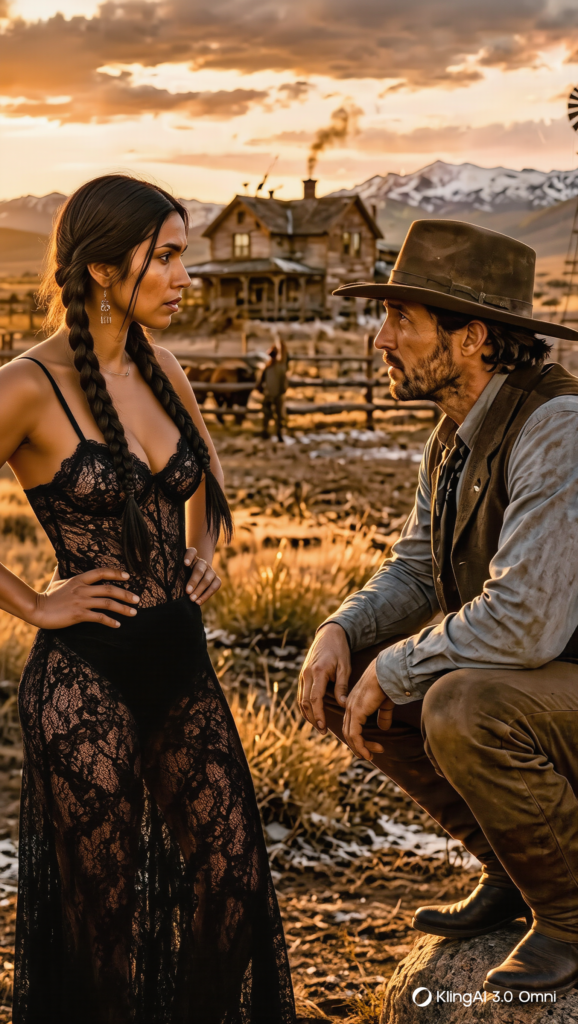
At the edge of that quiet valley stood the Carter ranch. It wasn’t the largest spread in the territory, nor the richest. But Ethan Carter had built it on three things his late father had taught him: honesty, discipline, and respect. Men who worked for him trusted his decisions, even when they didn’t understand them.
They were about to be tested on that.
That afternoon, Ethan rode the north fence line, checking for damage before the next storm. He was thirty-five, lean and quiet, with gray eyes that missed little. Behind him in the house waited his eight-year-old niece, Lily, the daughter of his late sister, the last of his family in the world.
His horse, a steady black gelding named Ranger, slowed near a cluster of frozen cottonwoods and snorted.
Ethan saw it then: what looked like a fallen blanket half-buried in a drift.
Then the blanket moved.
He was out of the saddle in a heartbeat, sweeping away the snow with both hands. Beneath it lay a young Apache woman, perhaps twenty-six, her lips blue, her black hair frozen into stiff ropes. Her moccasins were worn through. Her hands, when he touched them, were cold as river stone.
Her eyes opened. Tired. Wary. Ready to fight with whatever strength was left.
“You’re safe,” Ethan said gently. “Let me help you.”
For a moment she hesitated. Life had clearly taught her to distrust strangers, especially men like him. But the cold had stolen her last reserves. When she tried to rise, her knees buckled.
Ethan wrapped his heavy sheepskin coat around her shoulders and lifted her onto Ranger’s back. They rode home through the graying dusk, the wind already sharpening its teeth.
The ranch hands gathered at the barn as he rode in. Six men in all: old Gus Mahoney, the grizzled cowhand who’d worked the Carter range for thirty years; the Pruitt brothers, Sam and Eli; a quiet Mexican vaquero named Mateo Reyes; seventeen-year-old Tommy Bell, the youngest; and the foreman, Red Dawson.
Dawson was a big, sunburned man with a scar through one eyebrow and a voice that carried. He stepped forward, frowning.
“Who’s that?”
“Someone who needed help,” Ethan said.
Dawson’s eyes narrowed at the woman’s braids, her beaded collar. “Boss, we got barely enough work and barely enough grub to see us through to spring. Now you’re bringing home strays?”
Ethan met his gaze without raising his voice. “There’s always room for kindness, Red.”
Dawson spat into the snow and turned away. But Ethan saw the look that passed between him and the Pruitt brothers, and he knew this wasn’t finished.
Inside the house, the woman thawed slowly beside the fire, wrapped in quilts. Lily watched her from the stairs with enormous curious eyes. When Ethan handed her a bowl of hot stew, she held it with both trembling hands and ate with silent gratitude.
When she finished, she spoke. Her English was quiet and precise.
“My name is Ayana.”
She told them she had been traveling with a small band of her people, crossing the mountains to their winter grounds. Eleven days ago, in a sudden squall, she had been separated from them in a high pass. She had searched for days. She had found nothing but snow.
Ethan listened without interrupting. When she finished, he leaned forward.
“You can stay here as long as you need,” he said. “I could use a cook. Our last one quit in October. But on this ranch, everyone earns their place.”
“I will earn it,” she said simply.
Lily crept down the stairs and sat beside her. “Do you know how to make biscuits?” she asked.
For the first time, Ayana smiled. “I know how to make many things.”
The next morning, before the roosters stirred, the kitchen was already warm. The men stumbled in from feeding the horses to the smell of fresh bread, hot coffee, and buttermilk biscuits so golden and light that even Gus Mahoney paused in the doorway.
But good food doesn’t open closed hearts.
The men ate politely and said little. They didn’t speak to her unless they had to. Dawson didn’t speak to her at all. When she set his plate down, he pushed it an inch away before picking up his fork, a small, deliberate insult.
Ayana never complained. She worked from before dawn until long after dark: cooking, mending, scrubbing, hauling water. Only Lily followed her everywhere, chattering, and only Mateo and young Tommy ever thanked her.
On the third afternoon, carrying buckets from the well, Ayana stopped and looked toward the mountains.
Thick clouds were piling up above the snowy peaks, gray-bellied and heavy. The wind had shifted from west to north. And there was a strange silence in the valley. No birds. No elk bugling on the ridges. Even the cattle in the far pasture had bunched together, heads low.
Ayana knew that silence. She had heard it once before, eleven winters ago, and it had cost her nearly everything she loved.
Something cold settled deep in her heart.
The following morning began in an eerie hush. Horses stamped restlessly in their stalls. The milk cow refused to let down. Lily’s old hound, Biscuit, wouldn’t leave the porch.
Ayana stepped outside with a basket of bread. The air bit her face. Tiny ice crystals rode the wind, stinging like sand. She closed her eyes and listened.
Then she hurried inside.
Ethan was in the storeroom counting sacks. “Mr. Carter,” she said calmly, “a very great storm is coming. Not an ordinary winter storm. A killing one.”
He studied her. “The sky looks rough. But we’ve had rough before.”
“This is more.” She held his gaze. “The animals know. The wind knows. We should prepare while there is still time. Tonight will be too late.”
Ethan had spent his life reading weather and men. He knew the difference between fear and knowledge. What he saw in her eyes was knowledge.
He gathered the hands in the yard.
“We’re bringing in extra firewood today,” he announced. “Every water barrel filled. Cattle moved into the near pasture by the windbreak. Enough feed in the barn for every animal for a week.”
Gus and Mateo nodded and moved at once. Tommy followed. But the Pruitt brothers exchanged smirks, and Red Dawson laughed out loud.
“A week? Boss, with respect, she’s been here four days. Now she thinks she knows these mountains better than men who’ve worked ’em twenty years?”
“She’s right about the wind, Red,” Mateo said quietly.
“She’s a cook.” Dawson’s voice rose. “This snow’ll be gone by Sunday. We’re gonna break our backs because some half-froze squaw had a bad dream?”
The yard went silent.
Ethan’s voice was very low. “You’ll call her by her name, Red. And you’ll haul wood like I told you.”
Dawson’s jaw worked. Then he grabbed an axe and stalked off. But Ayana had heard every word. She said nothing. She simply went back to her kitchen and kept working.
All afternoon, she cooked. Great pots of bean soup and venison stew. Extra loaves of bread, cooled and wrapped. Strips of squash and onion drying over the stove. She filled every kettle, every bucket, every jar in the house with clean water.
Young Tommy watched her. “Why so much water, ma’am?”
“If the well freezes,” she said, “or if the doors are buried and no one can reach it, you will be glad of every drop.”
Tommy looked at the full jars, thoughtful. Then he went out and brought in two more barrels without being asked.
By evening, the wind had become a roar.
Snow fell in thick, blinding sheets, erasing the paths in minutes. The fences sank. The cottonwoods bent nearly double. The supply wagon from Laramie, expected before sundown with flour, coffee, sugar, and lamp oil for the winter, never came.
Ethan stood on the porch staring into the wall of white. “They should’ve been here by now.”
“They turned back,” Ayana said beside him. “No one with sense would cross the valley tonight. Or they did not turn back,” she added softly, “and we will not see them until spring.”
Darkness came early. At supper, Eli Pruitt went to the pantry for another sack of flour and came out scowling.
“There’s a flour sack missing. And a slab of bacon. They were here this morning.”
Every head turned toward the stove, where Ayana stood stirring the pot.
Red Dawson set down his spoon slowly. “Well, now,” he said. “Ain’t that interesting. Four days she’s here, and our grub starts walking off.” He stood, his chair scraping. “Where’d you hide it? You fixin’ to run off back to your people with our winter stores?”
“Red,” Ethan warned.
“No, Boss! We’re about to be snowed in with God knows how much food, and you’ve got a thief in the kitchen!” Dawson jabbed a finger at Ayana. “I say she goes. Tonight.”
“Into that?” Tommy blurted, pointing at the window, where the storm howled like a train. “She’ll be dead in an hour!”
“Then she should’ve thought of that before she stole from us.”
Ayana set down her spoon. Her voice was calm, but something hard glinted beneath it.
“I took nothing that belongs to you.”
“Then where is it?”
Before she could answer, the whole house shook. A gust hit the walls like a battering ram. Somewhere out in the dark, a horse screamed. Then another. Then came the splintering crack of wood.
“The corral!” Mateo shouted.
The men grabbed coats and lanterns and plunged out into the storm. Ethan went with them. They fought through snow up to their thighs, half-blind, roped to nothing, staggering toward the sound of panicked horses. A section of corral had blown down. Three horses had broken loose. It took nearly an hour of shouting and stumbling in the white dark to drive them back into the barn.
When they finally fought their way back to the house, faces raw and white with frost, Gus Mahoney leaned against the door, gasping.
“Couldn’t see the barn from ten feet,” he said. “Thought I’d lost the house for good.”
Ethan looked across the room at Ayana. She was calmly placing another log on the fire.
“This is only the beginning,” she said quietly.
No one laughed this time.
Then Ethan looked around the room again, and his heart stopped.
“Where’s Lily?”
Silence.
He took the stairs three at a time. Her bed was empty. Her quilt was gone. Her little boots were gone from beside the door.
And Biscuit, the old hound, was gone too.
Tommy went white. “She… she was crying when we went out. About the horses. About Biscuit, he got out when the door blew open. She asked me if he’d freeze.” His voice cracked. “I told her to stay inside. I told her.”
Ethan was already pulling on his coat, his face a mask of terror. “She went after the dog.”
“Boss, you can’t see your own hand out there!” Gus grabbed his arm. “You’ll walk in circles and die twenty feet from the porch!”
“She’s eight years old, Gus!”
Outside, the blizzard screamed louder than ever, a solid wall of white fury, swallowing the barn, the yard, the whole world.
And while every man in that room stood frozen in horror, the quiet Apache woman they had called a thief took a coil of rope from the wall, tied one end firmly to the porch post, knotted the other around her own waist, and opened the door into the storm.
“Hold the rope,” she said to Ethan. “Do not let it go.”
And she walked into the white, and vanished.
PART 2: THE ROPE
The door slammed shut behind her, and for a moment, no one breathed.
Ethan stood with the rope in his hands, feeling it pay out through his fingers, foot by foot, into the screaming dark. Each tug made his heart lurch. Each pause stopped it.
“She’s mad,” Eli Pruitt whispered. “She’ll never find her.”
“Shut up, Eli,” said Mateo.
Ten feet. Twenty. Forty. The rope kept moving, steady and deliberate. Then it went slack.
Ethan’s breath caught. “Ayana!” he roared into the crack of the door, knowing she couldn’t hear.
A long minute passed. Then two.
Then the rope jerked: three sharp tugs.
“Pull!” Ethan cried. “Everybody, pull!”
Six men grabbed that rope and hauled. It came in slowly, heavily, as though dragging something against the wind. At last a shape stumbled out of the white onto the porch: Ayana, her hair caked in ice, her face torn raw by the wind, and in her arms, wrapped in her own shawl, a small, shivering body.
Lily.
And trotting at her heels, half-frozen but wagging, came old Biscuit.
Ethan tore the child from her arms and crushed her to his chest, sobbing openly. Lily was crying too, her little hands blue. “I’m sorry, Uncle Ethan, I’m sorry, I just wanted Biscuit…”
“Where?” Ethan choked, looking at Ayana. “Where was she?”
“The old root cellar behind the smokehouse.” Ayana sank onto the bench by the door, gasping. “She lost the house. She found the cellar door and crawled inside. It was the wisest thing she could have done.” She looked at the girl, and her eyes softened. “Your little one has good instincts.”
“How did you find her in that?”
“The dog,” Ayana said simply. “I listened for the dog.”
They warmed Lily by the fire: not too close, not too fast, as Ayana instructed, rubbing her hands and feet gently with warm, not hot, cloths. “Too much heat too soon will hurt her more than the cold,” she said. Within the hour, the color returned to the child’s cheeks, and she fell asleep in Ayana’s lap, clutching a fistful of her calico sleeve.
Ethan knelt before them both. He tried to speak and couldn’t.
Ayana only nodded. She understood.
Across the room, Red Dawson stood silent by the wall, staring at the floor.
The next morning came with almost no light.
The snow fell without mercy. Wind hammered the house until every wall groaned. The windows showed nothing but white. The well was buried under six feet of drift. Every jar and barrel of water Ayana had filled the day before was now the only water they had.
Ethan gathered everyone around the long dining table.
“We stay calm,” he said. “No one leaves this house unless it’s life or death. We work together. We look after each other.”
Gus went to the pantry to take stock, and came back slowly, holding something.
A flour sack. And wrapped beside it, a slab of bacon.
“Found ’em,” he said quietly. “In a tin bin under the bottom shelf. Sealed tight against mice and damp. Along with dried beans, salt, and coffee.”
Every eye turned to Ayana.
“I moved them yesterday morning,” she said calmly. “Before anyone thought a storm would come. My grandmother taught me: always keep a hidden store. When hunger comes, people eat what they can see first. What they cannot see, they save.”
The room was silent. Eli Pruitt turned red to the ears.
Red Dawson looked at the flour sack for a long moment. Then he looked at Ayana. Something worked in his throat, but no words came out. He turned away.
Ayana didn’t wait for an apology. She stepped forward.
“From now on, we cook only what each meal needs,” she said. “The flour, the beans, the dried vegetables must last until the roads open. That could be one week. It could be three.”
No one argued. She divided the stores into careful portions, enough to keep strength up, never enough to waste. Even the Pruitt brothers could see she was planning not for days, but for weeks.
Late that afternoon, a tremendous crash shook the house.
They rushed to the windows. Through a brief tear in the blowing snow, they saw the stable roof sagging in the middle, half collapsed under the weight of the drifts.
“The horses!” Tommy shouted.
Ethan grabbed his coat. “I’m going.”
“Not like last night,” Ayana said, stepping in front of him. “Not all together, running blind. Too many men in deep snow only tire each other. Take three. Rope yourselves together, waist to waist. Tie the end to the porch. If one falls, the others pull him up. If one loses his way, the rope brings him home.”
The room fell silent. Her advice was simple. But it made sense, the kind of sense men forget when they’re afraid.
Ethan nodded. “That’s exactly what we’ll do.”
Within minutes, Ethan, Mateo, and Red Dawson stepped into the storm, roped together. The wind tried to knock them flat, but they reached the stable. Inside, terrified horses kicked at their stalls. Working together, they shored up the broken beam with fence posts and moved the animals to the sturdier end of the barn.
On the way back, Dawson slipped into a drift up to his chest. The rope snapped taut. Ethan and Mateo hauled him out, sputtering, before the snow could close over his head.
When they stumbled back inside, white from head to foot, Dawson sat by the fire for a long time, shaking. Finally, without looking up, he spoke.
“That rope,” he muttered. “That was her idea.”
“It was,” said Ethan.
Dawson said nothing more. But that night, when Ayana set down his plate, he didn’t push it away.
That evening, the fire became the heart of the house. Everyone gathered close as the storm howled outside.
Ayana showed them how to hang damp clothes so they would dry without stealing heat from the room. She told them to keep one great fire burning in the main hearth rather than many small ones, saving precious wood. She stuffed rags into the door cracks and showed Tommy how to bank the coals at night so they’d burn till morning.
Each suggestion was practical. Each made life a little easier.
And slowly, something began to change.
Men who had ignored her now asked her opinion. Mateo asked her how her people kept meat through winter. Tommy asked about the stars. Even old Gus, rubbing his stiff fingers, admitted it gruffly.
“We’d have burned half our wood and eaten half our grub by now without you, ma’am.”
Lily, curled on the hearth rug with Biscuit, looked up. “Ayana, how do you know all this?”
The fire crackled. For a long while, Ayana didn’t answer. When she did, her voice was very quiet.
“Eleven winters ago, my people were caught in a storm like this one, in these same mountains. We were forty-two. We came down from the pass, half frozen, and found a ranch. Warm windows. Smoke from the chimney.” She stared into the flames. “We knocked. The rancher came to the door with a rifle and told us to move on. He said he would not feed thieves.”
The room had gone perfectly still.
“We walked on into the storm. By morning, my mother was gone. My two little brothers. Eleven of our people in all.” Her voice did not break, but her hands tightened in her lap. “My grandfather saved the rest of us. He found an old hunter’s shelter in the rocks east of here and kept us alive for nine days. Everything I know, I learned from him in those nine days.”
She looked up then, straight at Red Dawson.
“When you called me a thief, I had heard those words before.”
Dawson’s face had gone gray. He stood abruptly and went to the window, staring out into the dark, his broad shoulders trembling. No one spoke.
Ethan looked from one to the other, and a terrible suspicion took shape in his mind. But he said nothing.
Not yet.
The fourth day of the blizzard tested them all.
The snow finally stopped falling, but the wind kept scouring the valley, piling drifts to the eaves. The pantry shelves were growing thin. Every meal was smaller than the last. Lily had developed a cough that worried Ethan more than he would say. The lamp oil was nearly gone.
That night, Ethan spread a map across the kitchen table.
“Road to Laramie is buried,” he said. “Even if we tried, we’d never make it. Forty miles.”
Ayana studied the map. Then she shook her head and placed one finger on a blank stretch east of the valley.
“We do not need the road.”
Everyone looked at her.
“The shelter my grandfather found. It is here, among the rocks, a half-day’s walk east. My people still leave stores there every autumn, for anyone caught by winter. Flour. Beans. Blankets. Lamp oil. Medicine.” She hesitated. “If it still stands.”
Eli Pruitt looked skeptical. “After eleven years? How can you be sure?”
“I cannot be sure,” Ayana said honestly. “But it is our best chance.”
Ethan folded the map. “Then we trust your memory.”
Before dawn the next morning, Ethan, Mateo, and, to everyone’s surprise, Red Dawson prepared for the trek. Dawson had volunteered without a word.
Ayana drew the route for them on paper: a line of tall lodgepole pines visible above the snow; a frozen creek that bent like an elbow; a rocky hill shaped like a resting horse.
“Do not hurry,” she told them. “Stay together. Watch the wind. If you cannot see the next landmark, stop and wait until you can. Fear makes men rush. Wisdom makes them slow.”
Ethan hugged Lily goodbye. The little girl coughed into his collar. “Come back,” she whispered.
“I promise.”
They set out into the gray dawn, three dark figures roped together against an endless white.
All that day, the people in the ranch house waited. Ayana kept the fire burning and Lily wrapped in quilts by the hearth, spooning broth between her lips. The hours crawled. Noon came. Then afternoon.
And in the late afternoon, the sky to the north turned black.
Ayana went to the window and her face changed. Gus saw it and felt his blood run cold.
“What is it?”
“The storm,” she said. “It is not over. It was only resting.” She turned, and for the first time since she’d come to the ranch, they saw fear in her eyes. “And they are still out there.”
Darkness fell. The wind rose again to a shriek. Snow drove sideways against the glass.
Ethan, Mateo, and Red Dawson did not come home.
At midnight, Lily woke, burning with fever, and called for her uncle.
Ayana knelt beside her and stroked her hair. Then she stood, took down her shawl, and reached for the rope.
“Ma’am,” Gus whispered, “you can’t. Not this time. Not that far.”
Ayana tied the knot at her waist.
“Eleven winters ago,” she said, “no one opened a door for my family. I will not leave anyone out in the dark.”
PART 3: WHAT THE STORM REVEALED
She did not go far into the storm. She was too wise for that.
Instead, Ayana climbed onto the barn’s hayloft roof, roped to the eaves, and did what her grandfather had done eleven winters ago. She built a fire in an iron washtub packed with lamp-oil rags, pitch pine, and the last of the kindling, and she kept it burning against the screaming wind, a single orange beacon in an ocean of black and white.
Gus and Tommy took turns at the base of the ladder, handing up wood. Hour after hour, she fed the fire. Her hands blistered. Her face was rubbed raw. Twice the wind nearly tore her from the roof.
She did not come down.
Out on the eastern flats, half a mile from the house, three men had been crouching behind a drift for hours, lost. The landmarks had vanished in the second storm. They had found the hunter’s shelter and its stores, exactly as Ayana promised, but on the way back, the world had disappeared around them.
Mateo’s hands were frozen. Ethan could barely feel his feet. Red Dawson had wrapped both of them in the blankets from the shelter and given up his own coat.
“If we stop,” Dawson said hoarsely, “we die.”
“If we walk the wrong way, we die,” Ethan answered.
Then Mateo grabbed his arm. “Boss. Look.”
Through a brief tear in the storm, low on the horizon, a speck of orange flickered.
Then it was gone. Then it came back.
Ethan’s heart leapt. “That’s the ranch.”
They walked toward that tiny light for two hours, losing it, stopping, waiting, finding it again, exactly as Ayana had taught them. If you cannot see the next landmark, stop and wait until you can.
At four in the morning, Tommy Bell heard shouting in the yard. He threw open the door, and three snow-caked men staggered onto the porch dragging a sled piled with sacks.
Flour. Beans. Lamp oil. Blankets. And a small leather pouch of willow bark and herbs.
Ayana came down from the roof so frozen she could barely climb. She took the pouch from Ethan’s hand without a word, brewed a bitter tea from the willow bark and herbs, and spooned it slowly between Lily’s lips.
By dawn, the fever had broken.
Two days later, the storm finally released its grip.
The sun rose over the snow-buried hills, bathing the frozen land in soft gold. The wind fell still. The silence that followed felt almost holy.
One by one, the hands stepped outside to look. Fences had vanished beneath the drifts. Trees had lost limbs. The stable needed a new roof. But every person and every animal on the Carter ranch had survived.
Within a week, neighbors from the nearby ranches began working their way across the valley on snowshoes. They were stunned to find the Carter place standing and everyone alive. Two other ranches had lost cattle. One had lost a man.
“We didn’t think anybody could live through that,” said old Josiah Barlow from the next spread, shaking his head.
Ethan smiled and looked toward the house. “We didn’t survive on luck.”
Everyone turned as Ayana stepped onto the porch carrying a basket of fresh bread. She stopped, startled to find every eye upon her.
Ethan walked to her side.
“When this storm started,” he said, loud enough for everyone to hear, “most of us thought Ayana was just our cook. Truth is, she became our teacher, our guide, and the reason every one of us is still standing here today. She found my niece in the storm. She found us in the dark. She kept us fed when we would’ve starved.”
The ranch hands lowered their heads in quiet respect.
Then Red Dawson stepped forward.
The big man’s hat was in his hands, and his scarred face was pale. He stood before Ayana for a long moment before he could speak.
“I judged you before I knew you,” he said hoarsely. “I called you a thief. And that wasn’t the first time I said it.” He swallowed hard. “Eleven years ago, I was a hand on the Whitlow place, up the north valley. I was the one who went to the door with old man Whitlow that night. I held the lantern while he told your people to move on.”
A murmur rippled through the crowd. Ayana’s face did not move.
“I’ve heard those children crying in my sleep for eleven years,” Dawson whispered. “I told myself they were thieves, so I wouldn’t have to think about it. And when I saw you, I hated you, because you made me remember.” Tears ran down into his beard. “I was wrong. I was wrong then and I was wrong now. And there’s nothing in this world I can do to make it right. But I’m asking your forgiveness anyway.”
The silence stretched until it seemed the whole valley was holding its breath.
Ayana looked at him for a long time. When she finally spoke, her voice was gentle.
“Out in the storm, you gave your coat to the others. Mr. Carter told me.” She paused. “My grandfather taught me that respect is earned through actions. We cannot change yesterday. But we can choose how we treat one another today.”
She held out her hand.
Red Dawson took it in both of his and wept like a child.
In the weeks that followed, everyone worked side by side, repairing fences, rebuilding the stable roof, and helping the neighboring ranches that had suffered. No one asked where anyone came from. They only cared that every helping hand made the community stronger.
And in the first week of spring, as the snow began to melt from the high passes, a small band of riders appeared on the eastern ridge.
Ayana dropped the bucket she was carrying.
Her people. Her grandfather’s brother, gray and stooped. Her cousins. The little group she’d lost in the pass months ago, alive. They had sheltered in the rocks all winter, praying for the daughter they believed the mountains had taken.
The reunion that followed in the Carter yard brought tears to every eye on that ranch, even old Gus Mahoney’s.
That evening, Ethan found Ayana on the porch, watching the sunset paint the snowy mountains gold and violet.
“I suppose you’ll be going with them,” he said quietly.
Ayana didn’t answer right away. Through the window behind them, Lily was laughing with Tommy as Biscuit begged at the table. Red Dawson was carefully setting out plates for the visitors, his big hands gentle.
“My people winter in these mountains,” she said at last. “The Carter ranch is on our road.” She turned and looked at him, and there was a warmth in her eyes he had never seen before. “Perhaps a kitchen here could use a cook who knows when the storms are coming.”
Ethan smiled. “This ranch could use a lot more than a cook.”
“I know,” she said softly. “I am not only a cook.”
“No,” he said. “You never were.”
As the snow melted and spring returned to the valley, the story of that winter spread far beyond the mountains. People no longer remembered the great blizzard only for its danger. They remembered it for the truth it revealed.
Real courage is often quiet. Real wisdom often goes unrecognized. And sometimes the person everyone underestimates becomes the one who holds the rope when everyone else has let go.
From that winter on, no one on the frontier ever called Ayana “just the cook” again.