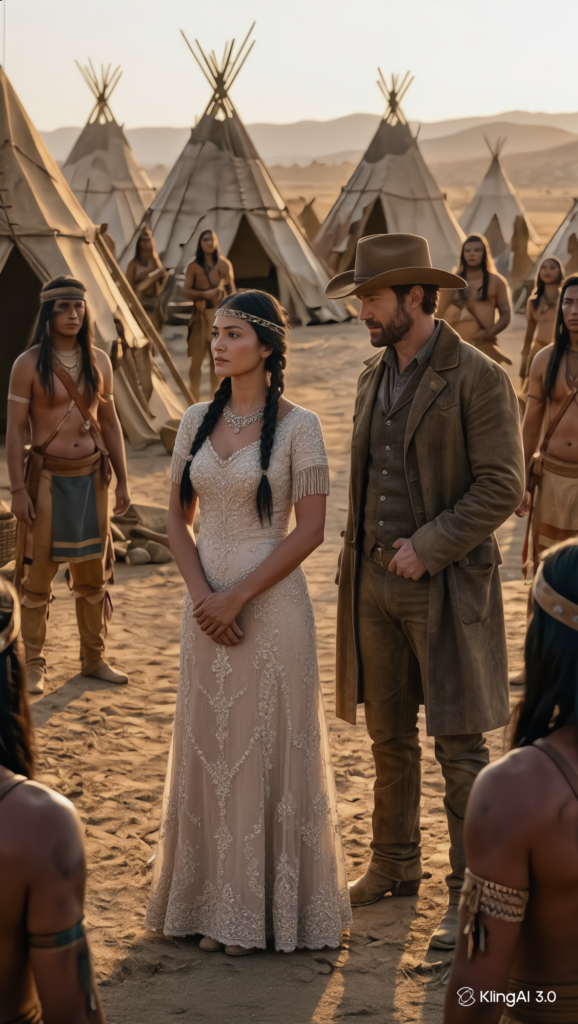
PART 1: The Fool of Red Creek
The sun had barely cleared the eastern hills when Jack Carter rode into Red Creek, and the town was already watching him.
He could feel it the way a man feels weather coming. Shopkeepers paused mid-sweep on their porches. Two ranch hands outside the general store stopped talking. A woman pulled her child back from the street as his tired bay gelding plodded past, hooves kicking up the pale dust that seemed to coat everything in this corner of the territory.
Jack didn’t blame them. He knew what he looked like. His boots were cracked at the seams. His hat had faded from brown to the color of dry grass under too many summers of open sky. His saddle had been patched so many times that more of it was repair than original leather. He looked like exactly what he was: a man who had spent eleven years drifting from ranch to ranch, breaking other people’s horses, mending other people’s fences, driving other people’s cattle across rivers that had tried more than once to drown him.
Eleven years of work. Eleven years of saving. And every dollar he’d ever kept had carried the same quiet promise: one day, a place of your own.
The land office sat at the end of Main Street, a narrow building with a sagging sign. Inside, a stooped clerk named Elias Pruitt looked up over a pair of wire spectacles and studied Jack the way a banker studies a bad loan.
“Looking to buy,” Jack said.
“With what?”
Jack set a leather pouch on the desk. The coins inside made a thin, lonely sound. “Forty-one dollars. And I’ll work off whatever else you need.”
Pruitt didn’t laugh, which Jack appreciated. Instead the old man sighed, pulled open a drawer, and slid a faded map across the desk.
“There’s one parcel you can afford,” he said quietly. “Only one.”
Jack leaned over the paper. His breath caught. The land stretched farther than he’d dared imagine: rolling hills, a broad valley, and a creek winding through the heart of it like a silver thread.
“That’s good land,” he said.
“It was.”
“What happened to it?”
Pruitt took off his spectacles and rubbed his eyes. “The Wilson family owned it, forty-odd years back. Built the cabin, broke the first ground. Then one day they packed up and left, and nobody ever learned why. Since then, four different families have tried to make a go of it. None lasted a full year.”
“Bad soil?”
“The soil’s fine.” Pruitt lowered his voice. “Folks say the place is cursed. Others say riders come through every spring. Apache riders. They don’t speak, don’t trade, just appear on the ridge and watch. One family woke up to find their fences cut. Another swore their well went sour overnight.” He paused. “People stopped asking questions. They just stopped going out there.”
Jack looked at the price written in the corner of the map. It was absurdly low.
“So nobody wants it.”
A thin smile crossed the clerk’s face. “That’s a polite way of putting it. There’s one man who’s made offers. Silas Crane. Owns the bank and half the cattle in this county. But he wants it for nearly nothing, and the territory won’t sell below the listed price.” He tapped the coins. “Which, as it happens, is just about what you’ve got.”
Jack signed the papers before noon.
Word traveled faster than his horse. By the time he reached the livery stable, a small crowd had gathered, and the laughter started before he’d even dismounted.
“You didn’t really buy the Wilson place?” called a rancher with a sunburned neck.
“You’d have better luck growing corn on a church roof,” said another.
“He’ll be back before the month’s out,” someone added. “If the Apaches leave anything to come back.”
The laughter rolled through the street. Jack loosened his cinch and said nothing. He had heard every version of this speech in eleven years: it can’t be done, men like you don’t get places like that, dreams are for fools and children. He’d stopped arguing a long time ago. He just kept moving.
But one voice cut through the noise, and it wasn’t laughing.
“Mr. Carter.”
The crowd parted. The man who stepped forward wore a black broadcloth coat far too fine for a frontier street, and a silver watch chain glinted across his vest. His face was smooth and pleasant, and his eyes were not.
“Silas Crane,” he said, extending a gloved hand. “I understand you’ve just purchased a property I had my eye on.”
Jack shook the hand. It was cold even through the leather. “Seems the territory liked my offer better.”
“The territory is shortsighted.” Crane smiled. “I’ll be direct, because I respect a man who works for a living. I’ll give you sixty dollars for that deed. Today. You’ll walk away with a twenty-dollar profit and your life unchanged. That’s a good morning’s business for anyone.”
“Why do you want it?”
Something flickered behind Crane’s smile. “Sentiment.”
“I’ve got some of that myself,” Jack said. “I’ll keep it.”
The street went quiet. Crane held his smile for a long moment, then let it fade by careful degrees, like a lamp being turned down.
“That valley has broken stronger men than you, Mr. Carter,” he said softly. “I’d hate for you to learn that the hard way.”
He tipped his hat and walked away. The crowd scattered after him, but Jack noticed two men lingering near the saloon: lean, unshaven, with revolvers worn low. They watched him until he rode out of town.
The ride took nearly three hours. The trail wound across open prairie before climbing into soft hills thick with tall grass that bowed and rippled under the wind. When Jack finally reached the property line, he pulled up his horse and simply sat there.
The ranch was old. But it was beautiful.
The cabin leaned slightly to one side, its porch weathered silver by countless seasons. A broken fence circled an empty corral where wildflowers had sprouted between the posts. Cottonwoods shaded the creek, and the air was alive with birdsong.
“You’re not finished,” Jack murmured. “You’ve just been waiting.”
He tied the bay near the cabin and pushed open the door. Dust lay over everything. A cracked stone fireplace stood against one wall; a rough-hewn table sat in the center of the room, untouched for years. Late sunlight slanted through the narrow windows and filled the cabin with a gold, drifting glow.
Jack took off his hat. For the first time in longer than he could remember, there was silence around him. It didn’t feel lonely. It felt like peace.
At dusk he built a small fire outside and ate a simple supper of bread, jerked beef, and beans, watching the colors of evening spill across the hills.
Then he saw them.
Far across the prairie, on a distant ridge, a line of riders had appeared. Six. Then eight. Then more than he could count in the failing light. They sat motionless, black silhouettes against a bleeding orange sky.
They were watching the ranch.
Jack’s hand drifted toward the old Winchester leaning against the woodpile. He did not lift it. He only stood, slowly, so they could see him.
For a long moment, nothing moved. Not the riders, not Jack, not even the wind.
Then, as one, the riders turned and vanished behind the hills.
Jack didn’t sleep much that night.
The days that followed brought work, and work brought a fragile kind of calm. He patched the corral, cleared the cabin, and rehung the barn door. But strange things kept happening.
On the second day he found fresh hoofprints crossing his land toward the creek. At the end of the trail, beside a flat stone, sat a finely woven basket filled with fresh herbs and a bundle of wild sage. No note. No sign of who had left it. He set it back exactly where he’d found it.
“If it’s somebody’s,” he said aloud, “they ought to find it where they left it.”
When he turned, a young Apache woman was standing beneath the cottonwoods across the water. She watched him with calm, unreadable eyes. He touched the brim of his hat. She nodded, glanced at the basket, and almost smiled. Then she was gone, as silently as smoke.
That evening, the basket was on his porch. Inside: fresh bread, dried berries, and a small piece of cedar carved into the shape of an eagle in flight.
Jack didn’t understand it. But he understood one thing: someone out there had chosen to welcome him, not drive him away.
And someone else, he was about to learn, had chosen the opposite.
On the fifth night, he woke to the smell of smoke.
He was out the door with the Winchester before he was fully awake. The barn. Orange light licked along its western wall where someone had piled dry brush against the boards. Jack ran for the creek with two buckets, hauling water through the dark until his arms burned and his lungs screamed, and by some mercy the old timber was too damp from the spring rains to catch properly. When the last flame hissed into steam, he stood gasping in the smoke, and he saw it nailed to the barn door.
A strip of red cloth. And beneath it, crudely painted, the outline of an arrow.
They want me to think it was the Apaches, he realized. A cold certainty settled into his chest. They want the whole town to think it.
He thought of Silas Crane’s cold glove. Of the two gunmen by the saloon. Of four families who had each lasted less than a year.
Fences cut. Wells gone sour.
It had never been a curse.
Jack sat on the porch until dawn, rifle across his knees. As the first gray light crept over the valley, he heard it: hoofbeats. Many of them. Coming from two directions at once.
He stood.
To the north, along the ridge, the Apache riders were returning, but not a handful this time. Dozens of them, a long unbroken line, moving steadily down into the valley.
And from the south, on the road from Red Creek, came a dust cloud. Jack counted twelve horses. At their head rode Silas Crane in his black coat, and behind him, rifles out and ready, rode the two gunmen from the saloon and ten more men Jack had never seen.
The two forces were converging on his ranch.
On him.
Crane reined up at the gate and raised his voice so it carried across the valley.
“Carter! We saw the fire from town! The savages have come back, just like I warned you!” He lifted his rifle and pointed it north, toward the descending line of riders. “Stand aside, son. My men will handle this, once and for all.”
Behind him, twelve rifle hammers clicked back in the cold morning air.
To the north, the Apache riders stopped. At their front, an old man with a weathered face looked down the valley at Jack, waiting.
Every gun in that valley was waiting for one man’s choice.
And Jack Carter walked off his porch, straight into the open ground between them.
PART 2: The Old Man’s Map
No one fired.
That was the first miracle, and Jack would think about it for the rest of his life: the stillness of that moment, the way the whole valley seemed to hold its breath. He walked until he stood in the center of the meadow, halfway between Crane’s gunmen and the Apache riders. Then he turned to face the road, set the butt of his Winchester on the ground, and leaned on it like a walking stick.
“Morning, Mr. Crane,” he called.
Crane’s jaw tightened. “Get out of the way, Carter.”
“Can’t do that. You’re on my land.”
“Have you lost your mind? They burned your barn!”
“Somebody tried to.” Jack reached into his shirt pocket and drew out the strip of red cloth. He held it up so the morning light caught it. “Left this behind. Funny thing is, it’s trade calico. The kind sold at the general store in Red Creek. Two bits a yard.” He let the cloth flutter in the wind. “And whoever painted that arrow on my door never saw an Apache arrow in his life. Drew it like a child’s picture of one.”
A murmur ran through Crane’s riders. One of the younger men, barely more than a boy, lowered his rifle an inch.
“You’re accusing me?” Crane said, and his voice had gone very quiet.
“I’m not accusing anybody. I’m just telling you what I found.” Jack let his gaze move slowly along the line of gunmen. “Four families tried to make a home here before me. Fences cut. Wells fouled. Every time, folks in town blamed the Apaches. And every time, the family left. And every time, somebody made an offer on the land.” He paused. “I’d hate to think any of you men rode out here this morning to start a war over a lie.”
The silence stretched.
Behind Jack, he heard a single horse move forward. He didn’t turn. He didn’t need to. He could hear the slow, deliberate hoofbeats crossing the grass, and then an old voice, accented but clear, spoke at his shoulder.
“He tells the truth.”
The old man had dismounted. He stood beside Jack now, unarmed, gray hair falling past his shoulders, his deep-lined face calm as still water. He looked directly at Silas Crane.
“My name is Nantan,” he said. “For forty years, my people have come to this creek each spring. For forty years, we have harmed no one here. We did not cut fences. We did not poison wells.” His eyes did not move from Crane’s face. “But we have watched. And we have seen who rides out from town in the dark.”
Crane’s face went white, then red.
“You’d take the word of an old Indian and a broke drifter over mine?” he said to his men. “I own the bank that holds your mortgages. I sign your wages.”
The young rider who’d lowered his rifle looked at the man beside him. Then he slid the rifle back into its scabbard.
“I signed on to protect a town, Mr. Crane,” he said. “I didn’t sign on for this.”
One by one, as if a spell were breaking, other men did the same. Not all of them. The two gunmen from the saloon kept their weapons up, eyes flicking from Crane to the line of Apache riders on the hillside, calculating odds they clearly did not like.
Crane looked at them. He looked at the dozens of riders on the ridge. He looked at the old man and the cowboy standing unarmed in the meadow.
And Jack saw the exact moment he understood that this morning was lost.
“This isn’t over, Carter,” Crane said. His voice shook with a fury he could barely contain. “You’ve got no idea what you’ve stepped into.”
He wheeled his horse and rode for town. His two gunmen followed. After a long moment, the rest of the riders turned and trailed after them, several glancing back at Jack with expressions he couldn’t read: shame, maybe, or something like respect.
When the dust had settled, Jack let out a breath he felt like he’d been holding for five days. His legs had gone weak. He sat down hard on the grass.
Nantan looked down at him, and for the first time, the old man smiled.
“You are either very brave,” he said, “or very foolish.”
“I’ve been asking myself the same thing all morning.”
Nantan laughed, a low, warm sound, and offered him a hand up.
They sat together on the porch while the rest of the Apache riders waited by the creek. The young woman Jack had seen beneath the cottonwoods brought water in a gourd and set it between them. Up close she was perhaps twenty, with steady dark eyes.
“My granddaughter, Ishtee,” Nantan said. “She left you the basket.”
Jack turned to her. “The eagle too?”
Ishtee nodded. “You put the basket back,” she said, her English careful. “Every man who lived here before you either took what we left or threw it in the creek. You were the first who left it for its owner.”
“It wasn’t mine.”
“That,” Nantan said, “is exactly why we came.”
Jack looked out at the valley. “I don’t understand any of this. Why does Crane want this land so badly? It’s good grass and good water, but he’s got thousands of acres.”
Nantan was quiet for a long time. Then he reached into a leather pouch at his belt and drew out a folded square of soft deerskin. He opened it carefully, the way a man handles something sacred.
Inside was a map, drawn by hand in faded ink. The edges were worn soft as cloth. But the valley at its center was unmistakable: the hills, the cottonwoods, the bend of the creek.
And something else. A small mark, near the eastern slope, where Jack had never been.
“There is a spring,” Nantan said, touching the mark. “Under the rocks, in the hill. It does not dry. Not in the worst summers. Not in the years of drought when every creek in this country becomes dust. When my grandfather was young, there was a drought so terrible that cattle died standing up. Families, ours and white families alike, came to this valley. This spring kept them alive.”
Jack stared at the map. “Crane knows about it.”
“Crane’s father knew about it. He was a hard man in a hard time. In the drought years, he wanted to fence the spring and sell the water. A barrel for a dollar. A dollar a family could not pay.” Nantan’s voice dropped. “The Wilsons would not let him. They swore that the water of this valley would belong to no one alone. And they put it in writing.”
“The deed?”
“Something older than a deed.” Nantan folded the map again. “A promise. Signed by the Wilsons and by my grandfather. It says this spring must always be open to any traveler who needs water, shelter, or safety, no matter what people they come from.”
Jack’s mind was racing now. “And if that paper exists, then whoever owns this land can’t sell the water.”
“Can’t fence it. Can’t sell it. Can’t turn it into money.” Nantan nodded slowly. “And another drought is coming. Our elders see it. The rains this spring were the last good rains for some time. In two summers, perhaps three, every rancher in this county will need that spring. The man who controls it will control them all.”
The pieces fell into place with a cold, heavy click. The cut fences. The fouled wells. The families who’d fled. The rumors of a curse, quietly spread and never questioned.
“Crane’s been driving people off this land for years,” Jack said. “Waiting for it to come up cheap. And I bought it out from under him with forty-one dollars.”
“Yes,” said Nantan. “That is why he is so angry.”
“Where’s the promise now? The paper?”
Something shadowed the old man’s face. “It was given to the Wilsons for safekeeping. When they left, they left in the night, frightened. Men in masks had come to their door.” He looked at the cabin behind them. “My grandfather believed they hid it somewhere on this land, so it could not be taken or burned. But in forty years, no one has found it.”
Jack sat very still. “And if Crane finds it first?”
“Then it burns,” Ishtee said quietly. “And the promise dies with it.”
The Apache families made camp along the creek that afternoon. There were nearly sixty of them: elders, young men, mothers with infants on their backs, children who stared at Jack with frank curiosity before dissolving into giggles. They had come, Nantan explained, for the spring gathering, as they had for generations. But this year they had come early, and in greater numbers, because word had reached them that a new man had bought the valley.
“We did not know what kind of man you would be,” Nantan said. “Now we know.”
That night, Jack couldn’t sleep. He lay on his bedroll in the dusty cabin, staring at the ceiling, turning the problem over and over like a stone in his hand.
Hidden somewhere on this land. Somewhere it couldn’t be burned.
Not the barn: barns burn. Not buried in a field: the Wilsons had fled in the dark, with no time to dig. It had to be somewhere close. Somewhere fireproof.
His eyes drifted to the cracked stone fireplace.
He was on his feet in an instant, lighting a lantern with shaking hands. He ran his fingers along the rough mortar, stone by stone. Most were solid. But one, low on the left side, near the hearth, shifted ever so slightly beneath his palm. The crack in the chimney, the one he’d taken for forty years of weather, ran straight to it.
He worked his knife into the mortar. It crumbled like dry bread. The stone came loose with a grinding scrape.
Behind it was a hollow. And in the hollow, wrapped in oilcloth gone stiff with age, was a tin box.
Jack’s heart pounded so hard he could hear it. He lifted the box out, set it on the old table, and opened the lid.
Inside lay a folded document, the ink faded but legible, the paper yellow as old bone. Two signatures at the bottom: Thomas Wilson, in a careful, laborious hand, and beside it a mark and a name written out by someone else: Goyahkla’s kinsman, Nantan the Elder.
He’d found it.
He was still staring at it when he heard the sound outside: the soft creak of a boot on the porch.
Jack turned. The door swung open.
In the doorway stood one of Crane’s gunmen, the taller one, with the scar along his jaw. His revolver was drawn and pointed directly at Jack’s chest. Behind him, in the darkness, a second shape moved, and Jack smelled coal oil.
“Evening, cowboy,” the gunman said, smiling at the tin box on the table. “Mr. Crane thanks you kindly for doing the digging.”
PART 3: The Promise Keeper
Jack didn’t move. His Winchester stood against the far wall, ten feet away. Ten feet might as well have been ten miles.
“Slide that paper across the table,” the gunman said. “Slow.”
“And then what? You let me walk?”
The man’s smile didn’t change. “Then the cabin catches fire. Tragic accident. Drifter knocks over a lantern, too drunk to get out. Town’ll shake its head and say it always knew you were a fool.”
Jack’s hand rested on the old document. He thought of eleven years of saving. Of the Wilsons fleeing in the dark. Of sixty people camped by the creek, trusting that the stranger in the cabin was who they believed him to be.
“No,” he said.
The gunman’s thumb drew back the hammer.
And from the darkness behind him came a voice, soft and perfectly calm.
“Put it down.”
The gunman froze. Pressed against the back of his neck, Jack could now see, was the point of a long hunting knife. Holding it was Ishtee. Behind her, on the porch, stood four young Apache men, and the second gunman was already face-down in the dirt, his coal-oil can rolling uselessly across the boards.
Slowly, very slowly, the scarred man lowered his revolver. Jack stepped forward and took it from his hand.
“We have been watching your cabin since sundown,” Ishtee said. “My grandfather said the Crane men would come back in the dark. They always do.”
They rode into Red Creek at noon the next day: Jack in front, Nantan beside him, the two bound gunmen behind, and more than fifty Apache riders following at a slow, peaceful walk.
The town poured into the street to watch. Shopkeepers stood frozen in their doorways. Children climbed onto rain barrels. The ranchers who had laughed at Jack a week before stood silent on the boardwalk, and not one of them was laughing now.
The sheriff, a gray-mustached man named Harlan Ames who had never once ridden out to investigate the troubles at the Wilson place, came out of his office with his hand near his gun. Then he saw the bound men, and the old document in Jack’s hand, and his face changed.
Jack read the promise aloud in front of the land office, his voice carrying across the silent street. He read how Thomas Wilson and Nantan’s grandfather had agreed, in a year of terrible drought, that the valley’s spring would never be fenced, never be sold, never be denied to any traveler in need of water, rest, or safety. He read the last line twice, because it was the line that mattered most:
“Let no man own the water that keeps all men alive.”
When he finished, the only sound was the wind.
Elias Pruitt, the old clerk, took the paper with trembling hands and examined it for a long time. “It’s genuine,” he said at last. “It was recorded in the territorial ledger in ‘41. I remember my father speaking of it. The page went missing from our books years ago.” He looked down the street, toward the bank. “Now I suppose we know who tore it out.”
The gunmen talked before the sun went down. Men facing a rope usually do. They named the nights, the cut fences, the fouled wells, and the man who paid them for every one.
Silas Crane was arrested on the steps of his own bank. He didn’t shout. He didn’t run. He only looked across the street at Jack Carter, the broke drifter with forty-one dollars, and for once, his smooth face held no smile at all.
Samuel Hollis, the old rancher who’d once warned Jack to leave the Apaches alone, came forward as the crowd thinned. He took off his hat and turned it slowly in his hands.
“I spent thirty years believing stories that weren’t true,” he said, to Jack and to Nantan both. “I told my children to be afraid of your people. I told them that valley was cursed.” His voice cracked. “And all that time, the curse was sitting in the bank, signing my loans.”
Nantan studied him for a long moment. Then he laid a hand on the rancher’s shoulder.
“It is never too late to remember,” he said.
The spring gathering was held at the ranch that year as it had been for generations, but it was not the same as before. On the third day, wagons came rolling up the trail from Red Creek. Samuel came, and Pruitt, and the young rider who had lowered his rifle in the meadow. Women brought pies and bread. Children who had been taught to fear Apache children were soon skipping stones beside them in the creek, shrieking with laughter, until no one could quite remember who had been afraid of whom.
Jack stood on his porch and watched it all, the cedar eagle in his hand.
Ishtee climbed the steps and stood beside him. “You could have sold the land to Crane that first morning,” she said. “Sixty dollars. You would have been a richer man.”
Jack looked out at the valley: the smoke of the cookfires curling through the cottonwoods, the elders pointing out places they had known as children, the spring on the eastern slope where Nantan had already led a dozen townsfolk to drink.
“No,” he said. “I’d have been poorer.”
She smiled, the full smile this time, the one she’d only half-shown him across the creek that first day.
Two summers later, the drought came, just as the elders had foretold. Creeks across the county shrank to cracked mud. Wells went dry. Cattle grew thin, and men grew desperate.
But every day, wagons rolled up the trail to the ranch that nobody had wanted, and every day, the spring in the eastern hill gave water to anyone who came. White ranchers and Apache families. Mexican herders and Mormon settlers. Not one was turned away, and not one was charged a cent.
At the gate, carved into a new cedar post by Jack’s own hands, were the words from the old promise:
LET NO MAN OWN THE WATER THAT KEEPS ALL MEN ALIVE.
The people of Red Creek no longer called it the Wilson place, or the cursed ranch, or the land nobody wanted.
They called it the Promise.
And the cowboy they had once called a fool, the man who walked unarmed into the space between two lines of rifles, was remembered for the rest of his days as something far rarer than a rich man or a hero.
He was the keeper of a promise. The man who proved that the strongest fences aren’t built from wire and wood, but from trust. And that sometimes the land nobody wants is simply waiting for the one person brave enough to deserve it.


