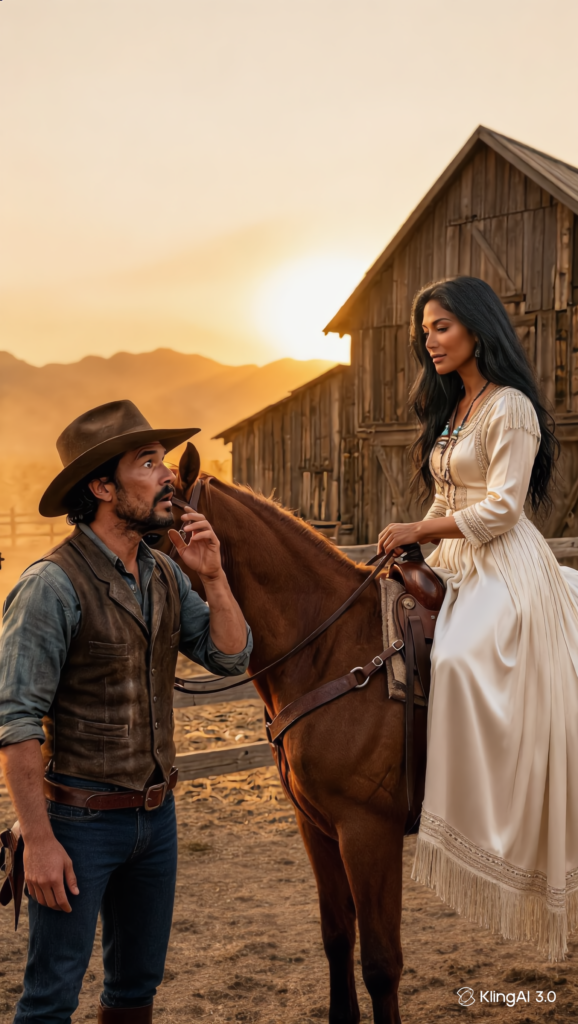
PART 1: The Rider at Sundown
For six years, no one had passed through the gate of the Carter ranch.
It stood at the end of a long dirt road where the prairie gave way to the foothills, a pair of weathered pine doors bound together by an iron chain as thick as a man’s wrist. Rust had crept into every link. The padlock had not turned in so long that a wasp had built a paper nest in the shadow of its keyhole. Travelers on the old Sandstone Trail learned to ride past without slowing. Children in Copper Bend dared one another to touch the chain, then ran off shrieking as if it might bite them.
Beyond the gate lay forty acres of brittle pasture, a barn that leaned a little more each winter, a stable, a farmhouse with a sagging porch, and a lone cottonwood tree whose branches clawed at the sky like the fingers of an old man reaching for something he could no longer remember.
And in that house lived Jack Carter.
People in town still spoke of the man he used to be. Back then, the gate had never been locked. Thirsty riders stopped at his well and left with full canteens and full bellies. Cowhands sat on his porch after long drives, trading lies and laughter until the stars came out. Jack had a voice like warm gravel and a handshake that made a stranger feel like kin. He and his younger brother, Daniel, had built that ranch board by board, fence post by fence post, with nothing but borrowed tools and stubborn hope.
Then, one autumn six years ago, something broke.
Nobody knew exactly what. Only that Daniel Carter rode out one stormy night and was never seen again, and that three days later Jack walked down to the end of the road carrying an iron chain. He wrapped it around the gate twice, snapped the lock shut, and threw the key into the creek.
When the preacher came to ask after him, Jack spoke through the closed gate.
“Some things are better left in the past, Reverend.”
He did not say another word.
After that, Jack went into town only when the flour ran out or a horseshoe needed a smith. He bought what he needed, paid in exact coins, and left without meeting anyone’s eye. His life narrowed to a single, unchanging rhythm. Rise before the sun. Feed the cattle. Mend the fences. Check the stable. Work until his hands bled or the light failed, whichever came first. Then sit beside the fire in the same worn chair, staring at the same empty chair across from him, until sleep dragged him under.
He had become a man who measured his days not in hours, but in silences.
It was late October when the silence finally broke.
Jack was in the barn, forking hay into the trough, when he heard it. At first he thought it was the wind moving through the dry grass, the way it always did before nightfall. He kept working.
Then he heard it again.
Hoofbeats.
Slow. Steady. Unhurried. Coming down the Sandstone Trail, the trail no one used anymore.
Jack set the pitchfork against the wall. His heart, which had beaten at the same dull pace for six years, gave an odd and unwelcome kick. He stepped out into the yard.
The sun was sinking behind the western hills, bleeding orange and crimson across the sky until the whole world seemed set on fire. Long shadows stretched from every fence post like black fingers pointing toward the gate.
And at the end of those shadows, someone was approaching.
Jack walked down the road. His boots crunched on gravel. With every step, the figure grew clearer.
It was a woman.
She rode a mare the color of wet sand, and behind her, on a lead rope, trailed a second horse: an old chestnut gelding, gaunt and swaybacked, its head hanging low with exhaustion. The woman wore a plain brown frontier dress beneath a wool blanket coat, and a leather satchel hung across her body. Her black hair was braided down her back. Her face was calm, but there was a weariness about her eyes that spoke of long miles and short sleep.
Apache, Jack thought. From the mountain country, by the look of her.
She reined in a few paces from the gate and looked at him for a long moment, as if measuring him against some picture she carried in her mind.
Jack put his hand on the chain.
“Road’s closed,” he said. “Has been for years. If you need water, there’s a creek two miles east.”
“I don’t need water.”
Her voice was low and even. Unafraid.
“Then you’ve got no business here.”
“My name is Mara,” she said. “And I have business with you, Jack Carter.”
His jaw tightened at the sound of his own name.
“I don’t know you.”
“No,” Mara agreed. “But I know you. I’ve known about you for a long time.”
Something cold slid down Jack’s spine.
“What do you want?”
Mara swung down from her mare. She moved carefully, stiffly, like someone who had been in the saddle for days. Then she turned and gently tugged the lead rope, guiding the old chestnut forward until it stood in the last red light of the sun.
“I came to return something that belongs to you.”
Jack looked at the horse. Just a tired old animal, ribs showing beneath a dull coat, mane tangled with burrs.
Then the gelding lifted its head.
And Jack saw the mark.
A small white blaze above the left eye, shaped like a crooked star.
The world stopped.
Jack’s hand slipped from the chain. All the blood drained from his face so fast that for a moment he thought he might fall. He took one step closer to the gate, then another, until his chest pressed against the rough pine.
“No,” he whispered. “No. That’s not possible.”
“You recognize him,” Mara said quietly.
Jack could not answer. His throat had closed.
Ember.
That was the horse’s name. Daniel had named him, when they were boys, because the colt’s coat had glowed like coals in the evening light. They had raised him together from a wobbly-legged foal. Broken him to saddle together. Ridden him double across these very hills, whooping like fools, Daniel’s arms wrapped around Jack’s waist.
And on the night Daniel vanished into the storm, he had been riding Ember.
Jack had searched for nine days. He had ridden until his own horse went lame, then walked until his boots split. He had combed every canyon, every riverbank, every ravine within sixty miles, shouting his brother’s name until his voice was gone. He had found nothing. Not a hoofprint. Not a scrap of cloth. Nothing but rain and rock and the terrible, swallowing silence.
In the end, he had told himself the truth he could bear: that the flood had taken them both. That his brother and his brother’s horse lay somewhere beneath the mud of the Red Fork River, and that there was nothing left to find.
He had believed it for six years.
And now Ember stood at his gate.
The old horse stretched its neck forward. Its nostrils flared. Then, slowly, deliberately, it pressed its velvet nose through the gap in the gate and against Jack’s shoulder, and let out a long, shuddering breath.
The same way it had greeted him every morning for eleven years.
Jack’s knees almost buckled. He gripped the gate with both hands and bowed his head, and for a long time he could not speak at all.
When at last he looked up, his eyes were wet and hard and burning.
“Where did you find him?”
“Far from here.”
“Where?”
“In the mountains. Near my people’s winter camp.”
“Then why now?” His voice cracked like a whip. “Six years. Six years, and you bring him back now? Who sent you? What do you want from me?”
Mara did not flinch. She held his gaze with a steadiness that unnerved him.
“No one sent me,” she said. “I came because I made a promise.”
“To who?”
She did not answer. Instead, she reached into the leather satchel and drew out a small pouch, its leather darkened with age and sweat, the drawstring frayed almost to threads.
Jack stopped breathing.
He knew that pouch. He would have known it anywhere. He had bought it himself, at the general store in Copper Bend, for Daniel’s eighteenth birthday. He had paid too much for it, and Daniel had teased him for a week about going soft, and then he had carried it every single day after.
“Where did you get that?” Jack’s voice was barely a whisper now.
“He wanted you to have it,” Mara said.
He.
Not he would have wanted.
He wanted.
Jack’s hands were shaking so badly he could barely work the chain. He did not need a key; the old lock was rusted half through, and with one savage wrench, he tore it open. The chain fell into the dust with a heavy, final clank. The gate swung inward, groaning on hinges that had not moved in six years.
He took the pouch from Mara’s outstretched hand.
His fingers fumbled at the drawstring. Inside, wrapped in a scrap of oilcloth, was a photograph. Its corners were soft and creased, its surface faded to brown and amber, but the image was unmistakable.
Two young men standing beside a chestnut colt with a crooked white star above its eye.
Jack on the left, scowling at the camera because he had hated sitting still. Daniel on the right, grinning like he had just heard the best joke of his life, one arm thrown across his brother’s shoulders.
The photographer had come through town the summer Ember turned two. Jack had thought the picture was lost in the flood along with everything else.
His thumb traced Daniel’s face. Then, slowly, he turned the photograph over.
On the back, written in pencil, in handwriting Jack would have recognized in the dark, were words that had not been there the last time he held this picture.
The letters were shaky. Uneven. The hand of a man who had been very weak when he wrote them.
Jack —
If you’re holding this, then I kept my word, and Ember found his way home.
Now it’s your turn. Don’t let her leave before she tells you everything.
I wasn’t alone out there, brother. And I didn’t stay gone because I wanted to.
— D.
Jack read the words once. Twice. A third time. Each pass struck him like a blow.
He lifted his head slowly and looked at Mara. In the dying light, her face had become something unreadable, something carved from sorrow and resolve.
“What does this mean?” he said. “What does this mean? Is he alive? Tell me. Where is my brother?”
Mara was silent for a long moment. The last sliver of sun slipped behind the hills. Darkness flooded the valley like water.
When she finally spoke, her voice was so quiet he almost didn’t hear it.
“You told him never to come back, Jack. That night, in the storm. Those were your last words to him.”
Jack staggered as if she had struck him.
No one knew that. No one alive could know that.
“He kept trying to come home anyway,” Mara said. “For six years, he kept trying.”
She reached up and untied something from the back of Ember’s saddle: a long bundle, wrapped in a woven blanket of red and black, bound with rawhide. She held it out to him with both hands, the way one might offer something sacred.
“And this,” she said, “is what was left of him.”
PART 2: The Letters in the Cabin
The bundle was lighter than Jack expected.
That was the first thing that frightened him.
He carried it into the house the way a man carries a sleeping child, as if a single misstep might shatter it. Mara followed in silence. She stabled both horses without being asked. When she came inside, Jack was standing at the kitchen table with the bundle laid before him, staring at it as though it might speak.
He had not lit the lamp. Mara did. The small flame bloomed, and the room swam up out of the dark: the cold hearth, the two chairs, the dust thick on every surface Jack had not touched in years.
“Open it,” she said gently.
“I can’t.”
“You’ve been waiting six years to know. Don’t make it seven.”
Jack drew a breath that rattled in his chest. With his pocketknife he cut the rawhide. The blanket fell open.
Inside lay Daniel’s saddle.
Not the whole thing. Weather and time had stripped it to its bones. But it was his, the high cantle Daniel had insisted on, the stirrups he had resoled himself. And burned into the leather of the seat jockey, in letters Daniel had carved with a heated nail when he was fifteen, was his name.
DANIEL CARTER.
Beneath the saddle lay a small wooden chest, no bigger than a family Bible, its lid fastened with a brass clasp.
And beside the chest lay a braided cord of horsehair, chestnut and black, with a single silver button woven into its end. A button from Daniel’s coat. The one their mother had sewn on.
Jack gripped the edge of the table.
“He’s dead,” he said. It was not a question.
Mara lowered her eyes. “Two winters ago.”
The words fell into the room and did not echo. They simply sank, the way a stone sinks into deep water.
Jack sat down very slowly in his chair. He did not weep. Not yet. He felt instead a vast and terrible hollowness, as if someone had reached inside his chest and scooped out whatever had been holding him upright for six years.
All this time, he had believed his brother died that night in the flood. He had mourned him, in his own crooked, silent way. He had built his whole life, his whole prison, around that grief.
And all this time, Daniel had been alive.
Four years. Four years of his brother breathing the same mountain air, watching the same moon. And Jack had never known.
“Tell me,” he said hoarsely. “All of it.”
Mara pulled out the second chair, the one across from him, the one no one had sat in for six years, and lowered herself into it.
“The night he left,” she began, “the river had already flooded the lower crossing. He tried the high trail instead, through Wolf Canyon. Ember slipped on the rocks. They both went down the slope. Your brother’s leg was broken in two places, and he struck his head. He doesn’t remember how long he lay there.”
Jack closed his eyes.
“My uncle found them three days later. He was tracking elk. He said the horse had not left Daniel’s side once. It stood over him in the rain like a guard. My uncle carried your brother back to our camp on a travois. He didn’t think he would live.”
“But he did.”
“He did. My grandmother set his leg. It healed crooked. He walked with a limp for the rest of his life.” A ghost of a smile touched her mouth. “He used to say it gave him character.”
Jack made a sound that was almost a laugh and almost a sob. That was Daniel. That was exactly Daniel.
“The blow to his head was worse,” Mara went on. “For most of that first winter, he didn’t know his own name. He knew the horse. He knew there was a ranch, and a brother, and that something terrible had happened between them. But the rest was fog. By the time his mind cleared, it was deep winter. The passes were snowed shut. No one could leave the mountains until spring.”
“And in the spring?”
Mara hesitated.
“In the spring,” she said carefully, “he rode down out of the mountains to come home to you.”
Jack’s head snapped up.
“He made it as far as the ridge above Copper Bend,” she said. “He could see the ranch from there. He told me he sat on that ridge for an entire day, watching the smoke rise from your chimney.”
“Then why didn’t he come down?” Jack’s voice rose, raw and desperate. “Why in God’s name didn’t he come down?”
Mara looked at him with eyes that held no accusation, only sorrow.
“Because the gate was chained,” she said. “And he remembered what you said to him.”
The words hit Jack like a fist to the heart.
He remembered too. He had spent six years trying to forget, and he remembered every syllable.
The argument had started over nothing. Over money, over a cattle sale, over the barn roof. Over everything and nothing, the way brothers fight. Daniel had told him he needed to leave for a while. Needed to see what lay past these hills before he spent his whole life inside them. And Jack had heard only abandonment. Their father had walked out when they were boys. Their mother had worked herself into an early grave. And now Daniel, the last of his family, the one person he had sworn to protect, wanted to leave him too.
So Jack had said it.
Standing in the rain, with lightning splitting the sky, he had said: If you ride out that gate tonight, don’t you ever come back. You hear me? You’re no brother of mine.
And Daniel had looked at him for one long moment, his face streaming with rain, and then he had climbed onto Ember and ridden into the storm.
“I didn’t mean it,” Jack whispered. “I never meant it. I went after him an hour later. I searched for nine days. When I couldn’t find him, I thought — I thought the river —” He pressed his fists against his eyes. “I chained the gate because I couldn’t stand to look at the road he rode away on. I thought it was my fault he was dead. I couldn’t face anyone. I couldn’t face myself.”
“He didn’t know that,” Mara said softly. “From that ridge, all he saw was a chain. He thought it was meant for him. He thought you’d meant every word.”
The lamp flickered. Somewhere outside, a coyote cried.
Jack lowered his hands and looked at the small wooden chest.
“What’s in there?”
Mara slid it across the table toward him.
“The answer to every question you’ve carried for six years.”
He opened it near midnight.
Inside were letters. Dozens of them. Bundled with twine, each envelope yellowed and soft. Every single one bore the same two words in Daniel’s hand.
For Jack.
The top envelope was dated six years ago, the first spring.
Jack opened it with trembling fingers.
Jack,
I sat on the ridge today and watched you mend the north fence. You still hammer like you’re mad at the nails. I wanted to ride down. I had my hand on the reins. But I saw the chain on the gate, and I understood.
I’m not angry. I want you to know that before anything else. I said things that night too. I called you a coward who’d rather rot on that ranch than live. I was wrong. You were never a coward. You were just scared of losing the last thing you had. I know, because I was scared too.
I’ll write again. Maybe one day I’ll be brave enough to send these.
Your brother,
Daniel
Jack set the letter down. His hand was shaking so badly the paper rattled against the table.
He opened the next one. And the next.
They came in a flood, the way the river had come that night. Daniel writing about learning to speak Mara’s language, badly, to everyone’s amusement. Daniel writing about teaching the children of the camp to throw a lasso. Daniel writing about the winter a fever swept through the camp, and how he and Mara’s uncle had ridden four days through snow to bring back medicine from the fort. Daniel writing about the stars in the high country, how close they seemed, how he wished Jack could see them.
And in every single letter, without fail, somewhere between the lines, the same quiet refrain.
I miss you.
I think about the ranch every day.
I’m going to come home. Next spring. I swear it.
Three times, the letters said, Daniel had ridden down to that ridge.
Three times, he had seen the chain.
Three times, he had turned back.
“Why didn’t anyone tell me?” Jack’s voice was ragged with exhaustion and grief. “One letter. One word. Anyone could have ridden down and told me he was alive.”
“He asked us not to,” Mara said. “Every time. He said if you wanted him back, you would unlock the gate. He said he wouldn’t force himself on a brother who’d shut him out. He was proud, Jack.” Her voice softened. “As proud as you.”
Jack laughed bitterly through his tears. “Stubborn as two mules in one harness. That’s what Ma used to call us.”
“He told me that too.”
Jack wiped his face with the back of his hand and picked up the next envelope. Then the next. The handwriting changed as he read. In the later letters, it grew loose and wandering. The lines sloped downward. Some words were crossed out and rewritten.
“He got sick,” Jack said quietly. It was not a question.
Mara nodded. “The winter before last. His lungs. The old injury from the fall had never fully healed. We did everything we could. My grandmother sat with him for weeks.”
“Did he suffer?”
Mara was silent for a moment. “Near the end, he was mostly peaceful. He talked about you a great deal. About the ranch. About Ember.”
Jack swallowed. “And the photograph? The words on the back?”
“He wrote those three days before he died. He made me promise to bring Ember home and to bring you these letters. But he made me promise something else too.” She met his gaze. “He told me not to come until I was sure you were ready. He said if I came too soon, while your heart was still all chains and iron, you’d burn every letter without reading them. So I waited. And I watched.”
“Watched?”
“Every few months, someone from my family passed by your ranch on the trail. Two years we watched. The chain never came off. The smoke rose from the chimney, but no one ever came through that gate. Then, this past summer, my cousin saw you standing at the end of the road. Just standing there, with your hand on the lock. For nearly an hour.” She paused. “He said you looked like a man trying to remember how to breathe.”
Jack had no memory of it. And yet he knew it was true. There had been days like that. More and more of them lately.
“That’s when I knew it was time,” Mara said.
She reached into the chest and lifted out the last of the letters. Unlike the others, it was sealed with a drop of red wax, pressed with the silver button from Daniel’s coat.
“He wrote this one last,” she said. “He said it was the only one that mattered.”
Jack took it. His thumb ran over the wax seal, feeling the shape of the button pressed into it. His mother’s button.
He broke the seal.
PART 3: The Open Gate
Jack,
I don’t have much strength left, so I’ll be quick about it.
I’ve written you a hundred letters, and I never sent one. That was my pride, not yours. I let a chain on a gate tell me what my brother felt, when I should have just ridden down and knocked. If there’s a lesson in any of this, maybe that’s it. Don’t let a silence talk for the people you love. Ask them.
I forgive you for what you said that night. I forgave you before I even reached the canyon. I hope you can forgive me for staying away.
I had plans, you know. I wanted to fix the barn roof proper this time. Plant apple trees along the creek like Ma always wanted. Build a bunkhouse so travelers would have somewhere safe to sleep when the weather turned. Make the ranch a place where people stopped, the way they used to.
I can’t do those things now. But you can.
Remember what we promised the day we broke Ember? That no matter how far life carried us, we’d always find our way back to that gate? Well, Ember kept that promise for me. Now I need you to keep it for both of us.
Open the gate, Jack. Not because I’m coming back. I’m not. Open it because life is still out there waiting for you, and it’s been knocking for six years.
You were always the strongest man I knew. Be strong enough to let people in.
Your brother, always,
Danny
Jack read it three times. Then he folded it with great care and pressed it against his chest, and at last, alone at his kitchen table at two in the morning with a stranger sitting silently across from him, Jack Carter wept.
He wept for the brother he had lost twice. For the four years he had stolen from them both with a single sentence spoken in anger. For every spring Daniel had sat on that ridge watching smoke rise from a chimney he could not bring himself to approach. He wept until there was nothing left inside him to pour out, and Mara sat with him the whole time, saying nothing, simply being there.
When the first gray light crept through the window, Jack lifted his head.
His eyes were red and swollen. But something in them had changed. The iron was gone.
“Where is he buried?” he asked.
“On a hill above our winter camp. Facing east. He asked for that. He said east was the direction of home.”
Jack nodded slowly. “Will you take me there? In the spring, when the passes open?”
Mara’s face softened into the first real smile he had seen from her. “He would like that.”
Mara left two days later.
Before she mounted her mare, Jack pressed a parcel of food into her hands, along with a leather pouch of coins she tried to refuse and he refused to take back.
“I don’t know how to thank you,” he said. “You kept his secret for two years. You rode three hundred miles to bring him home.”
“I only kept a promise,” Mara said. “Your brother gave my family far more than a horse. When the fever came, he rode through a blizzard for medicine that saved my little sister’s life. Some debts can’t be repaid. They can only be passed on.”
She glanced toward the end of the road, where the gate still hung open, the broken chain lying in the dust.
“Keep it open, Jack.”
“I will.”
He watched her ride until she was nothing but a speck against the hills, and then nothing at all.
That winter, the people of Copper Bend began to notice changes at the Carter ranch.
First, the chain disappeared from the gate. Then the barn roof was mended, properly this time, with new shingles hauled from town. Smoke rose from the chimney every morning, and on Sundays, for the first time in six years, Jack Carter sat in the back pew of the little whitewashed church. He didn’t say much. But when the preacher shook his hand at the door, Jack held on a moment longer than necessary and said, quietly, “Thank you for coming by, all those years. I’m sorry I never opened the gate.”
By March, a neighbor had stopped in for coffee. Then another. Then a young cowhand caught in a sleet storm who found the gate open and a lamp burning in the window, and a gruff, gray-bearded rancher who fed him stew and gave him a dry blanket by the fire and refused to take a cent for it.
When the snows melted, Jack rode north with Mara and her uncle into the high country. He knelt beside a small mound of earth on a hill facing east, marked with a cairn of white stones and a wooden cross Daniel had insisted on, carved with two words: GONE HOME.
Jack stayed on that hill for a long time. He told his brother about the barn roof. About the church. About the cowhand in the sleet. He told him he was sorry, and that he was grateful, and that he understood now.
Then he left the photograph tucked beneath one of the white stones. He had the letters. Daniel should have the picture.
Jack came home in early May with a wagon full of apple saplings.
He planted them along the creek, twelve in a row, exactly the way their mother had always wanted. He started framing a small bunkhouse beside the barn. And every evening, when the work was done, he would walk down the long dirt road to the gate and stand there as the sun went down, the way he once had in his darkest years.
Only now, he was not standing guard.
He was watching for travelers.
On one such evening, with the sky blazing the same fiery orange it had the night Mara first appeared, Ember ambled up beside him. The old horse had filled out over the winter. His coat shone again like coals. He nudged Jack’s shoulder with his nose, just as he always had.
Jack scratched the crooked white star above his eye.
“You brought him home, old friend,” he murmured. “Took the long way round. But you brought him home.”
Far down the trail, a lone rider appeared on the crest of a hill, silhouetted against the dying sun. Jack squinted. For a heartbeat, the lean shape, the easy slouch in the saddle, looked so familiar that his breath caught.
Then the rider dipped below the ridge and was gone.
Jack smiled anyway.
He turned back toward the house, where warm light glowed in every window. And as he walked up the road, Ember trailing at his heels, he left the gate standing wide open behind him.
It never closed again.
Sometimes the people we lose don’t truly leave us. They leave behind a message, waiting for the day our hearts are finally ready to receive it. Jack spent six years behind a chained gate, believing silence would protect him. In the end, it only kept out the one thing that could heal him: the truth that he had been loved, and forgiven, all along.


