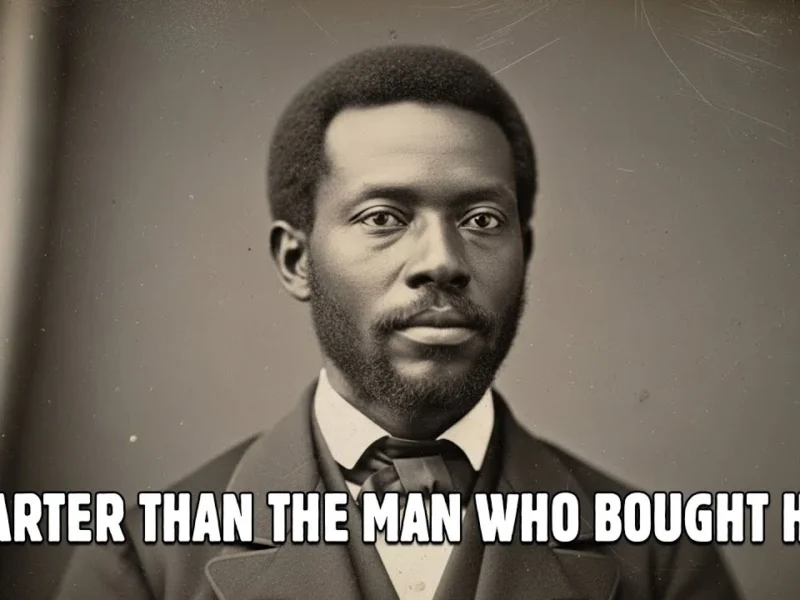
PART 1: THE PRICE OF A HUMAN LIFE
The first cold wind of autumn came down from the mountains like a warning nobody wanted to hear.
It swept through the streets of Red Creek, lifting dust from the wagon ruts and rattling the loose shutters of buildings that had stood too long against too many seasons. The town had once been lively, full of fiddle music on Saturday nights and children racing between the hitching posts. But that had been before the dry summer. Before the corn withered on the stalk and the hay came in thin and brown. Before every family in the valley began counting the sacks in their cellars and doing the same grim arithmetic late at night.
Fear had settled over Red Creek like a second layer of dust. Neighbors who had once shared seed and labor now locked their storehouses. Men spoke less and watched more. Kindness had not disappeared all at once. It had simply been rationed, like everything else, until there was almost none left.
Morris Walker felt it the moment he rode into town that morning.
He was not a remarkable man to look at. Thirty-four years old, broad through the shoulders, with a face weathered by work rather than worry. His ranch lay several miles north, a modest spread of good grass, a small herd, and a cabin he had built with his own hands. He was not rich, and he had never cared to be noticed. But his neighbors respected him for three things: he worked harder than any man in the valley, his word was as good as a signed contract, and he had never once been known to turn away someone in need.
He had come to trade grain for supplies. The four dollars and some coins in his pocket were meant to buy coffee, lamp oil, nails, and enough salt to cure the winter’s meat. He had planned every cent.
He was tying his horse outside the trading post when he noticed the crowd.
They were gathered near the old courthouse steps, perhaps two dozen people, and they had the restless, uneasy look of folk watching something they did not quite approve of but could not bring themselves to walk away from. Morris drifted closer.
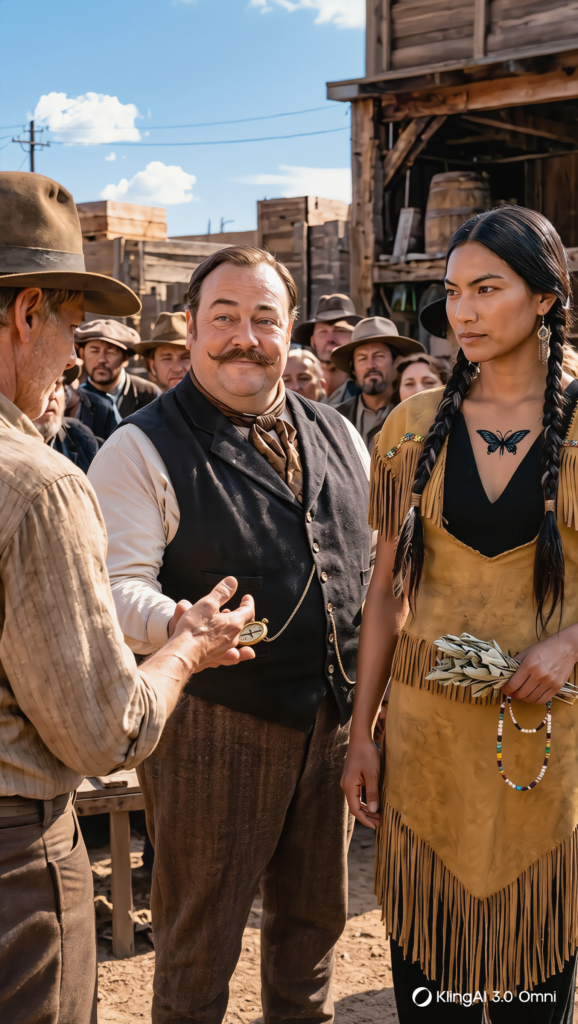
A trader stood on the back of a mud-spattered wagon. Morris knew the type: a man named Cyrus Vane who drifted through the territories buying and selling whatever turned a profit, and asking no questions about where it came from. His coat was expensive and filthy at the same time, and his voice had the loud, greasy confidence of a man used to cheating people.
Beside the wagon stood a young Apache woman.
She was wrapped in a threadbare blanket, her dark hair loose and dusty from long travel. There was a raw mark on one wrist where a rope had been. Yet she stood straight, her chin level, and though she kept her eyes lowered, there was nothing broken in the way she held herself. She had the stillness of someone who had decided, somewhere deep inside, that whatever happened to her body, they would not be allowed to touch her dignity.
“Strong back,” Vane was calling to the crowd. “Knows her way around a camp. Can cook, can mend, can haul water. Who’ll give me ten dollars?”
Silence.
“Eight, then.”
Someone in the crowd snorted. A woman pulled her children closer and walked away. Two men shook their heads and turned toward the saloon.
“Nobody wants that kind of trouble,” a rancher muttered.
“Winter’s coming,” another answered. “Every useless mouth is food taken from your own.”
The young woman heard every word. Morris saw the faint tightening at the corner of her jaw. But her expression never changed.
And then Morris noticed something that no one else seemed to see.
She was not looking at the crowd at all. Her eyes kept lifting, again and again, toward the mountains beyond the town. Toward the high ridges where gray clouds clung to the peaks like smoke. She studied them the way a scholar studies a page, as though the land itself were written in a language only she could read.
“Five dollars,” Vane said irritably.
Nothing.
The trader spat into the dust. “Fine. Two dollars. That’s all I’m asking. Two dollars, and you’re rid of me and I’m rid of her.”
The silence that followed was the ugliest sound Morris had ever heard.
He looked around. Every face was turned away or carefully blank. These were churchgoing people. Many of them were good people, in ordinary times. But fear had taught them to measure everything in sacks of flour and cords of wood, and by that measure, a human being in a threadbare blanket was worth less than two dollars.
Morris put his hand into his pocket and felt the coins. Two dollars was half of everything he had. It was the coffee and the lamp oil. It was the nails for the barn roof. It was the margin between a hard winter and a dangerous one.
He stood there for a long moment.
Then he walked to the wagon.
“I’ll pay,” he said.
Heads turned. A ripple of disbelief moved through the crowd. Vane’s face split into a grin, and he snatched the coins from Morris’s palm as though afraid he might change his mind. He scrawled something on a scrap of paper and pressed it into Morris’s hand. A bill of sale. As though she were a horse, or a plow.
Behind him, the whispers began.
“Walker’s lost his mind.”
“Can’t even keep his own barn roof on, and he’s buying another mouth to feed.”
“Two dollars he’ll need before the snow flies. Fool.”
Morris ignored them all. He walked to the young woman and stopped a respectful distance away. When he spoke, he kept his voice low, meant only for her.
“My name is Morris Walker. You don’t need to be afraid of me.”
For the first time, she lifted her eyes to his. They were dark and steady and full of a wary intelligence that measured him in a single glance.
Morris looked down at the scrap of paper in his hand. Then, slowly and deliberately, in front of the whole silent crowd, he tore it in half. Then in half again. He let the pieces fall into the dust at Vane’s feet.
“Nobody owns you,” he said. “Not him. Not me. You’re free to go wherever you choose.”
The crowd went utterly still. Even Vane’s grin faltered.
The young woman stared at the torn paper for a long moment. Something moved behind her eyes, though Morris could not tell whether it was relief or grief or simply disbelief.
“My name is Anaya,” she said quietly.
Then she turned and looked once more toward the mountains, where the gray clouds hung heavier now.
“My people are beyond those peaks,” she said. “Three weeks’ walk. Perhaps more.” She paused. “I will not reach them before the snow closes the passes.”
Morris understood. “Then you’re welcome at my place until spring. As a guest. Not a servant. When the passes open, I’ll give you a horse and supplies, and you can go home.”
She studied him for a long time, searching his face for the trick, the lie, the hidden price. Finding none, she gave a single slow nod.
They left Red Creek together, Morris leading his horse and Anaya walking beside him. Behind them, laughter followed them down the main street.
“Hope she’s worth it, Walker!” someone shouted.
At the trading post doorway stood Harlan Pike, the owner, a heavy-jawed man who sold most of the flour, coffee, and firewood in the valley and who had grown noticeably fatter while everyone else grew thin. “When you come begging for credit in January,” he called after them, “don’t bother. I don’t extend it to fools.”
Neither Morris nor Anaya looked back.
At the crest of the hill overlooking the town, Anaya stopped. She turned toward the mountains, and the wind tugged at her blanket. The air carried a sharp, clean scent Morris couldn’t place.
“The winter,” she said, almost to herself, “will be harder than they believe.”
Morris followed her gaze to the dark clouds coiling around the highest summits. He saw nothing but mountains and weather. Yet something in her voice raised the hair on the back of his neck.
The weeks that followed taught Morris more about his own land than eight years of working it.
Anaya was awake before him every morning, carrying water from the creek before the sun touched the hills. “In my family,” she told him, “everyone worked before the sun greeted the earth.” She mended torn blankets with stitches so fine he could barely see them. She organized tools that had lain scattered for months. She gathered dead wood from the forest and found herbs in places he had walked past a thousand times without seeing.
But it was the things she noticed that unsettled him.
One afternoon, while they mended a fence together, she knelt and picked up a few tiny seeds from a clump of dry grass. “The birds have harvested these much earlier than usual,” she said.
“Birds always gather before winter.”
“Yes,” she answered. “But never this early.”
That evening, she pointed to a flight of geese moving low across the valley, far lower than usual, and much too soon. The next morning, she ran her hand along the flank of his bay gelding and showed him the thick winter coat already coming in. A week later, she found beaver lodges along the creek built twice as high as he had ever seen them.
Every day, another sign. And every day, the clouds on the mountains grew heavier.
One night by the fire, Morris finally asked, “What are you seeing?”
Anaya looked toward the window, where the last light was dying behind the peaks. “My grandfather taught me that the land always speaks before danger arrives. The birds, the animals, the wind, even the trees. They prepare long before men notice.” She was quiet for a long moment. “This will be the hardest winter in many years. Perhaps in a lifetime.”
Morris had lived on the frontier long enough to respect anyone who truly understood the land. He did not know how to read the signs she read. But he knew how to read a person, and there was no doubt anywhere in her.
The next morning, he changed everything.
Instead of selling his surplus firewood in town as he’d planned, he stacked every log beside the cabin under a new lean-to. He repaired the barn roof with the last of his own lumber. He filled barrels with water, sealed his grain in tight containers, dried every scrap of meat, and traded his best saddle for blankets and oil.
His neighbors noticed.
“Expecting the end of the world, Walker?” one rancher laughed when he passed on the road.
“Spent two dollars on a stranger,” another grinned, “and now she’s got you hiding from a winter that ain’t even come yet.”
Morris only smiled politely and kept loading his wagon.
The air grew colder. Frost silvered the fields before dawn. And a strange, heavy stillness settled over the valley, as if the whole land were holding its breath.
Then one evening, Anaya stepped out onto the porch and did not come back inside.
Morris found her standing motionless, staring west. Over the distant peaks, enormous dark clouds were rolling toward them, thick and bruised and swallowing the last of the light. The wind carried a cold unlike anything he had ever felt, a cold with teeth.
“It begins tonight,” she said.
It came before midnight.
Morris woke to a roar like a freight train bearing down on the cabin. The walls shuddered. Snow hissed against the windows so thick and fast it looked like the world had been erased. From the barn, faintly, beneath the howl of the wind, came the panicked bellowing of cattle.
“The barn door,” Morris said, already pulling on his boots. “The latch must have torn loose. If the stock scatter in this, they’ll freeze by morning.”
“You must not go out there,” Anaya said sharply. “In a storm like this, the barn may as well be a hundred miles away.”
“It’s forty yards.”
“Forty yards is enough to die in.”
But those animals were everything he owned. Everything that stood between them and starvation. Morris tied one end of a rope around his waist and the other to the porch post. Then he lit a lantern, opened the door, and stepped into the white.
The wind hit him like a fist.
Within three steps, the cabin vanished behind him. Within ten, the lantern was only a feeble orange smear in a howling world of white. Snow drove into his eyes, his mouth, his lungs. He couldn’t see his own feet. He reached the barn by blind luck, wrestled the door shut against the wind, wedged the latch with a fence rail.
He turned back toward the cabin and followed the rope.
Then the rope went slack in his hands.
He pulled it in, hand over frozen hand, until he held the frayed, snapped end. Somewhere in the white, it had sawed itself apart against the corner of the woodpile.
Morris stood alone in the blizzard. He had no idea which way the cabin lay. Every direction was the same roaring, endless white. The cold was already crawling into his bones, slowing his thoughts, numbing his fingers until he could barely feel the lantern handle.
The wind gusted.
The lantern guttered.
And went out.
PART 2: THE WOMAN WHO READ THE WIND
Darkness. Wind. Cold so absolute it felt like burning.
Morris had heard the stories, as every frontier man had. Settlers found frozen solid ten feet from their own doors. Men who wandered in circles in a whiteout until they simply lay down in the snow and slept. He had never truly believed a man could be lost forty yards from home.
He believed it now.
He forced himself to stand still. Don’t walk. Walking kills you. But standing still was killing him too. He could no longer feel his feet. His thoughts had begun to drift, slow and strange, toward a warm and dangerous calm.
Then, through the roar, he heard something.
Not a voice. A sound. A steady, rhythmic clang… clang… clang, metal striking metal, faint but unmistakable, coming from somewhere to his left.
Morris turned toward it and staggered forward. The sound grew louder. Clang. Clang. His boot struck something solid: the bottom step of his own porch.
A hand closed around his wrist and hauled him upward.
Anaya dragged him through the door and slammed it shut against the storm. In her other hand was the iron skillet and a fire poker. She had been standing in the open doorway in that killing wind, beating them together without stopping, for nearly a quarter of an hour.
“The wind,” she said, breathing hard, pulling his frozen coat from his shoulders. “It carries sound downward along the ground in a storm. My grandfather taught me. When someone is lost, you do not go after them. You become a sound they can follow home.”
Morris could not answer. His teeth were chattering too violently. She wrapped him in every blanket in the cabin, set his hands in a basin of cool water, never hot, and brewed a bitter tea from dried roots that spread through his chest like slow fire.
It was nearly dawn before the feeling returned to his fingers. When it did, he looked at her across the firelight for a long time.
“I paid two dollars,” he said hoarsely. “And you just saved my life.”
Anaya shook her head gently. “You tore up the paper. You gave me back my life first. I only returned the debt.”
The snow did not stop for three days.
The wind shaped drifts higher than the cabin windows. The creek froze solid. The trail to town vanished completely. But inside, the stacked wood stayed dry, the barrels stayed full, and the repaired barn sheltered every animal. Morris’s ranch weathered the storm whole, because he had listened.
On the fourth morning, the wind finally fell silent.
Morris climbed the ridge behind the ranch and looked toward Red Creek. What he saw turned his stomach. Thin threads of smoke rose from only a handful of chimneys. Most of the town showed no sign of heat at all.
“We have to help them,” he said.
Anaya was already gathering blankets.
They loaded a heavy sled with grain, dried meat, firewood, and the herbs Anaya had gathered and dried through the autumn. Morris hitched his strongest horse. The journey was slow and treacherous, with snow reaching the animal’s chest and hidden ice lurking beneath the white.
Halfway there, Morris steered toward the familiar creek crossing.
“No,” Anaya said quietly. “Not there. Go upstream, by the leaning cottonwood.”
He hesitated, then obeyed. Moments later, the snow where they would have crossed slumped and collapsed with a wet sigh, revealing black water churning beneath.
Morris stared at it, then at her. “How did you know?”
“The wind leaves different marks where the ice is weak,” she said. “The snow lies softer there. Smoother. Like a lie told too carefully.”
Red Creek was barely recognizable.
People stood in their doorways wrapped in quilts, gray-faced and hollow-eyed. The shelves of the trading post were bare. Children huddled against their mothers. An old man sat on the courthouse steps, too exhausted even to shiver.
Some of the very people who had laughed at Morris now watched in silence as he unloaded the sled. An elderly widow named Martha Glenn accepted an armload of firewood with trembling hands.
“You came back for us,” she whispered. “After the way we treated you.”
“We couldn’t stay warm at home,” Morris said simply, “knowing others needed help.”
While he distributed supplies, Anaya moved quietly through the town. She checked on the elderly. She brewed hot herbal drinks for those weakened by cold and fever. She showed families how to pack rags and straw into the walls to stop the killing drafts, how to bank a fire so it burned slow through the night, how to warm stones and wrap them in cloth to keep children warm in their beds. Wherever she went, her calm confidence spread like heat.
But not everyone welcomed her.
Harlan Pike stood in the doorway of his trading post, arms folded. Morris had heard the rumors on the way in: Pike still had wood and flour locked in his back storehouse, and he was selling it at five times the autumn price to anyone who could pay.
“Well, look at this,” Pike said loudly. “The two-dollar squaw playing doctor.”
Heads turned.
“Strange, isn’t it?” Pike went on, raising his voice so the whole street could hear. “She shows up, and the worst winter in living memory follows right behind her. Some folks might call that a coincidence. I call it a curse.”
A few people shifted uneasily. Fear had a long memory, and an easy one.
Morris set down the sack of grain he was carrying and walked over to the trading post. He stopped close enough to see the sweat on Pike’s forehead despite the cold.
“She warned me about this storm three weeks before it came,” Morris said, and his voice carried just as far as Pike’s had. “She told me to stack my wood and seal my grain and fix my barn. I did. That’s why I have food to give these people today. And you, Harlan, have a storehouse full of firewood you’re selling at five times its worth while children freeze across the street.”
The crowd murmured. Pike’s face darkened to a deep red.
“What I sell and for how much is my business.”
“Then I hope,” Morris said quietly, “your business keeps you warm at night.”
For the next several days, Morris and Anaya traveled between the isolated ranches scattered across the valley. Anaya seemed able to sense the safe paths through the snow. She noticed broken branches that signaled unstable ground beneath drifts. She recognized sheltered hollows where stranded travelers could rest. She found a family of six huddled in a half-collapsed barn and led them home by a route no one had used in years.
Each successful journey saved another family. And each one earned her a little more of the respect the town had refused her.
On the seventh night, exhausted volunteers had gathered around the stove in the town hall when the door burst open. A rider staggered in, white with frost from hat to boots, gasping for breath.
“Families trapped,” he panted. “Beyond Eagle Pass. Three wagons caught on the road when the storm hit. They’ve been sheltering in the old line cabins, but their wood’s nearly gone. The pass is buried. Nobody can find a way through.”
A terrible silence fell. Everyone in the valley knew Eagle Pass. In good winters, it was dangerous. In this winter, it was a grave.
Then a voice from the back of the room cracked like breaking ice.
“My daughter.”
Harlan Pike pushed his way forward, his heavy face suddenly gray. “My daughter Clara and her boy. They were coming home from Fort Benton for the winter. They’d have been on that road.” He seized the rider’s coat. “Was there a woman with a little boy? Five years old? Red scarf?”
The rider’s eyes softened. “Yes, sir. The boy’s sick. Fever. They don’t think he’ll last much longer without help.”
Pike released him and stood swaying, as though he’d been struck.
Slowly, almost against their will, every face in the room turned toward Anaya.
For the first time, no one wondered whether she belonged among them. Every look was filled with desperate hope.
Pike turned too. His mouth worked, but no sound came out. The man who had called her a curse an hour’s ride ago could not find the words to ask for her help.
Anaya walked to the table where a large map lay spread. She studied the mountains for a long time, her finger tracing ridges and hollows. At last, she pointed to a narrow, winding valley that curled behind Eagle Pass like a hidden river.
“There is another way,” she said. “It is longer. But the hills shelter it from the worst winds, so the snow will lie shallower. My grandfather showed it to me when I was a child. Travelers rarely notice it, because they seek the fastest road instead of the safest.”
“No wagon’s been through that valley in years,” one man objected.
“That,” Anaya said, “is exactly why the drifts will be thinner.”
Morris looked around the room. “We made it this far by trusting her. We’d be fools to stop now.”
Harlan Pike lifted his head. His eyes were wet. When he spoke, his voice was barely above a whisper.
“Please.”
Anaya looked at him for a long moment. Then she nodded once.
“We leave before dawn.”
They set out in the black cold before sunrise: Morris, Anaya, six volunteers, and Harlan Pike, who had insisted on coming and had loaded two sleds himself with firewood from his own storehouse, every stick of it, without asking a cent.
The hidden valley was narrow and silent, walled by steep white slopes. Here the wind could not reach them, and the snow lay manageable, just as Anaya had promised.
Halfway through, she raised her hand sharply. Everyone stopped.
“No one speak,” she whispered. “No one call out. Walk softly.”
Morris followed her gaze to the slope above them. An immense overhang of snow hung there, heavy and smooth, like a wave frozen just before it broke.
They crept beneath it single file, the horses’ hooves muffled, every man holding his breath. It took nearly half an hour to pass. Not until they were well beyond did Anaya let them speak again. Behind them, as if to prove her right, a dull rumble shook the air, and a white cloud bloomed over the trail they had just walked.
By late afternoon, they reached the line cabins.
The sight broke something open in every man there. Parents huddled together with children wrapped in every scrap of cloth they owned, feeding the last splinters of a wagon bed into a dying fire. Faces turned toward the door with the dull disbelief of people who had stopped hoping.
Harlan Pike pushed through the doorway and fell to his knees beside a young woman holding a small boy in a red scarf. The child was flushed with fever and barely conscious.
“Clara,” Pike choked. “Clara, I’m here.”
Anaya knelt beside them. She laid her hand on the boy’s forehead, then on his chest. Without a word, she began to work. She brewed willow bark and yarrow into a tea, coaxed it between the child’s lips a spoonful at a time, cooled his forehead with snow wrapped in cloth, and sat with him through the long night while the volunteers fed the fire with Pike’s firewood.
Near dawn, the boy opened his eyes and asked for water.
Harlan Pike, the man who had called her a curse, put his face in his hands and wept.
PART 3: WHAT A LIFE IS WORTH
They reached Red Creek the following morning, every family alive.
Someone spotted the sleds on the far hill, and the church bell began to ring. Not slow and mournful, as it had rung too often that winter, but wild and joyous. People poured from their houses into the snow, cheering, weeping, embracing the rescued families as they came down the main street.
No one spoke about the two dollars that day.
Instead, they spoke about a quiet rancher who had chosen mercy when everyone else chose judgment. And about a woman whose wisdom had carried them all through the dark.
Spring came slowly to the frontier.
The great drifts softened into clear streams. Fresh grass crept back across the valleys. Birdsong returned to the quiet mornings, and the mountain passes, one by one, began to open.
Red Creek was not the same town it had been in autumn. The winter had tested every family, but it had also changed every heart. Neighbors who had once lived like strangers now worked side by side, repairing damaged barns, rebuilding broken fences, sharing seed and tools and livestock with those who had lost everything. Harlan Pike threw open his storehouse and sold at honest prices, and more than one family found its debt quietly forgiven.
One bright morning, the people of Red Creek gathered in the square where, months before, a trader had shouted a price no one would pay.
The mayor stepped forward with Morris and Anaya beside him. Many in the crowd lowered their heads.
“Last autumn, in this very place,” the mayor said, “we judged a human life to be worth less than two dollars. We were wrong. Today we thank two people who reminded us that every life has value, and that wisdom often comes from the place we least expect it.”
The applause rolled across the square like spring thunder.
Martha Glenn, the widow who had wept over an armful of firewood, stepped forward with a quilt sewn by the women of the town. Each square showed a scene from the valley: the mountains, the creek, the hidden valley behind Eagle Pass, and in the center, a small figure standing in an open doorway with a lantern, guiding someone home.
Then Harlan Pike came forward. He held his grandson’s hand, the boy healthy now and grinning. Pike removed his hat and stood before Anaya, and for a long moment, he could not speak.
“I called you a curse,” he finally said. “In front of all these people. You’d have been within your rights to let my family die.” His voice broke. “Instead you sat with my grandson all night. I’ll spend the rest of my life trying to deserve that.”
Anaya looked at him with quiet, unwavering eyes. “Then spend it well,” she said gently. “That is all anyone can do.”
That evening, as the sun set gold over the eastern hills, Morris saddled the finest horse he owned and loaded it with supplies: food, blankets, a good knife, and a rifle. Everything he had promised her in the dusty square half a year ago.
He found Anaya on the porch, watching the mountains. The passes were open now. Somewhere beyond those peaks, her people were waiting.
“It’s time,” Morris said, and was surprised at how heavily the words sat in his chest.
She looked at the horse for a long moment. Then she turned to him.
“When I stood in that square,” she said, “I believed the world had decided what I was worth. Two dollars. And not even that.” She reached into the fold of her blanket and drew out something small. Four torn scraps of paper, carefully kept. The bill of sale he had ripped apart in the dust.
“I picked these up after you walked away,” she said. “I kept them all winter. To remember the moment someone looked at me and saw a person.”
She stepped down from the porch and dropped the pieces into the cooking fire. They curled, blackened, and became nothing.
Then she took the horse’s reins.
“I will go to my grandfather,” she said. “He must know I am alive. He must know what happened here.” She paused, and for the first time since he had known her, she smiled fully. “But this valley has learned to listen to the land. That is rare. I think, perhaps, it is worth returning to.”
She mounted, turned the horse toward the mountains, and rode away into the evening light. Morris stood at the gate until she was only a speck against the peaks, and then nothing at all.
For six weeks, the porch was quiet.
Then one morning in early summer, Morris looked up from the fence he was mending and saw riders coming down from the mountains. At their head rode an old man with silver braids and a face carved by eighty winters.
Beside him rode Anaya.
The old man dismounted and studied Morris for a long while, the same searching look his granddaughter had given him in the square. Then he extended his hand.
“My granddaughter tells me,” he said, “that you paid two dollars for her life and then gave it back to her for nothing.” He gripped Morris’s hand firmly. “Among my people, that is called the act of a true man. We would be honored to call you friend.”
From that summer on, the families of the mountains and the families of Red Creek met each season to trade and share what they knew. And every autumn, when the birds harvested early and the geese flew low, the people of the valley went to find Anaya. Because they had learned, at terrible cost, what she had known all along.
The land always speaks before danger arrives.
You only have to be humble enough to listen.
For generations afterward, the people of Red Creek told the story of the quiet cowboy who followed his heart and the wise Apache woman whose courage saved a frontier. And they always ended it the same way.
The measure of a person is never what the world says they cost.
It is the good they bring into the lives of others.