PART 1: The Sealed Letter
Dawn came slowly over the Arizona frontier, painting the red cliffs above Copper Wells in soft bands of gold. Wind moved through the desert carrying the smell of sage and dry earth. Cottonwoods rustled along the creek. A few head of cattle grazed near a small ranch at the edge of town.
It was an ordinary morning. By noon it would no longer be.
Ethan Carter tightened the cinch on his sorrel mare and looked out over the open land. He was thirty-eight years old and had spent most of those years in the saddle. His hat was sweat-stained, his boots cracked and faded, and his face had the stillness of a man who had weathered hard seasons without letting them turn him hard.
People in Copper Wells respected him, in their way. If a fence needed mending, a lost calf needed tracking, or a family of greenhorns needed guiding through the passes, Ethan was the man they asked. He took every job with the same quiet resolve and never asked for more than was fair.
But respect isn’t the same as forgetting. Behind his back, and sometimes to his face when the saloon got loud, the old-timers still called him what they had called him since he was eight years old.
The thief’s boy.
Thirty years ago, during the famine winter, Ethan’s father, Thomas Carter, had broken into the government supply depot run by old Josiah Stroud. Twelve wagonloads of flour, beef, and blankets vanished in a single night. Thomas never denied it. He never explained it either. He simply rode out of Copper Wells the next spring and never came back. Ethan’s mother died believing her husband had disgraced them for reasons she would never understand.
Ethan had built his entire life on one rule: A Carter keeps his word. No matter what it cost him, he had never broken a promise. Some part of him had always believed that if he kept enough of them, he might someday pay back a debt he didn’t understand.
That morning a rider appeared on the dusty trail into town.
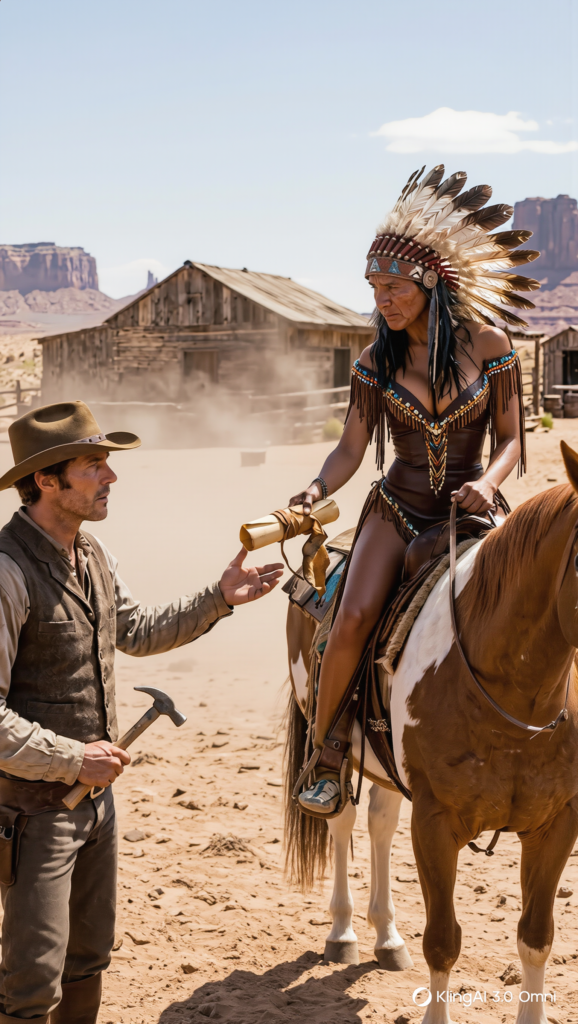
He wore traditional Apache clothing and sat his paint pony with complete ease. Conversations stopped along Main Street. Shopkeepers stepped out onto their porches. It had been many years since an Apache messenger had ridden into Copper Wells without fear on one side or anger on the other.
The rider stopped before the general store and asked a single question.
“Where can I find Ethan Carter?”
No one answered. Finally the storekeeper pointed east, toward the ranch.
A few minutes later the messenger stopped at Ethan’s gate. He laid his hand over his heart.
“Our chief asks to see you.”
Ethan frowned. “Me?”
“He said only you.”
It made no sense. Ethan had never spoken a word to the chief of the Apache band in the Red Mesa country. Over the years he had crossed paths with their hunters at a distance, always with mutual respect, never more. But something in the messenger’s quiet urgency told him this was no ordinary request.
He saddled the mare and followed.
They rode for hours across the desert. Red rock towers rose around them, tall saguaros stood silent under a blazing sky, and a hawk circled high above them. Neither man spoke much. The silence felt respectful rather than heavy.
Near sunset they reached the Apache camp, tucked beside a clear creek in a grove of cottonwoods. Children played by the water. Elders sat together in the shade, and cookfires sent thin threads of smoke into the evening air. Ethan noticed something that surprised him: no one looked at him with suspicion. They watched him with a quiet, almost knowing curiosity, as if they had been expecting him for a long time.
At the center of camp, on a blanket beneath the largest cottonwood, sat the chief.
His hair had gone silver, and illness had hollowed his cheeks, but his back was still straight. His eyes were deep, calm, and searching. Ethan took off his hat.
“You sent for me.”
The chief smiled. “I did. Sit, Ethan Carter.”
The way he said the name, Carter, with a strange tenderness, made something prickle at the back of Ethan’s neck.
The chief reached beside him and lifted a small leather pouch, worn soft by years of handling. Inside lay a folded letter sealed with dark wax pressed with an Apache symbol: a hand holding a single feather. He held it in both hands for a long moment before offering it.
“This must cross the frontier.”
Ethan took it carefully. “Who’s it for?”
The chief looked toward the distant mountains. “One man still remembers how to read our written words, the old way the missionaries taught us. Samuel Whitmore, at San Ysidro Mission, five days east. Let only him open it. No one else.”
“What does it say?”
The chief’s smile faded. “If I tell you now, its meaning would be lost. Some truths must arrive whole, or they do not arrive at all.”
Then his thin hand closed around Ethan’s wrist with surprising strength.
“Hear me. There are men who will want this letter. Men who need the old stories to stay as they are. Trust no one until it is read. Not a friend, not a stranger, not a man with a badge. No one.”
“Why me?” Ethan asked quietly. “Out of every man on this frontier, why me?”
The chief studied his face for a long time, as if searching it for someone else.
“Because you are known for keeping your word,” he said at last. “And because this letter has been waiting thirty years for a Carter to carry it.”
Before Ethan could ask what that meant, the chief closed his eyes, exhausted, and an elder woman gently signaled that the audience was over.
Ethan left before sunrise. Mist hung over the creek. When he looked back, the chief stood alone at the edge of the camp, wrapped in a blanket, watching him go. He did not wave. He simply watched, as a man watches something he knows he will never see again.
For two days the journey was peaceful. Ethan followed narrow trails through open valleys where wild horses grazed, forded shallow rivers that held the blue of the sky, and camped beneath cottonwoods. Every night he checked the pouch before sleeping. He never opened it. He never held it longer than he had to.
But the chief’s words rode with him. Thirty years. A Carter.
Thirty years ago was the famine winter. Thirty years ago his father had become a thief.
On the third afternoon he stopped at Dutchman’s Trading Post to rest the mare. Inside, men talked about cattle prices and new settlers coming west. A friendly merchant noticed the old pouch tied to his saddle.
“Family keepsake?”
“Something I promised to deliver,” Ethan said.
As he left, an old woman sweeping the porch watched him carefully. “Whatever you’re carrying,” she said softly, “carry it well. Some journeys only matter once they’re finished.”
And from the corner of the porch, a man in a black duster who had been whittling with a long knife stood, flipped a coin to the boy holding his horse, and rode off fast toward the south.
Ethan noticed. He told himself it meant nothing.
On the fourth day, threading a narrow canyon called the Devil’s Throat, he found fresh tracks crossing his trail: four horses, shod, moving fast. A half-mile on, three riders waited beside the path. They smiled. Their hands rested near their guns.
“Afternoon, friend,” said the one in the middle. “Where you headed?”
“East.”
The man’s eyes went to the pouch. “Looks like someone trusted you with something valuable.”
“Just something that belongs to somebody else.”
“Funny thing,” said the rider. “We’re looking for a letter. Some dying Apache’s lies, written up to make trouble for decent folks. Man we work for would pay a hundred dollars just to look at it. Maybe two hundred.”
“Not for sale.”
“Everything’s for sale, Carter.”
Ethan had never told them his name.
Time seemed to slow. He saw the fourth rider, the one whose tracks he’d followed, on the rim above him with a rifle. He saw the middle man’s thumb slide to the hammer of his pistol.
Ethan drove his heels into the mare’s flanks.
She exploded forward. A rifle cracked from the rim, and the bullet kicked up sand beside her hooves. Ethan bent low over her neck as pistol shots split the air. Something punched his left arm like a hot iron, but he kept riding, straight through the gap between two of the horses, and their mounts reared and scattered. He tore down the canyon, turned hard into a side wash he’d known since boyhood, and climbed a goat path no rider from outside the country would dare.
He did not stop until dark.
That night, on a ridge with no fire, he tied a strip of shirt around the bloody furrow in his arm and looked down at the valley below. Four tiny points of light were moving, torches, following his trail.
They were not trying to rob him. They were trying to bury something.
On the fifth day, swaying in the saddle from blood loss, Ethan rode into San Ysidro Mission.
It was a quiet place: a stone church, a handful of adobe houses, chickens in the yards, children laughing beneath old cottonwoods. A farmer pointed him to a small cabin at the edge of the village, where an old man sat on the porch carving cedar. He had white hair under a battered hat and round spectacles on the end of his nose.
“Samuel Whitmore?”
“You’ve found him.” The old man’s eyes went to Ethan’s bloody sleeve, and then to the pouch. The knife stopped. The cedar fell from his hand.
“Lord God,” he whispered. “That seal.”
“You know it?”
“I haven’t seen that seal in thirty years.” Samuel stood, trembling. “Come inside. Quickly.”
The cabin was crowded with books, rolled maps, and stacks of handwritten journals. Samuel bolted the door, drew the curtains, and laid the pouch on the table as if it were made of glass.
“The chief told me only you should open it,” Ethan said.
“Then I’ll honor that.”
Samuel broke the wax without tearing the paper and unfolded the letter with infinite care. His eyes moved across the hand-drawn Apache symbols, slowly at first, then faster.
His eyebrows rose. His lips parted. He took off his spectacles, closed his eyes, and pressed a hand over his mouth.
When he looked up, the color had drained from his face.
“Who else knows you’re carrying this?” he asked hoarsely.
“Four men tried to kill me for it yesterday. They knew my name.”
Samuel looked at the window, then back at Ethan, and his eyes filled with something like terror and something like wonder.
“Then they know what it says. And they know that if it’s ever read aloud, a very powerful man is ruined.”
“What does it say, Samuel?”
The old interpreter laid one shaking finger on the first line of symbols.
“It begins with a name. The chief wrote it three times, so there could be no mistake.” His voice broke. “Ethan… the first words of this letter are Thomas Carter.”
Outside, in the gathering dusk, the dogs of San Ysidro began to bark.
And beneath their barking came the sound Ethan had been dreading for two days: hoofbeats, a lot of them, coming down the road.
PART 2: What the Famine Winter Hid
“Lamp,” Ethan said. “Now.”
Samuel blew it out. Darkness swallowed the cabin. Through a gap in the curtain Ethan counted torches: six riders reining in at the edge of the village. In the lead sat a broad-shouldered man in a fine grey coat, with a silver star pinned to his chest.
Ethan knew him. Everyone in the territory did.
Virgil Stroud. Josiah Stroud’s son, owner of the biggest cattle outfit in Arizona, territorial land commissioner, and the loudest voice in the capital demanding the army remove the Red Mesa Apache to the reservation at San Carlos. The Red Mesa creek was the last year-round water between Copper Wells and the mountains. Everyone knew Stroud wanted it.
“Not a man with a badge,” Ethan whispered. “The chief knew.”
Stroud’s voice carried across the dusty square. “Samuel Whitmore! Territorial business! You’re harboring a fugitive and stolen property. Send Carter out with the letter, and nobody gets hurt.”
Samuel gripped Ethan’s sleeve. “Listen to me. You have to know what you’re protecting. It won’t take long.” He pulled Ethan down behind the stone hearth, struck a single match, and cupped it over the page. His voice was barely a whisper.
“To whoever reads these words. My name was given to me by my mother, but the white men called me Iron Cedar. I am old now, and I am dying, and I am the last who remembers. So I must tell what we promised never to tell.
“In the winter the white men call the Famine Winter, the deer were gone and the snow was deep. Our children were dying. We had nothing left to boil but the leather of our moccasins. The soldiers’ depot at Copper Wells was full of food, but its keeper, Josiah Stroud, said the food was for those who would sign away the Red Mesa water. Our chief would not sign. So Stroud let us starve.
“One night a white man rode into our camp alone. His name was Thomas Carter. He had twelve wagons behind him. He said, I cannot watch children die while flour rots in a shed. He took the food from Stroud’s depot with his own hands, and he gave it to us, and he asked one thing only: that we never speak his name, because his wife and son would suffer for it. One hundred and forty of my people lived because of him.”
The match burned Samuel’s fingers. He struck another.
Ethan could not breathe. Thirty years. Thirty years of the thief’s boy. His mother weeping at the kitchen table. His father riding away, never once explaining.
“Keep reading,” he whispered.
“Stroud knew who took his food. He said if Carter ever told the truth, he would tell the army the Apache had raided the depot, and the soldiers would come and kill us all. So Thomas Carter kept silent to protect us. He left his family so Stroud would have no reason to come after them. He lived with us in the mountains for nine years, and he died of a fever in my arms. He spoke of his son every day.”
A tear rolled down Ethan’s face into his beard. He didn’t wipe it away.
Outside, Stroud shouted again. “You have one minute, Whitmore!”
Samuel read faster. “Two summers later came the Great Drought. A wagon train of settlers lost the trail in the Dry Fork country. Their water was gone. They were dying. Our scouts found them. We remembered Thomas Carter, so we did for them what he did for us. We led them by night to the hidden springs and asked for nothing. Among them was a woman named Ellen Stroud, the wife of Josiah Stroud, and her small son. The boy was so sick from thirst that he could not cry. Our grandmother carried him on her back to the water.
“That boy lives today. His name is Virgil Stroud.”
Samuel lowered the page. In the darkness the two men stared at each other.
“The man outside,” Ethan said slowly, “who wants to drive the Red Mesa people off their water… is alive because they carried him to water.”
“And his father,” Samuel said, “branded your father a thief for feeding starving children, and kept the truth buried with a threat of massacre.” He folded the letter with shaking hands. “If this is read in public, Virgil Stroud’s whole campaign is finished. Every rancher he’s turned against the Apache, every speech in the capital about Apache raiders. It all rests on a story his own father invented.”
A rifle butt hammered the door.
“Time’s up!”
Ethan took the letter, slipped it back into the pouch, and buttoned it inside his shirt against his heart.
“Is there a back way?”
“Root cellar. Comes out under the church.” Samuel hesitated. “Ethan, I’m seventy-four years old. I can’t run.”
“Then I won’t leave you.”
The front door splintered. Ethan pulled Samuel down through the trapdoor just as boots thundered into the cabin above them. They crawled through damp darkness, past barrels and jars, until they came up through a loose flagstone behind the altar of the stone church.
They were not alone.
Father Alonzo, the mission priest, stood waiting with a lantern. Behind him, holding pitchforks, old shotguns, and axe handles, stood nearly every man and woman of San Ysidro.
“Samuel has taught our children their letters for twenty years,” the priest said calmly. “We don’t hand our friends to men who come at night with torches.”
Ethan looked at these strangers, farmers and shepherds and their wives, who had no reason to risk anything for him.
He thought of his father riding alone into a starving camp.
Stroud’s men poured out of the cabin and found themselves facing forty villagers in the square, lanterns raised and weapons ready. Stroud reined in, his face hard.
“This is territorial business. Stand aside.”
Father Alonzo did not move. “Then come back with a judge, Commissioner. In daylight.”
For a long, terrible moment Stroud’s hand hovered near his revolver. Ethan stepped out of the church doorway and stood in the lantern light where everyone could see him.
“You want the letter, Stroud?” His voice rang across the square. “Come to Copper Wells. Town hall, Saturday noon. I’ll have it read aloud in front of the whole town, the Indian agent, the army, and the Red Mesa elders. You can hear every word.”
Stroud’s eyes narrowed to slits. “You’d hang yourself in front of a crowd? A thief’s son, reading a dying savage’s fairy tales?”
“I’ll take my chances with the truth,” said Ethan. “My father did.”
Something flickered across Stroud’s face. It was gone almost before it appeared, but Ethan had seen it: not anger, but fear.
Stroud wheeled his horse. “Saturday, then. And Carter? Roads are dangerous between here and Copper Wells. A man could lose a lot more than a letter.”
The riders vanished into the night.
They left at dawn: Ethan, Samuel in a borrowed buggy, and six young men from San Ysidro who refused to stay behind. Father Alonzo telegraphed the Indian agent at Fort Verde, the army captain at Camp Grant, and the newspaper in Prescott. If Stroud wanted the letter to disappear, he would now have to make a lot of witnesses disappear with it.
On the second night of the return journey, as they camped by a dry wash, Samuel sat beside Ethan at the fire.
“He loved you,” the old man said quietly. “I knew your father a little, before. He talked about you constantly. Said you could rope a fence post before you could read.”
Ethan stared into the flames. “Thirty years I carried his name like a stone around my neck. I kept every promise I ever made, every single one, because I thought if I did, maybe I could make up for what he did.” He laughed, and it came out broken. “And all that time, he was the most honorable man in the territory.”
“You didn’t pay his debt, son,” Samuel said gently. “You inherited his character. That’s why the chief chose you. He’d been watching you for years, I’d wager. Waiting to see if Thomas Carter’s boy grew up into Thomas Carter’s man.”
Far off on the ridgeline, a single rider sat motionless against the stars, watching their fire. When dawn came, he was gone.
Saturday was two days away.
PART 3: Every Word, Read Aloud
By Saturday noon, the Copper Wells town hall was packed to the walls. Ranchers, shopkeepers, schoolteachers, and preachers filled every bench. Men stood three deep along the back. Captain Reyes from Camp Grant sat near the front with two soldiers. The Indian agent had come from Fort Verde. The Prescott newspaperman held his pencil ready.
Near the door, quiet and dignified, stood seven elders of the Red Mesa Apache. They had traveled through the night.
Virgil Stroud sat in the front row in his grey coat, surrounded by his men, smiling the confident smile of a man who had owned rooms like this for twenty years.
Samuel Whitmore stood at the podium and unfolded the letter. The hall went silent.
“Before I read,” Samuel said, “know this. I served as army interpreter in this territory for twenty-six years. I will translate these words exactly as they are written. I’ll answer for every one of them before God.”
He began to read.
He read of the Famine Winter and the dying children. He read how Josiah Stroud’s depot had been full while the Apache starved. He read how Thomas Carter rode in alone with twelve wagons and asked only that his name never be spoken.
A murmur rose and spread through the hall. Old men looked at each other. One woman put her hand over her mouth.
Stroud stood up. “This is slander! A forgery cooked up by a disgraced thief’s son and a senile old man…”
“Sit down, Mr. Stroud,” said Captain Reyes, without raising his voice. “You’ll have your turn.”
Samuel read on, through Thomas Carter’s nine years in exile and his death, through the drought summer and the dying wagon train in the Dry Fork country, and the Apache scouts who led the settlers by night to hidden water and asked for nothing.
Then he read the last part slowly.
“Among them was a woman named Ellen Stroud and her small son. Our grandmother carried the boy on her back to the water. That boy lives today. His name is Virgil Stroud.”
The hall fell into total silence.
Every head turned toward the front row.
Stroud had gone grey. His mouth worked, but no sound came.
Then old Walt Henley, a rancher of eighty, rose slowly on his cane. “My grandmother was on that wagon train,” he said hoarsely. “She always told us strangers came out of the dark and led us to water. She never knew who they were. Said they were angels.” He looked toward the door, at the Apache elders. “They weren’t angels, were they?”
The eldest of the Red Mesa people, a woman with long white braids, stepped forward. Her voice was soft, but it carried.
“My grandmother was the one who carried the little boy,” she said. “She told the story all her life. She said he was so thirsty he could not cry. She sang to him so he would not be afraid.” She looked directly at Virgil Stroud. “She said you held on to her braids the whole way.”
Stroud’s knees gave way. He sat down heavily, staring at the floor. A long time passed. When he spoke, his voice was the voice of a much younger man.
“My mother used to sing me a song,” he whispered. “When I was sick. She never knew where it came from. Said I brought it back from the desert.” He raised his eyes to the old woman, and they were wet. “I thought it was a dream.”
Nobody spoke. The silence wasn’t empty. It was full of thirty years of things that should have been said.
Finally Stroud stood. He did not look at his men, the captain, or the reporter. He looked at Ethan.
“My father told me your father was a thief,” he said. “I believed it my whole life. I built my name on that story.” His jaw tightened. “I’ll withdraw my petition against the Red Mesa people tomorrow. And I’ll see to it that the territorial records are corrected. Thomas Carter’s name will be cleared in writing, in every place my father’s lie was ever written down.”
He turned and walked out of the hall alone.
Then, one by one, people began to rise and come to Ethan. Old men who had called him the thief’s boy in the saloon shook his hand without a word. Some could not meet his eyes. Walt Henley gripped his shoulder and wept openly.
“Your daddy fed a hundred and forty children,” the old man said. “And I spent thirty years spitting when I said his name. God forgive me.”
A week later Ethan and Samuel rode back to the Red Mesa camp.
The people were gathered beneath the great cottonwood. The chief, Iron Cedar, had died peacefully three days after Ethan left. His family greeted Ethan with quiet gratitude. They knew he had honored every word.
At the tribe’s request, Samuel read the letter one final time. Apache families and settlers from the nearby ranches stood together in silence. There were no speeches and no celebration, only a shared understanding that the truth had finally come home.
Afterward the white-braided elder led Ethan up a narrow trail to a small grave high on the mesa, marked by a circle of stones and a weathered wooden cross.
Carved into the cross were two words: THOMAS CARTER.
Ethan knelt and laid his hand on the sun-warmed earth. For a long time he said nothing. Then he spoke, very quietly.
“I kept my word, Pa. Every time. Didn’t know why it mattered so much. Now I do.”
He set the empty leather pouch beside the cross, beneath a flat red stone.
“It carried your story home,” he whispered. “Now it belongs to everyone.”
As the sun sank behind the red cliffs, Ethan rode back down into the wide frontier. For the first time in thirty years, he carried no weight at all.
The greatest journeys aren’t measured in miles. They’re measured in promises kept, in truths that refuse to stay buried, and in quiet acts of kindness that outlive the people who made them.
THE END