PART ONE: The Five Words
The sun was bleeding out behind the Chiricahua peaks when Caleb Rourke realized the birds had stopped singing.
He had been riding since noon, returning from Fort Bowie with a wagon-load of flour sold, a pocket heavy with silver, and a small paper parcel tucked inside his coat: a blue hair ribbon, bought from the sutler’s wife for his daughter’s ninth birthday. Lily had asked for blue. She asked for blue everything, because her mother’s eyes had been blue, and Lily held onto every thread of the woman she had lost at four years old as though the threads might one day weave her back.
Caleb smiled at the thought, and then the smile faded, because the canyon had gone silent around him.
A frontier trail is never truly quiet. There is always the tick of insects in the creosote, the scrape of a lizard on stone, the restless complaint of a cactus wren. But now there was nothing. Even the wind seemed to hold its breath. His bay gelding, Jasper, flicked his ears forward and slowed without being asked.
“Easy,” Caleb murmured. His right hand drifted, not quite deliberately, toward the Winchester in its scabbard.
The trail ahead narrowed between two shoulders of red rock before bending out of sight. The shadows there were long and violet. And in those shadows, something moved.
A single rider walked his horse into the center of the trail and stopped.
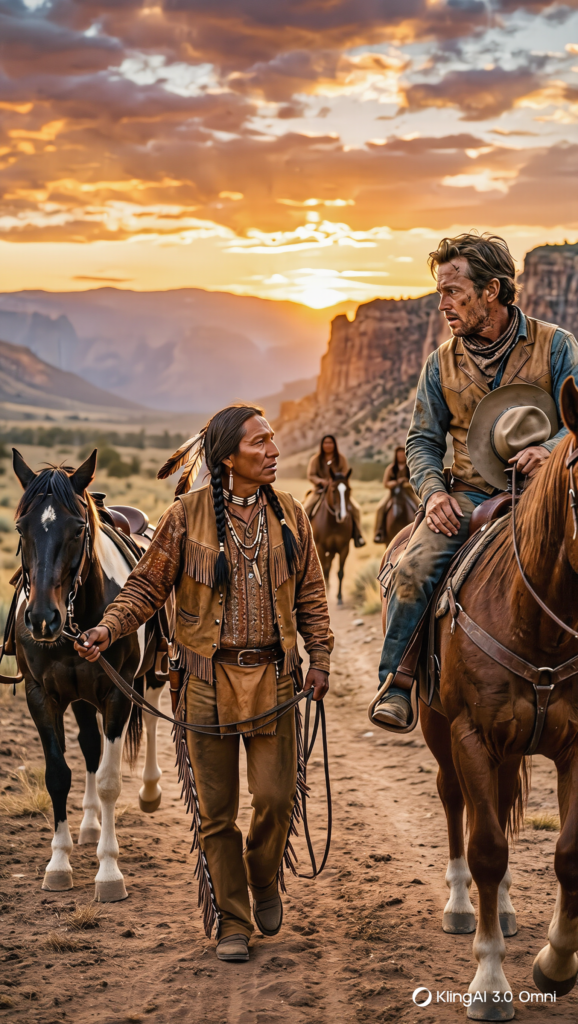
He sat a gray mustang without a saddle, as easily as if he had been born on its back. His hair was long and bound with a red cloth, his shirt the color of dust, and across his chest hung a bandolier worn smooth with years. He did not reach for a weapon. He simply waited.
Then the rocks came alive.
On the left ridge, three riders appeared. On the right, five more. Behind Caleb, he heard the soft crunch of hooves on gravel, and when he turned his head, he saw that the trail he had come down was now closed as well. Ten. Twenty. More. They rose out of the evening like the land itself had decided to stand up and look at him.
Apache.
Caleb’s heart struck against his ribs like a fist on a door. He had lived in this territory eleven years. He had heard every story the saloons could tell, the ones whispered by soldiers and the ones shouted by drunks, and he had learned to believe very few of them. But he also knew this: men did not arrange themselves across a trail like this by accident.
Slowly, deliberately, he lifted both hands from his body and held them open in the dying light.
“I’m not looking for trouble,” he called. His voice sounded thin in the vast stillness. “I’ve got no quarrel with anyone here.”
No one answered.
The rider on the gray urged his horse forward, one slow step at a time, until he was close enough that Caleb could see the lines carved into his face by sun and wind and grief. He was perhaps fifty. His eyes were dark and steady and terribly tired.
Caleb knew him. Every soul between Tucson and the Mexican line knew him.
Nakai.
Some called him a chief. The army called him a renegade. The newspapers in Prescott called him worse. Caleb had seen him once, six years ago, across the width of a dry riverbed, and he had never forgotten the stillness of the man, the way he had seemed less to look at the world than to listen to it.
Now Nakai stopped his horse so close that their stirrups nearly touched. For a long moment, he said nothing at all. He studied Caleb’s face as though searching for something written there in a language only he could read.
Then he leaned forward and spoke, so quietly that the words barely carried over the breathing of the horses.
“They are coming for her.”
Five words.
Caleb did not move. He was not sure he could. The words seemed to enter him not through his ears but through his chest, settling somewhere cold and deep.
“What?” he said. “Coming for who?”
Nakai did not repeat himself. His gaze shifted to the east, where the valley lay hidden behind the ridges, where a small adobe house stood beside a spring among cottonwoods. Where a nine-year-old girl was waiting for her father to bring home a blue ribbon.
“Lily,” Caleb whispered. Then louder, with a sudden savage edge: “How do you know my daughter’s name? How do you know anything about her?”
“I know,” Nakai said simply.
“Who’s coming? Who?”
“Men who wear no paint,” Nakai said. “But they will make the world believe they did.”
Caleb stared at him. The silver in his pocket, the flour sold, the long ride, all of it vanished. There was only the house, the spring, the girl. And old Tomás Ortega, the half-deaf vaquero who watched the place when Caleb was away, a man of seventy who could no longer hit a fence post with a rifle at twenty paces.
“When?” Caleb demanded.
“Tonight.” Nakai looked at the sky, where the first star had appeared like a pinprick in blue silk. “Perhaps already.”
Caleb’s hands came down. He jerked Jasper’s head toward home.
“Wait.”
The single word cracked like a whip. Caleb half turned, his face white with fury and fear.
“You’ll stop me? You block my road, you tell me my child’s in danger, and now you’ll stop me?”
Nakai pointed past him, toward a narrow game trail that climbed through the rocks to the north.
“Not the wagon road. The wagon road is where they will expect you. Go by the north wash. It is faster, and no one watches it.”
“Why should I believe a word you say?”
Something passed across Nakai’s face then. Not anger. Something older and heavier, like a stone turned over to reveal a wound beneath it.
“Because,” he said, “a long time ago, someone believed me.”
There was no time to ask what that meant. Caleb drove his heels into Jasper’s flanks and the gelding lunged up the game trail, hooves skittering on loose shale. Behind him, he heard Nakai say something sharp in his own tongue, and then the sound of many horses following.
He did not look back.
The north wash was a dry riverbed, pale as bone in the deepening dusk, twisting between walls of crumbling earth. Caleb rode it the way a man rides through a nightmare, bent low, the reins burning in his fists, every stride of the horse a prayer. Branches whipped his face. A low limb tore his hat away and he let it go.
They are coming for her.
Who would want Lily? She was a child. She owned nothing. She knew nothing. She spent her days chasing chickens, reading her mother’s old copy of Pilgrim’s Progress aloud to the goats, and asking Caleb impossible questions about why the stars didn’t fall.
Unless it was not Lily they wanted. Unless she was simply the surest way to make a man give up everything he had.
And there was only one man in the valley who wanted everything Caleb had.
Silas Varner.
Varner had come to the territory three years earlier with Eastern money and a smile that never quite reached his eyes. He had bought the Hatcher place, then the Dunmore place, then the old Spanish grant along the river. Rumor had it the Southern Pacific was surveying a line through the valley, and a railroad needed water for its engines. The best water for forty miles bubbled up from the spring behind Caleb Rourke’s house.
Varner had offered to buy it. Twice. The second time, he had offered three times what it was worth, and when Caleb refused, Varner had smiled that thin smile and said, “A man should think about what happens to his family if something happens to him.”
Caleb had thought it was a threat to him.
He had never once imagined it was a threat to her.
The wash opened onto the long slope above his land. Caleb reined Jasper to a sliding halt at the crest and looked down.
The valley lay in a bowl of blue shadow. The cottonwoods along the spring were dark shapes, and among them stood the house.
There was no light in the window.
Every night of her life, Lily had kept a lamp burning in that window when her father was away. It had been her mother’s custom, and Lily had taken it up the week after the funeral without a word from anyone. So you can find your way home, Papa. Caleb had never once ridden over this ridge after dark without seeing that small, steady yellow flame.
The window was black.
He did not remember riding down the slope. He remembered only the yard rushing toward him, the corral gate hanging open, the horses gone, the chickens scattered and silent. He was out of the saddle before Jasper stopped, the Winchester in his hands, running.
“Lily!”
The door of the house stood open. Inside, chairs had been overturned. The table was on its side. Lily’s sampler, the one she had been stitching all winter with the alphabet in crooked blue thread, lay on the floor with a boot print stamped across it.
“LILY!”
His voice broke against the adobe walls and came back to him empty.
He found Tomás behind the woodpile. The old vaquero was alive, groaning, blood crusted along his scalp where a rifle butt had split it. Caleb dropped to his knees beside him.
“Tomás. Tomás, look at me. Where is she?”
The old man’s eyes fluttered open. His lips moved. “Señor… they came at sundown… I tried…” He clutched Caleb’s sleeve with a trembling hand. “Painted faces, señor. Painted. Like the Apache.”
Caleb felt the earth tilt.
“How many?”
“Four. Five. No sé. They took the niña. They took her north.” Tomás’s grip tightened. “She screamed for you, señor. She screamed for you.”
Caleb rose slowly. His legs felt as though they belonged to someone else. He turned toward the house, toward the open door, and that was when he saw it.
Buried in the doorframe, at the height of a man’s heart, was an arrow.
Its shaft was painted in bands of red and black. Its fletching was hawk feather. Caleb had seen arrows like it before, in the saloon at Bowie, nailed above the bar as trophies by soldiers who bragged about the men they had taken them from.
It was an Apache arrow.
And behind him, at that exact moment, he heard the drumming of many hooves.
He spun around, Winchester rising to his shoulder.
Nakai’s riders were pouring down the slope into the yard, twenty, thirty, forty of them, their silhouettes black against the last red glow of the sky. And at their head rode Nakai himself on the gray mustang, with a young warrior close at his side.
The young man held something in his hand. It fluttered in the wind as he rode.
Caleb’s breath stopped.
It was a strip of blue calico, torn from a child’s dress.
Lily’s dress.
Caleb sighted down the barrel of the Winchester, square on the center of the young man’s chest. His finger found the trigger. His whole body shook with a rage so pure and so terrible that it felt like a fire in his blood.
“Stop right there!” he roared. “Or so help me God, I will kill every last one of you!”
The riders reined in. Forty rifles and bows came up in a single motion, every one of them aimed at Caleb Rourke.
And from somewhere far down the wagon road, faint but growing louder, came a sound that turned the moment from deadly to catastrophic.
A bugle.
The United States Cavalry was coming.
PART TWO: The Arrow and the Ribbon
For three heartbeats, no one breathed.
Caleb’s rifle was trained on the young warrior. Forty weapons were trained on Caleb. And beneath it all, the bugle sounded again, closer now, its brassy note bouncing off the canyon walls.
Nakai raised one hand. Slowly, his riders lowered their weapons. Only the young man with the blue calico kept his eyes fixed on Caleb, his face pale beneath his dark hair, his jaw clenched.
“Tahzay,” Nakai said quietly. “Give it to him.”
The young warrior hesitated, then nudged his horse forward and held out the strip of cloth. He could not have been more than seventeen.
“I found it on the rocks above the north fork,” he said in careful English. “Caught on a mesquite thorn. There were tracks. Five horses, shod with iron. One carried double.”
Caleb did not lower the rifle. “Shod with iron,” he repeated.
“Our horses wear no iron,” Nakai said. “Look at the yard, Rourke. Look before you shoot.”
Caleb looked.
In the last of the light, the dust of the yard was a page of writing. The marks of Nakai’s unshod ponies were soft and rounded, crowding the slope. But nearer the house, crossing and recrossing the ground by the door, were the sharp crescents of steel horseshoes, and beside them, the deep heel prints of boots.
Boots. Not moccasins.
Caleb lowered the rifle an inch. Then another. His arms were shaking.
“The arrow,” he said hoarsely.
Nakai swung down from his horse, walked to the doorframe, and pulled the arrow free with one sharp twist. He turned it in his fingers, and something like disgust crossed his face. He held it out.
“Look at the point.”
Caleb took it. The arrowhead was steel, machine-stamped, the kind sold by the gross out of mail-order catalogs back East as souvenirs for curious travelers.
“No Apache made this,” Nakai said. “This was made to be found. By you. And by them.”
He nodded toward the wagon road, where a line of blue-coated riders was now visible against the dusk, the guidon snapping above them.
Caleb understood all at once, the way a man understands a fall only after he has hit the ground.
It was not just about the water. It never had been.
If Silas Varner wanted the spring, he could try to frighten Caleb off the land. But if the whole territory believed Apache raiders had stolen a white child from her father’s house, the army would do the rest. Every Apache family within a hundred miles would be hunted, driven out or worse. The valley would be emptied. The land would go cheap. And the man who arrived with a railroad contract in one hand and a grieving father’s signature in the other would own it all.
Men who wear no paint. But they will make the world believe they did.
“He planned it,” Caleb whispered. “Varner. He planned all of it.”
“Yes,” said Nakai.
“And you knew.”
“My people watch this valley. We saw his men meeting in the hills two nights ago. We saw them buy paint from a trader in Willcox. I did not know whom they meant to take until today, when they began watching your house.” Nakai’s eyes did not leave Caleb’s. “I came to you as fast as I could.”
The cavalry thundered into the yard.
There were twenty troopers, led by a young captain with a sunburned face and a sharp red mustache. His horse reared when he saw the Apache riders, and in an instant every carbine in the troop came up.
“Hold!” the captain shouted. “Nobody move! Rourke, is that you? We heard shots at the Ortega crossing. What in God’s name is going on here?”
Caleb knew him. Captain Daniel Hollis, out of Fort Bowie. A decent man, by most accounts. Young, ambitious, and very, very eager.
“Captain,” Caleb said, stepping forward with his hands raised. “Lower your weapons.”
“Lower my… Rourke, you are standing in the middle of Nakai’s band. There is a hostile arrow in your hand and your house has been ransacked. Where’s your girl?”
“Taken.”
The word dropped like a stone. Hollis’s face went hard.
“By them?” He swung his carbine toward Nakai. “Sergeant! Put that man in irons!”
“No!”
Caleb moved before he thought. He stepped directly between Hollis’s carbine and Nakai’s chest, his arms spread wide.
The troopers froze. Behind him, Caleb heard forty Apache riders shift on their horses, and he knew that the next three seconds would decide whether this yard became a graveyard.
“Captain,” he said, very slowly, “you listen to me. Those men did not take my daughter. Look at the ground. Look at the tracks. Shod horses. Boot heels. That arrow has a store-bought steel point. Somebody wants you to believe the Apache did this. Somebody wants you to ride into those hills tonight and start a war.”
Hollis’s eyes flicked to the ground, then to the arrow, then back to Caleb. “Who?”
“Silas Varner.”
A ripple went through the troopers. Hollis’s mustache twitched.
“That is a serious accusation against a respected man.”
“My daughter is a serious matter,” Caleb said. “Nakai warned me on the trail an hour ago. If he’d taken her, why in God’s name would he ride to my door and wait for me?”
Hollis said nothing. The silence stretched until it was almost unbearable. Then old Tomás staggered up from behind the woodpile, holding his bleeding head.
“Capitán,” he croaked. “The ones who hit me. One of them, his paint was running in the sweat. Under it, his face was white as yours. And he had a scar, here.” He drew a finger down from his eye to his jaw. “Like a hook.”
Caleb’s blood went cold.
“Dutch Kessler,” he said. “Varner’s foreman.”
Hollis lowered his carbine.
“Sergeant,” he said quietly. “Stand the men down.”
They rode north by the light of a rising moon.
Tahzay led them, bent low over his pony’s neck, reading the trail in the silver darkness as easily as Caleb might have read a newspaper. Five shod horses. One carrying double, its hoofprints pressed deep. They headed straight into the broken country above the north fork, toward the old Coronado silver mine, abandoned these twenty years.
Behind Tahzay rode Caleb and Nakai, side by side. Behind them came Hollis and ten of his troopers, and behind them, twenty of Nakai’s warriors. The rest had gone with the remainder of Hollis’s men to escort Tomás to the fort and, Caleb suspected, to make sure neither side did anything foolish in the dark.
It was the strangest company the territory had ever seen. Blue coats and buckskin, carbines and bows, men who had spent years trying to kill one another now riding knee to knee through the night for the sake of a little girl none of them but Caleb had ever met.
For a long time, Caleb did not speak. His mind was a single, unbearable picture: Lily, alone, terrified, in the dark with men who had painted their faces to look like monsters. He wondered if she had cried. He wondered if she had called for him again. He wondered whether she still believed that her papa would come.
At last he turned to Nakai.
“On the trail,” he said, “you told me someone once believed you. What did you mean?”
Nakai rode in silence for so long that Caleb thought he would not answer. When he finally spoke, his voice was low.
“Seven years ago, in the winter of the deep snow, my son fell sick with the spotted fever. Our medicine could not help him. He was burning. Dying. I carried him in my arms down out of the mountains, to the nearest white house I could find.”
He looked at Caleb.
“It was your house.”
Caleb’s breath caught.
“You were away at the fort,” Nakai went on. “A woman answered the door. She had a rifle in her hands, and a little girl clinging to her skirt. She saw me, an Apache, with a knife at my belt, standing in the snow at her door. She could have shot me. Any other would have.”
“Ruth,” Caleb whispered.
“She looked at my son. And she lowered the rifle. She said, ‘Bring him in by the fire.’” Nakai’s voice roughened. “She nursed him for four days. She told no one. When the fever broke, she gave us food and a blanket and sent us home in the night so no soldiers would see. I asked her why. She said, ‘Because he is somebody’s child.’”
Caleb could not speak. He remembered coming home that winter and finding Ruth exhausted, hollow-eyed, the house smelling of willow bark and boiled sage. She had said only that a traveler had been sick. He had never asked more. He had been too busy, too tired, too sure there would always be time.
Six months later, Ruth was dead of the cholera.
“The little girl,” Nakai said quietly, “sat beside my son every day and sang to him. Songs about a pilgrim. She was two years old. She gave him her rag doll to hold.”
Caleb closed his eyes. Lily had once told him she remembered “a boy with long hair who was very sick.” He had laughed and told her she’d dreamed it.
“Your son,” Caleb managed. “Is he…”
Nakai nodded toward the rider ahead of them, the slender young warrior bent over the trail.
“Tahzay.”
Caleb stared at the young man’s back. Tahzay. The boy who had found the scrap of blue calico on a mesquite thorn. The boy who had ridden all evening on his father’s orders, tracking a child he had last seen when she was two years old and singing beside his fevered bed.
“I swore to your wife’s spirit,” Nakai said, “that if her child was ever in danger, I would come. That is why I stopped you on the road. The words were not a warning, Rourke. They were a promise kept.”
Caleb opened his mouth to answer, but Tahzay suddenly raised his hand.
The column stopped.
Ahead, in the cleft of the mountain, the black mouth of the old Coronado mine yawned in the moonlight. Before it, the faint orange glow of a dying campfire flickered against the rock. Five horses stood hobbled beside a broken ore cart.
And from somewhere deep inside the mine came a sound that tore Caleb’s heart in two.
A child, singing very softly, her voice trembling, as though singing were the only thing keeping her from screaming.
It was a hymn about a pilgrim.
Caleb was off his horse and moving before anyone could stop him. Nakai’s hand clamped on his arm like iron.
“Wait,” the chief hissed. “If they hear you, they will…”
A rifle shot cracked from the mine entrance. The bullet sang off the rock a foot from Caleb’s head. A voice bellowed from the darkness, thick with whiskey and fear.
“That’s far enough! Whoever’s out there, you take one more step and I swear on my mother’s grave, I’ll put the next bullet in the girl!”
And then a second voice, smooth, cultured, and terribly calm, drifted out of the mine.
“Now, now, Dutch. Let’s be civilized. Mr. Rourke? I know you’re out there. I believe it’s time you and I finally discussed the price of water.”
It was Silas Varner.
PART THREE: What Home Truly Means
Caleb stepped into the moonlight with his hands empty.
“I’m here, Varner.”
“Caleb, no,” Hollis hissed from behind a boulder, but Caleb kept walking until he stood in plain sight before the mouth of the mine.
Varner emerged from the darkness. He wore a gray traveling coat, immaculate even here, and he held a folded paper in one gloved hand. Behind him, Dutch Kessler loomed with a rifle, the hook-shaped scar livid through the smeared remains of his war paint. And in Kessler’s other hand, gripped by the collar of her torn blue dress, was Lily.
Her face was streaked with dirt and tears. Her braids had come undone. But when she saw her father, her eyes went wide and bright.
“Papa!”
“I’m here, sweetheart,” Caleb said, and his voice did not break, though it cost him everything he had. “I’m right here. You keep singing for me, all right? Papa’s right here.”
Varner smiled. “Touching. Now. This is a deed of sale, transferring your land and the spring to me, at a very generous price. Sign it, and you and your daughter ride home tonight. Refuse, and…” He shrugged. “These hills are full of savages. Tragedies happen.”
“There’s a cavalry captain behind those rocks,” Caleb said quietly. “He’s heard every word.”
For the first time, Varner’s smile faltered. His eyes darted to the boulders.
“Captain Hollis,” he called, his voice regaining its polish. “You’re a reasonable man. You’ve seen the arrow. You know what these people are. Who will a court believe? A respected businessman? Or a rancher who’s taken up with renegades?”
Hollis stepped out, carbine leveled. “I’ll believe what I’ve seen with my own eyes, Mr. Varner. And I’ve seen a white man in war paint holding a gun to a child.”
Varner’s jaw tightened. Dutch Kessler’s eyes swung wildly from Hollis to Caleb, his finger whitening on the trigger, and Caleb saw the exact moment the foreman decided he would not hang alone.
The rifle barrel began to swing toward Lily.
What happened next took less than a second, and Caleb would see it in his dreams for the rest of his life.
An arrow hissed out of the darkness above the mine.
It struck Kessler’s rifle at the breech and tore it from his hands. The weapon spun away into the rocks. Kessler howled, clutching his wrist, and in that instant Lily twisted free of his grip and ran, a small blue blur across the moonlit stones, straight into her father’s arms.
Caleb caught her and fell to his knees, wrapping himself around her, shielding her with his whole body.
On the ledge above the mine, Tahzay stood with his bow still drawn, a second arrow already nocked, aimed at Varner’s heart.
This arrow had no steel point from a catalog. It was flint, shaped by hand.
“Drop it,” Nakai said quietly, stepping from the shadows with twenty warriors at his back. “Or my son will not miss a second time.”
Varner looked at the bow. He looked at the carbines. He looked at the paper in his hand, the paper that was supposed to make him the king of the valley.
Then he let it fall.
Silas Varner was tried in Tucson that winter. The testimony of Captain Daniel Hollis, an officer of the United States Army, was impossible to dismiss. Neither was Tomás Ortega’s, nor that of the trader in Willcox who had sold Kessler the paint. Kessler himself, facing the rope, told the court everything: the railroad money, the plan to frame the Apache, the war Varner had meant to set ablaze so he could buy the ashes cheap.
Varner was sentenced to twenty years in the territorial prison at Yuma. The railroad, embarrassed, chose another route.
And the spring behind Caleb Rourke’s house kept on bubbling up, cold and clear, as it had for a thousand years before any man thought to own it.
On the evening of Lily’s ninth birthday, three weeks late, the yard of the Rourke ranch was full of people.
Tomás was there, his head still bandaged, playing a battered guitar. Captain Hollis came with two of his sergeants and a sack of peppermints. And riding slowly down the slope as the sun went red behind the Chiricahuas came Nakai, Tahzay, and a dozen others, their horses’ unshod hooves soft in the dust.
Lily ran to meet them. She stopped in front of Tahzay’s pony and looked up at him gravely.
“Papa says you’re the boy I sang to,” she said. “When I was little.”
Tahzay smiled for the first time Caleb had ever seen. He reached into the pouch at his belt and drew out something small and faded and lovingly mended: a rag doll with button eyes.
“You let me keep her,” he said. “I think it is time she came home.”
Lily took the doll and held it to her chest, and for a long moment no one in the yard could speak.
Later, when the stars had come out and the children of two peoples were chasing one another through the cottonwoods by the spring, Caleb found Nakai standing alone by the fence, looking out over the dark valley.
“I never thanked you,” Caleb said. “For those five words.”
Nakai shook his head. “You do not thank a man for paying a debt.”
“It wasn’t a debt. Not anymore.” Caleb drew the small paper parcel from his coat, the one he had carried all the way from Fort Bowie on the night that changed everything, and unwrapped it. The blue ribbon lay in his palm. “Ruth opened her door to your son because he was somebody’s child. You blocked my road because Lily was somebody’s child. I think that’s how it’s supposed to work. I think that’s the only thing that’s ever kept any of us alive out here.”
Nakai looked at the ribbon. Then he looked at the house, where a lamp was burning once again in the window, small and yellow and steady.
“When I stopped you on the trail,” he said, “you thought your home was those walls.”
“And now?”
The chief’s eyes moved across the yard: to Tomás and his guitar, to Hollis laughing with Tahzay, to Lily spinning in the firelight with a rag doll in one arm and a blue ribbon newly tied in her hair.
“Now,” Nakai said, “you know that home is whoever will ride through the dark to keep the lamp burning.”
Caleb looked at the window. At his daughter. At the strange, impossible family gathered in his yard under the desert stars.
And for the first time since the night Ruth died, he felt that he had truly found his way home.
Years later, when Lily Rourke was an old woman with silver in her hair, children in the valley would beg her to tell the story again: the story of the night the Apache chief stopped her father on the trail at sunset and whispered five words that saved her life.
She always told it the same way. And she always ended it the same way, touching the faded blue ribbon she still kept on her bedside table.
“He didn’t say those words to frighten my papa,” she would tell them. “He said them because, long ago, a woman with a rifle chose to open her door instead of closing it. Kindness is never wasted, children. Sometimes it just takes the long way home.”