PART 1: Two Hours Before Sundown
The sun did not shine on Oak Haven so much as sit on it.
In the summer of 1879 it pressed down on the Wyoming Territory like a hot iron on cheap cloth. It cracked the red earth into plates, warped the pine storefronts, and left the horses at the rails standing on three legs with their heads hung low. The sky was the color of bleached bone. The air tasted of dust and of something older and meaner beneath the dust.
Main Street was quiet, the way a crowd goes quiet before a hanging.
Nobody looked directly at the hitching post in front of the county jail. Nobody looked away from it either.
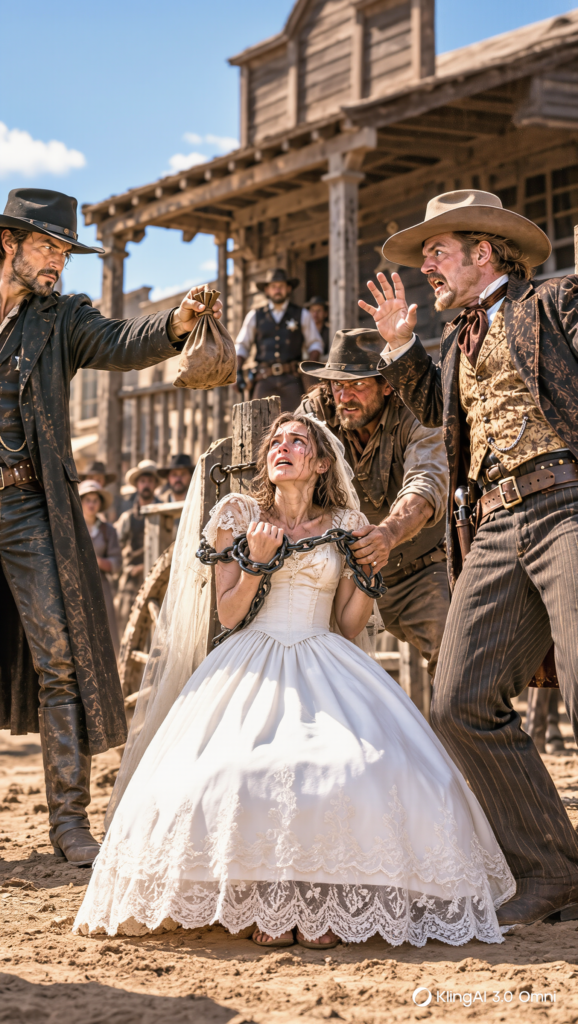
Temperance Rowe had been chained to that post for forty-eight hours.
She stood because she refused to sit. Her spine was pressed against the splintered wood and her wrists were locked behind it in an iron manacle bolted to a length of chain. A second iron ring had worn her ankles raw. She was twenty-six years old. She was the schoolteacher. In two years she had taught forty-three miners’ children to read, using primers she had ordered from St. Louis out of her own wages, and once she had sat three nights without sleeping beside a feverish boy whose mother worked double shifts at the laundry.
Now she stood in the middle of Main Street in the ruins of her wedding gown.
It had been ivory once, with eyelet lace at the throat and a modest train she had hemmed herself by lamplight. The skirt was torn from hem to hip. The lace hung in threads. Dried mud the color of old rust stiffened the fabric from the knees down. The veil was gone, trampled into the street somewhere, and she did not mourn it.
The one thing she had not lost was the book.
It was a battered McGuffey’s Second Reader. It had been in her hand when Roscoe Braithwaite’s men dragged her out of the schoolhouse, and she had not let go of it through anything that came after. Somewhere in the burning hours it had stopped being a book and become proof: a weight in her bound fingers that said she was still who she had been.
Her lips were split. The tops of her shoulders had blistered through the torn silk. The only water she’d had since dawn was a tin cup the Widow Carver had pushed through the crowd before Sheriff Halloway could stop her.
Tempy’s eyes were open, and they had been open most of the night. She watched Main Street the way she watched a classroom, quietly noting where each person stood and what each one was doing. She saw who crossed the street to avoid passing her, and who walked too close on the pretense of business at the jail. She saw the three Braithwaite ranch hands loafing at intervals along the boardwalk, watching. And she saw the clock above the assay office: ten past eleven.
The bond deadline was sundown.
The bond was one thousand dollars in gold coin. Roscoe Braithwaite’s lawyer had posted that number at the jail the morning they chained her. A teacher in the Territory earned perhaps thirty-five dollars a month, so they might as well have asked for the moon. That was the point. The bond had not been set to be paid. It had been set to announce a verdict that was already decided.
Everyone in Oak Haven knew what the matter really was. It was the schoolhouse.
The building stood on a quarter-acre that Amos Braithwaite, who owned the coal, the cattle, and most of the county commission, wanted for a mine office. The deed was in Tempy’s name. The previous territorial administrator had granted it to her outright, and it was legal and recorded. Braithwaite had offered to buy it and she had refused. He had pressured the commission, so she hired a territorial lawyer and documented everything. He threatened her funding, so she went to the mining families and built a fund of their own pennies. Every road he closed, she found another.
Three weeks ago his son Roscoe had come to the schoolhouse with what he clearly believed was a generous offer. She could keep her position and her salary if she would sign over the deed. Then he added, with the smirk of a man who had never been refused by anyone who could afford to mean it, that she should also become better acquainted with him socially.
She asked him to leave.
Four days later a deputy she had never seen arrived with a warrant charging her with the armed robbery of eight hundred dollars from the Territorial Bank of Oak Haven, the previous Thursday, at gunpoint. The witnesses were Roscoe Braithwaite and two men she had never laid eyes on. That Thursday she had been in the schoolhouse with twenty-six children who could swear to it.
It had not mattered.
Movement at the far end of the street caught her eye. A knot of men stood on the steps of Vance’s General Merchandise, and the store belonged to Thaddeus Vance, her fiancé. Her former fiancé, since this morning.
He had come to the post yesterday with his hat in his hands. He stood six feet away, never closer, and told her in his reasonable shopkeeper’s voice that it was out of his hands. Braithwaite was a man you didn’t cross. If she had only been sensible about the deed, none of this would have happened. He spoke like a man explaining to the drowning that it was their own fault for getting into the water.
This morning he had sent a clerk to the jail with a signed and witnessed renunciation of their betrothal, recorded in the county ledger. Halloway read it aloud from the porch. Some of the Braithwaite men laughed, not loudly, but loudly enough.
Tempy had kept her eyes on the clock and thought about forty-three children and a schoolhouse that needed to open in the fall.
The jailhouse door opened. Sheriff Ike Halloway stepped out with his thumbs hooked in his gun belt. He was a thin man with a thick mustache, and he had the look of someone who had been doing something he knew was wrong for so long that he could no longer see it clearly.
“Hot one today,” he said to no one.
Tempy did not look at him.
Then she heard the horse.
It was not the clean clip of a rider in a hurry. It was the heavier rhythm of a loaded animal at a working pace. At the north end of Main Street, where the federal trace came in, a man appeared on a road-worn buckskin gelding. Behind him on a lead rope came a mule carrying a second man face-down across the pack saddle, his wrists tied beneath the animal’s belly. He was alive; his back rose and fell.
The rider was in his middle thirties. He was built along lines that suggested he had once been something heavier and had been worn down by weather and loss into something leaner and more durable. He wore a shapeless dark hat pulled low and a duster the color of old smoke. A single Colt rode cross-draw on his left hip. His beard had gone untended, and his eyes moved across the town steadily, measuring everything without seeming to.
The Braithwaite hands straightened, the way men do when they recognize someone who might be dangerous.
The rider’s gaze traveled over the saloon, the dry goods store, and the jail. It reached the hitching post and stopped.
He looked at her for a long moment, without shock and without the elaborate looking-away the town had perfected. He took in the gown, the chain, the primer in her bound hands, her ankles, and the way she held herself upright. His expression did not change. Something in his posture did.
He tied the buckskin and the mule at the jail rail with careful knots, the knots of a man who expected to be there a while, and walked past the sheriff into the jailhouse without a word.
Through the wall Tempy heard voices. One was low and measured. The other was Halloway’s, rising slowly into the pitch of a man being backed into a corner.
Five minutes later the rider came back out with a paper in his hand.
“Federal bounty warrant,” he said, holding it up. “Four hundred dollars, issued out of Cheyenne. That’s the Marshal’s seal at the bottom.”
“The bond on the Rowe woman,” Halloway said carefully, “is one thousand dollars.”
“I know what it is.”
The rider took a leather satchel from inside his duster and set it on the porch rail. Without hurry, he laid out what was in it: the bounty warrant, a bank draft from the First Territorial Bank of Cheyenne, and then gold coins, counted one by one into a bright row in the noon sun. He laid them out patiently, like a man who had already done the arithmetic and knew exactly what it would cost him.
Then he looked up at the sheriff.
“One thousand dollars,” he said. “Every cent to my name. Take the chain off her.”
Main Street went silent.
The three Braithwaite hands had drifted in toward the porch, but they stopped about fifteen feet out. The rider was not threatening anyone. He simply stood there completely sure of himself, and it was enough to make them hesitate.
“I’ll need time to verify these instruments,” Halloway began.
“Territorial Code, Article Fourteen, Section Seven,” the rider said. “Proof of funds in the amount posted. You have a federal warrant under seal, a verified draft, and coin in hand.” He glanced at the crowd lining the boardwalks, then back. “And about forty witnesses who will remember exactly what this tender looked like. Every one of them can testify to it.”
One of the Braithwaite hands began edging toward the livery, the way a man does when he means to send word somewhere. The rider’s eyes followed him without his head turning.
“I’d suggest,” he said quietly, “we keep this simple.”
Halloway looked at the gold. He looked down the street toward the Braithwaite men. He looked, finally, at the woman on the post, and something crossed his face. Perhaps it was guilt. More likely it was guilt’s practical cousin, the calculation of risk.
He took a key from his vest and came down off the porch.
He could not meet Tempy’s eyes, and she did not make it easier for him by looking away. His hands trembled as he fitted the key. The lock gave a thick, heavy click, louder than seemed possible, and the manacle fell open. The chain slid off the post and struck the dirt.
Her hands were free.
For a moment she did not move. She had held her body so rigidly for so long that it had forgotten how to do anything else. She looked down and saw her knuckles bone-white around the primer, and she had to tell her fingers, one at a time, to loosen.
She stepped away from the post.
The world tilted.
She had not eaten in a day, had not slept in two, and had stood six hours in direct sun since dawn. Her body had kept a careful account the whole time, and now that she was free it demanded payment all at once. The red street rushed up at her. She felt the primer slip from her fingers.
A hand caught her arm and a shoulder came under her, and she stopped falling.
She was on one knee in the dust with gray closing in at the edges of her sight. The street sounded far away, as if she were underwater. The duster came off the rider’s shoulders and settled around hers, warm from his body and smelling of woodsmoke, horse, and hard weather. She was shaking violently, the way a body shakes once it is finally allowed to.
“Can you stand?” His voice was low and close.
Her legs did not answer. He lifted her without any ceremony and set her in his saddle in one practiced motion, and kept a hand on her arm until he was certain she wouldn’t fall.
“My book,” she rasped.
He picked the primer out of the dirt and laid it in her lap without comment. She pressed it to her chest.
He swung up behind her and raised his voice so it carried down the whole street. “Sheriff, the lady’s bond is paid in full. Get it into the ledger today, while all these folks still remember what was posted and what was tendered. The courts in Cheyenne take a particular interest in bond irregularities.”
Halloway stood in the dirt holding the key and said nothing.
The rider turned the buckskin north at a walk through the town’s silence, with the mule plodding behind. A quarter mile ahead the pines stood dark and green against the bleached land, a place a person could disappear into.
Behind them a door banged, and boots hit the boardwalk.
Tempy turned her head. High on the second-floor balcony of the Cattlemen’s Hotel stood Roscoe Braithwaite, broad-shouldered, coatless, and very still. He wasn’t shouting. He was lifting a rifle to his shoulder.
The rider’s arm tightened around her.
“Hold on to the horn,” he said. “And whatever happens, don’t let go of that book.”
Then the shot cracked across Main Street.
PART 2: What the Fire Knew
The bullet tore through the air a hand’s width from her ear and splintered a porch post on the far side of the street.
The buckskin bolted. The rider let it run, leaning over her so his body made a wall between her and the hotel. A second shot kicked up dirt beside the mule. Then the boardwalks were behind them, the pines closed overhead, and the merciless light broke into slanting shafts of green and gold.
He kept the horse at a hard canter for two miles, then eased to a trot, then to a walk. He checked their back trail twice with quick, professional glances. Neither of them spoke. It was not an uncomfortable silence. They were both busy with their own work: his was getting them clear, and hers was staying conscious.
At a shallow creek he stopped. He scouted thirty feet of bank and the ridgeline above before coming back to her.
“Can you get down?”
“I’ll manage.” She slid from the saddle, and her ankle buckled on a stone. His hand was at her elbow and gone again the instant she found her feet. He brought her his canteen. The water was snow-cold and tasted of rock and distance, and she made herself drink it slowly.
“What’s your name?”
“Mercer. Calhoun Mercer. Cal.”
“Temperance Rowe.”
“I know.” Something like a smile almost reached his face. “Whole town knows. You made quite an impression on Oak Haven for someone who mostly teaches children their letters.”
“The letters are what bother certain people.”
She sat on a flat rock because her legs decided for her. Then she told him, plainly, that she intended to go back. Braithwaite had no legal claim to the schoolhouse, and she would not surrender it because he had manufactured a charge and chained her to a post. She would repay every dollar he’d spent. She did not yet know how long it would take, but she would.
Before he could answer, the gray came back, harder this time. The primer slid off her knee. The green light overhead tilted, and something solid caught her before the stones did.
She came to with his saddlebag at her back and his fingers on her wrist, counting her pulse.
“There she is,” he said, carefully keeping any relief out of his voice. “Heatstroke. You were close to the edge.”
He fed her hardtack and made her eat it slowly. Then, because she asked, he tried to explain.
“I was there, and I had the money.”
“That isn’t an answer.”
“It’s the factual part of one.” He looked at the water. “There are things a man can ride past and things he can’t.”
It was not the whole truth, and they both knew it. Then he turned so she could see his face, and spoke very deliberately.
“I want you clear on one thing, Miss Rowe. Gold buys cattle and timber. It doesn’t purchase a human soul. That thousand dollars wasn’t a price. It was bail, to pull you out of the hands of wolves. You don’t owe me a day’s labor or a single bent knee.”
She had spent two years finding the hidden condition in every offer of help. The county lawyer had one, and so had the union man, and so, she now understood, had Thaddeus. She searched this man’s offer for one and found nothing.
“I believe you,” she said.
They rode until the light was gone and reached a stone line shack built into the rock on Windridge Pass. It was patched from a dozen kinds of timber and the stovepipe leaned crooked, but it was dry and warm once he had a fire going. He kept the fire small and hot so no glow would show past the trees.
By lamplight she finally looked at her ankles. The iron had worn them raw in rings, and the skin was hot and weeping. She knew from the mining camps what infection looked like at every stage, and this was still early. It had to be cleaned tonight.
The carbolic stung like fire. She breathed through it the way she taught the children: name the pain, breathe, don’t make it bigger than it is.
There were not enough bandages for both ankles.
They looked at the gown together, at the ruined train and the clean linen underskirt beneath it. She had chosen that bolt at Vance’s store, paid for it herself, and sewn it herself over three evenings because she had believed there was something meaningful in making it with her own hands. She realized now that a gown she had to build alone should have told her something about the marriage it was made for.
Cal drew his hunting knife, then stopped.
“May I?”
He was a stranger with a blade, alone with a woman in a mountain shack, and he was asking her permission.
“Yes.”
He cut the skirt cleanly at the knee and tore the underskirt into even strips. Then he bound her ankles with the precision of a man who had dressed wounds in the field, crossing the strips flat and tying small knots that would not press against the skin. His hands were scarred across the knuckles and they were gentle.
So her wedding train became bandages, and she found she did not grieve it.
He made sage tea from a plant he had picked in the dark beside the shack wall. She had brewed the same tea for the camp children for two years. When she asked how he knew it, he said a field surgeon in the Dakotas had taught him that book medicine and field medicine weren’t enemies, and that the best healers used both.
She could see he meant to sit up all night with the Winchester across his knees, so she told him to teach her what to listen for: hooves on the shale below the south approach, dogs, or voices carrying against the wind. Then she sent him to sleep.
“I’ve made errors from exhaustion,” he said quietly. “Significant ones.”
“Then let me keep you from making another.”
He slept within three minutes. In sleep his face looked younger, and more burdened than it ever let itself look awake.
On the third day they reached Delilah’s way station on the Green River. It was a long log house with a garden behind a split-rail fence and a ferry tied at the dock. Its keeper was tall and iron-haired, well past sixty, and once she had been enslaved. She looked at the bandaged ankles and the shortened gown and said only, “Come inside. Both of you.”
Over venison stew, Cal finally told the story he had been carrying.
Three years ago, as a deputy U.S. marshal, he had served a warrant on a homesteader named James Blackwell, who was twenty-eight and had a wife and two daughters. The charge was fraudulent title. The warrant had the right seals and the right signatures, and it looked like the two hundred warrants he had served before it.
“He told me the true deed was in his strongbox. He asked for five minutes.” Cal set his cup down without drinking. “I had legal process in hand. I didn’t wait.”
The warrant had been forged. The real deed turned up four days later. Blackwell was already dead.
“I followed a piece of paper,” Cal said, “and a man is dead because of it.”
Delilah leaned forward. Her voice held no softness, but it held something more honest.
“That warrant was a rope. It was made of seals and ink instead of hemp, but it was a rope all the same, and the men who forged it put it in your hands knowing you’d use it the way you were trained to. You should have waited. A man’s life was worth thirty minutes of your time. But what they did was murder, and what you did was a failure of judgment. Those aren’t the same crime.” She sat back. “Law without mercy is just a rope for wicked men to hang the poor with.”
Tempy thought of a thousand-dollar bond, a forged larceny charge, and a whole county’s machinery built to produce a verdict decided in advance. She understood that she was looking at the same rope.
The next day, behind the stable, Delilah handed Cal a short-barreled .38. Tempy said she needed to know how to do more than stand still and endure. Cal stood behind her and adjusted her elbow. “You’re gripping too hard. Firm isn’t tense. Hold it like a pen.”
Her first shot hit the log. Her fifth was inside the chalk circle.
“Keep it,” he said. “You’ll need it before this is done.”
The snow came at noon, in midsummer, because the Wyoming mountains keep their own schedule. With it came seven riders wearing the Braithwaite brand.
Then an eighth rider came up the trail at a hard gallop. It was Thaddeus Vance on his overfed gray, hat crooked and breathing hard, with a speech already rehearsed.
“Tempy, please. Braithwaite will drop the charge. No trial. Just sign the deed over to the county. You can say it was your choice.”
“It would be a lie,” she said from the doorway. “And everyone in Oak Haven would know it.”
“Love, you’ve already lost the town. Who will trust a schoolteacher who ran off with a bounty hunter?”
“Thaddeus.” Her voice was very quiet and very clear. “You signed a paper renouncing me in front of the whole town to save your store. I would not kneel to Roscoe Braithwaite in chains. I will not kneel to him now. Go home.”
He looked like a man discovering that love had never been the lever he thought it was. He rode away into the snow.
While the lead rider demanded that Cal surrender on a warrant no judge had signed, someone circled behind the station and set the barn on fire.
After that everything happened fast. Cal ran into the smoke and drove the screaming horses out. Rifles came up in the yard, and one shot struck the barn wall above his head. Cal fired once, at a man’s rifle rather than the man. Then they were all inside with the bar dropped across the door and the roar of the barn shaking the log walls.
“Out the back,” Cal said. “Both of you. The game trail northeast to the high country. I’ll hold the door.”
“Cal—”
“One man behind cover beats two women in the open. Go.”
She went. Behind them the Winchester fired once, then twice, then fell silent. The silence was the worst thing she had ever heard. Then it fired a third time.
Two hundred yards into the timber, he came out of the snow at a dead run with his left arm clamped against his ribs. Dark blood was spreading through his coat.
“You’re hit.”
“I’m aware.”
They climbed for an hour through the blizzard. By the end of it she was carrying half his weight on her shoulder, and when he tried to refuse, she gave him the look she saved for stubborn students. Delilah found a cave behind a granite overhang. By the light of a tinderbox Tempy cleaned the wound with the last of the carbolic. The ball had passed clean through between the fifth and sixth ribs and missed the lung. She stitched both holes with hands that did not shake.
“Stay with me,” she said. “I need you to mean it.”
“I mean it.”
The fever came anyway.
Through the long night she sat behind him with her arms around his chest above the bandages, giving him her warmth against the cold. In his delirium he talked to a dead man. The seals were right. I checked them. Blackwell, wait. Five minutes. Just wait.
“You’re in a cave on the Laramie Ridge,” she told him, her mouth close to his ear. “The storm is outside and I’m right here.”
His hand found her wrist and held on.
Near two in the morning the fever broke and he was soaked in sweat. In the gray hour before dawn, half awake, he asked her whether she had heard him.
“Some.”
“I’m sorry you had to.”
“Don’t be. You’ve been carrying a dead man’s name by yourself for three years. Carrying it alone doesn’t make it lighter. It only means nobody can help you set it down.” She kept her voice steady and did not let it go soft enough for him to dismiss. “Tonight you held a door so Delilah and I could live, and you took a bullet for it. That is not what a man does once he has stopped caring about right and wrong.”
He was quiet for a long time.
“I kept the badge,” he said finally. “When I resigned. I don’t know why.”
“Maybe because you weren’t finished.”
As he slipped back into true sleep, she said it so softly she wasn’t sure he heard:
“Your debt to the dead is paid, Cal. Come back to the living.”
He had heard.
PART 3: The Weight of Paper
The mining camp at Cinnabar Creek smelled of coal smoke, and a dead man’s printing press stood on the loading dock.
Tempy looked at it and something lit in her face. Cal, who had learned to read her face the way he read a trail, said, “You have an idea.”
“I have a very good one.”
For two years she had documented everything: the forged mine leases, the stolen land patents, and three sham auctions that had taken families’ land and passed it, through two holding companies, back to Braithwaite. With an Irish miner’s wife named Bridget, who had worked a press in Cork, she set the type letter by letter in mirror image. Cal pulled a stool to the composing table and spent the afternoon writing out thirteen fraudulent bond instruments he remembered from the Cheyenne marshal’s records. He had sat on that knowledge for three years because he’d had no way to use it. Now he did.
They printed two hundred broadsheets. At the bottom of the second ran thirty-seven names, families whose land or freedom Braithwaite had taken. Tempy had taught children from eleven of them.
Wells Fargo drivers carried them north toward Cheyenne and Denver in the mailbags. Tempy also sent a telegram to Federal Magistrate Aldis Crane in Denver, a man with no ties to Braithwaite and a long record of prosecuting corrupt county officials.
Watching the press work, Cal understood something. His gun could drop a tyrant. Her words could dismantle tyranny itself.
They rode into Oak Haven three days early, because Circuit Judge Harlan Peel was already in session and meant to ratify the charge and transfer the deed before anyone could object.
At the Widow Carver’s house they collected the strongbox: the certified deed recorded in three jurisdictions, two years of correspondence, and a fresh sheet bearing thirty-two signatures from families who had read the broadsheets and risked their names.
Then Tempy did something that frightened Cal more than the blizzard had.
“We go in unarmed,” she said. “Braithwaite wants drawn guns so he can call it lawlessness. We give him nothing to point to.”
He looked at her for a long moment. Then he unbuckled his gun belt and hung it on the saddle horn.
The courthouse door swung open and the room went silent.
Peel sat florid and confident at the bench. Amos Braithwaite sat in the front row with Roscoe beside him, his shoulder still bandaged from the bullet Tempy had put in it outside Delilah’s barn. And the gallery was full. The Hendricks family was there. So were stage drivers, Cinnabar miners, and Bridget, forty miles from home. More than thirty people had come.
“I am Temperance Rowe,” she said, in the voice she used for the back row of a schoolroom. “I hold the deed to the Oak Haven schoolhouse, and I am here to present evidence.”
Peel’s gavel came down. “You are a fugitive—”
“Her bond was paid in full,” Cal said, “in coin, before forty witnesses. It’s in this county’s ledger in the sheriff’s own hand.” He laid his four pages on the bench. “Thirteen fraudulent bond instruments from this jurisdiction. Denver has been notified.”
Roscoe’s hand went into his coat for his pocket pistol.
Sheriff Ike Halloway crossed the room in three strides with his revolver drawn. It was not aimed at Tempy, and not at Cal. It was aimed at Roscoe Braithwaite’s hand.
“Don’t,” Halloway said.
It was one word, from a man who had finally stopped calculating.
Then the doors opened, and Magistrate Aldis Crane walked in with two federal officers and a sealed injunction, and he read out three names: Amos Braithwaite, Roscoe Braithwaite, and Judge Harlan Peel.
The room did not erupt. It let out its breath, thirty people at once, as if they were one person.
On the bench, where Peel had been about to bring down his gavel, sat a rusted iron manacle. Cal had carried it in. Some evidence belongs in front of the people who need to see it.
The Braithwaite empire came apart over the next three months, slowly at first and then quickly, each collapse pulling down the next. The stolen parcels went back to their families. Thaddeus Vance sold his store to Bridget and left the Territory. Halloway resigned after writing a full confession, and he did not soften a single word of it.
In September the schoolhouse opened with fifty students. Tempy taught that first day with the pale circular scars showing above her boots, and she did not cover them.
In October the town asked Cal three times to be its marshal. He said yes on one condition: that the charter protect people’s liberties and not only punish crimes. He found the old badge in his coat pocket, held it in his palm for a moment, and pinned it on.
They were married in November beneath the old oak, where the hitching post had stood until someone tore it out. Nobody asked who had done it. Lanterns swayed in the cold branches. Delilah had sewn Tempy a blue-and-white calico dress she could work in, with a border of tiny embroidered flowers at the collar.
Cal’s ring was plain gold and rough with hammer marks. The blacksmith had made it from the bond gold, returned once the court voided the illegal charge.
She traced the dents with her thumb. “You gave up everything you owned,” she whispered, “to buy back my freedom.”
He held her face in his scarred hands and smiled, like a man who had come a very long way and finally arrived somewhere real.
“No, Tempy,” he said. “You used your freedom to buy back my soul.”
She laid her hand flat against his chest and felt his heart beating, strong and steady.
The school was open. The deed was safe. Somewhere a child was learning to read.
It was enough. It was more than enough.