PART 1: Sold for Twelve Dollars
The labor auction in Dry Creek, New Mexico Territory, was held on the courthouse steps every third Saturday, and most Saturdays it sold exactly what it sounded like: drifters and drunks too poor to pay their own fines, auctioned off for thirty or sixty days of work to whoever bid highest on their debt.
On the second Saturday of April 1883, the man on the block was someone nobody in town could put a name to.
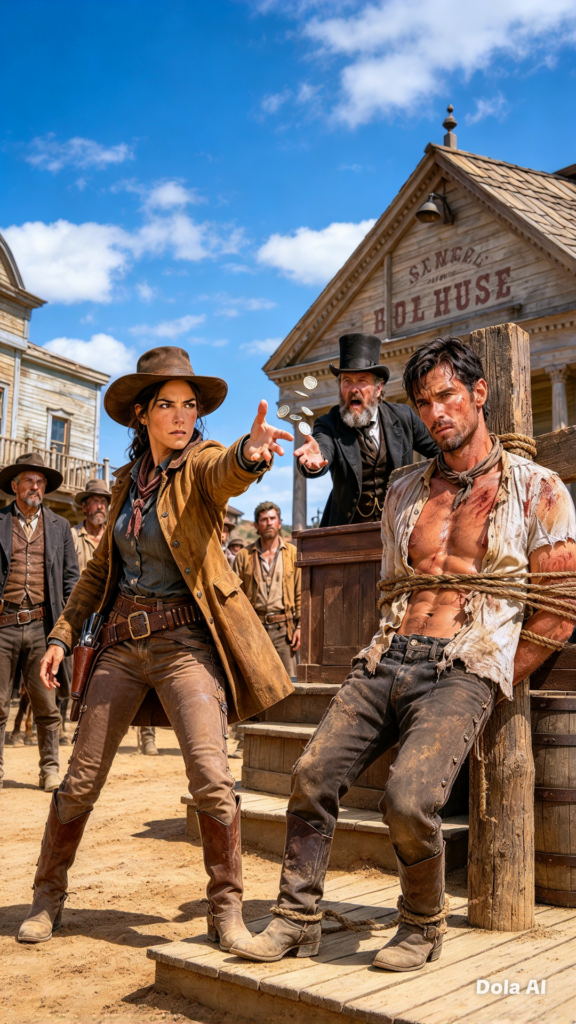
He had been found three days earlier a mile off the stage road, beaten nearly to death and robbed of everything but his boots. Doc Anselm had spent two sleepless nights and most of his own medicine keeping him breathing. The town had no jail budget for a stranger with no crime and no money, so Judge Otis Frame, a practical man and not an especially kind one, ruled that an unpaid debt for doctoring and jail board was a debt like any other. He put the man up for auction, to be bought by whoever would pay that debt in exchange for his labor once he was well enough to give any.
The stranger sat slumped on a bench at the top of the steps, barely conscious. His face was swollen purple, and one eye was crusted shut. A bloodstained bandage was wrapped around his ribs.
Silas Grout bid first.
Grout was known through three counties for working hired men into the ground and paying them in excuses. Two winters ago one of his auction men had frozen to death in a line shack, and the coroner had called it misadventure. Grout opened at eight dollars, a number meant to announce that he expected no competition, because decent people didn’t bid against Silas Grout for a man they’d have to nurse back to health first.
Grout walked up the steps and looked the stranger over. He pried open the swollen jaw with two fingers to check his teeth, the way he’d inspect a mule.
At the back of the crowd stood Cora Nash.
She hadn’t walked to town that morning intending to buy a person. She had come to sell six colts and buy fence wire, and the fence money was folded in her coat pocket: twelve dollars, every cent of it spoken for. She was twenty-seven and ran a small horse outfit alone on the creek bottom. She’d buried her father four years ago, and she knew to the penny how many months she was from losing the place.
She watched Grout’s fingers in the stranger’s mouth. She watched the stranger’s one good eye open, cloudy with fever, and fix on nothing. Something in her went hard and quick before her better judgment had any chance to weigh in.
“Twelve dollars,” she said.
The crowd turned. Grout turned slower, and uglier.
“That’s your fence money, Miss Nash,” he said. “Thrown at a man who might not live the week.”
“Then you’ve lost nothing you can’t earn back,” Cora said, “and I’ve lost a man I never had. Judge, is the bid good?”
Judge Frame had exactly no patience left for Silas Grout after twenty years on that bench. He brought his gavel down with something close to relief.
“Sold to Miss Cora Nash. Twelve dollars. Sixty days’ labor owed against her account.”
Grout leaned close as Cora passed him on the steps. “You’ll regret that, girl. A broke woman buying a broke man. Whole county’ll laugh.”
“Let them,” Cora said. “Laughing’s free. I’d hate for anybody in this county to start paying for things they get for nothing.”
She hauled the stranger home that afternoon in the bed of her wagon, on a pile of horse blankets, holding his head off the boards over every rut in the road. She had no idea she had just bought sixty days of labor from a man who could have paid the whole county’s debts twice over, if only he had still possessed a single scrap of paper proving who he was.
He didn’t wake for two full days.
Cora sat up both nights in the narrow spare room off her kitchen, spooning water between his cracked lips and changing the poultices Doc Anselm had shown her how to make. On the second night his fever spiked so high that she thought she’d paid twelve dollars for a funeral. Near midnight he began to talk in his sleep, low and steady. It wasn’t English. It sounded like Latin, recited clear and unhurried, as if he were reading it off a page only he could see.
On the third morning his eyes opened, and his fever had broken.
The first thing he said wasn’t his name. It was a question, asked in a voice far too clear and carefully spoken for a man found half dead in a ditch.
“Where is my father’s letter?”
“You didn’t have any letter on you,” Cora said, setting down a bowl of broth. “You didn’t have anything on you at all, mister, but the boots on your feet and enough bruises to paper a barn. What do I call you?”
He was quiet a long time. Something moved behind his eyes. Cora couldn’t name it, but she recognized it anyway: a man deciding how much of the truth was safe to spend.
“Tom,” he said finally. “Call me Tom.”
It didn’t sit right with her from the first hour, though she couldn’t have said exactly why.
Once Tom’s hands healed, they weren’t a drifter’s hands. They were long-fingered and smooth beneath the fresh blisters. He mended her fence line and set the wire tension with a precision no self-taught rancher ever bothered with. He ate with manners nobody learned in a bunkhouse, and he stood every single time she entered a room, even when the motion made him wince. He read the two old books on her shelf in a single evening. He could do figures in his head faster than she could do them on paper.
And he worked. He worked like a man paying off something larger than twelve dollars. By the end of his third week he’d rebuilt her corral, rehung the barn door, and gentled a mean little sorrel filly that had thrown Cora twice.
Then, in the fifth week, she mentioned in passing that a letter had come to the general store from a Chicago law office asking whether anyone had information about a missing gentleman last seen on the western stage routes.
Tom flinched hard, and then covered it so fast she nearly convinced herself she’d imagined it.
Six weeks in, they sat on the porch step at sundown. She was shelling peas, and he was mending a bridle beside her. She said it plainly.
“You’re no drifter, Tom. I don’t need your whole history. I bought sixty days of honest work, and I’ve gotten more than fair. But I’d be lying if I said I hadn’t noticed. You’re hiding something considerably larger than a name.”
Tom set the bridle down and looked at her for a long time, the way a man looks at a door he’s been afraid to open.
“If I told you,” he said slowly, “you’d be in more danger than you are right now just for knowing it. I’ve spent six weeks being grateful you don’t ask harder questions, Cora Nash. And I don’t know how to thank a woman for that kind of mercy, except by not spending it foolishly.”
“That’s not an answer.”
“No,” he agreed. “It isn’t. It’s the only honest thing I can give you yet.”
The truth came out sideways, the way most true things eventually do.
One morning in late May, Cora’s boot heel gave out on her way to town, and she borrowed Tom’s spare pair, the only possessions he’d arrived with. Halfway down the lane, the left heel split along a seam she hadn’t known was there, and something small and heavy dropped into the dirt of her own yard.
It was a signet ring of heavy gold, engraved with a crest she didn’t recognize: a rearing horse beneath a banner of wheat. Worked into the inside of the band, in letters so small she had to hold it up to the light to read them, were three initials.
N. A. B.
She was standing in the yard turning it over when Tom came around the barn and saw what she was holding.
For the first time in two months, Cora watched every careful wall the man had built come down at once. It wasn’t anger. It was something closer to exhaustion.
“Nathaniel Alden Bellamy,” he said quietly, before she could even ask. “That’s my name, Cora. My father is, or was, Charles Bellamy, of Bellamy Cattle and Rail out of Chicago. I expect you’ve heard of it, even out here.”
Cora had heard of it. Everyone who sold cattle within four hundred miles had. Half the beef that left the territory shipped under Bellamy contracts. It was a name spoken with the particular respect reserved for money too large to argue with.
“My father died eight months ago,” Nathaniel said, sitting down heavily on the porch step, as if the name itself weighed something. “Before he died, he’d started to suspect his own partner, a man named Julian Ashgrove, of skimming the western cattle contracts. Ashgrove was moving herds on paper that never existed on the ground and pocketing the difference. Father wrote me a letter laying out everything he suspected. Then he took sick and died within the week.” His jaw tightened. “The doctor called it his heart. I’ve never been sure.”
“So you came west.”
“Quietly, and under no name at all, to compare the actual herds with the actual ledgers. I didn’t trust anyone in Chicago to look honestly anymore, not even my father’s own lawyers.” He looked out at the road. “Somebody found out I was looking much faster than I expected. That tells me Ashgrove has eyes in places I hadn’t accounted for. Three men stopped the stage a mile out. They dragged me off it, took every paper I carried, including my father’s letter, and pulled my signet ring off my hand. I’d sewn the twin of it into that boot heel out of exactly this fear. They beat me until I stopped moving and left me in a ditch. By any reasonable account, they had every reason to believe I was dead.”
He looked at the ring in her palm.
“If Julian Ashgrove believes I’m dead, he’s already begun having me declared so in law. That would hand him control of a company worth more than this whole territory sees in a year. And if word ever reaches Chicago that I’m alive, he won’t make the mistake of an incomplete job twice.”
Cora sat down beside him. The ring was cooling in her hand.
“Why not tell me sooner? I bought you off an auction block for twelve dollars and sat up two nights watching you burn with fever. I think I earned the truth before your boot heel did.”
“Because the moment you knew, you became a target too,” he said. “I’ve seen what Ashgrove will do to protect a fortune he didn’t earn. I’d rather you be angry with me for keeping it from you than dead for knowing it a week sooner.”
Then something in his voice cracked open in a way it never had in two months of careful politeness.
“I have more money in banks I may never safely touch again than this entire valley is worth, and not one dollar of it has done me any good since the day they left me in that ditch. You bought a broken man for twelve dollars and gave him back his life without once asking what he was worth. Nobody in my whole privileged existence has ever handled me with that kind of honesty. And I find I’m more afraid of losing it than I ever was of losing the company.”
Cora didn’t answer. She closed his fingers over the ring and held his hand there a long moment. Then she stood, brushed off her skirt, and went to town in her own broken boots.
At the general store, old Pruitt, the storekeeper, leaned across the counter and lowered his voice.
“Funny thing, Cora. Stranger rode in on the noon stage. Calls himself a cattle buyer. But he hasn’t asked about a single steer.” Pruitt frowned. “All he’s asked about is that fella they found beat half to death on the stage road back in April. Whether he lived. Where he went.” He tapped the ledger. “Name’s Wendell Doss.”
Cora drove home so fast she nearly lamed her horse.
Nathaniel was splitting wood behind the barn. When she said the name, the axe slipped from his hands and thudded into the dirt. His face went the color of old ash.
“Doss,” he said. “Wendell Doss is Ashgrove’s fixer, Cora. He’s the man Ashgrove sends when the first men fail.” He turned toward the road, where a thin plume of dust was rising in the late sun. “If Doss is in Dry Creek, then Ashgrove knows I’m alive. And he’s sent the one man who has never once left a job half finished.”
PART 2: The Satchel
The dust on the road turned out to be the Hollister boys driving cattle. Neither of them slept that night anyway.
“We go to the sheriff,” Cora said at the kitchen table, lamplight carving shadows under her eyes.
“With what proof?” Nathaniel spread his hands. “A ring and a story? Ashgrove has spent eight months and a great deal of money making sure every piece of proof either burned in the fire at my father’s Chicago offices last winter or disappeared with three hired men who haven’t been seen since the night they left me in that ditch. Doss didn’t survive this long working for Ashgrove by leaving trails.”
“Then we find the one he left.”
He looked at her across the table. “You understand what you’re saying. If you help me, you’re in it. There’s no stepping back out.”
“I was in it the second I said twelve,” Cora said. “I just didn’t know it yet.”
In the long, quiet stretch of June, while they watched the road and waited, Nathaniel finally asked her the question he’d carried since April.
“Why’d you do it? A woman with her own small ranch and her own bills, bidding her fence money on a stranger nobody else would touch.”
Cora didn’t answer right away. She’d never told the whole of it to anyone in town. It wasn’t shameful. But grief that specific starts to sound like an excuse if you say it aloud too often.
“My father broke horses for the Anderson spread two valleys over for twenty years,” she said finally. “He built half their fence line with his own hands. When a fall broke his hip at fifty-one and he couldn’t ride the way he used to, Anderson suddenly found an unpaid feed bill nobody had ever mentioned. He auctioned off my father’s labor to cover it, same as you’d auction a lame horse. A man three counties over bought him and worked him at half wages until the day he died.” She snapped a pea pod. “And not one soul in that valley called it anything but business.”
“I’m sorry,” Nathaniel said quietly.
“I’m not telling you for sympathy. I’m telling you because I stood at his grave at nineteen with eleven dollars to my name, and I swore that if I ever had the money and the standing to bid on somebody the way that county bid on my father, I’d bid like a person instead of a buyer.” She met his eyes. “Twelve dollars wasn’t charity, Nathaniel. It was the one time in my life I could answer a wrong I watched happen to someone I loved. It was twenty years too late to matter to him. But it wasn’t too late to matter to somebody.”
He understood then why a woman running a modest horse operation alone had looked at a half-dead stranger and seen a person worth defending instead of a debt worth avoiding. Neither of them said it that afternoon, but it also explained why what was growing between them had taken root in something sturdier than gratitude. They had both spent years learning what it cost to be valued only for what use you still had. In each other, they’d found the rarer thing: being valued for something else entirely.
Silas Grout did not let the matter of his lost auction rest.
Three weeks later he rode into Cora’s yard, didn’t bother to dismount, and looked Nathaniel over with the same eye he’d used on the auction block.
“Word in town is your hired man’s healed up fine. Sixty days must be about done. I’ll take his contract off your hands, Miss Nash. Full value. Save you feeding a grown man through another winter.”
“He isn’t a debt to be traded, Mr. Grout,” Cora said. “His sixty days ended two weeks ago. He stays on now because I asked him and he agreed. That’s a considerably different arrangement than the one you’re describing.”
Grout’s eyes narrowed at Nathaniel. “Awful particular manners for a drifter. Almost like you weren’t raised the way you’re living now.”
It was the closest anyone in Dry Creek had come all summer to the truth, and Grout had stumbled onto it out of nothing but petty spite. Nathaniel answered him with a level, unbothered stare. He had learned in two months that silence answered bullies far better than argument.
Grout rode off unsatisfied.
“That man has spent twenty years mistaking cruelty for shrewdness,” Cora said, watching him go. “One day it’s going to cost him a great deal more than twelve dollars.”
In the end, it was Doc Anselm who handed them the trail Ashgrove had failed to erase.
Two days later, Wendell Doss came to the doctor’s surgery to have a gashed hand stitched. He said a horse had kicked him. Anselm noticed that the “cattle buyer” wouldn’t let a battered leather satchel out of arm’s reach even while his wound was being dressed. And on the satchel’s strap was a brass tag stamped with the name of a Chicago law firm: the very firm Nathaniel had told Cora he no longer trusted.
“A man doesn’t carry his employer’s legal correspondence on a cattle-buying trip,” Anselm told them that night in his surgery with the shades drawn. “Whatever’s in that satchel, it isn’t cattle contracts.”
“Then we need him away from it,” Nathaniel said.
It was Cora who worked out how. “A cattle buyer who’s been in town a week and never once rode out to look at a cow is either the laziest buyer in territorial history or no buyer at all. So I’ll give him a herd to look at.”
The next morning she rode to the hotel and offered her horses for his inspection, a perfectly reasonable errand for any rancher. For two full hours she kept Wendell Doss riding her fence lines and talking prices he had no intention of paying.
Doss was a lean, quiet man with pale eyes and a gentle voice, and that frightened her more than any scar could have. Twice he asked casual questions about the hired man she’d bought at auction. Twice she laughed and told him the fellow had wandered off toward Santa Fe a month ago, ungrateful as a stray cat.
“Pity,” Doss said mildly, watching her face. “I’d have liked to meet him.”
Meanwhile, Doc Anselm had spent thirty years cultivating a talent for looking entirely unremarkable while doing things he had no business doing. He let himself into Doss’s hotel room with a key the hotel keeper owed him. He opened the satchel and copied, in his own careful hand, the three documents that mattered most.
The first was a letter from Julian Ashgrove to the Chicago firm, dated two weeks after the attack. It instructed them to begin quietly declaring Nathaniel Bellamy dead in absentia, citing an eyewitness account of a body recovered and buried unidentified. No such body had ever existed.
The second was a ledger page in Ashgrove’s own hand, listing cattle contracts invoiced and paid for that no herd in the territory had ever produced. It was the exact scheme Charles Bellamy had died suspecting.
The third would matter most in a courtroom. It was a payment record made out to Wendell Doss, disguised as a consulting fee and dated the very week of the attack on the stage road, for services described only as territorial security.
“This is enough to hang the scheme,” Nathaniel said that night, reading the copied pages by lamplight with hands that weren’t entirely steady. “But it isn’t enough to hang Ashgrove for the attack. Not unless Doss testifies. And Doss has no earthly reason to testify against the man paying him.”
“Then we give him one,” Cora said.
They took the pages to Judge Otis Frame.
The judge read every word in silence. Then he took off his spectacles and pinched the bridge of his nose. “Miss Nash,” he said, “when you outbid Silas Grout on my courthouse steps, I took it for the most sentimental twelve dollars ever spent in this county.” He looked at Nathaniel. “I see I was wrong about which of us was the fool.”
Then he did something he admitted afterward he’d never done in twenty years on the bench. He wired the territorial marshal and asked him to send a telegram to Wendell Doss at the Dry Creek Hotel. It informed Doss that a federal inquiry into fraudulent contracts at Bellamy Cattle and Rail was already under way in Chicago. Any man who had taken money connected to those contracts would be treated as either a witness or a conspirator. The difference between those two futures would depend entirely on how quickly and how honestly he chose to speak.
“It’s almost entirely a bluff,” the judge confessed. “The inquiry exists. Its timeline doesn’t quite match what that wire implies. Doss will either read it as a door closing on Ashgrove and walk through the one left open to him…” He paused. “Or he’ll understand that his employer is finished, and he’ll tie off every loose end on his way out of the territory.”
“Meaning me,” said Nathaniel.
“Meaning you,” said the judge. “And very likely Miss Nash.”
That night Nathaniel didn’t go to bed. He sat on Cora’s porch with a rifle across his knees for the first time since she’d known him, watching the moonlit road.
Near midnight she came out and sat down beside him without a word. He didn’t send her back inside.
“If he runs instead of folding,” Nathaniel said quietly, “Ashgrove will know within the week that I’m alive and that I have proof. He’ll stop sending men who fail. He’ll send someone considerably more careful than Doss. Or he’ll come himself.”
“Then we’ll be considerably more careful too,” Cora said. “You’re not facing that man alone in a ditch a second time, Nathaniel Bellamy. Whatever comes up that road finds both of us waiting for it.”
He looked at her for a long moment in the dark. Whatever he’d meant to say about danger and fortune, and about keeping her clear of both, seemed to leave him all at once.
“Twelve dollars,” he said, almost to himself. “I have advisers in Chicago paid ten thousand a year who have never once sat up all night on a porch, prepared to mean it.”
“Advisers paid ten thousand a year generally haven’t got as much to lose,” Cora said.
They sat shoulder to shoulder until the sky began to grey. Just before dawn, Cora felt Nathaniel go rigid beside her.
A single rider was coming up the lane at a slow walk. He was lean and pale-eyed, with a fresh bandage on his hand and a battered leather satchel slung across his chest.
Wendell Doss stopped his horse thirty feet from the porch and looked at the man he had come west to kill.
Nathaniel raised the rifle.
Doss raised one empty hand and slid the other, slowly, inside his coat.
PART 3: What Twelve Dollars Buys
“Easy, son,” Doss said in that gentle voice. “If I’d come to shoot you, I wouldn’t have come up the front lane at sunrise like a Sunday preacher.”
He drew out not a pistol but a folded sheet of paper and held it up between two fingers.
“Your judge’s telegram reached me at ten o’clock last night,” he said. “I spent the next six hours deciding whether to ride for the border or ride here. I’ve done a great many things I’m not proud of in Julian Ashgrove’s employ. But I draw a line somewhere.” His pale eyes moved to Cora. “This lady lied to my face for two hours yesterday to protect a man she paid twelve dollars for. In twenty years of this work, nobody ever lied that well for me.” He tossed the paper onto the porch step. “That’s Ashgrove’s last wire to me. It came the same night as the judge’s. Read it.”
Cora unfolded it.
FINISH IT. BOY AND THE WOMAN BOTH. NO WITNESSES. — J.A.
“Finishing a job on a man already broken half to death in a ditch was further past my line than I care to go,” Doss said quietly. “Killing a woman for the crime of being decent to him goes further still. I’ll ride into town with you, and I’ll tell your judge the whole of it.”
He told it in Judge Frame’s chambers that morning, plainly and under oath. Self-preservation was the oldest motive in any courtroom, and if a scrap of conscience had come along with it, the judge was in no mood to sort one from the other.
Ashgrove had ordered the attack on the stage road and paid three men to make certain of it. When word reached Chicago, through Doc Anselm’s own innocent telegram asking about unclaimed patients, that the victim had somehow survived, Ashgrove had paid Doss to come finish the job properly.
“He told me straight out the boy was worth more to him dead than alive,” Doss said, and had the decency to look uncomfortable saying it with the boy himself sitting three feet away.
Judge Frame wired the sworn statement east, along with Doc Anselm’s copied documents and Ashgrove’s last telegram.
Within the month, a very different telegram arrived in Dry Creek, addressed directly to Nathaniel Alden Bellamy. Julian Ashgrove had been arrested in his Chicago office on charges of fraud and conspiracy to commit murder. Federal investigators had reopened the question of Charles Bellamy’s sudden death. And the whole of Bellamy Cattle and Rail, along with a fortune Nathaniel had very nearly stopped believing he’d ever safely claim, was once again unquestionably his.
Here’s the part the Chicago newspapers, when they finally got hold of the story, found harder to explain than the fraud and the attempted murder combined.
Nathaniel Bellamy went east exactly once, for exactly six weeks. He stayed long enough to testify at Ashgrove’s trial, install lawyers he actually trusted, and settle his father’s estate. And every person who dealt with him in those six weeks reported the same peculiar detail: in every meeting, the heir to one of the largest fortunes in the West kept asking how quickly he could finish his business and get back to New Mexico.
He came back in late summer on the same stage road where three men had once left him for dead. He didn’t come back to a hotel or a fine new house. He came back to Cora Nash’s small ranch on the creek bottom, where his sixty days of labor had technically ended months before. By any honest accounting, he’d never stopped working there since.
He stood in her yard with his hat in his hands, the way a much poorer man might have stood there.
“I could buy you any ranch in this territory,” he said. “Any house, any life you wanted. And I find I don’t want to offer you any of it. Because the only twelve dollars anyone has ever spent on me that meant a single thing was the twelve you spent when you had no earthly reason to believe I was worth it.”
“You’re worth a good deal more than twelve dollars now,” Cora said, not quite steadily.
“I was worth exactly as much then as I am now,” Nathaniel said. “You just happened to be the only person in this territory who bid on the man instead of the fortune.” He took a breath. “So I’m making you an offer, Cora Nash. No contract and no debt. Sixty days, sixty years, however long you’ll have me. I’d like to stay because you asked me, and because I said yes.”
Cora looked at him for a long moment: the broken stranger she’d held off the boards of her wagon over every rut in the road, now standing whole in her yard with the sun on his face.
“I’m asking,” she said.
They married that autumn in a ceremony so plain that half the Chicago papers, when they ran the story of the vanished heir found alive, couldn’t quite believe the photographs were real. There was a rancher’s daughter in her one good dress, standing beside a man worth more than the whole territory, in a dusty yard with borrowed chairs and a fiddler paid in fresh bread. Judge Frame performed the ceremony. Doc Anselm gave the bride away. Old Pruitt from the general store cried from the opening hymn to the last dance and blamed the dust.
The groom’s wedding gift to his bride was a single folded paper: the deed to the Anderson spread two valleys over, which Nathaniel had quietly bought that summer. On it, in his careful hand, he had written: For your father, who should have been treated like a person. Turn it into a place where the old ones are never auctioned off.
Cora read it twice. Then she put her face against his chest and wept in front of the entire county, and for once nobody in Dry Creek thought it was anything but right.
And Silas Grout?
Nathaniel used a small, quiet portion of the fortune to buy Grout’s overdue note at the bank and forgive it entirely. It was an act of mercy Grout never once thanked him for, and never once forgot. Folks in Dry Creek said that for the rest of his life, Silas Grout paid his hired men on time and in full, and that he never again bid on a single soul at the courthouse auction.
The rest of the fortune Nathaniel mostly left in Chicago, running the company from a distance through lawyers he trusted. He spent the better part of every year exactly where he had first learned what an honest twelve dollars was worth: on a small ranch on the creek bottom, beside the woman who had looked at a broken stranger on an auction block and seen a man worth saving.
Sometimes the best money ever spent is the money nobody expects to see again.
THE END