PART 1: Five Children on the Porch
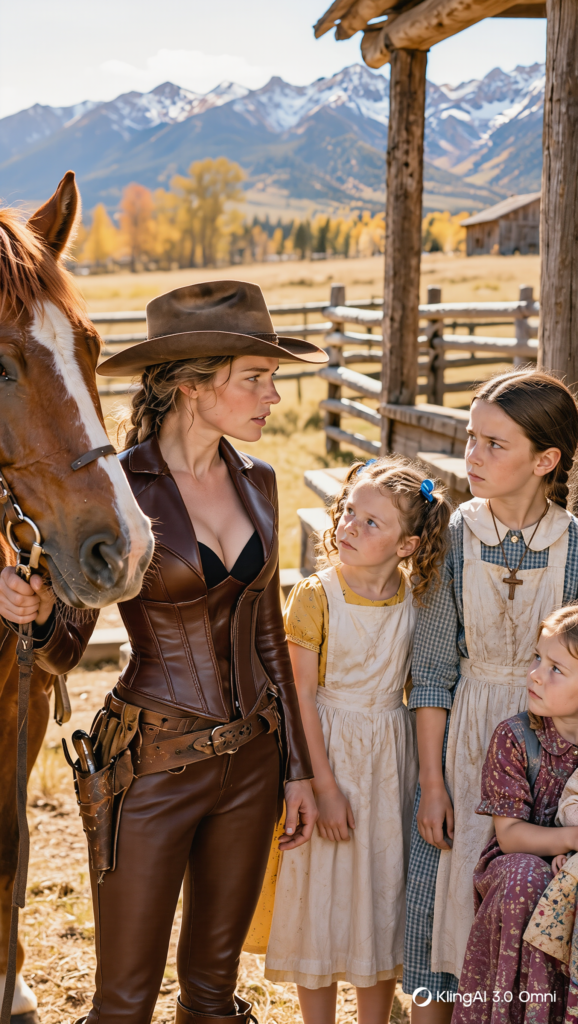
Temperance Ashcroft topped the last rise above the Toliver ranch leading a chestnut mare with a red ribbon braided into her mane.
The mare was a birthday present. Temperance had spent the whole summer gentling her for a girl she had never met, and she expected to find a grateful father waiting at the gate.
Instead she found five children sitting in a row on the porch steps, oldest to youngest, like birds on a fence rail. The smallest was swallowed by a quilt three sizes too big for her. All five stared past Temperance’s shoulder at the empty road behind her.
The oldest girl stood first. She was tall and thin, with a dish towel still slung over one shoulder.
“Did Papa send you?” she asked. “Is he coming behind you?”
“I’m looking for Lucian Toliver,” Temperance said gently. “He bought this mare for his daughter’s birthday. I was told to bring her on the fourteenth of October.”
The girl looked at the mare. Her chin trembled once and then went still.
“Today’s the fourteenth,” she said. “I’m Junia. It’s my birthday. And Papa’s been gone three days.”
Temperance was twenty-six that autumn, known up and down the Salmon River as the woman who gentled horses instead of breaking them. Her father had been a horse trader who believed a frightened animal learned nothing except fear. He’d taught her to work slow, speak low, and let the horse decide when it trusted you.
He’d been gone two winters now. Temperance lived alone in his cabin with a tall grey gelding named Whistler and a rotating string of green horses that paid her bills. Most nights the only voice she heard was her own, talking to the animals.
Then in June, a letter had come from Lucian Toliver in a careful, labored hand.
I want a sensible mare, easy to handle, it said. My eldest turns twelve in October. She has been mother to her brother and sisters since their mama passed, and she has not asked me for one thing in two years. I would like her to have something that belongs only to her.
Temperance had read that letter three times. Then she chose the best mare in her lot and named her Clover, and all summer she worked that mare as though the girl at the end of the road were someone she already loved.
Now that girl stood before her with a towel on her shoulder and grief in her eyes.
The children came clear one by one as Temperance tied the horses and followed them inside.
Junia ran the house. That was plain within a minute. She had bread rising, a pot on the stove, and a baby on her hip, and she issued orders to the others like a small, exhausted general. Thatcher was nine and watched Temperance as if she’d come to steal the woodpile. Mercy, seven, had already slipped outside to whisper secrets into Clover’s neck. Faye, five, sat at the table drawing on a slate with her tongue poking between her teeth. And the baby, Ottilie, not quite two, simply held out her arms to the stranger the way babies do.
“Papa went up to the Highline cow camp Monday,” Junia explained, “to bring the last cattle down before snow. He said he’d be home for Tuesday supper.” Her voice tightened. “He’s never late. Never. Not once since Mama died.”
Temperance looked at the chair at the head of the table. Someone had set a plate there anyway, three nights running, and no one had moved it.
She had planned to deliver a horse and ride home. Within an hour she knew she couldn’t. There were five children in this house and no grown-up, and a birthday nobody had the heart to mention.
So she found dried apples and the last of the sugar in the pantry and made the apple cake her own mother used to bake for birthdays, with a crust of cinnamon on top. Mercy helped. Faye licked the spoon. Thatcher pretended not to watch, then ate two slices.
After supper, Temperance led Clover up to the porch in the last of the light.
“Your father picked her out for you in June,” she told Junia. “He wrote that you’ve been mother to everyone for two years and never asked for a thing. He wanted you to have something that was only yours.”
Junia laid her hand on the mare’s neck. For a long time she said nothing. Then she began to cry quietly, the way a girl cries when she has been holding it in for three days.
“It doesn’t feel right,” she whispered. “Being happy about her. With Papa out there somewhere.”
“He planned this happiness for you,” Temperance said. “Taking it is one way of keeping faith with him.”
Thatcher found the note at sunrise.
It was nailed to the old fence post on the lower road, the one nobody used anymore. He came running so hard he lost his hat. The paper was rain-stained and curling. It had been there for days while five children watched the other road.
Temperance read the crude, slanting letters, and each word went through her like ice water.
TOLIVER IS TAKING US OVER THE MOUNTAIN. HE COMES HOME WHEN WE ARE ACROSS. TELL THE LAW AND HE DONT COME HOME AT ALL.
She read it twice. Lucian Toliver hadn’t been hurt, and he hadn’t gotten lost.
He had been taken.
Junia read it over her shoulder and went white. Thatcher’s fists clenched. Mercy started to cry, then Faye, then the baby, until the whole kitchen was a storm of fear.
Temperance knelt in the middle of them.
“Listen to me,” she said, and waited until they quieted. “Whoever wrote this needs your father alive. A man can’t guide anybody if he’s dead. That means he’s alive this morning. And that means we have time.”
It was Faye who gave them their first real clue, without knowing it.
While the others talked, the little girl slid her slate across the table. On it were three stick men in round hats. One wore a kerchief she had colored in hard with yellow chalk. Another held up a hand with only three fingers.
“These are the men,” Faye said. “They came Sunday. They asked Papa about the pass.”
Junia sat down hard. “I forgot. I was in the garden. Three men rode in Sunday looking for whoever knew Hollowback Pass. Papa told them the pass was no place for strangers this late in the season and sent them off. He was angry after. He checked his rifle before bed.”
Temperance studied the slate for a long moment: a yellow bandana, and a hand missing two fingers. Men in that big a hurry weren’t chasing something. They were running from something.
“Faye,” she said softly, “you may have just done more than any sheriff in the territory.”
Faye beamed and went back to drawing horses.
Temperance couldn’t leave five children alone, and she couldn’t find their father sitting in a kitchen. The answer lived two miles down the creek, in a sod-roofed cabin with a goat standing on the woodpile.
Perdita Quill was seventy if she was a day. She’d been a laundress at Fort Laramie in her youth, had buried two husbands since, and kept a Spencer carbine beside her butter churn. She listened to the whole story without interrupting once.
“Lucian Toliver sat up three nights with my second husband when he was dying,” Perdita said when it was done. “Nobody else in this valley bothered. Go do what needs doing, girl. I’ll keep the children.”
“They’re frightened,” Temperance warned. “The boy especially. He’ll want to go after his father himself.”
Perdita picked up her shawl and her carbine in the same motion. “Then he’ll have to get past me first,” she said. “Tougher men than him have broken their teeth trying.”
Placer Notch was a mining town with one crooked street and a stamp mill that pounded day and night. Temperance heard the news before she’d even tied Whistler to the rail.
Five days earlier, the Kestrel Mine payroll had been robbed on the road up from the railhead: eleven thousand dollars in gold coin. Three masked men, the driver said, and one wore a yellow bandana. The guard had taken a bullet in the shoulder. The county sheriff had led a posse south toward the Utah line, where the tracks led. No one had heard from them since.
Standing in the general store, Temperance felt the whole thing come together like a split log. The robbers had laid false tracks south, then doubled back north. They meant to cross the mountains into Montana, where nobody was looking for them. And the only man in the valley who knew that pass well enough to lead them over it before the snow was Lucian Toliver.
She sent a telegram to Boise asking for a federal marshal. Then she turned to the men in the store and asked who would ride with her.
Nobody answered. They studied their boots.
“You read the note yourself, miss,” one finally said. “Any armed party goes up that mountain gets Lucian killed.”
The mine superintendent, a heavy man in a brocade vest, spoke from the doorway. “The Kestrel will pay five hundred dollars for the return of that payroll. The gold, you understand. Not the man.”
Temperance turned and looked at him until he shifted uncomfortably.
“There are five children on that ranch,” she said quietly. “I’ll bring back your gold if I can. But I’m going up that mountain for their father.”
It was the blacksmith who stepped forward. Jory Pike was the biggest man in Placer Notch and one of the quietest, with forearms like fence posts and old burn scars on his hands.
“Lucian pulled me out of Deadfall Creek in the flood four years back,” he said. “I’d have drowned. I’m coming with you.”
Forty miles away and three thousand feet higher, Lucian Toliver was walking ahead of three armed men through snow halfway up his shins.
His hands were tied in front of him. His ribs throbbed where the one called Colgrave had kicked him the first night. Ozrick Colgrave wore a yellow bandana and was missing two fingers on his left hand. He spoke in a flat, patient voice that frightened Lucian more than any shouting could have. The other two were brothers who argued about everything except the gold.
They wanted Hollowback Pass. Lucian knew that if he took them the short way, they’d be across in two days, and he’d become a burden they had no reason to keep.
So he took them the long way. He led them up the wrong drainage and blamed the snow. He found excuses to double back. And every time the trail forked, while the men were busy with the horses, he nudged three stones together with his boot and turned the top one to point the way.
He had taught that sign to exactly one person in the world. He’d taught it to Junia the summer she was nine, walking the high meadows with her small hand in his.
Now he prayed harder than he had since the night Rosamond died that his daughter would remember.
That evening, at a fork below a granite shoulder, he did it again. He shifted his weight and nudged the third stone into place.
When he straightened up, Ozrick Colgrave was standing three feet behind him, looking at the ground.
For a long moment the outlaw said nothing. Snow ticked against their hats. Then Colgrave crouched, picked up the top stone, and turned it slowly in his three-fingered hand.
“Funny thing, Toliver,” he said in that flat, patient voice. “I’ve seen these stones at every fork since Cabin Creek.” He looked up, and his eyes were as empty as a frozen pond. “Who are you leaving them for?”
PART 2: Three Stones and a Promise
Lucian made himself breathe.
“Sheep men pile those,” he said evenly. “Basque herders, every summer. They mark the drives so they can find the water.”
Colgrave held his gaze for a long time. Then he tossed the stone into the snow, rose, and slammed the butt of his rifle into Lucian’s bruised ribs. Lucian folded to his knees, gasping.
“Then the sheep men won’t mind,” Colgrave said, “if you quit kicking their rocks.”
He walked away. Lucian knelt in the snow, fighting for breath, and understood two things. He could leave no more signs while Colgrave was watching. And if anyone was following him, they would now be walking into a man who was expecting them.
Temperance rode back to the ranch at dusk with Jory Pike behind her and laid out everything at the kitchen table. Perdita listened with her carbine across her knees. Thatcher listened from the stairs, where he was supposed to be asleep.
When she said the words Hollowback Pass, Junia sat up straight.
“If Papa’s guiding them,” she said slowly, “he’ll leave a sign. He always marks the trail in high country in case something goes wrong. Three stones stacked, with the top one pointing the way.” She looked at Temperance with a face far older than twelve. “He taught me. Just me. Thatcher was too little then.”
Temperance felt her heart lift and sink in the same breath. It lifted because now there was a trail. It sank because she knew what was coming next.
“I have to come,” Junia said. “You’ll ride right past his sign and never see it. You won’t know what you’re looking at. I will.”
“Absolutely not,” said Perdita.
Thatcher came thundering down the stairs shouting that if anybody went, it should be him. Mercy cried. The baby woke and joined in. Temperance let them all shout themselves out. Then she spoke to Junia alone.
“You’ll ride Clover. You’ll stay with the horses every time we stop. And if I tell you to turn around and go home, you’ll turn around and go home without a single word of argument. Can you promise me that?”
Junia looked her straight in the eye. “I promise.”
Then Temperance turned to Thatcher, who was red-faced and close to tears.
“I need you here,” she told him. “Mrs. Quill can shoot, but she can’t be everywhere. If a federal marshal comes, somebody has to lead him up the mountain trail to the old burn. You know that trail. Nobody else in this house does.”
Thatcher swallowed hard. Then he nodded, like a man accepting a commission.
They left before dawn, three riders and a packhorse, climbing through timber where frost had whitened every pine needle. By midmorning it had begun to snow. They were small, dry flakes, the kind that come before the big ones.
Junia found the first stones at the fork above Cabin Creek. Temperance would have ridden right past them. They looked like nothing: three loaf-sized rocks sitting together at the edge of the trail. But Junia slid off Clover and knelt beside them, and when she looked up, her face was shining.
“He’s alive,” she said. “He made this. He’s telling us left.”
They found six more that day.
Then, past a granite shoulder in the late afternoon, the signs stopped.
They rode a mile, then two, and found nothing at any fork. Junia grew quieter and paler with every empty crossing. At the third fork she slid down and searched the snow on her hands and knees until her fingers were raw.
“He wouldn’t stop,” she whispered. “He wouldn’t. Not unless…”
“Not unless somebody was watching him,” Temperance said quietly.
Jory crouched by the trail. Under the new snow were the tracks of six horses and four men walking, one of them dragging his feet. “They’re still together,” he said. “Still four. He’s still walking.”
Junia stood very still. Then she looked not at the ground but up, at the trees.
Eight feet up a lightning-scarred pine, wedged into the fork of a dead branch, sat three small stones. The top one pointed right.
“He couldn’t use the ground anymore,” Junia breathed. “So he used the trees.” She laughed, a broken little sound. “Papa, you clever old fox.”
After that they looked up. The signs were few and far apart, but they were there.
Above timberline, the trail crossed a long slope of broken rock with a frozen creek far below. Jory’s big bay stopped dead at the edge and refused. He snorted, backed, spun, and nothing could move him.
Clover walked straight onto the scree as if she’d been born there. She placed each hoof with care while Junia sat quiet and loose in the saddle and let her work. Halfway across, the mare stopped, lowered her head to study the ground, and then went on.
“She’s thinking!” Temperance called out, with a pride in her voice she didn’t try to hide. “That’s what I taught her all summer. Not to be brave. To think.”
She dismounted and led Jory’s bay across herself, talking low the whole way, one hand flat on his neck. It took twenty minutes. When they reached the far side, Jory shook his head in wonder.
“I’ve shod a thousand horses,” he said. “Never seen anybody walk one over a slide like that.”
They couldn’t risk a fire that night. They camped in a hollow among stunted firs and ate cold biscuits in the dark. Junia curled against Temperance for warmth. After a long while she spoke.
“Mama died of fever two winters ago,” she said into the darkness. “It went so fast. Papa rode to Placer Notch for the doctor, and when he got back, she was gone. He didn’t say a word for a week. He just worked. I think he blames himself for not being here.”
“My father died in his sleep,” Temperance said. “It was nobody’s fault. I still spent a year telling myself that if I’d just gone to see him one more time, maybe I could have done something.” She tucked the blanket tighter around the girl’s shoulders. “People who love hard blame themselves just as hard. It’s the price of it.”
Junia was quiet. Then she whispered, “Are you scared?”
“Yes,” Temperance said. “Being scared just means you know what’s at stake. It doesn’t mean you turn back.”
They found the outlaw camp late the next afternoon. They smelled smoke long before they saw it.
Temperance crawled to the lip of a ridge and looked down. The camp sat in a sheltered bowl just below the pass. Three men moved around a smoky fire. Their horses stood on a picket line at the far end of the bowl, heads low against the snow. And near the fire, sitting with his back against a boulder and his bound hands in his lap, was a lean, dark-bearded man with no hat.
Temperance had never seen Lucian Toliver. She knew him anyway. He had Junia’s straight shoulders and Thatcher’s stubborn jaw, and even tied and half frozen, he held himself like a man who had not given up.
Above the camp, snow was drifting deep across the pass. By tomorrow it could close for the winter.
Then the wind shifted and carried voices up the slope.
“…slowing us down every mile,” one of the brothers was saying. “He’s been leading us in circles since Cabin Creek, Oz. You know he has.”
“I know,” said Colgrave’s flat voice. “We go over at first light. He stays.”
“Stays how?”
“Tied to that rock,” Colgrave said. “No coat. Mountain’ll do the rest by noon, and nobody hangs for it.”
Beside Temperance, Jory went rigid. Further back in the trees, out of earshot, thank God, Junia waited with the horses.
“We wait for the marshal,” Jory whispered, but there was no conviction in it.
“There’s no time,” Temperance said. “You heard him. First light.” She pointed at the picket line. “Three rifles. But six horses. Without those horses, they can’t cross the pass in this snow, and they can’t outrun us either. A man on foot in deep snow is a man stuck in place.”
Jory stared at her. “You mean to steal their horses tonight?”
“I mean to borrow them,” Temperance said. “You cover me from the rocks.”
The moon rose behind thin clouds a little before midnight. The fire had burned down to red coals. Two of the outlaws snored under their blankets. The third sat hunched against a stump with a rifle across his knees, nodding.
Temperance came down the slope slowly, placing her feet in the snow the way Clover placed her hooves on the scree. She circled wide and downwind of the horses so they would smell her before they saw her. When she was close enough, she began to hum softly, the same tune over and over, the one her father used to hum in the corral back home.
The first horse lifted its head. Temperance stood stock-still and let it look her over. Then she laid her hand on its neck and felt it sigh.
One by one she untied them. She talked low, and one by one they followed her, their hooves muffled in the fresh snow. Four horses went up the slope behind her, then five.
The sixth was a big grey gelding, the one tied closest to the fire.
She had the knot half loosened when the grey threw up its head and let out a ringing, piercing whinny that echoed off every rock in the bowl.
The guard jerked awake.
Temperance froze in the open snow with nothing between her and the coals but thirty feet of moonlight. The man rose to his feet. The rifle came up off his knees and swung, slowly, toward the picket line.
Toward her.
PART 3: The Woman Who Stayed
Temperance didn’t run. Running is what prey does, and the eye follows motion.
She stayed perfectly still in the grey gelding’s shadow, one hand flat on its neck, and kept humming under her breath so low it was barely sound. The horse’s ears flicked back toward her. Its breathing slowed. It dropped its head and blew softly through its nose.
The guard squinted into the darkness at a single grey horse standing quietly at its post. He muttered a curse at the animal, sank back against the stump, and within a minute his chin was on his chest again.
Temperance led the grey up the slope. When she handed the last rope to Junia, her hands were shaking so hard she could barely hold it.
The outlaws found their empty picket line at dawn, and their shouting rang off every rock on the mountain.
Jory Pike rose from behind a boulder above the camp with his rifle at his shoulder. “You’ve got two feet of snow under you,” he called, in a voice like a hammer on an anvil. “Your horses are gone and the pass is closing. Throw down your guns where I can see them.”
The two brothers looked at each other and obeyed.
Ozrick Colgrave did not. He was fast for his size. He hauled Lucian up by the collar as a shield and jammed a pistol under his jaw. “I walk out of here with him,” he shouted, “or nobody walks out!”
What Colgrave didn’t know was that Lucian had spent two nights sawing his bonds against the sharp edge of the boulder behind him. When he twisted his wrists, the last strands gave way. He drove his elbow into Colgrave’s ribs. As the outlaw doubled over, Temperance stepped out of the rocks on the other side with her rifle leveled at his chest.
“Let him go,” she said.
Colgrave looked at her, at the rifle, and at the giant blacksmith above him. Then he dropped the pistol.
Junia had promised to stay with the horses. For five whole minutes after the shouting stopped, she kept that promise. Then she came flying down the slope, slipping and sliding in the snow, and threw herself at her father so hard they both went over.
Lucian held her. For a long time he didn’t say anything at all. He just held her and rocked her and pressed his face into her hair.
Then he looked up and saw the chestnut mare standing at the edge of camp with a red ribbon still braided in her mane, and Temperance holding her lead.
“You got her,” Lucian said to his daughter, and his voice broke in the middle. “You got your birthday mare.”
“She crossed the rock slide, Papa!” Junia laughed and cried at the same time. “She’s the smartest horse in the territory! And Miss Ashcroft stole six horses from the outlaws in the dark and nobody even woke up!”
Lucian turned and looked at Temperance for the first time. It was a long look. She felt it all the way down to her frozen boots.
“Miss Ashcroft,” he said, “I believe I owe you the second half of a payment. And a great deal more than that.”
They brought the outlaws down the mountain with their hands bound, the way Lucian had been marched up. Every coin of the eleven thousand dollars in gold rode in the outlaws’ own saddlebags.
Below timberline they met riders coming up, led by a Deputy U.S. Marshal named Sylvan Kirby. Riding beside him on a borrowed mule, fit to burst with importance, was Thatcher Toliver.
“Boy met my stage,” Kirby said. “Told me the whole story in one breath and led me up the trail to the old burn like he’d been guiding lawmen all his life.”
Thatcher didn’t look at the marshal. He looked at his father. He slid off the mule, walked forward very straight and very serious, and held out his hand like a man.
Lucian ignored the hand completely and pulled his son into his arms.
When they rode into the ranch yard at sunset, neighbors crowded the porch and lanterns glowed in every window. Mercy reached her father first, then Faye, clutching her slate. Perdita Quill came out last with the baby on her hip, and Ottilie, who hadn’t seen her papa in more than a week, stared a moment, then shrieked with joy and lunged so hard Perdita nearly dropped her.
Faye held up her slate. She had drawn a new picture: a tall man, a girl on a horse, and a woman with a long braid standing beside them.
“That’s you,” she told Temperance. “You brought Papa home.”
Perdita wiped her eyes with a corner of her shawl and glared at anyone who noticed. “Wind in my eyes,” she muttered. “This valley blows something terrible.”
Lucian’s hands had frostbite from a week tied in the cold. The doctor said he’d keep every finger if he was careful, but he couldn’t rope or split wood for six weeks.
So Temperance stayed.
She told herself it was only sensible. Somebody had to do the heavy work, and Junia couldn’t do it all. She had twelve horses promised to the Army at Boise Barracks by March waiting in her pens on the Salmon River, and she sent word for her neighbor to keep feeding them a while longer.
The weeks found their rhythm: mornings in the barn, afternoons working Clover with Junia, and after the children were asleep, an hour on the porch with Lucian, both of them bundled in coats against the cold, talking.
He told her about Rosamond, how she sang while she cooked and never once found the right note, and how some mornings he still reached for her before he remembered. Temperance told him about her father, the corrals, and the long, quiet evenings in the cabin.
“I didn’t know I was lonely,” she said one night. “Not until I came here and it stopped.”
Mercy talked to Clover every single day. She believed, with the absolute certainty of a seven-year-old, that horses understood every word and kept secrets better than people.
One afternoon in early December, Lucian came around the corner of the barn and heard her. She was standing on an upturned bucket with her arms around the mare’s neck.
“I asked God to make her stay,” Mercy was whispering. “Every night. I don’t think He’s listening, so I’m asking you. Tell her, Clover. She listens to you. Tell her we need her.”
Lucian stood very still. He didn’t let Mercy know he’d heard. He went back behind the barn and stood a long time by the woodpile, looking at his bandaged hands. For weeks he’d told himself that what he felt was gratitude. But gratitude doesn’t make a man’s heart jump when he hears a woman laughing across the yard.
The letter came on a Tuesday. The remount officer at Boise Barracks wanted his twelve horses saddle-broke and cavalry-ready by the first of March, or the contract would go to someone else.
Temperance read it at the kitchen table, folded it into her pocket, and walked out to the barn without a word. Lucian found her an hour later currying Whistler so hard the old grey was starting to look offended.
“You’re leaving,” he said.
“I have to.” She didn’t turn around. “That contract is everything my father built. It’s my living, Lucian. My whole life is back on that river.”
“Is it?” he asked quietly.
She stopped brushing. She didn’t answer, because the honest answer had changed over seven weeks, and saying it aloud scared her more than walking into that outlaw camp had.
He came and stood beside her and gently took the curry comb from her hand.
“Bring your horses here,” he said. “All twelve. I’ve got more winter pasture than I can use and a barn with six empty stalls. Boise’s closer to this ranch than to your river. You could finish them here and deliver them ahead of schedule.” He took a breath. “That’s the sensible part. The part I practiced. Here’s the part I didn’t.”
She turned to look at him.
“I don’t want you to stay because I need help,” Lucian said. “Or because my children love you, though they do. I want you to stay because I love you, Temperance. I think it started the minute you stepped out of those rocks with a rifle and told an outlaw to let me go. And I’m not asking you to stop being who you are. I’m asking you to be who you are here, with us.”
For once in her life, the woman who always knew what to say to a frightened horse couldn’t find a single word. Lucian didn’t push. He waited.
On Christmas morning, after the stockings and oranges and the carved wooden horse Jory Pike had made for Faye, the children led Temperance to the barn with her eyes covered.
When they let her look, Clover stood in the aisle with the same red ribbon braided into her mane that Temperance had tied there in October. Only now something else was knotted at the end of it: a thin gold wedding band. It had belonged to Lucian’s mother.
He knelt in the straw before her, clumsy with his healing hands, while five children held their breath.
“I’m asking proper this time,” he said. “Will you marry me, Temperance Ashcroft? Will you stay?”
Perdita Quill, who had come for Christmas dinner, stood in the barn doorway with her Bible under her arm.
Temperance looked at the children’s faces, at the man kneeling in the straw, and at the mare she had gentled all summer for a girl she had never met. A verse from the Psalms came back to her, the one her mother used to say on the darkest nights: Weeping may endure for a night, but joy cometh in the morning.
“Yes,” she said. “Yes, Lucian. I’ll stay.”
Mercy flung her arms around Clover’s neck. “I told you,” she whispered to the mare. “I told you she’d listen.”
They married in April, when the snow had left the low meadows and the creek ran high and loud. All twelve of Temperance’s Army horses had come up from the Salmon River in February, and every one of them reached Boise Barracks on time.
Jory Pike stood beside Lucian in a borrowed suit. Perdita Quill sat in the front pew in her Sunday bonnet, weeping openly and blaming the pollen. Thatcher handed his father the ring with the solemn care of a boy carrying dynamite. Mercy and Faye scattered wildflowers, Ottilie ate most of them, and Junia rode to church on Clover with a red ribbon in her mane.
That October, on the fourteenth, there was another birthday cake on the long table: apples and cinnamon, just like before.
This time there were seven chairs around the table, and none of them was empty.
The families we’re born into and the families we find are not so different in the end. Both begin the same way, with someone who decides to stay.
THE END


