PART 1: The Challenge
The year was 1886, and the Arizona Territory lay stretched and silent beneath a merciless summer sun.
Jonah Reed didn’t mind the silence. He’d come looking for it.
At thirty-four, he had already buried more than most men carry in a lifetime. Once, he’d owned a small horse ranch on the Brazos in Texas. He’d had a wife named Ruth, who laughed with her whole body, and a little daughter named Lily, who followed him to the barn every morning in her nightgown and named every foal before it could stand.
Then the diphtheria came through the county in the winter of ‘84. It took Lily in eleven days. It took Ruth nine days after that.
Jonah sold the ranch in the spring. He packed one saddlebag, and he rode west, and he never once looked back. He didn’t stop in towns if he could help it. Towns had families in them. Children’s voices. He kept to the empty country, where the only sound at night was the wind and the crackle of his own small fire.
In the bottom of his saddlebag, wrapped in a handkerchief, he carried a little wooden bird. Lily had asked him to carve it for her the week she fell sick. He’d finished it the night she died.
On the third evening without finding a running creek, Jonah saw a thread of smoke rising in the distance. His canteen was nearly empty. His horse, a patient gray mare named Hope (Ruth had named her), was stumbling with thirst.
He rode toward the smoke.
From the lip of a long valley, he looked down on an Apache village: a scatter of brush lodges along a slow green stream, cottonwoods leaning over the water, horses grazing, children running between the cookfires.
The peace lasted exactly as long as it took him to draw breath.
Then warriors rose out of the rocks on every side, rifles and bows leveled at his chest.
An old man stepped forward from among them. He was tall and straight-backed despite his years, with long gray hair and eyes as sharp as a hawk’s.
“You ride alone,” he said, in English worn smooth from trading.
Jonah slowly raised both empty hands. “I mean no harm. I’m only looking for water.”
The warriors exchanged hard, suspicious looks. Few white men rode into their lands without trouble following close behind.
Before anyone could answer, a small boy near the stream stumbled under the weight of a heavy water skin and dropped it in the dust. He was perhaps six, thin and flushed with heat, and he stood staring at the spilled water with his lip trembling.
Without a word, Jonah unslung his own canteen, the last of his water, and walked over and held it out to the boy.
The boy hesitated. Then he drank, greedily, while his mother watched from the cookfire with wide, startled eyes.
The old man saw all of it.
After a long silence, he nodded slowly. “I am Hashké,” he said. “This is my village. You may stay tonight. Tomorrow, the sun will decide where your road leads.”
Jonah kept to himself that evening. He watered and brushed down Hope, and sat alone at the far edge of the camp, staring into a small fire of his own.
But someone was watching him.
Her name was Neshdi, and she was the chief’s only daughter.
She was twenty-four and known across three valleys for her courage and her stubbornness. She rode better than half the warriors in the village, spoke her mind to anyone, chief or child, and had turned away every young man who had ever come courting with horses at her father’s lodge. Some said she’d never marry. Some said no man alive was good enough.
And Neshdi had no use at all for white men. Traders had cheated her people. Soldiers had broken every promise they had ever made. Her own mother had died of a fever the soldiers brought in their blankets, the winter Neshdi turned nine.
Yet this stranger puzzled her.
He asked for nothing. He boasted of nothing. He simply sat in the dark, turning a small wooden carving over and over in his fingers, staring into his fire with a sorrow she couldn’t name.
The next morning, shouts rang out from the horse herd. A yearling colt had wedged itself between two fallen cottonwood trunks on a rocky slope and was thrashing in terror, kicking so wildly that the young men trying to free it couldn’t get near.
Jonah walked over without a word.
Several warriors frowned and moved to stop him. But he didn’t rush. He knelt near the colt’s head, out of range of the flying hooves, and began to talk: low, steady, the same soft words over and over. Then, one at a time, he eased the broken branches away.
A few minutes later, the colt stood free. It was trembling. And then, to everyone’s astonishment, it stepped forward and pressed its head against Jonah’s chest.
The watching crowd went quiet.
“He has gentle hands,” an old woman murmured.
Neshdi couldn’t hide her surprise.
But not everyone was impressed.
Kotzi stood at the edge of the crowd with his arms folded. He was the strongest young warrior in the village, broad-shouldered and quick, and everyone knew he meant to marry the chief’s daughter and lead the people one day. He’d brought eight horses to Hashké’s lodge last spring. Neshdi had sent every one of them back.
Now he watched her watching the stranger. And something cold and bitter took root in his chest.
That evening, the village gathered around a great fire for drums and songs and stories. Laughter rolled across the valley under the stars.
Halfway through the night, one of the older women teased Neshdi, as the women always did. When would she finally choose a husband? Was she waiting for the moon to come down and ask her?
Neshdi laughed and stood up before everyone, the firelight bright on her face.
“I’ll marry the man who can ride Storm Cloud,” she declared.
The whole gathering burst into laughter.
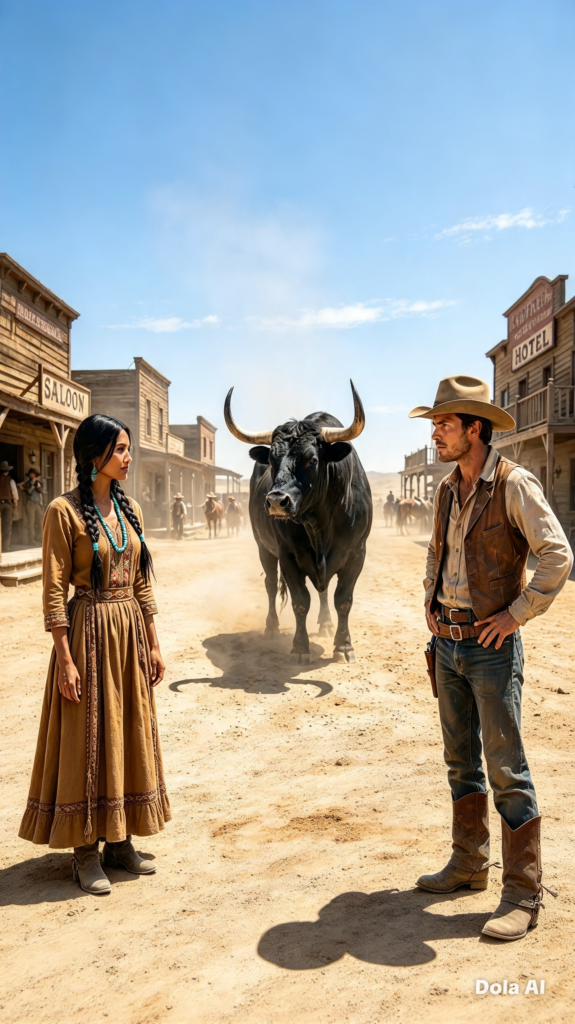
Storm Cloud was the enormous black bull penned in a stout corral at the edge of the village, a beast taken from a Mexican ranchero two winters ago. He stood taller at the shoulder than a man, with long, wickedly curved horns and a hide crossed with old scars. Three men had tried to ride him. Two still limped. One would never ride anything again.
Then Neshdi’s mischievous eyes found the stranger sitting alone at the edge of the firelight.
“Perhaps our guest would like to try,” she said sweetly.
More laughter. Everyone turned to watch the white man drop his eyes and shake his head.
Instead, Jonah Reed slowly rose to his feet.
His voice was quiet. But it carried.
“I accept.”
The laughter died so fast that even the drums stopped.
Men who’d been grinning a moment before stared at Jonah as though he had lost his mind. Women covered their mouths. Children scrambled off to tell everyone who’d missed it.
Kotzi threw back his head and laughed. “The stranger wants to die!”
But Chief Hashké didn’t laugh. His old eyes studied Jonah for a long time.
“You know nothing about Storm Cloud,” he said at last.
“Then I reckon it’s time I learned.”
The chief was silent a long while. Neshdi stood frozen, her face suddenly pale. What she’d meant as a joke had become something else entirely.
“The challenge will be in seven days,” said Hashké.
Seven days.
Most men would have spent them testing ropes and practicing with saddles, preparing for a brutal fight.
Jonah did none of it.
He spent his days sitting beneath a mesquite tree near Storm Cloud’s corral. He never carried a whip. He never shouted. He simply sat there, sometimes talking softly, sometimes not speaking at all. He watched.
The first day, Storm Cloud hit the fence so hard whenever he moved that the posts shuddered.
The second day, the bull charged only twice.
By the fourth day, Storm Cloud no longer charged at all. He stood on the far side of the corral, his great head lowered, watching the man under the mesquite tree with dark, wary eyes.
The village thought Jonah was a fool. Kotzi mocked him openly at every fire. “He talks to that bull like an old friend,” he said. “Maybe he hopes it will feel sorry for him and kill him gently.”
But Neshdi began to notice.
On the fifth afternoon, she found him under the mesquite, carving with a small pocketknife: a little wooden horse, its mane flying.
“You truly believe you can ride him?” she asked.
Jonah didn’t look up. “I believe fear makes a creature fight.”
She folded her arms. “And you’re not afraid?”
His knife went still. His eyes drifted toward the mountains.
“Everybody’s afraid,” he said quietly. “Some fears just cost more than others.”
Neshdi studied his face. “You speak like a man who’s lost something.”
She expected him to ignore her. Instead, after a long silence, he reached into his shirt pocket and drew out a small wooden bird, worn smooth from years of handling.
“I had a little girl,” he said. “Lily. She asked me to carve her this. I finished it the night she died.” He turned it over in his fingers. “My wife went nine days after.”
The words were gentle. But the weight behind them was immense.
Neshdi lowered her eyes.
“My mother died when I was nine,” she said softly. “A fever. My father has carried it every day since. He doesn’t speak of her. But he still sleeps on her side of the lodge.”
Jonah nodded slowly. “Pain doesn’t leave. You just learn to walk alongside it.”
For the first time, Neshdi didn’t see a lonely stranger.
She saw a wounded man still standing. And somehow that made him seem stronger than every warrior who’d ever brought horses to her father’s lodge.
After that, she came every day.
Sometimes they talked. She told him about the mountains she’d climbed as a girl, and the wild horse she’d gentled at twelve. He told her about the Brazos, and the foals Lily used to name. Sometimes they just sat in silence beneath the mesquite, watching the great bull watch them, and neither of them found the silence uncomfortable.
On the sixth day, Jonah finished the carved horse and held it out to her.
“For you,” he said. “So you’ll have something to remember the fool who tried to ride your bull.”
Neshdi took it. Her fingers trembled.
“I wish I’d never said it,” she whispered. “It was meant to be a joke. I didn’t think anyone would—” She stopped. “Please. Don’t do this. Walk away. No one will think less of you.”
Jonah looked at her for a long moment. Then he smiled. It was the first real smile she had seen on his face.
“I’ve been walking away from things for two years, Neshdi,” he said. “I think I’d like to stop.”
Kotzi saw them together that evening, Neshdi holding the little wooden horse, her face soft in the firelight in a way he had never once seen it soften for him.
He found her alone by the stream.
“You shame our people,” he hissed. “You laugh with a white stranger while real warriors stand beside you.”
Neshdi faced him without fear. “That stranger has shown more kindness in six days than most men show in their whole lives.”
The words struck Kotzi like a blade between the ribs.
She walked away. He stood alone in the dark by the water for a long time.
If the white man rode that bull tomorrow, Kotzi would lose everything. The chief’s daughter. The respect of the warriors. His future.
And slowly, in the darkness, a terrible idea began to form.
Long after midnight, while the whole village slept, a shadow slipped through the cottonwoods toward Storm Cloud’s corral.
Neshdi woke with a start. She didn’t know what had woken her. Some sound, maybe. A distant bellow.
She lay listening. Silence.
She told herself it was nothing. And she went back to sleep.
The morning of the challenge came with a strange hush over the valley.
Word had spread far beyond the village. Families from three neighboring camps had ridden in before dawn. Children clambered onto the rocks for a better view. Elders sat beneath brush shades. They had all come to see what everyone believed would be the last morning of the white stranger’s life.
Neshdi stood beside her father. Her heart felt like a stone.
She searched the crowd until she found Jonah. He stood quietly beside Hope, settling his hat on his head as though it were any ordinary day. There was no fear on his face. Only a kind of peace.
Chief Hashké stepped forward. “Jonah Reed. You may still walk away.”
The crowd went silent.
Jonah looked at Neshdi. Then he smiled. “I came this far. I’ll see it through.”
And then Neshdi heard it.
From inside the corral came a sound she’d never heard Storm Cloud make. Not the bellow of a bull’s anger. A scream. High and wild and full of agony.
Something was wrong.
At the edge of the crowd, half-hidden in the shadow of a lodge, she saw Kotzi. He was sweating. He wouldn’t meet anyone’s eyes. And there was a fresh black scorch mark on the sleeve of his shirt.
“Wait!” Neshdi cried. “Father, wait, don’t open—”
But the young men at the corral had already swung back the heavy gate.
Storm Cloud came out like an avalanche.
Blood ran down his black flanks. His eyes rolled white. Foam flew from his mouth. And he charged, head down, horns lowered, straight across the dusty ground toward the only man standing in the open.
PART 2: The Splinter
Women screamed and snatched their children back. Three warriors leaped forward, ready to drag the stranger clear.
But Jonah raised one hand.
“No.”
Everyone froze.
Slowly, deliberately, he took off his hat and let it fall in the dust. Then he walked forward. Toward the bull.
Storm Cloud lowered his horns and came at him like a runaway train.
Neshdi’s scream tore from her throat.
Jonah didn’t move. He didn’t run. He stood perfectly still in the path of a ton of maddened, bleeding animal, and he began to speak. The same low, steady murmur the bull had heard every day for a week beneath the mesquite tree.
The horns came closer. Ten yards. Five.
And Storm Cloud slowed.
His hooves skidded and churned in the dust. His great chest heaved. He stopped, close enough that his hot breath lifted the hair on Jonah’s forehead. He stood there trembling, blood dripping from his sides, staring into the man’s face.
Not a person in that valley breathed.
Jonah raised one hand very slowly and laid it flat against the bull’s forehead.
Storm Cloud shuddered all over. And lowered his head.
A ripple went through the crowd, a sound like wind through dry grass. Old men rose to their feet. Women pressed their hands to their mouths.
Neshdi felt tears spill down her face.
Jonah didn’t climb on. Not yet. Instead he ran his hand slowly down the bull’s neck, his shoulder, his heaving, bloody flank. His fingers stopped. His face went hard.
He knelt in the dust, right beneath the great horned head, and looked closely at the bull’s side. Then he reached out and, with a quick, sure pull, drew something from the black hide.
He stood up and held it high for the whole village to see.
It was a long, jagged splinter of sharpened wood. Its tip was dark with blood.
“Somebody drove these into his pen,” Jonah said quietly, his voice carrying across the silent valley. “Into the ground where he’d lie down. He’s got three more in his flank. And burn marks on his shoulder.” He looked down at the trembling bull. “He wasn’t mad, Chief Hashké. He was hurt. Somebody hurt him, so he’d kill whoever came near him this morning.”
A dangerous murmur rolled through the crowd.
Jonah drew the other three splinters out one by one, gently, talking softly to the bull all the while. Storm Cloud flinched each time, but he never moved his feet.
When the last splinter was out, Jonah put his hand on the bull’s neck. Then, slowly and carefully, he swung himself up onto the broad black back.
The whole valley held its breath.
Storm Cloud stood still. Not a kick. Not a bellow.
Then the great bull began to walk. Slowly, calmly, carrying the stranger once around the dusty arena, as gentle as an old plow horse coming home at sundown.
For a heartbeat, there was only silence.
Then the valley exploded.
Cheers rang off the canyon walls. Children shrieked and danced. Old warriors pounded each other on the shoulders. Chief Hashké stood with his hands raised to the sky, laughing out loud for the first time in fifteen years.
And Neshdi could not take her eyes off the quiet man on the black bull’s back, the man who had walked into the path of death and turned it gentle with nothing but his voice.
Jonah slid down from Storm Cloud’s back and turned toward her.
Neshdi was already running to him across the dust.
She never reached him.
Because out of the cheering, surging crowd, a shape came lunging. Kotzi, his face twisted with rage and terror, a long knife flashing in his hand.
“You stole everything from me!”
The blade was aimed at Neshdi. Not at Jonah. At her. The woman he couldn’t have.
Jonah saw it. He moved without thinking. He threw himself between them.
The knife went into his side.
He staggered. His hand went to the wound and came away red. He looked down at it with an odd, mild surprise.
Then three warriors hit Kotzi from behind and drove him into the dust. Chief Hashké was shouting. People were screaming.
And Jonah’s knees folded beneath him.
Neshdi caught him as he fell. She sank to the ground with his head in her lap, pressing both hands hard against the wound in his side. Blood welled hot between her fingers.
“Jonah. Jonah, look at me.”
His eyes found hers. Even now, with his blood soaking into her doeskin dress, his face was strangely calm.
“Is she safe?” he whispered. “Is Neshdi safe?”
“I’m right here,” she sobbed. “I’m right here, you fool. I’m safe.”
“Good,” he breathed. “Protect her.”
And his eyes closed.
Kotzi broke within the hour.
Pinned in the dust before the whole village, with the chief standing over him and Storm Cloud’s bloody splinters laid on the ground before him, the proud warrior’s courage crumbled away.
He confessed everything. That he’d crept into the corral after midnight. That he’d driven sharpened stakes into the ground where the bull lay down. That he’d struck Storm Cloud again and again with a burning brand until the beast was half mad with pain. That he’d meant for the stranger to die on the bull’s horns that morning, in front of everyone. And that when he hadn’t, Kotzi had lost his mind.
Shame covered the faces of everyone who had once praised him.
But no one in the village cared much about Kotzi’s confession.
They were watching the lodge where Jonah Reed lay burning with fever.
For three days, he didn’t wake.
The village healer, an old woman named Tséyi, cleaned the wound with boiled yucca and bound it with sweet herbs. But the knife had gone deep. The fever climbed. On the second night, Jonah began to talk in his sleep, calling for Lily, calling for Ruth, apologizing over and over to people who weren’t there.
Neshdi never left his side.
She brought water and wet his cracked lips. She changed his bandages. She held his hand through every long, dark night, and every hour of it, guilt ate at her heart like a coyote at a carcass.
I made a game of his courage. I laughed. And now he’s dying because of me.
On the third night, the fever spiked so high that his whole body shook. Old Tséyi came in, looked at him, and took Neshdi’s hand gently in both of hers.
“Daughter,” she said quietly. “You should say what you need to say to him. Tonight.”
Neshdi stared at her. Then down at the man burning on the buffalo robe.
His breathing had grown shallow. Ragged. And as she watched, it stopped.
PART 3: The Long Ride Home
“No.”
Neshdi seized his face in both her hands.
“No. Jonah Reed, you listen to me. You do not get to leave. Not like this. Not after everything.” Her voice cracked. “You told me you were done walking away. You promised.”
Nothing.
She bent close, her forehead against his burning forehead, and her tears fell onto his face.
“You came here looking for silence,” she whispered. “But you found us. You found me. Please. Please come back.”
A long, terrible moment passed.
Then Jonah’s chest lifted. A shallow, shuddering breath. Then another.
Old Tséyi let out a sharp breath of her own and pressed her hand to his forehead. Her eyes widened.
“The fever,” she murmured. “It’s breaking.”
Neshdi laid her head down on his chest and wept, listening to the slow, stubborn beat of his heart.
He woke at sunset on the fourth day.
The light came through the open flap of the lodge, gold and red, and the first thing he saw was Neshdi asleep in her clothes beside his pallet, her hand still wrapped around his.
He moved his fingers. Her eyes flew open.
For a long moment, they just looked at each other.
Then she began to cry.
“I mocked you,” she whispered. “I made a game of your courage, in front of everyone. And it nearly killed you.”
Jonah managed a weak smile. “You gave me something worth getting up for.”
“Don’t.” Tears ran freely down her face now. “Don’t be kind to me. I don’t deserve it.”
He reached up, slowly, and wiped a tear from her cheek with his thumb.
“Neshdi,” he said hoarsely. “You held my hand three nights straight in the dark. I heard you. I heard every word.” He swallowed. “Don’t tell me what you deserve.”
She caught his hand and pressed it against her cheek. And then, for the first time in her life, the proud daughter of Chief Hashké said what her heart had known since the afternoon beneath the mesquite tree.
“I don’t want a hero, Jonah,” she whispered. “I don’t care about the bull. I only want you.”
On the seventh day, Chief Hashké called the village together to decide Kotzi’s fate.
By the old ways, a man who tried to kill another in the camp could be put to death. Many in the village called for it. Kotzi stood before them, gaunt and gray-faced, and didn’t ask for mercy.
But before the chief could speak, Jonah limped forward, one arm across Neshdi’s shoulders, his face still pale with pain.
“Chief Hashké,” he said. “May I speak?”
The chief nodded.
Jonah looked at Kotzi for a long time.
“I lost my wife and my little girl,” he said quietly. “And for two years, I hated the whole world for it. Hated God. Hated anybody who still had what I’d lost.” He looked around at the gathered faces. “I know what it does to a man, to watch somebody else have the thing you wanted most. It doesn’t make what he did right. But it makes it understandable.” He turned back to the chief. “I’m alive. Neshdi’s alive. Storm Cloud’s alive. I don’t want anybody else to die over this. Not even him.”
The village was very quiet.
Kotzi stared at the man he’d tried to kill. For a long moment, his face worked. Then he dropped his eyes, and his shoulders began to shake.
Chief Hashké was silent a long while.
“Then hear my judgment,” he said at last. “Kotzi will leave this village. He will go to live among our people in the mountains to the north, and he will not return for two winters. He will carry water and wood for the old ones there, the way a boy does before he is trusted to carry a bow.” He looked at Kotzi. “And every day of those two winters, he will remember that the man he tried to murder asked that his life be spared.”
Kotzi left the next morning. He stopped at the edge of the village, looked back once at Jonah, and lifted a hand.
Jonah lifted his in return.
The weeks passed. With every sunrise, Jonah grew stronger.
The wound in his side healed into a long, pale scar. And Storm Cloud, to everyone’s amazement, had become gentle as a dog around him. The great black bull followed him down to the stream every morning, and the children who’d once hidden from it now climbed on its back while Jonah walked beside them, laughing.
Chief Hashké kept his word. Before the whole village, he named Jonah a brother of their people, and offered him land along the stream, and horses, and a lodge of his own.
But in the quiet, deep part of him, Jonah still carried an old fear.
One morning, before the sun had cleared the eastern ridge, he saddled Hope in the gray half-light. He tied on his single saddlebag. He took one long last look at the sleeping village.
He’d already lost one family. He couldn’t bear to be the reason another one ever grieved.
He rode out quietly to the edge of the valley.
Behind him came the sound of hoofbeats.
Neshdi drove her pony up the slope at a dead run and reined in right in front of him, blocking the trail. She swung down and stood in his path with her chin raised.
“You’re leaving,” she said quietly. It wasn’t a question.
Jonah looked down at his hands on the reins. “I know what loss does, Neshdi. I know what happens when love gets taken away. I can’t do it again. I can’t watch it happen to you.”
She stepped closer and laid her hand flat against Hope’s neck.
“And I know what happens when fear steals love before it’s even had a chance to begin,” she said. Her eyes were bright with tears. “You came here looking for silence, Jonah. Instead you found a home. You found people who care about you. A bull who follows you like a puppy.” She drew a shaking breath. “And you found me.”
He didn’t answer.
She reached into the pouch at her belt and drew out something small. The little carved horse, its mane flying. She held it up.
“You gave me this so I’d have something to remember the fool who tried to ride my bull,” she said. “I don’t want to remember you, Jonah Reed. I want to have you. Every day. For the rest of my life.”
The sun cleared the eastern ridge just then. Golden light poured across the valley, across the stream and the cottonwoods and the waking village, across the woman standing in his path.
Slowly, Jonah reached into his shirt pocket. He drew out the little wooden bird Lily had asked him to carve, worn smooth by two long years of grief.
He looked at it for a long time.
Then he climbed down from his saddle, took Neshdi’s hand, and pressed the little bird gently into her palm beside the horse.
“Lily would’ve liked you,” he said, his voice rough. “She always wanted a big sister to boss her around.”
Neshdi laughed through her tears, and closed her fingers around both carvings.
And Jonah Reed smiled. Not the tired smile of a lonely man. The smile of a man who has finally decided to stop running.
Months later, beneath a golden autumn sky, the whole valley gathered to celebrate their wedding.
Ranchers from the Mexican settlements rode in to trade and feast. Apache families came from three valleys away. Drums and fiddles played together beneath the cottonwoods, and for one long, bright day, nobody remembered to be suspicious of anybody at all.
And beside the happy couple stood Storm Cloud, black and enormous, his horns hung with garlands of autumn flowers, calm and proud as a king.
Chief Hashké raised his hands over his daughter and the man she’d chosen, and smiled.
“You came seeking loneliness, my son,” he said to Jonah. “But the Creator had already chosen something better for you.”
That night, beneath the stars, Neshdi set the little wooden bird and the little wooden horse side by side on a shelf in their new lodge.
A bird for the family Jonah had lost.
A horse for the family he’d found.
And both of them, at last, were home.