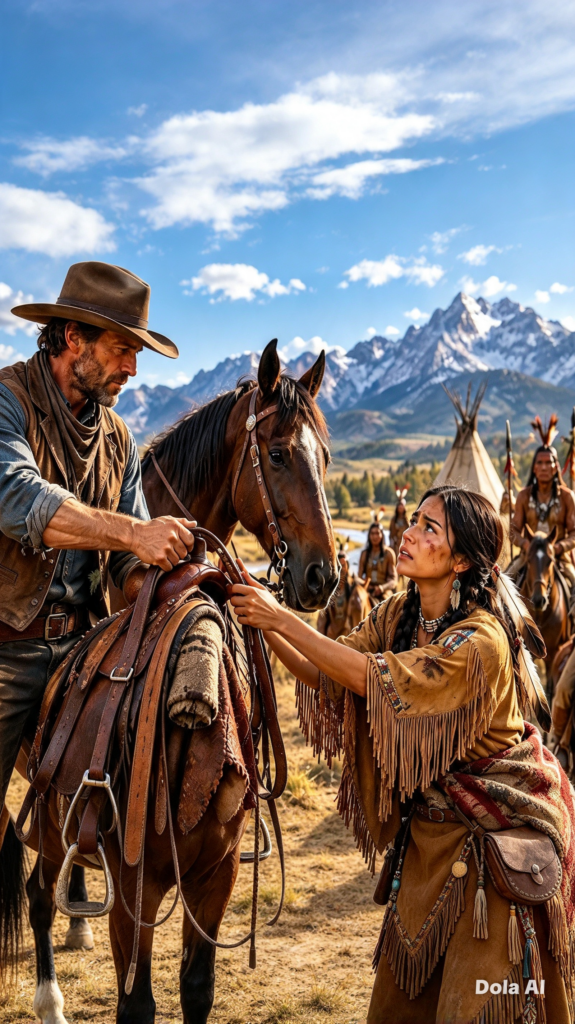
PART 1: The Bay Mare
The man had cash in his hand and a smile that never reached his eyes.
“Two hundred dollars,” said Jack Ransome, fanning the bills out on the top rail of the corral. “For that bay mare. That’s twice what she’s worth, and you know it, Hale.”
Silas Hale knew it. He also knew Jack Ransome.
Everyone in Pinto Valley, New Mexico Territory, knew Jack Ransome. He traded horses on the surface, and underneath that he traded in whiskey, stolen cattle, and things nobody said aloud in church. He had ridden into Silas’s yard that morning with two hired men, sweating hard. He’d asked for the fastest horse on the place, any price, right now.
The bay mare was the fastest horse in three counties. She had been Silas’s father’s horse. The old man had raised her from a foal and ridden her the last summer of his life. Silas hadn’t sold her in four years, though he’d had a dozen offers.
“Not for sale,” Silas said.
“Everything’s for sale.” Ransome’s smile thinned. “I’ve got business in the hills. Something of mine ran off last night, and I need it back before it gets where it’s going.”
“Then you’d best ride hard on what you’ve got.”
Ransome studied him, then shrugged, folded his money, and swung back into the saddle. He and his men rode out east, fast, toward the hills.
Silas watched them go, frowning. Then he turned, and he saw her.
She was standing at the far end of the hitching rail by the barn, where the morning shadows were deepest. She was a young Apache woman, perhaps twenty-two. She was alone, and she was covered in red dust from her moccasins to her loosened braid. She must have slipped into the yard while Ransome was talking. She had kept so still against the barn wall that Silas hadn’t noticed her at all.
Her eyes followed Ransome’s dust out of sight. Silas saw the fear in them, and then he saw her wrists.
They were raw. Rope burns circled both of them, angry and red. The rope had been cut, or chewed, or worn through on a rock. Silas had seen burns like that on horses that had fought a picket line all night.
He understood at once what “something of mine ran off” meant.
He looked at the bay mare dozing in the corral. He looked at the empty eastern road where Ransome would turn back soon, once he lost the trail in the rocks and realized it had doubled back. Then he looked at the woman’s bleeding wrists.
He walked to the corral, slipped a bridle onto the mare, threw his father’s old saddle over her back, and cinched it tight. Then he led her to the rail and held the reins out to the stranger.
“Take her,” he said quietly. “You’ll need the ride.”
The woman stared at the leather in his hand as if it might burn her.
When Silas lifted his hand to pass her the reins, she flinched. It was a hard, instinctive flinch, like someone who had been struck often by a raised hand. Silas stopped dead and lowered his hand slowly. He laid the reins on the top rail and stepped back three paces, giving her room.
She looked at the mare, then at him, as if trying to work out the trap.
Then, without a word of thanks, a name, or a promise, she picked up the reins with one brown hand, set her foot in the stirrup, and swung up onto his father’s mare like she’d been born in that saddle.
She turned the horse’s head west, away from Ransome’s road and toward the far blue hills, and rode.
Dust rose, hung in the still air, and settled. The trail went empty.
Mabel Hale had watched the whole thing from the chicken coop with a basket of eggs on her hip.
She was Silas’s younger sister, twenty-six and widowed two years now. She had kept house for him since her husband’s mule kicked him in the chest one morning and she found herself with nothing but a sewing basket and a brother who never once made her feel like a burden. She knew Silas better than anyone alive. She knew what that mare meant to him.
“She didn’t even say goodbye,” Mabel said softly, coming up beside him.
Silas shrugged. “It’s a horse.”
But he didn’t go back to the fence line. He stood with his hat crushed in his hands, watching the empty trail like a man watching a door swing shut.
Two hours later, Jack Ransome came back.
He came at a dead gallop, with his face red and his horse lathered. He reined up hard at the gate, looked at the empty corral where the bay mare had been, and then looked at Silas.
His face went dark and cold.
“You sold that mare after all, Hale,” he said softly. “Who’d you sell her to?”
“Didn’t sell her to anybody,” Silas said.
Ransome’s hired men shifted in their saddles. One let his hand drift toward his gun.
“I lost a horse and a debt this morning,” Ransome said. “A debt I paid good money for. Somebody helped her.” His eyes went to Mabel on the porch, then back to Silas. “If I find out it was you, Hale, you’ll wish you’d taken my two hundred dollars.”
He wheeled his horse and rode west along the same trail the mare had taken.
That night Silas mended fence he had already mended. Mabel watched him from the window until long after dark.
The next morning she found him on the porch before sunup. His coffee had gone cold, and his eyes were on the western ridge.
“You’re counting,” she said.
“Counting what?”
“Horses you don’t have anymore.”
He almost smiled. It faded too quickly, and it tugged at her heart the way a loose thread tugs at a hem.
“She had rope burns on her wrists, Mabel,” he said quietly. “Both of them. She flinched when I lifted my hand to pass her the reins. A body doesn’t learn a flinch like that in a day.” His jaw tightened. “Ransome said he paid for her. Paid for a debt. I’ve heard talk in town about men up near the agency who buy Apache women off the reservation rolls to work off ‘debts’ that never end.”
Mabel set a fresh cup down beside his boot.
“So it wasn’t just a horse,” she said.
Silas didn’t answer. He watched the trail until the light turned long and golden, and then he kept watching.
By the end of the week, half the county had an opinion.
“Fool,” they said at the general store. “Soft. A man gives away his best horse to an Apache he’ll never see again. He’s asking to be taken advantage of.”
Mabel heard it all and said nothing. She’d seen her brother’s face that first morning, looking at the empty corral like a man who had misplaced something he couldn’t name.
But the evenings told the truth.
Every night, Silas walked out to the corral and stood at the gate, resting his hand on the rail where the mare used to wait for him. The stars came up, and he didn’t move.
“Might be she’s not coming back,” Mabel said one night, bringing him coffee.
“No,” he said. “Might be she is.”
He said it like a prayer he was afraid to believe.
On the fifth evening, near dusk, Silas heard something on the road.
It wasn’t hooves. It was footsteps, slow and careful and tired: bare feet, or nearly bare, on the gravel.
He knew the walk before he saw her.
She came up the last rise alone. The bay mare was gone. Her braid had come loose, her moccasins were worn through at the toes, and the dust clung to her dress as if she’d walked through country that meant to keep her. She stopped ten paces from the gate, as though she’d spent the last of her courage just getting that far.
Silas’s heart sank. That mare had been his father’s. More than that, she had been his word given and kept. Now she was somewhere out there without the woman he’d given her to.
Then he looked at the woman’s face.
She was here. She was worn thin and empty-handed, but she was here. That was enough. It was more than enough.
“You walked,” he said.
“I walked,” she answered.
Something in his chest let go of the horse and held on to her instead.
Mabel came out onto the porch with a blanket. Silas took it from her hands and went down the steps. He wrapped it around the woman’s shoulders without asking. She stood very still and let him.
“My name is Lozen,” she said, very quietly. It was the first thing she had ever told him about herself.
“Silas,” he said. “That’s Mabel, my sister. Supper’s inside, Lozen. Nobody takes anything from you here.”
Lozen looked back at the hills behind her, then at the man in front of her. For the first time, something in her eyes softened.
Then Mabel, still on the porch, went rigid.
“Silas,” she whispered. “The ridge.”
He turned.
On the western ridge, silhouetted against the last red light of sunset, three riders sat their horses and looked down at the Hale ranch. They didn’t move. They just watched.
The one in the middle wore a flat black hat. Even from half a mile away, Silas knew the shape of him.
Jack Ransome had found her trail. And he had followed it straight to Silas’s gate.
PART 2: The Strange Request
“Inside,” Silas said quietly. “Both of you. Now.”
He barred the door, drew the curtains, and took his father’s Henry rifle down from over the mantel. He loaded it in the lamplight with steady hands. Mabel put coffee on, because there was nothing else to do with her own hands, and pushed a bowl of stew in front of Lozen, who stared at it as if she’d forgotten what food was for.
“Eat,” Mabel said gently. “Whatever comes up that road, it’ll come whether you’re hungry or not.”
Lozen ate.
Silas sat by the window with the rifle across his knees and watched the dark ridge. The riders didn’t come down. Somehow that was worse.
“They won’t come tonight,” Lozen said at last, setting down her empty bowl. “Ransome is a coward. He’ll wait for daylight, when he can tell the town you’re a horse thief who stole his property, and bring the sheriff with him. Then it’ll be the law that takes me back. Not him.”
“You’re not his property,” Silas said flatly.
“I am, by a paper.” Lozen pulled her sleeve back and looked at the raw, healing rope burns on her wrist without expression. “Last winter the agent stopped our rations. He said the beef hadn’t come. We knew he’d sold it. My brother Nanta borrowed twenty dollars of flour from Ransome’s store to feed my mother. Ransome made him put his mark on a paper he couldn’t read.” Her voice stayed flat and steady. “When Nanta couldn’t pay, the paper said the debt passed to his family. To me. I’ve worked for Ransome since the first snow. Cooking. Hauling. Other things.” She didn’t elaborate, and nobody asked her to. “Every month the debt grew instead of shrinking.”
Mabel had gone pale. “And your brother?”
Lozen was silent a moment.
“Nanta came to Ransome’s place ten days ago to take me home,” she said. “Ransome’s men shot him in the yard. They buried him by the creek like a dog.” For the first time, her voice cracked. “I chewed through the rope that night and ran. I was halfway to your ranch before they knew I was gone.”
The kitchen was very quiet.
“So that’s why you need to get home so badly,” Silas said softly.
Lozen looked up. “No. That’s why I can’t go home.”
She set her cup down slowly, as though she had been saving the words for a long time.
“I don’t ask you for another horse,” she said. “I ask for something harder.”
Silas waited. He had a way of waiting that made a room feel patient.
“My father is Chief Nahilzay,” Lozen said. Her chin lifted, but her voice stayed quiet. “Nanta was his only son. Nanta went to bring me home and died for it. In our way, a death like that must be answered at the council fire. Someone must stand before my father and say what happened.” She swallowed. “Many of our people say I caused it. That my debt killed my brother. That I should have stayed Ransome’s property and let the rest of my family live.” She met Silas’s eyes. “If I stand before the council alone, my own word won’t be enough. They may cast me out. And a woman cast out of her people, with Ransome hunting her…” She didn’t finish.
“What do you need from me?” Silas asked quietly.
“Ride with me to my father. Stand at the fire beside me and tell what you saw: the rope burns, the man who tried to buy your horse to run me down.” Her voice dropped. “A white man who speaks for an Apache woman, with no reason to lie and nothing to gain? That is a thing my father will listen to. I have no one else to ask.”
Silas studied his own hands resting on his knees.
“You’d trust me with that?” he asked.
“I trust you with my life,” she said simply. “This is smaller.”
Something moved in his jaw. He looked at the fire, then back at her, and the corners of his eyes creased the way they did when a decision settled in him.
“Then we ride at dawn,” he said.
Lozen closed her eyes a moment, like a woman setting down a weight she had carried a very long way. When she opened them, they were bright.
“Thank you, Silas Hale.”
“I’m coming too,” Mabel said firmly.
Both of them turned to stare at her.
“Ransome’s men saw me on the porch,” Mabel said, folding her arms. “If you two ride off and leave me here alone, I’m the next ‘debt’ he collects. Besides…” she nodded at Lozen, “she’ll want a woman along at that council fire. I’ve buried a husband. I know a thing or two about standing in front of people who think they know your grief better than you do.”
Lozen looked at Mabel a long moment. Then she nodded slowly.
Mabel put more wood on the fire that night and let it burn high.
They slipped out two hours before dawn on Silas’s two remaining horses, a sorrel gelding and Mabel’s old grey mare, leading a pack mule. They went out through the cottonwoods behind the barn, while the ridge was still black. Lozen walked ahead on foot. She refused to ride, saying she could read the ground better walking, and she moved silently in a pair of Mabel’s old boots, which were two sizes too big.
By midmorning they were deep in the red-rock canyons, and there was no sign of pursuit. Lozen set a pace that would have broken a cavalry trooper, and every so often she glanced back as if to make sure they were still there.
“You told me once you don’t laugh much,” Mabel called out on the second afternoon, teasing. “I don’t believe a word of it.”
Lozen turned, and the corner of her mouth tugged. “Then you’ve never seen me fall off a horse.”
Silas laughed, low and warm. “That a common thing for you?”
“Only when a handsome cowboy is watching,” she said, perfectly deadpan.
Mabel’s eyebrows shot up. Silas cleared his throat, and his ears went red.
Lozen’s eyes crinkled. “My brother’s words, not mine. He thought he was very funny.”
The laughter faded into something quieter. Mabel caught her brother’s gaze and saw how he looked at Lozen, and she smiled to herself.
That evening, at a creek crossing, Lozen crouched and let the cold water run over her raw wrists.
“Do you know what my name means?” she said quietly. “In the language of the soldiers’ interpreter, it means little. My mother named me for her grandmother, but the agent wrote it down as ‘Little Woman’ on the ration rolls.” Her mouth twisted. “Not the size of the woman. Her worth.”
“I don’t think so,” Mabel said.
Lozen looked up, surprised.
“You walked forty miles through Ransome’s country in borrowed boots, on no food, to keep a promise,” Mabel said. “There’s nothing little about that.”
Lozen held her gaze. Then she nodded once, slowly, as if filing the words away somewhere safe.
Silas helped his sister across the slick stones, then turned and offered Lozen his hand without thinking. She looked at it. Days ago, she had flinched from that same hand.
Now she took it. Her fingers stayed in his a breath longer than the crossing needed.
Something was changing in her. She was less guarded now, like a woman remembering she was allowed to be seen.
They reached Chief Nahilzay’s camp at dusk on the third day, in a high, hidden valley beneath the Black Range.
Warriors appeared out of the rocks long before they reached the lodges. Hands rested on weapons, and hard eyes went to the two white strangers. When they saw Lozen, a murmur went through them, and it was not all welcome.
By full dark, they were seated at the council fire.
A hundred people sat in a great circle in the firelight: elders, warriors, women with children in their laps. Across the flames sat Chief Nahilzay, an old man with a deeply lined face, his blanket pulled tight around his shoulders. Beside him sat a younger warrior with a cold, angry face. His name was Delshay, Nanta’s closest friend. He had spoken loudest that Lozen’s debt had killed her brother.
The chief didn’t smile.
“You gave my daughter a horse,” he said to Silas in heavily accented English. “A good one, she says. What did you want in return?”
“Nothing,” Silas said.
“Men always want something.”
“Then I wanted her to get where she was going.”
The chief’s eyes narrowed. “And you followed her here. Why?”
“Because the trail was bad, and she was alone, and she asked me to.”
“Did you touch her?”
“No, sir.”
Around the fire, the warriors had gone very still. Mabel held her breath. She’d seen her brother stand his ground before, but never like this: quiet, unarmed, under a hundred watching eyes.
Then, from the darkness beyond the edge of the firelight, came hooves.
Every head turned.
Into the circle of light rode Jack Ransome, with his two hired men behind him and a fourth man Silas didn’t know, wearing an army captain’s coat. They led a mule loaded with long wooden crates. Ransome had followed their trail for three days, and he hadn’t come empty-handed.
He swung down and touched his hat to the chief with a broad, oily smile.
“Evening, Chief,” he said cheerfully. “I believe you’ve got something of mine. Two things, actually.” He pointed at Lozen. “That girl is bound to me by a legal debt, signed by her brother.” He pointed at Silas. “And that man is a horse thief. He’s helped her steal from me. Captain Barlow here from the agency can confirm the paper’s good.”
The man in the army coat nodded uncomfortably.
Ransome patted the long crates on his mule.
“Now, I’m a reasonable man,” he said. “There’s twenty Winchester repeaters in these boxes and a thousand rounds of ammunition. Gift from me to your people, Chief. All you’ve got to do is hand over the girl and the horse thief, and we’ll call it square.”
A ripple went through the warriors around the fire. Twenty repeating rifles meant food for a starving winter and a defense against soldiers and raiders. It was a fortune.
Delshay rose to his feet, his face hard.
“Give her to him,” he said in their own tongue, loud enough for everyone to hear. “Her debt killed Nanta. Let her debt feed the rest of us.”
Chief Nahilzay looked at the crates of rifles. Then he looked at his daughter for a long, silent moment.
Lozen stood alone in the firelight, and the whole camp watched her.
Silas started to rise.
Ransome’s hand dropped to the pistol on his hip. “Don’t,” he said softly. “Not one step, Hale.”
PART 3: What She Traded
Lozen didn’t look at Ransome. She looked at her father.
When she spoke, it was first in her own tongue, low and certain. Mabel caught only pieces. Then Lozen turned so that both the white strangers and her own people could hear every word, and she spoke in English.
“Five days ago, this man gave me his father’s horse,” she said, laying her hand on Silas’s shoulder. “The best horse in three counties. He refused two hundred dollars from Jack Ransome so I could have it. He asked for nothing. When I came back on foot, he gave me his own blanket and slept by a cold window with a rifle to guard me. He spoke to me like a person, not a thing.”
Her voice didn’t shake.
“Ask me what I did with his horse.”
The chief’s brows drew together. “What did you do with it, daughter?”
Lozen lifted her chin.
“I traded her the same day,” she said. “To a Mormon settler on Turkey Creek. For grain. Six mules’ worth of corn and flour, enough to carry our people through the cold.” She turned and pointed. “Look in the storage lodge. You’ve all been eating from it for four days. The sacks are marked with the settler’s brand. Every child in this camp is eating because of Silas Hale’s horse.”
A stunned murmur ran around the fire. Several women turned to look at the storage lodge. One old woman began to weep quietly.
Silas stared at Lozen. His brow lifted slightly.
“You gave away a gift,” he said quietly. He wasn’t angry. He was curious.
“A gift freely given is mine to use,” Lozen answered. “My people were hungry. The winter came early. The children were thin. I knew what that horse cost you, Silas. I traded her anyway.” Her hands closed into fists at her sides. “And I walked forty miles back to your gate barefoot, because I would not ride into my father’s camp on a stolen horse while my people starved and call it honor.”
She turned to face the whole circle.
“Delshay says my debt killed my brother. It did not. Jack Ransome killed my brother, in his yard, for twenty dollars of flour he stole from us to begin with. Nanta died trying to bring me home. And now Ransome brings rifles to buy me back, the way he bought me the first time.” She looked at Ransome with burning contempt. “With things that were never his to sell.”
“Those rifles are perfectly good,” Ransome snapped. “Take the deal, old man, or I’ll be back with the cavalry and…”
“The rifles,” said Silas Hale quietly, “are stolen from the Fort Bayard armory.”
Ransome froze.
Silas had risen to his feet, with his hands open and empty at his sides, and he was looking at the man in the army coat.
“Those crates are stamped U.S. Ordnance, Fort Bayard, Captain,” Silas said evenly. “You’re the agency quartermaster. Captain Barlow. You’ve got a paper saying an Apache girl owes twenty dollars of flour she never received. And you’re riding with the man who’s handing out army repeaters to tribes. I’m only a rancher. But I can read a crate.”
Every eye in the circle swung to the crates on the mule. In the firelight, the black stenciled letters stood out plainly: U.S. ORDNANCE, FT. BAYARD.
Captain Barlow’s face went grey.
“Jack,” he said hoarsely. “You told me those were trade guns.”
“Shut up, Barlow.”
“You said nobody’d ever trace…”
Ransome’s pistol cleared leather.
He never got it level. Lozen was closest. She snatched a burning branch from the edge of the fire and swung it two-handed into his gun arm in a shower of sparks. The pistol went off into the dirt, and Ransome screamed and dropped it, clutching his burned wrist. Before his two hired men could clear their own guns, a dozen Apache rifles were leveled at their heads from every side of the circle.
And Delshay, the young warrior who had called for Lozen to be sold, was the first to put his knife to Jack Ransome’s throat.
“You killed my brother’s friend,” Delshay said softly in English. “And I almost let you buy his sister.” He looked at Lozen with shame in his eyes. “Forgive me, Lozen.”
She held his gaze. Then she nodded once.
The chief rose slowly to his feet, his blanket falling from his shoulders. For a long time he looked at his daughter: barefoot in borrowed boots, rope scars on her wrists, a burning branch still in her hand.
Then his stern face moved slowly, like ice giving way to spring water.
He turned to Silas, picked up a clay cup of warm broth from beside the fire, and pressed it into the rancher’s hands.
“Then sit closer, son,” said Chief Nahilzay. “You have earned the fire.”
They didn’t kill Jack Ransome. The chief wouldn’t allow it.
“Blood answered with blood feeds men like him,” the old man said. “Let the soldiers deal with their own thieves.”
So the next morning Silas and six of Nahilzay’s warriors marched Ransome, his two hired men, and Captain Barlow down out of the Black Range with their hands tied. The stolen rifle crates rode on the mule behind them. Mabel rode beside her brother the whole way, and Lozen walked ahead of them all, reading the trail.
They brought them through the gates of Fort Bayard in broad daylight.
The colonel in command was a tired, honest man named Prescott. He had suspected rifles were leaking out of his armory for months. He opened the crates, read the stencils, and looked at his own quartermaster with an expression Mabel would remember for the rest of her life. Captain Barlow broke within an hour. He confessed to the stolen ration beef, the false debt papers drawn up on Apache families who couldn’t read them, and the women sold for “labor” on those papers.
Jack Ransome was tried in Silver City that winter for the murder of Nanta, son of Nahilzay. Three of his own hired men testified against him to save themselves. He hanged in the spring.
Every debt paper in Captain Barlow’s ledger was burned in the fort’s parade ground under Colonel Prescott’s personal order. Lozen’s was the first.
She held the match.
It was almost a month before they rode back down the long trail toward the Hale ranch in Pinto Valley.
Two days out, Lozen turned off the main trail without a word and led them up a side canyon to a small homestead on Turkey Creek. A broad-shouldered Mormon farmer named Brother Aldous came out of his cabin, wiping his hands on his apron.
In his corral stood a bay mare.
Silas stopped his horse dead.
“Heard the whole story from one of the agency scouts,” Brother Aldous said, looking from Silas to Lozen. “About the man who gave up his father’s horse to a stranger, and what she did with it, and what came after.” He shook his head slowly. “I’ve been a Christian all my life, Mr. Hale. Never once seen it done properly until this month.” He opened the corral gate. “She’s yours. The grain was a gift. I’ll not take a horse for it.”
Silas couldn’t speak. He walked to the mare and laid his hand on her neck, and she turned her head and blew softly into his palm, the way she had done every morning for four years.
Mabel cried openly. Lozen looked away toward the hills.
The evening light had gone gold and heavy over the ranch when they finally came home.
Silas turned the bay mare into her old corral and stood at the gate a long time, his hat turning slowly in his hands. Mabel had gone inside to start supper. She’d made a show of saying she needed to, and then made a bigger show of letting the door bang shut behind her.
Lozen stood on the other side of the gate, holding the reins of the paint pony her father had given her for the journey home. Home to her people, she had said. Her father had held her a long time when she left the camp, and he had told her something in their own language that made her cry.
“Lozen,” Silas said. His voice came out rough and quiet. “You came back once. You could stay.”
She looked at him a long moment. The wind moved through her hair.
“You do not know what you ask,” she said.
“I know enough.” He lifted his eyes to hers. “I know I sleep better knowing you’re near. I know this gate feels wrong when you’re standing on the other side of it.”
Something eased in her face. The hardness she had carried like a shield for so long softened at the edges.
“My father said something to me when I left,” she said quietly. “He said, ‘I gave you a name that means little because I was afraid for you. I was wrong. Go find a man who knows how big you are.’” She swallowed. “My people will not understand this. Not at first. Neither will yours.”
“Then they’ll learn,” Silas said. “Slow. Like I did.”
She let out a breath that was almost a laugh. Then she stepped forward and laid her hand flat against his chest, over his heart, as if testing that it beat. Weeks ago, that hand had flinched from his.
“Then I stay,” she said.
Silas closed his eyes once. When he opened them, they were bright. He didn’t grab her or whoop or carry on. He simply turned and held out his hand, palm up, the way a man offers water to a stranger.
Lozen took it.
They walked through the gate together, her steps matching his, and the dust rose soft and copper-colored behind them. On the porch, Mabel stood with a dish towel pressed to her mouth and didn’t even pretend not to be watching.
The sun sank low and poured itself over the fence posts, the little house, the bay mare in her corral, and the two of them moving toward the light.
The gate stayed open behind them, swinging gently in the evening wind.
THE END


