PART ONE: The Girl in the Reeds
Jesse Calloway never looked at the river.
He rode beside it every evening, because the river trail was the only road home from the north pasture, but he kept his eyes on the trail ahead, on his horse’s ears, on the ridgeline, on anything but the brown water sliding past on his left. Six years he had ridden that trail. Six years he had not once turned his head.
The San Pedro had taken his son.
Sam had been six that spring, a towhead with a gap in his teeth and a laugh like a bucket of rocks being shaken. The rains had come late and hard in the mountains, and the river had risen in a single night from a lazy creek to a roaring brown wall. Sam had gone down to the bank to see it. Jesse had been in the barn. Martha, Jesse’s wife, had been hanging wash.
There had been no scream. Only an empty bank, a small boot print in the mud, and a carved wooden horse missing from the windowsill where the boy always kept it.
They searched for nine days. They dragged the eddies with ropes and hooks. Men came from three ranches and from the Mexican settlement downriver. They found nothing. Not a shirt. Not a shoe. Nothing.
Martha did not survive the second winter. The doctor in Tombstone called it consumption. Jesse knew better. She had simply stopped wanting to breathe in a world without Sam.
So Jesse lived alone now on his four hundred acres of creosote and mesquite, with his cattle and his horses and a silence so thick some nights he could hear his own heart beating. And every evening he rode home along the river, and he did not look at it.
Until the evening he heard someone crying.
It was early November. The light was going amber and long across the valley, and the cottonwoods along the San Pedro had turned the color of old brass. Jesse’s sorrel mare, Penny, was plodding toward home with her head low when, without any signal from him, she stopped dead and swung her ears toward the water.
Jesse frowned. “What is it, girl?”
Then he heard it too.
A thin sound, almost lost under the rush of the current. A sob, quickly muffled. Then silence. Then another, as though someone were biting down on her own hand to keep quiet and failing.
For the first time in six years, Jesse Calloway turned his head and looked at the river.
The reeds along the bank stood taller than a man, gold and rustling. Somewhere inside them, someone was weeping.
Jesse swung down, looped Penny’s reins over a branch, and walked slowly toward the water. The reeds closed around him, whispering. The crying stopped.
“Hello?” he called softly. “I heard you. Nobody’s going to hurt you.”
No answer. Only the river.
He took one more step and parted the reeds with his arm.
A knife came at his face.
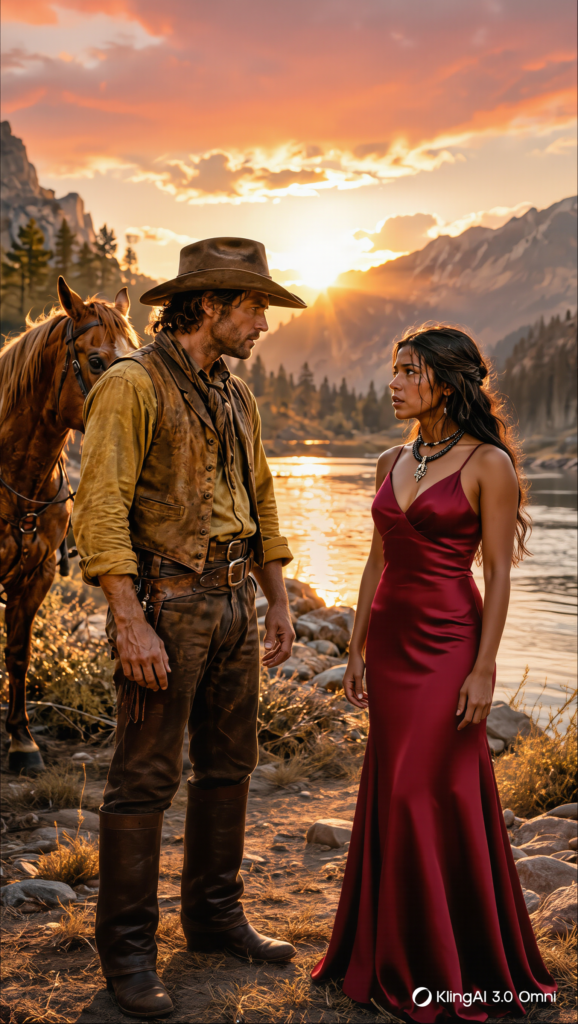
He jerked back so fast he fell, landing hard in the mud, and found himself staring up at a young woman crouched in a hollow of flattened reeds. She held the blade low and ready, the way someone holds a knife when they have been taught to use one. She could not have been more than nineteen. Her black hair hung in wet ropes around her face. Her calico dress was torn at the shoulder and dark with river water. A long cut ran down one forearm, crusted and swollen. Her feet were bare and bleeding.
She was Apache. Jesse knew it from the moccasin she still wore on one foot, from the beadwork at her throat, from the fierce, cornered stillness in her eyes.
Those eyes were the most frightened he had ever seen.
Jesse did not reach for his revolver. Slowly, carefully, he raised both empty hands.
“All right,” he said. “All right. I’m not going to touch you.”
She said nothing. The blade did not waver.
He moved very slowly, unbuckling the canteen from his belt. He set it on the mud between them and pushed it toward her with two fingers. Then he eased himself back until he was sitting in the reeds a good six feet away.
“Water,” he said. “It’s clean. Go on.”
For a long moment, she only stared at him. Then thirst won. She snatched up the canteen and drank like a creature that had forgotten what water was, her throat working, water spilling down her chin, the knife never leaving her other hand.
When she lowered it, she was gasping.
“How long you been out here?” Jesse asked.
She hesitated. Then, in rough but clear English: “Two days.”
“Running?”
A nod.
“From who?”
She looked past him, upriver, toward the north, where the valley narrowed into the broken country around the old Contention mill. Her whole body went rigid, as if she expected to see riders on the ridge that very second.
“Men,” she whispered. “Bad men. They took my people.”
Jesse felt his stomach turn to ice. He had heard the stories. Everyone in the territory had. Slave traders working the borderlands, men who rounded up Apache women and children and sold them south across the line to work the haciendas and the silver mines of Sonora. The army said the trade was finished. The army was wrong about many things.
“How many did they take?”
“Eleven.” Her voice cracked. “My grandmother. My cousins. Little ones.” She swallowed hard. “I got away when we crossed the river. I swam. They shot at me.” She touched the cut on her arm. “They think I drowned.”
“What’s your name?”
She studied him for a long time before answering, as if a name were something precious that could be stolen.
“Nahlin.”
“Nahlin. I’m Jesse Calloway. My place is about three miles south. You need a fire and food and somebody needs to look at that arm. Then we’ll ride to Fort Huachuca and get soldiers after these men.”
“No.” The word came out sharp as the blade in her hand. “No soldiers. No time. They sell them tomorrow. At sunrise. At the crossing at Contention, there is a man coming from Mexico with money. Tomorrow, my people are gone forever.”
“Then all the more reason…”
“You do not understand.” Her eyes were suddenly wet and furious. “I did not run to save myself. I ran to find someone. Someone who lives on this river.”
“Who?”
She did not answer him. Instead, slowly, she reached into the torn bodice of her dress and drew out something small, wrapped in a scrap of red flannel. She held it in her palm for a moment, her fingers trembling. Then she leaned forward and laid it on the mud between them, beside the canteen.
The flannel fell open.
Jesse Calloway stopped breathing.
It was a horse. A tiny wooden horse, no longer than his thumb, whittled from mesquite. One ear was chipped. The tail had been worn smooth by years of small hands. And burned into its flank, faint but unmistakable, was a brand: a C hanging from a curved line, like a letter swinging from a crescent moon.
The Calloway brand.
His brand.
He had carved that horse himself by lamplight in the winter of Sam’s fifth birthday, while Martha sat knitting and laughing at him for cutting his thumb twice. He had heated the tip of a nail in the stove and pressed the brand into its side, because Sam had said that every horse on the ranch had one and his should too.
The last time Jesse had seen it, it had been standing on the windowsill on the morning the river rose.
“Where,” he said. His voice did not sound like his own. “Where did you get this?”
Nahlin looked at him with something that was almost pity.
“From a boy,” she said quietly. “A boy my grandmother pulled out of the river six winters ago, a long way downstream. Half drowned. His head was cut open. For many days he did not speak. When he woke, he did not remember his name. He only held this horse, and he would not let go of it.”
Jesse could not move. The world had narrowed to the small carved shape lying in the mud.
“We called him Tsé,” Nahlin went on. “It means stone, because he was so stubborn. He grew up with us. He is my brother. He has hair like dry grass and a scar here.” She touched her own hairline above her left eye. “He is twelve winters now.”
Twelve.
Sam would be twelve.
“Before we crossed the river,” Nahlin said, “the boy gave me this horse. He told me, if I got away, I should find the ranch with this brand. He said he dreams about a house by a river and a man who smells like sawdust and coffee. He said maybe that man would help.” Her voice broke completely. “Tsé is with them. With the bad men. They say a white boy brings a very good price in Sonora. They are going to sell him tomorrow with the others.”
Jesse heard a sound, hoarse and broken, and realized it had come from his own throat.
He picked up the little horse. It weighed almost nothing. He turned it over, and his thumb found the place where the knife had slipped all those years ago, the small notch at the base of the neck. His thumb fit it perfectly.
Six years.
Six years he had believed his boy was lying somewhere at the bottom of the San Pedro, his bones tangled in roots and mud. Six years he had refused to look at the river because he could not bear to think of Sam inside it.
And all that time, Sam had been alive.
Alive, and growing, and dreaming of a man who smelled like sawdust and coffee.
Jesse rose to his feet. His legs shook. He did not care.
“How many men?” he said.
Nahlin blinked at him. “Seven. Maybe eight.”
“Where are they camped?”
“The old stamp mill at Contention. Inside the walls.”
“Can you ride?”
She stared at him. Something changed in her face. The fear did not leave it, but something fierce and bright rose up beneath it, like fire catching under wet wood.
“I can ride,” she said.
Jesse turned toward his horse.
And that was when they both heard it: the sound of hooves on the river trail behind them, and voices. Men’s voices. Laughing.
Nahlin went white. She seized Jesse’s sleeve and dragged him down into the reeds just as three riders came around the bend. Through the stalks, Jesse saw them clearly: hard, dirty men, rifles across their saddles, one with a coil of rope looped over his horn. The man in front was lean and red-bearded, with a Mexican sombrero hanging down his back and a fresh bandage on one hand.
He reined in beside Penny, who was still tied to the branch.
“Well now,” the red-bearded man said. “Lookee here. Nice little sorrel mare, all saddled up and nobody home.”
One of the others swung down and walked to the edge of the reeds. He crouched. Jesse watched him run a finger through the mud, through the fresh tracks of bare, bleeding feet.
“Blood, Red,” the man called. “Fresh. Squaw’s still alive.”
Red smiled, slow and unpleasant.
“Then she ain’t alone,” he said, and drew his pistol. “Come on out, whoever you are. Real slow. Or we start shooting into them reeds, and we keep shooting till something stops squealing.”
Nahlin’s knife hand was trembling. Jesse could feel her heart racing against his arm.
He looked down at the little wooden horse in his fist.
Then, very slowly, Jesse Calloway stood up.
PART TWO: The Stamp Mill at Contention
“Evening, gents,” Jesse said.
Three gun barrels swung toward him. He kept his hands loose and visible, the little wooden horse hidden in his left fist.
“Who the hell are you?” said Red.
“Jesse Calloway. That’s my mare you’re admiring. This is my land you’re standing on.” He nodded toward the mud. “And I reckon I’ve been tracking the same thing you have. Some Apache girl’s been stealing chickens off my place for two days. Followed her blood down here, but she’s gone. Went into the river, looks like.”
Red studied him with flat, pale eyes. Jesse made himself hold the stare. Behind him in the reeds, he prayed Nahlin understood, prayed she would stay still.
“That a fact,” Red said.
“That’s a fact.”
“She was hurt. Couldn’t have swum far.”
“Current’s fast here.” Jesse shrugged. “Reckon she’s halfway to Mexico by now. Face down.”
The man crouching at the bank snorted. “Saves us the trouble.”
Red holstered his pistol. But his eyes did not leave Jesse’s face. “You see anything else down here, rancher? Anything at all?”
“Just mud.”
For a long moment, Red said nothing. Then he grinned, showing a row of brown teeth.
“Well. Sorry for the disturbance.” He tipped his hat. “You keep off the north road tonight, Mr. Calloway. Folks around the old mill don’t take to visitors.”
They rode on. Jesse stood motionless until the last echo of their hooves faded upriver. Then his knees nearly buckled.
Nahlin rose from the reeds behind him, staring as though she had never seen a man before.
“You lied for me,” she said. “To men with guns.”
“I’d lie to the devil himself tonight,” Jesse said. “Come on. We’ve got until sunrise.”
He took her back to the ranch house. There was no time for anything else. He cleaned and bound her arm, fed her beans and cornbread while he loaded every weapon he owned, and found her a pair of Martha’s old boots, which were too big. She stuffed the toes with rags without complaint.
While she ate, Jesse knelt before the cedar chest at the foot of his bed and lifted the lid for the first time in four years. Martha’s things. Her Bible. Her good shawl. And, folded at the very bottom, the little blue shirt Sam had been wearing the night before the flood, the one he’d outgrown that very week.
Jesse held it to his face. It no longer smelled like anything.
When he came back into the kitchen, Nahlin was watching him with dark, solemn eyes.
“You loved him very much,” she said.
“I still do.” His voice was rough. “Tell me about him. About Tsé.”
So, while the moon rose and Jesse saddled two horses by lantern light, Nahlin told him.
She told him how her grandmother, Old Dilth, had found the half-drowned boy snagged in a cottonwood root forty miles downriver, cold and gray and barely breathing. How the women had warmed him between their bodies for three nights. How, when he woke, he had screamed and screamed for someone he could not name, and only stopped when Dilth put the little wooden horse back into his hands.
She told him how the boy had learned their language in a single summer, faster than any of the children born to it. How he could track a rabbit across bare stone and swim like an otter, though he would never go into the river above his knees. How he had fought a bigger boy for calling Nahlin’s mother a bad name, and lost, and gone back the next day and fought him again, and won.
“Stubborn,” Jesse said, and found that he was smiling through tears. “His mother used to say he got that from me.”
“He sings,” Nahlin said. “At night, when he thinks no one is listening. A song about a lady and a fair and a sweet young man. I do not know the words. He does not either. Only the sound.”
Jesse turned away and pressed his forehead against Penny’s warm neck.
Lavender’s Blue. Martha used to sing it to Sam every night at bedtime.
Six years. And the boy still carried it.
They rode north in darkness, keeping off the trail, following the river by sound. A half-moon silvered the water. Nahlin rode Jesse’s spare gelding like she had been born on it, bent low, silent, her eyes never resting.
Two miles below Contention, they left the horses in a mesquite thicket and went on foot.
The old stamp mill crouched on a bluff above the river, a hulking ruin of adobe walls and broken timbers, abandoned when the silver played out. Firelight flickered through its gaps. Jesse could hear voices, a guitar, a bottle shattering on stone.
He and Nahlin crept up a dry wash to the base of the wall. Through a gap where an adobe brick had fallen, Jesse looked inside.
The courtyard of the mill was lit by a single bonfire. Around it, seven men were drinking and playing cards. Against the far wall, beneath the rusted skeleton of the old stamp battery, sat the captives.
They were chained together by the ankles. Women, old and young. Children huddled against them. An ancient woman with white braids, sitting as straight and still as a carved post, her eyes closed, her lips moving in silent prayer. Old Dilth, Jesse thought.
And beside her, with his arm around a smaller child, his chin up and his jaw set in defiance, sat a boy.
Thin. Brown as a nut. Dressed in buckskin leggings and a ragged cotton shirt. His hair, grown long and tied back with a strip of red cloth, was the color of dry grass in the firelight. And above his left eye, pale against his tanned skin, ran a jagged white scar.
Jesse’s whole body began to shake.
The boy turned his head toward the fire. For one moment, the light fell full across his face. The gap in his front teeth was gone, filled in by grown teeth. His cheeks had lost their roundness. But the shape of him, the way he held his head, the stubborn set of his mouth that was so exactly like Martha’s…
Jesse bit down on his own fist so hard he tasted blood.
Sam.
It took everything he had not to vault over that wall.
Nahlin’s hand closed on his arm. “Not yet,” she breathed. “Look.”
A new rider was coming up the road from the south. Jesse watched him dismount at the mill gate: a big man in a fine black coat, a gold watch chain catching the firelight. Red came hurrying to meet him, hat in hand.
“Mr. Pike,” Red said. “Didn’t expect you till morning.”
Jesse knew that name. Every rancher on the San Pedro knew that name. Raymond Pike owned the biggest freight company between Tucson and the border. He hauled ore for the mines, supplies for the army, and mail for the territory. He sat on the town council in Tombstone. He had shaken Jesse’s hand at Martha’s funeral and said he was sorry for his loss.
“The Sonoran buyer moved his schedule,” Pike said, brushing dust from his sleeve. “He’ll be at the crossing an hour before dawn. Have them ready to move by four.” His gaze swept the captives and stopped on the boy. “That’s the white one?”
“Yes sir. Got blue eyes under all that dirt. Buyer’s paying triple for him.”
Pike walked over to the boy and seized his chin, turning his face to the light. The boy jerked free and spat in the dirt at Pike’s polished boots.
Pike laughed. “Spirited.” Then, almost idly, he backhanded the boy across the face.
The smaller child screamed. Old Dilth’s eyes snapped open. And the boy who had once been Sam Calloway slowly lifted his head, blood trickling from his lip, and stared up at Raymond Pike without a flicker of fear.
Jesse’s hand was already on his rifle.
“Not yet,” Nahlin hissed again, gripping his wrist with both hands. “If you shoot now, they shoot the children first.”
Jesse closed his eyes. Every second was a lifetime. When he opened them, his voice was ice.
“Then tell me how.”
Nahlin pointed to the far side of the mill, where the wall had collapsed into a pile of rubble near the old ore chute. Beyond it, a picket line of horses stood dozing in the dark.
“The chains run to an iron ring in the wall,” she whispered. “The key hangs on Red’s belt. If the horses scatter, the men will run after them. All of them. Horses are worth more than anything to them. More than us.”
Jesse looked at the picket line. Then at the bonfire. Then at the old dry timbers of the stamp battery towering over the captives’ heads.
A plan formed in his mind. A desperate, terrible, half-mad plan.
“Can you get to those horses without being seen?”
Nahlin almost smiled. “I am Apache.”
“When I fire the first shot, you cut them loose. Every one. Stampede them through the gate.”
“And you?”
Jesse looked at the boy beneath the stamp battery, wiping blood from his lip with the back of his hand.
“I’m going to get my son.”
Nahlin vanished into the dark like smoke.
Jesse counted to two hundred. Then he crawled through the gap in the wall and crept along the shadow of the inner wall toward the captives, inch by inch, until he was crouched behind the rusted iron of the stamp battery, close enough to hear Old Dilth’s whispered prayers.
Close enough to touch the boy.
He reached out through the darkness and laid his hand very gently over the boy’s mouth.
The boy went rigid. Jesse leaned close to his ear and, barely breathing, began to sing.
“Lavender’s blue, dilly dilly…”
The boy’s whole body went still. Slowly, he turned his head. In the faint red glow of the fire, his eyes searched Jesse’s face. Blue eyes. Martha’s eyes.
Jesse watched them fill with confusion. Then with something deeper, something buried six years under silt and silence, struggling up toward the light.
“I know you,” the boy whispered, in English that came out halting and strange, as if from very far away. “I dreamed you.”
Jesse could not speak. He only nodded, tears streaming into his beard.
And at that moment, a voice rang out across the courtyard, smooth and cold.
“Well, well. Mr. Calloway.”
Jesse looked up.
Raymond Pike stood ten feet away with a revolver aimed at the boy’s head. Behind him, Red and four others had their rifles leveled. And from the dark by the gate, two more men came dragging a struggling figure between them.
Nahlin. Her lip bloody. A rope around her wrists.
“Red told me he met a rancher by the river with a story about a drowned squaw,” Pike said pleasantly. “I thought that was a fine piece of storytelling. So I had Red’s boys watch the trail.” He thumbed back the hammer. “Now. Stand up slow, Mr. Calloway. Or I paint that wall with your boy’s brains, and you get to lose him twice.”
PART THREE: Lavender’s Blue
Jesse stood.
He let the rifle fall. He raised his hands. He did not take his eyes off Pike’s revolver for one second.
“You knew,” he said quietly. “You knew he was mine.”
Pike shrugged. “I recognized the brand on that toy the day my men brought him in. Calloway’s crescent. Didn’t figure it mattered. Dead boys don’t come home.” He smiled. “And neither will you.”
“Let them go,” Jesse said. “The boy, the girl, all of them. Take me instead. I’ve got four hundred acres and three hundred head. Sign it all over tonight.”
Pike laughed. “Mr. Calloway, by tomorrow noon I’ll own your ranch anyway. A grieving widower, out of his mind, killed by renegade Apaches he was trying to help. Nobody in Tombstone will even blink.”
The boy was on his feet now, his chain clanking. He stepped in front of Old Dilth and the small child, spreading his thin arms wide.
“Leave him alone,” he shouted, in English, his voice cracking with the effort of words he hadn’t used in years. “Leave my father alone!”
My father.
Jesse felt the words strike him like sunlight after six years of night.
And Old Dilth, who had sat motionless all this time, suddenly lifted her head and began to sing.
It was not a song Jesse knew. It was high and old and wild, rising off the adobe walls like a hawk climbing the wind. One by one, the other captives took it up, the women, the children, even the littlest ones, until the whole ruined courtyard rang with it.
The men faltered. Pike’s eyes flicked toward the sound for half a second.
Half a second was all Nahlin needed.
She drove her heel down onto her captor’s instep, twisted free of the rope she had been working loose since they caught her, and snatched the knife from his belt. Before anyone could turn, she sprinted toward the picket line, screaming like a mountain lion, and slashed the lead rope.
Thirty panicked horses exploded through the gate.
Chaos.
Men shouted and dove aside. Rifles fired wild. Red was knocked flat by a rearing bay. And in that storm of dust and hooves, Jesse Calloway hurled himself at Raymond Pike.
The revolver roared. Jesse felt the bullet tear a hot line across his ribs. He did not stop. He struck Pike full in the chest and drove him backward into the bonfire, scattering sparks and burning brands across the courtyard. Pike screamed, his fine black coat catching fire. Jesse wrenched the gun from his hand and turned it on the men behind him.
“DROP THEM!”
But it was not Jesse’s voice that the men obeyed.
From the darkness beyond the mill came the blast of a bugle, and then the hammer of many hooves. Through the shattered gate poured a column of blue-coated cavalry, carbines drawn, and riding at their head on a lathered horse came old Ramón Ortiz, Jesse’s neighbor from the Mexican settlement downriver.
Hours earlier, before they left the ranch, Jesse had scrawled a note and tied it to the bridle of his old pack mule, then turned the mule loose on the road to the settlement. He had not believed for one moment that it would arrive in time.
But Ramón could read. And Ramón had a fast horse. And Ramón had ridden through the night to Fort Huachuca, because he had searched that river for nine days six years ago, and he had never stopped grieving the little towheaded boy either.
Raymond Pike was tried in Tucson that spring. His freight ledgers, seized from his office, recorded every captive he had sold across the border for nine years: names, ages, prices. There were more than two hundred entries. The territorial newspapers printed every one of them.
Pike was hanged in June.
Of the eleven captives taken from Old Dilth’s band, all eleven came home. The army, shamed into action by the ledgers, sent a commission into Sonora. By the end of the following year, forty-three more were found and returned to their families.
It was not easy, afterward. Jesse had known it would not be.
Sam did not remember the ranch. He did not remember his mother. He remembered a song, a smell of sawdust and coffee, and a wooden horse. For the first weeks, he would not sleep in the house. He slept on a blanket on the porch, where he could see the stars and hear the river. Some nights he woke screaming, calling out in Apache for Dilth and Nahlin.
Jesse never once asked him to choose.
Instead, he rode with the boy every Sunday to the canyon in the Whetstone Mountains where Old Dilth’s band had made their winter camp. Sam would spend the day with his grandmother, his cousins, his sister. In the evening, Jesse would ride home with him, and the boy would be quiet, and Jesse would not press him.
By the second winter, Sam was sleeping inside.
By the third, he had started calling the house home.
And on the fourth spring, on the first warm evening of April, Jesse came out of the barn and found his son standing on the bank of the San Pedro, staring at the water.
Jesse’s heart stopped. He walked slowly down to stand beside him. The river was low and gentle, sliding gold and brown beneath the cottonwoods.
“Used to be I couldn’t look at it,” Jesse said. “Not for six years.”
Sam nodded. He was sixteen now, taller than Nahlin, nearly as tall as his father. “I still dream about it sometimes. The water. Being cold.” He paused. “And then I dream about Grandmother Dilth’s hands pulling me out.”
“She saved your life.”
“Twice,” Sam said. “Once from the river. Once when she started singing at the mill.” He looked down at his father. “You know what she told me after? She said she knew you’d come. She said a father who carves a horse for his son will always follow its tracks.”
Jesse could not answer.
Footsteps sounded behind them. Nahlin came down the bank, a basket of wild onions on her hip. She came to the ranch often now, to trade, to visit, to argue with Sam about everything under the sun. She stopped beside them and followed their gaze to the water.
“This is where I hid,” she said softly. “In those reeds. I thought I would die there.”
“I almost rode past,” Jesse admitted. “Penny stopped. Not me.”
Nahlin smiled. “Then the horse is wiser than the man.”
Sam laughed, and the sound of it, deep now but still shaken loose like a bucket of rocks, rolled out across the river.
Jesse reached into his vest pocket. He drew out the little mesquite horse, its chipped ear, its worn-smooth tail, its faint crescent brand. He had carried it every day for four years.
He held it out to his son.
Sam shook his head. “Give it to her,” he said, nodding at Nahlin. “She carried it to you. She’s the one who brought it home.”
So Jesse placed the little wooden horse in Nahlin’s palm and closed her fingers gently around it.
“Thank you,” he said, “for not keeping running.”
Nahlin looked at it for a long time. Then she looked at the father and son beside her, and at the river that had stolen everything from all of them and, in the end, given it all back.
“Thank you,” she said, “for stopping.”
The sun slipped behind the Huachucas. The water turned to fire, then to violet, then to silver. And for the first time in ten years, Jesse Calloway stood on the bank of the San Pedro River and looked at it without fear.
Somewhere behind him, his son was humming. Low and tuneless, the words long lost.
Lavender’s blue, dilly dilly…