PART 1: THE LAST MEAL
The winter wind came down off the high plains like a living thing, hungry and patient, dragging dust across the prairie and rattling the loose boards of the barn. The dying sun bled orange and gold along the horizon, but there was no warmth left in it. There hadn’t been for weeks.
Daniel Morgan rested both hands on the weathered fence rail and looked out at what remained of his life.
The pasture lay brittle and gray. Eleven months without a decent rain had turned the grass to straw and the creek to a cracked ribbon of mud. Of the forty head of cattle he’d driven onto this land six years ago, nine remained, rib-thin and listless. The barn roof sagged in the middle like a tired spine. His old sorrel gelding, Captain, stood in the corral with his head low, too weary even to swish his tail.
Daniel was thirty-eight. When he’d staked this claim with his wife, Clara, he had believed hard work was a kind of promise, that if a man gave the land his sweat, the land would give something back.
Then the fever took Clara in their third winter. Then the drought came. Then the bank.
In the breast pocket of his coat, folded so many times the creases had gone soft, was a letter from Harlan Pike, president of the Bluestem Cattlemen’s Bank. Daniel didn’t need to read it again. He knew every word.
Payment in full by the first of the month, or the Morgan property shall be surrendered to the Bank and sold at public auction.
Nineteen days.
He had no money. He had no crop. And after tonight, he would have no food.
He turned and walked back to the cabin as the light died.
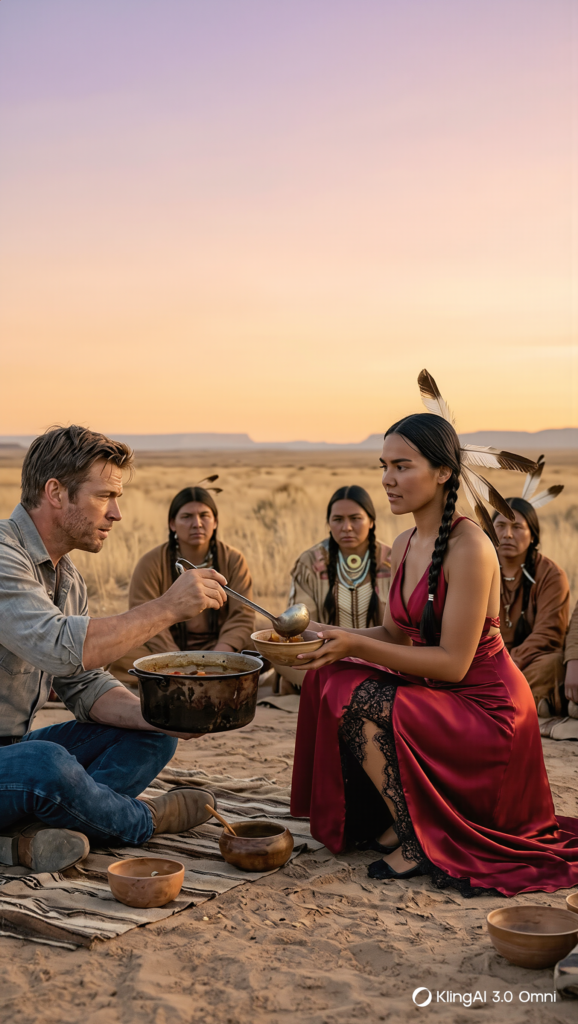
Inside, the stone fireplace threw a soft amber glow across the single room. On the plank table sat what remained of his provisions: a small tin bowl of beans, a heel of bread he’d baked two days ago, and one strip of dried beef no longer than his hand.
It wasn’t much. But it was everything. Town lay a full day’s ride away, and he’d have to sell Clara’s sewing machine to buy flour when he got there.
Daniel sat down and stared at the meal for a long time. Then he bowed his head, the way Clara used to, and whispered a quiet thanks. Over the years he had learned to be grateful for small things. They were the only kind he got anymore.
He picked up his spoon.
Outside, the wind shifted.
In the corral, Captain lifted his head and let out a low, uneasy nicker, a sound Daniel had learned to trust more than any man’s word.
He set down the spoon, took his rifle from the pegs over the door, and stepped onto the porch.
The prairie stretched for miles beneath the bruised violet sky. At first he saw nothing but rolling grass and the distant black line of hills.
Then three small figures appeared against the horizon.
They moved slowly. Painfully slowly. As they came closer, Daniel saw they were travelers on foot. An elderly Apache man led the way, his shoulders bowed, leaning on a staff of twisted cedar. Beside him walked a young woman, perhaps twenty, wrapped in a thin trade blanket, her face drawn tight with exhaustion. A boy of thirteen or fourteen trailed close behind, carrying nothing but a folded blanket over one shoulder. His moccasins were worn nearly through.
Daniel watched them with his rifle held low. They showed no anger. No threat. Only the bone-deep weariness of people who had walked further than any human body should.
They stopped a few yards from the porch. The old man slowly raised one open hand in greeting.
No words. No demands. Only that hand, held steady in the cold.
For a long moment, silence filled the space between them.
Daniel heard the voices of his neighbors in his head. Old Abel Turner at the feed store, spitting tobacco: You see strangers out there, Morgan, you bar the door. Especially that kind. The Henley brothers, who never left their ranch without a rifle. Harlan Pike himself, smiling over his ledger: A man alone on the frontier can’t afford charity. Charity’s a luxury for people with full barns.
Then he looked again.
The young woman swayed on her feet and caught herself against the boy’s shoulder. The boy glanced toward the warm light spilling from the cabin window, the light falling across that small tin bowl on the table, and then quickly looked down, as if ashamed to have looked at all.
Daniel understood at once.
They were starving.
He turned and looked through the window at his meal. If he shared it, tomorrow would come emptier than today. The road to town would be a long, hungry one. And if Pike heard he’d been feeding Apaches on mortgaged land, there’d be no mercy in the bank’s ledgers.
If he refused, these three would walk back into a night that would drop below freezing within the hour.
His heart grew heavy. And then, unbidden, he heard his mother’s voice from a childhood kitchen in Missouri, flour on her hands:
Kindness given in hard times is remembered long after kindness given in easy ones, Danny. Anybody can share a full table.
Daniel took a deep breath. He leaned the rifle against the doorframe.
Then he opened the cabin door wide and smiled.
“You’ve come a long way,” he said. “Please. Come in and get warm.”
The three travelers looked at one another in quiet astonishment. The old man placed one weathered hand over his heart and bowed his head. When he spoke, his English was slow but clear.
“I am called Bidzil. This is my granddaughter, Nalin. And this is Tse, my grandson.” He paused. “We will not forget this door.”
Daniel pulled out four plain wooden chairs. Without another word, he took the beans, the bread, and the dried beef, and divided them into four equal portions with his knife. Four small piles. Barely a mouthful each.
No one reached for more than their share. The boy, Tse, looked at his portion, then at Daniel’s, and quietly pushed a piece of his bread back across the table.
Daniel pushed it back. “Eat, son.”
The fire crackled. They ate slowly, in grateful silence, making each bite last. Outside, the wind howled across the empty prairie. Inside that humble cabin, four strangers shared a meal far too small to matter, and somehow it was the warmest Daniel had felt since Clara died.
When they finished, Nalin spoke for the first time. Her voice was soft. “We were traveling to our people in the Red Hills. Our wagon broke three days ago. Our horses…” She hesitated, glancing at her grandfather. “Our horses were taken.”
“Taken?” Daniel frowned. “By who?”
Bidzil’s eyes went to the window, to the dark road leading toward town. “Men who wanted horses more than they wanted honesty.”
Before Daniel could ask more, Captain screamed in the corral.
Not a nicker this time. A scream.
And beneath it, rising fast out of the night, came the drumming of hooves. Many hooves.
Daniel was on his feet in an instant. Through the window, he saw torches bobbing up the road like fireflies. Eight riders. Maybe ten. They swept into his yard in a whirl of dust and firelight, horses snorting, rifles glinting.
At their head rode a broad-shouldered man in a sheepskin coat. Daniel knew him. Everyone in Bluestem County knew him.
Cole Bracken. Foreman of Harlan Pike’s cattle operation. The man Pike sent when he wanted something done that no banker should be seen doing.
“MORGAN!” Bracken’s voice cracked across the yard like a whip. “Get out here!”
Daniel looked at his three guests. Tse had gone white. Nalin had pulled the boy behind her. Bidzil stood perfectly still, his face carved from stone.
“Stay inside,” Daniel said quietly. “Whatever happens.”
He picked up his rifle and stepped onto the porch.
Bracken’s torchlight fell across his face. “Evening, Morgan. We’re tracking three Apache horse thieves. Old man, girl, and a boy. Stole six head from Mr. Pike’s north pasture.” His eyes flicked to the cabin window. “Tracks lead right to your door.”
“Nobody here’s stolen anything,” Daniel said.
Bracken laughed. The men behind him laughed too. “That’s not what I asked. I asked are they here.”
“They’re my guests.”
The laughter stopped.
Bracken leaned forward in the saddle. In the flickering torchlight, his face looked carved out of tallow. “Your guests,” he repeated slowly. “Morgan, you’ve got nineteen days before Mr. Pike owns every board of this shack. You really want to spend them protecting horse thieves?”
“Those people didn’t steal your horses.” Daniel’s voice was steady, though his heart was slamming against his ribs. “They had their own horses stolen. Three days ago. Maybe you’d know something about that.”
A long, terrible silence.
Behind Bracken, a few of the riders shifted uneasily in their saddles. One of them, a young cowhand named Wes Holloway who’d once helped Daniel pull a calf from the mud, wouldn’t meet his eyes.
Bracken’s voice dropped low and cold. “Hand them over, Morgan. Or I’ll take them. And I’ll take this whole place down with them.”
“No.”
The word hung in the frozen air.
Bracken straightened. He raised his torch high, so its light fell across Daniel’s sagging barn, across the dry hay piled beneath its roof, across nine starving cattle and one old sorrel horse.
“I’m going to count to ten,” he said. “One.”
Daniel didn’t move.
“Two.”
Behind him, he heard the cabin door creak open. Tse’s young voice, trembling: “I’ll go with them. Don’t let them hurt him. I’ll go.”
“Get back inside, son!” Daniel barked, not turning around.
“Five. Six.”
Bracken’s men spread out across the yard. Rifles came up. Torches tilted toward the barn.
“Nine.”
Daniel raised his rifle.
Bracken smiled, almost kindly.
“Ten,” he said. And he turned to his men.
“Burn it.”
PART 2: FIRE AND WATER
The first torch arced through the dark like a falling star and landed on the barn roof.
The dry shingles caught with a sound like a gasp. Within seconds, flame was racing along the ridgeline, orange tongues licking up into the black sky. The cattle bellowed in terror. Captain reared in the corral, screaming.
Daniel fired once into the air. The riders’ horses shied and wheeled. Bracken’s voice rose above the chaos: “That’s your warning, Morgan! Next time we come, we come for all of it!”
And then they were gone, galloping back down the road, their laughter and torches vanishing into the night, leaving fire in their wake.
Daniel dropped the rifle and ran.
He had no well bucket big enough. No water trough deeper than a hand. The creek was dust. He stood in the yard watching his barn burn, and for one terrible moment, he simply froze. Everything he’d built. Everything Clara had touched.
Then a hand gripped his arm.
Bidzil.
“The animals first,” the old man said, calm as morning. “Wood can be built again. Breath cannot.”
What happened next, Daniel would remember for the rest of his life.
Tse vaulted the corral fence, threw his blanket over Captain’s eyes, and led the panicked horse out through the smoke as if he’d known him for years. Nalin flung open the cattle pen and drove the nine thin steers out into the open pasture with a sharp, high call that made them run straight and true. Bidzil took Daniel’s shovel and began throwing dirt, not on the fire, but on the dry grass between the barn and the cabin, cutting a line the flames couldn’t cross.
“Help me!” the old man called.
Daniel grabbed the axe and ripped down the brittle fence rails that ran from barn to house like a fuse. Together, an old Apache man, his granddaughter, a boy, and a broke rancher fought that fire until their hands bled and their lungs burned.
The barn was lost. It collapsed with a roar near midnight, sparks spiraling into the stars.
But the cabin stood. And every animal lived.
Near dawn, the four of them sat on the porch steps, black with soot, too exhausted to speak. The barn smoldered in the gray light like a dying campfire. Daniel stared at it for a long, long time.
“I’m sorry,” Nalin whispered at last. “This happened because of us.”
Daniel shook his head slowly. “This happened because of Cole Bracken.” He wiped his face with a blackened sleeve. “And whoever he answers to.”
Bidzil was quiet a while. Then he said something strange.
“You have been looking for water. Many times.”
Daniel turned in surprise. “How could you know that?”
The old man pointed to the scattered holes across the pasture, the half-dug wells Daniel had abandoned one by one over two summers. “The land tells its own story. Come. Let me show you something.”
They walked as the sun rose, the frost on the grass glittering silver. Bidzil led them across the pasture toward a rocky hillside at the far edge of Daniel’s claim, a slope so thick with thornbrush and tall dead grass Daniel had never bothered to clear it.
“My grandfather’s grandfather camped here,” Bidzil said, pushing aside the brush with his cedar staff. “Before there were fences. Before there were banks. We called this place Tó Hasdlizh. Water That Remembers.”
Behind a tumble of smooth, moss-covered stones, half-buried under years of fallen grass, Daniel heard it before he saw it.
A trickle.
Clear, cold water was seeping up from the earth, pooling in a hollow of rock and slipping away in a thin, bright thread into the soil.
Daniel dropped to his knees. He cupped his hands in it. It was ice cold and sweet as anything he had ever tasted. He drank, and drank again, and when he lifted his face, it was wet with more than water.
“Six years,” he whispered. “Six years I’ve been dying of thirst with this under my own land.”
“It is small,” Bidzil said. “But it never forgets its path. Clear the stones, guide it with a channel, and it will feed your pasture through any drought.”
Daniel stood slowly, water dripping from his fingers. And then, all at once, a cold suspicion crept up his spine.
“Pike knew.”
Nalin looked at him. “What?”
“Two summers ago, Harlan Pike sent a surveyor out here. Said it was for the bank’s records.” Daniel’s voice hardened. “The man spent a whole afternoon on this hillside. When I asked what he found, he said, ‘Nothing but rocks.’”
He turned toward town, eyes burning.
“Three months later, the bank called my loan early. And now Pike’s foreman burns my barn the same night three travelers whose horses were stolen show up at my door, and he calls them the thieves.” He shook his head. “This was never about horses. Pike wants this water. With the drought, it’s the only spring for twenty miles. Whoever owns it owns every ranch around it.”
Bidzil nodded slowly, as if he’d known all along. “And now you see the shape of the trap.”
That afternoon, two neighbors rode by: Abel Turner and his son Jacob. They reined up at the edge of the yard, staring at the black skeleton of the barn, then at the three Apache travelers sitting on Daniel’s porch.
“Lord Almighty, Daniel,” Abel said. “Bracken’s been telling the whole county you’re harboring thieves. Said you pulled a rifle on him.”
“Bracken burned my barn, Abel.”
Abel’s face flickered. “That’s… that’s a serious thing to say.”
“So is horse stealing.” Daniel stepped down off the porch. “These people came to me starving. Last night, they saved every animal I own. That’s all I know, and it’s all I need to know.”
Jacob, the son, looked at the boy Tse, who was patiently brushing ash out of Captain’s mane. Something passed across the young man’s face. Doubt, maybe. Or shame.
Abel cleared his throat. “Pike’s got a lot of friends, Daniel. Folks are scared. You stand with these people, you’ll stand alone.”
“Then I’ll stand alone.”
The Turners rode away without another word.
At sunset, the travelers prepared to leave.
Nalin folded the blankets they’d used and set them neatly by the hearth. Tse swept the cabin floor until it shone. Then Bidzil stood before Daniel in the doorway, leaning on his staff.
“Come with us,” Daniel said suddenly. “Bracken’s men are out there. It isn’t safe.”
“It is less safe for you if we stay.” The old man’s dark eyes were steady. “We must reach our people. And you must not face this alone.”
“I already am alone.”
Bidzil smiled, and for the first time Daniel saw something fierce and bright behind the old man’s weariness.
“You gave strangers your last meal when you had nothing,” he said. “A man like that is never alone for long.”
He placed his hand over his heart. Nalin did the same. Tse hesitated, then stepped forward and threw his thin arms around Daniel’s waist. Daniel stood frozen, then slowly rested his blackened hand on the boy’s head.
“Nineteen days,” Bidzil said. “Hold your ground for nineteen days.”
And then they were gone, three small figures disappearing into the golden prairie, the same way they had come.
Daniel held his ground.
He cleared the stones from the spring. He dug a channel with his bare hands and a broken shovel, guiding the cold water across his pasture. He slept with his rifle beside him. Twice, he saw riders watching from the ridge. Once, someone shot his mailbox to splinters in the night.
No one from town came to help. No one came at all.
And on the morning of the nineteenth day, a black buggy rolled up his road, followed by a dozen riders.
Harlan Pike stepped down in a fine gray suit, holding a leather folder. Behind him came Cole Bracken, a county deputy, a crowd of curious townsfolk, and an auctioneer with a brass bell.
“Mr. Morgan,” Pike said pleasantly, surveying the charred ruins of the barn. “Rough month, I see. Shame. Do you have the payment?”
Daniel stood on his porch. He had nothing in his pockets but a pocketknife and Clara’s wedding ring.
“No,” he said.
Pike smiled. “Then by the authority of the Bluestem Cattlemen’s Bank, this property, including all water rights,” he let the words linger, “is hereby surrendered for public sale.”
The auctioneer raised his bell.
And at that moment, a murmur rippled through the crowd. Heads turned. Someone pointed toward the horizon.
A great cloud of dust was rising from the prairie, rolling toward them, wide as a storm front.
And out of it, slowly, steadily, came riders. Dozens of riders.
Pike’s smile died on his face.
PART 3: THE DEBT THAT WASN’T A DEBT
They came at a calm, measured pace: no shouting, no war cries, only the steady rhythm of many horses. Forty riders at least, men and women both, leading pack animals heavy with goods. The townsfolk drew back in alarm. Bracken’s hand went to his gun. The deputy fumbled with his rifle.
At the ranch boundary, the riders halted together.
An elderly man in beautifully beaded buckskin rode forward, his gray hair braided with eagle feathers, his face lined with dignity and quiet authority. Beside him rode three people Daniel knew at once.
Bidzil, Nalin, and Tse.
The boy’s face split into a grin the instant he saw Daniel. Nalin placed her hand over her heart.
The elder dismounted and walked toward the porch, ignoring Pike entirely.
“I am Haske, leader of the Red Hills families,” he said. “My brother Bidzil tells me a rancher with nothing shared everything he had.” He looked at the burned barn, then at Daniel. “And that men came in the night and punished him for it.”
“It was only a meal,” Daniel said, his voice thick.
“To a man with plenty, perhaps.” Haske’s eyes softened. “To a man with nothing, it is a gift that cannot be forgotten.”
Pike stepped forward, his voice brittle. “This is a lawful bank proceeding. Whatever you people want, it has nothing to do with…”
“It has everything to do with you,” Haske said quietly.
He raised his hand. From the back of the column, two riders came forward leading six horses. Fine horses, well fed, each branded on the hip with Pike’s own mark, the Running P.
And with them, hands bound, rode two of Cole Bracken’s hired men.
A gasp rolled through the crowd.
“Our young men found these horses in a hidden canyon two days’ ride west,” Haske said. “Along with these men, and our own stolen horses, rebranded with the same iron.” He turned to the deputy. “They have already told us who ordered it. They will tell you as well.”
One of the bound men, pale and sweating, looked at Bracken and then at the deputy. “It was Bracken’s idea, Sheriff. Pike’s orders. Steal the Apache horses, hide some of Pike’s own stock, blame the Indians. Give Bracken an excuse to run Morgan off before the auction.” He swallowed. “Pike wanted that spring.”
The silence that followed was absolute.
Then a new voice came from the crowd. Young Wes Holloway pushed his way forward, the cowhand who hadn’t met Daniel’s eyes that night.
“It’s true,” he said, his voice shaking. “I was there. I saw Bracken throw the first torch. I should’ve said something. I’m saying it now.”
Behind him, Abel Turner stepped out of the crowd too, his hat in his hands. “And I’ll say this. My son Jacob rode out to Pike’s north pasture last week. Not one horse was ever missing from it.” He looked at Daniel, and his weathered face was full of shame. “I’m sorry, Daniel. We should have stood with you.”
The deputy turned slowly toward Harlan Pike and Cole Bracken.
Bracken drew his gun.
He never fired it. Before the barrel cleared leather, Tse, barely fourteen, slapped the flank of the nearest horse. It plunged sideways, knocking Bracken flat in the dust, and three townsmen were on him before he could rise.
Harlan Pike tried to climb into his buggy. The deputy caught him by his fine gray collar.
“Mr. Pike,” he said, “I believe this auction is canceled.”
There remained the matter of the debt.
Even with Pike in irons, the loan was real, and the bank’s new board would want its money. Daniel said so to Haske that evening as they sat by the spring, watching the water glitter in the sunset.
Haske only smiled and gestured to the pack horses.
Sacks of corn and dried beans. Seeds wrapped in cloth. Sturdy timber planks for a new barn. Coils of braided rope. Farming tools. And, at the very end of the line, eight fine young horses, gentle and strong.
“Sell four to pay the bank,” Haske said. “Keep four to work the land.”
“I can’t accept this,” Daniel said hoarsely. “It’s too much. I can never repay you.”
Haske laid a hand on his shoulder.
“We are not paying a debt, my friend,” he said. “And you do not owe one. We are helping a friend. That is all.”
Over the following weeks, the ranch filled with peaceful labor. Apache carpenters raised a new barn from the ashes. Skilled farmers showed Daniel how to stone-line his channel so the spring would never wash its banks. Nalin planted squash and beans beside the cabin, choosing the richest soil with her bare hands. Tse spent hours mending fences, laughing as Captain followed him around the yard like a dog.
And slowly, the neighbors came.
First the Turners, with a wagonload of lumber. Then the Henley brothers, who brought seed potatoes and stayed to help with the roof. Then Wes Holloway, who asked, cap in hand, if Daniel could use a ranch hand who’d learned the hard way what kind of man to work for.
Daniel hired him on the spot.
In return, Bidzil and the Red Hills families taught the settlers ways to save water through dry seasons, where hidden springs ran, and how to read the land as their ancestors had. Fear became curiosity. Curiosity became trust. Trust, at long last, became friendship.
A full year passed.
On a quiet evening, Daniel stood beside the spring as the sun slipped behind the hills. The pasture around him rolled thick and green. Thirty head of healthy cattle grazed near the new barn. Clara’s old apple tree beside the cabin had bloomed for the first time in five years.
The water still flowed, clear and cold, exactly as it had the morning Bidzil showed it to him. Water That Remembers.
Up at the cabin, warm light spilled from every window. Through the glass he could see them: Bidzil and Haske at the table, Nalin laughing with Abel Turner’s wife over a pot of stew, Tse arm-wrestling Wes Holloway and winning. Plates were piled high. Chairs had been borrowed from three different ranches. The table that had once held a single bowl of beans now held a feast.
Tse burst out the door and waved both arms. “Daniel! Supper’s getting cold!”
Daniel laughed and started up the hill.
He thought of that frozen night a year ago, staring at one small meal and wondering whether sharing it would leave him with nothing. He understood now what his mother had meant, all those years ago, flour on her hands.
Generosity never truly leaves a person empty. Sometimes it is a seed. You bury it in the hardest ground, in the coldest season, with no promise it will grow.
And sometimes it comes back as a harvest you never could have imagined.
Daniel Morgan believed he was giving away his last meal.
He never dreamed he was setting the first plate at a table that would one day feed an entire frontier.