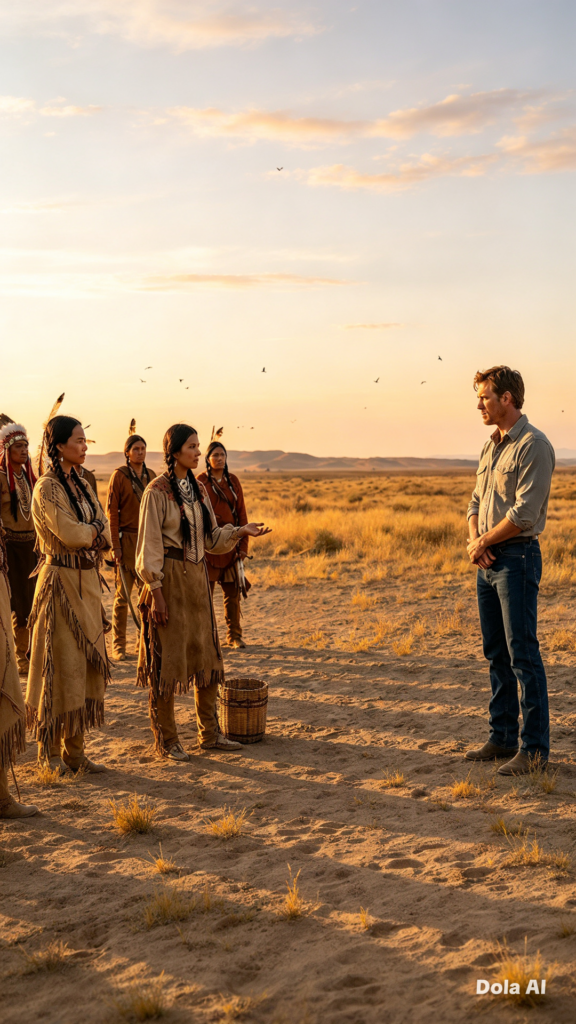
PART 1: The Last Canteen
In the summer of 1881, the rain forgot the Arizona Territory.
By August, the creeks along the San Carlos River had shrunk to cracked ribbons of mud. Stock tanks turned to clay. Cattle stood with their heads hung low in the shimmering heat, ribs showing like the slats of a barrel. Men who had faced Comanches and blizzards and bank foreclosures without flinching now stood in their yards at dawn, looking at a cloudless sky with the hollow eyes of the condemned.
Water had become worth more than gold. And every family in the valley guarded what little they had like a loaded gun.
Samuel Pryor understood that better than most.
His ranch sat alone at the far edge of Redwater Valley, where the grassland broke apart into red cliffs and twisting canyons. It wasn’t the biggest spread in the territory, or the richest. But his father had built the first cabin there with his own hands, and Sam had buried both his parents on the rise behind the barn. It was home. It was all he had.
Every morning began the same. He saddled his roan mare, Dolly, before the heat settled in, checked the stock, mended fences, and searched the horizon for any sign of a cloud.
Every morning ended in disappointment.
On the second Tuesday of August, he rode farther than usual. A spooked herd had torn through a section of fence near the west ridge the night before, and he carried a bundle of tools and a canteen nearly full. The trail wound between wind-carved boulders and dead brush. The only sounds were Dolly’s slow hooves and the far-off cry of a hawk.
By early afternoon, the heat was a living thing. It pressed down on his shoulders and burned through his shirt. He stopped beneath a single struggling cottonwood beside a dry creek bed and wiped the sweat from his eyes.
Dolly’s head came up sharply. She snorted and swung her ears south.
Sam followed her gaze.
Vultures. Six or seven of them, circling low over a rocky slope less than half a mile away.
In the desert, vultures meant something had died. Or was about to.
He nudged Dolly forward.
He found them at the foot of the slope, pressed into the thin wedge of shade beneath a sandstone boulder.
An Apache family.
A young woman sat with her back against the rock, holding two children: a boy of perhaps eight and a girl no older than four. Their lips were cracked and bleeding. The little girl’s eyes were half closed. A few feet away, an old man lay motionless on the hot sand, one arm across his chest. Beyond them, their horse had collapsed, too weak to rise.
No one spoke.
The woman lifted her head as Sam reined in. Her eyes were dark and exhausted. There was no anger in them. No fear either. Only the terrible calm of someone who has run out of hope and made her peace with it.
Sam stopped a few paces away. His hand rested on his canteen.
Every story he’d heard since boyhood came rushing back. The neighbors’ warnings that no Apache could be trusted. The travelers’ tales of raids and stolen horses. The old battles that had left scars on both sides. And worse than any of it, the plain truth he knew in his bones: if the town learned he had helped an Apache family, many would call it betrayal.
He looked at the children again. The little girl was struggling to keep her eyes open.
Fear and compassion fought a short, brutal war inside him.
He knew exactly how much water was left in his canteen. If he shared it, the ride home would become dangerous. If he kept it, these four people would never leave the desert alive.
A memory came to him, unbidden. His mother, years ago, standing at the door of their little cabin, pressing a loaf of fresh bread into the hands of a ragged traveler who had nothing to give in return. Sam, eight years old, had asked her why.
Kindness counts most, she had told him, when it costs you something.
Sam took a slow breath.
Then he climbed down from his horse.
The woman watched him carefully, but made no sudden move. He unslung the canteen, walked slowly to the children, and knelt in the sand. He pulled the cork, poured water into the crown of his hat, and held it out to the little girl.
She drank with trembling hands, slowly, as though she’d forgotten how.
The boy took only a few careful sips. Then he looked past Sam toward the old man.
Sam understood without a word.
He went to the old man and lifted his head gently. He let a little water touch his cracked lips. For a long moment, nothing happened. Then the old man swallowed, weakly, and his eyes opened.
The woman’s face crumpled with relief. She closed her eyes for a moment, as if in silent prayer.
Sam handed her the rest of the canteen. She took it in both hands, drank just enough to steady herself, and gave the last drops to her children.
The canteen was empty.
Not one word had passed between them. They didn’t share a language. They didn’t need one.
As the shadows began to lengthen, Sam studied the hills. He remembered something his father had shown him long ago: an old spring hidden deep in a narrow canyon two miles north. Most people had forgotten it existed, because it only ran in the driest years, seeping up from beneath the rock when everything else had failed.
It was their only chance.
He pointed toward the canyon and gestured for them to follow.
The woman helped the old man to his feet. The boy took his little sister’s hand. Together, they began a slow, staggering march across the silent desert, Sam leading Dolly so the old man could lean against the saddle.
It took them nearly two hours.
When they reached the canyon, the spring was small: a thread of cool water trickling from a crack in the stone into a shallow pool fringed with green grass. But to that exhausted family, it must have looked like a miracle.
The children threw themselves down and drank. The old man sat at the water’s edge and let it run over his hands, laughing softly, weakly, like a man who had not expected to laugh again.
The woman turned to Sam. She laid one hand over her heart and bowed her head.
Sam did the same.
He left them the little food he carried, a bundle of jerky and hardtack, and pointed to the canyon walls, hoping they’d understand to stay hidden until they were strong. As he turned Dolly toward home, he looked back once. The two children stood beside their mother, waving shyly.
He lifted his hat.
The ride home was long. His canteen was dry. The heat lay on his shoulders like a millstone. By the time he reached the ranch, his tongue felt like leather and his head pounded. But as the sunset turned the cliffs to fire, he felt a strange, quiet lightness he hadn’t felt in years.
He didn’t know yet that someone had been watching from the ridge.
The desert keeps no secrets.
Two days later, Sam rode into Redwater for flour, coffee, and fence wire. As he tied Dolly outside Holloway’s General Store, he noticed men on the boardwalk watching him. When he stepped inside, every conversation stopped.
The silence lasted only a few seconds. Then the whispers started, moving from corner to corner like wind through dry grass.
An old rancher named Gus Tillman stepped forward. “Heard you gave water to an Apache family out by the west ridge.”
Sam met his eyes. “They needed help.”
“You should’ve left them where you found them,” said another man, folding his arms.
Heads nodded around the store. From somewhere near the back, someone muttered that kindness to enemies only ever bought trouble.
Then the crowd parted, and Harlan Voss stepped through.
He owned the biggest ranch in Redwater Valley: twenty thousand acres along the river, and nearly every precious water right that came with it. He was a tall, silver-haired man in a fine black coat, with a pleasant voice and eyes like chips of flint. When the drought had come, Voss had bought out three failing neighbors for pennies on the dollar. He was, most people agreed, a man who knew how to profit from hard times.
“Now, now,” Voss said mildly. “Sam’s a good man. Soft-hearted, maybe.” He smiled. “But I’m sure he understands what’s at stake. Four ranches raided in the last month, Sam. Cattle stolen. Horses run off. And now you’ve gone and shown Apaches where to find water in the middle of our valley.” He shook his head sadly. “I hope you know what you’ve done.”
“They were dying,” Sam said quietly. “Two of them were children.”
The words hung in the air. No one answered.
The storekeeper wouldn’t meet Sam’s eyes as he wrapped the supplies.
Outside, Sheriff Abel Crane waited on the porch. He was an old man, gray and weathered, who had kept the peace in Redwater for twenty years. He liked Sam. He’d known his father.
“I heard,” Crane said.
“I couldn’t leave them, Abel.”
“I know.” The sheriff sighed and looked across the dusty street, where Voss stood talking with a knot of men, his hand resting on one man’s shoulder. “But not everybody sees it that way. People are scared, Sam. And Voss has a way of making scared men into angry ones.”
That night, Sam found his pasture gate standing open. A dozen head of cattle had wandered into the hills. It took him until midnight to bring them back.
The next morning, a quarter mile of fence had been cut.
The morning after that, he found a note nailed to his barn door.
Don’t bring death into this valley.
No name. No signature.
Sam folded the paper and put it in his pocket. He refused to let anger take root in him. But that night, he slept with his rifle beside the bed.
He was awakened just after midnight by the sound of horses.
Many horses.
He went to the window. Torches were coming up the lane. Twenty of them. Thirty. The flickering firelight threw long, wild shadows across the yard.
Sam pulled on his boots, took his rifle, and stepped out onto the porch.
The riders reined up in a wide half-circle before his house. He recognized nearly every face: men he’d branded calves with, traded seed with, sat beside in church. Gus Tillman. The Henley brothers. Young Pete Dawes, who wasn’t more than nineteen. Their faces were hard and frightened in the torchlight.
At their center, on a tall black gelding, sat Harlan Voss.
“Evening, Sam,” Voss said pleasantly.
“What’s this, Harlan?”
“Another ranch was hit tonight. The Morrows’ place, south of town. Barn burned. Forty head run off. Old Tom Morrow’s got a bullet in his arm.” Voss leaned forward in the saddle. “His boy says it was Apaches. And they came from the north. Right from that canyon of yours.”
“That’s a lie,” Sam said. “That family could barely walk.”
“Then you won’t mind showing us where they’re hiding.” Voss’s voice stayed calm, reasonable. “We’ll just go have a look. Make sure they’re harmless.”
Sam looked at the rifles across thirty saddles. He looked at the torches. He knew exactly what would happen if he showed these frightened, angry men the way to that hidden spring.
“No,” he said.
The word fell like a stone into still water.
Voss sighed, as though genuinely disappointed. “I was afraid you’d say that. Pete, Gus. Bring him along. He’ll show us in the morning, one way or another.”
Two men swung down from their saddles.
Sam raised his rifle.
“I don’t want to shoot anybody,” he said. “But nobody’s riding to that spring tonight.”
For a long moment, the yard was frozen. Sam stood alone on his porch with one rifle against thirty. Young Pete Dawes’s hand was shaking on his pistol grip.
And then, from the ridge to the east, came a sound that turned every head in the yard.
Hoofbeats.
Dozens of them.
Against the first gray light of dawn, a line of riders appeared along the crest of the ridge above Sam’s ranch. Ten. Twenty. Thirty. They sat their horses motionless, silhouetted against the paling sky, rifles and lances catching the light.
Apaches.
Panic rippled through the mob. Horses reared. Men shouted.
“They’ve come!” someone screamed. “God help us, they’ve come for us!”
“Rifles!” Voss roared, wheeling his horse. “Every man, rifles up!”
Thirty rifles swung toward the ridge.
On the crest, the riders began to move. Slowly, steadily, they started down the slope toward the ranch.
Young Pete Dawes, white-faced and trembling, raised his rifle and laid his cheek against the stock.
His finger tightened on the trigger.
PART 2: The Riders on the Ridge
Sam Pryor jumped off his porch.
He didn’t think about it. He simply ran, straight across the yard, straight past the torches and the rearing horses, until he stood alone in the open ground between the mob and the riders coming down the slope.
Then he raised both hands high above his head and turned his back on the Apaches.
“Hold your fire!” he shouted. “Pete! Gus! For God’s sake, hold!”
Every rifle in the yard was now pointed directly at his chest.
“Get out of the way, Pryor!” Gus Tillman bellowed.
“No.” Sam’s voice cracked, but he didn’t move. “You want to shoot at them, you’ll have to shoot through me first.”
Behind him, he heard the riders slowing. Hooves on stone. The creak of leather. They stopped perhaps fifty yards away.
And then a voice called out across the yard. A woman’s voice, clear and steady, in careful English.
“Samuel Pryor.”
He turned his head.
At the front of the line sat the young mother from the canyon. Her face was no longer gray with thirst. Her back was straight. Beside her, on a painted pony, sat the old man, his white hair braided and bound with red cloth. Behind them, holding his little sister in front of him in the saddle, sat the boy.
The old man dismounted slowly and walked forward alone. He walked unarmed through thirty raised rifles as calmly as a man walking through his own garden.
He stopped in front of Sam.
Then he reached inside his buckskin shirt and drew out a necklace: old silver beads and polished turquoise stones, worn smooth by years against his heart. He held it out in both hands.
Sam looked at the old man, astonished. Then, slowly, he took it.
The old man laid one hand over his heart. Sam did the same.
Behind the old man, one by one, every rider on that slope dismounted and bowed their heads.
The young woman walked forward and stood beside the old man.
“My name is Itsa,” she said. “This is my grandfather, Natanh. My son, Tobi. My daughter, Sihu.” She looked past Sam to the frozen mob. “Four days ago, we were dying in the desert. Everyone who passed us rode on. Only this man stopped. He gave us his last water. He led us to life.” She looked around at the men with their rifles. “Our people remember kindness. We came only to say thank you.”
The silence that followed was different from the frightened silence before.
Slowly, young Pete Dawes lowered his rifle. Then Gus Tillman. Then another, and another, until only one gun remained raised in the yard.
Harlan Voss’s.
“It’s a trick,” Voss said. His pleasant voice had gone hard. “They’re scouting us. Can’t you see? Last night they burned the Morrow place, and this morning they ride in smiling.”
Natanh spoke quietly in Apache. Itsa translated.
“My grandfather says: the people who burned your neighbor’s ranch did not ride unshod horses. They did not come from the north.” She pointed south, toward the river. “His scouts followed their trail last night. Twelve riders on shod horses, carrying iron brands. They drove the cattle south along the river.” She paused. “Toward the land of the man who holds the only gun still raised.”
Every head in the yard turned to Harlan Voss.
Voss’s face went very still. “That’s absurd.”
“Is it?” Sheriff Abel Crane rode into the torchlight from the lane. No one had heard him arrive. He’d been sitting his horse in the shadows of the barn for some time, listening. “Because I rode out to the Morrow place at midnight, Harlan. Looked at the tracks myself. Shod horses. All of them. Heading south.” He looked at Voss steadily. “Funny thing. Your north pasture fence was down this morning. And there’s forty head with fresh-burned brands grazing in your back canyon.”
A dangerous murmur ran through the mob.
Voss lowered his rifle slowly. Then, without a word, he wheeled his black gelding and spurred it away down the lane at a gallop.
“Let him go,” Crane said, as two men started after him. “He can’t run far. Not from this valley.”
As the sun rose over Redwater, something happened that no one in that valley would ever forget.
The torches burned out one by one. And men who had come to Sam’s ranch ready for war found themselves standing awkwardly in his yard beside Apache riders, neither side quite sure what to do with their hands.
Then little Sihu, four years old, slid down from her brother’s saddle, toddled across the yard, and solemnly offered Gus Tillman a piece of dried mesquite cake.
The old rancher stared at her. Then, slowly, his weathered face cracked into a smile. He knelt, took the cake, and ate it.
“Well, I’ll be,” he said hoarsely. “Thank you, little miss.”
And that was how it began.
Sam made coffee in the biggest pot he owned. Natanh’s riders shared dried venison. The townsmen shared tobacco. Men who had only ever known each other through fear sat on Sam’s corral rails in the morning sun, communicating with gestures and laughter and Itsa’s patient translation.
By noon, the riders had gone home. And for the first time in years, Redwater Valley felt something it hadn’t felt since the drought began.
Hope.
That evening, Sheriff Crane rode back out to the ranch. Sam met him on the porch.
“Voss is gone,” Crane said grimly. “Cleared out his house. But he didn’t leave the valley. One of his hands talked. Harlan’s been partnered with Dutch Merritt for over a year.”
Sam knew the name. Everyone in the territory did. Dutch Merritt ran the worst gang of rustlers and killers between Tucson and the Mexican border.
“Merritt’s men hit the ranches,” Crane went on. “They dress up the raids to look like Apache work. Ranchers panic and sell out cheap to Voss. Voss gets the land and the water rights. Merritt gets the cattle. And everybody blames the Apaches.” He spat over the porch rail. “It was a gold mine. Until you gave four people a drink of water and ruined the whole thing.”
“Where’s Voss now?”
“Riding to Merritt, most likely. And Sam?” Crane looked at him gravely. “If I were Harlan Voss, and I’d just lost everything because of one soft-hearted rancher, I know exactly where I’d want to go first.”
They came three nights later.
Sam woke to the smell of smoke.
He was on his feet with his rifle before he knew it. Through the window, orange light danced on the barn wall. Flames were licking up the side of his hay shed. Horses were screaming. And out in the yard, shapes were moving in the firelight.
He kicked open the door and stepped onto the porch.
A rifle butt came out of the darkness and struck him across the side of the head.
He went down hard. Stars burst behind his eyes. His rifle clattered away across the boards. Rough hands seized him by the arms and dragged him down the porch steps into the dirt.
When his vision cleared, he was on his knees in his own yard, surrounded by a dozen mounted men. His barn was burning. His cattle were bawling in terror as riders drove them through the broken gate.
A big, red-bearded man with a scarred face sat a buckskin horse in front of him. Dutch Merritt.
And beside him, on the tall black gelding, sat Harlan Voss.
“Evening, Sam,” Voss said softly. All the pleasantness was gone from his voice now. “You cost me a great deal of money.”
“You’ll hang for this, Harlan.”
“Maybe.” Voss smiled thinly. “But not before you show us that canyon. My partner here has a buyer in Sonora who’ll pay well for Apache horses. And I hear that family of yours brought a whole herd back to that spring.”
“Go to hell.”
Merritt leaned down, grabbed a fistful of Sam’s hair, and jerked his head back. He pressed the cold barrel of a revolver against Sam’s temple.
“Let me explain how this works, cowboy,” Merritt said. “You take us to that spring by sunrise. Or I put a bullet in your head right here, and we find it ourselves.”
He thumbed back the hammer.
Sam looked past him, toward the dark ridge where Natanh’s riders had first appeared. But tonight, the ridge was empty. Black and silent.
There was no one coming.
PART 3: Rain on Redwater
“All right,” Sam said.
Merritt grinned and let go of his hair. “Smart man.”
They tied his hands in front of him, threw him onto Dolly’s back, and rode north into the dark. Twelve outlaws, Voss, and Sam, with the burning barn glowing red behind them.
Sam rode in silence. His head throbbed where the rifle had struck him. Blood ran warm down the side of his face. But his mind was clear and cold.
He wasn’t taking them to the spring.
He was taking them into Diablo Gulch.
He’d grown up in these canyons. He knew every trail, every ledge, every dead end. And he knew that Diablo Gulch narrowed to a slot barely wider than a horse, with sheer walls on either side, and then dead-ended in a box canyon with one way in and one way out. A trap. If he could get them in there, and somehow get himself out first, he could block the slot.
Maybe. If he was lucky. If he lived long enough.
They rode for two hours. The stars wheeled slowly overhead. When the walls of the gulch began to close in around them, Merritt reined up and looked around suspiciously.
“This don’t look like any spring to me, Pryor.”
“Half a mile,” Sam said. “Through the narrows.”
Merritt studied his face for a long moment. Then he jerked his chin. “Lead on. But you so much as twitch wrong, and I’ll put one in your spine.”
They rode into the narrows single file. The walls rose black on either side until the sky was only a thin ribbon of stars. The horses’ hooves echoed off the stone. Sam’s heart pounded so hard he thought they must hear it.
They reached the box canyon. Merritt’s men fanned out into the open space, looking around in confusion at the bare rock walls.
“There’s no water here,” Voss said slowly. Then his face twisted. “He’s lying! Dutch, he’s—”
Sam drove his heels into Dolly’s flanks.
The mare exploded forward like a cannon shot, wheeling back toward the narrows. Behind him, rifles cracked. A bullet whined off the rock beside his head. Another tore through his sleeve. He hunched low over Dolly’s neck, his bound hands knotted in her mane, and prayed.
He made the narrows. Behind him came the thunder of pursuing hooves and Merritt’s bellowing voice.
And then, at the mouth of the slot, Sam saw them.
Shadows on the rim of the canyon walls. Dozens of them, silent as owls.
And at the mouth of the gulch, blocking the way out, a line of riders.
Not Apaches.
Townsmen.
Gus Tillman. The Henley brothers. Young Pete Dawes. Sheriff Abel Crane. Twenty men from Redwater, with rifles leveled across their saddles.
And beside them, on her painted pony, with Natanh and thirty Apache riders on the rim above, sat Itsa.
Sam reined Dolly to a sliding stop, gasping. “How—”
“Your barn,” Crane said. “Burned bright enough to see from town. We rode out and found your house empty. Then this young lady rode in.” He nodded toward Itsa. “Seems her people saw the fire too. Her grandfather’s scouts tracked you north. Figured you’d lead those devils somewhere you knew. Gus here said Diablo Gulch was the only place he’d pick.”
Behind Sam, the outlaws burst out of the narrows.
They saw the line of rifles at the mouth of the gulch. They looked up and saw the rim lined with Apache riders. They reined up so hard their horses sat back on their haunches.
“Drop your guns, Dutch,” Sheriff Crane called. “It’s over.”
For a long, terrible moment, Merritt’s hand hovered over his revolver. His eyes darted from the townsmen to the rim to the narrows behind him.
Then, with a curse, he threw down his gun.
One by one, his men did the same.
Only Harlan Voss sat motionless on his black gelding, staring at the townsmen and the Apaches lined up side by side against him. Staring at the one thing he had spent years making sure would never happen.
“Neighbors,” he said hoarsely. “Standing with them.”
“That’s right, Harlan,” said Gus Tillman quietly. “Turns out it was you we should’ve been afraid of all along.”
Harlan Voss and Dutch Merritt were tried in Prescott that autumn. The trial lasted four days. Ranchers from all over the territory testified about the raids. Natanh’s scouts, with Itsa translating, testified about the shod-horse tracks. Sam testified about the night in Diablo Gulch.
Both men were convicted. Voss’s land was seized and sold at auction. Every rancher he’d cheated out of their homes during the drought got their land back.
And the water rights along the river, the rights Voss had hoarded while his neighbors’ cattle died, were divided fairly among every family in the valley.
The rain came in October.
It started as a low rumble far off in the mountains. By evening, black clouds were boiling over the ridges. And when the first fat drops hit the dust, every person in Redwater Valley stepped out of their houses and stood in their yards with their faces turned up to the sky, laughing like children.
It rained for three days.
The dry creeks filled. The stock tanks brimmed. By the end of the month, the hills had turned green again, and the cattle were fattening on new grass.
The land healed. And slowly, so did the people.
Trade began between the ranches and Natanh’s people. Families exchanged beef for buckskin, flour for baskets, coffee for beadwork. Children who had been taught to fear each other raced together through the cottonwoods along the creek while their parents talked in the shade.
Sam rebuilt his barn. Half the valley came to help him raise it. Gus Tillman brought the lumber. The Henley brothers brought nails. And Natanh’s grandsons hauled timber down from the mountains on their ponies.
On a cool afternoon in late autumn, Itsa, Natanh, and the children rode down to Sam’s ranch once more.
This visit was nothing like the first. There was no fear in anyone’s eyes.
Natanh walked straight up to Sam and embraced him like an old friend. Tobi and Sihu proudly presented a woven blanket their family had made for him, its colors as bright as a desert sunrise.
“For your new barn,” Itsa said, smiling. “So it will be warm in winter.”
Sam held the blanket for a long time without speaking. He knew it represented far more than wool and thread.
“Thank you,” he finally said, his voice rough. “All of you.”
Natanh spoke softly. Itsa translated.
“My grandfather says you did not save four lives in the desert that day. You saved many more. Ours. Your neighbors’. Perhaps even the valley itself.” She smiled. “He says a single drop of water, given freely, can fill a dry river.”
Years later, people in Redwater still told the story of the rancher who gave his last water to strangers in the desert. Some called it a legend. Some called it a miracle.
Sam Pryor never called it anything. He only said, whenever anyone asked, that his mother had taught him something a long time ago.
Kindness counts most when it costs you something.
He had given away one canteen of water.
And it had come back to him as a river.


