PART 1: The Woman at the Water Trough
The heat broke late that September, and when it did, it left the Arizona Territory scorched and gasping like a man pulled from a fire.
Boone Callahan found her at sundown.
He had ridden in from the south range with the light going copper behind him and his horse’s head hanging low from the long day. As he came around the corner of the barn, he saw a shape slumped against the water trough, half in the shadow of the windmill. At first he took it for a bundle of old feed sacks the wind had blown loose.
Then the bundle moved.
Boone was off his horse before he had decided to be. He crossed the yard in long strides and dropped to one knee in the dust.
It was a woman. Apache, young, her face pressed to the rough planks of the trough as though she had crawled the last few yards and simply run out of strength before she could lift herself to the water. Dust caked her black hair. Her lips were split and bleeding. Her breath came ragged and shallow, the kind of breathing Boone had heard from cattle in the worst summers, just before they lay down and did not get up again.
Clutched against her ribs, so tightly her knuckles had gone pale, was a small bundle wrapped in faded red cloth.
“Easy,” Boone murmured. “Easy now.”
He did not touch her. Not yet. He cupped his hands beneath the trough’s spout, filled them with cool water, and held them close to her face.
Her eyes opened. They were dark and wild and fierce, and for one terrible moment Boone thought she might strike at him like a cornered animal.
Then she saw the water.
She drank from his hands. Slowly at first, then desperately, her fingers wrapping around his wrists to hold them steady. He filled his hands again. And again. He let the water run through his fingers over her cracked lips, over her forehead, down the back of her neck, until her breathing evened and the wildness in her eyes faded to plain exhaustion.
He did not ask her name. He did not ask where she had come from, or whose daughter she was, or what she carried so desperately in that red cloth bundle. He had been raised by a mother who used to say that a thirsty body should never have to answer questions before it is given water.
When at last she pushed herself up to sitting against the trough, the woman looked at him for a long moment.
“Alope,” she said. Her voice was hoarse as dry wind through cholla. “My name is Alope.”
“Boone.”
She nodded once, as if filing the name away somewhere safe.
“There’s stew on the stove,” Boone said. “And a bed, if you need one.”
Something hardened in her face.
The kettle sang low over the fire. Boone’s aunt Hattie, who had kept house for him since his mother passed, had taken one look at the young woman in the doorway and put a pot of coffee on without a word.
But Alope would not sit.
She stood just inside the kitchen with her back as straight as a lance, her hands folded in front of her over the red bundle, her chin lifted. Dust still clung to her. She swayed a little on her feet. But she would not sit.
“I won’t take charity,” she said. Her voice was quiet, but it did not bend. “Not a blanket. Not a plate. Not a roof. I pay my way, or I sleep under the sky.”
Hattie opened her mouth to argue. Boone gave her a small shake of his head.
He considered Alope the way he considered a fence line: slow, patient, turning the thing over to see where it might give and where it would hold. He took two tin cups down from the shelf and set them on the table.
“Then work it is,” he said. “Mornings, the stock needs watering. Evenings, the garden’s gone to weeds. Hattie’s knees can’t take the bending anymore, and I’m no hand at either.” He paused, and something gentled at the corner of his mouth. “Small wages. Three meals. The spare room. That fair to you?”
Alope studied him as though searching for the hook hidden inside the bait.
She did not find one.
Her chin lifted a fraction higher. And then, for the first time since Boone had found her at the trough, her shoulders eased.
“Fair,” she said.
And she sat.
The spare room was small and plain. A cot. A folded quilt Boone’s mother had pieced from flour sacks and old dresses. A single window facing east, toward the low brown hills where the sun would rise.
Boone carried the lamp in and set it on the windowsill carefully, like a man placing something precious.
“It ain’t much,” he said.
Alope touched the quilt. Ran her fingers along one of the seams, the small, careful stitches of a dead woman she would never know. In the lamplight her eyes were soft and very dark.
“It is warm,” she said. “That is enough.”
Supper was quiet. Stew and bread and the crackle of the fire. Hattie made small talk about the weather and the price of flour and a calf born with two white socks, and Alope answered politely when spoken to and otherwise ate in silence.
But Boone’s glances kept straying to her. To her hands, scarred across the knuckles. To the fine line of her jaw. To the bruised, tired shadows beneath her eyes.
Once, she caught him looking.
Neither of them looked away quite fast enough.
Later, when Hattie had gone to bed and the fire had burned down to embers, Boone found Alope still sitting at the table with her back to the hearth and that red bundle hugged against her ribs.
Out in the dark corral, a loose horse nickered.
Her whole body went still. Shoulders locked. Breath held. Eyes fixed on the black window. She did not move again until the sound had faded completely and the night had gone silent once more.
Boone set down the plate he was drying.
“You’re safe here tonight,” he said, low and easy. “Whatever you’re running from, it doesn’t cross my fence.”
She lifted her eyes to him. Something moved behind them. Fear and weariness, tangled together like barbed wire. She said nothing. Just nodded once and pulled the bundle closer.
“That your people’s land you came from?” Boone tried gently. “North, across the river?”
Her jaw tightened. She stared into the dying embers and let the silence stretch until it had weight.
“Some things I carry alone,” she said at last. “Not because I do not trust you. Because saying them out loud gives them feet.”
Boone did not push. He poured the last of the coffee into her cup and slid it across the boards toward her hand, close enough that their fingers nearly brushed.
“Then I’ll just sit here a while,” he said. “Feet or no feet.”
And for the first time that evening, the corner of her mouth softened. Just barely. Just enough.
The days found their own rhythm, quiet as the creek that ran behind the barn.
Boone woke before the sun. Alope woke before him. Each morning he came into the kitchen to find the kettle already whispering on the stove and the stock already watered, the chickens fed, the yard swept. By the end of the first week, the garden that had been a tangle of bindweed and pigweed for two summers stood in neat rows again, squash and beans and peppers lifting their leaves toward the sky like they had just remembered how.
On the third morning, he found her at the kitchen table mending his old gray shirt, the one with the torn elbow. Her stitches were small and sure. She worried her lower lip with her teeth whenever the needle wandered.
He watched from the doorway longer than he meant to.
“You’ll wear a hole in that shirt staring at it,” she said, without looking up.
“It’s already got one,” Boone said. “That’s why you’re fixing it.”
The corner of her mouth moved.
That made twice now. He was keeping count.
In the evenings, after the garden was weeded, Alope went to the horses. She didn’t ride. Not yet. She simply stood at the corral fence with her palms flat on the top rail and her breath slow, and waited.
Boone’s bay mare, Juniper, was a nervous, spiteful creature who had bitten two hired hands and kicked a horse trader clear through a gate. She had never taken to anyone but Boone’s late mother.
On the fourth evening, Juniper walked across the corral and put her nose against Alope’s sleeve like she was greeting an old friend.
Boone leaned on the rail beside her, shaking his head in wonder.
“She doesn’t take to anybody,” he said.
“She has been waiting,” Alope said softly, stroking the mare’s neck, “for someone who would not try to make her into something she is not.”
Boone turned that over for a long moment.
“Guess some of us have been waiting our whole lives,” he said. “And didn’t even know it.”
Alope’s hand stilled on the mare’s neck. The evening wind moved through the grass. Neither of them said anything more, and somehow that silence was the best conversation Boone had had in years.
She looked at him then. Really looked.
And Boone felt something small and steady take root in his chest, patient as a seed beneath the snow.
But the ranch was not the whole world. And the world was talking.
On the ninth day, a peddler came through with a wagon of tin pots and patent medicines. He took one look at Alope working in the garden and his eyes went narrow and greedy.
“That’s a fine-looking Apache gal you got there, Callahan,” he said, leaning on his wagon. “Heard tell there’s a band up north of the Gila been tearing the whole country apart looking for a runaway. Big band. Real big. Heard there’s a reward.”
Boone did not look up from the harness he was mending.
“Heard wrong,” he said. “Nobody here but my aunt and my hired help. You want water for your mules, there’s the trough. Then you best be moving on.”
The peddler moved on. But Boone saw him look back twice from the road. And that night, he noticed Alope did not sleep. The lamp burned in her window until nearly dawn.
On the tenth evening, the three of them sat on the porch as the sun went down blood-red behind the Dragoon Mountains. Hattie rocked in her chair with a bowl of beans to snap. Boone whittled. Alope sat on the top step with the red bundle in her lap, her hand resting flat on top of it like she was holding a door shut against a storm.
She had been silent all evening. Now she spoke without warning, her eyes on the darkening hills.
“My father is Tazhín,” she said.
Hattie’s hands went still on the beans.
Boone did not move. He did not reach for anything. He simply let the words land and stay.
Every man in the Territory knew that name. Tazhín was the war chief who had held the northern passes for fifteen years. The cavalry had sent three columns after him and lost two of them. Ranchers whispered his name around their fires the way old men in other countries whispered the names of storms.
“I was promised to a man I did not choose,” Alope said. Her voice stayed level, but her fingers tightened on the bundle. “His name is Nantan. He is strong. He is respected. He has led many raids. And he is the kind of man who looks at a woman the way a trader looks at a horse.”
“Your father agreed to it?” Boone asked quietly.
“My father believed it would unite two bands that have fought for many years. He believed it would bring peace.” She drew a long breath. “But I heard something the night before the wedding. Something I was not meant to hear.”
She looked down at the red bundle.
“Nantan does not want me. He wants my father’s place. He has made a bargain with the scalp hunters from Sonora. With the whiskey men. He means to lead my father’s warriors into a trap at Cañón del Muerto, where the Mexican soldiers are waiting, and then take what is left of the band for himself.” Her voice cracked for the first time. “My father would die. Half our people would die. And I would be the bride of the man who killed them.”
Hattie’s hand went to her mouth.
“I tried to tell my father,” Alope said. “But Nantan had already poured poison in his ear. He said I was a foolish girl looking for any excuse to escape a marriage I did not want. So I stood up before the elders and I refused the marriage. And my father, in his anger, told me to go.” Her chin rose. “So I went. I took nothing that was not mine.”
She untied the red cloth.
Inside lay a heel of hard bread, a tin cup, a small skinning knife, and something else: a folded piece of paper, creased and stained, with writing on it in Spanish and English.
“I took this,” she said. “From Nantan’s saddlebag, the night I left. It is the letter from the scalp hunters. It names the place. It names the day. It names the price they paid him.”
Boone took the paper carefully. He read it by the last of the light. His face went grim as granite.
“The day’s two weeks from now,” he said slowly.
“Yes.” Alope’s eyes were very bright. “I walked eleven days to find someone who could read it to the soldiers. Someone who would believe an Apache woman. But every ranch I came to, they pointed rifles at me. Or worse.” She looked at him. “Yours was the first where someone gave me water.”
For a long moment, Boone said nothing.
Then he took off his hat, slowly, the way a man does when he is about to say something he means.
“Alope,” he said, low and plain. “I’m glad you came.”
That was all. No pity. No questions he had no right to ask. He set his hat on the porch rail and held out his hand for the bundle as if it weighed nothing at all.
She gave it to him.
And something in her face loosened, the way a rope does when the knot finally gives.
Behind them, Hattie turned down the lamp and smiled into the dark.
The first gray light had barely touched the windows when the horses started screaming in the corral.
Hattie heard it first. Then the hoofbeats, hard and fast, coming down the lane like a heartbeat gone wrong. She set down her coffee and went to the door.
The rider was young Tom Pruitt from the next ranch over, dust to the eyebrows, his mare lathered and blowing. He nearly fell out of the saddle.
“Boone!” he yelled. “Boone, they’re coming! Apache! A hundred riders, maybe more! They crossed the river at first light and they ain’t slowing down!”
Boone came out with his shirt half-buttoned and his jaw set like iron.
“Which way?”
“Every way! They’re splitting to come around both sides. Pa’s already barred the doors. Boone, you gotta get out of here. They say it’s the war chief. They say he’s come for his daughter and he’s gonna burn every ranch between here and the Gila till he finds her!”
Boone turned.
Alope stood in the doorway, her hair loose around her shoulders, her eyes steady as a hawk’s.
“Go to the barn,” Boone said quietly. “Get low in the hay behind the tack room. Don’t come out till I say.”
She did not move.
“Alope.”
“No.” Her voice was soft, but it had a root to it, deep and unbreakable. “You hid me once already. I will not be hidden again.”
He crossed to her in three strides. “If they see you standing with me, they’ll think I stole you. They’ll kill me before I can say a word.”
“Then let them see me,” she said. “Let them look at me and see a woman who chose where to stand.”
Boone stared at her. Something in his chest went tight and warm all at once.
Then the ground began to hum.
It was not a sound so much as a feeling rising up through the soles of their boots. Hattie gripped the doorframe. Tom Pruitt’s mare reared and bolted, dragging him half across the yard before he got her under control.
Over the south ridge rose a long brown cloud of dust, hanging in the dawn like a held breath.
Then the riders came over it.
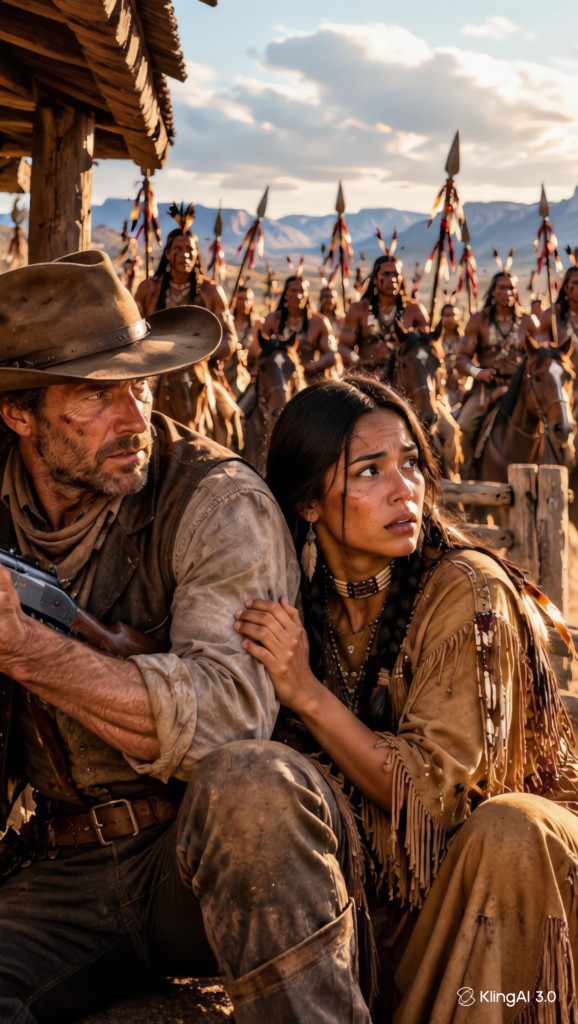
A hundred of them. Maybe more. Strung across the prairie like a living fence made of horses and painted men. They spilled down both sides of the valley, east and west, and the ring of them closed slowly around the ranch until there was no gap left at all.
They rode without shouting. That was the most frightening part. No war cries. No gunshots. Only the thunder of hooves, then the creak of leather, then a silence so complete Boone could hear his own heart.
At the center of the ring, on the crest of the south ridge, a single rider sat on a tall black stallion. He wore a red war band around his head and a Mexican officer’s saber at his hip. Even from this distance, Boone could see the rifle across his saddle.
And slowly, deliberately, the rider began to come straight down the hill toward the ranch.
Boone looked at Alope. Waiting for her to say my father.
But Alope’s face had gone white as bone. Her fingers dug into Boone’s arm so hard he felt her nails through his sleeve.
“That is not my father,” she whispered.
Her voice was shaking.
“That is Nantan.”
PART 2: The Man Who Wanted Her Back
Nantan rode down the hill at a walk.
He did not hurry. He had no need to. A hundred warriors sat their horses in a ring around the ranch, and every one of them held a rifle or a lance or a drawn bow. He rode like a man who had already won and merely needed to come collect his prize.
Boone drew Alope behind him. Not roughly, but firmly. Then he turned to Hattie.
“Inside,” he said. “Bar the door. Take Tom with you.”
“Boone Callahan, I am sixty-three years old and I have buried a husband and a sister, and I will not hide behind a bar while —”
“Hattie.”
She looked at his face. And she went inside.
But she did not bar the door. She stood behind it with the shotgun she had not fired in eleven years, watching through the crack.
Nantan reined his stallion in at the edge of the yard, barely twenty feet from the porch.
Up close, he was a striking man. Tall and lean and hard as rawhide, with high cheekbones and a mouth that seemed shaped for cruelty. His eyes went to Alope first. They traveled over her slowly, from her loose hair to her bare feet, the way a man looks at livestock he has bought and paid for.
Then they slid to Boone.
“You are the white man,” Nantan said in good English, “who has been keeping my bride.”
“I’m the man who gave her water,” Boone said. “Nobody keeps her.”
Nantan laughed, a low, ugly sound.
“Brave words from a man with no gun.” He leaned forward in his saddle. “Do you know what you have done, rancher? You have stolen the daughter of Tazhín. The bride promised to me before all the elders. By our law, I could burn your house with you inside it, and no man of my people would call it wrong.”
“She wasn’t stolen,” Boone said evenly. “She walked here. On her own two feet. Eleven days.”
“She is a foolish girl who ran from her duty.” Nantan’s eyes flicked to Alope. “Come here, woman. Now. And perhaps I will let the white man live.”
Alope did not move.
Nantan’s face darkened.
“Now,” he said, and this time his voice cracked across the yard like a whip.
Some of the riders in the ring shifted uneasily. Boone noticed it. Noticed, too, that not all of them were looking at Nantan with the eyes of loyal men. Some looked at the ground. Some looked at Alope with something like shame.
“She’ll come to you when she chooses,” Boone said. “If she ever does.”
Nantan swung down from his horse.
He walked toward the porch slowly, his rifle held loose in one hand, his other hand resting on the hilt of the saber. Boone did not step back. He did not reach for the rifle leaning against the porch post. He simply stood there in the dirt with his hands open at his sides.
Nantan stopped close enough that Boone could smell the whiskey on his breath.
Whiskey. At dawn.
“Do you know why she ran?” Nantan said softly, for Boone’s ears alone. “Because she is a liar and a coward. She made up stories. Wild stories. She shamed her father before the elders.” He smiled. “Whatever she has told you, white man, it is all lies.”
“Funny,” Boone said. “She hasn’t told me much of anything.”
The smile faltered. For just a heartbeat, something like fear flickered in Nantan’s eyes.
“She has something of mine,” he said, and now his voice was sharper. “She took it from my saddlebag. Give it to me, and I will take her and go. No one will be harmed. Your house will stand. Your old woman will live.” His fingers tightened on the rifle. “Refuse, and I will burn this ranch to the ground before the sun clears that ridge.”
Boone looked at him for a long, long moment.
Then he reached into his shirt pocket, slowly, and drew out the folded paper.
Nantan’s eyes locked on it like a hawk’s on a rabbit.
“This?” Boone said.
“Give it to me.”
“This letter from Sonora?” Boone raised his voice, not shouting, but loud enough that it carried across the silent yard to the nearest riders in the ring. “This letter from the scalp hunter Santiago Kirker, promising you four hundred silver pesos to lead Tazhín’s warriors into the canyon at Cañón del Muerto on the night of the new moon, where two hundred Mexican soldiers will be waiting to slaughter them?”
The silence that followed was absolute.
Then a murmur went through the ring of riders. It spread like wind through dry grass. Men turned to look at each other. Horses tossed their heads.
Nantan’s face went ashen. Then purple with rage.
“Lies!” he roared, whirling to face the ring. “The white man lies! He has been poisoned by the girl! He will say anything to keep her!”
“Then why,” said Alope, stepping out from behind Boone, “did you come with a hundred riders instead of my father?”
Her voice rang across the yard, high and clear and fearless.
“Where is Tazhín, Nantan?” she demanded. “Where is my father? You told these men he sent you. Did he? Or did you leave before he could stop you? Because you knew I had the letter. Because you knew if I reached the soldiers at Fort Bowie, your bargain would be finished. And so would you.”
Some of the riders in the ring were speaking openly now, in their own language, their voices rising. One young warrior near the front urged his horse forward a few steps, staring at Nantan with stricken eyes.
Nantan’s hand closed on the hilt of the saber.
“Enough,” he snarled.
He drew the blade. It flashed silver in the dawn.
And he lunged, not at Boone, but at Alope.
Boone moved without thinking.
He threw himself between them. The saber caught him across the left forearm, slicing through his sleeve and into flesh, and white-hot pain burst up his arm. He did not care. He grabbed Nantan’s wrist with both hands and drove him backward, and the two men went down together in the dust in a tangle of fists and knees and steel.
Nantan was stronger. Boone knew it within seconds. The Apache rolled on top of him, his forearm crushing down on Boone’s throat. The saber had fallen away, but Nantan’s free hand was groping for the knife at his belt. Boone’s vision began to go dark at the edges.
Above him, he heard Hattie’s shotgun boom. A warning shot into the sky.
He heard Alope screaming.
And then he heard something else.
Hoofbeats.
Not the thunder of a hundred riders, but a single horse, coming fast down the north ridge. And a voice, deep as a drum and old as the mountains, roaring a single word that shook the whole valley.
“NANTAN!”
The pressure on Boone’s throat vanished.
He rolled over onto his side, coughing, gasping, blood running down his arm into the dirt. Alope was kneeling beside him, her hands pressed over the wound, her face streaked with tears.
He lifted his head.
Down the north ridge came a gray horse, running flat out. On its back rode an old man with long silver hair streaming behind him, his face like weathered stone, his back straight as a pine. Behind him, cresting the ridge in a long wave, came another line of riders. Fifty of them. Maybe more.
The ring of Nantan’s warriors broke apart in confusion. Some raised their rifles. Then, one by one, they lowered them again.
Because they all knew that face.
The old man reined his gray horse to a stop in the center of the yard. Dust swirled around him. He looked down at Nantan, who stood frozen with the knife still in his hand. He looked at the white rancher bleeding in the dirt.
And then he looked at his daughter.
“Father,” Alope whispered.
Tazhín, war chief of the northern passes, said nothing. His eyes, dark and unreadable, moved slowly from her face to the folded paper lying in the dust where Boone had dropped it.
He held out his hand.
The young warrior who had ridden forward from the ring dismounted, picked up the paper, and carried it to the chief with both hands, his head bowed.
Tazhín unfolded it. His lips moved silently as he read. He could read Spanish. Few knew it.
When he finished, he folded the paper again with great care. His hands, Boone noticed, were trembling.
Then he lifted his eyes to Nantan.
And Boone, lying in the dust with his arm on fire, understood in that moment why grown cavalry officers had whispered this old man’s name like the name of a storm.
PART 3: The Open Gate
No one moved.
Tazhín spoke to Nantan in their own language. His voice was very quiet. Boone did not understand a word of it. He did not need to. He saw Nantan’s face drain of color. Saw the knife slip from his fingers into the dust. Saw the tall, proud warrior seem to shrink inside his own skin.
Then Tazhín spoke a single word to the riders.
Four men from his own band dismounted. They took Nantan by the arms. He did not resist. They bound his wrists with rawhide and led him away toward the north ridge, and the hundred riders who had followed him there parted silently to let him pass. Not one of them raised a hand to stop it.
Later, Alope would tell Boone what her father had said. That a man who sells his own people for silver has no people. That he would be taken before the full council of elders. That whatever they decided, he would never again ride as a warrior of the Chiricahua.
But in that moment, Boone knew none of it. He only knew that the chief had turned his gray horse and was looking down at him.
Alope rose to her feet and stood beside Boone. Her hands were red with his blood. Her chin was lifted.
Tazhín looked at the two of them for a very long time.
Then he swung down from his horse and walked across the yard. He was an old man, Boone saw now. Older than he had looked on horseback. He walked with a slight stiffness, as if every one of his seventy winters had settled into his knees. But his eyes were sharp and fierce and missed nothing.
He stopped in front of Boone.
“You are the man who kept my daughter,” he said in slow, careful English.
Boone got to his feet. It took him two tries. Hattie, who had come out onto the porch with the shotgun still in her hands, came down the steps and caught his good arm to steady him.
“No, sir,” Boone said. “I’m the man who gave her water. Nothing more. She was never mine to keep.”
Tazhín studied him.
“Why?” the old man asked. His voice was like gravel and river stone. “Why did you shelter my daughter? You did not know who she was. You did not know what she carried. You knew only that she was Apache, and that my people have given your people many reasons to hate us.”
Boone did not straighten his shoulders. He did not reach for pretty words. He simply told the truth, the way his mother had taught him.
“She was thirsty,” he said. “I had water.”
He shrugged with his one good shoulder.
“That’s all, chief. A body needs water. I don’t much care whose body it is.”
Silence moved through the riders like wind through grass. Alope stood very still beside her father, watching Boone’s face as though she could see the truth being weighed there on some invisible scale.
Tazhín was quiet for a long moment.
Then something eased in the old man’s jaw.
“Many men would have asked what she was worth first,” he said slowly. “Many men would have sold her to the soldiers. Or to Nantan. Or to the scalp hunters, who pay well for the hair of an Apache woman.” His eyes went to Boone’s bloody arm. “You asked nothing. And you bled for her.”
He turned to his daughter.
“I did not believe you,” he said, and his voice, for the first time, cracked. “I called you a foolish girl. I sent you away. And if this white man had not opened his gate, you would have died in the desert, and I would have ridden into Cañón del Muerto in two weeks’ time, and our people would have died with me.” He laid his hand on her shoulder. “I was the fool, my daughter. Not you.”
Alope’s eyes filled with tears. She bowed her head.
Tazhín looked back at Boone.
“You will eat at my fire,” he said. “You will be brother to my people. Any Callahan who rides into the northern passes will ride in peace, for as long as I live and as long as my sons live after me.”
Then his hand tightened gently on Alope’s shoulder.
“And my daughter,” he said, “will choose her own road.”
By noon, they were gone.
Tazhín’s warriors and Nantan’s warriors rode out together, one long line of shadow folding into the pines on the north ridge. The old chief rode last. At the crest of the hill, he turned his gray horse and lifted one hand toward the ranch. Not in farewell. In promise.
And then the hills were empty and the yard was quiet.
Hattie had stitched Boone’s arm at the kitchen table, fourteen stitches, scolding him the entire time for being a damn fool, with tears running down her cheeks. Now he sat on the porch steps with his arm bound in a clean white sling, watching the dust settle on the ridge.
Alope stood a few steps from him. Her shawl hung loose on her shoulders. Her eyes were still fixed on the place where her father had disappeared.
“You could have ridden with him,” Boone said quietly.
She was silent for a long moment.
“He would have taken me,” she said at last. “He would have been glad. But that is not the same as being wanted.” She turned to look at him. “And it is not the same as choosing.”
The evening came down slow and gold over the valley. Somewhere in the cottonwoods by the creek, a mourning dove called, and the crickets answered.
Boone stood up. His knees were shaking worse than they had when Nantan came down the hill.
“Alope,” he said, and his voice cracked like a man who had rehearsed nothing. “I’ve got a roof, and it ain’t much. A leaky barn. A garden you saved and a horse that likes you better than me. And there’s a chair by the fire that’s been empty since my mother passed.”
He drew a breath.
“Stay. Not for the winter. Not till the trouble blows over.” He swallowed hard. “Stay forever.”
She looked at him for a long moment, her chin lifted, and something bright moved behind her eyes. The first easy, unguarded thing he had ever seen there.
“Forever is a long word, Boone Callahan.”
“I know it,” he said. “I mean every letter.”
Then she smiled. And it was like the sun coming up over the far hills after the longest night of his life.
She put her hand in his, small and brown against his big, sunburned one, and he closed his fingers around it carefully, as though holding something that could break, and something that never could.
Hattie watched from the doorway and said nothing. Some moments, you don’t interrupt.
They were married the next spring, at the edge of the northern passes, beside a great council fire. Tazhín himself placed his daughter’s hand in Boone’s. Hattie wept through the whole thing and then danced until midnight with a Chiricahua elder who did not speak a word of English and did not need to.
The scalp hunters never came. The letter reached the commander at Fort Bowie, and the commander, to his credit, sent it on to Mexico City with a note of his own. The ambush at Cañón del Muerto was never sprung. A hundred lives, maybe more, went on living without ever knowing how near they had come to ending.
And on the Callahan ranch, the water trough by the windmill was never once allowed to run dry.
Travelers learned of it over the years. Cowhands and drifters. Mexican vaqueros and Apache hunters. Settlers with broken wagons and children with sunburned faces. They came through the gate, and the gate was always open, and there was always water, and no one was ever asked a single question before they drank.
Sometimes, on summer evenings, Boone would find his wife standing at the trough with her palm flat on the weathered wood, the way she had once stood at the corral fence waiting for Juniper.
“What are you thinking about?” he’d ask.
And Alope would smile and lean against his shoulder.
“How far I walked,” she’d say, “to find a man who would give me water and ask me nothing.” She would look out at the open gate, golden in the setting sun. “And how close I came to walking past.”
A single cup of water. A single unasked question. Boone Callahan had no idea that his simple decency would save a hundred lives and change the course of a whole people. We rarely know which of our small kindnesses will matter most. So give them freely. Leave the gate open. Someone may be crawling toward it right now.