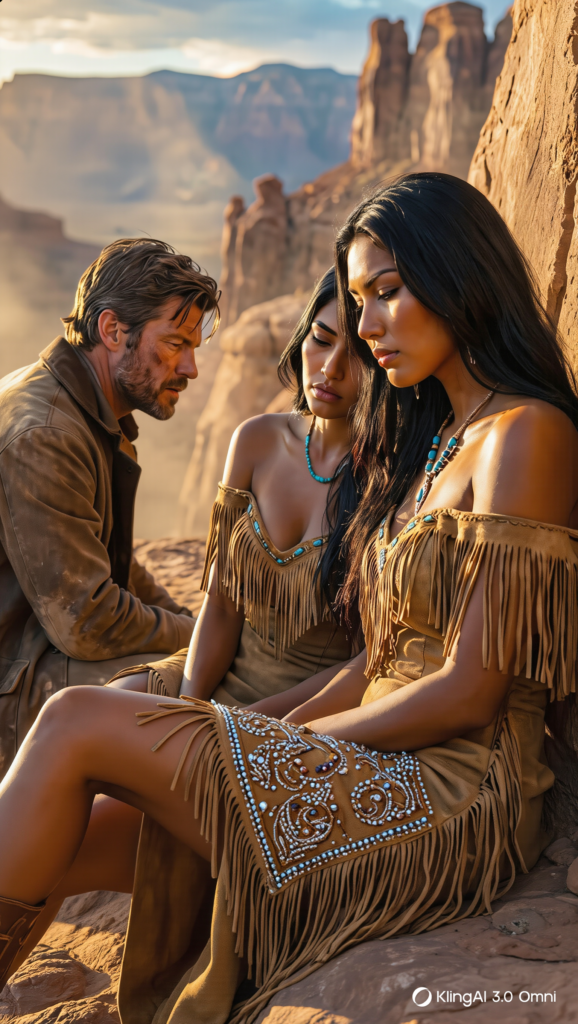
PART ONE: The Storm
The stage station at Corazón Springs sat alone on the high desert of New Mexico Territory like the last tooth in an old man’s jaw. It was a squat adobe building with a corral, a well, and a wind that never once in its existence had been still. In the third week of December 1879, that wind came down off the Continental Divide carrying snow so fine and dry it hissed against the walls like sand.
Caleb Moore rode in at two in the afternoon with ice in his mustache and his gray gelding’s breath freezing white on its chest. He was forty-six years old. He had been a Union cavalry sergeant, a buffalo-hide skinner, a freighter, and for the last nine years a cowhand for whatever brand needed a steady man through a hard season. He was riding south to a winter job at a ranch near Socorro, and he had stopped at Corazón Springs for one reason only: the well was the last sure water for thirty miles.
He drew the bucket up, broke the skin of ice on it with his fist, and let the gelding drink. That was when he heard the boy coughing.
The sound came from the lee of the corral wall, where an old freight tarp had been propped against the adobe on two broken poles. Beneath it, a young woman sat wrapped in a striped blanket of red and black and deep indigo. She had a child gathered inside it against her body, and his small dark head was tucked under her chin. The snow had drifted against the tarp until only the narrow opening showed, and in that opening the woman’s eyes met Caleb’s without blinking.
She was Navajo. He knew it from the blanket, from the silver buttons running down the side of her moccasins, and from the way her hair was gathered in a tight bun at her nape and bound with white wool yarn. She looked perhaps twenty-five. Her lips were blue at the edges. The boy coughed again, a deep, wet, rattling sound that Caleb had heard before in field hospitals during the war, and had hoped never to hear again.
Caleb crouched down slowly, keeping his hands open and visible.
“How long have you been out here?”
She answered in English, slow and careful. “Since the wagons left. Before the sun came up.”
The station keeper was a sour, rail-thin man named Purdy who kept a whiskey jug under the counter and a shotgun above it. Inside the station’s single smoky room, Purdy told Caleb the story in the bored voice of a man who considered it none of his concern.
A freight outfit hauling flour and hardware to Fort Wingate had pulled in the night before: six wagons, a dozen teamsters, and a boss named Jory Bask. Bask had picked up the woman and her boy at a trading post on the Rio Puerco, promising to carry them north toward the reservation in exchange for her labor cooking for the crew. Somewhere along the way, Purdy said, Bask had decided she owed him more than cooking. She had refused him. Last night, in front of every teamster in the outfit, he had accused her of stealing from his strongbox and had searched her bundle in the station yard by lantern light.
“Didn’t find nothing of his,” Purdy said, spitting into a coffee can. “But he found something of hers. A belt. Silver conchos, big as your palm, old Navajo work. Looked to be worth more than his whole wagon train. He tried to take it, and she bit him to the bone. Then he told her she could walk to the reservation, and he pulled out at four this morning without her.”
“And you let a woman and a sick child sit in a snowdrift for ten hours,” Caleb said quietly.
Purdy shrugged. “My station’s for paying passengers, mister. And Bask is the one who pays my freight bills. He said if I let her in, he’d haul for somebody else.” He poured himself another inch of whiskey. “Besides, he’s coming back for that belt. He told me so. Said once she’s froze stiff enough, she won’t put up such a fight.”
Caleb looked at him for a long moment. He didn’t say anything. He went back outside into the howling white, knelt in front of the tarp, and held out his hand.
“Ma’am, my name is Caleb Moore. I’m going to get you and your boy inside where it’s warm. The man in there won’t like it, but he’ll live with it.”
She looked at his hand. She looked at his face. Then, slowly, she shifted the blanket open just enough to show him the boy. He was small and thin, perhaps six years old, with his eyes half closed and his cheeks flushed with a sick, unnatural heat. His fingertips, where they curled over the edge of the blanket, had gone the waxy white of frostbite.
“His name is Tsosie,” she said. “I am Nizhoni.” She drew a breath. “If you take us inside, that man will come back for you, too.”
“I expect he will,” Caleb said. “Let me worry about that.”
Purdy cursed, but he didn’t reach for the shotgun. Caleb had seen to that by laying a five-dollar gold piece on the counter with one hand while resting the other, very calmly, on the butt of his Colt. The money bought a corner of the floor by the stove, a pot of hot water, and Purdy’s sullen silence.
Caleb had learned some doctoring in the war, the hard, practical kind learned by watching surgeons work by candlelight with too few hands. He knew not to rub frostbitten skin, and he knew not to put it near open heat. He warmed water until it was barely warmer than blood and let the boy’s fingers soak in it while Nizhoni held him on her lap. When the feeling came back, Tsosie screamed, a thin, raw sound that made the hair on Caleb’s neck stand. Nizhoni rocked him and sang low in her own language, never once raising her voice, never once letting her own face show what it cost her to hear him.
After a while the boy slept. His breathing was still bad, but his fingers had pinked up, and Caleb thought he would keep all ten of them.
Nizhoni sat with her back to the wall and her son across her knees and watched Caleb clean his rifle by the stove. She had not slept, and he could tell she did not intend to.
“Why did you stop?” she asked.
He thought about it honestly, because he could tell she would know the difference.
“I had a little brother,” he said finally. “Jamie. He followed me into the army when he was seventeen. He took sick with pneumonia the winter of ‘63, in a camp in Tennessee. He coughed the same way your boy does.” Caleb ran an oiled rag down the barrel and didn’t look up. “I was out on picket duty when he died. I wasn’t there. I’ve spent sixteen years riding past things. I reckon I’m tired of it.”
Nizhoni was quiet for a long time. The wind screamed around the building.
“My grandmother walked to Bosque Redondo,” she said at last. “When the soldiers came in the winter of my mother’s birth, they burned the peach trees in Canyon de Chelly and killed the sheep and made the People walk three hundred miles to a place where nothing would grow. Many died on the way. Old people. Babies. My grandmother carried my mother the whole way, and she carried the belt sewn inside her dress, so the soldiers would not take it. It was her mother’s. Four years later, when the People were allowed to go home, she carried it back again.” Nizhoni laid one hand flat against the folds of her blanket, and Caleb understood that the belt was there, sewn into the lining, against her heart. “She told me never to sell it. She said it was the proof that we came home.”
“Why were you on the Rio Puerco?”
Her face closed like a door. “My husband was a silversmith. He went to the trading post to sell his work, and he got sick, and he died there. I went to bring him home and I could not. The trader said he owed for his room and his medicine, and took everything to pay it. All except the belt.” She looked down at her sleeping son. “Bask said he would carry us home. I believed him.”
“How far is home?”
“Near the Chuska Mountains. Six days by wagon. Four on a good horse.”
Caleb set the rifle down across his knees and did arithmetic he already knew the answer to: a job in Socorro, forty dollars a month, a bunk and a stove for the winter. Then the other way, north into high country in December, with a sick child and a freight boss who already considered the silver his.
“I’ve only got one horse,” he said. “But I’ve got some money. Purdy has a mule he’ll sell, if he figures it’s the only way to get rid of us.”
Nizhoni studied him across the firelight. “You do not know me.”
“No, ma’am,” Caleb said. “But I’d like to see you home all the same.”
Jory Bask came back an hour after full dark.
Caleb heard the horses first, three of them, laboring through the drifts, and he was on his feet with the rifle before Purdy had even lifted his head from the counter. Through the frost-crusted window he saw lanterns swinging in the snow. Three men climbed down in the yard. The one in front was enormous, wrapped in a buffalo coat, with a hand bound in a dirty bandage and a face that seemed to have been built for grievance.
Bask kicked the door open and stood there with the storm pouring in around him, and his small eyes went straight to the corner by the stove.
“Well now,” he said. “Somebody’s been charitable.”
“She’s under my protection,” Caleb said. He held the rifle level, but not aimed at anyone yet. “The boy is sick. You’ll ride on.”
Bask laughed. He held up his bandaged hand. “That squaw bit me through to the bone, friend. She owes me for that, and she owes me for her passage, and she owes me for a strongbox that came up twenty dollars short. That belt’ll about cover it.” He grinned at the two men behind him, both of whom had rifles of their own. “Three of us. One of you. And Purdy here don’t want to get his floor bloody, do you, Purdy?”
Purdy said nothing. He had disappeared behind his counter entirely.
Caleb felt Nizhoni rise behind him. She didn’t hide. She stood beside him with the boy held against her hip and her chin up, the way a woman stands who has already survived worse than the man in front of her.
“There is no strongbox money,” she said clearly. “He lies. Everyone in his camp knew he lies.”
Bask’s face went dark red. He took one step forward, and Caleb brought the rifle up and laid the muzzle square on the center of that buffalo coat.
For a long, terrible moment, nobody moved. The stove ticked. Snow blew across the floor.
Then Tsosie, waking in his mother’s arms and seeing the big man in the doorway, let out a scream of pure terror. He twisted out of Nizhoni’s grip, hit the floor running, and darted past Bask’s legs and straight out the open door into the blizzard.
“Tsosie!” Nizhoni screamed.
She lunged after him, and Bask’s arm swept out and caught her around the waist, hauling her back. His teamsters brought their rifles up. In the doorway, the snow was so thick that the small dark shape of the boy was already gone, swallowed whole by a white, howling dark where the temperature was falling toward thirty below.
Caleb knew exactly how long a sick six-year-old would last out there. Minutes.
He looked at Bask, who was holding Nizhoni with one arm while his other hand groped at the lining of her blanket for the silver. He looked at the two rifles pointed at his chest. And he looked at the open door, where the boy’s tiny footprints were already filling in with snow.
If he went after the boy, he would leave Nizhoni alone with three armed men and the silver her grandmother had carried three hundred miles and back.
If he stayed, Tsosie would die in the dark, alone, the way Jamie had.
Nizhoni stopped fighting. She looked at Caleb across the room, and her voice came out low and steady and absolutely certain.
“Go,” she said. “Bring my son back.”
Caleb went out into the storm.
Behind him, before the wind took every other sound away, he heard the crack of a gunshot inside the station.
PART TWO: The Long Way North
He found the boy because the boy was crying.
Out in the blizzard there was no up and no down, no near and no far, only a roaring white wall that stung his eyes shut and sucked the breath out of his lungs. Caleb went down on his knees twice in the first fifty yards. The tracks were gone. The light from the station windows was gone. If not for the thin, high, broken sound coming from somewhere to his left, he would have walked in a circle until he froze.
Tsosie had run straight downhill, the way frightened things always run, and he had fetched up against the frozen bank of the creek that fed the springs. He was curled in a ball in the lee of a cutbank, with snow drifting over him already, and when Caleb’s hands found him in the dark, the boy fought him with every ounce of strength his small body had left.
“It’s me,” Caleb said. “It’s me. It’s all right. Your mother sent me.”
He didn’t know if the boy understood a word. But Tsosie stopped fighting. Caleb opened his own coat and buttoned the child inside it against his chest, skin against wool against skin, and the boy’s body was so cold it burned.
Getting back was worse than finding him. Caleb walked with his head down, following the creek bank upstream because it was the only thing in the whole world he could be certain of, counting his steps out loud to keep his mind from drifting. At four hundred and twelve steps, he walked straight into the corral fence. He followed it hand over hand to the station wall.
The door was standing open. Snow had drifted across the threshold. Inside, the stove had burned low, and Purdy was sitting on the floor behind his counter with his face gray and a dishrag pressed against a bloody furrow along his scalp.
Nizhoni was gone. So were Bask and his men.
“She went for his knife,” Purdy said hoarsely. He sounded astonished, as though he’d seen something that broke every rule of the world as he understood it. “Bask had her by the blanket, and she pulled his own knife off his belt and cut the whole lining loose. Belt and all. Then she threw it straight into my stove.” He gestured weakly at the iron stove. “Bask went crazy. He grabbed for it, and burned his good hand. One of his boys shot at her and creased me instead. She was out the back window before they knew which way she’d gone.”
Caleb crossed to the stove in three strides and flung open the door. In the bed of coals, black with soot and glowing dull red at the edges, lay a heavy belt of silver conchos. The leather was burning away. The silver, which had survived Bosque Redondo, was not going to be undone by a station stove.
“And Bask?”
“Went after her. Said he’d drag her back by the hair and take the belt out of the ashes after.” Purdy swallowed. “Mister, I didn’t help her. I want you to know that. I sat right here and I didn’t help her one bit.”
“I know it,” said Caleb. “You can help her now.”
He left Tsosie wrapped in every blanket in the station, with Purdy’s shotgun across Purdy’s knees and the hard promise that if anything happened to the boy, Caleb would come back and finish what Bask’s teamster had started. Then he dug the belt out of the coals with a pair of fire tongs, wrapped the hot silver in a wet sack, stuffed it into his saddlebag, and rode out into the storm.
He did not have to search for long. Nizhoni had not run blindly the way her son had. She had run for the one place in that country a Navajo woman would know to find cover in a blizzard: the old rock shelter a mile up the wash, where the stage drivers stabled spare horses in summer. And she had not been hiding there. She had been waiting.
When Caleb rode up, he found two of Bask’s teamsters trying to coax their horses back to their feet in the snow. One of them was bleeding from the arm. Bask himself sat against the rock wall, cradling his burned hand and cursing in a steady, slurred stream. Beyond them, up on a ledge of the shelter, out of reach and silhouetted against the faint glow of the snow, stood Nizhoni with Bask’s own rifle in her hands.
“My son,” she called down. The rifle didn’t waver. “Is he alive?”
“He’s alive,” Caleb said. “He’s in the station, warm. He’ll be fine.”
She made a single sound then, and it was the only time in all the days that followed that Caleb ever saw her composure break. Then the rifle came back up, level and steady, aimed at Jory Bask.
“Go back to your wagons,” Caleb told Bask. “You’ve got a burned hand, a wounded man, and a woman who can shoot better than either of your boys. You came after a belt that’s already gone. Ride north to Wingate and tell anyone who’ll listen. Tell them a squaw and a cowhand ran you off.”
Bask looked up at him with a hatred so naked it was almost a kind of honesty. “This ain’t over.”
“It is for tonight,” said Caleb.
They went. Caleb held out his hand to Nizhoni, and she climbed down off the ledge without taking it, and walked past him straight into the snow toward the station and her son. She ran the whole mile.
They left Corazón Springs three days later, when the storm had blown itself out and the sky came up hard and cloudless and so blue it hurt. Caleb had bought Purdy’s mule for twenty dollars, which was robbery. He paid it without arguing, which Nizhoni noticed. Tsosie rode in front of his mother on the mule, bundled to the eyes, and his cough was looser now and wetter, and Nizhoni said that was good, that it meant the sickness was coming out.
The belt rode in Caleb’s saddlebag. The fire had blackened the silver and burned the leather to nothing, but the conchos were whole, each one hammered by hand with a pattern of sunbursts and curving lines. On the second night, by the fire, Nizhoni laid them out on a blanket one by one and polished them with ash and snow-water, and slowly, as she worked, they began to shine again.
“Did you mean for it to burn?” Caleb asked her. “When you threw it in the stove?”
She considered the question gravely. “I meant for him not to have it. I thought, if it burns, it burns. My grandmother did not carry it home for a man like that.” She held one concho up to the firelight, and it flashed in her fingers. “But the silver did not burn. Good silver never does. My husband used to say that. He said fire only shows you which silver was real.”
They rode north through country so beautiful and so empty it made Caleb ache: red mesas striped with white snow, piñon and juniper black against the drifts, the long blue line of the Chuska Mountains growing slowly on the horizon. They talked the way people talk on long journeys, a little at a time, saving things up between them.
He learned that Nizhoni’s husband had been named Hastiin Yázhí, and that he had been funny, which surprised her family, since silversmiths were supposed to be serious men. He had made Tsosie a tiny silver horse no bigger than a thumbnail on the day he was born. Nizhoni had married him at seventeen and had been a widow for exactly four months.
She learned that Caleb had grown up on a farm in Iowa, that he could not sing a note but whistled very well, and that he had once been engaged to a girl named Margaret who’d married a banker while he was away at war. He had stood outside the church in his blue uniform the day he came home and found out, and he had never gone in. He had simply turned around and walked back to the depot and bought a ticket west, and had kept walking west, one way or another, ever since.
“You walk away from things,” Nizhoni observed. It wasn’t unkind. It was simply true.
“I do,” Caleb agreed.
“But you came back into the snow for my son.”
He didn’t have an answer for that. She didn’t seem to need one.
Tsosie got better. On the third day he began to talk, first in Navajo to his mother, and then, shyly, in a few broken words of English to Caleb. By the fourth day he wanted to ride in front of Caleb on the gray gelding, and Caleb let him, and taught him to hold the reins correctly and to keep his heels down. The boy watched everything Caleb did, how he checked the gelding’s feet each morning, how he built a fire in the lee of a rock out of the wind, how he scanned the backtrail every hour. And Caleb, feeling that small serious gaze on him all day long, found himself doing every one of those things a little more carefully than he had in years.
On the fifth morning, Caleb scanned the backtrail and saw riders.
They were a long way off, three dark specks against the snow, moving steady. Caleb knew without any doubt whatsoever who they were.
“He followed,” Nizhoni said. She was beside him, shading her eyes.
“He wants the silver,” Caleb said. “And a man like Bask can’t stand being made a fool of in front of other men. He’ll have told the whole freight crew at Wingate some story, and now he’s got to come back with the belt or he can’t ever show his face.”
“How far to my mother’s camp?”
“You tell me.”
She studied the mountains. “If we ride hard, tonight. But there is a canyon between here and there. Narrow. The only way through.”
They both understood what that meant. A narrow canyon was the perfect place for an ambush, and Bask’s men were riding fresh horses while theirs were tired.
They rode hard anyway. By late afternoon the canyon opened in front of them, a deep red gash in the earth, its walls hung with ice. Caleb stopped at its mouth and sat for a long time looking up at the rimrock.
“You go through first,” he said. “Both of you, on the mule. I’ll stay here and hold the mouth.”
“No.”
“Nizhoni—”
“No.” Her eyes flashed. “You will not stay behind alone and die so that we can live. I will not carry that home. My grandmother carried enough.”
“Then what do you suggest?”
She looked at the canyon. She looked up at the rimrock. And slowly, a hard light came into her face that Caleb would come to know very well in the years ahead.
“This is my country,” she said. “Not yours. Not his. Mine. I know a trail.”
Jory Bask and his two teamsters rode into the canyon an hour before sunset, rifles out, following a set of fresh tracks: a gray horse and a mule, plodding wearily up the center of the frozen wash.
They followed those tracks deep into the narrows, where the red walls closed in so tight that the sky was only a thin blue ribbon far above. They came around a bend and found the gray gelding and the mule tied to a juniper, with no riders in sight.
And from the rimrock above them, a woman’s voice called down in clear, ringing English.
“Jory Bask. Look up.”
They looked up. Nizhoni stood at the edge of the cliff, sixty feet above, with the low sun behind her, and she held something up in her hands that flashed like fire. It was the silver belt, polished and gleaming and strung on a new rawhide strap.
“You want my grandmother’s silver? Come and take it.”
Bask roared and spurred his horse toward the canyon wall, looking for a way up. And Caleb, lying flat behind the boulder at the bend where he had waited the past hour, put a rifle round into the ice-crusted rock just above the teamsters’ heads.
The canyon walls caught the sound and threw it back and forth until it seemed like a whole troop of cavalry was firing. Ice and rock came down in a roaring sheet. The teamsters’ horses went mad, rearing and plunging in the narrow space. One man was thrown. The other simply turned and fled back the way he had come at a dead run, his horse screaming.
Bask’s horse went down on the ice. He came up out of the snow with his rifle in his good hand, wild-eyed, and swung it toward the boulder where Caleb’s shot had come from.
Caleb was no longer behind the boulder. He was standing six feet away, with his Colt drawn and cocked and aimed at the center of Bask’s chest.
“Drop it.”
Bask stared at him, breathing hard. His eyes flicked up toward the rimrock, where Nizhoni still stood with the silver shining in her hands. Then they flicked back to Caleb.
“You’d kill a white man,” Bask said, “for a squaw’s belt?”
“No,” said Caleb. “But I’d kill a white man for a woman and a little boy he left out to freeze. Make up your mind which one you are.”
The canyon was very quiet. Somewhere above them, ice ticked as the sun left it.
Jory Bask dropped the rifle.
PART THREE: Home
They took Bask’s guns, his horse, and his boots. Caleb pointed him back down the canyon toward the long walk to Fort Wingate. It was a walk, Nizhoni noted dryly, considerably shorter than three hundred miles. Bask went. He never came into the Chuska country again. Two years later Caleb heard from a trader that he had been run out of the freighting business entirely, after the teamster he’d abandoned in the canyon told the whole post commander the truth of what happened at Corazón Springs.
They reached Nizhoni’s mother’s camp at full dark that same night. There was a cluster of hogans, round and earth-roofed, their doorways facing east, and a sheep corral of piled brush and juniper posts. A dozen dogs announced them from half a mile off. Then the people came out into the firelight: Nizhoni’s mother, her two aunts, a crowd of cousins and children and old men, all of them staring at the white man on the gray horse with a Navajo boy asleep in his arms.
Nizhoni’s mother was a small, fierce woman with silver bracelets on both wrists. She took her grandson from Caleb’s arms without a word and held him so hard he woke and complained. Then she listened while Nizhoni told the whole story in their own language, standing by the fire in the cold. Finally, Nizhoni drew the belt out from inside her blanket and put it into her mother’s hands.
The old woman looked at the silver for a long time. She ran her thumb over the sunbursts her own grandmother had worn. Then she looked up at Caleb.
She said something to her daughter. Nizhoni hesitated, and then translated it.
“She says the silver came home twice now. Once in her mother’s dress, and once in a white man’s saddlebag.” Nizhoni paused. “She says she does not know which journey was more unlikely.”
Then the old woman said something else, and the whole crowd around the fire laughed, and Nizhoni’s face turned a deep, dusky red in the firelight.
“What did she say?” Caleb asked.
“She says you are too thin,” Nizhoni said, not looking at him. “And that you will stay for the winter and be fed properly, and that it is not a question.”
He stayed for the winter.
He meant to leave in the spring. He told himself that every week of the long cold months, while he mended the sheep corral, and hauled wood up from the canyons, and taught Tsosie how to rope a fence post from the back of a burro. He told himself that while Nizhoni’s uncles taught him to herd sheep in snow, and laughed at him without malice when he did it badly, and taught him the Navajo words for horse and water and thank you, and then for idiot, which they used on him more often than the others.
He told himself he would leave in the spring while he watched Nizhoni set up her loom outside her mother’s hogan on the first mild day of February. He watched her weave a blanket over the following weeks in red and black and deep indigo, her hands moving so fast and certain that the pattern seemed to grow by itself. In the evenings she would sit beside him at the fire and tell him the stories that went with the patterns: Spider Woman, who taught the People to weave, and the Hero Twins, and the long journey home from Bosque Redondo, which her grandmother had told her a hundred times so that it would never be forgotten.
“Why do you tell it so often?” Caleb asked her once.
“So that we remember we came home,” she said. “So the children know that whatever is taken from them, they can still come home.”
In the spring, when the snow went off the mesas and the lambs came, Caleb stood in the corral at sunrise with a newborn lamb in his arms and Tsosie beside him, chattering in two languages at once. He realized with a kind of quiet astonishment that he had not thought about Socorro, or forty dollars a month, or any road leading anywhere else, for weeks.
That evening Nizhoni found him sitting on the hill above the camp, watching the sun go down behind the Chuskas.
“You are thinking of leaving,” she said.
“I was supposed to,” he said. “Everybody expects a man like me to keep on walking.”
She sat down beside him in the dry grass. She was quiet for a long time. Then she unfolded something from her lap and laid it across his knees. It was the blanket from her loom, finished, heavy and warm, in red and black and indigo. Down the center ran a single bold line of white that zigzagged back and forth across the pattern from one end to the other.
“It is called a spirit line,” she said. “Weavers leave a path, so that the weaver’s spirit is not trapped inside the blanket. So it can always find its way out.” She touched the white line with one finger. “But I made this one different. I made the path go all the way through, from edge to edge. So that a man who walks into it can find his way back again.”
Caleb looked down at the blanket for a long, long time. He found he could not speak.
“You came back into the snow for my son,” Nizhoni said softly. “I think you are not a man who walks away. I think you are a man who has never had anything worth coming back to.”
“I do now,” Caleb said, when he could.
“Yes,” said Nizhoni. “You do.”
They were married that summer in the Navajo way, in her mother’s hogan, with a basket of blue cornmeal mush between them. Nizhoni’s uncles were openly skeptical, and her mother was openly delighted. Tsosie wore his father’s tiny silver horse on a thong around his neck and refused to sit still through any of it.
Nizhoni wore her great-great-grandmother’s silver belt. It shone like the sun.
Caleb Moore lived thirty-one more years in the Chuska country. He raised sheep and horses and, eventually, a son and two daughters of his own beside Tsosie, who grew up to become one of the finest silversmiths on the reservation, just as his father had been. Caleb learned enough Navajo to be laughed at in it and never enough to stop. He never again went more than three days’ ride from home. Every time he came back over the last ridge and saw the smoke rising from the hogan doorways facing east, he thought of Corazón Springs, and a young woman’s steady eyes looking out at him from under a snow-covered tarp.
When he was very old, one of his granddaughters asked him why he had stopped that day at the stage station, when everyone else had ridden past.
Caleb thought about it for a long time, the way he always thought about things that mattered.
“I’d spent my whole life riding past things,” he said finally. “Your grandmother taught me that some silver is real, and fire only proves it. I guess that day I finally found out which kind I was.”
Then he pulled the old spirit-line blanket up over his knees, the one with the white path that ran all the way through from edge to edge, and he looked out the east-facing door at the morning coming gold across the mesas. He was home.


