PART 1: The Hand in the Snow
The first heavy snow of the season came weeks early.
What began as a cold morning under a pale sky turned by noon into a howling storm that swallowed the mountains and buried every trail in white. Ranchers hurried home before dark. Travelers took shelter wherever they could find it. Even the wild animals vanished into the timber to wait out the wind.
Only one rider kept moving.
His name was Ethan Walker, a quiet cowboy of thirty-one who had spent most of his life crossing lonely country. He knew these mountains well enough to respect them, and experience had taught him something more important: the wilderness often rewards patience, but it never shows mercy to those who underestimate it.
His bay gelding, Sorrel Jack, pushed carefully through snow already deep enough to drag at his knees. Ethan pulled his heavy coat tighter and tugged his hat brim low. He had hoped to reach an old trapper’s cabin before sundown, but with every mile, that hope grew thinner.
Around his neck, under his shirt, hung the only thing he owned from a mother he had never known: a small dark stone, polished smooth, threaded on a leather cord. His father had placed it over his head on his deathbed eleven years ago and said only, “Your mother wanted you to have this. She said it would always lead you home.” Ethan had never understood what that meant. He wore it anyway.
The silence felt wrong. Storms usually carried the crack of breaking branches or the distant cry of an animal. This afternoon there was almost nothing, only the endless hiss of wind.
Then Sorrel Jack stopped.
The horse raised his head and stared hard into a narrow valley ringed with tall pines.
“What is it, boy?” Ethan asked softly.
The horse wouldn’t move. Ethan trusted that animal more than his own eyes. Over the years Jack had sensed danger long before Ethan ever saw it. Slowly, he swung down and searched the unbroken white.
At first he saw nothing. Then he noticed a scrap of blue cloth fluttering weakly beneath a snow-laden branch. It had no business being there. No traveler would leave cloth hanging in a tree in weather like this.
Ethan waded toward it, sinking to his knees with every step. When he reached the branch, he saw the cloth wasn’t tied there at all. The wind had torn it from someone’s clothing and caught it on the bark.
His heart tightened. Someone had passed here, and recently.
He searched the ground, but the storm had erased nearly everything. Only faint hollows remained beneath the fresh snow, already filling. Most men would have turned back. The storm was strengthening, and the light was failing fast.
Ethan couldn’t ignore what he’d found.
He tied Jack’s reins to a pine and followed the faint hollows deeper into the valley. The wind screamed louder between the cliffs. Snow lashed his face so hard he could barely keep his eyes open.
Then he heard it. The sound was so faint he almost believed he had imagined it.
It was a weak cry.
He froze. It came again. It wasn’t an animal. It was a human voice.
Ethan plowed forward as fast as the snow allowed. The sound faded and then returned from another direction. At last he reached a steep slope where broken rocks jutted from the snow like frozen waves.
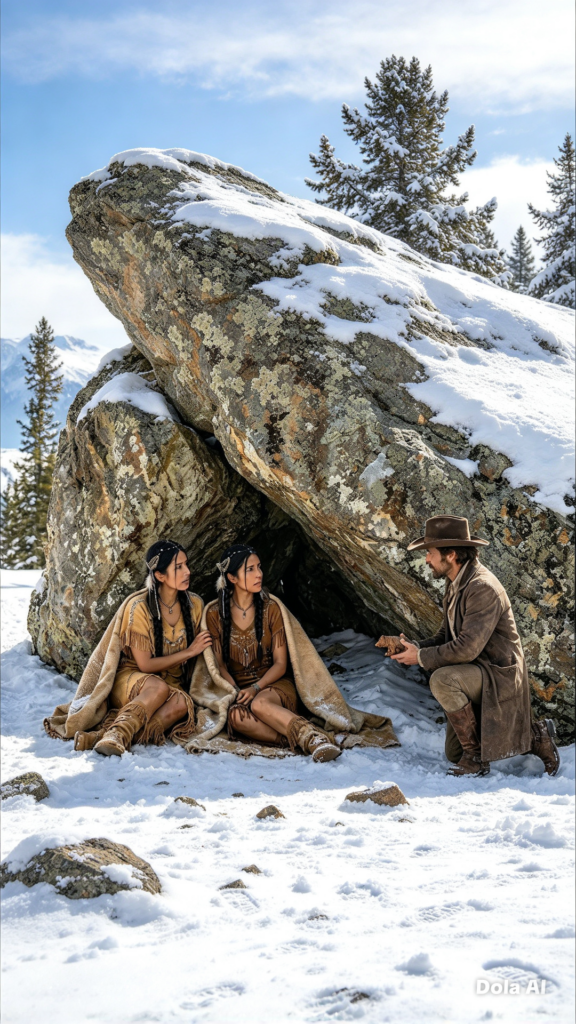
There, barely above the drift, was a gloved hand. Only the fingers showed.
He dropped to his knees and dug with both hands. The snow was wind-packed and hard as plaster. His fingers went numb in seconds, but he kept clawing until he uncovered the arm of a young woman wrapped in heavy furs. Her face was pale with cold. Her breathing was so shallow he could barely see it.
She was alive.
Relief flooded his chest, but only for a moment. As he cleared more snow, he saw something terrible. Her outstretched hand wasn’t reaching up for help. It was reaching sideways, toward another spot beneath the snow.
Someone else was buried beside her.
Ethan dug faster than he ever had in his life. His hands bled against hidden ice as sharp as broken glass. He didn’t stop. Within moments he uncovered the shoulder of a second woman. She was older, but no less exhausted.
The two women had wrapped themselves around each other in a desperate attempt to survive the freezing night. Ethan understood instantly. Neither had tried to save only herself. Each had refused to leave the other. That simple act of loyalty had probably kept them both alive long enough for help to come.
He checked their breathing. Both were alive, but barely. Another hour in the snow and neither would survive.
He fought his way back to Jack and gathered every blanket, rope, and supply he carried. Working against the storm, he lashed together a rough sled of pine boughs and tied it behind the horse. It took every ounce of his strength to drag the two women onto it. Their clothing was frozen stiff, and their bodies were limp.
Just before he mounted, the younger woman’s eyes opened.
She looked directly into his face. First there was fear, then confusion. Then her gaze dropped to his throat, where his shirt had pulled open in the struggle, and to the small dark stone hanging there on its leather cord.
Her lips moved. The wind nearly stole the words.
“You came.”
Before Ethan could answer, her eyes fell shut again.
He stared at her in silence. Those weren’t the words of someone surprised to be rescued. They were the words of someone who had been waiting for him.
The old trapper’s cabin stood at the edge of a frozen creek, sheltered by towering pines that broke the worst of the wind. By the time Ethan reached it, full night had fallen. His hands were raw and stiff, and every muscle in his body burned from dragging the sled through the drifts.
He led Jack into a lean-to beside the cabin, then carried both women inside, one at a time. The cabin was bare: a stone fireplace, a rough plank table, two narrow bunks built against the wall. It wasn’t much, but it meant warmth, and tonight warmth was the difference between life and death.
He worked fast. He built a fire from dry wood stacked inside months ago. Soon flames licked across the logs and filled the cabin with heat. He wrapped both women in dry blankets, tucked hot stones from the hearth beneath the bedding, and set water to boil.
Slowly, color returned to their faces.
The hours crawled by. The storm battered the walls, but inside there was only the crackle of burning pine.
Near midnight, the older woman opened her eyes. She looked around without speaking. Her gaze settled on Ethan, sitting by the fire sharpening a small knife.
“You saved us,” she said softly.
“Found you just in time,” Ethan said.
She nodded but showed little surprise. “Then the mountain chose well.”
Ethan frowned. “I don’t follow.”
Before she could answer, the young woman stirred and sat bolt upright, gasping as if waking from a terrible dream. The older woman laid a gentle hand on her shoulder.
“It’s over,” she murmured. “We’re warm. We’re safe.”
The young woman looked at Ethan. For a long moment no one spoke.
“My name is Ayanna,” she said at last. “This is my aunt, Nita.”
Ethan introduced himself with a quiet smile. Neither woman reached for the food warming by the fire. Instead they exchanged worried glances, as if something far heavier than the storm still weighed on them.
“You weren’t just crossing these mountains,” Ethan said carefully. “Nobody travels this country in weather like this without a reason.”
Nita sighed. From beneath her blanket she drew a small leather pouch tied with braided cord and held it close.
“This is why.”
Ethan expected gold, or medicine. Instead she opened the pouch and revealed a smooth, dark stone polished by long years of handling. Pale markings curved across its surface like flowing water.
“It belonged to my father,” Nita said. “And to his father before him.”
Ethan leaned closer to the firelight, and the breath went out of him.
He knew those markings. He had traced them with his thumb ten thousand times on long, lonely nights. They were the same curving pale lines, like flowing water, on the same dark stone, only larger.
Slowly, without a word, he reached up and drew the leather cord from under his shirt. He let the small stone at his throat swing free in the firelight.
Nita went utterly still.
Ayanna made a small sound, half sob and half laugh. “I told you,” she whispered to her aunt. “In the snow. I saw it, and I told you.”
Nita’s hands began to tremble. She stared at the stone around Ethan’s neck as though it were a ghost.
“Where did you get that?” Her voice cracked. “Tell me the truth, cowboy. Where did you get that stone?”
“My father gave it to me before he died,” Ethan said slowly. “He said it belonged to my mother. I never knew her. She died when I was a baby.”
Tears spilled down the old woman’s weathered face.
“Your father,” she whispered. “Was his name Jonas Walker?”
The fire popped. Outside, the wind howled. Ethan couldn’t breathe.
“How could you possibly know that?”
Nita reached across the space between them and laid her trembling fingers against the small stone at his throat.
“Because there were only two of these ever made,” she said. “My father carved the big one for our people. He carved this little one for his youngest daughter, my sister Tala, on the day she married a white trapper named Jonas Walker.” Her voice broke completely. “Ethan Walker, I am not a stranger you pulled out of the snow. I am your mother’s sister.”
PART 2: The Stone That Leads Home
For a long time Ethan couldn’t speak.
He sat by the fire with the small stone clutched in his fist, staring at the old woman who claimed to share his blood. Her cheekbones were high and fine. Her eyes were dark and steady. He thought of the only image of his mother he’d ever had, his father’s halting descriptions on rare whiskey nights. Dark eyes. Steady as a mountain. She could quiet a spooked horse just by humming.
“My father told me she died of fever,” Ethan said hoarsely. “When I was six months old. He said there was nothing anyone could do.”
Nita closed her eyes. “Your father told you what he could bear to tell you.”
Ayanna took Ethan’s bleeding hand in both of hers. “Tell him, Auntie. He has the right.”
Nita drew a long breath.
“Thirty-one years ago, men came into our valley. Silver hunters. Their leader was a young man with pale eyes and a voice like cold water. They believed our people’s stone marked a hidden silver lode, because my father would ride off into the high country with it and come back with no explanation. They wanted it. My father would not give it.” She looked at the fire. “They burned the village that night. Your mother was living with Jonas in a cabin below the camp, but she ran up to help our people escape. She carried children up the trail to the hidden valley, one after another, all night long. On her last trip down, the leader caught her on the trail.”
Ethan’s jaw went tight.
“Your father found her at dawn,” Nita whispered. “He carried you out of that valley in his coat and never came back. He told no one. I believe he thought if the hunters ever learned Tala had a son, they would come for the little stone, too. So he took you far away and raised you as a white man’s boy, and he let the world forget you were ever ours.”
Ethan stared into the flames. Eleven years his father had been dead. For thirty-one years Ethan had believed a fever took his mother. And all that time, the truth had been sitting in these mountains, waiting under the snow.
“The hunters,” he said finally. “The pale-eyed man. What happened to him?”
“He never stopped looking,” Nita said. “He grew old and rich hunting silver in other mountains. But he never forgot our stone. Three days ago he came back with eight men. They tore our village apart searching for it. When they couldn’t find it, they burned what they could and tracked us into the mountains.”
“His name,” Ethan said quietly.
“Silas Brandt.”
Ethan knew the name. Everyone in the territory knew it. Brandt owned half the mining claims from here to Leadville and had a reputation for buying judges the way other men bought cattle.
“If they wanted the stone so badly,” Ethan asked, “why leave you buried in the snow?”
Ayanna lowered her eyes. “They didn’t. We buried ourselves.”
He stared at her.
“We knew they’d keep searching the trails,” she said. “The storm was our only chance. We dug into the drift and let it cover us, so they’d ride past and believe we died in the blizzard.” She looked at him with a strange, shining certainty. “Auntie said we couldn’t last the night. I told her that if the mountain wanted us to live, it would send someone.” Her voice dropped. “Then I opened my eyes, and I saw Tala’s stone around your neck.”
The morning came clear and bitterly cold. Sunlight blazed off the fresh snow until the whole world glittered.
Ethan stepped outside with a bucket in one hand and his rifle over his shoulder, meaning only to check on Jack and break ice on the creek.
Halfway to the water, he stopped.
There were tracks.
They hadn’t been there the night before. A line of fresh prints crossed the snow at the tree line and vanished behind a stand of pines. Whoever had made them had been careful, moving slowly and keeping to cover. Ethan crouched to study them.
There were two men on foot. They had passed the cabin within the hour.
He went back inside quietly. “Someone’s close.”
Both women were on their feet at once. Ayanna peered through a crack beside the shutter. “I don’t see anyone.”
“They’re keeping their distance,” Ethan said. “That worries me more.”
Nita gripped the leather pouch. “Scouts. Brandt’s.”
“If they find this cabin, the rest will follow.”
Nita pointed north, toward the high peaks. “There’s another place. My people built a winter shelter there long ago, at the mouth of the hidden valley. Very few outsiders know it exists. If the snow isn’t too deep, we can reach it by sundown.”
Within the hour they had packed everything they could carry. Ayanna tucked the leather pouch deep inside her coat. Before they left, Ethan erased every sign the cabin had been used. He scattered fresh snow across the doorway, brushed out their tracks as best he could, and led Jack away along the hard-frozen creek bed, where hooves left no prints.
The trail grew steeper with every mile. In places the snow came nearly to their hips. Ethan offered more than once to carry Ayanna’s bundle, but she refused with a tired smile.
“We’ve survived this far,” she said. “I can still walk.”
As they climbed, Nita walked close beside him and told him about his mother in a low voice, as if she’d been saving the words for thirty years. Tala had laughed too loudly at her own jokes. She’d been the fastest runner in the village and the worst cook. She had once tamed a wild colt by sitting in its corral and singing for three days straight.
“You have her hands,” Nita said, glancing at his raw, bandaged fingers. “She would have dug through that snow just as you did. She never could walk past anyone in trouble.”
Ethan said nothing. His throat was too tight.
By late afternoon, dark clouds were massing again. As they crested a narrow ridge, Ethan threw up a hand. “Stop.”
Far below, two riders came out of the trees, moving slowly and leaning from their saddles to study the ground. One pointed toward the valley where the trapper’s cabin stood. The other nodded and wheeled his horse uphill.
“They’ve found our trail,” Ethan said softly.
Ayanna went pale. “They’ll search every hollow in these mountains.”
“Then we keep moving.”
As they started down the far side of the ridge, Nita slowed. “There’s something I haven’t told you yet, Ethan.”
He turned.
She glanced at the pouch beneath Ayanna’s coat. “Brandt believes that stone leads to silver. He has believed it for thirty years. He’s wrong.” Her voice dropped nearly to a whisper. “It leads to people.”
The words hung in the frozen air.
“Those markings aren’t decoration,” Nita said. “They’re a map, carved in the old way, of every hidden valley in these mountains where our children and elders can shelter when danger comes. Only the keeper of the stone knows how to read it. There are more than sixty of our people hiding in those valleys right now, waiting for us to bring it home.” She looked at him. “If Brandt takes the stone and learns to read it, every refuge becomes a trap.”
Ethan understood then. The stone had never guarded treasure. It guarded lives, just as his mother had, carrying children up a burning trail one at a time until the very end.
The last stretch tested every ounce of their strength. The narrow trail climbed between towering cliffs, then opened suddenly into a hushed, sheltered valley that seemed untouched by the outside world. Tall pines ringed it on every side.
“There,” Nita said, pointing to a small log shelter built against the rocks.
The sun was setting behind the snowy peaks when they reached it. Ethan got a fire going, and warm light filled the tiny room.
As they rested, a soft whistle sounded outside. Ethan reached for his rifle, but Nita gently pushed the barrel down. “One of ours.”
Three Apache scouts slipped in from the cold. Relief flooded their faces at the sight of Nita and Ayanna alive. The eldest, a lean man with silver-streaked braids named Hosteen, embraced Nita and listened in silence while she spoke quickly in their language. Then he turned and studied Ethan’s face for a long time.
He didn’t look at the cowboy hat or the white man’s coat. He looked at Ethan’s eyes and at the small stone hanging at his throat.
“Tala’s boy,” Hosteen said quietly. “I was nine years old the night your mother carried me up this trail on her back. I have waited thirty-one years to thank someone for it.” He put a hand on Ethan’s shoulder. “Welcome home, nephew.”
Ethan had faced blizzards, stampedes, and men with guns. He had never been so close to breaking down in front of strangers.
Nita untied the leather pouch and placed the great stone in Hosteen’s hands. He held it with deep reverence.
Then, from outside, the wind carried a sound across the valley: hooves, a lot of them.
The scouts were out the door instantly, melting into the trees. Ethan stood at the doorway with his rifle and watched the narrow trail that led into the valley.
Riders came out of the dusk. Ethan counted eight, all of them heavily armed. At their head rode an old man in a fine wolfskin coat, sitting his horse as if he owned the mountain. His hair was white. His eyes were pale as frost.
Silas Brandt reined in at the edge of the clearing and raised his voice. It carried like cold water over stones.
“I know you’re in there, Walker!” he called. “My scouts saw your horse. Funny thing. When they described the cowboy who dug those women out of the snow, I didn’t believe it. So I came to see for myself.” He smiled thinly. “You’ve got your father’s look. I’d know Jonas Walker’s face anywhere. I watched it the morning he found what I left of your mother on that trail.”
Inside the shelter, Ayanna gasped. Nita’s hand flew to her mouth.
Ethan stood in the doorway, completely still. The rifle was steady in his hands.
“Send out the stone,” Brandt called. “Or I’ll do to you exactly what I did to her.”
PART 3: What His Mother Would Have Done
Ethan stepped out into the snow.
“Ethan, no!” Ayanna cried.
He walked forward until he stood alone in the open clearing, thirty feet from the old man on the horse. Eight rifles turned to follow him. The rage in his chest was so hot that for a moment he couldn’t see anything but those pale eyes.
He could kill Silas Brandt right now. He could put a bullet through the man’s heart before a single one of those eight rifles fired, and every soul in the territory would say he was justified.
And then he thought of his mother. She hadn’t spent her last night fighting. She had spent it carrying children up a mountain.
“You came here for the stone,” Ethan said. His voice carried through the cold air, steady and clear. “So did your scouts. So did your men. Thirty-one years you’ve hunted it.” He let his eyes move slowly along the ring of pines around the clearing. “Look around you, Brandt.”
Brandt’s smile faltered.
One by one, the scouts rose from behind the pines and the snow-covered rocks. Three became ten, ten became twenty, and then more appeared along the cliff tops above, men and young women alike, bows drawn and rifles leveled. The people of the hidden valley had heard the hooves. Sixty souls Brandt had hunted for thirty years now surrounded his eight hired guns on every side.
The riders’ horses danced nervously. Their eyes swept the trees, and every one of them understood at the same moment. They had ridden into a place they couldn’t ride out of.
“You came here thinking that stone leads to silver,” Ethan said. “It doesn’t. It leads to them. And now they’ve found you.”
“Shoot him!” Brandt snarled. “Shoot him, damn you!”
Not one of his men moved.
The leader of the hired guns, a weathered man with a grey beard, slowly lowered his rifle. “Brandt paid us to find silver,” he said. “Not to die in a box canyon for an old man’s grudge.” He tossed his rifle into the snow. One by one, the others followed.
Brandt sat alone on his horse in the center of the clearing, trembling with fury. His hand dropped toward the pistol at his hip.
Ethan raised his rifle. “Don’t.”
For a long moment the old man held his gaze. Then he did something Ethan didn’t expect. His face crumpled. Underneath all the wealth and the wolfskin coat, he was just a frightened old man who had spent his whole life chasing something that had never existed.
“Thirty-one years,” Brandt whispered. “There was never any silver?”
“Never,” said Nita from the doorway. “Only children.”
Brandt’s hand fell away from the gun.
Hosteen stepped forward. “We will not kill him,” he said to Ethan quietly. “That is not our way. And I think it was not your mother’s way either.”
“No,” Ethan said. He lowered his rifle. “It wasn’t.” He looked up at Brandt. “There’s a federal marshal in Silver Fork. You’ll ride down this mountain with your hands tied, the way my father carried me down with nothing. You’ll answer for burning a village three days ago. And I’ll testify to every word you just said to me about my mother, in front of a judge you can’t buy.”
They sent Brandt and his men down the mountain under guard the next morning. The scouts rode with them as far as the territorial line, and Ethan rode as far as the marshal’s door. The bearded leader of the hired guns turned witness before they’d gone ten miles. Months later, Silas Brandt was convicted of arson and attempted murder. He died in a territorial prison two winters after that, still muttering about silver.
That first night in the hidden valley, though, there was only firelight.
Families came out of the high refuges by the dozen: children laughing and throwing snow, and elders who wept openly when they saw the stone safe in Hosteen’s hands. They built a great fire in the clearing and shared what little food they had with the cowboy who had arrived as a stranger.
One by one, the old people came to Ethan. Each had a story about Tala. One remembered her terrible cooking, another her laugh, and a third the night she carried him up the burning trail on her back. Ethan listened to every word as though he were drinking water after a long drought.
Late that night, Nita sat beside him at the fire. From her coat she drew something wrapped in soft deerskin. Inside was a faded tintype, cracked at one corner. It showed a young woman with dark, steady eyes, laughing at whoever held the camera, and beside her a tall young man in a trapper’s coat, gazing at her as if she had hung the moon.
“Jonas gave me this the week before you were born,” Nita said softly. “I’ve kept it for thirty-one years. I always believed someday Tala’s son would come home to claim it.”
Ethan held the photograph of his parents in his bandaged hands. For the first time since he was a child, he wept.
He didn’t leave in the morning.
He stayed through the long winter in the hidden valley. He cut wood, hunted with the scouts, and learned the old words for snow and stone and home. Ayanna taught him the song his mother had sung to quiet wild horses. Hosteen taught him to read the curving lines on the great stone, the map of every refuge in the mountains. When spring came, the elders gathered at the council fire and asked Ethan Walker, Tala’s son, to become one of the stone’s keepers. It was the first time in the band’s memory that a man raised outside the valley had been trusted with it.
He said yes.
When the snow finally melted from the high passes, Ethan rode down the mountain on Sorrel Jack with his mother’s small stone at his throat and his parents’ photograph in his breast pocket. He was going to settle his affairs in town, and then he was coming back.
He finally understood what his father’s last words had meant. She said it would always lead you home.
It had. It had simply waited thirty-one years, and a blizzard, and one cowboy who refused to ride past a hand reaching up out of the snow.
The greatest rewards aren’t measured in silver or gold. They’re measured in the lives we choose to protect, and sometimes, if we’re very lucky, in the family we find waiting at the end of the trail.
THE END