PART 1: The Woman at the Post
The crossroads at Dry Fork was the kind of place decent men passed through without stopping.
It wasn’t a town. It was a trading post, a water trough, a saloon built of warped planks, and a hitching rail where the wind never stopped blowing grit into a man’s eyes. Four trails met there, from the mining camps, the border, the cattle country, and the reservation lands, and whatever moved along those trails eventually washed up at Dry Fork. Whiskey. Stolen horses. Rifles sold to anyone with gold.
And sometimes, people.
Cole Brannan had heard the rumors. Everyone in the territory had. But he’d never believed them until the afternoon he rode in to water his horse and saw her.
She was tied to a post beside the saloon, out in the full white glare of the sun. Rawhide bound her wrists behind the wood. Her dark hair hung loose and tangled, her lips were split and cracked from thirst, and a crude board leaned against the post at her feet with a number chalked on it.
A price.
She was young, perhaps twenty, Apache by the cut of her moccasins and the beadwork at her collar. But what stopped Cole cold was not her bruises or her bonds. It was her eyes. She was not weeping. She was not begging. She was watching the doorway of the saloon with a steady, burning patience, the way a hawk watches a field.
Three men sat on the trading post porch, chewing tobacco and pretending she wasn’t there. A teamster watered his mules not ten feet from her and never once looked up.
Cole stood with his canteen in his hand for a long moment.
He was not a brave man, or so he’d always told himself. He was a rancher with a quarter-section of hard ground, sixty head of cattle, a mortgage, and nobody in the world who’d miss him much if he took a bullet in a place like Dry Fork. He had every reason to fill his canteen and ride on.
He walked to the post instead.
The woman’s eyes shifted to him. Something flickered there: not hope, but calculation, as if she were measuring what kind of man he was and how much trouble he would be.
“I’m not going to hurt you,” Cole said quietly.
He drew his knife.
The rawhide parted in two clean strokes. Her arms fell free, and she caught herself against the post, swaying. Cole uncapped the canteen and held it out.
For a heartbeat, she only stared at it. Then she took it and drank, slowly and carefully, the way someone drinks who has known real thirst before and knows better than to gulp. When she lowered it, she studied him again, with a fierce, wary pride that made him feel he was the one being judged.
“Can you ride?” he asked.
She nodded once.
That was when the saloon door banged open.
“Now what in the hell do you think you’re doing with my merchandise?”
The man in the doorway was big through the shoulders and soft through the middle, with a sunburned scalp beneath a greasy hat and a Colt worn high on his hip. Two more men crowded behind him, smelling of whiskey and trouble.
Cole knew the name before anyone spoke it. Everyone along these trails knew Boone Kessler.
“She’s not merchandise,” Cole said.
Kessler laughed, a wet, ugly sound. “She is if I say she is. Paid good money for her. Lost a man getting her, too. So you put your little knife away, cowboy, and you tie her back up nice, and maybe I let you ride out of here with all your teeth.”
The porch had gone silent. The teamster had found urgent business behind his wagon.
Cole didn’t move. The woman stood half a step behind him now, and he could feel her stillness at his back like a held breath.
“Here’s what’s going to happen,” Cole said, and he was surprised by how steady his voice came out. “She’s going to get on my horse. And I’m going to walk her out of here. And you’re going to let us, because there are six men on that porch who’ll be talking about this in every camp from here to Tucson, and I don’t think you want them saying Boone Kessler shot a man in the back over a woman he stole.”
Kessler’s face darkened. His hand drifted toward his gun.
Cole’s hand rested on his own.
For one long, scorching second, the crossroads held perfectly still.
Then Kessler smiled. It was worse than the laugh.
“Go on, then,” he said softly. “Take her. Take her home. But I know your face now, cowboy. And I know there ain’t but one way out of this country you’d be headed with that brand on your saddle.” He spat in the dust. “I’ll be seeing you.”
Cole lifted the woman into his saddle and led the horse out of Dry Fork on foot, never once looking back.
It was the longest walk of his life.
She followed him like a silent shadow across the red earth.
After the first mile, she slid down from the saddle and refused to ride while he walked. So they walked together, his horse plodding slowly between them. Cole didn’t press her to speak. Now and then he glanced back to make sure she was still there, and every time she was, a few paces behind, her dark eyes missing nothing: the lay of the land, the hawks circling high, the man who had offered her water.
His ranch sat alone in a broad, empty valley: a weathered house and a barn holding fast against an enormous sky. He led her inside, the floorboards creaking under his boots, and showed her the small spare room. It was plain but clean, with a quilt on the bed and a window facing west.
“Yours,” he said. The word came out rough, but he meant it gently.
He brought her stew, bread, and cool water from the well. She ate in silence. When she finished, she looked up at him for a long moment.
“Lian,” she said.
It was the first word she had spoken.
“Cole,” he answered.
She nodded, as if filing the name away somewhere safe.
The days that followed settled into a quiet rhythm.
They spoke little at first. Their conversation was a language of small gestures: a plate pushed forward, a nod of thanks, a cup refilled before it ran empty. She watched him mend a bridle by firelight, his hands capable and sure. He watched her stand at the window in the evenings, staring toward the darkening hills, her proud profile etched with something he could only call sorrow.
Once, when he reached to take her empty bowl, her fingers brushed his.
They both went still.
Something passed between them in that quiet room, warm and startling. He didn’t pull away. After a moment, neither did she. It was only a touch, but it felt like the first fragile bridge across a deep canyon.
As her strength returned, so did a quiet industriousness. She didn’t ask permission. She simply began. One afternoon he came in from the corral to find his torn spare shirt mended with tiny, perfect stitches and folded neatly on his chair. The sight of it lodged in his throat for hours. In return, he left small offerings by her door: a cup of wild honey from a bee tree he’d found, a smooth black river stone that caught the light like obsidian.
One evening, struggling to rehang the warped barn door, he felt her appear at his side. Without a word, she braced the wood just so, holding it steady. Their shoulders nearly touched. He drove the pin home with a solid tap.
“There,” he said.
She released her hold. A faint smile touched her lips. “It is good.”
That was all. But something shifted in that moment, as the first stars pricked the deep blue sky.
And yet, every night, Cole sat on the porch with his rifle across his knees. Because every night, he remembered Boone Kessler’s smile.
Kessler came on the eleventh day.
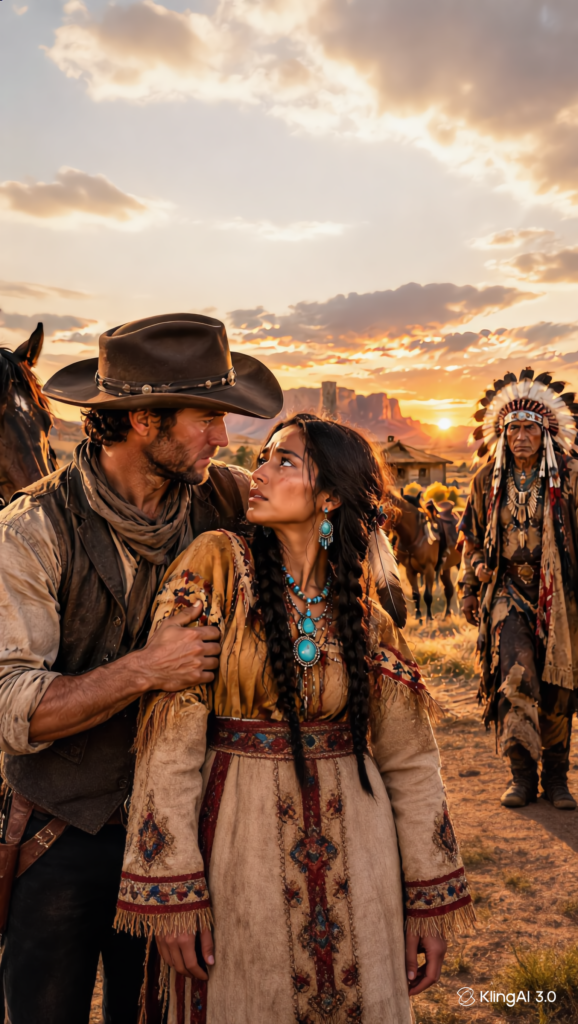
Six riders crested the eastern rise at midmorning and came down the valley at an easy walk, the way men ride when they believe they have all the time in the world. Cole met them at the gate with his Winchester. Lian stood in the doorway of the house behind him.
Kessler reined up and leaned on his saddle horn, grinning.
“Told you I’d be seeing you.”
“You’ve seen me,” Cole said. “Now ride on.”
“Can’t do that.” Kessler’s eyes slid past him to the doorway. “See, that girl’s worth more than you know. There’s a man waiting on her. A man who pays very well and doesn’t care to be disappointed.” His grin widened. “So I’ll be generous. You’ve got till sundown tomorrow. You bring her to the Dry Fork road, and we forget all this. Or we come back after dark, and we take her, and we burn everything you own with you inside it.”
He turned his horse, then looked back.
“Sundown, cowboy.”
They rode away laughing.
That night, Cole didn’t sleep at all. He cleaned his rifle and his old Navy revolver, counted his cartridges twice, and filled every bucket on the place with water against fire. Near midnight he looked up and found Lian standing in the doorway of her room, watching him.
“You could take the horse,” he said quietly. “Go tonight. Back to your people. They’d never find you.”
She looked at him for a long time.
“No,” she said.
“Lian, they’ll—”
“No.”
She said nothing more. But she did not go back to her room. She sat down across the table from him and stayed there, silent and unafraid, until dawn.
The next day crawled by in heat and dread. As the sun sank toward the western hills, Cole took his place behind the stone wall of the well house, rifle ready. Lian crouched beside the barn with his revolver, which she had taken from the table without asking and checked with the easy competence of someone who had held a gun before.
The sky turned orange, then red.
Then Cole saw the dust.
It rose not from the east, where Kessler’s men had gone, but from the north, from the high ridge that led toward the mountains and the reservation lands beyond. A long line of dust, moving fast.
Riders. A dozen of them, emerging from the shimmering heat.
Not Kessler’s men. Apache.
They came down the slope in a tight, silent formation, rifles in their hands, and at their head rode a tall man on a gray horse, his long hair streaked with silver, his face carved and hard as weathered stone.
Beside the barn, the revolver slipped from Lian’s fingers and fell into the dust.
“Chuya,” she whispered.
Cole turned. Her face had gone white as bone.
“Who is he?”
She couldn’t seem to take her eyes off the rider on the gray horse. When she finally spoke, her voice was barely a breath, filled with something between reverence and terror.
“My father,” she said. “The soldiers said they buried him seven years ago.”
The riders swept into the yard and fanned out in a half circle, surrounding the house. The tall man reined his gray to a halt directly in front of Cole. He didn’t look at his daughter. He looked only at the cowboy, with eyes as dark and cold as a winter river.
When he spoke, his English was low and heavy as gravel.
“So. You are the man who cut the ropes.”
“I am,” Cole said.
Chuya’s hand tightened on his rifle.
“Then you have ruined everything,” he said. “And now I must decide what to do with you.”
PART 2: The Secret in the Ropes
For a long moment no one moved. The sun hung blood-red on the horizon. Cole set his rifle against the well house wall, slowly, deliberately, and stepped out into the open yard with his hat in his hands.
Fear sat tight across his shoulders. But he walked forward anyway.
Chuya dismounted. His movements were fluid and unhurried. For a while he did not look at Cole at all. His gaze swept over the mended barn door, the sturdy corral, the small patch of earth by the porch where Lian had planted wild herbs and flowers in the past week. It was a slow, thorough assessment, and Cole stood in the heavy silence and let him make it.
Finally those dark eyes settled on him.
“You gave her water,” Chuya said. “When she was bound in the sun, and every man at that crossroads looked away, you gave her water and asked for nothing.”
“It was only right.”
“Right.” Chuya turned the word over as if it were a strange stone. “And in doing what was right, you have undone six months of my work.”
Lian came across the yard then, fast, and stopped beside Cole. Her shoulder brushed his arm, a small, silent declaration that did not escape her father’s notice.
“Father,” she said, her voice shaking. “They told us you were dead. The soldiers. They said they saw your body. We sang for you.”
For the first time, something cracked in Chuya’s stone face.
“I know, little bird,” he said quietly. “I let them believe it. It was the only way.”
They talked by lamplight in Cole’s kitchen while Chuya’s warriors kept watch in the darkness outside. And slowly, piece by piece, the secret came out.
Seven years before, Chuya explained, Apache children had begun disappearing from the camps near the border. A boy here, a girl there, taken while gathering wood or watering horses. At first the families believed it was raiding. Then a trader, drunk and talkative, let slip that there was a market for them, a buyer down in the mining country who paid in gold and asked no questions. Children sold into the mines. Young women sold to men who would never let them go.
“I went to the soldiers,” Chuya said. “I told them. They laughed. An Apache complaining of thieves, they said.” His jaw tightened. “So I went to find the buyer myself. I was ambushed on the Dry Fork trail. I was shot twice and left for dead. A soldier who found me reported that I had died. When I woke, weeks later, in a cave where an old woman of our people had dragged me, I understood the gift I had been given.”
“A dead man can go anywhere,” Cole said slowly.
“A dead man can watch. A dead man can listen.” Chuya nodded. “For seven years I have hunted the men who sell our children. I have found the traders. I have found the crossroads. I have freed many. But the one at the center, the one who pays and gives the orders, I have never found. He never shows his face. He sends his money through men like Kessler, and the captives are always taken to him in the dark.”
He looked at his daughter, and his voice softened.
“Then, six months ago, she found me.”
Lian’s eyes were bright with unshed tears. “I heard a rumor. A tall Apache with silver in his hair, haunting the border trails like a ghost. I knew it was him. I knew it.” She looked at Cole. “And when I learned what he was doing, I asked to help.”
A cold understanding was creeping into Cole’s chest.
“The post at Dry Fork,” he said. “You weren’t captured.”
“I was captured,” Lian said quietly. “But I let them take me.”
The room went very silent.
“It was the only way to reach the buyer,” Chuya said. “Kessler was going to deliver her to him himself. My warriors were following at a distance. When the trade was made, we would finally see his face. Finally end it.” He let out a long breath. “And then a cowboy rode into Dry Fork to water his horse.”
Cole sat back hard in his chair. He thought of her eyes that day, watching the saloon door with that burning patience. Not despair. Strategy. She had been waiting for her enemy, and he had walked up and cut her loose.
“I’m sorry,” he said hoarsely. “I didn’t know.”
“No,” Chuya agreed. “You did not.” He leaned forward, studying Cole in the lamplight. “But there is something I must understand. My daughter knew the plan was broken the moment you cut those ropes. She could have left you that same night. She knew these hills better than you know your own barn. Every night she could have taken your horse and come back to me.” He turned to his daughter. “Why didn’t you?”
Lian didn’t answer. She looked at the table, and then at Cole, and the answer was written so plainly on her face that Cole felt the floor tilt beneath him.
Chuya saw it too. For a long moment he said nothing at all.
“Kessler is coming tonight,” Cole said finally. “He gave me until sundown.”
“I know,” said Chuya. “That is why we came. My scouts have been watching his camp for two days.” A thin, dangerous smile touched his face. “And now, perhaps, the broken plan can be mended. Kessler cannot return to his buyer empty-handed. If he fails tonight, he must go to the buyer himself and explain. And when he does, we will be behind him.”
“So we let him come,” Cole said.
“We let him come. We let him fail. And we let him run.”
Kessler came two hours after midnight.
Cole heard the horses first, a muffled drumming from the east. Then the shapes of riders slipped through the starlight, more than six this time. Ten. Twelve. Torches flared one by one, orange and hungry.
“Cowboy!” Kessler’s voice rolled across the valley. “Time’s up!”
Cole stood alone on the porch, as they had planned. Inside the dark house, Lian waited by the window with his revolver. In the barn, in the shadows of the corral, behind the stone of the well house, twelve Apache warriors lay so still that Cole himself could not see them, though he knew exactly where they were.
“Last chance!” Kessler shouted. “Send her out!”
“Come and get her,” Cole called back.
Kessler swore and waved his torch. “Burn it!”
The riders surged forward.
Then the night exploded.
Rifles cracked from the barn, from the well house, from the dark grass on both flanks. Horses screamed and reared. Torches tumbled into the dirt. Kessler’s men, who had come expecting one frightened cowboy, found themselves caught in a storm of fire from every direction at once. Three were knocked from their saddles in the first seconds. The rest wheeled in panic, colliding, shouting.
A man broke for the porch with a torch raised high. Cole fired once, and the torch spun away into the dark. A rider swung toward the window where Lian stood, and her shot rang out flat and sure, and he fell back across his horse’s neck.
Through the chaos Cole saw Kessler, wild-eyed, hauling his horse around.
“Get out!” Kessler bellowed. “Get out!”
What was left of his gang scattered into the night, back the way they had come.
And behind them, silent as owls, four Apache riders slipped away into the dark and followed.
The valley fell quiet again. Smoke drifted from a smoldering torch in the yard. Cole stood on the porch, his hands shaking now that it was over, and felt Lian’s hand slip into his.
He looked down at her. She looked up at him. Neither of them said anything.
Across the yard, standing beside his gray horse in the starlight, Chuya watched his daughter holding the cowboy’s hand. His face was unreadable.
“Now we wait,” he said. “And in the morning, if the spirits are kind, we will know the name of the man I have hunted for seven years.”
He turned and walked into the dark to join his men.
Lian’s grip on Cole’s hand tightened.
“When this is finished,” she whispered, “he will want me to come home.”
And Cole, who had faced down Boone Kessler twice without flinching, found that this was the only thing in the world he was truly afraid of.
PART 3: What the Father Saw
The scouts returned at dawn the following day, and they brought the name with them.
Kessler had ridden hard through the night, straight to a fine stone house on the edge of the mining town of Silver Bend. The man who opened the door to him, in his dressing gown, by lamplight, was Judge Harlan Voss, the territorial magistrate. The man who sat on the bench. The man every Apache complaint had been brought to for seven years, and who had dismissed every one.
Chuya listened to the report in silence. When it was finished, he closed his eyes for a long moment.
“No wonder the soldiers laughed,” he said.
It was Cole who rode to the army post at Fort Hollis, three days’ ride north, with Kessler’s saddlebags slung behind him, recovered from the yard the night of the raid. Inside them were a ledger and letters, every page in Judge Voss’s own careful hand. Names. Prices. Dates. A white rancher’s sworn testimony and a magistrate’s own handwriting were things even a skeptical colonel could not laugh away.
Two weeks later, a cavalry detachment rode into Silver Bend. Judge Harlan Voss was led out of his stone house in irons. Boone Kessler was taken in a mining camp saloon, too drunk to reach his gun. And in a locked compound behind the judge’s stables, soldiers found nine Apache children, alive, frightened, and waiting.
They were home with their families before the moon was full.
Chuya came back to the ranch on a clear, golden afternoon. He came alone this time.
He dismounted at the gate and walked slowly up the path, looking once more at the barn, the corral, and the garden where Lian’s herbs grew thick and green. Then he stopped in front of Cole and his daughter.
“There is one more secret,” he said. “The last one.”
Lian’s breath caught.
“When my daughter found me, six months ago,” Chuya said, “I did not want her to go to Dry Fork. I forbade it. She went anyway.” A ghost of pride touched his voice. “She is very much her mother. So I made her one condition. If any man along those trails proved himself better than the men who bought and sold our people, if any man saw her and treated her as a person rather than a prize, she was to stay and learn his heart. Because I told her that if one such man existed, then the fight was not hopeless. Then there was something on this side of the world worth making peace with.”
He looked at Cole steadily.
“She was not only sent to find our enemy. She was sent to find whether a man like you existed. Not a man of words. A man of worth.”
Cole couldn’t speak.
“I came here ready to take my daughter home,” Chuya went on, his voice low. “But I have watched her these weeks. I have seen how she looks at this land, and at you. It was not your ropes that held her here. It was her choice.” He laid a weathered hand on Cole’s shoulder. “So I give you my blessing. Not as a treaty. Not as a debt. As a father who knows his child’s heart.”
Lian stepped forward and wrapped her arms around him. He held her tightly, eyes closed, then cupped her face in his hands.
“Be happy, little bird,” he said softly. “Your nest is here now.”
He gave Cole one final nod, mounted his gray, and rode away toward the mountains.
When the dust had settled, Cole turned and found Lian already looking at him, her eyes shining.
“I was afraid,” she said. “Afraid my heart had led me somewhere that could never be mine.”
He caught her hand and held it against his cheek. “Every beam of this place is yours. It’s been yours since the day you looked at me like I was worth something. I was just too scared of hoping to say it.”
“I love you, Cole,” she said simply. “Not as a refuge. As my choice.”
He pulled her into his arms. “And I love you. I think I have since you first stood in my doorway, all fire and grace. I just didn’t have the words.”
That evening they walked to the gate together and watched the sky burn orange and violet over the hills.
“It doesn’t feel the same anymore,” Cole said. “Before, I was just holding this land. Now I’m building it. With you.”
“You are not my protector,” Lian said, smiling. “And I am not your rescued one.”
“Partners,” he said.
“Partners,” she echoed.
The seasons turned. They built a second room onto the cabin, their laughter as constant as the hammering. She showed him which wild herbs could heal; he taught her the names he knew for the stars. Chuya came every spring when the cottonwoods shed their white fluff, no longer a ghost but a grandfather, sitting on the porch in comfortable silence and telling stories of a little girl with a spirit like a quick, bright bird.
Along the trails, people began to tell their story too: the cowboy who cut the ropes at Dry Fork, and the Apache woman who chose to stay. They say the wind sounds different in that valley.
One evening, years later, Cole took Lian’s hand at the gate and looked out over the fields they had raised together.
“It’s a good promise, this land,” he said.
She leaned her head on his shoulder. “It is a promise we built.”
And beneath that vast, star-scattered sky, the frontier felt not like an ending, but like a beginning meant to last.