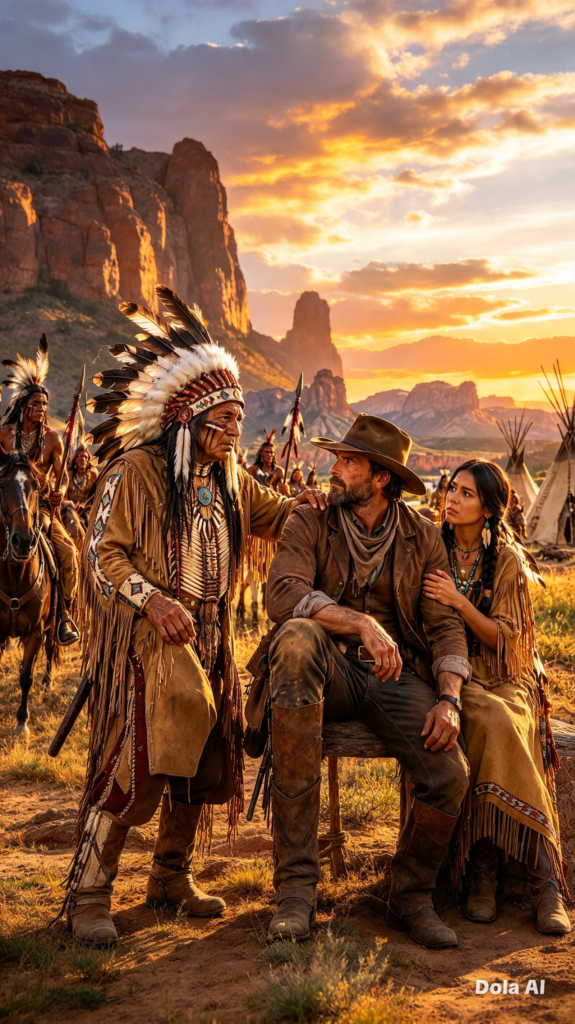
PART 1: A Cup of Water
The sun hung low and mean over Josiah Wren’s fence line, and Neska’s throat felt packed with sand.
She had walked since before dawn. Her moccasins were gray with dust. Her braid had come half undone. She kept her eyes fixed on the cabin door because looking anywhere else felt like giving up.
A man came around the corner of the barn with a bucket in each hand.
He stopped.
He was perhaps thirty-five, tall and rawboned, with a sun-creased face and hands like old saddle leather. He looked at her the way men look at weather that might turn: careful, measuring, giving nothing away.
“Water,” Neska said. It came out cracked and broken. “Please.”
He set the buckets down.
He didn’t ask her name. He didn’t ask what people she belonged to, or where she’d come from, or what trouble might be riding behind her. He simply walked to the iron pump beside the trough and worked the handle. The squeak and gush of it was the sweetest sound Neska had heard in a week.
He filled a tin dipper and held it out to her.
She drank. Then drank again. He waited, saying nothing, while the water ran down her chin.
When she lowered the dipper, he nodded toward the porch.
“There’s stew,” he said. “It’s not good. But it’s hot.”
Neska followed him, because her legs had nothing left to argue with.
The stew was good. He pulled out a chair for her without fuss, then sat across the table and ate as though she weren’t the strangest thing to walk onto his land in ten years.
Halfway through the bowl, he spoke again.
“Cattle don’t care who feeds them,” he said. “Neither does a fence line.” He wiped his mouth with the back of his hand. “I’ve got more work than one man can do. There’s a bunk in the back room. If you want it.”
Neska set down her spoon.
In her experience, white men always wanted something in return. Land. Horses. Silence. Worse things. She’d been taught to look for the price behind every gift.
But this man just looked back at her, quiet and steady, and she found no hunger in his eyes, and no fear.
“Why?” she whispered.
He shrugged. “You asked for water. That’s all.”
Neither of them saw the old man in the cottonwoods down by the creek.
He sat his gray horse in the deep shade, perfectly still, the way a hawk sits on a dead branch. He watched the cabin until the lamp was lit and the door closed.
Then he turned his horse and rode slowly back into the hills.
The days that followed settled into a quiet rhythm.
Neska kept to the edges of the yard, but her hands were never idle. Josiah noticed it first in the tack shed, the morning he found her sitting on an upturned bucket mending a cracked bridle. She stitched the old leather with a patience that was almost like prayer. Nobody had asked her to. She’d simply seen something broken and made it whole.
The next week, his bay mare spooked at the gate, rearing and wild-eyed, striking at the air. Before Josiah could get there, Neska had stepped in close, humming low in her throat, and laid her palm flat against the mare’s trembling neck. In half a minute, the horse stood still and blowing, her head lowered against the girl’s shoulder.
Josiah stood frozen in the barn doorway.
Plenty of folks had gentled horses for him over the years. None had ever made him stand still just by watching them do it.
“You’ve got a gift,” he told her that evening, handing her a tin cup of coffee on the porch.
She wrapped both hands around it and kept her eyes down. “A gift is only something you’re allowed to keep. I have learned to be careful with mine.”
He frowned. He didn’t understand the words, and he didn’t like the weight they carried in her voice.
She drank quickly. Then she slipped away to the back room like a shadow afraid of daylight.
Josiah stayed out by the corral rail long after dark, watching the last red light drain out behind the pines.
She did the work of two hired men and asked for nothing. And every time he looked at her, she turned her face away, as though being seen were a debt she could never repay.
He meant to know why.
He meant to make her understand that here, at least, nobody would ever take her gift away.
Three weeks after she came, Josiah rode into Cibecue Crossing for nails, coffee, and a new harness for the mule.
Walt Penny, the storekeeper, leaned over his counter and spoke low, the way men do when they want a thing said without having to own it.
“Word gets around, Josiah. Apache woman living under your roof. Folks are saying trouble follows her kind.”
Josiah laid his coins on the counter one at a time. He didn’t argue. He didn’t explain.
“Anything else you’re selling today, Walt?”
The storekeeper blinked and rang him up.
But behind Josiah, a well-dressed man stepped away from the cracker barrel. He was perhaps fifty, in a gray suit too fine for Cibecue Crossing, with a gold watch chain and a smile that didn’t reach his eyes.
“Mr. Wren. Silas Rourke. Western Range Cattle Company.” He held out a soft hand. Josiah didn’t take it. Rourke let it drop without a flicker. “I’ve written you three letters about that spring on your north quarter.”
“And I’ve answered three times.”
“My company would pay four thousand dollars for it. Cash.” Rourke’s smile widened. “That’s more than your whole place is worth, if you’ll forgive me.”
“It’s not for sale.”
“Everything’s for sale, Mr. Wren. It’s only a question of price.” Rourke leaned in. “And of what it costs a man not to sell. You’ve heard the army’s talking about moving the Cibecue bands off this creek? Onto the San Carlos reservation? Once they’re gone, every rancher in this valley will need that water. You’d be wise to sell while it’s still worth something.” He glanced toward the door. “Before your houseguest’s people give the army a reason to move faster.”
Josiah turned and walked out without a word.
He didn’t see Neska standing just outside the door, holding the mule’s new harness. She had heard every word.
That evening, Josiah found her kneeling beside the bunk in the back room, rolling her few belongings into a tight bundle. A comb. A faded blue ribbon. A small knife with a carved bone handle.
“Where do you think you’re going?” he asked quietly.
“Where I’m wanted,” she said, without looking up.
He didn’t answer at first. He stood in the lamplight with his hat in his hands, turning it over and over as though he’d forgotten what hands were for.
“You’re already wanted here,” he said finally.
Her fingers stopped on the knot.
“Folks in town talk,” Josiah went on. “They’ll talk till the day they die. I never cared much for the sound of it.”
She looked up at last. His face was honest in a way that made her chest hurt. There was no pity in it. No price.
“It’s only coffee,” he said. “But it’s warm. And I’d take it poorly if you left before you drank it.”
She let the bundle go.
He built up the fire with two lengths of split pine. The kettle began to mutter. He poured two cups, handed her one, and sat across from her. Not too near. Not too far.
She wrapped both hands around her cup. Somewhere out past the dark, a coyote called, and another one answered.
“I don’t know how to thank a man like you,” she said.
“Start small,” said Josiah. “Say it’s good coffee.”
She laughed. It burst out of her short and startled and real, and she clapped her hand over her mouth as though she’d broken something.
Josiah laughed too, low and rusty, like a door that hadn’t been opened in years. It surprised them both.
For the first time since she’d come down out of the hills, Neska thought: This might be a place where a person could rest.
And her heart broke a little. Because she knew she couldn’t stay.
Josiah woke at two in the morning to the smell of smoke.
He was on his feet with his rifle before he was fully awake. Through the window, orange light danced on the barn wall. The haystack beside the corral was a roaring column of flame.
He ran out barefoot into the yard, shouting. The horses were screaming in the barn. He threw open the doors and drove them out into the night. He pumped water until his arms gave out. It was no use. By the time the fire burned itself down to embers, the whole winter’s hay was gone.
He stood in the smoking yard, black with soot, gasping.
Then he turned to the house and called her name.
“Neska!”
No answer.
He went inside. The back room was empty. The bundle was gone. The bunk was cold.
He walked back out onto the porch, numb, and stood staring at the ashes of his winter.
In the soft dust beside the porch steps lay a single moccasin print, heading north. Toward the hills.
Josiah sat down slowly on the top step.
He didn’t sleep the rest of that night. He sat there in the dark, with his rifle across his knees, and he told himself he hadn’t been a fool. That she’d had nothing to do with it. That there had to be some other reason.
He almost believed it.
At dawn, he heard the horses.
Six riders came down the wagon road out of the hills, moving slow and proud, their long shadows stretching across the frost. Apache warriors, painted for council.
And riding at their center, on a tall gray horse, came an old man with silver at his temples and eyes that missed nothing.
He reined in at Josiah’s gate.
And riding just behind him, her face pale and her eyes red from weeping, was Neska.
PART 2: The Chief’s Daughter
Josiah stood up slowly on the porch.
His rifle leaned against the post beside him. He looked at it. Then he left it where it was, walked down the steps, and went out to his gate with his hat in his hands.
The old man looked at the fence line. At the stacked firewood. At the swept porch. At the smoking black ruin of the haystack. Then, finally, at Josiah himself.
He let the silence stretch until it ached.
“You tend your land,” the old man said at last, in slow, careful English. “And you do not run.”
“Running’s a poor way to keep a home,” said Josiah.
“Some men would have sent the girl away. Or asked a price for her bread.”
“She earned her bread.”
The old man studied him a long while. Behind him, Neska sat her pony with her eyes fixed on Josiah’s face. He couldn’t read what was in them.
“I am Nantahe,” the old man said. “I lead the people on the upper Cibecue.” He paused. “And this is my daughter.”
Josiah didn’t move. But something in his chest went very still.
“Daughter,” he repeated quietly.
“Yes.” Nantahe’s dark eyes didn’t waver. “Two moons ago, I sent her down from the hills with nothing but a blanket and a silence. I told her to go to the white man who holds the spring on the north quarter. To eat at his table. To work in his fields. And to watch him.”
“Watch me,” said Josiah.
“Yes. To judge your heart.”
Josiah looked at Neska. She didn’t look away. But her face was white, and her hands were trembling on the reins.
“Why?” Josiah asked. His voice was very flat.
Nantahe swung down from his horse. Slowly, because he was old. He walked to the gate and laid one hand on the top rail.
“Because the soldiers are coming,” he said. “The army means to move my people off this creek. Onto the San Carlos, where the water is bad and the children die in the summer heat. They say they will come before the first snow.” He looked out across Josiah’s land, toward the low green line of cottonwoods on the north quarter. “But there is a man at Fort Apache. Major Collier. A fair man, my scouts say. He has told us that if my people have a white neighbor who will speak for us, who will swear we have lived in peace beside him, who will share the water of the north spring so that our cattle and his can drink together, then he will write to Washington. And perhaps the soldiers will not come.”
Josiah stared at him.
“The spring,” he said slowly. “That’s what this was about.”
“Rourke’s men have been to every rancher on this creek,” Nantahe said quietly. “Every one of them has sold. Only you would not. So I needed to know what kind of man you were. Whether you would stand for us. Or whether you would sell us, the way the others did, the first time someone offered you enough gold.” He paused. “So I sent my eyes.”
Josiah turned and looked at Neska.
“Was any of it true?” he asked. His voice cracked on the last word. “The coffee. The laughing. Any of it?”
Neska slid down from her pony. She walked to the gate and stood beside her father, facing Josiah across the rail.
“I left last night to bring him my report,” she said. Her voice shook. “I meant to tell him what I’d seen, and then come back to you before morning. I didn’t know about the fire. I swear it. My father’s scouts saw the men who set it, riding south toward the Rourke camp.” She swallowed hard. “I didn’t burn your hay, Josiah.”
“That’s not what I asked you.”
She drew a long, ragged breath.
“Father,” she said, without looking away from Josiah. “You asked me to be your eyes. You asked me to tell you what I have seen.”
Nantahe nodded slowly.
“I have seen a man who gave water to a stranger and asked for nothing,” Neska said. “A man who sat up all night with a sick horse and never told anyone. Who fed the Mexican sheepherder’s children when their father was hurt and never spoke of it. Who listened to the whole town call me a savage, and walked out of that store without a word, because he didn’t think their talk was worth an answer.”
Her eyes filled.
“Somewhere between his gate and his hearth, Father, I stopped being your eyes.” She reached across the rail and took Josiah’s rough hand in hers. “My report became my life.”
Josiah looked down at her small hand in his.
Old Nantahe looked from his daughter to the rancher. Something in his weathered face shifted. Not softened, quite. But eased, as if a heavy load had been set down.
“Josiah Wren,” he said. “I will ask you one question. And I will know if you lie.” He leaned on the gate. “Silas Rourke has offered you four thousand dollars for that spring. If he offers you ten thousand, will you sell?”
Josiah didn’t hesitate.
“No.”
“Twenty thousand?”
“No.”
“If he burns your barn? Your house? If the whole town turns its back on you? If the army comes and you stand alone between my people and their guns?”
Josiah looked the old chief straight in the eye.
“Sir,” he said quietly, “I don’t own that spring. I just happen to be the one standing next to it. Water belongs to whoever’s thirsty. Your daughter taught me that, the day she stumbled up to my pump.”
The old chief was silent a long, long time.
Then he nodded once. Slowly. Like a door opening.
“Then I will tell Major Collier I have found my neighbor,” Nantahe said. “And from this day on, Josiah Wren, any man who rides against this ranch rides against my people too.”
Three days later, Silas Rourke came back.
He didn’t come to the store this time. He rode straight up Josiah’s lane with eight hired men behind him, all of them carrying rifles.
Josiah met him at the gate. Neska stood on the porch behind him, and two of Nantahe’s warriors sat their ponies in the cottonwoods by the creek, watching.
“Mr. Wren,” Rourke said pleasantly. “Terrible thing about your hay. Winter’s coming. Hard to keep a herd alive without feed.” He drew a folded paper from his coat. “Ten thousand dollars. That’s my last offer. And my company’s prepared to forget you’ve been harboring hostiles.”
“Nobody’s hostile here but you, Rourke.”
Rourke sighed. “I was afraid you’d say that.” He glanced over Josiah’s shoulder at the porch. “That girl. She’s Nantahe’s daughter, isn’t she? Funny. Major Collier will be very interested to hear that the old chief’s been sending spies to white ranches. Spies, Mr. Wren. In wartime, they hang spies.”
“There’s no war.”
“There will be,” Rourke said softly, “when the army hears an Apache raiding party burned a white man’s barn. My men will swear they saw the girl leaving with a torch.” He smiled. “Unless, of course, the white man suddenly decides to sell his spring, and his story changes.”
Josiah went very still.
Then he heard Neska scream.
He spun around. Two of Rourke’s riders had circled behind the house on foot while Rourke talked. One had Neska by the arm, dragging her off the porch. The other had a pistol pressed to her temple.
The warriors in the cottonwoods kicked their ponies forward.
“Call them off!” Rourke shouted. “Call off your Apaches, Wren, or she dies right here!”
Josiah raised both hands toward the creek. “Hold!” he shouted. “Hold back!”
The two warriors reined in, faces like stone.
Rourke smiled and tucked the sale paper back into his coat.
“Fort Apache is thirty miles north,” he said. “My men will take the girl there tonight, and hand her over to the army as a spy. Unless you ride into my camp by sundown tomorrow and sign this paper in front of witnesses.” He turned his horse. “Your choice, Mr. Wren. Your spring. Or her neck.”
They rode away with Neska thrown across a saddle, her wrists bound, her braid hanging down.
The last thing Josiah saw was her face, turned back toward him over the horse’s flank.
She wasn’t crying.
She was mouthing one word at him, over and over. No. No. No.
PART 3: Two Worlds, One Fire
Josiah was saddling his horse before the dust had settled.
The two warriors rode up from the creek and sat their ponies in front of him, blocking the barn door.
“Where are you going?” one of them asked in rough English. His name was Kesh. He was Neska’s cousin.
“Rourke’s camp.”
“To sign his paper?”
Josiah cinched the girth tight. “If that’s what it takes to get her back.”
Kesh studied him a long moment. “Then you would give him the spring. And the army would come. And my people would go to San Carlos.”
Josiah stopped. He leaned his forehead against the saddle and closed his eyes.
“I don’t know what else to do,” he said hoarsely. “I can’t let them hang her, Kesh. I can’t.”
Kesh was quiet. Then he said, “The chief said, any man who rides against this ranch rides against my people. He meant it.” He turned his pony toward the hills. “Do not sign anything yet, white man. Wait for my uncle.”
Nantahe came down out of the hills at midnight.
He didn’t bring six warriors this time. He brought forty.
They gathered in Josiah’s yard in the dark, silent as shadows, their ponies stamping and blowing in the cold. Josiah stood among them with his rifle. Across the yard, Nantahe sat his gray horse and spoke quietly in Apache. When he finished, he turned to Josiah.
“Rourke’s camp is at the old stage station on Carrizo Wash,” he said. “My scouts have watched it all evening. He has fourteen men. They are drinking. My daughter is tied in the stable.”
“Fourteen men with rifles,” said Josiah. “If we ride in shooting, they’ll kill her.”
“Yes,” said Nantahe. “So we will not ride in shooting.” He looked at Josiah. “You will ride in. Alone. With his paper. As he asked.”
Josiah stared at him.
“And while every man in that camp watches you sign,” the old chief said, “my people will come in from the dark.”
Josiah rode into Rourke’s camp an hour after dawn, alone, with his rifle in its scabbard and his hands in plain sight.
The old stage station sat in a bare hollow beside the dry wash. Rourke’s men lounged around a smoldering fire, rifles across their knees. A few were still drunk from the night before.
Rourke came out of the station house, smiling.
“Mr. Wren. Punctual. I do admire that.” He snapped his fingers. “Bring her out.”
Two men dragged Neska out of the stable. Her wrists were bound. There was a bruise on her cheek. But when she saw Josiah, her chin came up.
“Don’t do it,” she said clearly. “Josiah, don’t. Not for me.”
“Quiet,” said Rourke. He held out the sale paper and a pen. “Sign, Mr. Wren. In front of my witnesses. Then we’ll all go home.”
Josiah dismounted slowly. He walked to the barrel Rourke had set up as a desk. He took the pen.
Every man in that camp turned to watch.
Josiah looked down at the paper for a long moment. Then he looked up at Rourke.
“You know,” he said, “there’s one thing you forgot to ask about that spring.”
Rourke frowned. “And what’s that?”
“Whose people have been drinking from it,” said Josiah, “for three hundred years.”
And he dropped the pen.
From every side of the hollow, the dry brush rose up.
Forty Apache warriors stood up out of the sage where they had been lying since before dawn, so close that Rourke’s men could have spit on them. Rifles. Bows. Every one of them aimed into the camp.
Rourke’s drunken gunmen froze, staring in horror. Not a single man reached for a weapon.
Kesh stepped up behind the two men holding Neska and laid his knife gently against the back of one man’s neck. Both men let go of her arms at once.
Neska ran straight across the camp into Josiah’s arms.
Rourke had gone white as paper. “This is an outrage,” he stammered. “An armed attack on American citizens. When the army hears—”
“When the army hears what?” said a new voice.
Every head turned.
A column of blue-coated cavalry was riding down the wash. Twenty troopers. And at their head, on a tall bay horse, rode a lean officer with a gray mustache and a major’s oak leaves on his shoulders.
Behind him, on her own pony, rode the Mexican sheepherder’s wife from the creek, whose children Josiah had fed in the winter.
“Major Collier,” the woman said, pointing at Rourke. “That is the man. My boy saw his riders burn the Wren hay. He saw them laughing about blaming the Apaches.”
Major Collier reined in and looked around the hollow: at the forty Apache warriors, at Rourke’s terrified men, at the rancher holding the chief’s daughter in his arms.
Then he looked at Rourke.
“I received a message at midnight from Chief Nantahe,” the major said dryly. “Delivered by a very fast rider. It said, if I wanted to meet the honest white neighbor I’d asked for, and the man who’d been trying to start a war on the Cibecue, I should come to Carrizo Wash at sunup.” He took out a notebook. “Mr. Rourke, you’re under arrest for arson, kidnapping, and conspiracy to incite hostilities against a peaceful band under the protection of the United States Army.”
Rourke opened his mouth. Then he shut it.
Two weeks later, Major Collier rode up the lane to the Wren ranch with a letter from Washington.
The order to move the Cibecue bands to San Carlos had been suspended, pending review. And a new document lay beside it on Josiah’s kitchen table: a water-sharing agreement, signed by Josiah Wren and by Chief Nantahe, witnessed by the major, giving the people of the upper Cibecue the right to water their stock at the north spring forever.
“It’s the first one I’ve ever seen,” Collier admitted, shaking Josiah’s hand. “The first time a white rancher in this territory has signed his water away to his Apache neighbors instead of the other way around.” He shook his head slowly. “You’re either the bravest man in Arizona, Mr. Wren, or the craziest.”
“Water belongs to whoever’s thirsty,” said Josiah.
The major looked at him for a long moment. Then he smiled.
“I’ll put that in my report.”
That evening, Nantahe came down to the ranch one last time.
He came alone, without warriors, and sat with Josiah by the fire in the little cabin. Neska poured coffee for them both.
For a long time, the old chief said nothing. He watched the flames.
Then he said, “Tell me why you want her.”
Josiah looked up, startled.
“Not for the water,” Nantahe said quietly. “Not for the treaty. Not for the army. You.”
Josiah didn’t look at the floor. He didn’t measure his words like a man buying cattle. He looked straight at the chief.
“Because she’s braver than me,” he said. “She works harder than me. She mended every broken thing on this place without anyone asking. She laughs at my cooking, and she’s usually right to.” He glanced at Neska, standing by the stove. “I’d want her if there was no spring and no treaty and no army. I’d want her if every gate in this territory stayed shut to me for the rest of my life.”
“And if she said no?”
Josiah’s jaw tightened. “Then I’d saddle her pony myself, and wish her well. A wife isn’t a thing you win, sir. She’s a person you’re lucky to stand beside.”
Something changed in the old chief’s face. Not a smile. Something deeper.
He turned and looked at his daughter.
Neska’s hands were knotted in her skirt. Her heart was pounding so hard she could feel it in her throat.
Nantahe nodded once.
“You’ll do,” he said.
They were married at the north spring on a clear morning in October.
Nantahe’s people came down out of the hills. Ranch families came up from the creek. The Mexican sheepherder and his wife and their four children came. Major Collier rode out from the fort in his dress uniform. Even Walt Penny closed the store for the day.
The old chief stood before them all beside the spring, where the cold water bubbled up out of the stone and ran away green through the cottonwoods.
“This man came to us with nothing but honesty in his hands,” Nantahe said, his voice carrying like distant thunder. “He did not take. He gave.” He turned to Josiah, and something warm moved behind his dark eyes. “You protected what was mine. Now I bless what is yours.”
One by one, his warriors raised their hands in an old, silent blessing.
Then Nantahe took his daughter’s hand and laid it in Josiah’s rough palm.
“Two worlds,” he said softly. “One fire.”
When the guests had gone and the sun was sinking red behind the pines, Josiah and Neska stood together at the gate.
On the ridge above the creek, a lone rider on a gray horse paused against the sky. Old Nantahe lifted his hand.
Not a chief’s farewell. A father’s.
Josiah lifted his hand back. Then he turned and looked down at his wife, and he laughed, that low, surprised, rusty laugh she’d come to love more than any sound in the world.
“Well,” he said. “Reckon I ought to make some coffee.”
“Start small,” said Neska, smiling up at him. “Tell me it’s good.”
“It’s terrible.”
“I know,” she said, and took his hand, and led him home.
Two worlds. One fire.
And it all began with a single cup of water, given to a stranger who asked for nothing but that.


