PART 1: The Scream in Coyote Canyon
The Arizona Territory did not forgive mistakes. Wade Callahan had learned that the hard way, burying his younger brother beneath a mesquite tree six summers ago because Wade had looked away for one heartbeat too long. Since then, he had learned to watch everything: the angle of the light, the silence of the birds, the restless twitch of his horse’s ears.
So when the bay gelding, Judge, stopped dead in the trail at the mouth of Coyote Canyon, Wade stopped too.
The sun was bleeding out behind the Dragoon Mountains, staining the cliffs the color of rust and old wounds. Heat still rose from the stone in shimmering waves. Somewhere above, a hawk wheeled and cried. Then the hawk fell silent, and in that silence, Wade heard it.
A scream. Thin, ragged, cut short as though a hand had been clamped over it.
Every sensible instinct told him to ride on. He was two hours from his ranch on Sweetwater Creek, carrying forty dollars of flour, coffee, and cartridges from the trading post at Redrock. Whatever was happening in that canyon belonged to someone else. On the frontier, a man who meddled in other people’s trouble usually ended up wearing it.
But the scream came again. Weaker this time. And Wade Callahan had already buried one person because he hesitated.
He slid his Winchester from its scabbard and walked Judge into the canyon.
The signs told the story before he reached the end of it. Hoofprints, shod, at least four horses, churned the sand in frantic circles. A spent shell casing glinted beside a boulder. Then blood: a dark, broken trail of it leading up a slope of loose shale toward a crevice in the canyon wall.
Voices drifted from deeper in the canyon. Men’s voices, loose and laughing.
“She can’t have gone far, Silas. Not with that leg.”
“Spread out. Price on her head’s the same whether she’s breathing or not.”
Wade’s jaw tightened. He knew that voice, or at least he knew the kind of man who owned it. Since the territorial legislature had quietly posted bounties on “hostile raiders,” a certain breed of man had drifted into the borderlands. They didn’t hunt raiders. They hunted whoever was easiest to find.
He left Judge tied in the shadow of a cottonwood and climbed the shale on his knees, rifle cradled in his arms.
He found her wedged deep in the crevice.
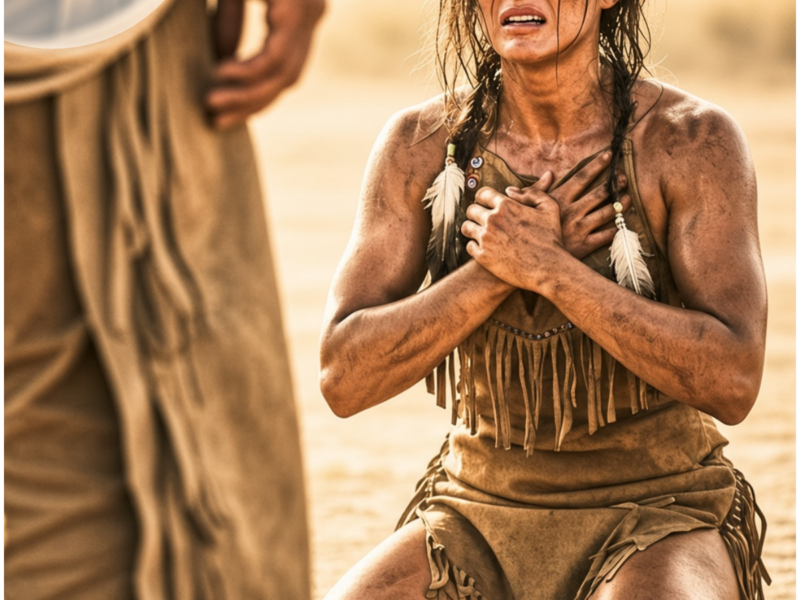
She was young, perhaps twenty, with black hair tangled across a face streaked with dust and dried blood. A bullet had torn through the meat of her left thigh, and she’d tied it off with a strip of her own skirt. In her right hand she gripped a knife, its blade pointed straight at Wade’s throat. Her eyes were the most frightening thing about her. They held no pleading. Only the flat, absolute resolve of someone who had already decided how she would die.
Wade lowered his rifle slowly and laid it on the stone.
“I’m not with them,” he whispered.
She didn’t move. The knife didn’t waver.
Below, boots scraped on rock. “Blood up here! Crane, she went up the slope!”
Wade looked at the woman, then down at the canyon floor where shadows were moving toward the shale. He had perhaps a minute. Maybe less.
“Listen to me,” he said, holding her gaze. “You can cut me if you want. But if you stay here, they’ll find you. I can get you out.”
Something flickered across her face. Calculation, not trust.
“Why?” she said in English, hoarse and accented.
The question struck him harder than the knife could have. He didn’t have a good answer. He only had the truth.
“Because I couldn’t live with riding away.”
The boots were closer now. Wade picked up a fist-sized stone, rose to a crouch, and hurled it far across the canyon, where it clattered down a dry wash in a long, rattling cascade.
“Over there!” someone shouted. “She’s heading for the wash!”
The footsteps veered away.
When Wade turned back, the knife had lowered an inch.
He didn’t wait for permission. He slid an arm under her shoulders, lifted her as gently as the rocks allowed, and half-carried, half-dragged her down the back side of the slope. She bit down on her own sleeve to keep from crying out. He felt her body shake with every step.
At the cottonwood, he hoisted her onto Judge’s saddle and swung up behind her. Then he did the one thing that might save them both. He didn’t run. He walked the horse, slow and quiet, up a goat path he’d known since boyhood, keeping to the rocks where shod hooves left no mark.
Behind them, the laughter in the canyon turned to cursing.
Night fell hard over Sweetwater Creek. Wade’s cabin sat low and lonely beneath a stand of cottonwoods, a squat structure of logs and adobe he’d built with his brother’s help in a summer that now felt like another man’s life.
He laid the woman on his own bed and lit the lamp.
“I need to look at that leg,” he said.
She stared at him for a long moment. Then she nodded once.
The bullet had passed clean through, but the wound was dirty and angry. Wade boiled water, cleaned it with whiskey, and packed it with creosote poultice the way an old Mexican vaquero had taught him years ago. She made no sound the entire time. Only her hand, clenched white around the bedpost, betrayed the pain.
When he finished, he set a bowl of beans and a cup of coffee beside her, then dragged his chair to the far side of the room near the door, laid his rifle across his knees, and faced outward.
“Nobody comes through that door tonight,” he said. “Not while I’m breathing.”
For a long time there was only the hiss of the lamp. Then, very softly:
“Nita.”
He turned. She was watching him.
“My name,” she said. “Nita.”
“Wade.”
“Wade.” She tested the word like a stranger’s coin. “Those men will come.”
“Probably.”
“You should have left me.”
He looked at the dark window, where the cottonwoods moved like restless ghosts.
“Maybe,” he said. “But I didn’t.”
The next two days passed in a strange, fragile peace. Nita slept much of the first day, feverish and restless. Wade sat beside her with cold cloths and listened to her murmur in a language he didn’t understand, a name repeated over and over: Tazhay. Tazhay.
On the second evening, the fever broke. She sat on the porch wrapped in his wool blanket while he mended harness, and for the first time, she spoke freely.
She had been traveling with her aunt and two cousins to trade at a Mexican village in the south. Silas Crane’s men had found them at a water hole. Her aunt and cousins had scattered. She didn’t know whether they lived. She had run for six miles on a wounded leg before collapsing in Coyote Canyon.
“Who’s Tazhay?” Wade asked quietly.
Her eyes went to the dark line of the mountains.
“My father.”
“He’ll be looking for you.”
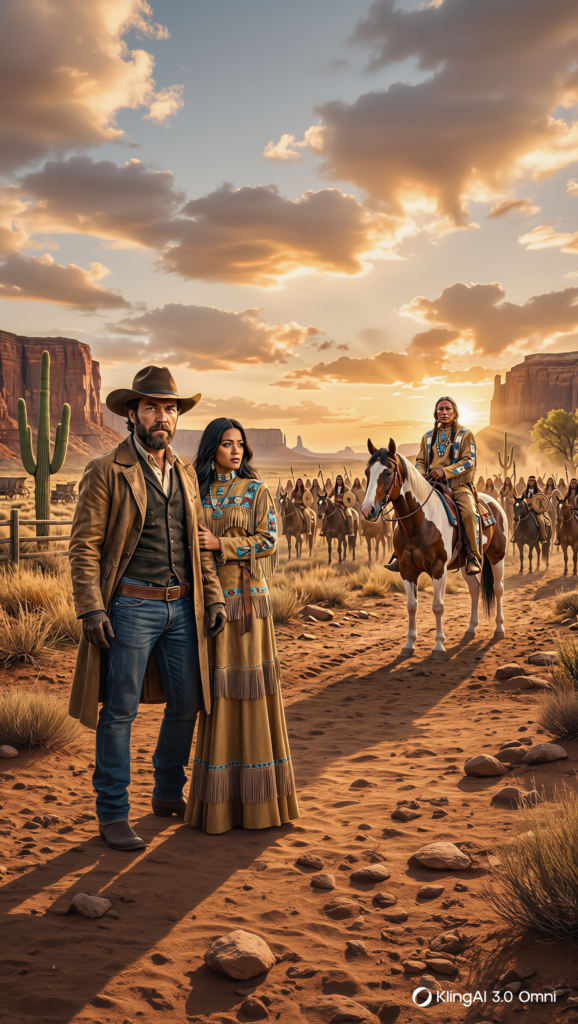
“He will be looking with three hundred men,” she said simply. “He leads our people in these mountains.”
The awl slipped in Wade’s fingers and pricked his thumb. He watched a bead of blood rise, and he understood, all at once, the full shape of what he had done.
If Tazhay found his daughter here, in a white man’s cabin, wounded, how would that look? And if the people of Redrock learned he was sheltering the daughter of an Apache war chief, what would they do to him?
He had stepped onto a narrow rope stretched over a canyon, and both ends were on fire.
On the third morning, Wade rode to Redrock for medicine. He told himself it was necessary. Really, he needed to know how much the town knew.
The answer was: too much.
Silas Crane stood on the boardwalk outside the Gilded Spur saloon, a tall, rawboned man with a silver-studded hatband and eyes like a rattlesnake’s, flat, patient, utterly without warmth. A crowd surrounded him.
“I’m telling you,” Crane was saying, “that squaw is a scout for a war party. My boys caught her spying on the stage road. She got away, and now she’s bringing three hundred bucks down on this town. Somebody’s hiding her. Somebody’s a traitor.”
His gaze drifted across the street and landed on Wade like a hand on the shoulder.
“Afternoon, Callahan,” Crane called. “Heard you rode through Coyote Canyon Tuesday evening.”
The crowd turned.
Wade tied Judge to the rail with deliberate care. “I ride a lot of places, Crane.”
“Funny thing. Tracks of one shod horse, riding heavy, coming out the goat path toward Sweetwater.” Crane smiled without moving his eyes. “Riding heavy. Like it was carrying two.”
The street went silent. Old Marshal Hobbs, gray and soft-bellied, stared at his boots. The storekeeper, Mrs. Abernathy, pressed a hand to her chest.
Wade walked into the general store, bought carbolic and bandages, and walked back out without a word. He felt every eye in Redrock burning into his back as he rode away.
He pushed Judge hard all the way home.
That night, he couldn’t sleep. He sat on the porch with the rifle while Nita lay inside. Coyotes yipped along the creek. The moon rose huge and orange, then shrank white as it climbed.
Around three in the morning, the coyotes stopped.
Wade’s hand closed on the Winchester.
He smelled it before he saw it: coal oil. Then a match flared in the darkness by the barn, and in its sudden light he saw Silas Crane’s face grinning like a skull.
The barn went up in a roar.
Horses screamed. Flames raced up the dry timbers, lighting the yard in a hellish orange glare. And in that glare, Wade counted them: seven men, rifles leveled, ringed around the cabin.
“Callahan!” Crane shouted over the fire. “Send out the squaw, and you walk away clean. Make me come in, and I burn the house with both of you in it.”
Behind Wade, the door creaked. Nita stood in the doorway, leaning on the frame, knife in hand.
“Give me to them,” she said quietly. “It is me they want.”
Wade didn’t turn around. He worked the Winchester’s lever, chambering a round with a hard metallic clack that carried across the yard.
“Get back inside, Nita.”
“Wade—”
“I said get back inside.”
Crane laughed. “Last chance, cowboy. You really gonna die for an Apache?”
Wade stepped down off the porch and into the firelight, rifle raised, alone against seven.
“Come find out.”
Crane raised his rifle.
And then the ground began to tremble.
It started as a low vibration through Wade’s boots, then grew into a rolling thunder that drowned even the roar of the burning barn. Crane’s men spun around, wide-eyed.
On the ridge above Sweetwater Creek, silhouetted against the paling sky, a line of riders appeared. Ten. Fifty. A hundred. More kept rising over the crest until the entire ridgeline was a wall of horses and men, the firelight glinting off rifle barrels and lance points.
At the center sat a single rider on a gray horse, motionless, staring down at the blazing barn, at the armed men, at the wounded woman in the cabin doorway.
And at Wade Callahan, standing in the middle of it all with a rifle in his hands.
From where Tazhay sat, there was no way to know who had set the fire. No way to know who had shot his daughter.
Only one white man stood between her and the ridge.
The chief raised his arm.
Three hundred rifles swung toward the cabin.
PART 2: The Chief’s Judgment
For a moment that stretched like an eternity, no one breathed.
Then Silas Crane did what cowards always do. He ran.
“Ride!” he bellowed, vaulting onto his horse. His men scrambled after him, scattering into the dark like quail before a hawk. Within seconds, the yard held only Wade, the roaring barn, and a terrified horse kicking at its stall.
Wade did the only thing he could think of. He dropped the Winchester in the dirt.
Then he turned his back on three hundred rifles and ran into the burning barn.
He heard Nita scream his name. He heard shouts in Apache from the ridge. Then all sound vanished into the furnace roar. Smoke clawed at his lungs. Embers rained onto his shoulders. Judge was rearing in the back stall, eyes white with terror, and the old mare, Bess, was down on her knees, coughing.
Wade tore his bandana over his face, threw open the stall, and slapped Judge toward the open door. The gelding bolted. Then he hauled at Bess’s halter, pleading, cursing, pulling with every ounce of strength in his body, until the old mare staggered upright and stumbled with him out into the night just as the roof beam gave way behind them in a volcano of sparks.
He collapsed onto his knees in the dirt, coughing so hard he tasted blood.
When he lifted his head, a ring of horses surrounded him.
Dozens of Apache warriors sat motionless, rifles trained on his chest. Their faces were painted, unreadable in the flickering light. The gray horse stepped through the circle, and its rider dismounted.
Tazhay was not a large man, but he moved with the stillness of a mountain. His face was carved by fifty years of sun and war, his eyes deep-set and dark. He looked down at Wade for a long time without speaking.
Then he walked past him, toward the cabin.
Nita limped down the porch steps and fell into her father’s arms. The chief held her, one hand cradling the back of her head, and for a moment the war leader of three hundred men was only a father who had thought his daughter dead.
Then he saw the bandage on her leg.
His face changed. He turned slowly toward Wade, and the look in his eyes was colder than any winter Wade had known.
A young warrior stepped forward, broad-shouldered with a scar splitting his eyebrow, and pressed the muzzle of his rifle against Wade’s temple. He spoke rapidly in Apache. Wade didn’t need a translator. The meaning was clear.
Let me kill him.
Nita’s voice rang out, sharp as a whip. She spoke fast and fierce, pointing at the burning barn, at the direction Crane had fled, at the bandage, at Wade. Her father listened without interrupting. The scarred warrior argued back. Nita shouted him down.
Finally, Tazhay raised one hand, and all of them fell silent.
He crouched in front of Wade until their eyes were level. When he spoke, his English was slow and precise.
“My daughter says you saved her life.”
Wade wiped soot from his mouth. “She saved most of it herself. I just gave her a ride.”
“Koyah,” the chief nodded toward the scarred warrior, “says a white man’s word is like water in sand. He says you helped her because you wanted the reward for returning her. Or because you wanted something else.”
The insult hung in the air. Wade felt anger rise, then let it go.
“Koyah’s got reason to think that,” he said quietly. “Men like Crane gave him every reason. I can’t prove anything to you, Chief. All I can tell you is what I did. You’ll judge it however you judge it.”
Tazhay studied him the way a man studies a horse he’s thinking of buying, looking for the hidden lameness.
“You ran into fire,” the chief said, “for an old horse.”
“She’s been with me twelve years.”
“With three hundred guns at your back.”
Wade shrugged. “Guns weren’t going to save her.”
Something moved behind the chief’s eyes. Not warmth. Not yet. But something.
Then hoofbeats sounded on the trail from the east, and a scout rode hard into the firelight, gasping out words in Apache. The warriors stirred. Koyah’s face darkened.
Nita turned pale and translated before her father could stop her.
“The men who fled,” she said. “They rode to your town. They are telling everyone that the Apache have attacked your ranch and murdered you. They are ringing the church bell. Men are gathering guns.”
Wade closed his eyes.
He could see it as clearly as if he stood in the street himself: Crane on the boardwalk, his voice rising over the frantic bell, painting a picture of a massacre. Frightened farmers loading shotguns. Mothers hiding children in root cellars. Old Marshal Hobbs swept along by a tide he was too weak to stop.
And by sunrise, an armed mob of a hundred terrified townsmen riding toward Sweetwater Creek, straight into three hundred warriors who had every reason to defend themselves.
There would be no survivors worth counting on either side.
“How many?” Tazhay asked his scout.
“Many. The whole town.”
Koyah spat into the dirt and spoke again, his voice hard as flint. Nita’s face went white.
“What did he say?” Wade asked.
She hesitated. “He says if they come to fight, then we should go to them first. Before dawn. While they are still afraid.”
The warriors murmured. Some nodded. The firelight caught the edges of their weapons, and Wade understood with sickening clarity that Redrock had perhaps three hours left to exist.
He got to his feet. His legs shook, but he stood.
“Chief Tazhay,” he said. “Let me go to them.”
Koyah laughed, a harsh, contemptuous sound.
“Let me go,” Wade repeated. “They think I’m dead. If I ride in alive, Crane’s story falls apart. I can stop this. Give me until the sun’s full up.”
“And if you are wrong?” Tazhay asked.
“Then I’ll be the first one dead, and you won’t have lost anything.”
“And if you are lying? If you ride to them and lead them here?”
Wade looked straight into the chief’s eyes.
“Then keep something of mine,” he said. “Keep my horse. Keep my rifle. Keep my land. If I betray you, burn it all.”
The chief was silent for a long moment. Then he shook his head slowly.
“Those things mean little.” He nodded toward the cabin doorway, toward Nita. “I will keep your word. If you break it, every one of my people will know what a white man’s word is worth. And my daughter will know she was wrong about you.”
Somehow, that was heavier than any threat of death.
“Fair enough,” Wade said.
Tazhay turned to Nita. Something passed between father and daughter, a silent conversation of a lifetime. Then the chief stepped back.
“Go,” he said. “When the sun clears the mountain, we ride. With you, or over you.”
Wade rode Judge bareback into Redrock just as the eastern sky began to turn the color of a fresh bruise.
The church bell was still clanging. Torches blazed along Main Street. Nearly a hundred men crowded the road, farmers in nightshirts clutching squirrel rifles, cowhands with pistols, the blacksmith with a hammer. Their faces were gray with terror.
Silas Crane stood on a wagon bed in the center of it all, his voice cracking like a bullwhip.
“They gutted him like a steer, I’m telling you! I saw it with my own eyes! Callahan’s dead, and his ranch is ashes, and those devils are coming here next! Every man who can hold a gun—”
“Morning, Crane.”
The street went dead silent.
Wade walked Judge through the crowd. Men stumbled back from him as though he were a ghost. His face was black with soot, his shirt scorched, his hands blistered raw, but he was unmistakably, undeniably alive.
Crane’s face went the color of tallow.
“Callahan,” he breathed. Then, recovering fast, “Look at him! He’s burned! They tortured him, and he got away—”
“You burned my barn, Silas.” Wade’s voice carried to every corner of the street. “With your own hand. I watched you strike the match.”
A ripple went through the crowd.
“He’s lying!” Crane shouted. “He’s been hiding that squaw for days! He’s working with them! He brought them here!”
Faces turned toward Wade, uncertain now, suspicious. He could feel the crowd balanced on a knife’s edge, ready to tip toward whichever voice shouted loudest.
He slid down from Judge and climbed onto the edge of the water trough, so they could all see him.
“Yes,” he said. “I helped her.”
Gasps. A man near the front raised his shotgun.
“I found a girl in Coyote Canyon with a bullet in her leg. Crane’s bullet. She was traveling to trade, and he hunted her because the territory pays for scalps and doesn’t ask whose. Her name is Nita. She’s the daughter of Chief Tazhay. And right now, Tazhay is sitting on my ridge with three hundred warriors, deciding whether this town lives or dies.”
Silence. Absolute and terrible.
“He hasn’t attacked anyone,” Wade went on. “He came for his daughter. He found her alive because somebody in this territory still remembers how to be decent. And he gave me until sunrise to come here and prove that the rest of us aren’t all Silas Crane.”
Mrs. Abernathy’s voice broke through the hush. “What do you want us to do?”
Wade looked out over their frightened faces: the blacksmith, the storekeeper, the young cowhands, the old marshal.
“Put down the guns,” he said. “Ride out with me. Not as an army. As neighbors. Let him see we’re not coming to fight.”
“That’s suicide!” someone shouted.
“No,” Wade said. “Suicide is riding out there with rifles and giving three hundred men a reason. I’ve stood in front of those warriors. They’re not looking for a war. But they’ll finish one.”
He drew a ragged breath.
“We stand together, or this town dies. Now, who is with me?”
For a long moment, no one moved.
Then old Marshal Hobbs, who had looked at his boots for twenty years, unbuckled his gunbelt and let it fall to the dust.
“I’m with you, Wade.”
The blacksmith laid down his hammer. Mrs. Abernathy stepped off the boardwalk. One by one, then by the dozen, rifles clattered onto the street.
Silas Crane watched it happen with mounting fury. His story was dying in front of him, and with it, the bounty, his reputation, and perhaps his neck.
“You fools,” he hissed. “You’re all dead men.”
Then he drew his pistol and fired.
The shot cracked across Main Street like breaking bone.
Wade felt the impact before he heard it, a sledgehammer blow to the left side of his chest that spun him off the water trough. The sky wheeled overhead. The ground rushed up. Somewhere a woman was screaming.
He lay in the dust, staring up at a sky turning gold above the mountains.
The sun was rising.
And on the ridge, three hundred warriors were waiting for a man who was never going to arrive.
PART 3: The Decision No One Forgot
Wade drifted in and out of darkness.
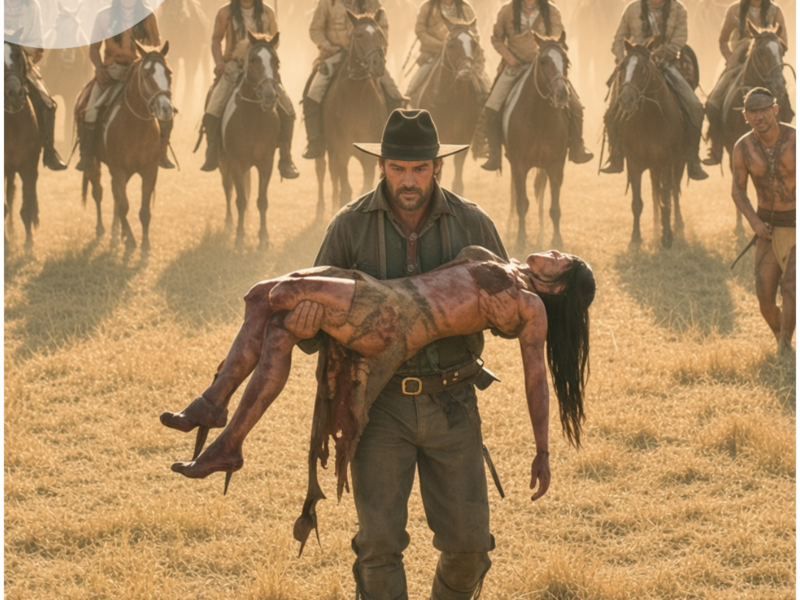
He felt hands pressing on his chest. Heard Mrs. Abernathy barking orders. Heard the marshal shouting, then a scuffle, then a heavy thud as half a dozen men tackled Silas Crane into the horse trough and held him there, spluttering, until Hobbs locked iron cuffs around his wrists.
“The bullet glanced off his collarbone,” someone was saying. “Missed his heart by a finger’s width. Lord Almighty, he’s lucky.”
“Sun’s up,” another voice whispered. “Sun’s up, and he didn’t make it back.”
Wade tried to rise. Pain blazed through his shoulder and stole his breath.
“Help me up,” he croaked.
“Wade, you can’t—”
“Help me up.”
They lifted him onto Judge. He clung to the gelding’s mane with his good hand, swaying, blood soaking through the bandage. Behind him, the people of Redrock followed: unarmed, frightened, a ragged procession of farmers, shopkeepers, and cowhands walking toward the thing they feared most in the world.
They were halfway to Sweetwater Creek when they saw the dust.
Three hundred riders poured down from the ridge like a flood breaking loose. The earth shook beneath them. Several townsmen turned to run. Mrs. Abernathy grabbed two by their collars and held them where they stood.
Wade nudged Judge forward, alone, to the front.
The Apache warriors thundered across the flats and then, a hundred yards away, split smoothly to either side, circling the townspeople in a vast, slow ring of horses and dust. Rifles were raised. Faces were hard.
Tazhay rode into the center of the ring. Nita sat behind him on the gray horse, her arms around his waist.
The chief looked at the bloody bandage on Wade’s chest. He looked at the unarmed crowd behind him. He looked at Marshal Hobbs, who stepped forward dragging a cuffed and soaking Silas Crane by the collar.
“This is the man who shot your daughter,” Hobbs said, his voice trembling but steady. “And he just tried to kill Wade Callahan for telling the truth. He’ll hang for it under territorial law. You have my word.”
Koyah urged his horse forward, rifle raised, eyes fixed on Crane with a hatred that burned like the barn fire.
Crane fell to his knees in the dirt, whimpering.
Everyone waited for the chief to speak. On this word, Wade knew, everything hung. Tazhay had every right to demand Crane’s life. He had three hundred warriors who would gladly take it, and a town too weak to stop them.
The chief dismounted. He walked slowly to Crane and stood over him, looking down at the trembling man for a long time.
Then he turned his back on him entirely, as if Crane were no longer worth seeing, and walked to Wade.
“You are late,” Tazhay said.
Wade managed a crooked smile. “Got held up.”
“Koyah said you would not come back. He said you would bring an army.”
“I brought one.” Wade nodded at the unarmed townspeople. “Just not the kind he expected.”
The chief looked at the crowd for a long moment: the women in their aprons, the old marshal, the blacksmith with empty hands. People who had walked, defenseless, toward the thing they feared most, because one man had asked them to.
Then Tazhay did something no one on the frontier had ever seen.
He drew his knife.
The townspeople gasped. Several warriors tensed. The chief raised the blade, then drew it swiftly across his own palm. Blood welled in a dark line. He held out his bleeding hand toward Wade.
Nita slid down from the horse and stood beside her father. Her eyes shone.
“In our way,” she said softly, “this is not done lightly. My father has done it only once before in his life, with his own brother before he died. He is asking you to be his brother.”
Wade stared at the outstretched hand. He thought of the mesquite tree, the small grave beneath it, the brother he had failed to protect. He thought of six years spent watching everything and trusting nothing.
He drew his own knife with his good hand and cut his palm.
Their hands met. Blood mingled. Tazhay’s grip was iron.
“My brother,” the chief said. Loud enough for every warrior and every townsman to hear. “Whoever harms this man harms me. Whoever stands against his people stands against mine.”
Then he turned to his warriors and spoke in Apache. Koyah lowered his rifle. Slowly, reluctantly, then with a grudging nod toward Wade, he backed his horse away from Crane.
“The man who hunted my daughter belongs to your law,” Tazhay said to Hobbs. “Let your people see what your law is worth. If it is worth nothing, we will know.”
“It’ll be worth something,” Hobbs said. “I swear it.”
And for the first time in twenty years, the old marshal sounded like he believed it.
Silas Crane was tried in Tucson that winter. The courtroom was packed. Wade testified with his arm in a sling. Nita testified too, the first Apache woman ever to sit in that witness chair, and when she finished speaking, the jury needed less than an hour.
The territory quietly repealed its bounty a year later. Some said it was because of the trial. Others said it was because no one in Cochise County would collect it anymore.
The barn on Sweetwater Creek was rebuilt that spring. Redrock men hauled the timber. Apache men raised the frame. Women from both sides cooked over shared fires while children who had never before been allowed near each other raced barefoot along the creek, shrieking with laughter.
Nita came often. She learned to read from the battered Bible on Wade’s shelf, and he learned her language, stumbling over the words while she laughed at him. Whether what grew between them was friendship or something deeper, they never said aloud. They didn’t need to. It was there, quiet and certain, in the way she always looked for him first when she rode into the valley.
On the anniversary of that night, Wade climbed the ridge above his ranch. Tazhay was already there, sitting on the gray horse, watching the sun rise over the land they now shared.
“You know,” Wade said, “you could have taken Crane. Nobody would have stopped you.”
The chief nodded. “Yes.”
“Why didn’t you?”
Tazhay was silent for a long moment, watching the light spill gold across the valley where Apache and settler children were already playing by the creek.
“Because a man who saves one life for no reward,” he said, “teaches others to do the same. A man who takes a life for revenge teaches only more revenge.” He looked at Wade. “You showed me which kind of man I wanted my people to see.”
Below them, Nita stepped out onto the porch and waved up at the ridge.
Wade raised his scarred palm in return.
He had once believed the frontier never forgave a mistake. Now he knew it had one mercy left in it: that one stubborn act of decency, at the right moment, could change the course of every life it touched.
He had stopped for a scream in a canyon.
And it had given him back a brother.