Texas 1980 Cold Case Solved After 40 Years: Justice for Dean and Tina Clouse
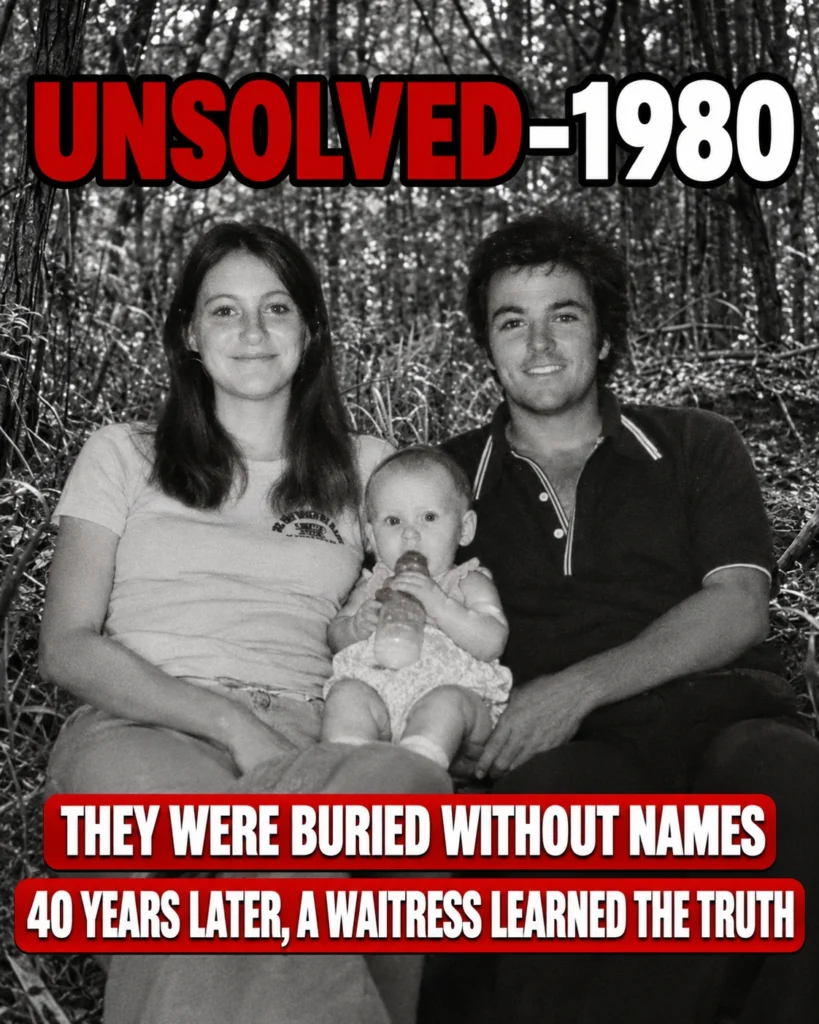
In the winter of 1980, Harold Dean Clouse Jr.and his wife, Tina Gail Linn, drove their reddish-brown GMC out of Lewisville, Texas.
They had moved to the small town only a few months earlier from Florida so that Dean could find work as a carpenter.
He was 21.
She was 17.
Their daughter, Holly Marie, was not yet a year old.
That was the last time anyone in the family heard from them.
The final contact was a letter Tina sent to her mother-in-law, with a photo of Holly pushing a baby walker.
After that came complete silence.
On January 12, 1981, in a dense stretch of woods near Wallisville Road in Harris County, Texas, a dog found human bones.
Police discovered two badly decomposed bodies.
The man had been bound, gagged, and beaten to death.
The woman had been strangled.
Their faces were still clear enough for a forensic artist to reconstruct, but no one in Texas recognized them.
There were no papers and no leads, and no one came forward to claim them.
They were buried in a Harris County cemetery under the only name the system had for them: the Harris County Does.
One detail was even more haunting than the killings themselves.
No child’s body was found at the scene.
If the couple had a baby, she had vanished without a trace.
For 40 years, no one knew who the two victims were.
No one knew where the baby was, or whether she was alive or dead.
In Florida, a mother named Donna Casasanta never stopped asking about her son, her daughter-in-law, and her granddaughter.
The story would only be rewritten when forensic genealogy arrived, when a researcher stopped scrolling at two reconstructed faces on a website, and when a team of investigators refused to let the case die in silence.
This is the story of Dean and Tina Clouse, of a nomadic cult, of a baby left at a church door, and of 40 years of waiting for justice.
Who They Were
Harold Dean Clouse Jr.
, known to family and friends as Dean, was born on June 7, 1959.
His father died in 1966, when Dean was only seven.
He grew up with three sisters and a brother in a working-class family that had to get by after losing its breadwinner.
His mother, Donna Casasanta, was a woman who never gave up on anything.
She passed that character on to her son, never imagining that one day her own persistence would be the only thing keeping his story from being buried forever.
Dean grew into a handsome, charismatic young man whose temperament people described as unpredictable.
He was not the type to accept a life already mapped out for him.
As a teenager, he became curious about the Jesus People Movement, sometimes called the “Jesus Freaks.
” It was a religious wave popular in the 1970s: long-bearded men and long-haired women who lived on the road in converted buses, preached on street corners, and believed they were following Jesus in the most basic way possible.
Dean traveled with one such group for several months, riding along, listening to the music, joining prayer sessions by the highway.
His family was not pleased.
They worried he was being drawn into a world they neither understood nor controlled.
But the worry eased when Dean came home after a few months, once the wandering life lost its appeal.
He was never an official member of any cult.
He was simply a young man looking for something, and in the end he found it somewhere else entirely: in woodworking.
Dean became a skilled cabinetmaker, the kind of craftsman who could build furniture by hand that customers were happy to pay well for.
It gave him what the road never could: a clear direction.
Then Dean met Tina.
Tina Gail Linn was born on September 21, 1963, in Volusia County, Florida.
When she met Dean, she was 15 and he was 17.
The two families already knew each other.
Dean’s sister had dated Tina’s brother, a relationship that would also end in marriage.
So when Dean and Tina grew close, no one was surprised.
The speed, however, was another matter.
People described it as love at first sight, the kind that burned so fast that before anyone could get used to the idea, the two were inseparable.
Dean was confident and had concrete plans.
Tina was young and bright, and she saw in Dean a man whose ambitions reached far beyond the small life New Smyrna Beach could offer.
They married at the Volusia County Courthouse on June 25, 1979.
Dean was 20.
Tina was 15.
Less than a year later, Holly Marie Clouse was born.
Tina was 16.
In the eyes of many, they were two children raising a child.
But Dean had a trade, determination, and a plan.
He wanted to work where carpenters were in demand and his skill would be paid what it was worth.
That place was Texas.
The Move to Texas
In the summer of 1980, Dean, Tina, and Holly loaded their belongings into the reddish-brown GMC and left New Smyrna Beach for Lewisville, a small suburb of Dallas.
Before leaving, the young family had been living with Sherry Linn, Tina’s sister.
The goodbye was hard.
Donna did not want her son to go so far away.
The Linn family worried about Tina, so young, taking a baby to a distant state.
But Dean was determined.
He told his mother there were better opportunities in Texas, and that he could build a better life there for his wife and child.
Donna let him go, the way every mother must when a grown son chooses his own path.
She did not know it would be the last time she saw him.
The first months in Lewisville seemed to go well.
Dean found carpentry work, and the family began to settle in.
Tina wrote home regularly, sending small news of their new life and photos of Holly growing day by day.
The last letter reached Donna in October 1980.
Inside was a photo of Holly standing and pushing a baby walker, a healthy baby learning her first steps.
It was the last image anyone in the family would see of Holly Marie Clouse for more than four decades.
After that, everything stopped.
No letters, no phone calls, not a word.
A young family that had kept in close touch suddenly went silent, as if someone had flipped a switch.
The Bodies in the Woods
On January 12, 1981, about three months after that last letter, a dog found human remains in the woods near Wallisville Road, north of Houston, roughly 250 miles from Lewisville.
Harris County deputies found two badly decomposed bodies.
The man had been bound, gagged, and beaten to death.
The woman had been strangled.
Investigators estimated that both were very young, perhaps teenagers or in their early twenties.
Their early theory was that the woman had been attacked first and the man killed trying to protect her.
Either way, the picture was horrifying.
A 21-year-old husband bound and helpless while his wife was strangled, or Tina forced to watch Dean beaten to death before she was killed herself.
This was not a spontaneous act.
Someone wanted these two people dead and carried it out in an organized way.
A Harris County forensic artist reconstructed their faces, and the images were widely circulated.
No one recognized them.
The reason would only become clear much later.
Dean and Tina had been in Texas just a few months.
They had no friends, no long-time coworkers, no close neighbors.
They had arrived and disappeared before anyone had a chance to know them.
So they were buried as the Harris County Does.
Police noted one thing at the scene that no one knew what to do with at the time.
There was no child’s body.
No small bones, no baby clothes.
If the couple had a child, she was not there.
Either the baby had died somewhere else and was never found, or she was still alive, in someone’s hands.
But since police did not know who the victims were, they could not know a child was involved at all.
The case began dying the moment it was opened.
The Call From “Sister Susan”
While the two bodies lay unidentified in Houston, the Clouse and Linn families in Florida were living through a different kind of torture: not knowing.
Donna waited through November and December of 1980 without a single letter.
She called, and no one answered.
She wrote, and no one replied.
Sherry Linn heard nothing.
Neither did Tina’s brother, Les Linn.
Everyone sensed something was wrong, but no one knew enough to say what.
Then, sometime in late December 1980 or early January 1981, Donna received a phone call from a woman who called herself Sister Susan.
She said she was calling from Los Angeles and wanted to return Dean and Tina’s car to the family.
But the car was not the most important part of the call.
Sister Susan said Dean and Tina had joined her religious group.
They no longer wanted contact with their families, she said, and they were giving up all material possessions, including the car, as part of their new life.
Consider the timing.
When Sister Susan said Dean and Tina had joined her group of their own free will, both of them were very likely already dead.
Their bodies would be found only weeks later.
That call was not a message from Dean and Tina.
It came from whoever had their car, and possibly from someone who knew exactly what had happened to them.
The family could not have known that.
All they knew was that someone was saying their children were alive and simply did not want to talk.
For a family desperate for any news at all, even painful news was better than silence.
A meeting was arranged at Daytona International Speedway in Florida for the car to be handed back, and the family notified the authorities.
When the group arrived, it looked like a scene from a film no one wanted to watch: one man and three women in long white robes, with long hair, driving Dean’s reddish-brown GMC into a racetrack parking lot in the early 1980s.
The women were arrested, and the car was returned to Donna.
That should have been the start of an investigation.
It was not.
When the family, and later investigators, tried to find the arrest records, there was nothing.
No reports, no names, no photographs.
Three women in white robes had been arrested while returning the car of two missing people, and not a single piece of paper proved it had ever happened.
Whether the records were never filed, destroyed, or lost in the bureaucracy, the result was the same.
The one lead that might have pointed to the killers had evaporated.
With the car returned and an explanation offered, the story settled into one that no one wanted to accept but everyone did: your son joined a cult, he doesn’t want to talk to his family anymore, and that’s his choice.
Donna went to the police and reported them missing: Dean, Tina, and baby Holly, last known in Lewisville, Texas.
The response was predictable.
An adult man who had once traveled with a religious group, now said to have joined another.
A car already returned.
This was not a missing persons case, police said.
It was an adult making a choice.
And so the matter sank.
Forty Years of Waiting
The two families were trapped in a state with no name.
They could not mourn, because there was no proof anyone had died.
They could not feel relief, because no one had heard anything.
And they could not search, because police said there was nothing to search for.
At first, they hoped Dean would call or write, or show up one day at the door with Tina and Holly, ready to talk about his years on the road.
As one year became five, then ten, then twenty, the hope did not disappear.
It changed shape.
It became heavier, more stubborn, closer to reluctant acceptance than belief.
Maybe they were out there, living with some religious group, raising Holly in a way the family could never imagine.
Maybe one day, when Holly was grown, she would find her way home.
Donna kept the last photo of Holly with the walker.
She kept the returned GMC.
She kept everything connected to Dean, Tina, and Holly as if it were evidence that they had existed, that she had once had a son, a daughter-in-law, and a granddaughter.
She never cleaned out Dean’s room.
She hung a large painting in her home showing Dean, Tina, and Holly together, the little family when it was still whole.
She looked at it every day and asked the same question no one could answer: where is my son, and where is my granddaughter?
She never accepted Sister Susan’s story as the truth.
She could not prove it was a lie, but she knew.
Decades later, Les Linn could see clearly what the family could not see then.
The phone call and the returned car were a perfectly designed diversion.
By claiming that Dean and Tina had left willingly, the group shut down any chance of an investigation.
If two adults said they wanted no contact with their families, police would not look for them.
If the car had been returned, there was no reason to suspect a crime.
Most importantly, it kept anyone from connecting the couple missing from Lewisville with the two unidentified bodies in Houston.
For four decades, two cases existed side by side: a missing persons case that no one investigated, and a murder case in which no one could identify the victims.
And somewhere in between, a baby disappeared.
The Christ Family
To understand what happened to Dean and Tina in the last weeks of their lives, you have to understand the group investigators believe was involved, and that means going back to the Jesus People Movement of the 1970s.
Thousands of young Americans, tired of the Vietnam War, tired of consumer culture, tired of everything their parents’ generation stood for, returned to the Bible in their own way.
They lived communally, shared everything, and believed Jesus would return soon.
Most of these groups were harmless, made up of idealistic young people searching for meaning.
Some went much further.
According to Rick Alan Ross, a leading American expert on cults, the Christ Family was one of the most extreme groups to come out of that movement.
It was not just a religious community but an organized cult with absolute leadership and rules that outsiders immediately recognized as abnormal.
Its founder and leader was Charles McHugh, though no one in the group used that name.
He called himself “Lightning Amen” and claimed to be the reincarnation of Jesus Christ.
His California Department of Corrections photo shows a middle-aged man with a long beard and the eyes of someone who believes completely in himself.
Ross described him as a harsh, extreme leader who tolerated no challenge to his authority.
Many members took the surname “Christ” when they joined, as if they had been reborn in the leader’s name.
Life in the Christ Family followed strict rules.
Members gave up all possessions: money, cars, ordinary clothes, everything from their previous lives.
They wore white robes and went barefoot in any weather.
Leather was forbidden.
Men and women lived separately and followed a strict vegetarian diet.
The group was completely nomadic, traveling in converted buses and donated cars across the American Southwest, through Texas, New Mexico, California, and Arizona.
They begged for food in towns, asked for donations on street corners, and moved on before anyone could ask too many questions.
Beneath the religious surface, Ross and later investigators pointed to a darker side.
The group was linked to drug trafficking.
Full details were never made public, but according to Ross, drug activity was inseparable from how the group operated and traveled.
The group also had a history of violence.
In 1978, there were reports that members had abandoned a child at a laundromat.
In 1979, members were accused in connection with another murder.
This was not a harmless group singing hymns around a campfire.
It was an organization capable of violence, with financial motives, and with a history of treating children as things that could be left behind when they were no longer useful.
Piecing the evidence together, investigators concluded that Dean and Tina had willingly joined the Christ Family while in Texas.
Given Dean’s past, that is not hard to believe.
He had once traveled with a Jesus People group, and he was genuinely curious about the movement.
And for a young family alone in a new state, with no friends and no support, people offering instant community, food, shelter, and companionship would have been a powerful draw.
Investigators believe the couple were on their way to Blythe, California, where the Christ Family kept a winter camp, when they were killed.
The biggest question remains: why?
Ross offered the theory many investigators consider the most likely.
Dean and Tina may have witnessed the group’s illegal activity, especially drug trafficking, and wanted to leave.
In a group like the Christ Family, leaving is not an option once you have seen what you were not supposed to see.
Ross said bluntly that he did not believe there was any way to separate these murders from the Christ Family.
Investigators also considered another possibility.
The group may have wanted to keep Holly.
A small child could be raised entirely inside a nomadic group living outside the law, with no papers, no official identity, and no past.
If Dean and Tina tried to leave with their daughter, that could have triggered a deadly conflict.
Whatever the motive, the outcome was the same: two people dead in the woods outside Houston, and a baby absorbed into the network of a cult moving across four states.
Why the Case Went Cold
Looking back, there were five main reasons the case stalled for 40 years, and each one reinforced the others.
First, Dean and Tina had no roots in Texas.
They had arrived only months earlier, and no one knew them well enough to recognize their reconstructed faces.
Second, the cult actively covered its tracks.
The call from Sister Susan, the returned car, and the claim that the couple had left willingly were all designed to stop the family from searching and the police from investigating.
Third, evidence was lost or never properly connected.
The Daytona arrest records disappeared, and the crime scene was never linked to any missing persons report.
Fourth, the Christ Family’s constant movement through Texas, New Mexico, California, and Arizona made it almost impossible to track.
Members were known in the Yuma area for begging food, but they never stayed anywhere long enough to be followed.
Fifth, the technology did not exist.
Before forensic genealogy, there was no way to link unidentified bodies in Houston to a missing family in Florida.
The two cases sat in two police systems in two states, roughly a thousand miles apart, with nothing to connect them.
Donna knew none of this.
She only knew that her son was gone and that no one would give her answers.
So she kept calling the police, kept asking, and kept waiting.
A First Attempt, and Another Wall
In July 2011, for the first time in 30 years, someone took another look at the two unidentified bodies in the Harris County cemetery.
A cold case investigation was opened, and the first step was to exhume both victims to collect DNA.
It was the right move.
DNA databases such as CODIS already existed, and if any relative of the victims had submitted a sample, the software could have found a match.
The remains were lifted from the ground, samples were taken, and DNA profiles were created.
Then nothing happened.
No match came back.
The Clouse family in Florida had no idea that two unidentified bodies in Houston might be their son and daughter-in-law, so they had never submitted DNA.
Neither had the Linn family.
The DNA had been collected, but the method that could finally break the case had not yet been applied to forensic work.
The Power of Forensic Genealogy
When you first hear about forensic genealogy, it sounds like science fiction, but the principle is surprisingly simple.
Instead of comparing a victim’s DNA with a criminal database, investigators compare it with public genealogy databases, websites where millions of people voluntarily share their DNA to learn about their ancestry.
If one of your third cousins has submitted a sample, a skilled genealogist can build a family tree backward and find you.
You never have to submit a sample yourself.
Your family doesn’t even need to know you’re missing.
All it takes is one distant relative curious enough about their roots to spit into a tube and mail it off.
This technology cracked the Golden State Killer case in 2018 and has since transformed how law enforcement approaches cold cases.
But it requires three things: a DNA sample from the victim, a lab that can turn it into a genealogical profile, and a genealogist skilled enough to turn raw data into a name.
By 2021, the Harris County Does case had the samples from the 2011 exhumation.
It had access to a lab.
What it lacked was someone who would look at the case and decide that these two people deserved their names back.
The Woman Who Stopped Scrolling
Misty Gillis is not a police officer, a lawyer, or a scientist with a doctorate and a million-dollar lab.
She is a forensic genealogist, someone who spends hours in front of a screen building family trees from DNA fragments and public records, connecting people who don’t know they are related.
She had started in genetic genealogy about three and a half years earlier, after helping her grandfather discover the identity of his biological father, a man he had never known.
That experience changed the direction of her life.
She began working with Identifinders International, an organization that specializes in forensic identification.
In 2021, while browsing the Doe Network, a nonprofit website that posts information about unidentified victims, Gillis came across two reconstructed faces: a young man and a young woman found in the woods near Houston in 1981.
No names, no identities, and no one to claim them for 40 years.
Nothing required her to stop.
The Doe Network has thousands of cases just like it.
She could have scrolled past, thinking it was someone else’s case, in another state, from another decade.
But she stopped, looked at those two faces, and decided they deserved names.
Sometimes the fate of a 40-year-old cold case depends on one person stopping instead of scrolling.
Identifinders International contacted Harris County and asked for bone samples to be sent to its partner lab to create a genealogical DNA profile.
The county agreed.
Then came four months of waiting while the lab extracted DNA from remains that had been decaying for four decades and built a profile detailed enough to compare with public genealogy databases.
The research was funded not by a government budget or a police agency, but by a true crime podcast.
That is the reality of cold case work in America: sometimes justice depends on whether an entertainment show is willing to write a check.
The DNA data came back in October 2021, and from then on everything moved quickly.
After 40 years of silence, it took just seven days.
Gillis and her colleague Allison Peacock, founder of FHD Forensics, began building the family tree.
They found distant relatives in the databases and worked backward, branch by branch, until the tree led to a specific name: Harold Dean Clouse Jr.
, born June 7, 1959, out of contact with his family since October 1980, last known in Lewisville, Texas.
Gillis later described the moment in the simple terms of someone who spends her career searching for the dead: he had a story, and he had a family.
After 40 years as an anonymous file number, Dean Clouse finally had his name back.
At that point, Gillis didn’t know about Tina or Holly.
She only knew the male victim had been identified and that he had family in Florida.
“Where Is Holly?”
When researchers reached the Clouse family, a crucial piece fell into place.
Dean’s sister, Debbie Brooks, learned that her brother’s remains had been found in Houston, and she told the researchers something they hadn’t known: Dean’s wife, Tina, had disappeared at the same time.
The woman found beside him was very likely Tina.
That was quickly confirmed.
The Jane Doe who had lain beside Dean in the Houston woods for four decades was Tina Gail Linn Clouse.
She was 17 when she died.
In January 2022, the Houston Chronicle broke the story.
After 40 years, the Harris County Does had names: Harold Dean Clouse Jr.
and Tina Gail Linn Clouse, two young people from Florida who came to Texas looking for a better life, were murdered, and lay unidentified for four decades.
The news spread across the country.
For the Casasanta and Linn families, the answer they had waited 40 years for was the one they had feared most.
Dean and Tina had not walked away to join a cult.
They had been killed, and they had been lying in the ground in Houston the whole time the family waited for a call that would never come.
Amid the grief, one question rose above everything else, more urgent than the pain and the anger: where is Holly?
No child’s body had been found in 1981, and no unidentified baby in the records matched Holly’s description.
Either she had died somewhere and was never found, or she was alive, now a 41-year-old woman who did not know who she really was.
She would not know her parents had been murdered, or that a grandmother in Florida had spent a lifetime looking for her.
She would have no memory of Dean, of Tina, of the reddish-brown GMC, or of that last letter with the photo of the baby walker.
The Texas Attorney General’s office under Ken Paxton had just created a Cold Case and Missing Persons Unit, and the Clouse case became one of its first.
First Assistant Attorney General Brent Webster declared that finding Holly was the top priority.
The Search for Holly
Investigators knew that if Holly was alive, she had no idea she was being sought.
She would be a middle-aged woman living an ordinary life, with no memory of her first ten months and no reason to suspect that the life she was living was not the one that should have been hers.
Finding her was like looking for a needle in a haystack the size of the United States.
But they had a starting point: the women in white robes.
They knew Christ Family members had shown up in Daytona with the car, and that the group operated in the Southwest, especially Arizona.
And they had a specific lead, which Webster later described at a press conference.
Two women had brought a baby to a church in Arizona.
They wore white robes and were barefoot, exactly matching the description of Christ Family members.
According to Webster, one of the women claimed to be the baby’s mother.
She said she could not raise a child under the group’s living conditions and wanted to leave the baby in the church’s care.
The church was in Yuma, Arizona, the same area where the Christ Family was known for begging food and asking for donations.
It was not random.
The group had once left a child at a laundromat, and once again a child had been left behind when she was no longer useful to them.
The pastor of that church adopted the baby.
He had no idea where she came from, or that her parents had been murdered.
He only knew that a baby needed a home and that he could give her one.
She received a new name, grew up in a loving family, and never knew her past.
Working with the National Center for Missing and Exploited Children, the Lewisville Police Department, and agencies across several states, investigators traced the adoption forward.
The trail led from Arizona to Oklahoma.
Holly’s adoptive father had moved there with her after the adoption.
She grew up there, married, had children, and built her own life, never suspecting that a family in Florida had been searching for her for four decades.
June 7, 2022
June 7, 2022, was Dean Clouse’s birthday, a day that had gone uncelebrated since 1980.
That day, two investigators walked into a restaurant in Cushing, Oklahoma, a small town of fewer than 8,000 people in the flat farmland at the center of the state.
They asked to speak with a waitress working that shift.
She was 42, with a husband and five children, and a life that looked completely ordinary from the outside.
She did not know she was Baby Holly.
The investigators told her she had a large family in Florida that had been searching for her for more than 40 years.
They told her that her biological parents, Harold Dean Clouse Jr.
and Tina Gail Linn, had been murdered in late 1980 or early 1981.
They told her she had been left at a church in Arizona at ten months old by women from a nomadic religious group, and that she had been a missing person for four decades without knowing it.
Holly later said she was completely shocked and overwhelmed.
She had always known she was adopted.
That was never a secret.
But she had never known why.
She didn’t know that barefoot women in white robes had carried her to a church door, or that one of them had claimed to be her mother.
That was a lie, because her real mother had died in the woods outside Houston.
She didn’t know she had aunts, uncles, cousins, and a grandmother who had never stopped looking.
In one conversation, everything she thought she knew about her origins changed.
The news reached the Casasanta and Linn families almost immediately.
Donna, who had waited 40 years, kept every memento, and looked at the painting on her wall every day, called it a birthday gift from heaven, because Holly had been found on Dean’s birthday.
The son she had lost four decades earlier had, in a sense, given her the gift she had waited longer than any grandmother should.
On June 9, 2022, the Texas Attorney General’s office held a press conference in Austin.
Webster announced that Baby Holly had been found alive and well in Oklahoma.
Within hours, the story was everywhere: CBS, NBC, ABC, Fox News, NPR, the Houston Chronicle.
The tale of two unidentified people in Houston, a vanished baby, and a grandmother who waited 40 years touched the whole country.
Everyone wanted to know who Holly was now and whether she was all right.
The answer brought relief.
She had a family, children, and a stable life.
She had been raised in a loving home and had not been abused.
Webster stressed that Holly’s adoptive family were not suspects in her parents’ murders.
But he also said what no one wanted to hear and everyone needed to: even as everyone celebrated finding Holly, investigators were still looking for suspects.
Holly had been found.
The people who killed her parents had not.
The Families Speak
Cheryl Clouse, Dean’s sister and Holly’s aunt, said that the night Holly was found, the whole family slept well for the first time in 40 years.
It’s the kind of statement you don’t think about until someone says it: that not knowing can keep a family awake, literally, for four decades.
Les Linn, Tina’s brother, said the first thing he thought of when he heard Holly had been found was the call he had received eight months earlier, telling him his sister was dead.
Two calls, one bringing death and one bringing life, eight months apart, both arriving after 40 years of silence.
Sherry Linn Greene, Tina’s sister, spoke about her with a tenderness time had not faded.
That baby, she said, was Tina’s whole life.
For a 17-year-old with a small child, far from home and family, Holly was the center of her world.
Sherry added that she believed Tina could finally rest, knowing Holly was back with her family.
Holly’s Story
For 42 years, Holly Marie, now Holly Marie Miller, had lived without knowing she was a missing person.
She knew she had been adopted, but not how.
She did not know that at ten months old, barefoot women in white robes and head coverings had carried her into a church in Yuma, or that one of them had claimed to be her mother and said she could not raise a child under the group’s conditions.
By then, Holly’s real mother was almost certainly dead, strangled and lying in the Houston woods, where weeks would pass before a dog found her.
The woman who called herself Holly’s mother was a member of the Christ Family, the group investigators believe was directly connected to Dean and Tina’s deaths.
The pastor who adopted Holly knew none of this.
He believed he was taking in a baby whose birth mother had given her up because of hard circumstances.
He later moved his family to Oklahoma, where Holly grew up, went to school, married, and became a mother of five.
She lived in Cushing, a quiet town where people know each other and life moves at a slower pace.
She worked as a waitress, went to church, and raised her children.
Through all those years, she carried an emptiness she could not quite name.
She grew up loved, but the questions stayed with her: who am I really, and why didn’t they keep me?
When the truth came, it was more painful than anything she had imagined.
Her parents had not given her up.
They had been murdered, and someone had taken her.
Holly told reporters that there was one thing she wanted answered more than anything else.
She hoped that people who had been in the group might know when her parents joined the Christ Family, what happened to them while they were with it, whether they had been separated, and how her adoption came about, including whether it was her mother who gave her away.
That last question is the heaviest.
Did Tina, the 17-year-old mother Holly cannot remember, hand her over herself in a moment of desperation? Or was Holly taken after her mother died, claimed by a stranger posing as her mother and left behind like something the group no longer needed? The difference is the difference between a young mother making the most painful choice of her life and a child taken from the arms of her murdered mother.
Holly does not know which is true, and she may never know.
The Reunion
In November 2022, five months after she was found, Holly met her biological family in person.
They had first met over Zoom, which allowed her to see her grandmother, aunts, and uncles without flying across the country.
Meeting face to face was different.
Donna Casasanta, who had waited 40 years, finally held her granddaughter.
Holly met Cheryl Clouse, who was seeing her niece for the first time since she was a baby.
She met Les Linn and Sherry Linn Greene, who still carried living memories of her mother.
And the family showed Holly something she never knew existed: a photo album Tina had made, recording every moment with her daughter, every first step, every smile, every day.
A 17-year-old girl, alone in a faraway state, had taken the time to make an album for her baby, as if she somehow knew that one day Holly would need proof that she had been loved.
Forty years later, the album finally reached the person it was made for.
Holly turned the pages, looking at the face of a mother she could not remember, and at herself as a baby in a life she never got to live.
It was proof that she had belonged somewhere, and that she had not been abandoned.
She had been taken.
A Case Still Open
Even amid the reunion, a cold truth hung over everything.
The murders of Dean and Tina Clouse remain unsolved.
No one has been arrested, charged, or tried.
Charles McHugh, the Christ Family leader many believe held the answers, died in 2010, taking his secrets with him 12 years before the case was cracked.
No one has confirmed whether physical evidence from the 1981 crime scene still exists, or in what condition.
The Daytona arrest records are gone.
Many of the people who might know something have died, forgotten, or chosen to stay silent.
Brent Webster called on anyone with information to come forward, including anyone who was ever a member of the Christ Family, anyone who saw Dean and Tina with the group, and anyone who knows what happened on the journey from Texas to Arizona.
Tips can be given to the Texas Attorney General’s Cold Case Unit hotline at 512-936-0742, or by email to the unit.
“We are still looking for suspects in this case,” he said.
It is a sentence the family both wants and does not want to hear: the investigation continues, but after 40 years, no one has paid for Dean and Tina’s deaths.
What They Left Behind
The family created the Dean and Tina Linn Clouse Memorial Fund to help pay for forensic genealogy work for law enforcement agencies.
The idea is simple.
If this technology could bring Dean, Tina, and Holly back from 40 years of silence, it can do the same for thousands of other cold cases across the country.
Every donation means their deaths are helping other families find their loved ones.
Holly chose to tell her story in her own words.
In November 2023, she published a memoir titled Finding Baby Holly: Lost to a Cult, Surviving My Parents’ Murders, and Saved by Prayer.
It is more than a personal story.
It is a record of what happens when an extreme group enters the life of a young family, and of the price everyone pays when the system fails to protect the most vulnerable.
The case shows the extraordinary power of forensic genealogy, a tool that did not exist in forensic work a decade earlier and that solved in days what 40 years of traditional investigation could not.
It also exposes a painful lesson about preserving evidence.
If the Daytona arrest records had not been lost, or if someone had connected the Florida missing persons report with the Texas murders sooner, this story might have ended very differently.
Above all, it is proof that a family’s love is something time cannot destroy.
Donna Casasanta had no evidence and no leads.
She had a painting on the wall, a returned car, and the conviction that her son had not simply walked away.
Forty years later, she was proven right.
Back to the Woods
Return to where it all began: the dense woods near Wallisville Road, north of Houston, in January 1981.
Two bodies lay among the trees and weeds, nameless, unclaimed, and unknown.
Today they have names.
Harold Dean Clouse Jr.
, 21, a carpenter and young father who came to Texas to build a better life for his family.
Tina Gail Linn Clouse, 17, a young mother from Florida who made a photo album for a daughter she would never see grow up.
And the baby they carried with them, Holly Marie, now a 42-year-old mother of five in Oklahoma who has finally learned where she came from.
But the killers have never been found, and the case is not over.
Someone out there knows what happened to Dean and Tina Clouse in the winter of 1980.
Someone knows why a young couple was murdered in the woods and their child taken.
For four decades, the case stayed cold.
But the silence has been broken, and once it is broken, it does not return.