If you believe that stories like this deserve to b…
If you believe that stories like this deserve to be told, that cold cases everyone else has forgotten still matter, subscribe to Cold Case Reopened.
We tell the stories of the forgotten victims and the people who refuse to let them be forgotten.
Now, back to the case.
In the world of firearms trafficking in the United States, every legally purchased gun has a serial number, and every serial number can be traced back to its original owner.
That is the ATF’s tracing system, the Bureau of Alcohol, Tobacco, Firearms, and Explosives.
When a gun is used in a crime or turns up in the hands of someone who should not have it, the ATF can track the life of that gun from the manufacturer to the distributor to the first buyer to every recorded transfer afterward.
That is exactly what began to happen with William Mueller’s collection.
The first gun to surface was a Colt 45.
It was traced and confirmed as Nancy Mueller’s personal firearm.
>> >> This gun was not in the hands of some random stranger.
It had been sold by Kirby Kehoe, Chevy’s father, in Seattle, Washington.
When the ATF traced the Colt from the final buyer back through the chain of transfers, the path led straight to Kirby Kehoe.
That was the first thread.
And when you pull one thread in a murder case, you never know how fast the entire fabric will unravel.
But at that point, the ATF did not yet have enough evidence to connect the guns to the murders.
They knew Nancy Mueller’s gun was where it should not be.
They knew Kirby Kehoe was the one who sold it.
But selling a gun, even one that belonged to a murder victim, does not automatically prove the seller is the killer.
Kirby could have bought the gun legally before Mueller died.
It could have passed through many hands.
The ATF needed more, and more began to arrive.
In February 1996, only about a month after the murders, but 4 months before the bodies were discovered, a man named Travis Brake was arrested.
When police searched him, Brake was carrying a gun.
The serial number of that gun was traced and confirmed as belonging to William Mueller’s collection.
This was the second gun from the Mueller collection to turn up in the hands of a stranger.
This time, it was not in Seattle, but in an entirely different location.
Mueller’s guns were scattering across the country and each one was a puzzle piece leading back to the murders.
Brake was arrested but at that time the Mueller family still had not been found.
>> >> They were still only missing.
No one knew they were dead.
So the gun traced back to Mueller raised questions but did not yet trigger a murder investigation.
Four months later when the bodies were found in June 1996 everything changed.
The guns that had already surfaced now became evidence in a homicide case.
The ATF began expanding the trace searching for any other guns from the Mueller collection circulating on the market and they found them.
On December 10th 1996 nearly a year after the murders >> >> Daniel Lewis Lee’s former roommate was arrested in South Dakota.
This person was in possession of a rifle registered in the name of William Mueller.
South Dakota more than 1000 miles from Tilly, Arkansas.
Muellers guns were not just turning up in Seattle and Arkansas.
They had spread across America from Washington to South Dakota sold at gun shows and passed through many hands and now one was found in the hands of Daniel Lewis Lee’s roommate.
That was the first time the name Daniel Lewis Lee appeared in the Mueller investigation file.
Not yet as a murder suspect, not yet as an accomplice, only as a name indirectly linked to a stolen gun.
But ATF agents noted that name and they began pulling more threads.
The next day December 11th, 1996 Lee left Washington heading toward Oklahoma as if he sensed the ground under his feet was starting to shake.
Meanwhile the federal investigation was pointing more and more clearly toward the Kehoe family.
The ATF determined that Muellers guns had been sold by people with direct ties to Kirby Kehoe and his son Chevie.
The distribution network for the stolen property ran from Tilly, Arkansas to Spokane, Washington to gun shows across multiple states and every path led back to the Kehoe family.
Authorities began searching for Chevie Kehoe.
He was not easy to find.
He moved constantly, never staying in one place too long, using different vehicles and addresses.
He was someone who knew how to hide and he knew that hiding was necessary.
Then, February 15th, 1997 arrived, more than a year after the murders.
Chevie Kehoe and his brother Shane were driving on an Ohio highway toward a campground.
Ohio State Troopers spotted the vehicle and had reason to pull it over.
What happened next was not a routine traffic stop.
Chevie Kehoe was not the type to stop and hand over his license.
When the troopers approached, the situation escalated in seconds.
A shootout erupted.
The two Kehoe brothers exchanged fire with Ohio State Troopers on the highway in broad daylight in a gunfight in which both sides could have died.
This was not the Kehoe brothers first shootout with law enforcement and it would not be the last.
But this time, the outcome changed everything.
Shane Kehoe was arrested.
Chevie escaped.
The two brothers were separated and that separation was the final thing that broke the wall of silence surrounding the Mueller family murders.
Shane Kehoe, once separated from his older brother’s control, began to talk.
Not immediately, not completely, but enough.
On June 16th, 1997, four months after the Ohio shootout, Shane Kehoe turned himself in to authorities and he told them the most important thing anyone had said in the entire investigation up to that point.
Shane stated that in February 1997, Chevie had confessed to him that Chevie himself had participated in the murder of the Mueller family along with another man whom Shane did not name.
Chevie had told his younger brother what he had done, not out of remorse, but out of bragging.
That was the nature of Chevie Kehoe.
He could not keep secrets about his crimes because he was proud of them, and that pride, like Byron De La Beckwith in the Medgar Evers case 30 years earlier, ultimately became the thing that destroyed him.
Shane’s statement gave authorities what they had lacked for more than a year, direct confirmation that Chevie Kehoe was involved in the murders.
Not speculation, not circumstantial links, a family member stating that the suspect had confessed.
The next day, June 17th, 1997, Chevie Kehoe was arrested.
His flight was over, but the case was not finished.
Authorities still did not know the identity of the second man, the accomplice Shane had mentioned but not named.
They had Chevie.
They did not yet have the accomplice.
The investigation continued.
ATF agents tracked Chevie Kehoe’s network of relationships in the white supremacist movement looking for anyone with direct ties to both Kehoe and the Tilly area, anyone with a history of violence, anyone who had traveled with Kehoe around January 1996.
Daniel Lewis Lee was the name that had appeared earlier when his roommate was arrested with a Mueller gun in South Dakota.
Now, that name resurfaced.
This time in Chevie Kehoe’s direct network of associations.
Lee and Kehoe knew each other through white supremacist groups.
They had been together in Washington.
They had driven across the country together in late 1995.
Every path led to Daniel Lewis Lee.
On September 24th, 1997, Daniel Lewis Lee was arrested for the last time.
He could not run anymore.
Both of the men who killed the Mueller family were now in the hands of the authorities.
From Nancy Mueller’s Colt 45 sold in Seattle to the shootout on the Ohio highway.
From Shane Kehoe’s statement to the final arrest in the fall of 1997, it had taken nearly 2 years to build enough evidence and catch the right people.
But the case was still not over.
Arresting suspects is one thing, convicting them is something else entirely.
And the thing that would break the case open, the thing that would turn it from a difficult prosecution into an unshakable conviction, would come from the person no one expected most.
Chevy Kehoe’s mother.
Gloria Kehoe was no stranger to violence.
>> >> She had lived with it in her family for years.
Her husband Kirby had participated in the robbery of the Mueller home in 1995.
Her oldest son Chevy was a murderer, a bomber, an interstate robber.
Her youngest son Shane had shot it out with police on an Ohio highway.
>> >> The Kehoe family was not an ordinary family that got pulled into trouble.
They were the center of the trouble.
But Gloria was different.
She was not a warrior.
She was not a fanatic.
She was a mother living in fear.
And by March 1998, that fear had grown larger than loyalty.
She walked into an ATF office and betrayed her son.
According to the official ATF website, the mother of Chevy and Shane Kehoe, fearing for her own life, contacted ATF agents and provided invaluable information that led to the arrests.
But Gloria did not just provide general information.
She told everything.
She stated that Chevy had confessed directly to her the details of the murder of the Mueller family.
He told his mother what he had done in that house on the night of January 11th, 1996.
He told her about posing as police, about breaking in and waiting, >> >> about beating Mueller with a gun butt, about torturing Sarah, about putting plastic bags over the heads of all three people.
And he told his mother for the same reason he told his brother Shane, not out of remorse, but out of pride.
Gloria also gave authorities what Shane’s statement had lacked, the name of the accomplice.
Gloria Kehoe named the second man who participated in the murders as Daniel Lewis Lee.
She explained that Lee and Chevy knew each other through white supremacist groups.
She explained that the two of them had planned to rob the Mueller family to finance their dream of establishing an all-white nation.
>> >> She described how Kehoe and Lee dressed as police officers, entered the Mueller home, bound the entire family, and killed them.
Gloria’s statement was the thing that turned the case from circumstantial evidence into direct evidence.
Before Gloria, authorities had stolen guns, Shane’s statement about Chevy’s confession, and the network of connections between Kehoe and Lee.
All of it was strong, but all of it was indirect.
After Gloria, they had a direct witness stating that the suspect had described the murders to her in detail, and that witness was the suspect’s own mother.
In a courtroom, there is nothing stronger than the testimony of your own family against you.
Alongside the testimony, forensic evidence continued to strengthen the case.
Paint analysis showed that paint from Chevy Kehoe’s truck matched paint found on the duct tape wrapped around the bodies of the Mueller family.
The duct tape that Kehoe and Lee used to seal the plastic bags over the victims’ heads had come into contact with Kehoe’s truck at some point, and that paint residue survived long enough underwater for forensic scientists to confirm the match.
Agents recovered a pair of handcuff keys from Chevy Kehoe’s home, and those keys were compatible with the handcuffs found on the victims’ bodies.
Daniel Lewis Lee’s fingerprints were found on a display case that had belonged to William Mueller.
That display case was recovered from a storage unit rented under Kehoe’s name.
And in Spokane, when federal agents searched a garage that Kehoe and Lee had used at the former Shadows Motel and RV Park on Division Street, they found more guns that had belonged to the Mueller family’s collection.
Each piece of evidence was a strand of rope.
Individually, each strand could be broken by a good defense attorney.
But braided together, Gloria’s testimony, Shane’s testimony, the truck paint, the handcuff keys, the fingerprints, the stolen guns, the interstate distribution network for the stolen property, they formed a rope that could not be cut.
In March 1999, Daniel Lewis Lee and Chevie Kehoe went to trial.
The trial took place in federal court, not state court, because the case involved multiple states and was prosecuted under federal racketeering laws.
Specifically, both were charged with murder in aid of racketeering under the RICO Act, >> >> the Racketeer Influenced and Corrupt Organizations Act, along with conspiracy, robbery, and firearms violations.
This was the first death penalty case in the federal courts of the Eastern District of Arkansas.
The two defendants sat in the courtroom, both 26 years old.
Chevie Kehoe was from Colville, Washington.
Daniel Lee was from Yukon, Oklahoma.
The jury consisted of nine black members and three white members.
>> >> The trial lasted two months.
Prosecutors presented the entire chain of evidence, from the 1995 robbery to the January 1996 murders, from the stolen guns scattered across the country to the testimony of Gloria and Shane Kehoe, from the forensic evidence to the criminal network of the Aryan Peoples Republic.
They argued that the murder of the Mueller family was an organized act to collect weapons and money for an extreme political goal, that Kehoe was the leader who planned everything, and that Lee was an active accomplice who participated in every stage of the crime.
Both Gloria and Shane Kehoe took the stand and testified against Chevie.
Mother and younger brother, the two people closest to him, stood before the jury and recounted what Chevie had told them.
Shane’s testimony carried particular weight.
He stated that Chevie had described the murders in detail and revealed that Chevie himself had killed Sara Powell because Lee was unable to do it.
That detail, that Lee refused to kill the 8-year-old girl and Kehoe had to do it himself, would become the center of the largest debate in the entire case.
But first, the jury had to decide guilt or innocence.
After 2 months of trial, the jury deliberated.
The result left no ambiguity.
Both Chevie Kehoe and Daniel Lewis Lee were found guilty of three counts of murder in aid of racketeering, conspiracy, and related charges.
Guilty, both of them, on every count.
When the court clerk read the verdict, Kehoe and Lee sat expressionless.
Nancy Mueller’s mother, Earline Branch Peterson, and Nancy’s sister, Kim Gurell, wept.
Ms.
Gurell told a reporter after the trial not to come near her.
The emotions were too strong.
Three years of waiting, two months of trial, and now two words, guilty.
But the sentencing was where everything became complicated.
The jury sentenced Chevie Kehoe to three consecutive life sentences without parole.
He would die in prison, never get out.
That was the heaviest sentence possible short of death.
But the jury sentenced Daniel Lewis Lee to death.
The leader received life.
The follower received death.
Kehoe planned everything, initiated the robbery, ordered the killings, and personally killed Sara Powell when Lee refused.
Lee participated.
Lee was present.
Lee helped restrain and torture the victims.
But Lee did not kill the little girl.
Kehoe killed the little girl.
And Kehoe lived.
Lee died.
That was the central paradox of the case, and it would haunt everyone involved, from the victim’s family to the judge to the prosecutors themselves, for more than two decades afterward.
Other sentences were also handed down.
Kirby Kehoe, the father, pleaded guilty and was sentenced to 44 months in prison.
Shane Kehoe was sentenced to 24 years.
Faron Lovelace, another accomplice in the group’s criminal network, was also convicted of murder and sentenced to death.
The Mueller family died because two fanatics wanted to build a paradise for white people.
Now, both of those men had been convicted.
But the justice the victim’s family received was not the kind of justice they expected.
And what happened next would prove that sometimes convicting the killers is only the beginning of an entirely different battle.
Erleen Branch Peterson, mother of Nancy Mueller and grandmother of Sara Powell, believed she knew exactly why the two killers received different sentences.
Not because of the evidence, not because of the law, but because of appearance.
Peterson explained that everyone in the courtroom, including herself, held a prejudice against Daniel Lee from the moment they saw him.
Lee was missing one eye.
He had a swastika tattoo on his neck.
He looked exactly like the image people imagined when they thought of a fascist murderer.
Chevie Kehoe was different.
He dressed neatly, clean-cut, more like a young businessman than a child killer.
Peterson said that difference, the difference in outward appearance between the two defendants, was what caused the jury to decide who lived and who died.
Kehoe looked harmless.
Lee looked like a monster.
And the jury sentenced based on appearance, not based on who actually killed the 8-year-old girl.
That was not just the opinion of a grieving grandmother.
The prosecutors in the case had agreed not to seek the death penalty for Lee if the jury sentenced Kehoe to life.
The plan was to withdraw the death request for Lee after Kehoe received his sentence.
But when Kehoe received life instead of death, that plan collapsed.
The jury had already sentenced Lee to death before the prosecutors could act.
And once a sentence is pronounced, it cannot easily be withdrawn.
Judge Thomas Eisele, who presided over the trial, >> >> lived with that decision for the rest of his life.
In 2015, more than 16 years after the trial, Eisele wrote that he had questioned his decisions ever since and still held the firm belief that justice had not been served in this particular case, especially regarding the death sentence imposed on Daniel Lewis Lee.
He called the disparity in sentences between Kehoe and Lee a perfect illustration of the inexplicable randomness in the death penalty system.
A federal judge, the one with the power to impose the sentence, publicly said that his own sentence was unjust.
That is not something that happens often.
Attorney General Eric Holder also expressed opposition, believing that Kehoe was the leader and Lee was only the follower.
The evidence showed that Kehoe had killed Sarah after Lee refused, and that fact made Lee’s death sentence, while Kehoe received life, a paradox that no legal logic could satisfactorily explain.
But, the strongest opposition did not come from the judge or the attorney general.
It came from the victim’s family.
Earlean Branch Peterson, the woman who lost her daughter and granddaughter at the hands of Kehoe and Lee, >> >> the woman who had every reason in the world to want both killers dead, was the one who fought hardest to save Daniel Lee’s life.
Peterson recorded a 6-minute video sent to President Donald Trump begging him to grant clemency to Lee.
In the video, she held a photograph of her daughter Nancy and said that Daniel Lee had destroyed her life, but she could not believe that taking his life would change anything.
She said she believed he should be granted clemency for what he had done.
Her family had told the court to take the death penalty off the table.
Kehoe had planned everything and killed Sarah.
That was the family’s position.
Kehoe deserved to die more than Lee.
But, if Kehoe was not going to die, then Lee should not die either.
Peterson said she could not understand how executing Daniel Lee would honor her daughter.
She said that commuting the sentence to life would help her and her family more than anything.
William Mueller’s son, Scott, took a more neutral stance.
He neither supported nor opposed the execution.
But, the rest of the family, Nancy’s mother, Nancy’s sister, Nancy’s niece, all stood on the same side.
No death penalty.
>> >> Monica Violet, Nancy’s niece, and Kim Aguerrel, Nancy’s sister, along with Peterson, sued in federal court arguing that proceeding with the execution during the COVID-19 pandemic violated their rights and their desire to witness the execution.
The family wanted to be present if the government insisted on killing Lee.
But, the pandemic made travel dangerous and the small viewing room did not allow for social distancing.
One of the people organizing the execution even tested positive for COVID-19 just days before the scheduled date.
The family requested a delay.
The court agreed to the delay.
Then the government appealed.
>> >> Then the appeals court reversed the delay.
Then everything happened overnight.
On July 14th, 2020, the federal government executed Daniel Lewis Lee at the federal prison USP Terre Haute, Indiana.
Lee was pronounced dead at 8:07 am after being injected with a lethal dose of pentobarbital.
This was the first federal execution in 17 years since 2003 and the first of 10 federal executions carried out in 2020 under the Trump administration.
For 4 hours before the execution, Lee lay strapped to the gurney while lawyers in court argued over his fate.
Only 31 minutes after the appeals court removed the final legal obstacle, while multiple petitions were still pending and with no notice to defense counsel, he was executed.
Lee’s final words before the drugs entered his body were a declaration of innocence.
He said he was not responsible for the deaths of the Mueller family.
He said they were killing an innocent man.
His head tilted slightly to the left.
His breathing became labored.
For a few moments, his chest stopped moving.
His lips turned blue and his fingers turned ashen gray.
Ruth Friedman, Lee’s attorney and director of the Federal Capital Habeas Project, called the process reckless and relentless.
She said it was shameful that the government thought it was appropriate to carry out this execution when the judges in his case and even the victim’s family opposed it.
The victim’s family opposed it.
The trial judge opposed it.
The former attorney general opposed it.
The original prosecutors had planned to withdraw the death request >> >> and the government still executed him.
That is the nature of this case.
There are no clean answers.
There is no tidy ending.
Chevie Kehoe, the planner, the leader, the one who personally killed the 8-year-old girl, is currently serving his sentence in federal prison under inmate number 21300009.
Three consecutive life sentences, never to get out, but still alive.
Daniel Lewis Lee, the follower, the one who refused to kill a child, died on the execution gurney at age 47.
William Mueller is buried at Nogo Cemetery in Nogo, Pope County, not far from the house where he was killed.
Nancy Mueller and Sara Powell are buried side by side at Walnut Grove Cemetery in Hector, Pope County.
Mother and daughter, together in death as in life.
Earlene Branch Peterson never stopped saying that Lee’s sentence was unjust.
She never stopped believing that her family deserved to be heard.
She was not heard.
This case does not end with a neat moment of catharsis where justice triumphs and everyone hugs and cries.
It ends with a question that has no answer.
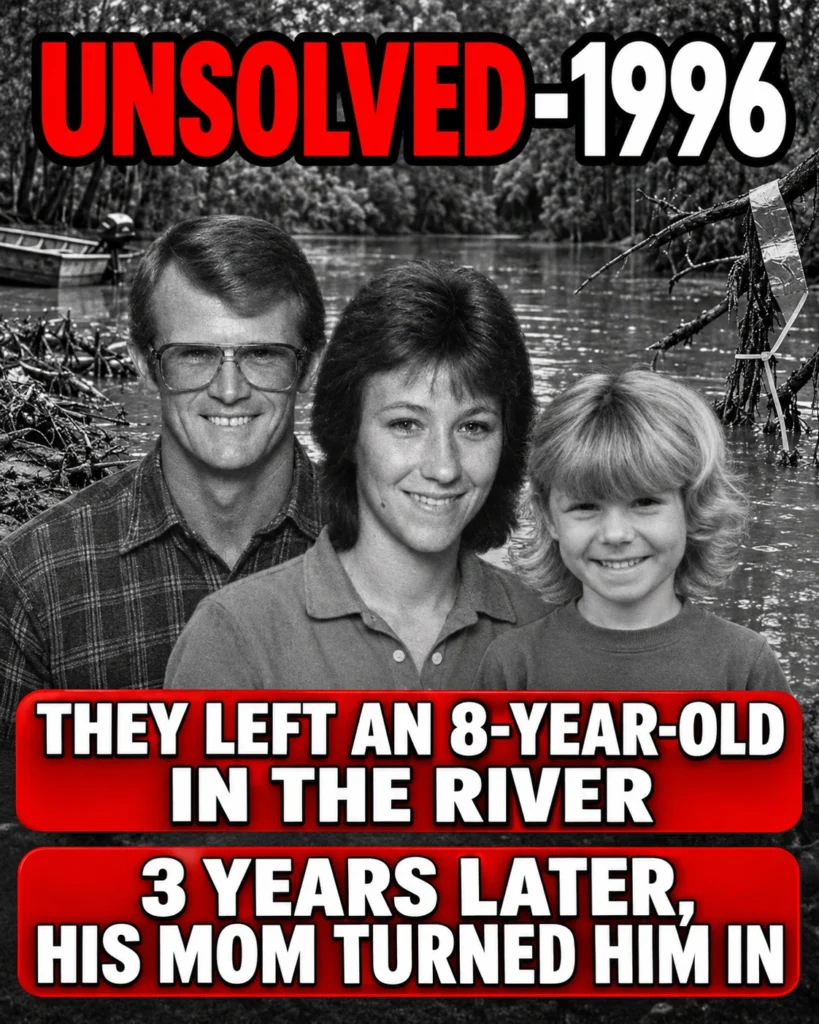
When the leader lives and the follower dies, when the victim’s family begs you not to kill the killer and you kill him anyway, when the judge who tried the case writes that justice was not served, then what is real justice? On June 28th, 1996, three bodies floated up in a branch of the Illinois bayou near Russellville, Arkansas.
Plastic bags over the heads.
Rocks tied to the bodies.
An 8-year-old girl.
Now they have names.
William Mueller, 52, a veteran, a gun dealer, the man who wore his army jacket until the last day.
Nancy Ann Mueller, 28, nee Branch, the young wife from Pope County.
Sara Elizabeth Powell, 8.
The little girl whom even one of the the killers could not bring himself to kill.
They have names.
They have faces.
They have a story.
And now you know that story.
>> >> This is Cold Case Reopened.
We tell the stories of the forgotten victims and the people who refuse to let them be forgotten.
If [snorts] this story stays with you, subscribe and share it.
The next case is waiting.