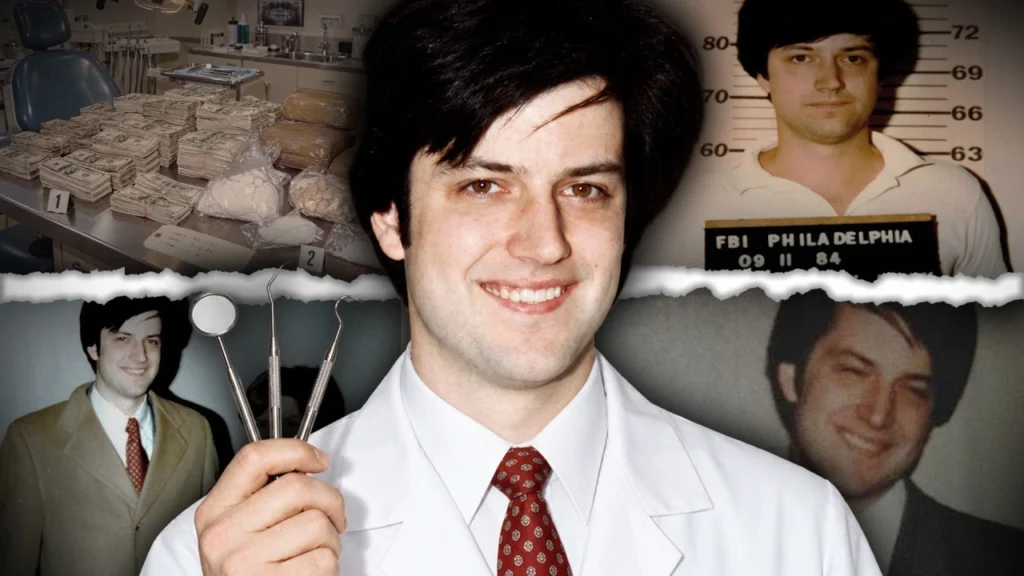

At 5:20 in the evening on May 15th, 1986, a fishing boat pulls into a marina in Virginia Beach and a man steps onto the dock.
>> >> His neighbors know him as Brian O’Neill, a businessman from Philadelphia who sold a computer company and now trade stocks.
>> >> But FBI agents are waiting for him and as soon as he steps ashore, they place him in handcuffs.
Across town, another group of agents enters his home and arrests his wife.
The name on the warrant is one that nobody in his neighborhood has ever heard.
His real name is Lawrence William Lavin, better known as Larry, a dentist who began selling drugs as an undergraduate at the University of Pennsylvania.
During dental school, he recruited classmates into a growing cocaine network which he eventually managed through payphones while working as a dentist in the suburbs.
Authorities estimated that his operation was bringing in $5 million a month and by the time it collapsed, Lavin would receive a 42-year prison sentence.
But the story of how a dentist secretly built a $5 million a month cocaine empire begins more than a decade before his arrest when he was still a college freshman.
In the fall of 1973, Lavin arrived at the University of Pennsylvania >> >> in West Philadelphia after leaving his hometown of Haverhill, Massachusetts.
Penn was an Ivy League university where many students were preparing for careers in law, finance, and medicine.
But there was also a thriving market for marijuana, particularly among students living in fraternity houses.
Lavin soon recognized an opportunity to make money supplying them.
During his first week on campus, he met another freshman named Marsha Osborne who was studying physical therapy.
Their relationship would continue throughout his rise in the drug business and the years that followed.
According to Mark Bowden who documented Lavin’s story in his book Doctor Dealer, Lavin had chosen dentistry because it promised a good income and manageable working hours.
But before he ever began treating patients, he was already building a business of his own.
As a sophomore, Lavin joined the Phi Delta Theta fraternity, where an older member had been supplying marijuana to the house as a side business.
When that student left town for a week, Lavin arranged for suppliers around Penn to give him 10 lb of marijuana on credit.
He sold the entire supply within days and paid the older student $500 for access to his contacts.
The student subsequently handed the business over to him.
Over the next 2 years, >> >> Lavin expanded the operation by assigning a dealer to each class year and renting a house off campus that was used exclusively to store drugs.
What began as a temporary arrangement to supply one fraternity had become an organized distribution business serving students across the university.
The FBI would later establish that Lavin had been dealing drugs since his undergraduate years.
By the time he graduated in 1977 and enrolled at Penn’s Dental School that fall, he was already running a drug operation alongside his education.
Then the product changed.
Weed came in bales.
It smelled.
It took up space.
And the profit on a pound didn’t cover the risk of moving it.
Cocaine fit in a jar.
Around that time, he set a sample in front of his best customer, a South Philadelphia produce vendor named Billy Motto, known on the street as Billy South Philly, and Motto’s customers came back asking for more.
Lavin pooled $112,000 and bought 2 kilos.
In October 1978, after a street dealer turned up at their home, Marsha threatened to leave.
He promised he’d quit once he was worth $100,000.
He passed that number and kept going.
He didn’t choose between the two lives, he ran both.
Lectures and clinic during the day, phones at night, textbooks after that.
The indictment he’d later plead to dated the the to 1978.
A Justice Department report said he was netting about $60,000 a month before he finished dental school.
The FBI said he graduated 1981 a multi-millionaire.
He bought a house in Devon on the Main Line and opened a practice.
His patients knew a dentist.
His neighbors knew a husband with a baby on the way and the network under him, authorities said, was grossing $5 million a month selling to stockbrokers, lawyers, and other professionals.
More than 100 students and professionals were part of it.
The government’s estimate, the Philadelphia Inquirer reported, was 100 lb of cocaine a month.
5 million a month is 60 million a year.
Authorities said it may have been the largest drug ring in Philadelphia history and they gave it a name, the Yuppie Cocaine Ring.
All that cash needed somewhere to go.
In 1980, Levin took it to a Philadelphia businessman named Mark Stewart, who controlled almost 40 companies, including a sports arena and a record label.
Stewart’s arena put Levin on salary and his other companies wrote Levin checks.
That solved one problem and created the one that finished him.
In 1982, the FBI was working a bankruptcy fraud investigation of Stewart and Levin’s name came up in it.
The agent reading those files was Charles Reed, known as Chuck.
In early 1983, Reed walked into the dental office with grand jury subpoenas.
Levin sold the operation that summer.
Then he picked up a payphone to talk about the sale and the line on the other end was tapped.
By December, a federal judge had authorized wiretaps on eight phones tied to his people.
On September 10th, 1984, he was indicted on federal drug charges and on October 1st on tax charges.
>> >> He made bail.
Before the end of October, he, his wife Marcia, and their son had left the house in Devon and nobody in Philadelphia knew where they went.
For the next year and a half, he was Brian O’Neal of Virginia Beach.
Authorities conceded it would have been hard to catch him without a clue and a letter his wife mailed home.
Then came the dock.
A judge ordered him held without bail.
Marciello was charged with helping him flee on release.
He pleaded innocent two weeks after his arrest and his lawyer said that could change if the government’s case looked unbeatable.
It did.
In late June, one day before trial, he pleaded guilty to every charge including the federal kingpin statute which carries 10 years to life.
That September, one judge gave him 22 years for the drugs and a second judge stacked 20 more on top for tax evasion.
42 years.
That’s the answer in outline.
What the outline leaves out is how a dental student kept more than 100 people moving that much cocaine for close to 10 years without one of them walking police to his door.
It came down to three things.
The way he built the operation, the place he put the money, and the one rule he couldn’t keep.
Start with the build.
The blueprint came out of a shoe warehouse.
Lavin spent a college summer packing sneakers at the Converse plant back home in Haverhill.
And while the rest of the crew ducked behind pallets to get high, he studied the floor.
Orders poured in by the hundreds.
Stock arrived on a fixed schedule to meet them.
Every box left sized and labeled for the customer who asked for it.
He went back to Penn and ran weed the same way.
He was 19.
100 lb bales came into the house and were broken down within hours by crews who did nothing else.
The product went out in Ziploc weighed to set sizes >> >> as uniform as anything on a store shelf.
Each class year had its own dealer.
So, a freshman never met the man at the top and the man at the top never had to meet a freshman.
And every dollar that came back went straight into the next buy.
He didn’t stack profit.
If you want to make money, he tell people, you have to keep it rolling.
By the spring of 1975, he was crossing campus with stacks of $100 bills in his pockets, and nobody else at Penn was selling in volume.
That house existed because of a complaint.
By junior year, so many customers were filing through Phi Delta Theta that his own brothers sat him down and told him he’d get the whole chapter raided.
He didn’t slow down.
He moved the stash into a four-story rental at $800 a month and kept it for business only, the first of many addresses that would hold product and nothing with his name on it.
Later, when he and Marcia picked out a Victorian together, he chose it for the shared basement because police couldn’t legally tie anything stored down there to him.
Most couples ask about the kitchen.
The first real loss taught him where to stand.
In the summer of 1976, he pushed a partner into carrying most of the bankroll, about $30,000, down to Florida for a discount load.
The partner bought 100 lb of ragweed nobody could sell.
>> >> He was trying to dump it in a parking lot when men with shotguns closed in on him.
They were police.
Lavin spent that summer joking that his partner would look good in stripes.
He was also close to broke.
He rebuilt from Marcia’s apartment, where he had five phone lines installed and worked them through the night.
She covered the rent and utilities from her hospital paycheck while he worked the phones.
And she thought of his drug money as some kind of game.
In the same stretch, he was accepted to Penn’s dental school and got engaged to Marcia.
From then on, that was the shape of it.
Other people carried the weight.
He stayed on the phone.
The rebuild ran on credit.
He fronted product and watched how people paid.
That’s how he found Billy Motto, who back then was a stranger selling fruit off a stand by day and running a street lottery by night.
Lavin fronted him 30 lb of Colombian weed.
Motto came back inside a week with every dollar he owed, crumpled into a brown grocery bag.
Motto became his steadiest customer and then the first man to put Lavin’s cocaine on the street.
Credit did two jobs at once.
It moved product faster than cash sales could and it showed him who paid.
By the time cocaine arrived, Lavin already knew which customers he trust with it.
Motto hesitated when Lavin first set a jar of white powder in front of him.
He agreed to try it on his own customers and he came back saying they couldn’t get enough.
Lavin’s description was that business went from nothing to zoom.
Weed had taught him the method.
What came next raised the price of every mistake.
Cocaine changed the math and it changed the staffing.
A kilo didn’t need a crew of fraternity brothers to break it down.
It needed people who could keep books, keep quiet, and pass through an airport without drawing a second look.
Lavin found them sitting next to him in lecture halls.
The first was a classmate named Ken Widmer, clean-cut and bound for a practice of his own.
Lavin told him about the business outright and Widmer didn’t back away.
He asked in.
He offered his apartment as a place to unload shipments, then started selling to a third dental student, David Ackerman, a sharp, wealthy, tightly wound New Yorker.
Those three, all headed for the same profession, became the spine of the thing.
By day they sat through the same lectures.
At night they moved product through Widmer’s apartment.
By the FBI’s count, the network would grow past 100 students and professionals.
The customer base climbed with them.
The buyers were stockbrokers, lawyers, and other professionals, people with salaries and no reason to go near a street corner.
They wanted a seller who looked like them.
He did.
The buys were in Florida and the money had to get there.
Lavin and Widmer would walk up to airport security in oversized tweed overcoats with cash packed inside.
Past the checkpoint, they’d step into a men’s room and slide the bundles under the stall divider to a runner who packed them into a carry-on and boarded the flight south.
In summer, when an overcoat would have turned heads, the runner taped $5,000 packets of hundreds flat against his chest and legs and flew like that.
It held together until Lavin brought in an old friend.
Glenn Fuller had been running schemes with him since they were teenagers in Haverhill, and he said he could get 2 kilos of top-grade cocaine through people he knew in Dayton, Ohio.
Lavin sent him with high $10,000 in cash.
Fuller slid the money under his hotel bed, went out for a meal, and came back to find it gone.
He went after a hotel maid for answers and got himself in trouble with the hotel instead.
Lavin held him liable for all of it and put him to work paying it down as a cross-country mule.
That lasted until November 1980.
Fuller, worn out from the road, dozed off at the wheel on the New Jersey Turnpike with 10 lb of cocaine in the trunk, and troopers searched the car.
Lavin put up $200,000 in bail for Fuller and his passenger and $50,000 for a lawyer and wrote off another $224,000 in profit he’d been counting on.
It was the most serious legal threat the operation had faced.
His own name never came up, but a state trooper had come within one conversation of it.
Do, so Lavin stepped back another layer.
He handed day-to-day control to Ackerman, >> >> and the two of them rebuilt the operation the way a company restructures after an audit.
They rented five apartments across Philadelphia so that the cocaine, the cash, and the ledgers never sat under the same roof.
A raid on any one of them would turn up a third of the picture.
A full-time bookkeeper kept the accounts for $1,500 a week, and a friend of hers managed the leases.
Messages moved the same way the product did, in pieces.
Court records show his people worked from payphones and a beeper service run out of a radio company.
And when they flew, they flew under false names and addresses.
The supply line got shorter, too.
A 24-year-old bartender named Willie Harcourt had started out carrying cash for $500 a trip.
He turned out to be the best networker in the outfit.
Harcourt worked his way past the middleman to a Cuban supplier in Miami known as Paco and sealed the relationship over a bottle of champagne at the man’s fortified waterfront estate.
From that point, the dental students were buying at the source.
In the spring of 1981, Ackerman and Harcourt flew down to ask Paco for a volume discount.
Paco made a counter offer.
Move 50 kilos in a single month and he’d rebate $100,000.
Ackerman told his customers there was a shortage and held product back until they were hungry for it, then flooded them and made with three large runs.
The last 18 kilos, worth $1.
3 million, were cut and bagged in one 12-hour session over Memorial Day weekend.
That same spring, Lavin graduated from Penn’s dental school.
50 kilos in a month.
Hold on to that number.
None of this ran clean.
The operation was built so the risk landed on somebody else and it kept landing.
The partner in Florida was arrested, Fuller was arrested, and in March 1980, the risk came through Lavin’s own front door.
Two armed men forced their way into his apartment, pistol-whipped him across the head, held Marsha on the floor at gunpoint, and left with 30,000 and a pound of cocaine.
When they were gone, he passed the rest of the cash and product out a back window to a neighbor, and Marsha vacuumed powder off the floor before police arrived.
>> >> She told him they could have been killed and that he was hooked on the business and couldn’t admit it.
They were married that June.
Ackerman came apart next.
The man running the daily business was using the product hard enough that he locked himself inside his apartment for days at a stretch.
Lavin pulled him out of management, then bought him out and came up $400,000 short on what Ackerman’s share was worth.
Lavin was slipping, too.
The day his son was born in May 1982, he threw a party at the house in Devon with cocaine, Quaaludes, and prostitutes.
Through all of it, the dental practice stayed open.
>> >> He and Wiler had bought it together for $75,000 and he liked the work.
He treated working-class patients at a discount, sometimes for nothing.
By Bowden’s count, he’d made close to $3,000,000 by the time he graduated and he put $219,000 of it into a colonial in Devon.
The man in the white coat was real.
So was the other one.
And the other one had a problem no apartment could solve and he’d had it since before he graduated.
By 1980, he was holding about half a million dollars in cash with a student’s income to explain it.
He couldn’t bank it.
He couldn’t buy a house with it.
A dentist can explain a nice car.
He can’t explain a duffel bag.
That’s where Mark Stewart came in in January 1980.
Lavin found him through contacts in the dental world, a real estate developer and financial advisor who pulled up to the apartment at 7:30 one morning in a black Cadillac wearing rose-tinted glasses and gold rings.
Lavin told him where the money came from.
>> >> Stewart didn’t blink.
He offered to sell Lavin a 49% stake in his companies and pay him a salary of $15,000 a year.
And Lavin handed over $50,000 from a black briefcase before the meeting ended.
About half a million followed.
On paper, the dealer became an investor.
They formed a corporation called Lawmark for Larry and Mark.
Stewart steered the money into an arena at 46th and Market Streets in West Philadelphia and a minor league basketball team.
The arena carried Lavin on its payroll and Stewart’s other businesses cut checks to him and his associates.
Cash went in from a briefcase and came back as a paycheck.
Some of it became a $150,000 townhouse in Society Hill bought after the robbery with a pistol for the bedside table.
Stewart had his own appetites though and Lavin’s cash wasn’t enough to feed them.
In late 1980, he took control of a Philadelphia record company called WMOT Enterprises which had been producing records since 1971 and was short on cash.
It needed the line of credit he could arrange.
Between January and September of 1981, a federal appeals court later found, Stewart moved about $335 million into an escrow account in his own name and $144 million of it belonged to the record company taken without its other offices knowing.
About $440,000 came out of that account and went to Lavin.
He spent it on houses, a car, a swimming pool, and a seat on the Philadelphia Stock Exchange.
A seat on the Stock Exchange.
Five years earlier, he’d been weighing Ziploc bags in a rented house near campus.
>> >> So, the dentist’s laundered salary was now tangled up with somebody else’s embezzlement and the man holding both was getting reckless.
The arena was losing money every month it stayed open and Lavin wanted it shut down.
In the early hours of October 4th, 1981, the arena burned.
Stewart was later charged with paying a member of the Pagans Motorcycle Club to set the fire.
The insurance claim for $1.
4 million went nowhere.
The next year, the record company went into bankruptcy.
A fire at an arena draws investigators.
A bankrupt record label draws auditors.
>> >> Stewart now had both and every file they opened had the same dentist’s name in it.
The name reached the desk in June of 1982.
The FBI was working a bankruptcy fraud case against Stewart, and the agent assigned to his books was Chuck Reed, a former accountant.
Reed went through Stewart’s records box by box, and one name kept turning up that didn’t belong.
A dentist in his 20s drawing a $25,000 salary from a basketball arena, driving a BMW, writing large checks into >> >> Stewart’s companies.
Reed had read enough ledgers to know what a young professional’s income looked like.
This wasn’t that.
He figured there was one business that threw off that much cash.
On a snowy Friday evening in February 1983, Reed walked into the practice and told the receptionist, “You tell Dr. Lavin that we want to see him right now”.
Lavin came out relaxed and denied all of it.
Reed set two federal grand jury subpoenas on the desk.
On his way out, he asked where the money for the BMW parked out front had come from.
Lavin understood the question.
That summer, at a McDonald’s, he sold the whole operation to one of his biggest dealers, Francis Burns, known as Franny, for $500,000 in installments.
>> >> He was out.
All he had to do was stay off the phone.
On August 23rd, 1983, he stopped at a graffiti-covered payphone on Roosevelt Boulevard and called a customer in Phoenix named Wayne Heinauer to smooth over the handoff.
He walked him through it.
Burns was taking over.
The business moved 60 to 80 kilos a month.
The new smuggler would be Burns’ father-in-law, who was dying of cancer, and Lavin said wouldn’t talk if anything happened.
Lavin had used a payphone because payphones were safe.
Heinauer’s phone wasn’t.
A federal judge in Arizona had authorized a wiretap on it.
Every word went onto tape.
Remember the 50-kilo month? At that time, the government’s estimate for every cocaine dealer in Philadelphia put together was under 12 kilos a month.
The agents listening to that tape had just heard one man describe five to seven times the city’s supply, and that man was a dentist.
Now, two investigations were pointed at the same person, one following the money and one following the product, and they merged.
Agents put a pen register on the home phone of Bruce Taylor, one of Lavin’s managers, and ran it from June to December.
It logged call after call to pay phones and to the beeper service, and more than 50 to a single associate.
They watched Taylor and Burns for about five months.
They staked out airports and matched deliveries to what they had heard on the Phoenix wire.
They found a cocaine storage facility in Phoenix, and Heinauer was arrested at the Canadian border carrying a kilo that was 80% pure.
Reed wrote it all into an affidavit that ran 185 pages.
In December 1983, a federal judge authorized wiretaps on eight phones.
The taps ran until January 21st, 1984.
The order spelled out what they were after: the dates, the times, the places, and how the purchases were financed.
The FBI, the IRS, the DEA, and county detectives had all fed the affidavit.
20 agents with shotguns raided Taylor’s home, the apartments, >> >> the beepers, the false names, the layers of people between him and the product.
Every piece of it had been designed to keep anyone to arrest from reaching him.
It worked for a decade, but it couldn’t survive with somebody mapping the whole thing at once.
The drug indictment came down on September 10th, 1984.
Agents took him the next morning at a dumpster where he was throwing out forged documents on his way to work.
At the courthouse, he read the charge and found the kingpin statute, a law he’d assumed was for mob bosses.
10 years minimum, life maximum with no parole.
He wouldn’t name anyone.
The people he built it with made a different choice.
Burns cooperated, Taylor cooperated, and Ken Weidler, his classmate, his partner in the practice, agreed to wear a He was out on a $150,000 bail.
The tax indictment landed October 1st.
Before sunrise on October 27th, he put Marcia, who was pregnant, and their 2-year-old son into a rental car with $1.
6 million and a set of new identities.
Larry Lavin stopped existing that morning.
They bought a house in a waterfront suburb of Virginia Beach under the name O’Neill.
It cost $200,000 and he spent another $50,000 on a pool shaped like Mickey Mouse, a jacuzzi, and a greenhouse for Marcia’s orchids.
A daughter was born there.
He bought a boat and mutual funds.
He gave the neighbors stock tips, mentored the teenagers on the block, and worked on his lawn until, by Bowden’s telling, it won the neighborhood’s award for best yard.
A federal fugitive and he took the prize for landscaping.
Back in Philadelphia, the case ran on without him.
The remaining defendants went after the wiretaps, and in December 1984, a federal judge ruled the surveillance stood.
On September 4th, 1986, Judge Louis Pollak called the case an American tragedy and gave him 22 years and a $100,000 fine.
That afternoon, Judge Louis Bechtle added 20 years and $140,000 for the taxes to run after the first sentence.
The lighter sentence came to 42 years.
The money kept generating paperwork after he was gone.
The record company Stewart had drained went to court to collect that 300 Albert 505 385 out of what the government seized, arguing it had been a victim, too.
In August 1991, a federal appeals court ruled against it.
The government kept the estate.
He was released in 2005 after federal prisons in Kansas and Wisconsin and a medical facility in Minnesota.
He’d served about 19 and a half years.
Marcia had divorced him and raised the children.
His dental license was gone.
In 2020, the Philadelphia Inquirer found him living in Tampa working as an executive >> >> at a telemarketing company.
He was back in sales.
The patients in Devon and the neighbors in Virginia Beach knew the same man.
So did the 100 people who worked for him.
That’s the story of Larry Lavin.
Thanks for watching >> >> and I’ll see you in the next one.