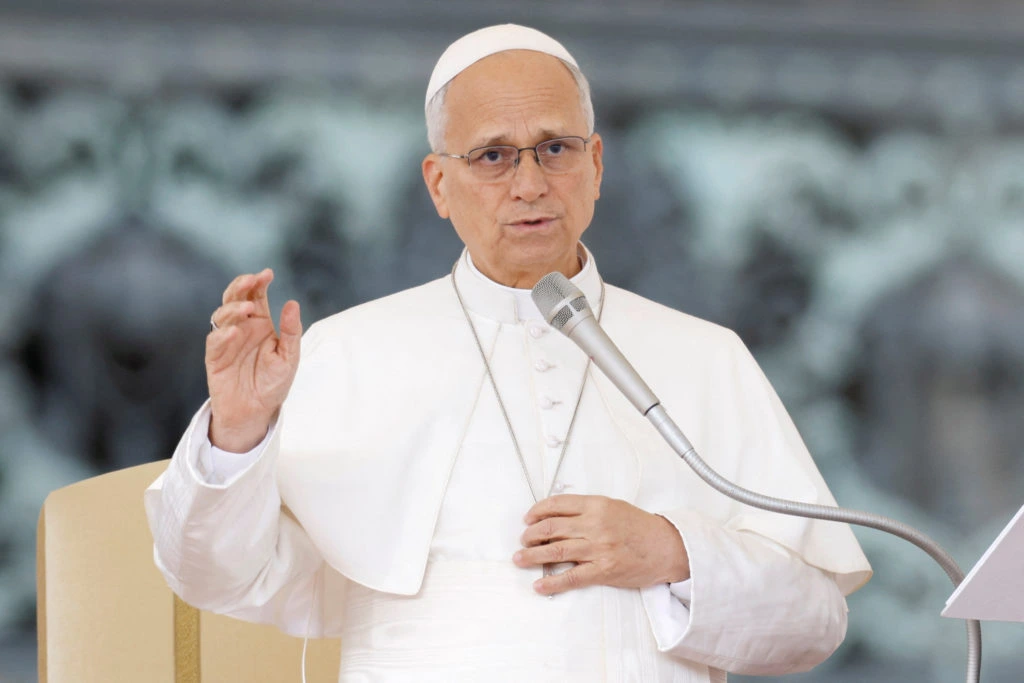
Pope Leo XIV and Three Catholic Traditions: The Quiet Decisions That Could Reshape the Vatican

For centuries, the Vatican has been governed by traditions that appear almost impossible to change.
Its hierarchy, ceremonial practices, and administrative structures have survived wars, political revolutions, and the rise and fall of empires.
Yet the election of Pope Leo XIV in May 2025 introduced a new question about the future of the Catholic Church.
Could a pope known for restraint and careful judgment transform deeply rooted institutions without openly declaring a revolution?
Three developments have attracted particular attention: the relationship between papal authority and commercial imagery, the expanding administrative responsibilities of women, and the continuing controversy surrounding the traditional Latin Mass.
Together, they reveal the complicated choices facing a Church attempting to preserve its identity while responding to modern expectations.
But the most important distinction is between reforms that have actually occurred and dramatic claims that remain unverified.
The story begins with a man whose path to the papacy was anything but conventional.
On May 8, 2025, Robert Francis Prevost was elected Pope Leo XIV, becoming the first American-born pontiff in Catholic history.
Born in Chicago in 1955, he entered the Order of Saint Augustine and spent significant years serving communities in Peru.
His experiences in Latin America exposed him to the realities of pastoral ministry far removed from the ceremonial grandeur of Rome.
He later became bishop of Chiclayo before assuming leadership of the Vatican’s Dicastery for Bishops.
That appointment gave him direct experience with one of the Catholic Church’s most consequential administrative responsibilities: evaluating and recommending candidates for episcopal leadership.
By the time he entered the conclave, Prevost understood both the spiritual responsibilities of local communities and the institutional machinery governing the worldwide Church.
His election therefore represented more than a geographical milestone.
It brought together missionary experience, theological formation, and practical administrative knowledge.
Observers quickly began examining his public gestures for indications of how he intended to govern.
One particularly intriguing story concerned the commercial use of his image.
According to accounts circulating after his election, souvenir vendors near St. Peter’s Square experienced uncertainty about producing officially authorized merchandise featuring the new pontiff.
The narrative suggested that Vatican administrators had deliberately withheld permission for certain commercial reproductions.
Some commentators interpreted the alleged restriction as an expression of personal austerity.
Others saw a possible statement about the commercialization of religious leadership.
The symbolism was compelling.
For generations, papal portraits have appeared on devotional cards, commemorative objects, and souvenirs sold to pilgrims visiting Rome.
These objects can serve as personal reminders of a pilgrimage or expressions of affection for the reigning pontiff.
But their commercial production also raises questions about the boundary between religious devotion and consumer culture.
A pope who deliberately limited commercial exploitation of his likeness could make a powerful statement about humility.
Nevertheless, the available account does not establish that Leo XIV imposed a comprehensive prohibition on merchandise bearing his image.
Nor does it demonstrate that a centuries-old Catholic tradition was formally abolished.
The distinction matters because commercial licensing practices are not equivalent to binding doctrines or universal liturgical customs.
Even so, the broader question remains relevant.
How should a spiritual institution preserve the dignity of religious symbols in a world where almost every recognizable image can become a commercial product?
For Leo, whose pastoral background included service among economically disadvantaged communities, that question carries particular resonance.
A second development concerns the governance of Vatican City State.
Unlike most countries, Vatican City combines the authority of a sovereign state with the institutional structures of the Catholic Church.
Its administration involves security, infrastructure, cultural preservation, financial oversight, and the management of services supporting Vatican operations.
Historically, senior clerics have occupied many of its most prominent leadership positions.
But the assumption that such responsibilities must always belong exclusively to ordained men has increasingly been challenged.
A significant turning point occurred under Pope Francis.
In February 2025, Francis appointed Sister Raffaella Petrini as president of the Pontifical Commission for Vatican City State and president of the Governorate, with her responsibilities beginning in March.
A Franciscan Sister of the Eucharist, Petrini became the first woman to hold these positions.
Her appointment was historically significant because it placed a woman religious at the head of the Vatican’s civil administration.
The decision also reflected a distinction between sacramental authority and administrative responsibility.
Catholic teaching reserves priestly ordination to men, but many governmental and managerial functions do not inherently require priestly orders.
Petrini’s appointment demonstrated how those responsibilities could be entrusted to a qualified woman without changing the Church’s doctrine concerning ordination.
The narrative surrounding Leo XIV claims that a new fundamental law issued on July 31, 2026, formally eliminated a longstanding requirement that the commission’s president be a cardinal.
However, the precise legal changes, date, and asserted 342-year precedent require confirmation from the relevant official legislative text.
The appointment itself had already occurred under Francis.
It would therefore be misleading to describe the elevation of Petrini as a reform initiated entirely by Leo.
The larger significance lies in the institutional continuity between the two pontificates.
Rather than reversing his predecessor’s decision, Leo inherited an administrative structure in which a woman occupied one of Vatican City’s most senior offices.
That reality challenges simplistic assumptions about the relationship between tradition and reform.
The Church can preserve its sacramental teachings while reconsidering which positions require clerical status.
It can also recognize professional competence as an important qualification for civil leadership.
For supporters of greater female participation in Catholic administration, Petrini’s appointment represents a concrete precedent.
For those concerned about institutional change, it raises questions about the appropriate boundaries between ecclesiastical authority and secular management.
Both perspectives reflect a larger debate about how the Vatican should govern itself.
The third issue is arguably the most emotionally charged.
For decades, the traditional Latin Mass has occupied a contested place in Catholic life.
The liturgy, associated with the Roman Missal used before the reforms following the Second Vatican Council, remains deeply meaningful to communities attached to its ceremonial language, music, and ritual practices.
The Second Vatican Council, held between 1962 and 1965, initiated a period of liturgical renewal that profoundly changed Catholic worship.
The widespread adoption of vernacular languages made the Mass more accessible to congregations across the world.
Yet some Catholics continued to cherish the older form of the Roman Rite.
In 2007, Pope Benedict XVI issued Summorum Pontificum, broadening the circumstances under which priests could celebrate Mass using the 1962 Roman Missal.
Benedict hoped that greater liturgical accommodation might encourage reconciliation within the Church.
But the policy remained controversial.
Some bishops welcomed the increased flexibility.
Others worried that competing liturgical practices could deepen divisions over the authority and interpretation of the Second Vatican Council.
In 2021, Pope Francis issued Traditionis Custodes, substantially restricting the use of the older liturgy and returning greater regulatory responsibility to diocesan bishops under Vatican oversight.
The decision generated strong reactions among traditionalist Catholic communities.
For many worshippers, the older Mass was not simply an aesthetic preference.
It represented a spiritual inheritance connecting their religious lives to earlier generations.
For defenders of the restrictions, the issue concerned ecclesial unity and acceptance of the Council’s liturgical reforms.
Pope Leo XIV inherited this unresolved disagreement.
The account provided describes him as approaching the question cautiously rather than immediately reversing Francis’s legislation.
That characterization is consistent with the broader challenge confronting any pontiff attempting to manage a deeply divided religious community.
An immediate restoration of unrestricted access could be interpreted as a rejection of his predecessor’s priorities.
A refusal to consider pastoral exceptions could alienate communities that regard the older liturgy as central to their religious identity.
The narrative also describes permission for Cardinal Raymond Leo Burke to celebrate the traditional liturgy at St. Peter’s Basilica during a 2025 pilgrimage.
Such an event, where authorized, would carry considerable symbolic significance.
Burke has been one of the most prominent Catholic figures associated with traditional liturgical practice.
His celebration of the older Mass in a major Vatican setting would naturally attract attention from both supporters and critics.
However, a particular liturgical permission should not automatically be interpreted as a universal reversal of existing legislation.
The account further alleges that bishops were offered renewable two-year dispensations to accommodate traditional communities.
That precise policy would need to be established through an authenticated Vatican directive before being treated as a general rule.
What is clear is that the liturgical debate cannot be reduced to a simple conflict between progress and tradition.
It involves legitimate questions about pastoral care, church unity, episcopal authority, and the meaning of historical continuity.
These three controversies also connect to a broader theme in Leo XIV’s leadership.
The Second Vatican Council remains central to the Church’s understanding of its modern mission.
Its documents address the nature of the Church, religious freedom, relations with other faiths, and the responsibilities shared by bishops and the faithful.
A renewed emphasis on studying those texts would not constitute an abandonment of tradition.
Instead, it could represent an attempt to understand more carefully how the Church’s established teachings should guide present decisions.
Likewise, consultation with the College of Cardinals reflects an enduring principle of Catholic governance.
The pope possesses supreme authority, but the Church also recognizes the responsibilities of bishops as successors to the apostles.
Consultative gatherings can provide opportunities to discuss disagreements before they become institutional crises.
Such discussions do not eliminate papal authority.
They can, however, influence how that authority is exercised.
The most consequential question surrounding Leo XIV may therefore be less dramatic than the suggestion that he suddenly abolished three ancient traditions.
It concerns whether a modern pontiff can combine institutional continuity with meaningful administrative and pastoral adjustments.
The historical record already shows that the Catholic Church has repeatedly modified its governing arrangements while maintaining claims of doctrinal continuity.
Vatican City’s legal institutions have evolved.
The responsibilities assigned to laypeople and women have expanded.
Liturgical regulations have changed under successive pontificates.
And the relationship between central authority and local bishops remains an active subject of theological discussion.
Not every administrative decision represents a revolution.
Not every accommodation constitutes a reversal.
And not every inherited practice possesses the same authority as Catholic doctrine.
Understanding these differences is essential to evaluating claims about dramatic changes inside the Vatican.
For Pope Leo XIV, the challenge is especially delicate.
He leads a global religious institution whose members hold widely different expectations about reform.
Some Catholics want greater openness and broader participation in decision-making.
Others fear that rapid changes could weaken the Church’s continuity with its past.
Still others seek a less polarized approach that recognizes legitimate concerns on both sides.
The future of his pontificate will depend partly on how these competing expectations are managed.
The most lasting reforms may ultimately be those that attract the least spectacle.
A carefully revised administrative procedure, a more inclusive appointment process, or a measured pastoral accommodation can influence Catholic life for years without producing a dramatic public confrontation.
That possibility offers a more grounded interpretation of the early debate surrounding Leo XIV.
Rather than assuming that three ancient traditions have been destroyed, the evidence invites a closer examination of how institutions adapt while preserving their essential identity.
The Vatican has survived for centuries not because every custom remained unchanged, but because successive generations continually negotiated the relationship between inherited authority and new circumstances.
Whether Pope Leo XIV will be remembered as a major reformer remains a question for history.
What can already be said is that the choices facing him extend far beyond ceremonies, souvenirs, and administrative titles.
They concern the fundamental challenge of governing a worldwide Church whose past is inseparable from its future.
And perhaps the most important question is not which traditions a pope might remove, but which traditions must endure, which practices can evolve, and who has the authority to decide the difference.


