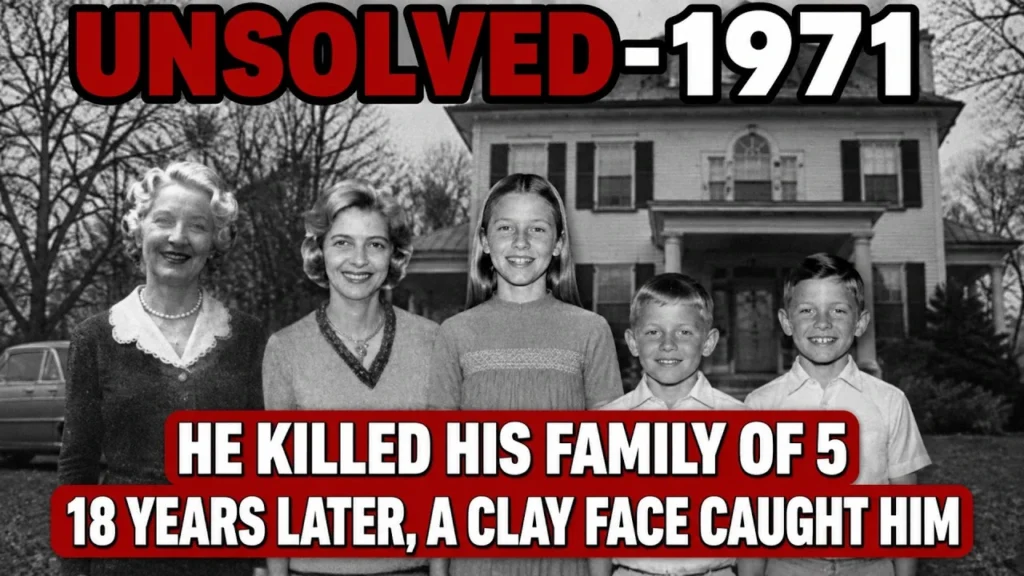
And John List knew how to keep his mouth shut bett…
And John List knew how to keep his mouth shut better than anyone.
The most frightening thing about Robert Clark’s new life was not the hiding.
It was the repetition.
He rebuilt his old life exactly.
Every detail, every pattern, as if running a program that had already been written.
In Denver, he quickly left the cook job and went back to accounting, the work he had done all his life.
He joined a Lutheran church, the same denomination, the same theology, the same kind of church he had attended every Sunday for 46 years before.
He became an active member organizing rides for elderly congregants who could not drive themselves.
He lived quietly, politely, punctually, reliably.
No drinking, no smoking, no girlfriend, no close friends, no past.
Robert Clark was John List minus the family, minus the mansion, minus the murders.
Everything else was identical.
From 1979 to 1986, he worked as controller at a paper box factory outside Denver.
A mid-level accounting management job, the right specialty, the right middle class salary, exactly the kind of work a man like John List would choose.
He did not seek attention.
He did not live extravagantly.
He made no mistake that would make anyone ask questions.
He just lived day after day, year after year, as if the five people dead in the ballroom in Westfield had never existed.
Meanwhile, the house where he killed his family was disappearing, too.
After the bodies were found in December 1971, Breeze Null was repossessed by the bank and put up for sale.
No one bought it.
The mansion became a haunted sight in the eyes of the whole town of Westfield.
children climbing the fence at night, breaking windows, looking for macob souvenirs.
Eventually, the house was boarded up.
And then on August 30, 1972, less than a year after the murders, Breez Null caught fire.
The blaze was officially determined to be arson, but no one was ever caught.
The fire burned the entire 19 room mansion, including the stained glass ceiling said to be signed Tiffany work in the ballroom where four bodies had lain on sleeping bags for a month.
That glass ceiling was worth at least $100,000 at the time, about $560,000 today.
It burned to ash along with every physical trace left behind.
In 1974, a new house was built on the same lot at 431 Hillside Avenue, but Westfield residents still called it the list house.
Children growing up in the town turned that address into a dare for kids brave enough to go near it.
Breeze null was gone, but its ghost was not.
And the case, the case died faster than the house.
The FBI put John List on a nationwide wanted list as soon as the bodies were found.
They issued a federal warrant.
They checked airports, stations, border crossings.
They contacted everyone List had ever known.
Nothing, not one lead, not one sighting, not one financial transaction.
John List or whoever he had become had vanished from every system the 1970s could offer.
Remember that this was the era before the internet, before email, before cell phones, before surveillance cameras on every corner.
If a middle-aged white man with a valid social security card moved to a new city and caused no trouble, he was almost invisible.
John List had committed what the FBI called the perfect crime.
Not because the murders were perfect, but because the disappearance was perfect.
Local law enforcement in Westfield gradually gave up.
The case file went into a cold case drawer.
The original detectives retired.
Newcomers did not prioritize a case 10 years old, 15 years old.
Westfield wanted to forget.
New Jersey wanted to forget.
The whole system bet that time would do what investigation could not.
Bury the case in oblivion.
If you are still following, if you want to know exactly what pulled John List out of the dark after nearly two decades, subscribe to Cold Case Reopened.
We tell the stories of cases everyone thought were dead until someone refused to let them die.
And in this case, the first person who refused was not a detective, not the FBI, but a neighbor in Colorado.
In 1985, Robert Clark married again.
He met Dolores Miller at a church function.
The exact pattern, the exact place John List would look for a wife.
Dolores was an Army PX clerk, a gentle, devout woman who believed in family values.
She knew nothing about Bob Clark’s past.
He did not tell her, and she had no reason to ask.
They married and lived together in Denver.
In February 1987, their neighbor Wanda Flannry was reading a tabloid magazine with an article about the List family murders in New Jersey.
The article included an old photograph of John List from 1971.
Flannry looked at the picture and felt her blood go cold.
The man in the photo looked exactly like a younger version of her neighbor Bob Clark.
Same face, same build, same kind of glasses, Flannry told Dolores.
Dolores dismissed it completely.
Her husband went to church every Sunday.
She said her husband was the most decent man she knew.
The idea that Bob Clark was a mass murderer sounded like a cruel joke.
Flannry did not push.
She set the suspicion aside, but she did not forget, never completely.
In February 1988, the Clarks moved to Midlotheian, Virginia.
Bob Clark took a new accounting job in Richmond.
Wanda Flannry lost touch with them and the case stayed dead until television put a hand in.
In 1988, a new program went on the air on Fox, America’s Most Wanted, hosted by John Walsh, a father whose own son had been murdered.
The show specialized in unsolved cases and asking viewers for tips.
The List case was proposed.
But there was a problem.
The newest photograph of John List was 18 years old.
In 1971, he was 46, dark-haired, wearing a suit.
Now he was 63.
18 years change a human face more than any cosmetic surgery.
An old photograph was almost useless.
The producers needed a solution that had never been tried.
They went to Frank Bender.
Frank Bender was a self-taught forensic sculptor living in Philadelphia.
He began his career in 1976 while studying at the Pennsylvania Academy of the Fine Arts.
He asked an acquaintance to let him into the City Morg to study anatomy, saw a badly decomposed body, and said he knew what the woman had looked like when she was alive.
A forensic employee challenged him to prove it.
Bender modeled the face in clay.
The bust helped identify the body as Anna Duval, 62, from Phoenix.
Years later, a man was convicted of killing Duval.
Bender’s career started there.
He became one of the best forensic sculptors in America, specializing in reconstructing unidentified victims faces and predicting the appearance of fugitives.
The John List case was his greatest challenge.
Bender had only faded old photographs shot from the front.
No profile, no standard mug shot showing the jaw and skull structure.
He needed more than pictures.
He needed to understand John List from the inside.
Bender worked with Richard Walter, a criminal psychologist, to build a full psychological profile.
They studied the confession letter, daily habits, the obsessive need for control, the closed off life.
Walter concluded that list was the kind of man who never changed.
He would still go to church, still work as an accountant, still wear a suit, still live by the old pattern.
Bender translated that psychological profile into clay.
He predicted list would be balding, might have skin cancer from age, and would wear old-fashioned glasses, not modern frames, but the round kind an extremely conservative man would choose.
Bender went to an antique shop and bought a pair of thin rimmed round glasses.
He set the glasses on the clay bust.
Three months of work.
Every line, every wrinkle, every angle of the jaw calculated from aging biology and criminal psychology.
When the bust was finished, Bender looked at it and believed he was looking straight at John List in 1989.
At the same time, the FBI created a predicted image with their own computer software.
But when they were told America’s Most Wanted wanted to use Bender’s bust alongside it, the FBI refused to put their image on the same program.
Frank Bender’s clay bust would stand alone in front of millions of television viewers.
And everything depended on whether a self-taught sculptor in Philadelphia had guessed right.
On May 21, 1989, Frank Bender’s Clay Bust appeared on the screens of millions of American families.
America’s Most Wanted aired an episode on the list family massacre, recounted the entire sequence of November 9, 1971, and placed the bust beside the 18-year-old photograph of John List.
John Walsh looked into the camera and told viewers, “If you recognize this man, call us”.
In Aurora, Colorado, Wanda Flannry was watching the program with her daughter, Eva Mitchell.
When the bust appeared on the screen, both women jumped to their feet.
That was Bob Clark.
Not similar.
Not somewhat similar.
That was him.
The same receding hairline.
The same long face.
The same thin rimmed round glasses.
The same ordinary to the point of invisible look Flannry had seen everyday over the neighbor’s fence for years.
Two years earlier, Flannry had told Dolores Clark that her husband looked like the killer in the magazine.
Dolores had dismissed it.
This time, Flannry did not tell Dolores.
She called America’s Most Wanted directly.
She was not the only one.
Within hours after the program ended, about 20 calls came in from Richmond, Virginia, where Bob Clark was now living and working.
Former neighbors, co-workers, people from church, all recognized the same face.
Frank Bender, the self-taught sculptor in Philadelphia, had guessed right.
Not merely acceptably right.
Right.
To a degree that was chilling.
When the FBI later compared the bust with photographs of John List after his arrest, the resemblance made even veteran agents shake their heads.
From the receding hairline to the wrinkles around the eyes, from the angle of the jaw to the glasses Bender had bought in an antique shop.
Everything matched as if Bender had seen List in the flesh before he sculpted.
John Walsh later said that when FBI agents went to arrest List, they were stunned by how accurate the bust was.
That was not art.
That was magic disguised as science.
11 days.
From the moment the program aired to the moment the handcuffs clicked shut.
Only 11 days.
On June 1, 1989, FBI agents appeared at Robert Clark’s house in Richmond, Virginia.
Dolores Clark opened the door.
They asked where Bob Clark was.
She said he was at the office.
The FBI drove to the accounting office where Clark worked.
They walked in.
The man standing in front of them looked exactly like the clay bust.
balding, round glasses, average build, a face so ordinary no one would look twice on the street.
An agent asked, “Are you Bob Clark?” He said, “Yes”.
The agent asked again, “Are you John List?” He said, “No”.
He said he did not know who John List was.
He said this was a mistake.
He said he was just an accountant in Richmond.
But fingerprints do not make mistakes.
The FBI took Robert Clark’s fingerprints on the spot and sent them for comparison with the fingerprint record John List had left when he applied for a gun permit in New Jersey in 1971.
A complete match, 10 fingers, no margin of error.
Robert Peter Clark was John Emile List.
17 years, 6 months, and 23 days after killing the five people he loved most and walking out the door of Breeze Null, John List was handcuffed in an accounting office in Virginia while wearing a suit to work just as he had every day for nearly two decades on the run.
Dolores Miller Clark, the second wife, collapsed.
She had lived with him for four years, gone to church with him every Sunday, eaten dinner with him every night, slept beside him every night, and never known that her husband had shot his first wife, his mother, and his three children, and laid the bodies on sleeping bags in a ballroom.
She was the sixth victim, not by a bullet, but by a lie that lasted four years of marriage and thousands of nights sleeping next to a murderer without knowing it.
They divorced in 1989.
She never spoke publicly much about what she felt, but her silence said more than any interview.
List was extradited to Union County, New Jersey, and he kept denying even after the fingerprints matched.
Even after the FBI compared military records, even after the 1971 crime scene evidence matched the biometric traces of the man sitting in the interrogation room, Robert Clark would not die.
He held on to that false name for months, refusing to admit he had ever been John List, refusing to admit Breeze Null had ever existed, refusing to admit the five bodies in the ballroom had anything to do with him.
Finally, on February 16, 1990, facing a mountain of evidence that could not be denied.
Military fingerprints, gun permit fingerprints, physical evidence from the scene, and the confession letter in his own handwriting.
John List admitted his true identity.
Robert Clark disappeared for the last time.
The trial began on April 2nd, 1990 in Union County Superior Court in Elizabeth, New Jersey.
18 and 1/2 years after the murders.
Defense attorney Elijah Miller did not deny that John List had killed five members of his family.
He could not deny it.
The confession letter, the fingerprints, and List’s own admission had removed every possibility of denial.
Instead, Miller argued that List suffered from obsessive compulsive disorder, that he had a fragmented personality, unable to face compounding hardship, and that he truly believed he was saving his family’s souls in a world he no longer understood.
Miller asked the court to find List guilty of secondderee murder without intent rather than firstderee.
On the other side, prosecutor Elellanar Clark tore that argument apart with the five-page letter list had left behind.
She read passage after passage to the jury.
The plan to cancel the newspaper, the plan to call the school, the plan to close the bank accounts, the funeral instructions, the escape route.
She asked the jury, “Is this the behavior of a man who has lost control, or is this the plan of a man who calculated every detail from the temperature in the house to the music playing through the speakers, then calmly walked out the door and started a new life?” Elellanar Clark described List as cruel and calculating to the point of evil.
She said he wanted a new life, so he simply closed all the old accounts and left.
bank accounts, family accounts, accounts of living.
Psychiatrist Steven Siming, who examined List by court order, offered a diagnosis just as cold.
He confirmed List had an obsessive personality, but added that there was no evidence of genuine remorse.
“He is a cold man,” Simring said.
Judge William Wartimer, who presided over the trial, later described list in six words that every document on the case, remorseless and without honor.
The trial lasted 7 days.
The jury did not deliberate long.
On April 12th, 1990, John Emile List was found guilty on all five counts of first-degree murder.
Judge Warttimerimer imposed five consecutive life sentences, one for each victim.
Helen, Alma, Patricia, John Jr.
, Frederick.
Five names, five lives cut short.
Five sentences stacked on top of one another to guarantee that John List would never walk out of prison.
He was 64 when he was sentenced.
he would die in prison and he knew it.
John Liss did not accept the sentence.
He appealed.
His lawyers offered two arguments they believed were strong enough to overturn the verdict.
The first argument, post-traumatic stress disorder from military service in World War II, had impaired List’s judgment and made him unable to make a rational decision at the time of the murders.
The second argument, the five-page letter list left at Breeze Null was confidential information sent to his pastor covered by the privilege between congregant and shepherd and therefore should not have been used as evidence at trial.
Both arguments were rejected by the federal appeals court.
On PTSD, the court concluded there was no clinical evidence that List lost the ability to understand his conduct at the time of the crime.
On the contrary, the meticulous planning from cancelling the newspaper subscription to lowering the temperature in the house proved he was fully lucid and in control of every detail.
On the letter, the court ruled that List had voluntarily left the letter at the scene with a note titled to the finder for whoever found it, an act that eliminated any claim of confidentiality.
He did not mail the letter to the pastor.
He left it on the desk next to five bodies for police to find.
That was not confidential information.
That was a confession.
The United States Supreme Court refused to hear the case.
Every legal door slammed shut.
John List would die in a New Jersey prison, and no power on earth could change that.
In prison, List lived by the same pattern he had lived all his life.
Disciplined, quiet, rule following, causing no trouble.
He went to chapel in prison every Sunday just as he had in Westfield, in Denver, in Richmond.
He prayed, he read the Bible, and he waited in the way he told a reporter for the day he would meet his family again in heaven.
In 2002, in the only interview he agreed to give publicly, reporter Connie Chung went to the New Jersey State Prison in Trenton to talk with John List.
This was the first time since his arrest in 1989 that he spoke directly to the media about the murders.
He was 76, white-haired, sitting in a visiting room in prison clothes, and he told Chung things any criminal psychologist would analyze for years.
I wish I had never done what I did, he said.
I have regretted my actions and prayed for forgiveness ever since.
When Chung asked why he did not kill himself instead of killing his family, List answered with the same twisted religious logic he had written in the letter 31 years earlier.
He believed suicide would keep him out of heaven and if he did not go to heaven, he would never see his family again.
He had to live so he would have a chance to reunite with the people he had killed with his own hands.
Then he said a sentence Chung later called the most chilling moment of her interviewing career.
I feel that when we get to heaven we will not be concerned about these earthly things.
They will forgive me or they will not realize what happened.
Not realize what happened.
He believed that in heaven Helen would not remember the bullet in the back of her head.
Patricia would not remember her father standing with a gun waiting when she walked through the door after school.
John Jr.
would not remember that he had tried to fight back and been shot multiple times in the chest and face.
Frederick would not remember.
Elma would not remember.
And if they did not remember, there was nothing to forgive.
Psychiatrist Simmering had been right.
He was a cold man.
On March 21, 2008, John Emil List died at the New Jersey State Prison in Trenton of complications from pneumonia.
He was 82.
He had been in prison 18 years, almost exactly the same length of time he had lived free under the name Robert Clark after killing his family.
18 years on the run, 18 years in prison.
That symmetry was not accidental in a cosmic sense, but it was perfect in a poetic one.
He died without ever publicly admitting that what he did was wrong in a moral sense.
He only said he wished he had chosen another way.
The difference between those two things says everything about who John List was.
Helen and the three children were buried at Fairview Cemetery in Westfield.
Elma was buried separately.
Five graves for five lives cut short by the man they trusted most in the world.
But the John Liss case is not only a story about one family.
It is a story about how a crime was solved and a legacy that changed everything afterward.
The first legacy is forensic science.
Frank Bender’s clay bust became a symbol of age progression technique, predicting how a fugitive’s face would age.
Before the list case, that technique barely existed in law enforcement.
After the list case, it became a standard tool.
The FBI and agencies around the world began using age progression for every long-term manhunt.
Frank Bender proved that art and science combined could do what the technology of that time could not.
Look through 18 years and find a face that had changed.
The second legacy is crime media.
The list case was one of the first and most prominent successes of America’s most wanted.
The show first aired in February 1988, and The List episode aired a little more than a year later when the program was still proving its worth.
The 11-day success from broadcast to arrest demonstrated the power of television to turn millions of viewers into millions of potential witnesses.
America’s Most Wanted continued for 25 seasons, and the producers claimed the show helped lead to the capture of more than 1,000 fugitives.
Many similar programs appeared afterward around the world.
All of them owe the John List case a part of that.
The third legacy is criminal psychology.
John list became a classic case study of family annihilation.
When one family member, usually the father, destroys the entire family and then either kills himself or disappears.
List is the prototype of the model family annihilator.
Perfect on the outside, disciplined, devout, respected by the community, but inside so obsessed with control that when he lost control, the only response was destruction.
Criminal psychologists classify list in the anomic group.
men who treat the family as a social symbol and when they lose social status the family becomes a meaningless accessory to a life that no longer exists.
The fourth legacy is popular culture.
The case inspired a long line of media works, books, documentaries, podcasts, and most notably the series The Watcher on Netflix in which the character John Graph is drawn directly from John List.
In Westfield, he is called the bogeyman, the townstanding ghost, the story parents tell children, the name kids whisper when they walk past 431 Hillside Avenue, even though the old house has been gone since 1972, and the final legacy, larger than all the others, is the lesson.
The John List case exposed the dark side of the postwar American dream.
The pressure to maintain an image of success at any cost.
The stigma of financial failure so deep that a man would rather kill his whole family than admit bankruptcy.
And the way extremist religion can be twisted into a weapon to justify the most horrific act a human being can commit against the people he loves most.
John List was not a monster in the sense movies usually use.
He was not insane.
He did not hear voices in his head.
He was an accountant who put on a suit and went to work every morning.
A Sunday school teacher who taught children about God.
A father who drove his children to school and then went home and shot them.
That is what is most frightening.
Not madness.
Ordinary life.
431 Hillside Avenue, Westfield, New Jersey.
A new house stands on the old lot.
A new driveway, a new yard, new walls.
But under the foundation, the ground is still the ground where Breeze Null once stood.
where hymn music once echoed through 19 empty rooms.
Where five bodies once lay on sleeping bags in the ballroom for nearly a month and no one knew.
Five people, one bullet for each of them.
18 years on the run, 18 years in prison, and a clay bust that pulled Justice out of the dark.
An 18-year cold case.
A sculptor who saw a face.
A neighbor who picked up the phone.
And justice, late as it was, arrived.
This is cold case reopened.
We tell the stories of forgotten victims and the people who refuse to let them be forgotten forever.
If this story stays with you, subscribe and share.
The next case is waiting.