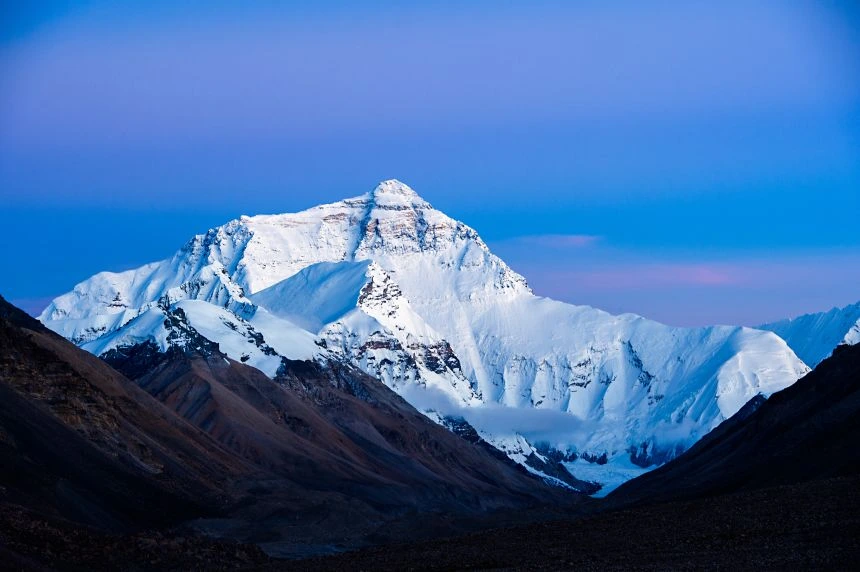
One by one, they turned toward it, and their fear…
One by one, they turned toward it, and their fear gave way to astonishment.
They stopped speaking about the route and the oxygen.
All of us looked at the enormous figure, wondering how it had appeared before us on Everest.
We stood there, unable to look away.
The huge statue remained in front of us, towering above the snow.
For a few moments, nobody spoke.
We were all trying to understand how such a figure could be standing in that place.
Then I saw its body move.
At first, I thought my eyes were playing tricks on me.
I blinked and looked again.
The figure was no longer still.
It turned and began moving across the mountain away from where we stood.
I could not explain what I was seeing, but I knew I did not want to lose sight of it.
Some of the volunteers backed away in fear.
Others stared in wonder.
I told them to stay together and watch carefully.
The statue moved slowly as though it knew we were behind it.
I took one step after it, then another.
One by one, the others followed.
We started across the snow in the direction the figure had taken.
I kept turning to make sure everyone remained close.
The statue moved ahead without leaving footprints that I could see.
Yet, it stayed clear in front of us.
Its shape stood out against the white mountain, and we could follow it even when the ground changed.
Nobody understood why we were following it.
But none of us wanted to remain where we were.
The fear of being lost was still inside us.
Yet, the sight of the statue gave us something to follow.
I heard one person whisper that it could not be real.
Another asked whether we were all seeing the same thing.
I had no answer.
I only knew that the figure was moving ahead and the people with me were beginning to move too.
As we continued, the statue seemed to guide us around dangerousl looking areas.
I tried to study the ground beneath our feet, but the vision did not feel like an ordinary journey.
The mountain appeared bright in some places and dark in others.
I could see the people following me, but their faces still showed exhaustion and fear.
Nobody was arguing now.
They were watching the statue and keeping close to the group.
Whenever we slowed down, it seemed to continue a short distance, then wait for us to catch up.
I kept looking at its shape, afraid it might disappear if I turned away.
I wanted to ask what it was doing there and why it had appeared to us, but I could not speak to it, and it did not speak to us.
It simply continued leading us over the snow.
I started paying more attention to the land than to the questions in my mind.
The statue was taking us toward a route that looked less exposed than the slope we had crossed before.
I did not know whether that meant we were safe, but the path seemed easier to follow.
The others remained close behind me, and I tried to keep them moving at the same pace.
There was no room for anyone to wander away.
I could still feel the fear of being lost.
But now I also felt a strange hope.
The figure was showing us a direction when I had been unable to find one.
I had no explanation for what I was seeing.
I could only follow and watch carefully.
The mountain was still enormous around us.
Yet the route ahead no longer seemed completely unknown.
After a while, I noticed details in the landscape that felt familiar.
The shape of a distant ridge reminded me of places I had seen while guiding people through the Everest region.
I looked more carefully at the slope and the rocks beside the route.
My thoughts began to settle.
I believed I recognized the direction we were taking.
I turned to the group and told them to keep following the figure.
I said the land was beginning to look familiar to me.
Some of them asked whether I was certain and I told them that I was not completely certain, but I had seen similar features before.
The statue continued moving at the same slow pace.
I kept the route in my mind as best I could, noticing every turn and change in the ground.
I did not want to forget any part of it.
The more we moved, the more familiar the route became.
I recognized the way the slope opened toward a clearer line of travel and how the nearby land was shaped.
It was not a route I could name from where I stood, but I knew I had been in that part of the region before.
I could see a way forward that seemed to lead toward a known path on the Nepal side of Everest.
The volunteers noticed the change in my voice when I told them we might be getting closer to safety.
One of them began to smile.
Another said that we should keep moving before anything changed.
The statue continued ahead, guiding us toward the familiar route.
I wanted to thank it, but I did not know how.
I also wondered whether the others understood what I was feeling.
For the first time since we had become lost, I believed we might make it back.
When the statue reached the route I recognized, it seemed to slow down.
I looked toward the familiar ground and felt relief rise inside me.
The volunteers began to react with excitement.
Someone called out that we had found our way.
Another started to laugh and a few people raised their hands as though they were about to celebrate.
I was just about to join them when the vision ended.
I woke with a sudden jolt, struggling to understand where I was.
The real mountain was around me and I could hear people calling my name.
Their voices were filled with fear and pain.
I blinked, tried to sit up and saw the volunteers gathered nearby.
They looked exhausted and frightened.
For a moment, I could not speak.
I had been dreaming about leading them through a route, but now I had to understand where we actually were.
I heard Matteo calling my name as he crouched beside me.
He was the volunteer from Spain who had told us he was a Christian.
The others were close by watching me with worry.
Mateo asked whether I could hear him and whether I was badly hurt.
I answered as clearly as I could, then looked around.
We were all still there, and I was relieved to see the 14 volunteers together.
They told me they had tried to work out where they were while I was unconscious, but they could not agree on a safe direction.
When I stood, I looked across the snow and recognized features near us that matched part of the place I had seen in my vision.
The sight made my heart beat faster.
I told them I had seen a huge statue of Jesus leading us through a route that looked familiar.
I could tell some of them did not know what to make of my words.
Mateo listened without interrupting.
When I finished describing the route, he said, “If you remember the way the statue took you, perhaps we should follow it”.
A few volunteers looked doubtful.
One asked whether I was sure the path had not been part of the confusion caused by my head injury.
I could not prove what I had seen, and I did not ask them to believe that the statue had physically appeared on Everest.
I only told them that I remembered a route and recognized signs of it around us.
We had no better plan.
The group was frightened and our supplies were limited.
I looked toward the direction I remembered and tried to picture each turn the statue had taken.
Then I pointed toward the route and asked everyone to stay together.
The volunteers checked their equipment and prepared to move.
Mateo remained beside me as we got ready to follow the path I remembered.
We began moving along the direction I had chosen, and I kept everyone close together.
I took the lead, but checked behind me often to make sure nobody had fallen back.
My head still hurt from the blow, and the ground seemed to shift whenever I looked down.
I tried not to show how unsteady I felt.
The volunteers were tired and frightened, so they needed me to remain calm.
I studied the slope, the rocks, and the line of the ridge, comparing what I saw with the route, I remembered.
Some details looked familiar, but I did not treat that as enough.
I told everyone to move slowly and wait whenever someone needed help.
No one was to walk ahead alone.
Mateo stayed near the middle of the group, watching the others and helping anyone who struggled.
We moved together, one careful step at a time.
The way forward was rough and narrow.
In some places, loose rocks lay beneath a thin layer of snow.
In others, the surface was hard ice that gave little grip under our boots.
I chose each step carefully before asking the group to follow.
We moved around patches of broken ice and avoided ground that looked unstable.
A few volunteers wanted to hurry because they were anxious to reach a known route, but I told them that speed could make things worse.
We had to watch where we put our feet and leave enough space between one another.
I checked each person as we went, making sure they could still walk and were not too weak to continue.
No one wanted to stop for long.
The cold, their fear, and our limited oxygen made every delay feel serious.
But I knew that rushing across unfamiliar ground could put us in greater danger.
As we continued, we came across signs that other climbers had passed through the area.
We saw damaged equipment, a piece of old rope, and clothing that had been left among the rocks.
Then I noticed human remains partly exposed by the snow.
Some were only bones, while other remains were still covered by old climbing gear.
I could not tell who they had been or how long they had been there.
The sight shocked the volunteers.
One person turned away while another stood very still and stared at the ground.
I told everyone not to touch anything and to keep moving with care.
We paused briefly in silence, aware that the mountain held the memory of people who had never returned.
There was nothing we could do for them in that moment.
We had little equipment and were trying to get ourselves to safety.
I urged the group forward and they followed.
The route became harder as we crossed the uneven ground.
I walked first, testing each step before putting my weight on it.
Sometimes I had to turn aside and look for a safer way around a stretch of ice.
The others waited until I signaled that they could follow.
We could not move quickly, but we continued without anyone leaving the group.
My head throbbed and I felt tired.
Yet the responsibility of guiding 14 people kept me focused.
I watched their faces for signs that someone was becoming too weak to continue.
Whenever we stopped, I asked if they were able to go on.
Each person gave an answer and we moved again.
Our scientific kits and other equipment had been scattered during the storm.
I could not see a safe way to search for them.
So I focused on guiding the volunteers.
The samples and instruments could not matter more than the people beside me.
Our oxygen was running low and everyone knew we could not keep wandering.
The volunteers were exhausted and some had begun to lose hope.
I encouraged them to save their strength by keeping a steady pace and avoiding unnecessary movement.
Mateo helped me remind them to stay close.
He did not try to take over or rush ahead.
He simply stayed with the group and supported those who needed encouragement.
I kept looking for signs that the land was becoming familiar.
A ridge, a bend in the slope, or a change in the ground could help me decide whether we were moving in the right direction.
I could not promise that we would reach safety, but I told them we had to continue carefully.
Their trust in me felt heavy, yet I knew stopping would not solve our problem.
We kept moving, even when the path seemed to offer no easy way forward.
After what felt like a long struggle, I began to recognize the shape of the land around us.
A ridge and a bend in the slope matched features I remembered from journeys through the Everest region.
I looked again, then recognized a section of the route that I had seen before.
I told the others that we might be close to a familiar trail, but I did not want them to celebrate too soon.
We continued for several minutes, carefully following the ground until the way opened ahead.
Then I saw the route clearly.
It was a path I knew and I recognized where it led.
A wave of relief passed through me.
I pointed it out to the group and their faces changed as they understood that we had reached familiar ground.
We were still tired and frightened, but we were no longer lost.
I led them onto the route and made sure that all 14 stayed together.
Once we were on the familiar trail, we moved toward a safer, well-used area.
I watched the ground and kept checking that everyone remained with us.
In time, we saw signs that other people had passed along the route.
The site brought relief because it confirmed that we were moving in the right direction.
We continued until we reached a place where the surroundings were known to me and we could stop without blocking the path.
I counted the volunteers carefully, checking each face and asking whether anyone was seriously hurt.
Some had bruises and scratches, and everyone looked exhausted, but all 14 were with me.
I felt dizzy, and my head still hurt, but I could stand and speak clearly.
The group was safe enough to rest and seek help if needed.
After the frightening hours on the mountain, seeing everyone together mattered more to me than anything else.
When we checked our belongings, it was clear that we had lost the scientific instruments and the samples we had gathered.
Some packs were damaged and the kits were nowhere to be found.
The work we had come to do was gone, but none of us wanted to complain.
We had survived a sudden storm, become separated from our route, and found our way back together.
Mateo thanked me for guiding the group, but I told him I had not found the way alone.
I explained that before waking, I had seen Jesus lead us along a route that became familiar to me.
Some of the volunteers remained unsure what to think while others listened quietly.
I did not ask them to accept my explanation.
I only told them what I remembered and how grateful I was that we were alive.
We gave thanks to Jesus for bringing us through that danger.
I did not yet understand what that gratitude would mean for my life.
But I knew the experience had changed something inside me.
In the days after we were safe, I had time to think about what had happened.
My body was tired and my head still hurt.
But my thoughts kept returning to the vision and to the people who had followed me.
I wondered why I had seen Jesus and why I had believed he was guiding us.
I also thought about Mateo who had listened to me without laughing or telling me what I had to believe.
I wanted to understand his faith but I was not ready to accept everything at once.
I had grown up with my own beliefs and traditions and I knew a serious change in faith would affect how I understood my life.
Still, I could not simply forget what I had experienced.
I felt that I needed to learn more before deciding what it meant.
When I spoke privately with Mateo, I asked him why he believed in Jesus.
He told me that Christians believe Jesus is the son of God, that he died and rose again, and that people can receive forgiveness through him.
Mateo said faith was not a way to control God or guarantee that nothing bad would ever happen.
It was trusting Jesus and trying to follow his teachings.
I asked whether he thought the vision I described proved that Christianity was true.
He answered carefully.
He said he could not prove what I had seen and he did not want to force an explanation on me.
He only wanted to share what he believed and help me find answers in the Bible.
His honesty mattered to me.
He did not use my fear or confusion to pressure me into making a quick decision.
I asked Matteo whether a blow to the head, fear, or the lack of oxygen could have affected what I saw.
He said those were reasonable questions and doctors were best placed to discuss the possible effects of my injury.
He did not pretend to know what had happened inside my body or mind.
He also said that science and faith did not have to be enemies.
Scientific research could examine samples, weather, and the condition of the mountain.
While my vision remained a personal experience that could not be tested in a laboratory, his answer helped me feel free to ask questions instead of hiding them.
I still wanted to understand why the figure in my vision had looked like Jesus and why the route it showed me had seemed familiar.
Mateo listened, then offered to read the Gospel with me if I wanted.
I agreed to read with him.
We began with the Gospel of John.
Taking time to discuss what we read.
I learned about Jesus compassion, his teachings, and the way he spoke to people who felt lost or afraid.
Some parts were difficult for me, and I did not pretend to understand everything.
I asked Matteo questions and sometimes he said he did not know the answer.
That was better than being given an answer that did not make sense to me.
We talked about forgiveness and the way Jesus called people to turn away from wrongdoing.
I thought about the fear I had felt while the group seemed lost and about the calm I felt when I woke and saw the others around me.
I began to wonder whether the vision had pointed me toward a relationship with Jesus, not merely toward a path across the mountain.
At first, I worried that following Jesus would mean rejecting my Sherpa identity or feeling ashamed of where I came from.
Mateo did not ask me to reject my family or my heritage.
He said becoming a Christian meant deciding what I believed about Jesus and learning to live according to his teachings.
I understood that my culture and my faith were not the same question.
I could remain grateful for my family, the people of Nepal and the mountains where I had worked since I was young.
I could also examine the Christian message honestly.
My work had taught me to respect the land and avoid treating Everest as a place that existed only for visitors.
Reading the Bible made me think more about humility, care for others, and the responsibility people have toward the world around them.
As I continued reading and talking with Mateo, my doubts did not disappear in a single day.
I considered what I had learned, prayed in my own words, and asked Jesus to guide me.
I was not looking for another frightening experience.
I wanted to understand the truth and choose with a clear mind.
Later in 2024, I reached a decision.
I accepted Jesus Christ as my Lord and Savior and asked him to forgive me and guide my life.
My prayer was quiet.
There was no sudden light or voice that others could hear.
I simply spoke honestly about what I believed and the life I wanted to follow.
That decision did not make every question disappear, but it changed the direction of my life.
I began to read more of the Bible and to pray regularly, trusting Jesus as I continued to learn.
Since that decision, my faith has remained part of my life.
I still have moments when I need to think carefully and seek answers.
But I no longer feel I must hide my questions from God.
I am grateful to Mateo for sharing his beliefs without forcing them on me.
I am also grateful for the 14 volunteers who trusted me and stayed together during a frightening experience.
I do not tell this story to claim that scientific research proved a miracle.
The citizen science project was meant to gather evidence about the environment and any scientific findings must be judged through research and testing.
My vision was personal.
It shaped my faith, but it was not a laboratory result.
I still believe that careful research matters and that people can serve the mountain by helping scientists understand its changing environment.
When I look back on May 2024, I believe Jesus guided me through the vision and helped me lead the group toward a route I recognized.
I cannot show anyone a physical statue or ask science to confirm what I saw.
I can only share what I experienced and what I came to believe afterward.
The volunteers survived and I remain grateful for every one of them.
I also understand why people may ask questions about the storm, my injury or the vision.
I asked questions myself.
But after reading about Jesus and learning from Matteo, I chose to trust Christ.
I have followed him since 2024 and my faith continues today.
I share this testimony not as proof that every person must interpret my experience in the same way, but as an honest account of why I believe Jesus met me in my time of need and changed my Life.


