
PART 2
“What do you mean they weren’t yours?” Miriam’s grip tightened on the hammer. “I came in from the creek side before dawn,” Silas said. “Those tracks came down from the ridge.” “So someone else was here. Looking for what?” His eyes flicked to the tarp. That was answer enough. Miriam stepped toward it. Silas moved in front of her. “Not yet.” “You don’t get to tell me what I can see in my father’s cellar.” “You’re right,” he said quietly. “But start with this.”
He handed her a photograph. Wendell, older and grayer, standing beside his pickup. Behind him was a building Miriam knew instantly — the Virginia nursing home where she worked. The date was four years before he died. “What is this?” “The first time he drove down to see you.” “He never came.” “I know.” Silas handed her a second photo: Wendell’s truck parked across from a small brick house. Her house. Then a third: a much younger Jonah climbing the steps of his elementary school, backpack bouncing.
Miriam’s chest locked tight. “If my father drove all that way, he would have knocked.” “That’s what I told him,” Silas said. He sat slowly on the cot. “Your daddy could rebuild a transmission in the dark. He’d crawl under a forty-ton machine nobody else would touch. But when it came to you, he was terrified.” Miriam laughed bitterly. “Of me?” “Of hearing you say you didn’t want him anymore.”
The words hit like a fist. For twenty-three years, she had told herself one story about that morning by her car: he let me go because he didn’t care enough to stop me. Now Silas was offering another — that maybe Wendell had stood behind that door, desperate to move, and simply didn’t know how. It didn’t erase anything. Somehow, it hurt more.
“Did Grandpa know about me?” Jonah asked softly. “He knew,” Silas said. He pulled down a battered cardboard box. Inside were birthday cards, newspaper clippings, and envelopes — dozens of them, unsent. Miriam. For Jonah, age 6. For Jonah, age 8. And one that made her sit down: For Miriam — if I ever find the nerve.
“That isn’t love,” Miriam whispered. Silas didn’t argue. “No. Sometimes it’s cowardice wearing love’s coat. He failed you. He knew it.” Then he pointed to an old wooden doorframe. Faint pencil marks ran up it, with Jonah’s name beside them. Not real heights — guesses. Wendell had been marking where he imagined his grandson might reach each year.
Jonah pressed his back to the frame. One of the last lines landed almost exactly at his shoulder. Miriam turned away. That nearly broke her. Not because Wendell had been a good grandfather — he hadn’t been there. But because somewhere on this lonely mountain, an old man had been imagining a grandson he was too ashamed to meet.
“What was he preparing for?” she finally asked. Silas’s face hardened. “About two years before he died, the phone calls started. Then letters. People wanted this land.” He pulled the tarp aside. Behind it, bolted into the concrete, stood an old steel safe. “I can’t open it. He never gave me the combination.” “Then who has it?” Silas looked straight at her. “You do.”
He handed her a folded scrap of paper in Wendell’s blocky handwriting: She already knows the numbers. “I haven’t spoken to my father in over twenty years,” she said. Then Jonah tugged her sleeve. “Mom. Look.” On the doorframe, four dates were carved far deeper than the rest. Her mother’s birthday. Miriam’s birthday. The day she left home. The day Jonah was born.
She tried the dates in order. Nothing. Reversed. Nothing. For twenty minutes she spun the dial while Silas waited in silence. Then Jonah spoke up. “Maybe Grandpa didn’t mean the dates. Maybe he meant how old you were.” Miriam stared at the wall. Seventeen, when her mother died. Twenty, when she left. Thirty-two, when Jonah was born. Not dates on a calendar — the moments that had broken and remade Wendell’s life.
The last number clicked. The lock released. “Well,” Silas murmured, “I’ll be damned.” There was no gold inside. No stacks of cash. Just folders — deeds, tax records, survey maps, savings bonds, and mineral leases going back decades. On the bottom shelf sat a metal cash box with enough money for groceries, a battery, and heat for a while. To Miriam, it felt like a fortune. Silas barely glanced at it. He was staring at the maps.
“Your father bought small mineral interests whenever he could afford them,” he explained, “back when folks around here thought they were worthless. What’s on top of the land and what’s underneath don’t always belong to the same person.” “So this place is valuable?” “Maybe. Could be worth a little, could be worth a lot. That’s the honest answer.” Wendell hadn’t guessed. He had documented everything.
Then Miriam found a folder labeled OFFERS — DO NOT SIGN. Letters from companies she’d never heard of, each covered in Wendell’s angry margin notes: Too low. Won’t explain assignment clause. Keeps calling after I said no. One letter, dated eighteen months before his death, had just three words across it: Find out why. Clipped behind it was a photocopied business card. The company meant nothing to her. The name written beneath it stopped her heart.
Garrett Reeves. “Mom?” Jonah whispered. Memories rearranged themselves in a sickening flash. Garrett asking why she still kept “that useless mountain land.” Garrett warning her about taxes. Garrett offering to find “someone who’d take it off her hands” — and making her feel foolish every time she hesitated. “He was my partner,” she said hollowly. “Twelve years.”
At the bottom of the folder was one more note in Wendell’s hand: Asked too many questions about Miriam. Don’t trust him. “Did Garrett ever meet your father?” Silas asked. “Not that I knew of.” That answer scared her more than a yes would have. A pile of junk with an address. For years she’d heard contempt in those words. Now she heard pressure. “Is Garrett the one who made the footprints?” Jonah asked. Miriam looked at the cellar stairs. “I don’t know.” And for once, she refused to pretend she did.
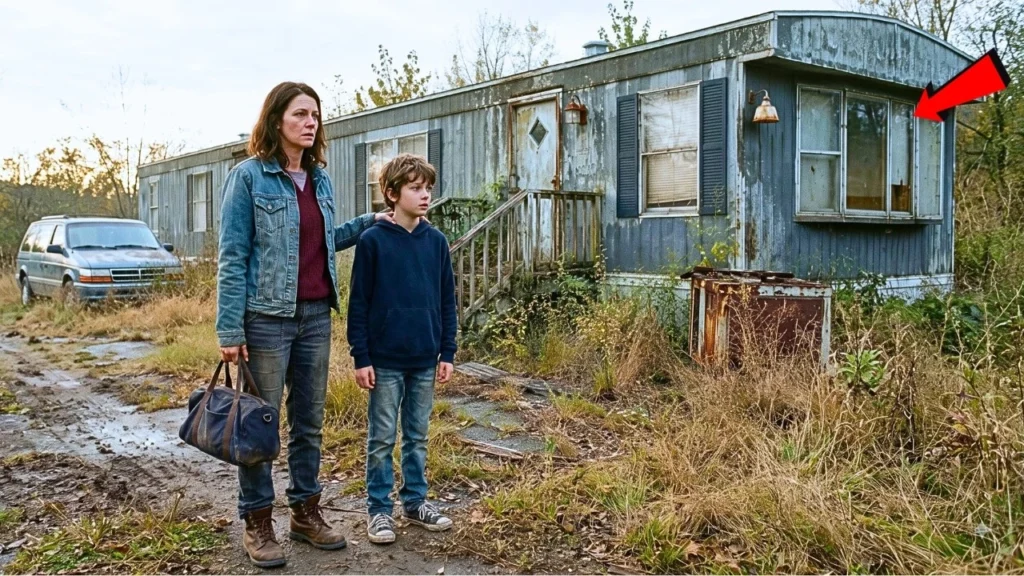
The old Miriam would have called Garrett screaming. Instead, she placed every document with his name into a separate folder. “We don’t call him,” she said. “We find out what this means first.” It wasn’t wealth she felt. It wasn’t revenge. It was control — something she hadn’t felt in years. That afternoon, Silas got the van running. They bought groceries, two space heaters, a new lock. Jonah picked a blue blanket for the little bedroom at the end of the hall, and that night he slept in a real bed for the first time in over a week.
The next morning, Silas called her outside. In the mud beside the old tracks was a fresh set — big boots, deep square treads. They came from the tree line straight to the mobile home and stopped beneath Jonah’s bedroom window. Someone had stood there in the dark, looking in at her sleeping son.
Miriam photographed every print, every scratch on the skirting, every tire mark near the road. She drove to town and filed a sheriff’s report. Then she walked into the office of Nora Whitcomb, an attorney with twenty years of estate and mineral rights cases, and set Wendell’s papers on her desk. “I need to know what I actually own. Not what someone says it’s worth. Not what someone wants me to believe.” Nora looked at her. “That’s exactly the right question.”
Over the next days, the picture sharpened. Wendell’s records were meticulous. Some interests were small; others needed title verification. No overnight fortune — but enough that an inexperienced heir should never sign anything without independent advice. Enough that someone might see her as an easy target. “As for Garrett,” Nora said, “this proves contact. It doesn’t prove motive. Protect yourself first. Questions later.” For once, Miriam wasn’t disappointed not to be handed a villain. She wanted the truth more than revenge.
Life at the mobile home began to change in small ways. Silas fixed the furnace. Miriam scrubbed years of grime from the kitchen while Jonah hauled broken furniture outside. One afternoon she found him standing against Wendell’s marks again. “Grandpa was pretty close,” he said. He was — less than an inch off. “Do you think he would’ve liked me?” Miriam could have given an easy answer. She gave an honest one. “I think he already did.”
That night Silas told her that Wendell once asked what kind of boy Jonah was. “How would I know? I’d never met him,” Silas had said. Wendell looked down at a photograph and answered, “If he’s anything like Miriam, he’ll be stubborn enough to survive me.” For the first time in decades, Miriam laughed at something her father said. Then she cried — not the desperate tears of the minivan, but grief and gratitude tangled together.
Three days later, they came back from town to find Silas frozen beside the back door. The frame was splintered. Someone had forced it open. Inside, nothing of value was gone — the TV, the tools, even the cash were untouched. But Wendell’s papers were flung across the floor, drawers yanked out, books torn from shelves. “They were searching,” Silas said. The safe was still locked — and the important documents were already in Nora’s office. Whoever it was had come too late.
It should have terrified her. Instead, Miriam felt something rise up her spine: anger. Not the reckless kind. The kind that straightens your back. Garrett had made decisions for years because she hated confrontation. Wendell had lost decades over one conversation he was too scared to have. Silence. Avoidance. Fear. She saw the pattern running through her whole family — and she would not hand it to Jonah. “Do you want to leave?” she asked him. “Do you?” She looked around the damaged home. “No. We’ll be careful. But I’m done being chased out of places.”
At 10:47 that night, Jonah called from his room. “Mom?” Far up the dirt road, beyond the trees, two headlights glowed. A pickup truck. Not moving. Just sitting there, facing the house. Miriam killed the light. Thirty seconds. Forty. Nearly a minute. Then the headlights went dark, and the truck turned and vanished before Silas reached his own. “Garrett drives a pickup,” Miriam said. “So does half of West Virginia,” Silas replied. She nodded. She would not turn fear into fact just because it fit the story.
The next morning, Nora called. “One of the companies that approached your father changed ownership three years ago. And someone connected to Garrett has a financial stake in it. His older brother — Malcolm Reeves.” There was more: old emails between Garrett and Malcolm discussing properties in the area. Wendell’s parcel number was in an attachment — dated before Garrett ever told Miriam to sell. Miriam felt sick. Twelve years beside a man, and she was only now wondering when his interest in “worthless land” had truly begun.
“Suspicion isn’t proof,” Nora warned. “We document. We secure your ownership. We let the facts lead.” Title specialists verified Wendell’s paperwork. The mineral interests were real — their value tied to future agreements, not a lottery ticket. But they gave Miriam something better than money: choice. Through Nora, she rejected every outstanding offer and directed all contact to counsel.
Garrett called three times. She didn’t answer. The fourth time he left a voicemail: “Miriam, you don’t understand what you’re dealing with. Call me before you make a mistake.” A year ago, those words would have made her doubt herself. Now she pressed delete. When he finally contacted Nora, he claimed he’d only pushed the sale because the land seemed like a burden. Maybe some of that was true. Miriam no longer needed his version of anything. The break-in stayed under investigation, with no proof tying it to him. She accepted that, too. She was done filling silence with assumptions.
One cold evening, Silas arrived with a weathered envelope in Wendell’s handwriting. “This one wasn’t in the box. He made me promise not to give it to you until you opened that safe yourself.” Miriam almost smiled. “Even dead, he’s stubborn.” “You have no idea.” She unfolded two pages. Wendell wrote about her mother first — how after losing her, he mistook silence for strength. Machines made sense. When they broke, you found the bad part and replaced it. People didn’t work that way.
Then she reached the line that stopped her breath: I kept thinking I needed something worth giving you before I had the right to come back. So I saved papers. I kept the land. I put away what money I could. I told myself one day I’d have enough to prove I’d done something right. Jonah leaned quietly against her shoulder as she read the end: But I understand now I spent too many years trying to leave you something valuable, when I should have spent them telling you that you were valuable to me.
For twenty years, part of Miriam had waited for her father to walk through a door and say he was sorry. He never did. Now his apology was shaking in her hands. It didn’t give back the years. It didn’t make him the father she needed. But she finally understood: his silence hadn’t meant she was unloved. It meant he was a flawed, frightened man who learned too late that love left unspoken can wound almost as deeply as love withheld.
“Mom, are you okay?” Jonah whispered. She pulled him into her arms. “I will be.” Silas slipped quietly outside. And in the kitchen of the mobile home she’d once been ashamed to inherit, Miriam made a promise: her son would never have to guess how much he mattered.
Weeks became months. New glass in the window. A roof that didn’t leak. Fresh paint on the tired walls. But Miriam refused to touch the old doorframe. Jonah added a new line beneath his grandfather’s guesses — and this one was real. One winter morning, he stood at the window watching Silas fix the porch steps. “Mom? We’re not homeless anymore. Right?”
Miriam looked around. The floor still creaked. One cabinet never quite closed. But the heat was on, the fridge was full, her father’s marks were on the wall, and her son was safe. She knelt and wrapped him in her arms. “No, sweetheart. We’re home.”
She had come to that mountain believing her father left her a place to hide. Instead, he left her enough truth to stop running. Wendell’s greatest inheritance wasn’t buried in the ground. It was the lesson he learned too late: never let pride, fear, or silence stop you from telling the people you love how much they matter.
💬 Is there someone you need to say it to today — before it’s too late? Tell us in the comments: what does “home” truly mean to you? ❤️ Share this story with someone who needs to hear it.