PART 2
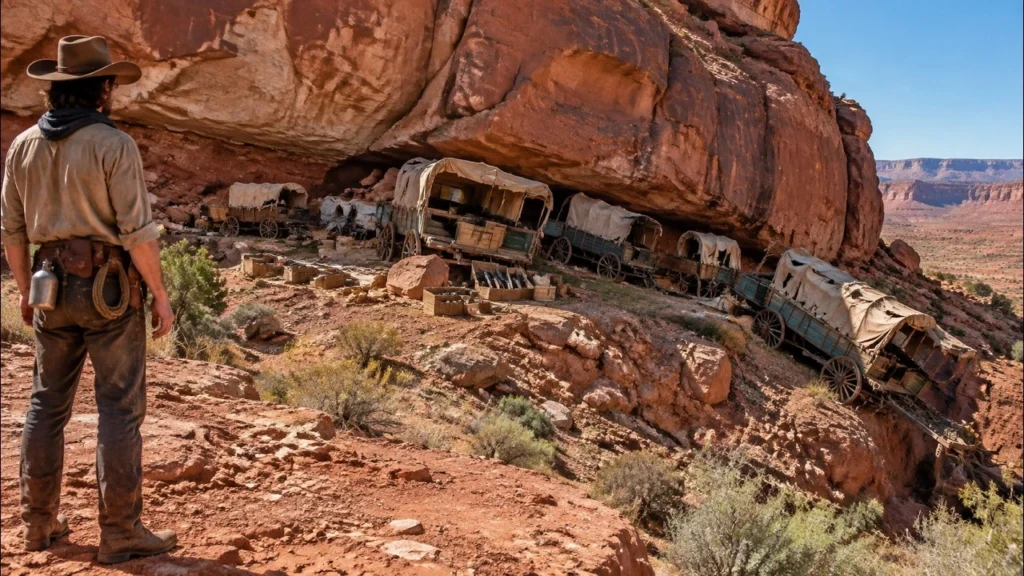
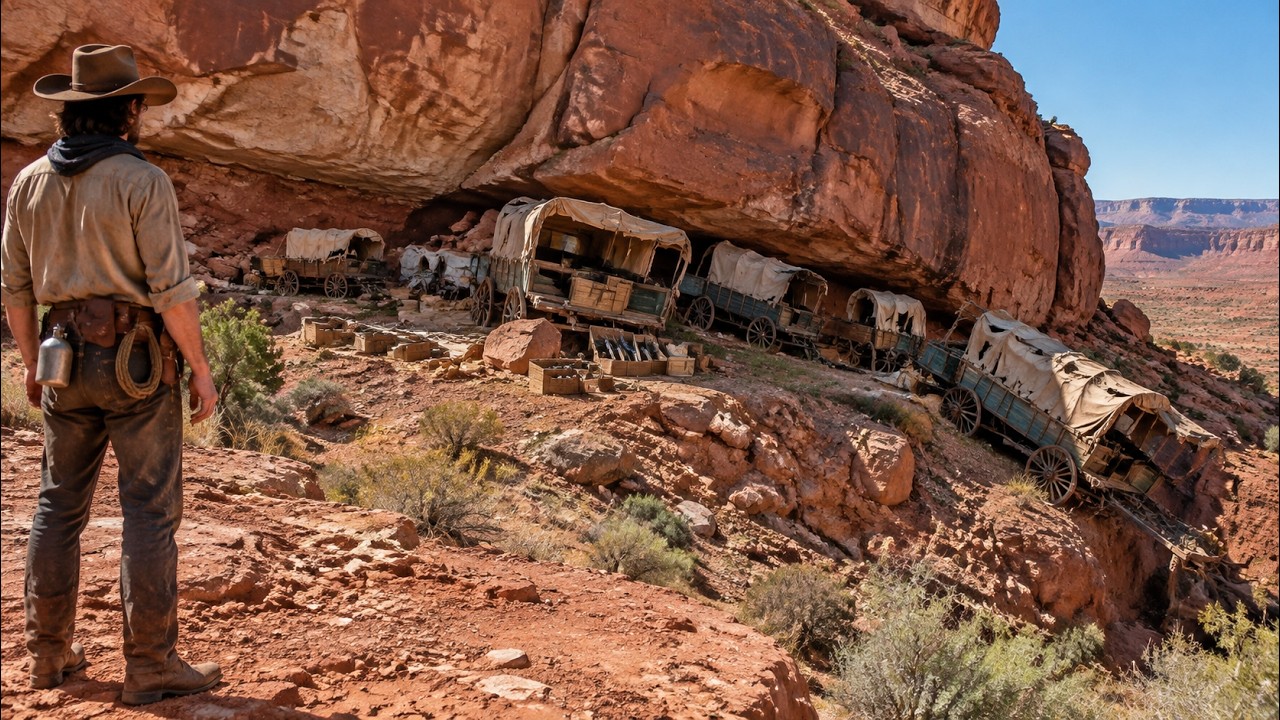
David backed off the mound at dusk. He built a small fire in the lee of the far bank, boiled coffee in Mercer’s cup, and sat staring at the slide until the last light was gone. He barely slept. At dawn, he went back to work — slowly, from the upper end down, the way Mercer had taught him. A man who works a wreck in haste buries what he means to save.
Under the second wagon was a slab he had to lever twice before it moved. When it finally rolled aside, David went still. It was Wiley Prine. What three winters under stone had left of him, still in the coat David remembered, belt buckle shining like the day it was made. Beside him was the tin box teamsters used for waybills. Inside, wrapped in oilcloth, were a folded paper and a heavy leather pouch.
David sat back on his heels in the wind for a long time before he opened the paper. It was Wiley’s pencil scrawl, gone soft with damp, dated the fourth day of the run. In his short, plain way, Wiley had written that the lieutenant ordered the tail of the column to shelter under the cliff — against the guide’s plain word not to. That the slab came down before anyone could move the teams. That he was writing this in case someone ever found them, so the story would be set straight.
The guide is not to blame, Wiley had written. He said so plainly at the noon halt, with three soldiers standing by. He named all three soldiers. At the bottom, in a steadier hand, as if he’d waited to be sure, he named the lieutenant.
And one more line: the pouch held $81 in coin, his to give, and he wished it to go to whoever found him — for the trouble of the finding. Then his full name, and the date.
David folded the letter back into the oilcloth and held it in his lap a long time. Then he took out Mercer’s tin cup and set it on a flat stone beside Wiley’s letter. Two things from two men who had believed in him, sitting together in the sun.
He did not leave the slide that day, or the next. He worked the mound stone by stone, marking every opened place with canvas weighted by a rock so he wouldn’t lose count. He found the second teamster, gloves still on, reins wrapped once around his wrist. He opened the third wagon and found the weapons crates stacked exactly as they’d been loaded, iron bands rusty but sound. He counted them against the manifest he remembered. The number was right.
He didn’t move the crates. He wrote instead. On a sheet of brown paper he’d kept for harness tallies, in the plainest hand he could manage, he recorded everything: the count of wagons, the count of crates, the stenciling, where each man lay, and the date. He folded Wiley’s letter inside, tied it twice in the oilcloth with the cup and his father’s letter, and on the fifth morning, he rode south.
Four days later, he stood at the gate of Fort Howerin — the same post that had ruined him — and gave his name to the sentry. They made him wait on a bench outside the orderly room for two hours. Then he was called in.
The officer of the day was Captain Ordway, gray at the temples, new to the post. He knew the convoy only from the file. David laid the brown paper on his desk, set Wiley’s letter beside it, and said simply, “This is where your wagons are.” The captain read both pages. Then he read them again. He asked three questions, wrote down the answers, and sent for a sergeant.
Within a week, twelve men, two wagons, a farrier, and a young lieutenant rode north — with David Tanner at the head of the column. The disgraced guide nobody would hire was leading the army back into the badlands.
At the slide, David walked Sergeant Ives along the mound end to end before a single stone was moved. Ives listened, nodded, and didn’t rush him. The detail worked for eleven days — the same eleven days the first search had spent finding nothing. This time they brought it all out: six wagons, the remains of eleven mules, four soldiers, Wiley Prine, ninety-two crates of ordnance, and every piece of iron harness.
The farrier built coffins from the wagons’ own sideboards. They wrapped the men in fresh canvas and carried them home on the recovered beds. Back at the fort, the captain took David’s full statement, the sergeant’s corroboration, and a corporal’s check of every crate against the manifest. He filed it all with Wiley’s letter enclosed.
The record of the loss was reopened — and rewritten. A copy of the new report, signed by the captain and the post commander, was sent to Rimrock and pinned to the board outside the freight office. Right where every man who had crossed the street to avoid David Tanner could stand and read the truth in his own time.
David wasn’t there to watch them read it. He was already back at the slide, hired by the post at day rate to help bring out the last of it. He stayed through September and into the first snow of October. The captain paid him a guide’s wage — $28 — plus pay for the use of his horse. Wiley’s $81, David kept, just as Wiley had asked. He didn’t spend a cent of it that year.
When the last wagon rolled south, David turned off alone at the fork above the basin. He rode to the plank barn a mile from the log house where he was born. Mercer’s old freight barn. It had stood empty since the old man died. The roof had gone soft in two places, and a side door hung by one hinge. But the frame was sound, the stalls were just as Mercer left them, and the old freight scale bolted to the sill still swung true when David touched it.
Mercer had no kin. The county clerk told him the barn and its half-acre could be taken up for seven dollars. David paid it out of the leather pouch inside his shirt and signed his name on the clerk’s counter with a borrowed pencil.
All fall, he worked. He split cedar shakes and reshingled the roof from a ladder made of pine and rungs cut from a broken wagon tongue. He rehung the door on a hinge cut from old harness leather. He swept the loft, laid fresh straw, and cleaned the scale with kerosene. He set Mercer’s tin cup on the shelf above the forge, right where Mercer had always kept it.
Then, one by one, the men began to come. Henley came first, hat in his hands, standing just inside the door. He had wool going to the rail siding in spring and needed a freighter who knew the country. He didn’t mention the envelope on the pine table. David didn’t either. They shook hands over the freight scale, and Henley left a $4 deposit on the desk.
A week later, a rancher named Bevan — who hadn’t spoken to David in three years — brought a broken singletree to mend, paid in advance, and stayed to drink coffee from the tin cup. The blacksmith from Rimrock rode out one Sunday with a keg of nails he swore he’d overordered and helped hang a new north door. A widow named Merle who ran the boarding house sent a boy every Friday with a covered plate of supper and refused to take a single coin for it.
By the first hard freeze, David had two contracts signed: Henley’s spring wool haul, and a supply run for Fort Howerin itself — at a guide’s and freighter’s rate together. He hired a 19-year-old named Wren from a railroad family, a boy who could handle a team and wanted to learn the country. And David began teaching him exactly as Mercer had once taught him. How to judge weight. How to check a kingbolt. How to read a wash, a butte, a sky.
Men who came on business started calling the place Tanner’s. After a while, David heard the name in town without turning his head. It had simply become the name of the place.
On a still evening in late November, with the first real snow lying on the ridges and the yard going blue in the dusk, David closed the north door and stood a moment with his hand on the latch. Coals glowed in the forge. The tin cup caught the red light on its rolled rim. The buckskin dozed in the near stall, white sock on the near hind, old wire scar along his ribs. A second horse, taken in trade, worked slowly at his hay.
He sat at the plank desk and untied the oilcloth. Wiley’s letter. His father’s short letter, the creases dark with handling. He didn’t read either one. He just set the tin cup beside them — the way they had once lain together on a flat stone at the foot of the slide. Two men who had taught him what a man was. Mercer, who saw a boy pull a splinter from a horse’s hoof and decided he was worth teaching. And Wiley, who lay under rock three winters with the truth folded in a tin box, waiting for someone to come.
The lieutenant’s name was in Wiley’s letter. It was in the army’s report. It was on the board in Rimrock for anyone to read. David had never spoken it once, and he never would. He didn’t need to. And the men who’d crossed the street for three years? He searched himself and found he wasn’t carrying them anywhere he could locate.
He thought of his father in a back room by the railroad. He would write in the spring, he decided — after the wool haul. Maybe send a photograph if the man with the camera came through. Then he thought of Wren, who’d asked that afternoon how a man could tell by looking whether a wash would hold a wagon in the rain — and of how carefully the boy had listened to the answer.
David put the cup back on the shelf. He tied the oilcloth twice and returned it to the drawer. He banked the forge, put out the lamp, and stood in the dark barn listening to the horses breathe and the wind move along the eaves of Mercer’s roof. His roof now.
He was 40 years old. He had a barn, a half-acre, a good buckskin horse, two signed contracts, and a boy learning the trade under him. He had left Rimrock with eleven dollars and forty-two cents, and spent seven of it on a piece of paper at the county clerk’s counter.
It was the best seven dollars he ever spent.
💬 Have you ever been written off by the people around you — and kept going anyway? Tell us in the comments: what’s the one thing everyone called a loss that you still believe you’ll find your way back to? 🤠 Share this with someone who needs to hear that the truth always finds its way out.