She fought for her life
She fought for her life.
The evidence under her fingernails is what led us here.
Then the detective said, she made this happen.
Leslie Perlov’s fight for survival didn’t just preserve the evidence that solved her own murder.
It solved Janet Taylor’s, too.
On October 31st, 2018, Halloween, a team of Santa Clara County deputies followed John Arthur Getreu to a medical building in Union City.
They had been watching him for days, waiting for the right moment.
Getreu was 74 years old by then, a quiet man living an unremarkable life in Hayward.
He walked into the building, had his appointment, walked out into the parking lot, and tossed a coffee cup into a trash can as he left.
He did not look around.
He did not notice the deputies.
He had no idea that the most important piece of evidence in a 45-year-old murder case was now sitting in a public trash can with his saliva on the rim.
The deputies retrieved that coffee cup.
On November 9th, the Santa Clara County crime lab processed the DNA from the cup and compared it to the unknown male profile from Leslie Perlov’s fingernails.
The match was confirmed.
The probability of a random match was approximately one in 65 septillion.
That is a number with 24 zeros after it.
On November 20th, 2018, John Arthur Getreu was arrested at his home in Hayward.
Sergeant Noe Cortez made a phone call to Diane Perlov.
Diane, we got him.
He’s in jail.
What happened in the interrogation room revealed exactly who John Getreu was beneath the surface.
He told investigators he had never been arrested.
That was a lie.
He had served years in a German prison for killing Margaret Williams.
When detectives showed him a photograph of Leslie Perlov’s crime scene, he looked at it and said, she’s cute anyway.
He was asked whether he ever fantasized about hurting women.
His answer, that’s what it looks like.
And then came the most chilling moment.
Without any prompting, Getreu brought up a second girl that Cortez had never mentioned.
Nobody in the room had said anything about Janet Taylor, but Getreu knew.
Okay, I had involvement, he said, but I don’t remember it.
When a detective told him, you had to have known this was coming, Getreu nodded.
Yeah, I knew that.
Then he paused and added, why did it take so damn long? While the Perlov arrest was making headlines, San Mateo County’s cold case team had already been working Janet Taylor’s case.
Investigators David Tresmontan and Rick Jackson had reopened it.
Jackson was a retired Los Angeles Police Department homicide detective with over 30 years of experience, widely respected in law enforcement circles.
He and Tresmontan had inherited the case from a retiring investigator whose parting words to them were simple.
I hope you can solve it.
Now they had Getreu’s DNA profile from the Perlov case.
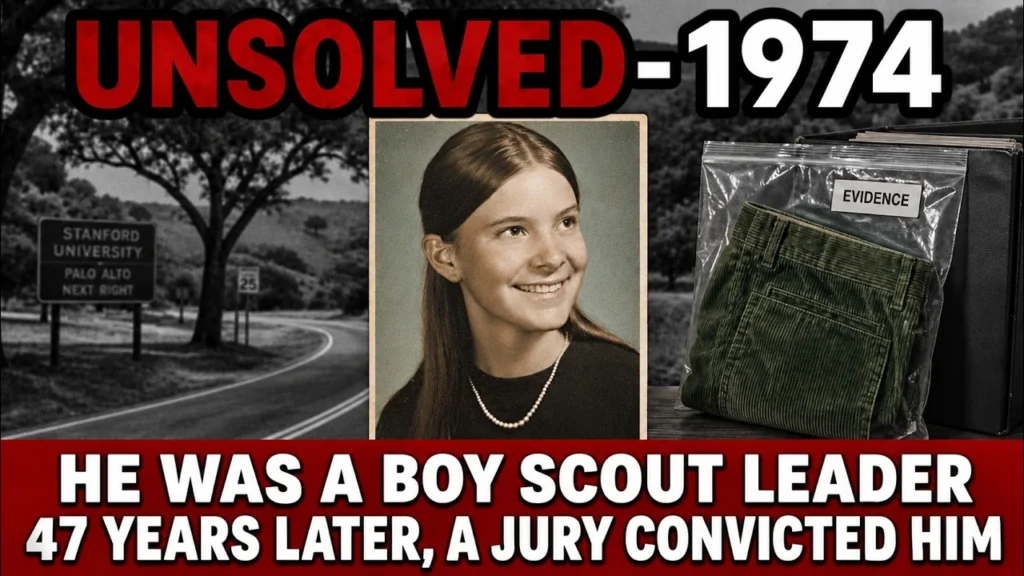
And they had something else, the green corduroy pants, the same pants that Celia Hartnett had examined under fluorescent lights in 1974 back when she and Janet had been lab partners at Menlo Atherton High School.
The pants had been sealed in evidence storage for 45 years, sitting on a shelf through the terms of eight different presidents, through the invention of the personal computer and the internet and the smartphone, waiting.
San Mateo County criminalist Alice Hilker pulled those pants out of storage.
She swabbed the outside of the pants and found DNA consistent with Getreu with a match probability of one in 34,000.
Then she swabbed the inside of the torn area.
The DNA there matched Getreu at a probability of one in 102 billion.
Detective Jackson later described the moment he got the lab results.
I’ve worked homicides for 30 years.
When you get that call, it gives you goosebumps.
On May 16th, 2019, San Mateo County officially charged John Arthur Getreu with the murder of Janet Ann Taylor.
Bail was set at $10 million.
Assistant Sheriff Gregory Rothaus told the press, the suspect’s MO was very similar and both victims were last seen leaving the Stanford University campus area.
The green corduroy pants had waited longer than Janet was alive, but they finally spoke.
By the time the trial date approached, Getreu had done everything in his power to delay it.
He was hospitalized twice just before scheduled proceedings.
The COVID-19 pandemic froze courtrooms across California.
His defense attorney, John Haley, filed a petition with the California Supreme Court to suppress the DNA evidence from the discarded coffee cup, arguing that collecting it violated the Fourth Amendment.
The American Civil Liberties Union filed an amicus brief supporting the challenge.
The petition was ultimately unsuccessful, but it halted jury selection that had been scheduled for May of 2021.
When the trial finally began on August 11th, 2021, it had been more than 47 years since Janet Taylor’s murder.
Opening statements came on August 30th.
The courtroom was full.
Janet’s family sat in the gallery.
Some of them had been waiting for this moment for their entire adult lives.
had been born after Janet died and knew her only through photographs and the stories their parents told.
Prosecutor Josh Stauffer framed the case directly.
He told the jury this was a sexually motivated killing.
The DNA on Janet ‘s clothing, Getreu’s proximity to the crime scene, his history of violence against women, and his own words during the 2018 interrogation all pointed in one direction.
The witnesses who took the stand had been carrying this story for decades.
Russell Bissonnette, the man who had loved Janet and built a life with her in the LaHonda Woods, testified about the last morning he saw her, the phone calls the next day, the trip to the morgue.
Detective Gordon Curry showed the jury a map, Getreu’s aunt’s house on Roberta Drive in Woodside, Sand Hill Road where the body was found, about 2 miles, about 6 minutes.
The route joins Sand Hill Road directly.
James Schroder testified about his friend Janet, the quiet force of nature and the replacement car that was almost finished.
Margaret Williams’s brother Evan traveled from overseas to take the stand.
He told the jury what John Getreu had done to his 15-year-old sister in Germany in 1963.
He described the impact on his family.
He put a name and a face to the fact that Getreu’s violence against women did not begin on the Stanford campus.
It began across an ocean more than a decade earlier.
And then there was Debbie Adams, Janet’s childhood best friend, the woman who had spent that last Sunday afternoon with Janet on the Stanford campus, who had watched her walk through the backyard toward the road.
Debbie Adams had been diagnosed with cancer.
She died in May of 2021 just months before the trial began.
But her testimony had been recorded by video deposition.
So when the time came, her voice filled the courtroom.
She spoke about Janet, about their friendship, about that evening.
The jury heard from a woman who was no longer alive, testifying about a friend who had been dead for 47 years.
Two voices from the past reaching across time.
The defense argued contamination.
Haley told the jury that the green corduroy pants had been stored in a shared evidence bag and could have been cross-contaminated with DNA from the Perlov case.
It was the only argument available to the defense.
The DNA itself could not be disputed.
The genetic match was overwhelming.
So the only path was to suggest that the evidence had been corrupted during storage, that 45 years in an evidence room had somehow mixed one case with another.
Prosecutor Stauffer responded sharply.
He walked the jury through the chain of custody, the different counties that held the evidence, the separate storage facilities.
He told the jury that the two counties had shared photographs during their parallel investigations, not clothing.
The physical evidence from the Taylor case had never been in the same room as the evidence from the Perlov case.
He dismissed the contamination theory as trafficking in fairy tales.
The jury did not take long to make up their minds.
On September 14th, 2021 at approximately 4:40 in the afternoon, they returned.
They had deliberated for roughly 1 hour.
Eight men and four women delivered a unanimous verdict.
Guilty.
First-degree murder with the special circumstance of infliction of great bodily injury.
Prosecutor Stauffer addressed the cameras outside the courtroom.
Today, justice was done, he said.
San Mateo County District Attorney Steve Wagstaff added, this case was made exclusively on DNA evidence.
We’re grateful to modern science.
The Taylor family waited decades for that word, guilty.
It landed in the courtroom like a held breath finally released.
On November 5th, 2021, Judge Robert D.
Foiles sentenced John Arthur Getreu in a San Mateo County courtroom.
The judge called the crimes evil and despicable.
He said, words cannot begin to express my sorrow in this case.
And then he said the thing that carried the most weight.
He wished that Janet’s parents had lived to see this day.
Under the sentencing law that was in effect in 1974, the term imposed was 7 years to life plus a $5,000 fine.
It was not life without parole, but for a man who was 77 years old, it amounted to the same thing.
Detective Gordon Curry spoke after the sentencing.
It’s like we’re on a peaceful lake, he said, and Getreu is a speedboat leaving long wakes in everyone’s life.
Then he paused.
I’m glad that he’s finally out of gas.
In January of 2023, more than a year after the Taylor conviction, John Getreu stood in a Santa Clara County courtroom and pleaded guilty to the first-degree murder of Leslie Marie Perlov.
Judge Hanley Chew sentenced him to a consecutive term of 7 years to life, back-to-back life sentences, one for each woman.
On September 22nd, 2023, John Arthur Getreu died of natural causes at the California Healthcare Facility in Stockton.
He was 79 years old.
He never named any additional victims.
Detective Tresmontan once described what it was like to speak Russell Bissonnette during the reinvestigation.
He said Bissonnette was quite emotional, even 45 years later.
The grief had not faded.
It had just gone quiet.
For nearly half a century, the people who loved Janet had been carrying two weights.
The first was the loss itself.
The second was not knowing.
Not knowing who did it.
Not knowing why.
Not knowing if the person who took her from them was still walking around, still breathing the same air, still free.
The verdict did not bring Janet back.
Nothing could do that.
But it removed that second weight.
And for people who had been carrying it since 1974, that removal changed something fundamental in how they could remember her.
After the verdict, Jane Schroeder bought a bottle of champagne and brought it to Bissonnette, not to celebrate the conviction, to celebrate Janet’s life, to raise a glass to the woman they had lost in a way that finally felt like it was allowed.
Getrude’s own son, Aaron, released a statement that held a kind of terrible honesty.
We only knew him as a loving father and grandfather, he said.
But science doesn’t lie.
He urged his father to name any other victims.
His father never did.
The Taylor family, who had maintained their privacy throughout the investigation and the trial, issued a brief statement.
We are pleased with the results of the trial.
We miss Janet but have many great memories of her.
Detective Jackson recalled that when he and Tremontin first contacted the Taylor family to tell them the case had been reopened, the family was shocked.
They had stopped expecting that call years ago.
Chuck was gone.
Margaret was elderly.
The years had taught them to live without answers.
They were very surprised that we were even looking at the case, Jackson said.
I think they had accepted that it would never be solved.
That is what makes cold case work different from any other kind of investigation.
You are not just solving a crime.
You are reaching into the lives of people who have already learned how to live without justice and telling them that the thing they stopped hoping for is real.
The family’s earlier statement about Janet said it best.
Janet lived life with enthusiasm and courage.
As a spunky, fun-loving youngest of three children, she added much laughter and joy to our family.
She loved animals and cherished her friends.
Janet’s future was bright.
It would have been wonderful to see what she would have done.
The green corduroy pants sat in an evidence room on a shelf in San Mateo County for 47 years.
They waited longer than Janet Taylor was alive.
But when the science finally existed to read what was on them, they told her story.
And that story ended with a guilty verdict, a life sentence, and a killer who died behind bars.
Janet Taylor was 21 years old.
She was a daughter, a sister, a girlfriend, and a friend.
She held a brown belt in martial arts and welcomed strangers into her home for dinner.
She loved dogs and lived in the woods and had a future that should have unfolded for decades.
It didn’t.
But her name is not forgotten.
And the people who loved her made sure of that.
If you believe these stories deserve to be told and that the victims in cold cases deserve to be remembered for who they were, subscribe to this channel and share this video with someone who cares about justice.
Click the video on screen for another case that stayed cold for decades until one breakthrough changed everything.