But knowing two murders were likely connected and…
But knowing two murders were likely connected and proving who did them were two very different things.
And the investigation that followed would be defined not by what detectives found, but by what kept leading them in the wrong direction.
The first major distraction came from a horrifying coincidence.
Janet’s friend Barbara Rocky had been murdered in Utah on March 11th, 1974, just 13 days before Janet’s own death.
Then, six days after Janet was killed, Rocky’s boyfriend, Peter Thompson, was attacked and mutilated by a hitchhiker in San Mateo County.
Three violent crimes, three connections to the same social circle, all within the span of a single month.
Investigators spent significant time and resources chasing the apparent link between these events.
It went nowhere.
Rocky’s killer, a man named Gerald Hicker, eventually confessed in 2009.
He had no connection to Janet Taylor’s murder.
In March of 1975, deputies got a tip about a man in Mill Valley who kept photographs of Janet and a newspaper clipping about her murder in his room.
They searched the room.
The man turned out to be a personal acquaintance of Janet’s.
Another dead end.
That same summer, in July of 1975, the San Mateo Times ran a headline that must have felt like an earthquake to the Taylor family.
Double murder may be solved, it read.
But it wasn’t solved.
The lead collapsed.
Then came Ted Bundy.
Bundy, one of the most prolific serial killers in American history, had taken a class at Stanford during the early 1970s.
His pattern was known to include strangulation, and he targeted young women on or near college campuses.
On paper, the connection seemed plausible, even compelling.
Investigators spent years examining whether he could be connected to the murders near campus.
They requested records, compared timelines, analyzed his movements during the early 1970s.
They didn’t rule him out until 1989, 15 years after Janet was killed.
He wasn’t their man either.
Over the years, other tips came in, anonymous calls, letters, psychics who claimed to have visions.
A man who bore a passing resemblance to a composite sketch was questioned and released.
Every lead generated its own file, its own set of follow-up interviews, its own small universe of dead ends.
The detectives who worked the case were not careless.
They were simply hunting in the dark, and the man they were looking for had left them nothing to see by.
The core problem was invisible, and investigators had no way to see it at the time.
The man who killed Janet Taylor had no criminal record in any American database.
He was a stranger to the victim.
There was no witness who saw the crime.
DNA profiling technology would not exist for another decade, and the two linked murders fell on opposite sides of a county boundary, splitting jurisdiction between San Mateo and Santa Clara counties in a way that made coordination harder than it should have been.
So the case went cold.
The file sat.
The evidence sat.
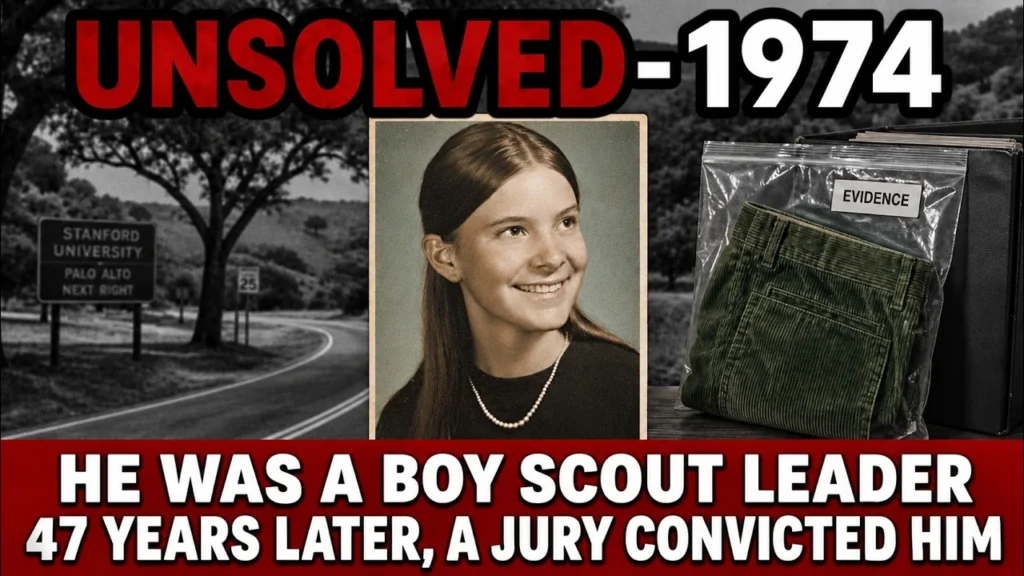
The green corduroy pants that Janet wore on the last night of her life were sealed in a bag in a sheriff’s evidence room.
They would stay there for decades, and the parents who buried their daughter grew older with every passing year, still waiting for a phone call that never came.
If you want to see how this case finally broke open after 47 years, hit the like button so more people can find stories like this one.
We still have a long way to go.
By the fall of 1974, the Stanford campus had become a place where fear was no longer abstract.
It was specific, and it had an address.
Between February of 1973 and October of 1974, four people connected to the Stanford community were murdered.
None of the cases were solved.
The first was Leslie Marie Perlov, 21 years old, a Stanford graduate working as a law library clerk.
She vanished on February 13th, 1973, and her body was found three days later under an oak tree in the foothills.
She had been strangled.
Six months later, in September of 1973, David Levine, a physics graduate student, was stabbed to death on campus.
His case remains unsolved to this day.
Then came Janet Taylor in March of 1974.
And in October of 1974, just 7 months after Janet, Arlis Perry was found murdered inside Stanford’s Memorial Church.
Perry’s case would take its own winding path to resolution.
Decades later, DNA evidence implicated a security guard named Steven Crawford, who killed himself the day investigators came to collect his DNA in 2018.
The Stanford Daily captured what it felt like to be on campus during that stretch.
The scenario was becoming tragically, frighteningly familiar, the paper wrote.
After four unsolved homicides, Stanford is a decidedly grimmer place than the country club most students chose to attend.
And Stanford’s murders did not exist in a vacuum.
Across Northern California, the early 1970s were a season of killing that defies easy comprehension.
The sheer concentration of serial violence in a single region during a single decade has no parallel in American criminal history.
Ed Kemper, standing 6 ft 9 in tall and weighing nearly 300 lb, was hunting female hitchhikers around Santa Cruz through 1972 and 1973.
He murdered six young women who had simply stuck out their thumbs on the road before he was caught.
The Santa Rosa hitchhiker murders claimed at least seven young women between 1972 and 1973.
Their bodies found along rural roads in Sonoma County, and those cases remain unsolved to this day.
The Zodiac killings were still fresh, with the unidentified killer’s taunting letters to newspapers burned into the public consciousness.
The Zebra murders terrorized San Francisco.
The point is not to catalog horror.
The point is context.
Janet Taylor stuck her thumb out in a place and at a time when multiple predators were actively hunting women who did exactly that.
The cultural norm of hitchhiking had not caught up with the reality of what was happening on the roads.
By the time it did, the practice would be nearly extinct.
But in March of 1974, that shift had not yet happened.
For the families of the Stanford victims, the years didn’t bring answers.
They just brought distance from the people they had lost.
Birthdays came and went.
The anniversaries of the murders passed in private silence.
The families watched the world move on while they stayed anchored to a date that would never stop mattering.
The hitchhiking culture that had seemed so harmless began to die.
By the late 1970s, the roads around Stanford were quieter.
Fewer thumbs on the roadside.
Fewer strangers climbing into strangers’ cars.
The fear that four murders had seated into the campus community had changed the way people moved through their own lives.
It was a small, invisible monument to what had been lost.
Chuck Taylor’s health declined through the late 1980s and into the 1990s.
On May 7th, 1994, 20 years after his daughter’s murder, Chuck Taylor died at Stanford Hospital, the same institution where his daughter’s killer had once worked.
He was 74 years old.
His memorial service was held at the Chuck Taylor Grove besides Stanford Stadium, a place named in his honor.
His wife, Margaret, survived him.
Neither of them ever learned who killed Janet.
The case file stayed cold.
The evidence bags stayed sealed.
And somewhere in the Bay Area, the man who did it was still breathing.
It was 1974 and John Arthur Getreu was living at his aunt’s house on Roberta Drive in Woodside.
He was 29 years old.
He worked as a medical and cardiology lab technician at Stanford Hospital.
He had a wife, a quiet life, and a commute that took him past Sand Hill Road on a regular basis.
Detective Gordon Curry would later testify that the aunt’s house was about 2 mi from where Janet’s body was found, a trip of roughly 6 minutes by car along a route that joins Sand Hill Road.
Nobody in California knew what Getreu had done before he arrived.
He was born on August 26th, 1944 in Newark, Ohio.
His father was a career Army non-commissioned officer, and the family moved constantly, living on military bases in Hawaii, North Carolina, Japan, and Germany.
By the time Getreu was a teenager, the family was stationed in Bad Kreuznach, a military town in western Germany.
On the night of June 8th, 1963, after a youth club dance on the base, 18-year-old John Getreu attacked 15-year-old Margaret Williams, the daughter of the 8th Infantry Division chaplain.
He killed her by strangulation.
In a German courtroom, he told the judge, I just wanted to knock her out.
On July 13th, 1964, a juvenile court sentenced him to 10 years for the crime.
He served roughly 6 years in German prison.
During that time, according to records later reviewed by American investigators, he received some form of rehabilitation treatment.
The German authorities considered his case a juvenile matter.
They believed he could be reformed.
On March 7th, 1969, he was released from prison and flown out of Germany within 24 hours.
According to German court documents later obtained by San Mateo County detectives, German officials believed he was likely to lead a righteous life after returning to his parents in the United States under probation supervision.
They were wrong.
When Getreu arrived back in the United States, no American law enforcement agency was notified about his conviction.
No flag was placed in any database.
No probation officer in the United States was assigned to supervise him.
He simply stepped off a plane and disappeared into civilian life, carrying a killing conviction that nobody in the country knew about.
By 1970, Getreu was working at a California hospital where he married a co-worker.
By 1972, he was a security guard for a private firm in Palo Alto, a job that required a background check that apparently found nothing.
And at the time of the two Stanford area murders, he was a technician inside Stanford Hospital itself, wearing a badge, walking the halls, trusted by the institution that employed him.
There is a reason investigators never found him.
National sex offender registration did not exist in the United States until 1994.
The National Sex Offender Registry was not created until Getreu’s German conviction was not entered into any American database.
When Santa Clara County Sheriff Laurie Smith was asked about this years later, her answer was blunt.
He was not in any of the computer systems.
He was a killer with a documented history of lethal violence against women, and the system that should have tracked him simply did not exist.
Consider what that means.
A man who strangled a 15-year-old girl to death was allowed to move freely through one of the most prestigious university communities in the country with no monitoring, no registration, and no record that any American authority could access.
The gap between what was known about him overseas and what was known about him at home was total and absolute.
He went back to work.
He went back to his daily routine.
He lived in the same community as the families of the women he killed.
He may have passed Chuck Taylor on the street.
He may have sat in a waiting room at the same hospital where Margaret Taylor took her children for checkups.
And for 47 years, no one had any idea.
Leslie Marie Perlov was 21 years old.
She had graduated from Stanford in 1972 and was working as a clerk at the North County Law Library in Palo Alto.
She was quiet and studious, the kind of person who kept her life organized and her plans on track.
On the evening of February 13th, 1973, Leslie vanished.
Her orange Chevrolet Nova was found abandoned near Old Page Mill Road.
Three days later, on February 16th, deputies discovered her body under an oak tree in the foothills above the Stanford campus in the area now known as the Dish.
A scarf had been knotted around her neck.
Leslie’s sister, Diane, later revealed a haunting detail about that scarf.
The scarf tied around her neck that day was mine, she said.
But Leslie did something in the final minutes of her life that would eventually change everything.
She fought.
She fought hard.
And in the struggle, her attacker’s DNA ended up under all 10 of her fingernails, every single one.
In 1973, DNA profiling did not exist.
The science that could read that evidence had not been invented.
But the Santa Clara County Crime Lab preserved Leslie’s fingernail clippings with care, sealing them away for a day that nobody could yet imagine.
For 43 years, that evidence sat in storage, waiting.
In 2016, Santa Clara County Sergeant Noe Cortez was assigned to Leslie Perlov’s cold case.
It was the kind of assignment that can feel like a long shot, A decades old murder with no living witnesses, no identified suspect, and a case file that had been reviewed and shelved by multiple generations of detectives before him.
The easy conclusion would have been that everything worth trying had already been tried.
But Cortez did not reach that conclusion.
He did something simple and critical.
He sent Leslie’s preserved fingernail clippings to the county crime lab.
When the results came back, the lab had found a clear, unknown male DNA profile.
Cortez now had a genetic fingerprint.
He just had no name to match it to.
In July of 2018, investigators sent the DNA profile to Parabon NanoLabs, a forensic firm based in Virginia.
Parabon specialized in a technique that had only recently become possible, investigative genetic genealogy.
The concept was straightforward in principle, but staggeringly complex in execution.
You take a DNA profile, upload it to a public genealogy database like GEDmatch, where millions of people have voluntarily submitted their DNA for ancestry research.
You search for distant relatives who share segments of DNA with the unknown suspect.
Then you do the hard part.
You build family trees backward through generations, identifying common ancestors, and then trace those family trees forward again to living descendants.
You cross-reference birth records, marriage records, census data, obituaries, yearbooks.
You narrow the field from hundreds of potential relatives down to a handful of candidates who were the right age in the right place at the right time.
The technique had been used just months earlier in April of 2018 to identify the Golden State Killer, one of the most prolific serial predators in American history.
That arrest had changed everything.
Cold case detectives across the country suddenly realized that unsolvable cases might not be unsolvable anymore.
The DNA under Leslie Perlov’s fingernails, which had been meaningless for 43 years, was now a key that could unlock a door.
When Parabon ran Leslie Perlov’s unknown male DNA through the genealogy database, the family trees converged on a single name, John Arthur Getreu.
Diane Perlov had waited 45 years.
A detective later told her something that would stay with her for the rest of her life.