On the evening of March 24th, 1974, Janet Taylor w…
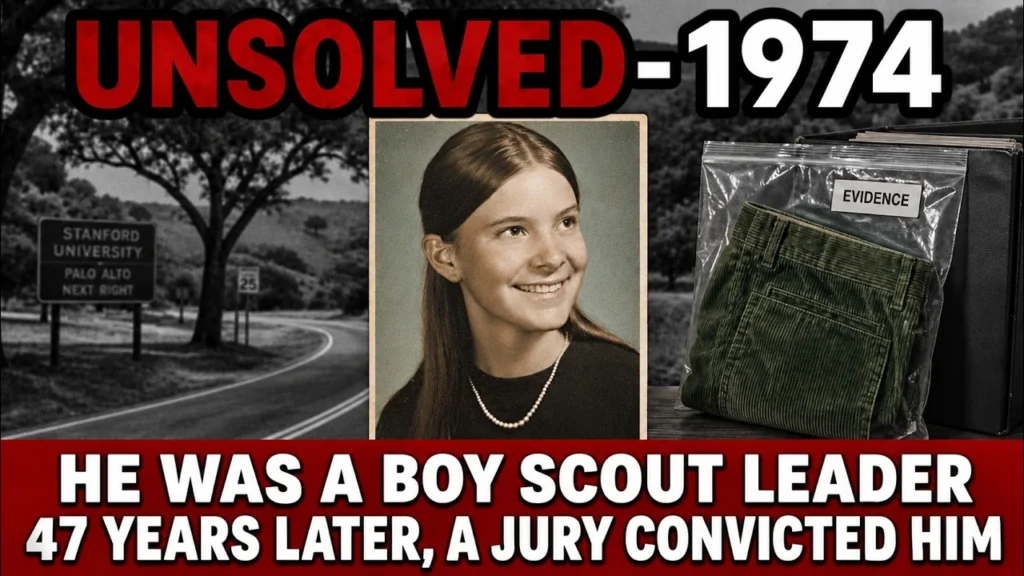
On the evening of March 24th, 1974, Janet Taylor walked through a friend’s backyard on the Stanford campus, stepped onto the road, and stuck out her thumb for a ride home.
She never made it.
The next morning, a milk truck driver spotted what he thought was debris in a ditch on Sand Hill Road.
Then he saw a foot.
Janet was 21 years old.
Her father was a Stanford football legend, and the man who killed her had been working just 2 miles away inside Stanford’s own hospital.
The FBI looked, the sheriff’s office looked.
They chased leads for nearly half a century, and the answer was sitting in a pair of green corduroy pants sealed in an evidence bag, waiting for science to catch up.
It took 47 years, but science did catch up.
This is the story of Janet Anne Taylor and the longest road to justice her family would ever walk.
If you’re new here, this channel covers cold cases that everyone thought would stay buried and the people who refused to let them go.
If those are the stories that matter to you, consider subscribing.
We cover a new case every week.
Now, to understand the weight of what happened on Sand Hill Road that night, you have to understand the name Janet Taylor carried.
Her father, Charles Albert Taylor, was born in Portland, Oregon in January of 1920, and by the time he reached Stanford, he was already something special.
Chuck Taylor played guard on Stanford’s undefeated 1940 football team, a group that became known as the Wow Boys.
He played in the 1941 Rose Bowl where Stanford beat Nebraska, and by 1942, he had earned consensus All-American honors.
After the war, he came back to Stanford as head coach.
In 1951, at just 31 years old, he led the team to the Rose Bowl and became the youngest man ever named coach of the year by the American Football Coaches Association.
That season, Stanford went nine and two.
Chuck Taylor wasn’t just winning games, he was building something, recruiting players, reshaping the program, turning Stanford football into a program that could stand alongside the powerhouses of the Pacific Coast Conference.
By the 1960s, he had risen to athletic director, a position he held from 1963 to 1971.
During those years, he oversaw the expansion of Stanford’s entire athletic program, not just football, but tennis, swimming, track, all of it.
He was one of only two men in Stanford history to have been part of the Rose Bowl as a player, as a head coach, and as an athletic director.
That name, Taylor, was woven into the fabric of the university.
People on campus knew it the way they knew the name of the buildings.
It carried weight.
Chuck and his wife Margaret raised their family on the peninsula with deep Stanford roots.
The family home was on campus, surrounded by the same oak trees and sandstone arches that defined the university.
They had three children, and Janet was the youngest.
Growing up, she was the spunky one, fun-loving, full of laughter and mischief.
Her older sister would later describe her as fun, pleasant, outgoing, talkative, smart, beautiful, strong, compassionate, and well-balanced.
That is a long list of words, and every one of them mattered to the people who said them.
Janet graduated from Menlo Atherton High School, where she was remembered as someone who moved through the hallways with a kind of natural confidence that wasn’t arrogance, it was warmth.
She attended Canada College in Redwood City until January of 1974, studying and figuring out what came next, the way most 21 year olds do.
She had just started working at a maritime information firm in Palo Alto, a small outfit where she was learning the business from the ground up.
But the thing that defined Janet, at least according to the people who loved her, was that she lived with a kind of fearless warmth that pulled everyone in.
She held a brown belt in martial arts.
Her boyfriend, Russell Bissonnette, later said he genuinely believed she could handle herself in any situation.
It really surprised me what happened here, he testified years later, because I thought she’d be taking anybody apart if they tried to attack her.
Janet and Russell had met through Canada College, and by 1974 they were living together in a small cabin in the La Honda Woods, a remote and beautiful stretch of forest in the hills west of Stanford.
They were, in Russell’s own words, connected.
We were kind of unusual people.
They had dogs, a puppy, and a life they were building together in the trees.
Her friend, James Schroder, who went by Gideon, called her a quiet force of nature.
He remembered a Saturday after Thanksgiving when Janet and Russell invited a group of stranded strangers into their home for dinner.
It was just like Russell and Janet to welcome people like that, he said.
Years later, after everything had happened, Janet’s family released a statement that said it all.
Janet lived life with enthusiasm and courage.
As a spunky, fun-loving youngest of three children, she added much laughter and joy to our family.
She loved animals and cherished her friends.
Janet’s future was bright.
It would have been wonderful to see what she would have done.
That is who Janet Taylor was, not a case number, not a victim in a headline, a person deeply known and deeply missed.
If these are the kinds of stories you believe deserve to be told, hit subscribe and stay with us.
There a lot more to this case.
March 24th, 1974 was a Sunday.
That morning, around 10:30, Russell Bissonnette drove Janet to her job on Page Mill Road.
Her car had broken down recently, and they were still working on getting a replacement running.
It was the kind of small, irritating problem that fills an ordinary day.
Russell dropped her off and went about his afternoon.
It was the last time he would ever see her.
After work, Janet made her way to the Stanford campus to visit her childhood best friend, Debbie Adams.
Debbie was home from an out-of-state college, staying at her family’s house on Gerona Road.
The two of them had grown up together on the Stanford campus.
They were close in the way that only childhood friends can be.
The kind of bond where you can show up unannounced and it still feels like coming home.
They spent the afternoon together.
But as the evening came on, Janet started getting anxious.
She needed to get back to La Honda.
The dogs needed to be fed.
The puppy needed attention.
La Honda was a winding drive into the hills, roughly 15 miles from the Stanford campus, and without her own car, she had no easy way to get there.
Debbie’s family offered to arrange a ride, but Janet didn’t want to wait.
Hitchhiking was just what people did in 1974, especially in Northern California.
It was part of the culture.
On the Stanford campus, students thumbed rides along Palm Drive and El Camino Real without a second thought.
On Highway 1 along the coast, you could stand by the road for 5 minutes and someone would pull over.
In the hills around La Honda and Skyline Boulevard where Janet and Russell lived, hitchhiking was practically the public transit system.
There were no buses winding through those mountain roads.
If you didn’t have a car, you stuck out your thumb.
It is difficult, looking back from the present day, to understand how normal this felt.
The counterculture of the 1960s had woven hitchhiking into the social fabric of the Bay Area.
It was an act of trust between strangers.
You picked people up because it was the decent thing to do.
You accepted rides because refusing one felt almost rude.
The dangers were there, of course.
They were always there, but they had not yet become the defining feature of the practice.
That would come later after the body count rose high enough to change the conversation.
Debbie Adams would later testify that neither of them felt any fear about Janet hitchhiking home that evening.
It was just how you got around.
So Janet walked through the backyards that connected Girona Road to the main road, made her way to the area near Junipero Serra Boulevard and Mayfield Avenue and stuck out her thumb.
It was approximately 7:00 in the evening.
The last confirmed sighting of Janet Taylor alive was around 7:05 in the evening, standing at the roadside less than a mile from where another young woman, Leslie Perlov, had been found dead 13 months earlier.
By about 7:35 in the evening, according to accounts from the time, she had been picked up.
She climbed into a vehicle and she vanished.
That evening, Russell finished his shift at the Bach Dancing and Dynamite Society, a jazz club down in Miramar on the coast.
The Bach was a small, legendary place right on the beach where people came to hear live jazz with the sound of waves in the background.
Russell worked there regularly.
It was part of the rhythm of their life together.
He got home to the La Honda cabin around 10:30 or 11:00 at night.
The cabin sat among the redwoods down a dirt road far from the nearest street light.
Janet wasn’t there, but he wasn’t alarmed.
He assumed she had decided to spend the night at Debbie’s place.
It had happened before.
He went to sleep.
There is one detail from this part of the story that has haunted the people who loved Janet for over 50 years.
Schroder and Bissonnette had been working on a replacement car for her.
They were almost done, days away, maybe less.
If that car was ready, Schroder later said, we’d all be sitting around drinking beer with Janet.
This decision seemed small at the time.
A broken car, an evening visit, a thumb on the side of the road.
It wasn’t.
The next morning, March 25th, 1974, Ernesto Evangelio was driving his milk truck along Sand Hill Road.
Evangelio worked for the Peninsula Creamery, making his rounds through Woodside and Portola Valley, the way he did every weekday morning.
Sand Hill Road runs through the rolling hills west of the Stanford campus, bordered by oak trees and open land.
In 1974, it was even quieter than it is today.
As his truck moved along the road near Manzanita Way, Evangelio noticed what he thought was a pile of debris in a roadside ditch.
Then, something caught his eye.
A foot.
He stopped the truck.
He got out.
He walked over and checked for a pulse.
There was none.
He went to a neighbor’s house and had them call the police.
When San Mateo County Sheriff’s deputies arrived, they found Janet Taylor lying in the ditch, clothed but barefoot.
It had rained hard all through the night, a steady downpour that had soaked the hills and the road.
But Janet’s feet were clean, and the ground directly beneath her body was dry.
That told investigators something critical.
She had not been killed in that ditch.
She had been placed there after the rain started, dumped like something discarded.
Her clothing told a violent story.
The right sleeve of her black rain jacket had been nearly torn off.
Her blue shirt was ripped from the shoulder down one side.
Her green corduroy pants were torn.
Her shoes, her belt, and pieces of her clothing were found scattered along Sand Hill Road, some of them about half a mile away on the opposite side of the road.
They had been thrown from a moving vehicle.
Her purse was never recovered.
The forensic pathologist, Dr. Peter Benson, performed the autopsy.
He found a fractured hyoid bone, hemorrhages in the neck, blood-filled lungs consistent with asphyxia, and bruising to the face.
The ribbed pattern of Janet’s turtleneck sweater had been pressed so deeply into her neck that it left an imprint in the bruising.
She had been strangled by hand with tremendous force through the fabric of her own clothing.
While deputies were processing the scene that morning, Russell Bissonnette woke up in the LaHonda cabin and realized Janet still hadn’t come home.
He started making phone calls.
He called Janet’s parents at the family home on campus.
He called friends.
He called Debbie Adams.
Nobody had seen her since the night before.
Nobody knew where she was.
Each call ratcheted the dread a little higher.
And then the worst phone call came, the one from the sheriff’s office.
Russell drove from LaHonda to the peninsula and met Chuck and Margaret Taylor.
Together, they went to the San Mateo County morgue to identify their daughter’s body.
Chuck Taylor had spent his entire adult life being strong in public.
He had coached men through losses, managed a sprawling athletic program, stood at podiums, and spoken with authority.
Nothing in that life had prepared him for what he saw in the morgue that morning.
There is one more detail from that morning that carries a strange, painful weight.
The criminalist assigned to examine Janet’s clothing for trace evidence was a woman named Celia Hartnett.
Years earlier, Hartnett and Janet had sat next to each other in biology lab at Menlo-Atherton High School.
They had been lab partners.
Now, Hartnett was examining her classmates’ torn clothing under fluorescent lights, looking for anything the killer might have left behind.
She found trace evidence on those green corduroy pants, biological material that did not belong to Janet.
Something the killer had left behind without knowing it.
But in 1974, there was no technology that could read it.
The science of DNA profiling was still a decade away.
Genetic fingerprinting would not be developed until 1984, and forensic DNA databases would not exist until the 1990s.
So the evidence was cataloged, sealed, and stored.
The green corduroy pants went into a bag.
The bag went onto a shelf, and the clock started ticking on a weight that would outlast most of the people involved in the case.
The San Mateo County Sheriff’s Office opened case number 742309.
Within days of Janet’s murder, their homicide detectives were sitting down with counterparts from Santa Clara County in a conference room in Redwood City.
The connection between the two cases was obvious and immediate.
Leslie Perlov had been murdered in February of 1973.
Janet Taylor had been murdered in March of 1974.
Both women were 21 years old.
Both had been strangled.
Both were found barefoot without their purses, and both were last seen leaving the Stanford campus area.
The Sheriff’s Office later wrote that for many years, both killings remained unsolved despite the sincere efforts of seasoned investigators.