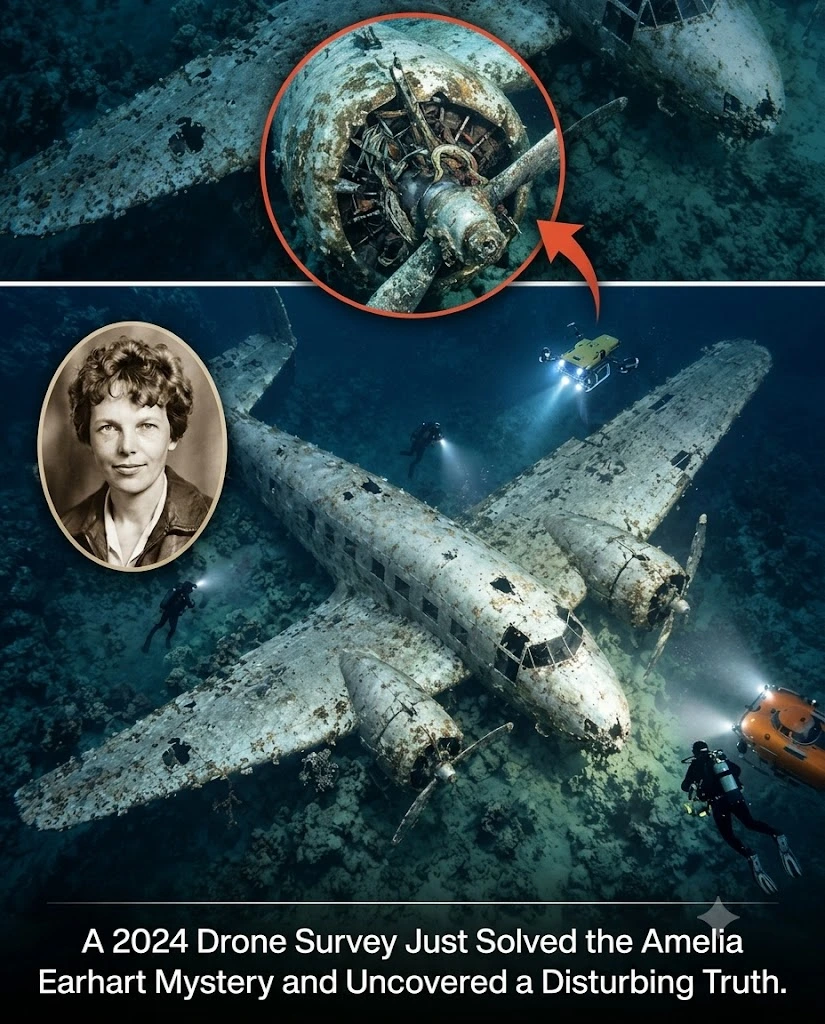
On July 2, 1937, Amelia Earhart and navigator Fred Noonan departed Lae, New Guinea, aboard a Lockheed Electra 10E.
They were attempting an extraordinary flight around the world.
Their next destination was Howland Island, a tiny strip of land in the central Pacific.
Finding it would be one of the most difficult navigation challenges of the journey.
The island was barely visible against the enormous surrounding ocean.
A United States Coast Guard vessel, the Itasca, waited nearby to provide radio assistance.
But communication problems complicated the approach.
Earhart reported difficulty locating the island and indicated that fuel was running low.
Her final confirmed radio transmission placed the aircraft along a navigational line extending northwest and southeast.
Then the signals stopped.
Neither Earhart nor Noonan was seen again.
The United States launched an extensive search, but no confirmed wreckage was recovered.
The most widely accepted explanation remains that the aircraft exhausted its fuel and crashed into the Pacific near Howland Island.
However, another theory gradually emerged.
It centered on Nikumaroro, formerly known as Gardner Island, roughly 400 miles southeast of Howland.
The island lies along a possible extension of the navigational line described in Earhart’s final transmission.
Researchers associated with The International Group for Historic Aircraft Recovery, known as TIGHAR, proposed that Earhart and Noonan might have reached the island and landed on its exposed reef.
Under this hypothesis, the aircraft remained accessible for a period before ocean conditions eventually carried it away.
The possibility attracted attention because of an observation made shortly after the disappearance.
In July 1937, American naval aircraft searched Gardner Island.
Pilots reported signs of previous habitation but found no aircraft or survivors.
The island was uninhabited at the time, although the wreck of the British freighter Norwich City had been stranded on its reef since 1929.
Investigators later questioned whether the search had overlooked evidence of stranded aviators.
But the most intriguing discovery came three years later.
In 1940, British colonial administrator Gerald Gallagher reported that human skeletal remains had been discovered on the island.
Nearby were objects reportedly including a sextant box and fragments associated with footwear.
Gallagher considered the possibility that the remains belonged to Earhart.
The bones were sent to Fiji for examination.
Physician D. W. Hoodless concluded that they belonged to a middle-aged man.
For decades, that assessment appeared to weaken the connection to Earhart.
Then the bones disappeared.
Only the original measurements survived.
In 2018, forensic anthropologist Richard Jantz reexamined those records.
Using statistical comparisons and estimates of Earhart’s body proportions, he argued that the measurements were consistent with her physique.
His research suggested that Earhart was a stronger match than most individuals in the comparison population.
But the conclusion remained disputed.
Other researchers questioned the methodology, and without the original bones, modern DNA testing was impossible.
The evidence was intriguing, but it could not establish identity.
Additional discoveries came from archaeological investigations at a location known as the Seven Site.
Researchers recovered fragments of glass containers, cosmetic-related materials, and other objects potentially dating to the period surrounding Earhart’s disappearance.
Some items resembled products available in the United States during the 1930s.
One broken container was investigated as a possible match for a historical freckle-treatment product.
Other finds included fragments that might have belonged to a compact mirror and bottles associated with personal care.
Supporters of the castaway hypothesis argued that these objects could indicate the presence of an American woman.
Critics offered another explanation.
The island had experienced shipwrecks, colonial settlement, and repeated visits by travelers.
Objects from the appropriate historical period did not necessarily belong to Earhart.
The uncertainty extended to another controversial clue.
A photograph taken in October 1937 by British official Eric Bevington showed part of the island’s reef near the wreck of the Norwich City.
Decades later, researchers identified a tiny shape in the photograph that they suggested resembled part of an aircraft’s landing gear.
The image became known as the Bevington object.
But the feature was too small and indistinct to identify conclusively.
No corresponding aircraft component has been recovered from that location.
Then investigators returned to an even more unsettling source of evidence.
Radio transmissions.
In the days following Earhart’s disappearance, numerous listeners reported receiving signals they believed came from her aircraft.
Some accounts described a distressed female voice.
Others involved fragmented messages or unexplained radio activity.
TIGHAR researchers examined historical records and identified transmissions they considered potentially credible.
They proposed that an aircraft stranded on Nikumaroro’s reef might have transmitted intermittently while its radio equipment remained functional.
Under this interpretation, rising tides could have interrupted attempts to communicate.
Yet none of the reported transmissions has been conclusively authenticated as originating from Earhart.
Radio interference, mistaken identification, and incomplete records complicate the evidence.
The theory nevertheless continued to attract investigators.
In 2020, researchers examining satellite imagery identified an unusual shape in Nikumaroro’s lagoon.
The feature, called the Tarawa object, appeared in images from multiple years.
Its dimensions and appearance prompted speculation that it might represent submerged aircraft wreckage.
The possibility was especially compelling because the object seemed partially concealed by shifting sediment.
A new expedition was organized through the Archaeological Legacy Institute, with participation connected to Purdue University.
Purdue had a significant historical relationship with Earhart.
She served as an adviser there, and funding associated with the university helped provide the Lockheed Electra used during her final journey.
For the institution, locating the aircraft would represent the recovery of an extraordinary part of its history.
After logistical and permitting challenges, the expedition reached Nikumaroro in October 2026.
The team included researchers, technical specialists, and representatives from Kiribati.
Their equipment included aerial drones, marine survey instruments, and tools intended to investigate the lagoon.
But the island presented serious obstacles.
Dangerous reef conditions and strong winds limited access to survey locations.
Researchers had to balance the search against the safety of their personnel and the protection of the surrounding marine environment.
When they finally examined the Tarawa object, the results were disappointing.
The mysterious feature was not confirmed aircraft wreckage.
Instead, investigators concluded that it most likely consisted of large pieces of driftwood deposited near a sandy peninsula.
A remaining Y-shaped fragment had developed a reflective carbonate coating.
That surface apparently helped create the metallic appearance visible in satellite imagery.
The discovery demonstrated how easily natural materials can resemble manufactured objects when viewed remotely.
The expedition reported no conclusive evidence connecting the lagoon feature to Earhart’s aircraft.
For investigators hoping to find the missing Electra, it was a significant setback.
Yet it also represented an important scientific result.
A promising target had been examined directly, and a natural explanation had emerged.
The investigation therefore returned to its original uncertainty.
The skeletal measurements remained disputed.
The artifacts lacked definitive identification.
The historical photograph showed an unexplained shape.
And the radio reports could not establish that Earhart had reached Nikumaroro.
Meanwhile, the conventional crash-at-sea explanation remained plausible.
In 2024, another search effort led by Deep Sea Vision announced a sonar target near Howland Island that resembled an aircraft.
The discovery attracted international attention.
But a subsequent examination revealed that the target was a natural rock formation.
Once again, an apparently promising clue had failed to produce the missing airplane.
The repeated disappointments reveal the extraordinary difficulty of searching for a relatively small aircraft across the vast Pacific.
Deep water, complex seabed terrain, shifting sediment, and incomplete historical records all complicate the investigation.
The central question remains unresolved.
Did Earhart and Noonan crash into the ocean after exhausting their fuel?
Or did they reach a remote island and survive temporarily before disappearing?
The second possibility carries particularly disturbing implications.
If they landed on Nikumaroro, their disappearance might have involved days of isolation rather than an immediate crash.
They would have faced limited freshwater, intense heat, and little hope of rescue.
But that scenario remains a hypothesis, not an established account of their final days.
Nearly nine decades after the disappearance, no verified remains of the Lockheed Electra have been recovered.
No confirmed physical evidence establishes the final location of Earhart or Noonan.
And the most promising discoveries have repeatedly turned into unanswered questions.
The October 2026 expedition did not solve the mystery.
Instead, it demonstrated how essential it is to test even the most convincing clues against physical evidence.
Somewhere in the Pacific, the final chapter of Amelia Earhart’s journey may still exist in the form of wreckage waiting to be discovered.
Until that evidence is found, her last flight remains suspended between two possibilities.
A plane lost beneath an immense ocean.
Or two aviators who may have reached land, only to disappear beyond the reach of rescue.
The mystery endures because neither ending has yet been proved.