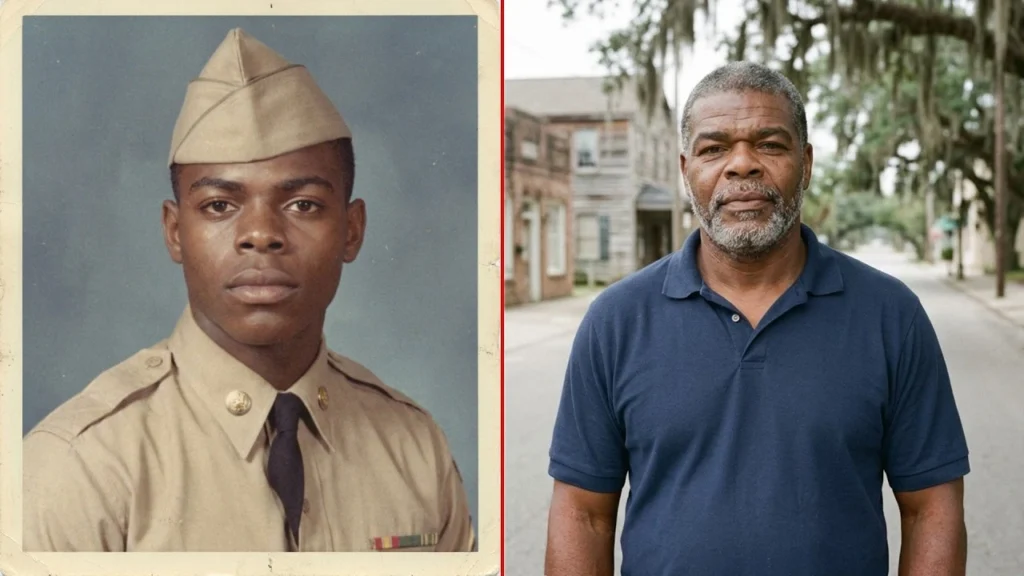
Yolanda had been a girl of seven when Leland went…
Yolanda had been a girl of seven when Leland went missing, and she had met her husband only after he came home.
She had never known the real Leland at all.
She had nothing to gain from the lie and everything to lose from the truth.
And her children, who had grown up as minces, now did not know what their own last name really was.
He knew the name of his first grade teacher and the color of the school bus.
The family lawyer had died in 1999.
His son still had the files from the old law office in a storage unit, and the Mincity estate file was there, 3 in thick.
In it were the lawyer’s handwritten notes from April of 1988.
He had not simply taken the man’s word.
Over two long meetings, he had asked him 41 questions about Leland’s childhood, his schooling, his relatives, and the business.
Next to everyone, the lawyer had written the answer the man gave and a check mark.
What was the name of the boat your father lost in a hurricane when you were a boy? The little Audrey.
Who taught your Sunday school class? Miss Hattie Bell.
What did your father give you on your 16th birthday? a pocketk knife with a mother of pearl handle which you lost off the end of the dock the same week.
Every answer was right.
On the final page, the lawyer had written, “No doubt this is Leland”.
The old man had known Leland Mincy as a boy.
He had been fooled like everyone else.
The rest of the file explained how the man had never been tested by anyone else.
Nobody had contested the will.
Audrey, the only other heir, had welcomed him home.
When an inheritance is not disputed, no court ever examines who the heir really is.
The papers were signed in the lawyer’s office and the company changed hands.
Brisco crossed the lawyer off her list.
But his notes told her something useful.
The man’s answers had been too good.
A brother who had been gone for 21 years through a war and a prison camp should have forgotten something.
This man had forgotten nothing at all.
He had learned those answers from someone, and he had studied them.
He knew his little sister’s favorite candy, the pink coconut squares from the drugstore on Brotton Street.
If someone had fed him those details, Brisco thought, it was probably Leland himself.
And the people Leland had talked to most in the last months of his life were the men of his platoon.
As next of kin, Audrey could request her brother’s full army file.
It came in August.
It included the record of his unit for the month he went missing.
On September 14th, 1967, his platoon had been caught in a firefight at the edge of a stretch of jungle and had pulled back under heavy fire.
When the men were counted that night, two were missing.
One was Private First Class Leland Mincy.
The other was a private from rural Alabama named Wardell Pinkney.
Both were listed as missing in action.
The platoon was ordered to move on before anyone could go back to search for them.
Two weeks later, a patrol passed through the same area and found nothing but craters and burned trees.
Three weeks later, there was a second entry about Wardell Pinkney.
On October 6th, 1967, military police in Saigon had picked him up in Soul Alley, a crowded quarter near the big air base where black soldiers who had run from the war could disappear among the bars and back rooms.
Some of them hid there for years, living on the black market, and the military police raided the alley again and again.
Pinkney was being driven back to his unit when he jumped out of the jeep at a crossing and ran.
He was never seen again.
His status was changed from missing in action to deserter and a warrant was issued for his arrest.
Leland Mincy stayed missing.
So, two young men had vanished from the same platoon on the same day.
One had stayed in the jungle for 56 years.
The other had turned up alive in Saigon three weeks later and then disappeared for good.
Brisco could not stop asking herself the darkest question of all.
Had one of them killed the other out there in the jungle.
Brisco wrote both names on a card and pinned it above her desk.
Audrey’s lawyer, who was already preparing the court case over the company, asked a judge to order the army to release one more thing.
Wardell Pinkney’s own file with his photograph and the fingerprint card every recruit filled out on his first day.
He knew all of it.
And now Brisco was about to learn why.
Through a veterans group for the old division, she found the man who had carried the platoon’s radio in 1967.
His name was Herbert Gaither.
He was 77 and lived outside Columbus, Ohio.
They spoke on a video call.
Gaither in his basement den with his medals in a frame on the shelf behind him.
He had never heard that anyone came home in Leland’s name, and when Brisco told him, he took off his glasses and rubbed his eyes for a long time.
Gaither remembered Leland Mincy and Wardell Pinkney right away.
The two of them, he said, had been inseparable from the week they met.
They were nearly the same age, the same height, and the same build, and they called each other brother.
The rest of the platoon called them the twins.
>> The Savannah boy read his mama’s letters out loud.
Pretty soon, we all knew that family.
His buddy must have watched him die.
Before that day, he was the bravest man we had.
It was only a guess.
Gaither had not seen what happened on September 14th.
The fight had been loud and confused, and the pair had been together at the far edge of the line.
When it was over, they were simply gone.
Three weeks later came the news from Saigon, and most of the platoon decided Wardell had run to save his own skin.
Gaither also remembered how much Leland talked about home, the boats, his father, the little sister he called Peanut, and the pink coconut candy she loved.
Wardell, who came from a poor farm with nothing to tell, had heard it all a hundred times.
That evening, Gaither sent Brisco a scanned photograph.
It showed a dozen soldiers in front of a row of tents squinting into the sun.
In the middle stood two young men with their arms around each other’s shoulders.
On the back, someone had written in faded pencil, “The twins, 1967”.
Brisco put the photograph next to a picture of the man who had come home in 1988.
The faces were 20 years apart, but there was no question which of the two young soldiers she was looking at.
And the Pentagon’s report on the remains settled the last fear.
Leland Mincy had been killed by a mortar blast.
Nobody had murdered him.
He knew how to stay out of every file that mattered.
A photograph was not proof, and Brisco needed proof.
She also needed to understand how a deserter with a federal warrant had lived for 31 years in plain sight, running a business and paying taxes without ever being caught.
The answer was simple.
In those years, the army did not send anyone out to hunt for deserters.
A warrant went into a national computer and waited.
It only went off if the man was arrested or applied for a job that checked his fingerprints and someone ran those prints through the FBI.
The man who called himself Leland Mincy had never been arrested.
He never applied for a government job.
He never claimed veterans benefits, which would have meant pulling his army records.
And the army had never been told he was alive because the only person who knew the whole story had promised not to tell.
No other government office ever noticed either.
To social security, a missing soldier was not a dead man.
So when his number began to be used again in 1988, nothing looked wrong.
But Brisco knew that ordinary people get fingerprinted more often than they think.
She asked Yolanda whether anything had ever happened to the family that brought the police to the house.
Yolanda remembered a break-in at their beach house on Tybee Island in the summer of 1996.
The police had dusted the house for Prince and to tell the burglar’s prints apart from theirs, an officer had taken Prince from her and her husband at the kitchen table.
Prints taken that way are compared only with the marks found at the scene.
They are never run through the FBI because the people they belong to are not suspects.
When the case is closed, the card simply stays in the folder.
The burglar in 1996 was never caught, and the folder went into storage with thousands of others.
The island’s police department still had its old case files in a storage building.
It took a clerk most of a week to find the right box.
Inside the folder for the 1996 burglary was an index card with 10 inked fingerprints and a signature at the bottom.
Leland Mincy.
These prints sat in a burglary file for 27 years.
Nobody ever ran them.
>> Wardell Pinkney’s Army file held the fingerprint card made when he was drafted.
Brisco sent both cards to a certified fingerprint examiner, a retired state crime lab analyst who had testified in more than 200 trials.
He compared the ridges finger by finger, the way it had been done long before computers, and marked the matching points on enlarged copies.
In September of 2023, the answer came back.
The prince from the beach house and the prince from the army belonged to the same man.
The man Audrey had buried as her brother was Wardell Pinkney.
He knew his own mother’s address by heart, and he never once wrote to it.
Brisco found Wardell’s younger brother, Alton Pinkney, still living in the farmhouse where they grew up in rural Alabama.
Alton was 70.
He had been 14 in 1967 when two men from the army and one from the FBI knocked on the door.
They told his mother that Wardell had deserted and asked if he had come home or written.
He had not.
People in town said things about him for years after that.
The family wrote to the army, to their congressman, and to every soldier from the county who came home asking if anyone had seen him.
>> Mama never let anybody call him a coward.
She’d say, “My boy is coming home”.
And all that time he was in Savannah calling another man’s parents mama and daddy.
>> Their mother died in 1994 without ever knowing where he was.
Alton told Brisco he had made his peace with it.
He had decided long ago that his brother had died somewhere in Asia, ashamed and alone.
The Pinkneys had been poor.
Their father farmed cotton on rented land, and the house had no indoor plumbing until 1966.
Wardell had joined the army hoping to learn a trade and send money home.
He was the first person in the family to see the ocean, Alton said, and he wrote home about it from the troop ship.
Then Brisco showed him the photographs from Savannah.
Alton went into the back room and came out with the shoe box of his own pictures.
Wardell at 16, Wardell at his high school graduation, Wardell in uniform the day he left.
The face was the same face, the round cheeks, the heavy brows, the way he stood with his weight on one leg.
Alton looked at the pictures from Savannah for a long time.
the man on the dock, the man at a wedding, the man holding a grandchild.
Then he said quietly that his mother had died in a house with no telephone and that his brother had lived the whole time in a big white house 400 miles away.
The clipping Yolanda had found in the wallet now read very differently.
It was dated November of 1987.
Wardell had known that Leland’s parents were dead 5 months before he climbed those porch steps.
He had known exactly who was left in that house.
a sister who had been nine years old when Leland went away.
The tears on the top step had been part of the plan.
So had the questions he answered so perfectly and the promise he made Audrey keep.
He had chosen his moment carefully when there was nobody left alive who could look him in the eye and say that he was not Leland Mincy.
Why he did it, nobody could ask him now.
Maybe it was the money.
Maybe it was something sadder.
a broken man who could not go home as himself and borrowed the only other home he knew by heart.
Either way, he had taken his dead friend’s name and with it a sister, a church pew, and a company, and he had held on to them to the very end.
He knew everything about the Mincys, and the Mincies never knew a single thing about him.
In 2024, Audrey Faircloth went to court in Savannah.
Under her parents’ will, if Leland did not outlive them, the company was hers.
Leland had died in 1967, 20 years before his parents.
Yolanda and her children did not fight it.
They had known nothing, and they were as shaken as Audrey was.
The judge returned Mincy Seafood to Audrey.
Audrey told the court she did not want the house where Yolanda had raised her children.
Yolanda kept it, and her children kept the name they had grown up with.
Audrey did not pretend to forgive him.
She told a reporter that she was angry and that she would stay angry.
A stranger had sat at her table, held her children, and cried on her shoulder, and every bit of it had been a performance.
The only person he had never lied to, she said, was her brother, and her brother was the one he had left in the jungle.
The stone in the Savannah cemetery was recut.
Where it had said Leland Mincy, it now said Wardell Pinkney, 1946 to 2019.
Alton came from Alabama to see it.
He stood there a long time in silence.
That fall, Leland Mincy came home at last.
He was buried with full military honors at a national cemetery an hour from Savannah.
Soldiers fired three volleys.
A bugler played taps and an officer knelt in front of Audrey and handed her the folded flag.
>> I never thought I’d have to bury my brother twice.
The first time I was burying a stranger.
>> Herbert Gaither drove down from Ohio for the funeral.
Afterward, he gave Audrey the original of the photograph from 1967, and she took it home and put it on the piano next to her brother’s high school picture.
Alton Pinkney came to the funeral, too, in his only suit.
He and Audrey had spoken on the phone twice, and neither of them had known what to say.
At the graveside, they stood next to each other without speaking.
Both families had lost a son in 1967.
For 56 years, neither family had known the truth.
For 31 years, a man had lived inside her brother’s name, and he had done it with her brother’s own stories.
Leland had told them to his best friend at night in a jungle camp so that he would not forget home.
His friend never forgot a